Some of the strongest evidence for the multi-store model (Atkinson & Shiffrin, 1968) comes from serial position effect studies and studies of brain-damaged patients.
The serial position effect is the tendency to remember the first and last items in a series better than those in the middle. It reflects how information is processed and stored by two different memory systems: short-term memory and long-term memory.
The tendency to recall earlier words is called the primacy effect; the tendency to recall later words is called the recency effect.
Glanzer and Cunitz (1966)
Aim
The primary aim of Glanzer and Cunitz’s experiment was to investigate the serial position effect with and without the presence of an interference (filler) task.
Specifically, they wanted to test the predictions of the Multi-Store Model of memory (MSM) which posits that information flows through separate memory structures.
They hypothesized that short-term memory (STM) and long-term memory (LTM) are separate stores. If so, disrupting STM should spare LTM.
The study involved two separate experiments (immediate vs delayed recall).
Participants were Army enlisted men (not randomly assigned). Experiment I used 20-word lists; Experiment II used 15-word lists.
Experiment I (Immediate Recall)
In Experiment I, presentation rate and repetition of words were manipulated to examine effects on long-term storage and the beginning of the serial position curve.
The researchers presented 240 Army enlisted men with lists of 20 common monosyllabic nouns (e.g. pen, house, car) under different conditions:
-
- Presentation rate: 3 sec/word (1S/P), 6 sec/word (2S), or 9 sec/word (3S).
- Repetition: Each word presented once (1S/P), twice (2P), or three times (3P). After each list, participants had 2 minutes to write down the words they recalled in any order.
Experiment II (Delayed Condition)
In Experiment II, delay between end of list and recall (0, 10, 30 sec) was varied to examine effects on short-term storage and the end of the serial position curve. During the delay, subjects counted out loud.
- 46 Army enlisted men were shown fifteen 15-word lists. Each word was shown for 1 sec with 2 sec between words.
- After the last word of each list, either a crosshatch symbol (#) or a digit from 1–9 appeared.
- A crosshatch meant immediate recall. A digit meant counting aloud from that number for 10 or 30 sec before recalling.
- Each delay condition (0, 10, 30 sec) was used for 5 lists per participant, in random order.
Results
Primacy Effect (Experiment I)
- In the first experiment, people were better at remembering words from the beginning of a list compared to words in the middle. This is called the primacy effect.
- Longer presentation, 2 or 3 seconds per word instead of 1, boosted recall at the beginning and middle of the list. It barely helped the last few words.
- Showing the words more than once didn’t really help people remember the words at the beginning of the list better than just showing them for a longer time.
- The researchers think that the primacy effect happens because people have time to store the first few words in their long-term memory, which is like a big mental library.
Recency Effect (Experiment II)
- In the second experiment, people initially remembered words from the end of the list better than words from the middle. This is called the recency effect.
- Counting for 10 or 30 seconds before recall made it harder to remember the list’s last words. Counting for 30 seconds made the recency effect completely go away.
- Counting didn’t really affect how well people remembered words from the beginning or middle of the list.
- The recency effect happens because the last few words are still in short-term memory.
- Short-term memory acts like a small mental notepad. It clears quickly unless you repeat an item or shift it into long-term memory.

Conclusion
- Dual storage mechanisms: The study provides evidence for the involvement of both long-term and short-term storage mechanisms in free recall tasks.
- Primacy effect and long-term storage: The primacy effect (better recall of early list items) is attributed to long-term storage. This is supported by Experiment I, which showed that increasing presentation rate, a variable thought to affect long-term storage, improved recall of early list positions.
- Recency effect and short-term storage: The recency effect (better recall of last list items) is attributed to short-term storage. Experiment II showed that a filled delay before recall reduced or eliminated the recency effect. This suggests the last few words were held in a short-term store that decays rapidly.
- Implications for memory strategies: The findings suggest two memory strategies: rehearse early items more to aid long-term storage, and rehearse during any delay to prevent short-term decay.
Strengths
- Familiar materials: The monosyllabic nouns (e.g. pen, house, car) used were familiar to participants and easy to pronounce and recall. Simple, high-frequency nouns isolate the effects of presentation rate, repetition, and delay on recall at different list positions.
- Systematic manipulation: The experiments systematically manipulated variables thought to affect long-term and short-term memory (presentation rate, repetition, and delay) and measured their impact on recall at different list positions.
- Double dissociation: The double dissociation between variables affecting primacy (presentation rate) and recency (delay) provides strong evidence for distinct memory stores, advancing understanding of human memory.
Weaknesses
- Dissociation across experiments: Experiment I and Experiment II used different participant groups, different list lengths (20 vs 15 words), and different presentation rates. The double dissociation is therefore across experiments rather than within the same participants.
- Confounded delay task: Counting aloud during the delay could work by blocking rehearsal, overwriting the store, or simply shifting attention. The design cannot separate these, so a passive delay with no counting task might not have abolished recency in the same way.
- Limited generalizability: The experiments used a specific population (Army enlisted men) and simple verbal materials (lists of common nouns), so the findings may not generalize to other populations, materials, or real-world memory situations.
- No individual-differences data: The study did not examine how individual differences in cognitive abilities, strategies, or prior knowledge might influence the primacy and recency effects.
Murdock (1962)
Procedure
Murdock’s experiment involved a total of 103 participants, all of whom were students from an introductory psychology course.
The participants were of both sexes and were fulfilling a course requirement by taking part in the study.
Murdock presented participants with lists of 10 to 40 words, one word at a time, at a rate of either one word per second or one word every two seconds.
Independent variables:
- List length: The number of words in each list, which varied among 10, 15, 20, 30, and 40 words.
- Presentation rate: The speed at which the words were presented, either 1 word per second or 1 word every 2 seconds.
Dependent variable:
- Probability of recall: The proportion of participants who correctly recalled a word at a given serial position, used as the study’s measure of memory performance.
Between-Subjects Design
The participants were assigned to one of the six groups, each of which had a different combination of list length and presentation rate.
- Group 10-2 (10 words, 2 seconds/word): 18 participants
- Group 20-1 (20 words, 1 second/word): 16 participants
- Group 15-2 (15 words, 2 seconds/word): 19 participants
- Group 30-1 (30 words, 1 second/word): 19 participants
- Group 20-2 (20 words, 2 seconds/word): 15 participants
- Group 40-1 (40 words, 1 second/word): 16 participants
After the list was finished, participants were asked to recall as many words as they could in any order.
Results
Murdock found that the probability of recalling any word depended on its serial position in the list.
Words from the beginning (primacy) and the end (recency) of the list were recalled more often than words from the middle. Middle items fared worst.
The recency effect extended over the last 8 serial positions and was present even in longer lists of up to 40 words.
Additionally, Murdock observed a flat middle section (asymptote) in the serial position curve, which was less pronounced in shorter lists.
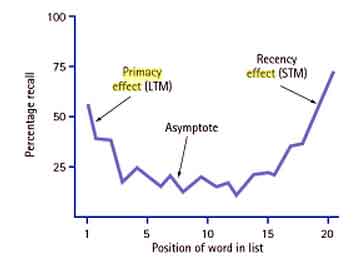
The improved recall of words at the beginning of the list is called the primacy effect; that at the end, the recency effect. This holds even for 40-word lists.
Conclusion
Separate Memory Stores
According to the multi-store model, participants recall the list’s first and last words from two separate memory stores. Long-term memory holds the early words. Short-term memory holds the recent ones.
The primacy effect occurs because participants have time to rehearse the first few words, transferring them from short-term memory to long-term memory.
The recency effect occurs because the last few words are still available in short-term memory, which holds about 7 items.
Middle words are recalled less often. They have been displaced from short-term memory by later words but not rehearsed enough to reach long-term memory. This results in the asymptote, the flat middle section of the curve.
Inhibition Effects
The primacy and recency limbs, Murdock proposed, reflect proactive and retroactive inhibition effects operating within the list itself. Interference shapes the curve.
He noted that the primacy effect levels off after the first 3 or 4 serial positions. This matches findings that proactive interference in short-term memory peaks after about 3 prior words.
The middle asymptote fits too. Retroactive interference in short-term memory approaches a non-zero asymptote there.
The S-shaped recency limb fits the same curve. Together, he argued, these inhibition effects produce the serial position curve’s characteristic shape in free recall.
Strengths
- Large sample size: Murdock used a total of 103 participants, which increases the reliability and generalizability of the results.
- Varied list lengths and presentation rates: Murdock varied list length (10, 15, 20, 30, and 40 words) and presentation rate (1 or 2 seconds per word) to test the serial position effect under many conditions.
- Fixed recency span: The recency effect held for roughly the same last 8 serial positions regardless of list length, a quantitative constraint any later model of the curve has to reproduce.
Weaknesses
- Limited scope: The experiment focused solely on the serial position effect in free recall of unrelated words. It did not investigate the effect in other contexts or with different types of stimuli (e.g., related words, sentences, or images).
- Lack of control for individual differences: Although the large sample size helps mitigate this issue, individual differences in memory abilities, strategies, or motivation may have influenced the results.
- Artificial setting: The experiment was conducted in a controlled laboratory setting, which may not fully reflect how memory works in real-life situations.
- Potential confounding variables: Factors such as fatigue, practice effects, or attention lapses may have influenced participants’ performance. Murdock did try to control for some of these by analyzing practice effects across sessions.
- Limited generalizability: The experiment used only college students as participants, which may limit the generalizability of the findings to other populations or age groups.
Rundus (1971)
Aim
If the primacy effect reflects items reaching a long-term store through rehearsal, then rehearsal frequency should predict later recall. Rundus (1971) tested this directly. The result would sharpen exactly how the primacy effect arises.
Method
Rundus used the overt-rehearsal paradigm. Participants rehearsed each word aloud, whenever they wished, while a new list was read aloud to them.
Recording their spoken rehearsals let the experimenter count exactly how many times each serial position had been rehearsed before free recall began. Free recall of the list followed immediately.
Results
Rehearsal frequency was highest for the earliest list positions, typically four or five rehearsals per item, and fell sharply for later items. The final positions received only one or two rehearsals each.
Recall at the primacy end tracked rehearsal frequency closely: items rehearsed more were recalled better. Recall at the recency end did not follow this pattern.
The last few items were recalled well despite little rehearsal. The dissociation was clean: whatever moved rehearsal moved primacy recall, while recency stayed strong regardless of how little a word had been rehearsed.
Conclusion
The results pinned down the mechanism.
Rundus’s results explain the primacy effect mechanistically. Early items get extra rehearsal because fewer competing words crowd the start of a list, and that rehearsal transfers them into long-term memory.
Recency works differently. The last few words survive in a short-lived store, not because of rehearsal. Together with Murdock’s parametric curve and Glanzer and Cunitz’s double dissociation, Rundus’s rehearsal counts complete the main behavioural case for the multi-store model.
Strengths
- Direct measure: Rehearsal is measured directly, not inferred, so the primacy account rests on observed behaviour rather than a hypothetical process.
- Within-participant dissociation: The same participants show rehearsal-linked primacy and rehearsal-independent recency, a stronger test than comparing across groups.
Weaknesses
- Reactivity: Requiring rehearsal aloud may change what participants would naturally do, since they might over-rehearse simply to comply.
- Rote rehearsal only: The design captures maintenance-style repetition but cannot see silent, deeper processing of the words.
- Narrow materials: The study still uses common word lists in a laboratory setting, like Murdock’s and Glanzer and Cunitz’s experiments.
Critical Evaluation of the Two-Store Account
The double dissociation from Glanzer and Cunitz is a powerful argument for two separate memory stores. Later evidence both reinforces and complicates that picture.
Neuropsychological Support
If two stores really underlie the two limbs of the curve, brain damage should be able to separate them too. Baddeley and Warrington (1970) tested amnesic patients who had poor long-term memory but a normal digit span.
A normal digit span indicates intact short-term memory, so the primacy loss in these patients cannot be explained by a short-term deficit.
These patients showed normal recency but reduced primacy. The opposite pattern appears in the rarer patients with an isolated short-term memory problem.
Because two different kinds of brain damage produce opposite effects on the two limbs, this amnesia evidence supports separate stores independently of any counting-task manipulation.
This is the same double-dissociation logic Glanzer and Cunitz used with delay and presentation rate, but now applied to brain damage instead of an experimental manipulation.
Long-Term Recency Challenges the Two-Store View
If recency really reflects items sitting in a short-term store, emptying that store right before recall should wipe it out. Bjork and Whitten (1974) tested this with a continuous-distractor paradigm: arithmetic problems separated every item, including the gap between the final item and the recall test.
On the two-store view, that terminal distractor should have emptied short-term memory and erased recency. It did not.
Recall stayed better for the last few items than for middle ones, even though no item could plausibly still sit in a short-lived store.
This long-term recency effect cannot be explained by short-term readout at all.
The finding does not overturn the two-store account outright.
But it does show that recency cannot be reduced to a single short-term readout mechanism, and any full theory of the curve must explain this long-range case too.
A Single-Mechanism Alternative: SIMPLE
If one mechanism can produce recency at both short and long time scales, perhaps the same mechanism produces primacy too. Brown, Neath and Chater’s (2007) SIMPLE model proposes exactly that.
Items are represented along a time dimension, and how well one is retrieved depends on how distinctive its position is compared with its neighbours. The most recent items stand out because they sit close to the moment of recall.
The earliest items stand out because they are separated from a growing crowd of later items. Middle items get crowded from both sides.
This single ratio rule reproduces both limbs of the serial position curve without needing separate short-term and long-term stores. It also explains long-term recency, which the two-store view struggles with.
Craik and Watkins (1973) added a related complication: merely repeating an item to hold it in mind, without deeper processing, does not build durable long-term storage. That finding fed the levels-of-processing framework.
Contemporary Research
The serial position curve remains a benchmark for models of short-term and working memory. It sets a high bar.
Oberauer and colleagues (2018) reviewed short-term and working-memory findings across immediate serial recall, free recall, complex-span tasks, and continuous-distractor tasks. The review spanned verbal, visual, and spatial materials, and populations from children to older adults.
From this evidence, they distilled quantitative benchmarks that any adequate model must reproduce. Primacy and recency top that list.
A plausible bow curve alone is not enough. A good model must also reproduce long-term recency, how the two limbs behave under a filled delay, and how the curve changes across development and old age.
Modern accounts, from SIMPLE to newer working-memory models, are all judged against this same battery.
Key Takeaways
- Serial Position Curve: Free recall of a list shows a U-shaped curve; the first few items (primacy) and last few items (recency) are recalled better than middle items.
- Two Memory Stores: Glanzer and Cunitz (1966) showed a double dissociation: slowing presentation raised primacy but not recency, while a filled delay wiped out recency but not primacy.
- Rehearsal Drives Primacy: Rundus (1971) found that early words get rehearsed more, and that rehearsal, not just delay, explains their better recall.
- Recency Is Fragile: A filled 30-second delay abolishes the recency effect entirely, evidence for a short-lived store that empties quickly.
- Beyond Two Stores: Long-term recency and single-mechanism models like SIMPLE show the curve alone does not prove two separate stores.
- Still a Benchmark: Modern memory models are still tested against the same primacy-and-recency curve Murdock first mapped in 1962.
References
Atkinson, R. C., & Shiffrin, R. M. (1968). Human memory: A proposed system and its control processes. In K. W. Spence & J. T. Spence (Eds.), The psychology of learning and motivation (Vol. 2, pp. 89–195). Academic Press.
Baddeley, A. D., & Warrington, E. K. (1970). Amnesia and the distinction between long- and short-term memory. Journal of Verbal Learning and Verbal Behavior, 9(2), 176–189. https://doi.org/10.1016/S0022-5371(70)80048-2
Bjork, R. A., & Whitten, W. B. (1974). Recency-sensitive retrieval processes in long-term free recall. Cognitive Psychology, 6(2), 173–189. https://doi.org/10.1016/0010-0285(74)90009-7
Brown, G. D. A., Neath, I., & Chater, N. (2007). A temporal ratio model of memory. Psychological Review, 114(3), 539–576. https://doi.org/10.1037/0033-295X.114.3.539
Craik, F. I. M., & Watkins, M. J. (1973). The role of rehearsal in short-term memory. Journal of Verbal Learning and Verbal Behavior, 12(6), 599–607. https://doi.org/10.1016/S0022-5371(73)80039-8
Glanzer, M., & Cunitz, A. R. (1966). Two storage mechanisms in free recall. Journal of Verbal Learning and Verbal Behavior, 5(4), 351–360. https://doi.org/10.1016/S0022-5371(66)80044-0
Murdock, B. B. (1962). The serial position effect of free recall. Journal of Experimental Psychology, 64(5), 482–488. https://doi.org/10.1037/h0045106
Oberauer, K., Lewandowsky, S., Awh, E., Brown, G. D. A., Conway, A., Cowan, N., Donkin, C., Farrell, S., Hitch, G. J., Hurlstone, M. J., Ma, W. J., Morey, C. C., Nee, D. E., Schweppe, J., Vergauwe, E., & Ward, G. (2018). Benchmarks for models of short-term and working memory. Psychological Bulletin, 144(9), 885–958. https://doi.org/10.1037/bul0000153
Rundus, D. (1971). Analysis of rehearsal processes in free recall. Journal of Experimental Psychology, 89(1), 63–77. https://doi.org/10.1037/h0031185