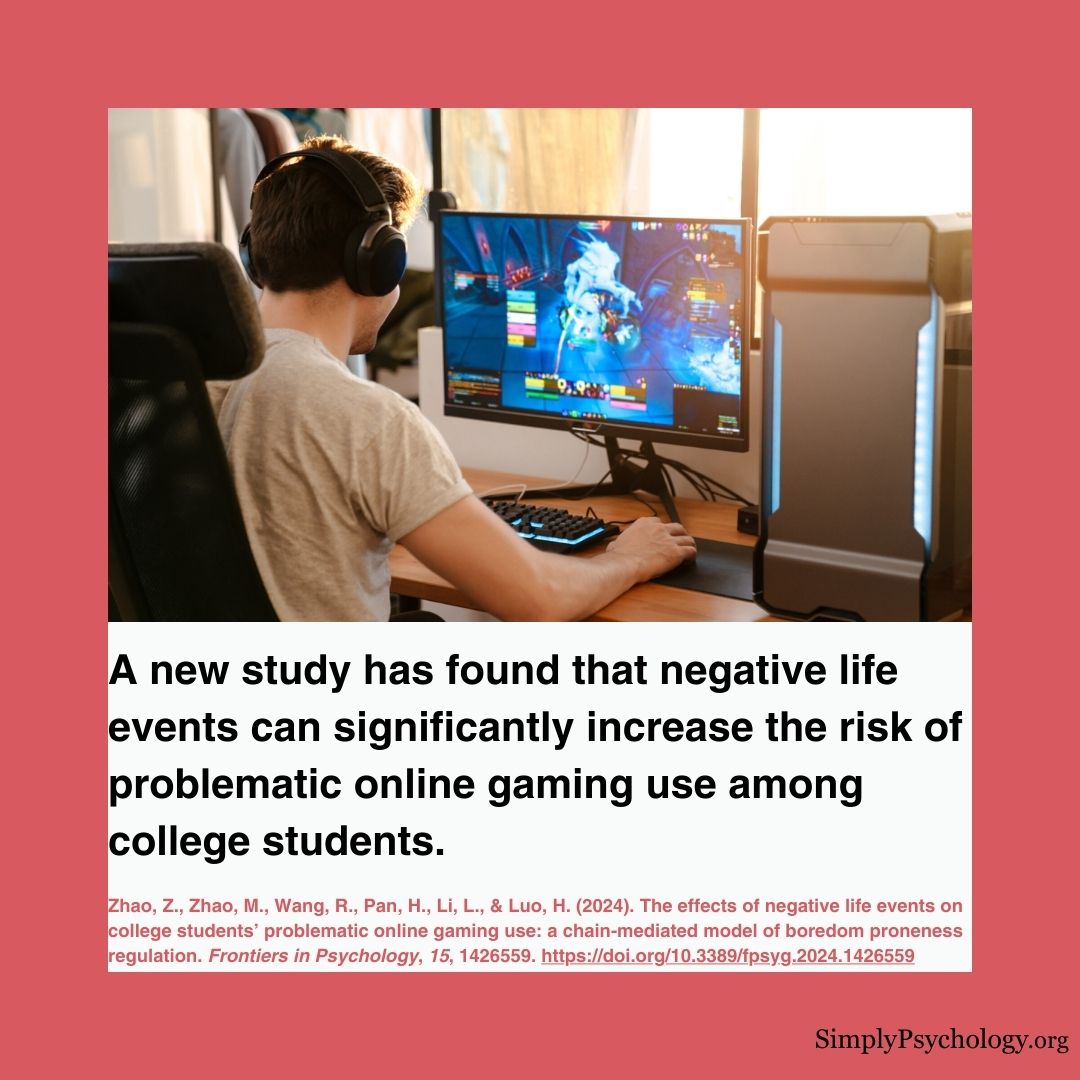
Problematic online gaming behavior refers to excessive gaming that negatively impacts daily life, relationships, and mental health.
It may relate to basic psychological needs by serving as a coping mechanism when these needs are unmet.
Studying this area is crucial as it affects millions worldwide, particularly young adults, potentially leading to academic, social, and psychological issues.
Understanding its mechanisms can inform prevention strategies and interventions, promoting healthier digital engagement and overall well-being.

Zhao, Z., Zhao, M., Wang, R., Pan, H., Li, L., & Luo, H. (2024). The effects of negative life events on college students’ problematic online gaming use: a chain-mediated model of boredom proneness regulation. Frontiers in Psychology, 15, 1426559. https://doi.org/10.3389/fpsyg.2024.1426559
Key Points
- Negative life events significantly and positively predict problematic online gaming use among college students.
- Basic psychological needs and anxiety play mediating roles between negative life events and problematic online gaming use.
- Boredom proneness moderates the impact of negative life events on basic psychological needs, anxiety, and problematic online gaming use.
- The study supports the I-PACE model, Self-Determination Theory, the Vulnerability-Stress Model, and the Bioecological Model in explaining problematic online gaming use.
- Males exhibit significantly higher levels of problematic online gaming use compared to females.
- The study proposes a model for the formation process of problematic online gaming use within the I-PACE framework.
- The research highlights the importance of addressing negative life events, fulfilling basic psychological needs, managing anxiety, and considering boredom proneness in preventing problematic online gaming use.
- Limitations include the cross-sectional design and sample from a single university, limiting causal inference and generalizability.
Rationale
The prevalence of internet gaming disorder among college students is 11%, higher than other student populations (Shao et al., 2018).
This study aims to examine the impact of negative life events on college students’ problematic online gaming use, focusing on the mediating roles of basic psychological needs and anxiety, and the moderating effect of boredom proneness.
The research is grounded in several theoretical frameworks:
- The I-PACE model (Brand et al., 2016) suggests that internet addiction results from interactions between triggering, moderating, and mediating variables.
- Self-Determination Theory posits that fulfilling basic psychological needs (autonomy, competence, and relatedness) is crucial for positive development (Song & Zhao, 2021).
- The Vulnerability-Stress Model proposes that certain dispositions, when activated by environmental factors, increase the risk of anxiety (Riskind & Alloy, 2006).
- The Bioecological Model emphasizes the interaction between individual development and the environment (Bronfenbrenner & Morris, 2006).
By integrating these theories, the study aims to provide a comprehensive understanding of the psychological mechanisms underlying problematic online gaming use in college students, addressing a gap in current research and offering insights for clinical interventions.
Method
The study employed a cross-sectional survey design, collecting data from college students using standardized questionnaires to measure negative life events, basic psychological needs, anxiety, problematic online gaming use, and boredom proneness.
Procedure
Participants completed a series of questionnaires through the Wen juan xing (Questionnaire Star) platform.
The survey included measures for negative life events, basic psychological needs, anxiety, problematic online gaming use, and boredom proneness.
Sample
The study initially collected data from 1,115 students across four grades (freshman to senior) at a university.
After filtering for valid responses and online gaming experience, the final sample consisted of 881 participants (457 females, 424 males) aged 17-23 years (mean age 18.86 ± 1.35).
Participants spent an average of 2.44 ± 2.02 hours per day gaming.
Measures
- Adolescent Self-rating Life Events Checklist (ASLEC): 26 items measuring negative life events across five factors.
- Basic Psychological Needs Satisfaction Scale: 21 items assessing autonomy, relatedness, and competence.
- Generalized Anxiety Disorder-7 (GAD-7): 7 items screening for anxiety symptoms.
- DSM-5 criteria questionnaire: 9 items measuring internet gaming disorder.
- College Student Boredom Proneness Questionnaire: 30 items assessing boredom proneness across two dimensions.
Statistical measures
The study used SPSS 23.0 for common method bias analysis, correlation analysis, Independent Samples t-Test, One-Way ANOVA, and hierarchical regression analysis.
Chain mediating effects were examined using Model 6 within the PROCESS microprogram, while Model 85 was used for assessing moderating effects.
Results
Hypothesis 1: Negative life events significantly and positively predict problematic online gaming use among college students. (Confirmed)
Hypothesis 2: Basic psychological needs and anxiety exert a serial mediating role in the influence of negative life events on problematic online gaming use. (Confirmed)
Hypothesis 3: The influence of negative life events on basic psychological needs, anxiety, and problematic online gaming use is moderated by boredom proneness. (Confirmed)
Additional findings:
- Males exhibited significantly higher levels of problematic online gaming use compared to females.
- No significant differences in problematic online gaming use were found among different grade levels.
- Under high boredom proneness, negative life events significantly predicted anxiety and problematic online gaming use, but not basic psychological needs.
- Under low boredom proneness, negative life events significantly predicted basic psychological needs negatively, had a diminished positive effect on anxiety, and did not significantly predict problematic online gaming use.
Insight
This study provides a comprehensive understanding of the psychological mechanisms underlying problematic online gaming use in college students.
By integrating multiple theoretical frameworks, it offers a nuanced perspective on how negative life events can lead to problematic online gaming behaviors through the mediating roles of basic psychological needs and anxiety, moderated by boredom proneness.
The findings extend previous research by demonstrating the complex interplay between environmental factors (negative life events), individual characteristics (boredom proneness), and psychological processes (basic needs satisfaction and anxiety) in the development of problematic online gaming use.
This aligns with and further validates the I-PACE model, which emphasizes the interaction between personal, affective, cognitive, and executive factors in internet addiction.
The study’s results highlight the importance of considering multiple factors when addressing problematic online gaming use.
It suggests that interventions should not only focus on reducing gaming time but also address underlying issues such as coping with negative life events, fulfilling basic psychological needs, managing anxiety, and dealing with boredom.
Future research could explore longitudinal effects to establish causality, investigate cultural differences in these relationships, and develop and test interventions based on these findings.
Additionally, examining the role of other personality traits or environmental factors could further enhance our understanding of problematic online gaming use.
Implications
Clinical Practice:
- Mental health professionals working with college students should assess for negative life events, basic psychological needs satisfaction, anxiety levels, and boredom proneness when addressing problematic online gaming use.
- Interventions should be multifaceted, focusing on enhancing coping skills for negative life events, promoting the fulfillment of basic psychological needs, managing anxiety, and developing strategies to combat boredom.
- Gender differences in problematic online gaming use suggest that tailored approaches may be necessary for male and female college students.
Future Research:
- Longitudinal studies are needed to establish causal relationships between the variables examined in this study.
- Cross-cultural studies could investigate whether these findings are consistent across different cultural contexts.
- Research on developing and testing interventions based on these findings could provide valuable insights for prevention and treatment strategies.
- Exploration of other potential moderating factors, such as different personality traits or environmental influences, could further enhance our understanding of problematic online gaming use.
Policy Development:
- Educational institutions should consider implementing programs that address negative life events, promote psychological well-being, and provide alternative activities to combat boredom among college students.
- Gaming industry regulations could be informed by these findings, potentially leading to the development of games that better satisfy basic psychological needs without promoting addictive behaviors.
Strengths
This study had several methodological strengths, including:
- The study had a large sample size (881 participants), providing robust statistical power.
- It employed well-established, validated measures for all variables, enhancing the reliability of the findings.
- The research integrated multiple theoretical frameworks, offering a comprehensive perspective on problematic online gaming use.
- The inclusion of boredom proneness as a moderating variable provided novel insights into the complex relationships between the studied variables.
- The study controlled for gender and grade level, accounting for potential confounding variables.
- The use of sophisticated statistical techniques, including chain mediation and moderated mediation analyses, allowed for a nuanced examination of the relationships between variables.
Limitations
Geographical and Demographical Restrictions:
- The sample was drawn from a single university, limiting the generalizability of the findings to other populations or regions.
- The study focused on college students, so the results may not apply to other age groups or non-student populations.
Methodological Restrictions:
- The cross-sectional design limits causal inferences about the relationships between variables.
- Self-report measures were used, which may be subject to social desirability bias or inaccurate self-assessment.
- The study did not account for potential cultural factors that might influence gaming behaviors or psychological processes.
Implications of Limitations:
- Future research should include more diverse samples from multiple universities and regions to enhance generalizability.
- Longitudinal studies are needed to establish causal relationships and examine how these variables interact over time.
- Including objective measures of gaming behavior and psychological well-being could complement self-report data.
- Cross-cultural studies could provide insights into how cultural factors might moderate the relationships observed in this study.
References
Primary reference
Zhao, Z., Zhao, M., Wang, R., Pan, H., Li, L., & Luo, H. (2024). The effects of negative life events on college students’ problematic online gaming use: a chain-mediated model of boredom proneness regulation. Frontiers in Psychology, 15, 1426559. https://doi.org/10.3389/fpsyg.2024.1426559
Other references
Brand, M., Young, K. S., Laier, C., Wölfling, K., & Potenza, M. N. (2016). Integrating psychological and neurobiological considerations regarding the development and maintenance of specific Internet-use disorders: An Interaction of Person-Affect-Cognition-Execution (I-PACE) model. Neuroscience & Biobehavioral Reviews, 71, 252-266. https://doi.org/10.1016/j.neubiorev.2016.08.033
Bronfenbrenner, U., & Morris, P. A. (2006). The bioecological model of human development. In W. Damon & R. M. Lerner (Eds.), Handbook of child psychology (6th ed., pp. 793-828). Hoboken, NJ: Wiley.
Riskind, J. H., & Alloy, L. B. (2006). Cognitive vulnerability to emotional disorders: Theory and research design/methodology. Cognitive vulnerability to emotional disorders, 11-40.
Shao, Y. J., Zheng, T., Wang, Y. Q., Liu, L., Chen, Y., & Yao, Y. S. (2018). Internet addiction detection rate among college students in the People’s Republic of China: a meta-analysis. Child and adolescent psychiatry and mental health, 12, 1-10. https://doi.org/10.1186/s13034-018-0231-6
Song, T. J., & Zhao, H. (2021). The relationship between basic psychological needs satisfaction and mobile phone addiction among female college students: The mediating role of fear of missing out and the moderating role of social support. Journal of Shandong Women’s University, 69-77.
Keep Learning
Socratic questions for a college class to discuss this paper:
- How might cultural differences influence the relationships between negative life events, basic psychological needs, anxiety, and problematic online gaming use?
- What are the ethical considerations in researching and addressing problematic online gaming use among college students?
- How might the findings of this study be applied to other forms of behavioral addictions, such as social media addiction or smartphone addiction?
- In what ways could the gaming industry incorporate these findings to create games that are engaging but less likely to lead to problematic use?
- How might the COVID-19 pandemic and its associated life changes have affected the variables studied in this research?
- What role might parenting styles or early childhood experiences play in the development of problematic online gaming use in college students?
- How could universities and colleges use these findings to develop effective prevention and intervention programs for problematic online gaming use?
- What are the potential long-term consequences of problematic online gaming use for college students’ academic performance, career prospects, and personal relationships?
- How might gender roles and societal expectations contribute to the observed differences in problematic online gaming use between males and females?
- In what ways could future research build upon this study to further our understanding of problematic online gaming use and its prevention?