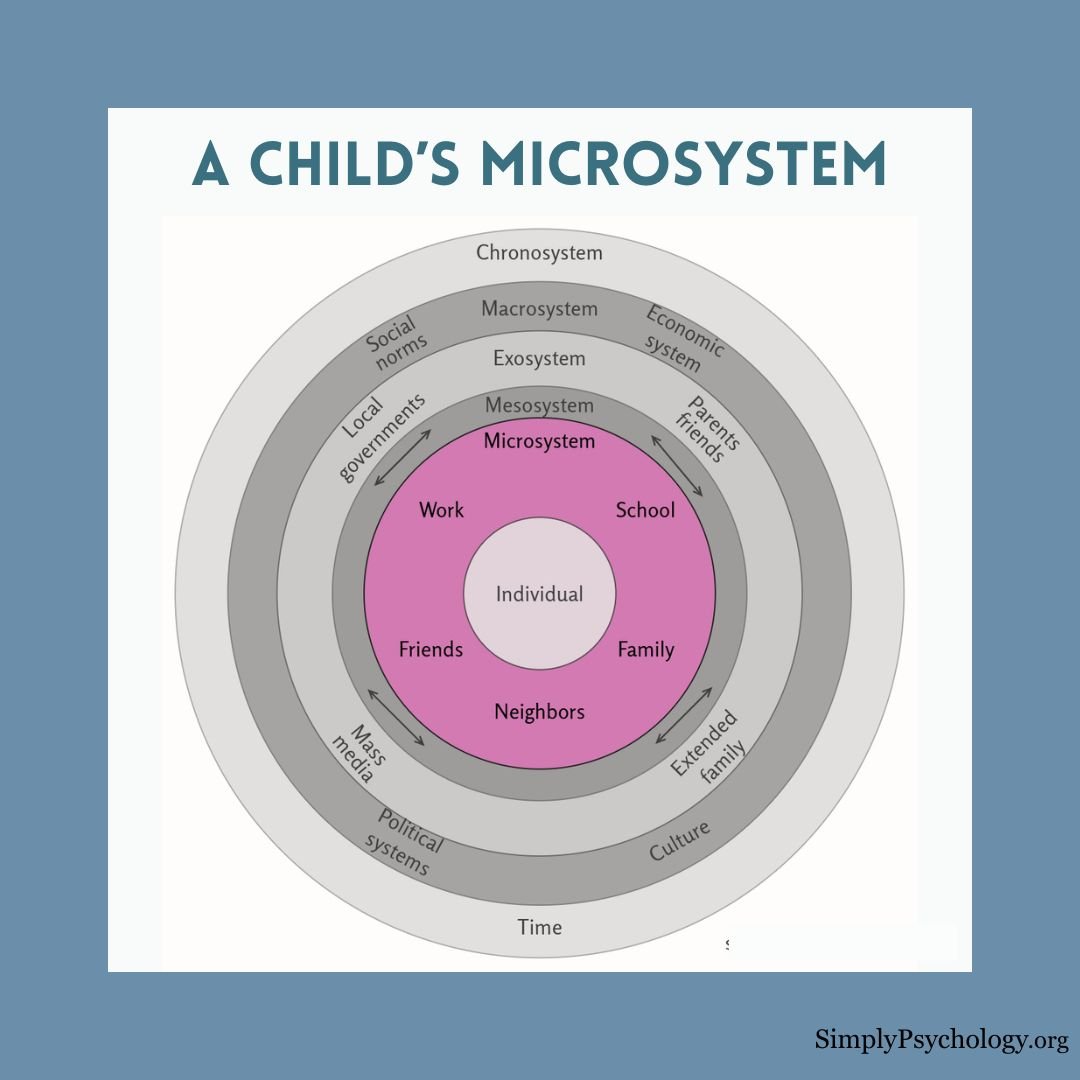
Bronfenbrenner’s microsystem is the innermost layer of his ecological systems theory. The theory holds that a child’s development is shaped by nested layers of environment, from the immediate family out to the wider culture.
Bronfenbrenner later renamed it the Bioecological Model, a revision that shifted the focus from these layers themselves to the everyday interactions happening within them.
It encompasses an individual’s immediate environment and direct interactions. This includes family, peers, school, and neighborhood.
These close relationships and settings have the most direct impact on a person’s development. The microsystem influences behavior, beliefs, and overall growth through daily, face-to-face interactions.
It’s particularly crucial in early childhood development but remains important throughout life.

By understanding the dynamics within the microsystem, we can better appreciate how these early experiences lay the foundation for a child’s future growth and well-being.
Examples of the Microsystem
Here are some examples of common microsystems:
Family
- Parents, siblings, and extended family: The family represents a child’s primary microsystem. The bonds children form with parents, siblings, and extended family are central to their emotional, social, and cognitive growth.
- Family structure and dynamics: Family structure, whether nuclear, single-parent, blended, or extended, shapes family dynamics and a child’s day-to-day experience differently.
- Parenting styles and their impact: Parenting styles, such as authoritative, authoritarian, permissive, or uninvolved, shape a child’s behaviour and development. Supportive parenting builds cognitive and language skills; harsh parenting can hinder social and emotional growth.
School
- Teachers and classmates: The school becomes a crucial microsystem as children grow. Teacher-student relationships and classroom interactions shape a child’s academic performance, self-esteem, and social skills.
- Classroom environment: The classroom’s physical layout, resources, and social dynamics all affect learning. A well-organised, inclusive classroom fosters a more positive learning experience.
- Educational practices and policies: Teaching methods, curriculum design, and assessment strategies directly affect academic progress. Policies such as inclusion and anti-bullying initiatives create a more supportive, equitable environment.
Peer Group
- Close friends and playmates: Close friends and playmates form a significant microsystem, offering companionship, social learning, and belonging. Positive peer relationships build social skills, empathy, and identity.
- Social interactions and relationships: Peer interactions teach children to navigate social situations, negotiate, and resolve conflicts, building empathy and social competence.
- Peer influence on behavior and attitudes: Peers strongly influence a child’s behaviour, attitudes, and values, especially in adolescence, for better or worse, from academic choices to risk-taking.
Religious Institutions
- Religious leaders and community members: For children raised in religious families, religious institutions serve as an important microsystem. Religious leaders and community members provide guidance, support and a sense of community.
- Religious teachings and practices: Religious teachings and practices can shape a child’s moral compass, values, and beliefs about the world.
- Impact on values and beliefs: Exposure to religious environments can impact a child’s understanding of morality, spirituality, and purpose.
Neighbourhood
- Neighbors and local community: The neighbourhood is a broader microsystem. Neighbours and the local community offer belonging, support, and social control, especially important in raising children.
- Physical environment (e.g., parks, safety): A neighbourhood’s parks, playgrounds, and safe spaces shape children’s physical and mental well-being by enabling outdoor play, exploration, and social interaction.
- Community resources and support: Community resources, such as libraries and after-school programmes, support learning and social growth. A lack of these, common in underprivileged neighbourhoods, limits a child’s opportunities.
Recent research supports this: Zhou, Lin, and Guo (2025) found that supportive neighbourhoods buffered the link between family dysfunction, parenting stress, and children’s involvement in bullying.
The Child as an Active Participant
The microsystem, as the most proximal layer of a child’s environment, plays a crucial role in shaping development through direct, face-to-face interactions and relationships. However, it’s essential to recognize that children are not passive recipients of these influences.
Instead, they actively participate in and shape their microsystem, a concept central to Bronfenbrenner’s bioecological systems theory.
This active participation is evident in several ways:
- Bi-directional influences: The microsystem’s relationships run both ways: the child both shapes and is shaped by their environment. Temperament, a “force characteristic“, affects how caregivers respond, which in turn shapes the child.
- Individual differences in response: Children respond to similar microsystem influences in different ways. Temperament, personality, and “resource characteristics” shape each child’s response, which is why siblings in the same family can develop differently.
- Shaping of self-concept and identity: Through consistent interactions within their microsystems, children build their self-concept and identity, internalising the cultural values, beliefs, and norms highlighted in Vygotsky’s sociocultural theory.
- Direct impact on development: The quality of microsystem interactions directly shapes a child’s cognitive, social, emotional, and physical growth. These ongoing exchanges, Bronfenbrenner’s “proximal processes,” are the engine of development.
- Active influence on the environment: Children’s behaviors and characteristics elicit different responses from others. A curious child may prompt richer interaction from adults, while a shy child experiences different patterns.
Understanding the child as an active participant in the microsystem highlights the complex, dynamic nature of early development.
It emphasizes that while the immediate environment significantly influences a child’s growth, the child’s own characteristics and actions play a pivotal role in shaping their developmental journey.
Recent Findings and Evolving Understanding
Virtual Microsystems in the Digital Age
Recognizing the significant role of technology in children’s lives, Navarro & Tudge (2022) proposed the neo-ecological theory.
This theory builds upon Bronfenbrenner’s original model by introducing the concept of “virtual microsystems” to account for online interactions and their impact on development.
Navarro and Tudge built on an earlier idea. Johnson and Puplampu (2008) had already proposed an “ecological techno-subsystem” within the microsystem. It covers living elements, such as a child’s online peers. It also covers non-living elements, such as hardware, software, and content.
They emphasize the unique features of virtual environments: constant availability, publicness, and asynchronicity. These factors can influence a child’s social connections, identity formation, and exposure to diverse values and information.
Culture’s Pervasive Influence
Contemporary research increasingly emphasizes the integral role of culture in shaping child development within microsystems.
Vélez-Agosto et al. (2017) challenge the idea that culture belongs solely within the macrosystem. They argue that culture is woven into everyday routines. That includes interactions within the family, school, and peer groups.
They advocate for a more nuanced understanding of culture’s pervasive influence on proximal processes and their developmental consequences.
Moving Beyond Single-Variable Outcomes
Researchers acknowledge a shift in developmental science towards studying multiple, interconnected developmental outcomes rather than focusing on isolated variables.
This approach aligns with the bioecological model’s emphasis on the interconnectedness of various psychological domains.
For instance, a child’s experiences in the family microsystem can influence their cognitive, social, and emotional development simultaneously.
This shift raises new questions for practice.
Future research should investigate how proximal processes within different microsystems may have differential effects across these various developmental domains, contributing to a more holistic understanding of a child’s growth.
By understanding the interconnectedness of the systems influencing child development, parents, educators, community leaders, and policymakers can contribute to creating supportive environments that foster positive outcomes for children.
Putting Theory into Practice: Applications of the Bioecological Model
For Parents and Caregivers:
- Foster Strong Relationships within the Microsystem: Parents and caregivers should prioritise strong, positive relationships with their children: consistent love, support, and guidance, alongside activities that promote cognitive, social, and emotional growth.
- Facilitate Open Communication: Open, attentive communication at home helps children express their thoughts and feelings. It also helps parents understand a child’s experiences at school and with peers.
- Be Mindful of Individual Differences: Each child responds to their microsystem differently. Stay sensitive to your child’s temperament, strengths, and challenges, and adapt your parenting approach to support their development.
- Promote Active Participation: Encourage your child’s active participation: opportunities to make choices, explore interests, and build skills. This involvement fosters a sense of agency and self-efficacy.
For Educators and School Systems:
- Cultivate Positive Teacher-Student Relationships: Teachers should build supportive, nurturing relationships with students. A classroom where children feel safe, respected, and valued boosts academic motivation and well-being.
- Encourage Parental Involvement: Schools should actively encourage parental involvement. Regular communication and parent-teacher meetings help bridge the gap between the home and school microsystems.
- Tailor Teaching Approaches to Individual Needs: Tailor teaching to individual learning styles and needs, recognising that children come from diverse backgrounds. Differentiated instruction boosts engagement and outcomes for all students.
- Incorporate Culturally Sensitive Practices: Create inclusive learning environments that value cultural diversity. Integrating culturally relevant materials and perspectives helps every student feel represented.
For Community Leaders and Policymakers:
- Invest in Early Childhood Education: Prioritise funding for high-quality early childhood education. Accessible, affordable childcare and preschool boost cognitive, social, and emotional development, especially for disadvantaged children.
- Promote Family-Friendly Policies: Policies such as paid parental leave, affordable childcare, and flexible work reduce parental stress, making parents more available for their children.
- Strengthen Neighbourhood Resources: Invest in safe, supportive neighbourhoods: affordable housing, healthcare, green spaces, libraries, and community centres. Improving this physical and social environment benefits children and families.
- Address Social and Economic Inequities: Poverty and inequity limit children’s access to resources and opportunities. Policies addressing income inequality and supporting low-income families create a more equitable start for all children.
- Support Further Research and Evaluation: Fund research that deepens understanding of child development across diverse contexts, to guide evidence-based interventions and policies for all children and families.
Key Takeaways
- Definition: The microsystem is the innermost layer of Bronfenbrenner’s theory: the people and settings with direct, face-to-face contact with a child, such as family, school, and peers.
- Bidirectional: Relationships in the microsystem run both ways: the child shapes the people and settings around them just as much as they shape the child.
- Consequences: A breakdown in the microsystem, through neglect, family conflict, or peer rejection, can lead to falling academic achievement, social isolation, and mental-health difficulties.
- Digital Microsystems: Researchers now treat online spaces as genuine “virtual microsystems”, alongside family, school, and peers, in a child’s everyday environment.
- Proximal Processes: What matters most is not just the microsystem’s presence but the quality of ongoing, reciprocal interaction within it, the true engine of development.
- Applications: Understanding the microsystem shapes practice in parenting, teaching, and policy, all aimed at strengthening the relationships and settings closest to a child.
References
Bronfenbrenner, U., & Ceci, S. J. (1994). Nature-nurture reconceptualized in developmental perspective: A bioecological model. Psychological Review, 101 (4), 568–586. https://doi.org/10.1037/0033-295X.101.4.568
Bronfenbrenner, U. (1995). Developmental ecology through space and time: A future perspective. In P. Moen, G. H. Elder, Jr., & K. Lüscher (Eds.), Examining lives in context: Perspectives on the ecology of human development (pp. 619–647). American Psychological Association. https://doi.org/10.1037/10176-018
Bronfenbrenner, U. (1999). Environments in developmental perspective: Theoretical and operational models. In S. L. Friedman & T. D. Wachs (Eds.), Measuring environment across the life span: Emerging methods and concepts (pp.3-28). American Psychological Association. https://doi.org/10.1037/10317-001
Cassells, R., & Evans, G. (2020). Concepts from the bioecological model of human development. In L. Tach, R. Dunifon, & D. L. Miller (Eds.), Confronting inequality: How policies and practices shape children’s opportunities (pp. 221–232). American Psychological Association. https://doi.org/10.1037/0000187-010
Ferguson, K. T., & Evans, G. W. (2019). Social ecological theory: Family systems and family psychology in bioecological and bioecocultural perspective. In B. H. Fiese, M. Celano, K. Deater-Deckard, E. N. Jouriles, & M. A. Whisman (Eds.), APA handbook of contemporary family psychology: Foundations, methods, and contemporary issues across the lifespan (pp. 143–161). American Psychological Association. https://doi.org/10.1037/0000099-009
Guy-Evans, O. (2024, January 17). Bronfenbrenner’s Ecological Systems Theory. Simply Psychology. https://www.simplypsychology.org/bronfenbrenner.html
Johnson, G. M., & Puplampu, K. P. (2008). Internet use during childhood and the ecological techno-subsystem. Canadian Journal of Learning and Technology, 34(1), 19–28.
Navarro, J. L., & Tudge, J. R. (2022). Technologizing Bronfenbrenner: neo-ecological theory. Current Psychology, 1-17. https://doi.org/10.1007/s12144-022-02738-3
McLeod, S. (2024, January 24). Vygotsky’s Theory Of Cognitive Development. Simply Psychology. https://www.simplypsychology.org/vygotsky.html
Rosa, E. M., & Tudge, J. (2013). Urie Bronfenbrenner’s theory of human development: Its evolution from ecology to bioecology. Journal of family theory & review, 5(4), 243-258. https://doi.org/10.1111/jftr.12022
Vélez-Agosto, N. M., Soto-Crespo, J. G., Vizcarrondo-Oppenheimer, M., Vega-Molina, S., & García Coll, C. (2017). Bronfenbrenner’s bioecological theory revision: Moving culture from the macro into the micro. Perspectives on psychological science, 12(5), 900-910. https://doi.org/10.1177/1745691617704397
Zhou, Q., Lin, C., & Guo, X. (2025). Family dysfunction, parenting stress, and child mental health: Associations with bullying involvement and the moderating role of neighborhood support. Frontiers in Psychology, 16, 1644696. https://doi.org/10.3389/fpsyg.2025.1644696