Vygotsky’s theory of cognitive development emphasizes the role of social interaction and culture in learning.
He believed that children learn through guided participation with more knowledgeable others, like teachers or peers.
Key concepts include the zone of proximal development (learning just beyond a child’s current ability, with support) and the role of language in shaping thought.
Key Takeaways
- Social interaction: Learning happens first between people before it becomes internal. Children develop thinking skills through guided conversations and shared activities with more knowledgeable others.
- Zone of Proximal Development: This “sweet spot” is the gap between what a child can do alone and what they can do with support. Growth occurs when teachers or peers provide just enough help to bridge that gap.
- Scaffolding: Temporary support helps learners master new skills. As understanding improves, the support is gradually reduced until the child can work independently.
- Language: Words act as tools for thought as well as communication. Talking with others, and later to oneself, helps children plan, reason, and solve problems.
- Culture: Each culture shapes how and what children learn. Tools, traditions, and social norms provide the framework for cognitive development.
Sociocultural Theory
Sociocultural theory, proposed by Lev Vygotsky, asserts that a person’s learning and cognitive development are fundamentally shaped by social interactions and their surrounding culture.
Learning, in his view, is a shared activity.
Vygotsky’s Brief Biography
Lev Vygotsky had a remarkably short but influential career.
Born in 1896, he pursued interests in literature, psychology, and education before producing pioneering work on the social foundations of cognition.
Tragically, he died at just 37 years old in 1934, leaving many of his manuscripts incomplete.
The insights he offered, particularly on how social and cultural factors fuel cognitive development, have shaped modern thinking in developmental psychology and education.
Vygotsky believed social interaction and language are the essential tools used to pass on cultural knowledge (like math or coding skills). The social environment is not just where a child learns, but is the force that literally shapes the cognitive development.
1. The More Knowledgeable Other (MKO)
The MKO is simply anyone who knows more than the learner about a specific task.
- This could be a teacher or parent, but also a friend, older sibling, or even a computer program, like an educational app or AI.
- The MKO’s job is to share their superior understanding. Vygotsky argued that our most advanced skills and reasoning abilities can only develop when we interact with these more advanced people.
2. The Learning Sweet Spot (ZPD)
The Zone of Proximal Development (ZPD) is the ideal space for learning.
- It’s the gap between what you can do alone and what you can do when you get a little help from an MKO.
- If a task is too easy, it’s boring. If it’s too hard, you get frustrated. The ZPD is where the challenge is just right, pushing you to grow but making success possible with guidance.
3. Giving Just the Right Help (Scaffolding)
Scaffolding is the actual help the MKO gives.
Think of it like the temporary supports construction workers use on a building. They’re necessary early on, then removed once the structure is complete.
- The MKO gives hints, prompts, and encouragement (the scaffolding) to help the learner complete the task inside the ZPD.
- The goal is to provide just enough help so the learner can succeed. As the learner improves, the MKO gradually removes the support until the learner can do the task independently.
4. Language: The Tool for Thought
- Vygotsky viewed language as the primary cultural tool that allows us to develop higher-level thinking. It’s not just for talking; it’s the mechanism we use to think and reason.
- This process involves an essential shift, where external dialogue moves inward to become thought:
- It starts with Social Speech (talking to others), then moves to Private Speech: talking to oneself aloud, like a child narrating their actions (“The block goes here”).
- The goal is for this self-talk to become Inner Speech (silent thought). This means we have successfully internalized the language structures used in social life, allowing us to plan, organize, and solve problems entirely in our heads.
- The MKO’s dialogue with the learner is what gets internalized, essentially shaping the learner’s future independent thinking.
Key Terms
- Sociocultural Theory: Vygotsky’s approach emphasizing the role of social interaction and culture in shaping cognitive development. It posits that higher mental functions (advanced, consciously controlled processes such as planning, reasoning, and self-regulation) develop through collaborative dialogues within a cultural context.
- Culture: The values, beliefs, customs, and tools specific to a community or society. Vygotsky argued that culture heavily influences how and what individuals learn, by providing tools of intellectual adaptation.
- Tools of Intellectual Adaptation: The various cultural instruments (language, counting systems, mnemonic devices, etc.) passed down through generations. These tools shape how individuals learn, think, and solve problems within their social group.
- Internalization: The process of absorbing knowledge from social interaction (instructions, dialogue, cultural tools — the language, symbols, and know-how a society hands down) into mental processes. As a result, learners gradually adopt new strategies or knowledge as their own.
- Make-Believe Play: A form of imaginative or pretend play in which children explore roles, rules, and behaviors beyond their current abilities. Vygotsky highlighted how this context naturally stretches children’s skills, fosters self-regulation, and supports cognitive growth.
- Zone of Proximal Development (ZPD): The “sweet spot” of learning tasks that a person cannot accomplish alone but can master with guidance. The concept underscores the importance of social support in moving from current ability to potential capacity.
- More Knowledgeable Other: A person or resource that possesses greater expertise in a given task or concept. This can be a teacher, parent, peer, or even a tool (like Chat-GPT). The MKO guides or models the task, helping learners advance to the next level.
- Scaffolding: A method of providing just enough support (e.g., hints, prompts, modeling) to help learners complete tasks they cannot yet perform independently. As learners’ competence grows, the level of support is gradually withdrawn.
- Inner Speech: The silent, internal dialogue individuals use for thinking and self-regulation. It develops from social language (communication with others) to private speech (talking aloud to oneself) and finally merges into silent thought.
- Private Speech: Speech directed to oneself (often audible in young children) to guide thinking and behavior. According to Vygotsky, private speech is an important step in the development of inner speech and higher mental functions.
Effects of Culture
Vygotsky’s (1978) theory emphasizes individuals’ active role in their cognitive development, highlighting the interplay between innate abilities, social interaction, and cultural tools.
Vygotsky posited that people aren’t passive recipients of knowledge but actively interact with their environment.
This interaction forms the basis of cognitive development.
Infants are born with basic abilities for intellectual development, called “elementary mental functions.” These include attention, sensation, perception, and memory.
Development of Higher Mental Functions
Through interaction within the sociocultural environment, elementary functions develop into more sophisticated “higher mental functions.”
Higher mental functions are advanced cognitive processes that develop through social interaction and cultural influences. They are distinct from the basic, innate elementary mental functions.
Unlike elementary functions (like basic attention or memory), higher functions are:
- Conscious awareness: The individual is aware of these processes.
- Voluntary control: They can be deliberately used and controlled.
- Mediated: They involve the use of cultural tools or signs (like language).
- Social in origin: They develop through social interaction.
Examples include language and communication, logical reasoning, problem-solving, planning, attention control, self-regulation, and metacognition.
Vygotsky posited that higher mental functions are not innate but develop through social interaction and the internalization of cultural tools.
Tools of Intellectual Adaptation
Cultural tools are the thinking and problem-solving strategies a culture hands down.
These tools, such as language, counting systems, mnemonic techniques, and art forms, shape the way individuals think, problem-solve, and interact with the world.
Tools of intellectual adaptation is Vygotsky’s term for methods of thinking and problem-solving strategies that children internalize through social interactions with the more knowledgeable members of society.
These tools work through mediation. Just as a physical tool such as a hammer acts outward on the material world, a sign works inward. A word, a tally mark, or a diagram organizes a person’s own thinking the same way.
A basic (“elementary”) mental process, like simple memory or attention, becomes a “higher” mental function only once it is mediated by one of these culturally supplied sign-tools. The parallel is exact.
This has a direct consequence.
Because the specific sign-tools a culture hands down differ from place to place, cognitive potential is broadly universal, but the skill and expertise built on that potential is culturally determined.
Cultural tools, particularly language, influence the development of higher-order thinking skills.
Other tools include writing systems, number systems, mnemonic techniques, works of art, diagrams, maps, and drawings.
These tools are products of sociocultural evolution, passed down and transformed across generations.
How Culture Shapes Thinking
Each culture provides its children with tools of intellectual adaptation that allow them to use basic mental functions more effectively.
These tools, along with social interaction, contribute to the development of higher mental functions through a process of internalization.
This historical and cultural embeddedness means that tools carry within them the accumulated knowledge and practices of a particular community.
For example, biological factors limit memory in young children. However, culture determines the type of memory strategy we develop.
Cultural Variations in Cognitive Tools
For example, children in Western culture often use note-taking to help with memory.
In pre-literate societies, other strategies are used, such as tying knots in a string, carrying pebbles, or reciting ancestors’ names to aid recall.
Vygotsky argued that even when we think alone, our mental processes are shaped by the beliefs, values, and tools of our culture. Cognitive functions are therefore socio-culturally determined.
The tools of intellectual adaptation vary from one culture to another, as shown in the memory strategies above.
More Knowledgeable Other
The more knowledgeable other (MKO) is a person, resource, or tool with greater knowledge or skill than the learner on a specific topic.
While it is often implied that the MKO is a teacher or an older adult, this is not always the case.
The role is fluid and contextual, based entirely on the specific knowledge being sought.
For instance, a learner’s peers or an adult’s children might be the MKOs for cutting-edge technical skills, social media trends, or the newest gaming strategies.
Crucially, the MKO need not be a person at all. Technology can also serve as an MKO.
Examples include electronic tutors, educational software, or AI models that are programmed with more knowledge than the user.
The key is simply that the MKO must be a source with a superior grasp of the topic.
Tools Can Be MKOs, Too!
Tools and technology can act as MKOs.
For example, consider using fraction strips.
These strips aren’t just colored paper; their design embodies the mathematical rules of fractions.
When a student uses them to add one-half and one-quarter, the strips themselves guide the learner’s thinking, helping them see how the pieces fit together.
In essence, a tool structures the learning experience.
By interacting with it, the learner can solve a problem, like fractions, that they couldn’t figure out alone.
The Role in Learning and Development
The MKO’s primary function is to guide the learner through a process of shared dialogue, providing hints, instructions, and encouragement (scaffolding).
This assistance allows the learner to successfully tackle tasks that are just beyond their current independent ability – the zone of proximal development (ZPD).
Through this interaction, the learner begins to internalize the process, incorporating the “how-to” into their own private speech and thought.
This enables them to later tackle similar tasks independently, effectively shifting the knowledge from an external guide to an internal skill.
The Fluidity of the MKO Role
The MKO is not a static position of superiority.
As learners gain understanding, they can transition from novices to becoming the MKO for their peers.
This highlights the collaborative nature of learning within the ZPD, where knowledge is co-constructed rather than simply transmitted.
Zone of Proximal Development
The concept of the more knowledgeable other relates to the second important principle of Vygotsky’s work, the zone of proximal development (ZPD).
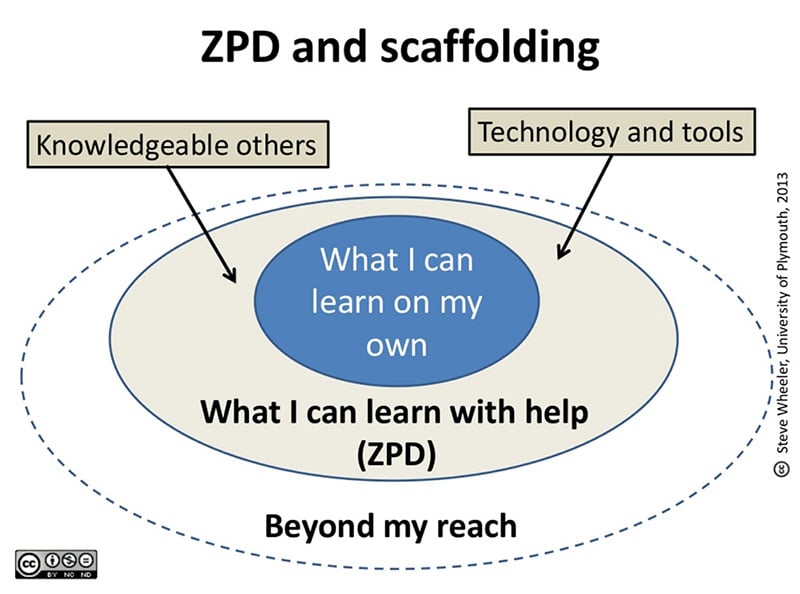
The ZPD is the gap between what a learner can do alone and what they can do with guidance from a skilled partner.
Vygotsky (1978) saw the ZPD as the area where instruction is most effective. It is Vygotsky’s central instructional concept.
Guidance there helps the child build skills for independent use later, fostering higher mental functions.
The ZPD is not a static space but constantly shifts as the child learns and develops new skills. As a child’s competence grows, their zone of proximal development also expands to encompass new challenges.
Learning Through Social Interaction
Vygotsky emphasizes social interaction as crucial to learning, arguing that children develop more fully with support than alone.
He defines the gap between actual and potential learning as the ZPD, asserting that collaboration with more knowledgeable others is essential to bridge this gap.
According to Vygotsky (1978), the child (or a novice) learns through social interaction with a skillful tutor. The tutor may model behaviors and/or provide verbal instructions for the child.
Vygotsky refers to this as cooperative or collaborative dialogue.
The child tries to understand the tutor’s actions or instructions, often from a parent or teacher. The child then internalizes this information, using it to guide their own performance.
Social interaction, therefore, supports the child’s cognitive development in the ZPD, leading to a higher level of reasoning.
Internalization of Knowledge
Internalization is a central concept in Vygotsky’s theory, bridging the gap between social interaction and individual cognitive development.
It’s the process by which external, socially mediated activities are transformed into internal mental processes, allowing individuals to acquire new knowledge and skills.
Vygotsky viewed higher mental functions, such as language, reasoning, and self-regulation, as originating in social interaction.
He argued that these functions are not innate or biologically determined but acquired through participation in culturally meaningful activities with others.
Active Learning Within the ZPD
Internalization within the ZPD is not a passive transfer of information. It is a dynamic process in which learners actively participate and build their own understanding.
This active engagement means learners do not simply copy the expert’s actions. They develop a deeper understanding of the underlying principles and strategies.
For example, a child solving a problem with a parent’s guidance does not just memorize the answer. They actively construct their own understanding through dialogue and interaction.
This process, often called scaffolding, provides support matched to the learner’s current ability. That support gradually diminishes as the learner gains mastery.
Scaffolding
The term “scaffolding” is now synonymous with the ZPD in the literature, though Vygotsky never used it himself. Wood, Bruner, and Ross (1976) introduced it.
Scaffolding is the support an educator or more knowledgeable person gives to guide a student through the zone of proximal development.
It’s the “how” of guided learning: the specific strategies an MKO uses to bridge the gap between a learner’s current ability and their potential.
How Scaffolding Works
This support can be provided in many different ways, such as modeling or asking questions, and is used across different subjects and age groups.
Scaffolding is a dynamic process that changes based on the student’s progress and the task at hand, so it will look different in different situations.
Contingency, or responsiveness, is paramount: the teacher continually assesses the learner’s understanding and calibrates support accordingly.
Support is tapered off (i.e., withdrawn) as it becomes unnecessary, much as a scaffold is removed from a building during construction.
The student will then be able to complete the task again independently.
Example of Scaffolding in Action
Schaffer (1996) gives the example of a young girl given her first jigsaw. Alone, she performs poorly in attempting to solve the puzzle.
The father then sits with her and demonstrates basic strategies, such as finding all the corner and edge pieces first. He gives her a couple of pieces to fit together herself and offers encouragement when she succeeds.
As the child becomes more competent, the father allows the child to work more independently.
What is ‘fading’ and ‘transfer of responsibility’ in the context of scaffolding?
Effective scaffolding is a dynamic process defined by the gradual withdrawal of support.
This process is often called fading. The MKO steadily reduces the level of aid as the learner’s competence grows, so the learner takes on more responsibility.
The ultimate goal of scaffolding is the transfer of responsibility, where the operational control over the task shifts entirely from the MKO to the learner.
The learner has successfully internalized the skills and can now use them intrapsychologically.
Before fading can begin, the MKO must first recruit the learner’s interest and simplify the task into manageable steps.
This ensures the learner is engaged and the initial cognitive load is appropriate for the ZPD.
Evidence for Vygotsky and the ZPD
- Aim: Freund (1990) tested whether guided learning within the ZPD produces better performance than discovery learning alone.
- Method: Children decided which furniture items belonged in particular areas of a doll’s house. Some first practiced with their mother (the ZPD condition) before attempting the task alone; others worked on it entirely by themselves (the discovery-learning condition).
- Results: Children who had previously worked with their mother showed greater improvement on the task than their first attempt, compared with children who worked alone throughout.
- Conclusion: Guided learning within the ZPD led to greater understanding and performance than discovery learning alone, supporting Vygotsky’s account of the ZPD.
Measuring the ZPD: Dynamic Assessment
Vygotsky’s ZPD necessitates a departure from traditional ‘static’ intelligence tests, which only measure what a child can do independently.
The Vygotskian-derived approach is called Dynamic Assessment (DA), which measures a child’s learning potential.
Assessing Potential, Not Just Performance
In DA, the assessor actively intervenes during the testing process by providing hints, feedback, or coaching.
This process-oriented measurement of change is believed to reveal a student’s ZPD and their capacity to learn from instruction. It goes beyond measuring just their current achievement.
Dynamic assessment thus aligns with Vygotsky’s belief that cognitive ability is not fixed but can be developed through mediated learning.
The goal is to promote development while simultaneously assessing it, making DA both diagnostic (revealing abilities) and developmental (enhancing learning).
Vygotsky and Language
Vygotsky believed that language develops from social interactions for communication purposes. Vygotsky viewed language as man’s greatest tool for communicating with the outside world.
According to Vygotsky (1962), language plays two critical roles in cognitive development:
-
- Cultural transmission of knowledge: Language is the primary vehicle for passing down cultural knowledge, values, and practices across generations. This transmission occurs through formal instruction and informal interactions, shaping individuals’ understanding of the world and their place within it.
- Language becomes a powerful tool for intellectual adaptation: Language is not merely a tool for communication; it’s a tool for thinking. Language facilitates the development of higher mental functions like abstract thinking, planning, and problem-solving.
Vygotsky (1987) differentiates between three forms of language:
-
-
Social Speech (Age 2+): Language is used entirely for external communication to interact with others and share meaning (e.g., asking for a toy).
-
Private Speech (Age 3+): Speech is directed to the self and is often spoken aloud. It serves an intellectual purpose, helping children guide their own thinking and actions (e.g., a child saying, “First, I put the big block here”).
-
Inner Speech (Age 7+): Private speech becomes internal and silent. It transforms into our internal monologue: the silent thought we use for planning, reasoning, and abstract thinking.
-
The Connection Between Thought and Language
For Vygotsky, thought and language are initially separate systems from the beginning of life, merging at around three years of age.
At this point, speech and thought become interdependent: thought becomes verbal, and speech becomes representational.
As children develop mental representation, especially language, they start to communicate with themselves much as they would communicate with others.
The Emergence of Inner Speech
When this happens, children’s monologues are internalized to become inner speech.
The internalization of language is important as it drives cognitive development.
This internal dialogue allows individuals to mentally rehearse different viewpoints, contributing to more sophisticated social understanding and problem-solving abilities.
“Inner speech is not the interiour aspect of external speech – it is a function in itself. It still remains speech, i.e., thought connected with words.
But while in external speech thought is embodied in words, in inner speech words dies as they bring forth thought. Inner speech is to a large extent thinking in pure meanings.”
(Vygotsky, 1962: p. 149)
Private Speech
Vygotsky (1987) was the first psychologist to document the importance of private speech.
He considered private speech the transition point between social and inner speech: the moment when language and thought unite to form verbal thinking.
Thus, in Vygotsky’s view, private speech was the earliest manifestation of inner speech. Indeed, private speech is more similar (in form and function) to inner speech than social speech.
Private speech is “typically defined, in contrast to social speech, as speech addressed to the self (not to others) for the purpose of self-regulation (rather than communication).”
(Diaz, 1992, p.62)
Private speech is overt, audible, and observable, often seen in children who talk to themselves while problem-solving.
Conversely, inner speech is covert or hidden because it happens internally. It is the silent, internal dialogue that adults often engage in while thinking or problem-solving.
Piaget’s View: Egocentric Speech
Piaget (1959) described children’s self-directed talk as egocentric speech, a sign of cognitive immaturity that gradually disappears as they become socialized.
He believed this speech was not adapted for communication and served little developmental function.
Vygotsky’s View: Private Speech as a Tool for Growth
Vygotsky fundamentally disagreed, arguing that private speech is social in origin and essential for cognitive growth.
It arises when children use the language of social problem-solving they have learned from others to guide their own actions.
Rather than fading away, this audible self-talk becomes inner speech: a silent, internal dialogue used for self-regulation and complex thought.
Vygotsky (1934, 1987) viewed private speech as:
“A revolution in development which is triggered when preverbal thought and preintellectual language come together to create fundamentally new forms of mental functioning.” (Fernyhough & Fradley, 2005: p. 1)
Vygotsky and Piaget also disagreed on two further points: the developmental course private speech follows, and the environmental circumstances in which it occurs most often (Berk & Garvin, 1984).

Functions of Private Speech
Through private speech, children collaborate with themselves. They do this the same way a more knowledgeable other, such as an adult, collaborates with them to achieve a given function.
Vygotsky sees “private speech” as a means for children to plan activities and strategies, aiding their development.
Private speech uses language for self-regulation.
Private speech is not just aimless chatter; it serves a vital self-regulatory function.
As children develop, they must transition away from adult guidance. They learn to direct their own actions and thoughts.
Private speech emerges as a way for children to guide their own behavior, especially during challenging tasks. They are essentially verbalizing the thought process that will eventually become internalized as inner speech.
Empirical Support for Private Speech
Berk (1986) provided empirical support for the notion of private speech. She found that most private speech exhibited by children serves to describe or guide the child’s actions.
Language therefore accelerates thinking and understanding. Jerome Bruner takes the same view.
Vygotsky believed that children who engage in large amounts of private speech are more socially competent than children who do not use it extensively.
Vygotsky (1987) notes that private speech does more than accompany a child’s activity. It helps children overcome task obstacles. It also enhances imagination, thinking, and conscious awareness.
Children use private speech most often on moderately difficult tasks, self-regulating by verbally planning and organizing their thoughts (Winsler et al., 2007).
Private Speech in Action
Imagine a child working on a complex puzzle. They might say things like, “Where does this piece go? No, it doesn’t fit there. Maybe I should try turning it around.”
This self-directed talk helps them to:
- Focus attention: By verbalizing the problem and possible solutions, children are more likely to stay on task.
- Plan and sequence actions: Talking through the steps helps them organize their approach.
- Monitor progress: They can use their words to evaluate their success and make adjustments.
Research Evidence
The frequency and content of private speech correlate with behavior or performance.
Private speech appears at times of difficulty with a task. It has been documented on executive-function tasks (Fernyhough & Fradley, 2005) and problem-solving tasks (Behrend et al., 1992). It also appears in schoolwork, in language (Berk & Landau, 1993) and in mathematics (Ostad & Sorensen, 2007).
Other evidence points the same way (Behrend et al., 1992). Children who showed the characteristic whispering and lip movements of private speech during a difficult task were generally more attentive and successful than their quieter classmates.
Two controlled studies put Vygotsky’s self-regulation claim to a direct experimental test: does private speech really track task difficulty and relate to performance, as the theory predicts?
- Aim: Fernyhough and Fradley (2005) tested whether children’s private speech varies systematically with task difficulty and relates to performance on an executive (planning) task.
- Method: Forty-six 5- and 6-year-olds completed a mechanical Tower of London planning puzzle, two sets of four puzzles of increasing difficulty, on two separate occasions, while their spontaneous speech was recorded and coded into task-irrelevant versus self-regulatory private speech.
- Results: Private speech rose then fell rather than climbing steadily with difficulty, and children did not shift towards more self-regulatory speech as the puzzles got harder. Self-regulatory speech related to performance on the same puzzle but did not predict performance on later ones.
- Conclusion: Private speech is tied to moment-to-moment self-regulation, supporting Vygotsky’s claim that it serves an executive function, but its relationship with difficulty is more complex than “harder task, more self-talk,” and its benefit is immediate rather than lasting.
A more recent study extended this test to children at developmental risk.
- Aim: Mulvihill, Matthews, Dux and Carroll (2023) tested whether increased, increasingly internalized private speech under task difficulty holds in children at developmental risk, and whether atypical development changes its regulatory function or only its timing.
- Method: Fifty-two typically developing and 25 at-risk 3- to 4-year-olds each completed Duplo construction and card-sorting tasks at two difficulty levels, while their private speech was coded for amount, form, and self-regulatory content.
- Results: At-risk children produced less internalized private speech overall, but harder tasks produced more utterances, more overt speech, and more self-reflective content in both groups alike.
- Conclusion: The self-regulatory function of private speech appears intact even where its typical pace of internalization is delayed, suggesting the underlying mechanism generalizes beyond typically developing children.
Together, the two studies offer real but qualified support for Vygotsky over Piaget’s “meaningless by-product” account. Private speech genuinely tracks difficulty, but neither study licenses the simplest version of the prediction.
Developmental Trajectory
Berk also found that children used private speech more often when working alone on challenging tasks, or when their teacher was not immediately available to help.
Furthermore, Berk also found that private speech develops similarly in all children regardless of cultural background.
The Social Environment and Private Speech
Vygotsky (1987) proposed that private speech is a product of an individual’s social environment.
High positive correlations between rates of social interaction and private speech in children support this hypothesis.
Children raised in cognitively and linguistically stimulating environments start using and internalizing private speech faster than other children. These environments are more common in higher socioeconomic-status families.
Indeed, children raised in environments characterized by low verbal and social exchanges exhibit delays in private speech development.
From Private Speech to Inner Speech
As children’s skills improve, private speech becomes quieter and shorter, forming an internal “shorthand” that signals increasing mastery.
Over time, this external self-talk transforms into silent inner speech.
Private speech follows a curvilinear pattern: peaking around ages 3–4, declining by 6–7, and becoming largely internalized by age 10 (Diaz, 1992).
Vygotsky (1987) argued that private speech does not fade because children become socialized, as Piaget claimed. Instead, it “goes underground” to become inner speech or verbal thought (Frauenglass & Diaz, 1985).
Inner Speech
Inner speech develops from private speech. As Vygotsky (1987) proposed, private speech “goes underground” to become inner speech.
Inner speech is a silent, internal language of thought that we use to reason, plan, and regulate our behavior.
Unlike private speech, which is outwardly audible self-talk, inner speech is a completely internal process.
Language as a Tool for Thought
Vygotsky viewed language as a “tool” that mediates between our thoughts and actions.
In the context of inner speech, language provides the very structure and form for our internal dialogue.
It’s how we represent ideas, construct arguments, and engage in mental problem-solving.
Our capacity for silent thought (inner speech) is not an innate ability but rather a developmental achievement that emerges from our social world.
- Our earliest experiences with language and dialogue shape the very structure of our internal thought processes.
- Language acts as a tool, a system of representation, that enables us to think and reason internally.
- We carry the patterns and structures of social dialogue into our private mental landscapes.
The quality and development of inner speech can vary significantly across individuals.
Social experiences, cultural background, and developmental differences can all shape how inner speech manifests and the role it plays in cognitive functioning.
Characteristics
- Social dialogue: Inner speech is not merely a solitary monologue but retains the dialogic structure of social interaction.
This means that when we engage in inner speech, we are essentially conversing with ourselves. We mentally rehearse different viewpoints, consider alternatives, and work through problems using language as our primary tool.
- Abbreviated and telegraphic: Inner speech is typically highly condensed, lacking the full grammatical structure of spoken language.
This is because, in our own minds, we don’t need to state every detail explicitly. We can rely on shared context and understanding implicit in our internal dialogue.
- Simultaneity of perspectives: A key characteristic of mature inner speech is the ability to hold multiple perspectives simultaneously.
Rather than a linear, back-and-forth exchange, inner speech can encompass a complex interplay of ideas, allowing for more nuanced and flexible thinking.
Functions
- Planning and problem solving: Inner speech is essential for planning future actions, considering potential consequences, and developing strategies for navigating challenges.
- Self-regulation and control: Inner speech facilitates self-regulation, as it allows us to inhibit impulsive behaviors, stay focused on goals, and manage our emotions and motivations.
- Social understanding: There is a link between inner speech and our capacity to understand others’ minds. Engaging in internal dialogue, mentally representing different perspectives, might lay the groundwork for making sense of others’ thoughts, feelings, and intentions.
Educational Implications
Vygotsky’s approach to child development is a form of social constructivism, based on the idea that cognitive functions are the products of social interactions.
Social constructivism posits that knowledge is constructed and learning occurs through social interactions within a cultural and historical context.
Vygotsky emphasized the collaborative nature of learning by constructing knowledge through social negotiation. He rejected the assumption made by Piaget that it was possible to separate learning from its social context.
Vygotsky believed everything is learned on two levels. First, through interaction with others, then integrated into the individual’s mental structure.
Every function in the child’s cultural development appears twice: first, on the social level, and later, on the individual level; first, between people (interpsychological) and then inside the child (intrapsychological).
This applies equally to voluntary attention, to logical memory, and to the formation of concepts. All the higher functions originate as actual relationships between individuals.
(Vygotsky, 1978, p.57)
Constructivism in the Classroom
Constructivist teaching shifts away from rote learning and teacher-centered models (Cannella & Reiff, 1994) toward a student-centered, collaborative approach.
Vygotsky’s theory encourages both teacher and students to take non-traditional roles.
Instead of simply transmitting information, the teacher co-creates meaning with students, allowing them to take ownership of their learning (Hausfather, 1996).
For example, a student and teacher may begin a task with different levels of understanding.
As they work together, the teacher adapts explanations to match the student’s perspective, helping the learner reach deeper comprehension.
Intersubjectivity: Shared Understanding
This process of mutual adaptation is known as intersubjectivity.
It occurs when teacher and student align their perspectives and work toward shared meaning.
Through this interaction, the student not only learns the task. They also internalize how to think about it, transforming the external collaboration into inner speech or private dialogue.
Teaching Within the Zone of Proximal Development
Vygotsky believed cognitive growth happens within the ZPD, so effective instruction should target a level just beyond the learner’s current ability.
He emphasized that teaching focused only on what children can already do offers limited developmental value:
Learning which is oriented toward developmental levels that have already been reached is ineffective… It does not aim for a new stage of the developmental process but rather lags behind this process. (Vygotsky, 1978)
Instruction, therefore, should challenge learners slightly above their comfort zone, prompting new reasoning and skill development.
Collaboration, Appropriation, and Joint Attention
Appropriation (the process of making shared knowledge one’s own) is essential for development within the ZPD.
Effective collaboration requires joint attention and shared problem-solving, fostering a process of cognitive, social, and emotional interchange (Hausfather, 1996).
For this to succeed, the partners must be at different developmental levels. The more advanced partner must stay aware of the learner’s current stage (Driscoll, 1994; Hausfather, 1996).
If one partner dominates or lacks sensitivity to the other’s level, learning becomes less effective.
Collaborative Learning and the ZPD
Vygotsky’s ideas underpin modern collaborative learning approaches, where mixed-ability groups allow advanced peers to help others operate within their ZPD.
Techniques such as scaffolding and reciprocal teaching exemplify this principle, enabling learners to co-construct understanding through guided support.
Reciprocal Teaching
A contemporary educational application of Vygotsky’s theory is “reciprocal teaching,” used to improve students’ ability to learn from text.
Teachers and students practice four key skills together: summarizing, questioning, clarifying, and predicting. The teacher’s role shrinks over time.
Reciprocal teaching creates a dialogue between students and teachers. This becomes an instructional strategy in its own right, pushing students beyond answering questions into genuine discourse (Driscoll, 1994; Hausfather, 1996).
Brown and Palincsar (1989) tested this directly.
Their reciprocal-teaching program successfully taught reading strategies, demonstrating the Vygotskian approach in practice.
Turn-taking was central. The teacher and students alternated turns leading small group discussions on a reading. After modeling four reading strategies, students began to assume the teaching role.
The results showed significant gains over other instructional strategies (Driscoll, 1994; Hausfather,1996).
Cognitively Guided Instruction and Classroom Design
Cognitively guided instruction is another strategy to implement Vygotsky’s theory.
This strategy involves the teacher and students exploring math problems and then sharing their problem-solving strategies in an open dialogue (Hausfather,1996).
Based on Vygotsky’s theory, the physical classroom would provide clustered desks or tables and workspace for peer instruction, collaboration, and small-group instruction.
Learning becomes a reciprocal experience for the students and teacher.
Like the environment, the instructional design of the material to be learned would be structured to promote and encourage student interaction and collaboration.
Thus the classroom becomes a community of learning.
Scaffolding
Vygotsky’s theory of cognitive development is relevant to instructional concepts such as “scaffolding” and “apprenticeship.” In both, a teacher or more advanced peer helps structure or arrange a task so a novice can work on it successfully.
A teacher’s role is to identify each individual’s current level of development and provide them with opportunities to cross their ZPD.
How Scaffolding Supports Learning
A crucial element in this process is what later became known as scaffolding. This is the way a teacher provides students with frameworks and experiences that encourage them to extend their existing schemata and take on new skills, competencies, and understanding.
Scaffolding describes the conditions that support the child’s learning, to move from what they already know to new knowledge and abilities.
Scaffolding is temporary by design.
Scaffolding requires the teacher to allow students to extend their current skills and knowledge.
During scaffolding, the support offered by an adult (or more knowledgeable other) gradually decreases as the child becomes more skilled in the task.
As the adult withdraws their help, the child assumes more of the strategic planning.
Independence is the goal.
The child eventually gains the competence to master similar problems without a teacher’s aid or a more knowledgeable peer.
This is more than simple instruction. Learning experiences must actively challenge existing mental structures and provide frameworks for new learning.
Five ways in which an adult can “scaffold” a child’s learning:
- Engaging the child’s interest
- Maintaining the child’s interest in the task e.g., avoiding distraction and providing clear instructions on how to start the task.
- Keeping the child’s frustration under control e.g., by supportive interactions, adapting instructions according to where the child is struggling.
- Emphasizing the important features of the task
- Demonstrating the task: showing the child how to do the task in simple, clear steps.
As the child progresses through the ZPD, the necessary scaffolding level declines from 5 to 1.
The teacher must engage students’ interests, simplify tasks to be manageable, and motivate students to pursue the instructional goal.
The teacher must also watch for gaps between the student’s efforts and the solution, manage frustration and risk, and model an ideal version of the task (Hausfather, 1996).
Importance of Play
Vygotsky emphasized make-believe play as a key driver of cognitive growth.
In this type of play, children pretend to run a ‘store’ or play ‘family,’ using language and actions modeled after adults.
By exploring these roles and rules, children begin to understand social expectations in a fun, engaging way.
They practice symbolic thinking. This means using objects or words to represent ideas, while developing self-control skills.
Make-believe play also creates a fertile ground for the zone of proximal development (ZPD).
As children take on pretend roles, they often strive to enact abilities or behaviors slightly beyond their current level.
They may use more advanced language or problem-solving methods. This happens with help from peers, or by following the “rules” of the role they are playing.
In this sense, play naturally scaffolds their learning, pushing them to stretch their existing skills.
Play and Self-Regulation
Another key benefit of play is its role in fostering self-regulation.
Children learn to follow agreed-upon roles and rules, such as the “parent” caring for the “baby,” which encourages impulse control and deliberate planning.
They talk themselves through tasks, often engaging in private speech that eventually becomes internalized as thought.
Through the creative, low-pressure environment of make-believe play, children develop social, cognitive, and linguistic capacities. These form the foundation for more complex mental functions.
Challenges to Traditional Teaching Methods
Vygotsky’s social development theory challenges traditional teaching methods. Historically, schools have been organized around recitation teaching.
The teacher disseminates knowledge to be memorized by the students, who in turn recite the information to the teacher (Hausfather,1996).
However, the studies described above offer empirical evidence that learning based on the social development theory facilitates cognitive development over other instructional strategies.
The structure of our schools does not reflect the rapid changes our society is experiencing.
Technology and the Changing Learning Environment
The integration of computer technology has dramatically increased opportunities for social interaction and collaboration.
Learning is no longer confined to physical classrooms. Students can now form learning relationships across distances through digital platforms and cyberspace.
Technology functions as a cultural tool, allowing students to mediate and internalize their learning in new ways.
Recent research agrees. Learning contexts that incorporate technology can significantly enhance engagement and understanding (Crawford, 1996).
More recent work extends this directly to virtual and digital learning environments. Cho and Lee (2020) found that software-based scaffolding strategies can guide students through their zone of proximal development. This works much as a human tutor would. These strategies offer contingent hints that fade as the learner improves.
If schools continue to resist structural change, students risk being ill-prepared for the modern world, where collaboration, adaptability, and digital literacy are essential.
Critical Evaluation
Vygotsky’s work has not received the same level of intense scrutiny that Piaget’s has, partly due to the time-consuming process of translating Vygotsky’s work from Russian.
Also, Vygotsky’s sociocultural perspective does not provide as many specific hypotheses to test as Piaget’s theory, making refutation difficult.
Strengths of Vygotsky’s Theory
Vygotsky’s theory also has real strengths that explain its lasting influence on psychology and education.
- Fills the gap Piaget left: Vygotsky makes the social world central to development, explaining what Piaget’s theory leaves out. Segall et al. (1999) call Piaget’s child “completely divorced from the social environment.”
- Sparked decades of research: Though Vygotsky did little research himself, his ideas on scaffolding, peer tutoring, and private speech launched decades of study and underpin modern constructivist teaching. They also seeded later traditions: Cultural Psychology (Cole, 1990) and distributed cognition (Salomon, 1993).
- Explains what Piaget could not: The theory accounts for private speech, the role of instruction, and why thinking varies across cultures, phenomena that sit awkwardly within a universal-stage model.
Before exploring each critique in detail, here are the main concerns raised about Vygotsky’s theory:
- Overemphasis on environment: The theory prioritizes social and cultural influences and pays less attention to biological maturation.
- Neglect of emotion: The theory focuses on cognitive development while largely overlooking emotional and social-emotional growth.
- Vague on internalization: Vygotsky never fully explained the specific mechanisms by which social dialogue becomes internal thought.
- Possible Eurocentric bias: Vygotsky’s ranking of cultures risks treating European, literate culture as a developmental “apex.”
- The ZPD may be too asymmetrical: The classic expert-novice model can understate genuine peer-to-peer collaboration.
- Limited testability: The theory generates comparatively few specific, falsifiable hypotheses, making it harder to test or refute than Piaget’s.
- MKO over-reliance: Poorly managed scaffolding can backfire: if support is not faded as competence grows, learners may become dependent on external guidance instead of internalizing the skill themselves.
Risk of Overemphasizing Environmental Influence
Vygotsky prioritized cultural tools and social interaction in shaping mental processes. He paid less attention to innate cognitive abilities and developmental processes that unfold more independently of social influence.
Vygotsky’s intense focus on the sociocultural environment left him with a comparatively vague explanation of biology’s role in development. This is a gap modern developmental psychology seeks to integrate.
This imbalance may have led Vygotsky to underestimate elementary mental functions (the “natural line”) in shaping higher mental functions (shaped by cultural tools).
The theory struggles to explain why cross-cultural studies find that developmental stages (except the formal operational stage) occur in the same order in every culture. This suggests maturation, a biological process, plays a role independent of social context.
Lack of Attention to Emotional Development
The theory is criticized for focusing primarily on cognitive development while neglecting the emotional and social-emotional aspects of development.
Modern developmental psychology recognizes that cognitive and emotional development are deeply intertwined. Critics argue that Vygotsky’s theory doesn’t adequately address how emotions influence cognitive processes and vice versa.
- Vygotsky emphasized the social nature of learning but did not explore how children develop emotional intelligence or regulate emotions through social interaction.
- The ZPD concept focuses on cognitive tasks. Critics argue it should also consider emotional challenges and how supportive relationships build emotional competence.
- Internalization in Vygotsky’s theory focuses on cognitive processes. Critics argue it should also cover how children internalize emotional coping strategies.
Vague Explanation of Internalization
People take in (internalize) dialogues and guidance they’ve received from others who are more knowledgeable. This internalized information is then used to guide their own actions and thinking.
While Vygotsky considered internalization a cornerstone of his theory, he did not fully articulate the specific mechanisms by which this process occurs.
This concept is important because it describes how social interactions and cultural contexts contribute to individual cognitive development.
The idea is that higher mental functions first exist in the social realm (between people) before becoming internalized and part of an individual’s cognitive processes.
Eurocentric Bias
Vygotsky saw cultural development like a ladder, with European culture at the top. This view implies some cultures are “better” than others.
Vygotsky’s tendency to view cultural development as a linear hierarchy (often positioning European culture at the apex) can lead to:
- An oversimplification of cultural differences
- An underappreciation of the unique strengths and values of diverse cultural perspectives
A more nuanced view, recognizing the diversity of cultural tools and the situated nature of cognitive development, would better capture how culture shapes human thought and behavior.
Collaborative ZPD
Collaborative ZPD challenges traditional interpretations of ZPD that focus on the asymmetry between a more knowledgeable individual and a less knowledgeable learner.
Instead, a collaborative ZPD emphasizes the symmetrical nature of peer learning. Knowledge is co-constructed through mutual contribution and challenge, even among peers with comparable expertise.
Collaborative ZPD represents a shift in perspective. It moves from viewing learning as an individual endeavor to recognizing it as a social practice (Tudge, 1992).
The most significant aspect of a collaborative ZPD is not the individual benefits gained by each participant.
It is the emergence of something new. This is “a new form of collective consciousness” that transcends any single contributor.
Teachers need to go beyond simply placing students in groups and instead create conditions that foster genuine collaboration, characterized by:
- Transactive discussion (Kruger & Tomasello, 1986), where students clarify, elaborate, justify, and critique their own and each other’s reasoning.
- Opportunities for students to challenge each other’s thinking, prompting metacognitive awareness and deeper engagement with the content.
Limited Testability
Vygotsky’s theory generates comparatively few specific, falsifiable hypotheses next to Piaget’s tightly staged model. Broad, programmatic claims are harder to confirm or refute with a single experiment.
This partly reflects Vygotsky’s own career. His ideas were left as sketches rather than a fully worked-out system, cut short by his death at 37. Many concepts, including the ZPD itself, were never spelled out precisely enough to generate one sharp prediction.
The theory is also under-tested cross-culturally. This limits how confidently it generalizes beyond the contexts where it has actually been studied.
Where it has been tested directly, such as the private-speech studies described above, the evidence tends to be real but partial. It confirms the mechanism, not the boundaries.
Vygotsky vs. Piaget
Piaget held that cognitive development must precede learning. Vygotsky disagreed, arguing that “learning is a necessary and universal aspect of the process of developing culturally organized, specifically human psychological function” (1978, p. 90).
In other words, social learning precedes (i.e., come before) development.

Vygotsky’s theory differs from that of Piaget in several important ways:
Vygotsky places more emphasis on how culture affects cognitive development.
Piaget emphasized universal cognitive change: all children go through the same sequence regardless of their cultural experiences. Vygotsky, by contrast, expected development to vary with cultural diversity.
This contradicts Piaget’s view of universal stages of development (Vygotsky does not refer to stages like Piaget does).
Hence, Vygotsky assumes cognitive development varies across cultures, whereas Piaget states cognitive development is mostly universal across cultures.
Vygotsky places considerably more emphasis on social factors contributing to cognitive development.
- Vygotsky states the importance of cultural and social context for learning.
Cognitive development stems from social interactions from guided learning within the zone of proximal development as children and their partners co-construct knowledge.
In contrast, Piaget maintains that cognitive development stems largely from independent explorations in which children construct knowledge.
- For Vygotsky, the environment in which children grow up will influence how they think and what they think about.
The importance of scaffolding and language may differ for all cultures. Rogoff (1990) emphasizes the importance of observation and practice in pre-industrial societies (e.g., learning to use a canoe among Micronesian Islanders).
Vygotsky places more (and different) emphasis on the role of language in cognitive development.
According to Piaget, language depends on thought for its development (i.e., thought comes before language).
For Vygotsky, thought and language start as separate systems and merge at around three years of age, producing verbal thought (inner speech).
In Piaget’s theory, egocentric (or private) speech gradually disappears as children develop truly social speech: monitoring and adapting what they say to others.
Vygotsky disagreed. Because language helps children think about and control their behavior, he saw it as a key foundation for complex cognitive skills.
As children age, this self-directed speech becomes silent, or private, speech: the inner dialogue we use to plan and carry out activities.
For Vygotsky, cognitive development results from an internalization of language.
According to Vygotsky, adults are an important source of cognitive development.
Adults transmit their culture’s tools of intellectual adaptation that children internalize.
In contrast, Piaget emphasizes the importance of peers, as peer interaction promotes social perspective-taking.
Vygotsky vs. the Information-Processing Approach
A third theory challenges Vygotsky too. It is the information-processing (IP) approach. IP theorists model the mind on a computer analogy, explaining development as steady improvement in specific mechanisms: encoding, storage, retrieval, attention, and strategy use (Pine, 1999).
On this point, IP theory sides with Piaget. Both treat the mind’s structures as independent of a child’s social relationships, practices, and culture (Meadows, 1995). The engine of change sits inside the child’s own information-processing system.
Vygotsky’s reply is familiar.
A purely internal, mechanistic account cannot explain why performance is so sensitive to guided instruction within the ZPD. Nor can it explain why thought varies with the cultural tools a child is given.
Even so, IP theory adds something Vygotsky’s sketches do not. It explains, in fine detail, how a single mechanism such as attention or working memory changes with practice. The two traditions are arguably complementary.
References
Abtahi, Y. (2018). Pupils, tools and the Zone of Proximal Development. Research in Mathematics Education, 20(1), 1-13.
Behrend, D.A., Rosengren, K.S., & Perlmutter, M. (1992). The relation between private speech and parental interactive style. In R.M. Diaz & L.E. Berk (Eds.), Private speech: From social interaction to self-regulation (pp. 85–100). Hillsdale, NJ: Erlbaum.
Berk, L. E. (1986). Relationship of elementary school children’s private speech to behavioral accompaniment to task, attention, and task performance. Developmental Psychology, 22(5), 671.
Berk, L. E. (1994). Vygotsky’s theory: The importance of make-believe play. Young Children, 50(1), 30-39.
Berk, L. & Garvin, R. (1984). Development of private speech among low-income Appalachian children. Developmental Psychology, 20(2), 271-286.
Berk, L. E., & Landau, S. (1993). Private speech of learning-disabled and normally achieving children in classroom academic and laboratory contexts. Child Development, 64, 556–571.
Cannella, G. S., & Reiff, J. C. (1994). Individual constructivist teacher education: Teachers as empowered learners. Teacher education quarterly, 27-38.
Crawford, K. (1996) Vygotskian approaches to human development in the information era. Educational Studies in Mathematics, (31),43-62.
Cho, B.-Y., & Lee, H.-J. (2020). Exploring the use of scaffolding strategies in a virtual learning environment: A sociocultural perspective. Journal of Educational Computing Research, 58(3), 523-545.
Cole, M. (1990). Cultural psychology: A once and future discipline? In J. J. Berman (Ed.), Nebraska Symposium on Motivation, 1989: Cross-cultural perspectives (pp. 279-335). University of Nebraska Press.
Diaz, R. M., & Berk, L. E. (1992). Private speech: From social interaction to self-regulation. Lawrence Erlbaum.
Driscoll, M. P. (1994). Psychology of Learning for Instruction. Needham, Ma: Allyn && Bacon.
Eun, B. (2010). From learning to development: A sociocultural approach to instruction. Cambridge Journal of Education, 40(4), 401-418.
Frauenglass, M. & Diaz, R. (1985). Self-regulatory functions of children’s private speech: A critical analysis of recent challenges to Vygotsky’s theory. Developmental Psychology, 21(2), 357-364.
Fernyhough, C., & Fradley, E. (2005). Private speech on an executive task: Relations with task difficulty and task performance. Cognitive Development, 20, 103–120.
Freund, L. S. (1990). Maternal regulation of children’s problem-solving behavior and its impact on children’s performance. Child Development, 61, 113-126.
Hausfather, S. J. (1996). Vygotsky and Schooling: Creating a Social Contest for learning. Action in Teacher Education, (18),1-10.
Gredler, M. E., & Shields, C. C. (2004). Does no one read Vygotsky’s words? Commentary on Glassman. Educational Researcher, 33(2), 21-25.
Kruger, A. C., & Tomasello, M. (1986). Transactive discussions with peers and adults. Developmental Psychology, 22(5), 681-685.
Lidz, C. S. (1991). Practitioner’s Guide to Dynamic Assessment. New York: Guilford Press.
Meadows, S. (1995). Cognitive development. In P. E. Bryant & A. M. Colman (Eds.), Developmental psychology. Longman.
Mulvihill, A., Matthews, N., Dux, P. E., & Carroll, A. (2023). Task difficulty and private speech in typically developing and at-risk preschool children. Journal of Child Language, 50(2), 464–491. https://doi.org/10.1017/S0305000921000945
Ostad, S. A., & Sorensen, P. M. (2007). Private speech and strategy-use patterns: Bidirectional comparisons of children with and without mathematical difficulties in a developmental perspective. Journal of Learning Disabilities, 40, 2–14.
Piaget, J. (1959). The language and thought of the child (Vol. 5) . Psychology Press.
Pine, K. (1999). Theories of cognitive development. In D. Messer & S. Millar (Eds.), Exploring developmental psychology (pp. 176–191). Arnold.
Puntambekar, S., & Hubscher, R. (2005). Tools for scaffolding students in a complex learning environment: What have we gained and what have we missed?. Educational psychologist, 40(1), 1-12.
Rogoff, B. (1990). Apprenticeship in thinking: Cognitive development in social context. Oxford university press.
Saettler, P. (1990). The Evolution of American Educational Technology. Egnlewood, Co: Libraries Unlimited.
Salomon, G. (Ed.). (1993). Distributed cognitions: Psychological and educational considerations. Cambridge University Press.
Schaffer, R. (1996) . Social development. Oxford: Blackwell.
Segall, M. H., Dasen, P. R., Berry, J. W., & Poortinga, Y. H. (1999). Human behavior in global perspective: An introduction to cross-cultural psychology (2nd ed.). Allyn & Bacon.
Siraj-Blatchford, I. (2009). Conceptualising progression in the pedagogy of play and sustained shared thinking in early childhood education: A Vygotskian perspective. Educational and Child Psychology, 26(2), 77-89.
Vygotsky, L. S. (1962). Thought and language. Cambridge MA: MIT Press.
Vygotsky, L. S. (1978). Mind in society: The development of higher psychological processes. Cambridge, MA: Harvard University Press.
Vygotsky, L. S. (1987). Thinking and speech. In R.W. Rieber & A.S. Carton (Eds.), The collected works of L.S. Vygotsky, Volume 1: Problems of general psychology (pp. 39–285). New York: Plenum Press. (Original work published 1934.)
Wertsch, J. V., & Tulviste, P. (1992). L. S. Vygotsky and contemporary developmental psychology. Developmental Psychology, 28(4), 548-557.
Wertsch, J. V., Sohmer, R. (1995). Vygotsky on learning and development. Human Development, (38), 332-37.
Winsler, A., Abar, B., Feder, M. A., Schunn, C. D., & Rubio, D. A. (2007). Private speech and executive functioning among high-functioning children with autistic spectrum disorders. Journal of Autism and Developmental Disorders, 37, 1617-1635.
Wood, D., Bruner, J., & Ross, G. (1976). The role of tutoring in problem solving. Journal of Child Psychology and Child Psychiatry, 17, 89−100.
Further Reading
FAQs
What is Vygotsky’s Theory
Vygotsky believed that cognitive development was founded on social interaction. According to Vygotsky, much of what children acquire in their understanding of the world is the product of collaboration.
How is Vygotsky’s theory applied in teaching and learning?
Vygotsky’s theory has profound implications for classroom learning. Teachers guide, support, and encourage children, yet also help them to develop problem-solving strategies that can be generalized to other situations.
Children learn best not when they are isolated, but when they interact with others, particularly more knowledgeable others who can provide the guidance and encouragement to master new skills.
What was Vygotsky’s best know concept?
Lev Vygotsky was a seminal Russian psychologist best known for his sociocultural theory. He constructed the idea of a zone of proximal development, which are those tasks which are too difficult for a child to solve alone but s/he can accomplish with the help of adults or more skilled peers.
Vygotsky has developed a sociocultural approach to cognitive development. He developed his theories at around the same time as Jean Piaget was starting to develop his ideas (1920’s and 30″s), but he died at the age of 37, and so his theories are incomplete – although some of his writings are still being translated from Russian.
Like Piaget, Vygotsky could be described as a constructivist, in that he was interested in knowledge acquisition as a cumulative event – with new experiences and understandings incorporated into existing cognitive frameworks.
However, while Piaget’s theory is structural (arguing that physiological stages govern development), Vygotsky denies the existence of any guiding framework independent of culture and context.
No single principle (such as Piaget’s equilibration) can account for development. Individual development cannot be understood without reference to the social and cultural context within which it is embedded.
Higher mental processes in the individual have their origin in social processes.
What is Vygotsky’s Social Development Theory?
Vygotsky’s Social Development Theory is often referred to as the Sociocultural Theory.
Vygotsky’s Social Development Theory posits that social interaction is fundamental to cognitive development.
Vygotsky emphasized the influence of cultural and social contexts on learning, claiming that knowledge is constructed through social collaboration.
His most known concept, the Zone of Proximal Development, refers to the difference between what a learner can do independently and what they can achieve with guidance.

