At the very heart of cognitive psychology is the idea of information processing.
Information processing theory is a framework that views the human mind as a complex system through which information flows, much like a digital computer.
Key Takeaways
- Computer Analogy: The mind is compared to a computer: it takes in information, encodes it, stores it, retrieves it, and produces a behavioural output.
- Hardware/Software: The brain is the hardware; the mind and its processes are the software running on it.
- Serial vs Parallel: Early models assumed the mind processes information one step at a time, but the brain actually runs many operations in parallel.
- Channel Capacity: Miller (1956) found that short-term memory holds only about seven items at once, a hard limit on how much the mind can process.
- Key Limitation: Computers manipulate symbols without understanding them, and the analogy says little about emotion, motivation, or biological plasticity.
- Modern Evidence: Recent neural-network research suggests recurrent, parallel models fit the brain far better than the classic serial computer ever did.
Computer-Mind Analogy
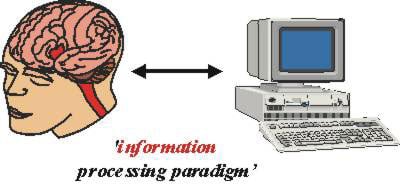
The development of the computer in the 1950s and 1960s had a profound influence on psychology.
It gave cognitive psychologists a compelling metaphor for the mind. That metaphor helped establish the cognitive approach as psychology’s dominant paradigm.
The analogy works simply.
A computer receives input, encodes it into a usable format, stores and manipulates the information, and produces an output. Cognitive psychologists proposed that the human mind works the same way.
In this framework, the brain corresponds to the computer’s physical hardware. The mind and its internal processes correspond to the software.
Cognitive psychologists in this tradition treat people as active processors: they take in symbolic input, recode it, make decisions, store the results, and turn these internal states into behaviour.
Core Principles of Information Processing
- Coding: Sensory input from the environment is translated into a usable mental format, much as a telecommunications system converts a voice signal into an electromagnetic code. The eye, for instance, receives visual information and converts it into electrical neural activity, which is then transmitted to the brain for further processing.
- Channel capacity: The human information-processing system has finite limits. At any given moment, only so much information can be held and processed, a constraint that bears directly on attention and short-term memory.
- Serial and parallel processing: Information can be processed sequentially, one operation at a time, or simultaneously across multiple cognitive processes running in parallel.
- Storage and retrieval: Like a computer’s memory, the mind stores information and retrieves it when needed. Mental processes such as memory, perception, and attention carry out this work.
This finite channel capacity has a famous figure attached to it. Miller (1956) found that immediate memory holds only about seven items, plus or minus two, before it overflows.
The limit is a lasting one. Cognitive psychologists still cite this “magic number seven” as a benchmark for the mind’s limited channel.
The influence of this approach has extended well beyond its origins.
Cognitive psychology has influenced and integrated with many other approaches and areas of study to produce, for example, social learning theory, cognitive neuropsychology, and artificial intelligence (AI).
Flowchart and Stage Models
Mental processes are unobservable, but flowcharts and box-and-arrow diagrams can model them precisely, showing how information passes between different systems. These models generate specific, testable predictions, evaluated through controlled experiments, computational simulations, and neuroimaging.
The information-processing model of memory is a series of stages, or boxes. Each box represents a stage of processing. Arrows indicate the flow of information from one stage to the next.
- Input processes are concerned with the analysis of the stimuli.
- Storage processes cover everything that happens to stimuli internally in the brain and can include coding and manipulation of the stimuli.
- Output processes are responsible for preparing an appropriate response to a stimulus.
A quintessential example of an information-processing model is the multi-store model of memory proposed by Atkinson and Shiffrin in 1968.

This model suggests information flows sequentially from sensory stores, into a limited-capacity short-term store via attention, and eventually into a practically unlimited long-term store via rehearsal.
Broadbent offers another example.
Donald Broadbent’s filter model of selective attention uses the concept of an information buffer. It explains how the brain tunes out competing stimuli to prevent overload, representing the mind as a limited-capacity channel.
Broadbent’s Filter Theory (1958), inspired by the demands placed on air traffic controllers, proposed that attention operates as a bottleneck. Incoming sensory information is briefly held in a buffer. A selective filter then passes only one channel through to the central processor, chosen by physical characteristics such as pitch or location, while all other information is discarded entirely.

Later theorists kept Broadbent’s bottleneck but moved it. Treisman (1964) argued that unattended channels are weakened, or attenuated, rather than fully blocked. Deutsch and Deutsch (1963) went further, placing the point of selection later, near the response stage, after the brain has already analysed meaning.
Sternberg’s Memory-Scanning Study
The information-processing approach is defined as much by its method as by its computer metaphor: it infers the mind’s hidden processing stages from precisely measured reaction times. Sternberg (1966) supplies the classic demonstration.
Aim: To determine whether the mind searches short-term memory serially (one item at a time) or in parallel (all at once). If serial, does it stop at a match, or check every item regardless?
Method: The test was simple.
Participants held a short memory set of digits, then saw a single probe digit and judged whether it was in the set. The key measure was how reaction time changed as the memory set grew larger.
Results: Reaction time increased as an almost perfectly linear function of set size. “Yes” and “no” trials rose at the same rate.
Conclusion: The linear increase points to a serial scan. The equal cost of “yes” and “no” trials shows that scan is exhaustive: the system checks the whole set even after it finds the target.
This makes Sternberg’s task a template for the whole information-processing approach: an unobservable mental operation is inferred from a measurable behavioural signature. Later researchers questioned whether the same linear pattern could also arise from certain parallel models, showing that reaction-time data alone cannot always pin down the underlying architecture.
Serial & Parallel Processing
- Serial processing is a cognitive operation in which each process must complete before the next can begin.
- Parallel processing describes a mechanism in which two or more cognitive processes occur simultaneously.
The distinction between these two modes is foundational to cognitive psychology, with implications for how we learn, how attention operates, and how the brain is physically organised.
Computer Analogy and Brain Architecture
The traditional information-processing approach initially assumed that human cognition was primarily serial. Early computers shaped this assumption: they could perform only one operation at a time, in a strict linear sequence.
Modern cognitive science has revised this picture considerably.
The human brain is composed of billions of interconnected neurons and operates as a massively parallel structure, distributing operations across multiple systems simultaneously.
Functional neuroimaging data now indicates that parallel processing in the brain is the rule rather than the exception.
Controlled and Automatic Processing
How much a task relies on serial or parallel processing depends largely on how practised the individual is at performing it.
- Serial processing is associated with controlled processes: slow, deliberate, capacity-limited operations that proceed one step at a time and demand conscious attention.
- Parallel processing is associated with automatic processes: fast, simultaneous operations that place little or no demand on attentional resources and run largely outside conscious awareness.
A learner driver illustrates this clearly.
Because steering, gear changes, and monitoring surrounding traffic each require deliberate attention, they cannot easily be performed at the same time, forcing a serial, step-by-step approach.
An experienced driver, by contrast, performs all of these tasks in parallel, managing them seamlessly without conscious effort.
System 1 and System 2 Thinking
This distinction maps onto dual-process models of reasoning and judgement.
System 1 is fast, intuitive, and automatic, operating in parallel without deliberate effort.
System 2 is slower, analytical, and rule-governed, proceeding serially and demanding conscious engagement.
Most everyday cognition involves an interaction between the two, with System 1 handling routine processing and System 2 recruited when tasks exceed automatic capacity.
Bottlenecks and Limitations
Despite the brain’s capacity for parallel processing, multitasking has clear limits.
Research on the psychological refractory period demonstrates that early sensory and perceptual processing of two simultaneous tasks can overlap. The term describes the measurable delay in responding to a second task presented soon after a first.
A bottleneck always emerges at response selection, though. When the brain must decide how to respond to incoming stimuli, processing becomes serial regardless of how much parallelism preceded it. Parallel processing, in other words, does not extend indefinitely through the cognitive system.
Applications in Perception and Speech
The interplay between serial and parallel processing has been studied extensively across specific cognitive domains.
In visual perception, the system relies heavily on parallel processing. Depth is computed from two parallel streams of input, one from each eye, while separate neural channels simultaneously handle fine detail, contrast, and colour.
Real-World Applications
The information-processing approach is not just theory. It shapes how psychologists build technology, teach students, and test the mind.
Artificial Intelligence and Human-Computer Interaction
Minds and machines trade ideas in both directions. Cognitive models inform artificial intelligence: the General Problem Solver, symbolic reasoning, and neural networks all began as attempts to mechanise human thought. AI returns the favour by supplying testable models of cognition.
Machines do not think like people.
The computer that beat the reigning world chess champion in 1997 evaluated up to 200 million positions every second, far more than any grandmaster considers. A shared outcome does not mean a shared process.
In human-computer interaction, designers apply what is known about attention, working memory, and response selection. They limit on-screen choices, chunk information, and respect the brain’s central bottleneck, so interfaces fit how people actually process information. Good interface design, in this sense, is applied cognitive psychology.
Education and Learning
Working memory has a strict channel capacity: the same limit Miller (1956) described as roughly seven items. Cognitive-load theory builds directly on this constraint.
Instruction should chunk material into fewer, larger units, avoid overloading the learner, and build long-term knowledge structures that lighten the load once a concept becomes familiar.
Findings on encoding and retrieval feed directly into study technique. Spaced practice spreads learning out over time rather than cramming it into one session. Retrieval practice, or self-testing, strengthens memory more than simply re-reading notes. The gains are real.
Elaboration links new material to what a student already knows, giving the information more retrieval routes later. Together, these techniques translate the theory’s own stages, encoding, storage, and retrieval, into concrete study habits.
Cognitive Assessment
Treating cognition as separable components licenses targeted testing.
Reaction-time tasks, working-memory span measures, processing-speed indices, and tasks like the Stroop task or dichotic listening all isolate one processing component at a time.
The same chronometric logic behind Sternberg’s memory-scanning task underlies much of this testing: a precisely measured reaction time can reveal something about an unobservable mental process. The principle scales.
These measures are used in intelligence testing, in assessing brain injury, and in tracking cognitive change across development and old age.
Because each component can be measured on its own, small deficits become visible long before they would affect everyday behaviour. A clinician can pinpoint which specific stage, input, storage, or output, has been disrupted, rather than relying on a single global score.
Human Factors and Ergonomics
Aviation, driving, and control-room design all depend on the same ideas.
Engineers use information-processing accounts of attention, workload, and dual-task interference to design displays, alarms, and workflows that respect human capacity limits and minimise error.
Air-traffic control is the very setting that inspired Broadbent’s model in the first place: a controller who must select one radio message from several competing channels. It remains a proving ground for these principles today.
A poorly designed cockpit display, for instance, can overload a pilot’s limited attention exactly as Broadbent’s model would predict, forcing a serial bottleneck at the worst possible moment.
This connects directly to the central bottleneck already described above: a control-room operator, like anyone else, can only select one response at a time. Well-designed systems build in this limit rather than fighting it, however much parallel monitoring came before it.
Critical Evaluation
Before exploring each critique in detail, here are the main concerns raised about the information-processing approach:
- Serial vs Parallel Processing: the models assume information is processed one step at a time, but dual-task research shows much processing happens in parallel.
- Limits of the Computer Analogy: computers and human brains diverge in key ways, from emotion and motivation to biological plasticity.
- Low Ecological Validity: the research rests on controlled lab experiments that may not reflect real-world cognition.
- Oversimplified Processing: the earliest models assumed a rigid, step-by-step flow that ignores top-down influences on perception.
1. Serial vs Parallel Processing
- Serial processing effectively means one process has to be completed before the next starts.
- Parallel processing assumes some or all processes involved in a cognitive task(s) occur at the same time.
There is evidence from dual-task experiments that parallel processing is possible. Whether a task is processed serially or in parallel is hard to pin down. It likely depends on two things: the processes the task requires, and how much practice the person has had.
Practice matters. Parallel processing becomes more common as skill increases: a skilled typist thinks several letters ahead, while a novice focuses on just one letter at a time.
2. Limits of the Computer Analogy
Computers can be regarded as information processing systems insofar as they:
- Combining information: they combine information presented with stored information to provide solutions to a variety of problems.
- Limited capacity: most computers have a central processor of limited capacity, and it is usually assumed that capacity limitations affect the human attentional system.
However:
- Processing style: the human brain has the capacity for extensive parallel processing, while computers often rely on serial processing.
- Emotion and motivation: humans are influenced in their cognitions by conflicting emotional and motivational factors.
- No true understanding: computers manipulate formal symbols based on algorithms and syntax but have no inherent understanding of those symbols.
- Biological plasticity: human brains are open, plastic biological systems that constantly adapt to their environment. They re-create memories and structures rather than pulling static files from a hard drive.
- Systematic bias: the computer metaphor assumes rational information processing. Humans, however, make systematic, predictable mistakes due to cognitive biases and heuristics.
3. Low Ecological Validity
Most laboratory studies are artificial and lack ecological validity: how well findings generalise to real-world settings.
In everyday life, cognitive processes serve a goal. You pay attention in class to pass the exam. Laboratory experiments strip away this real-world context, isolating cognition from other motivational factors.
The data are easy to interpret. But they may not apply outside the lab.
More recently, ecologically valid approaches to cognition have been proposed, such as Neisser’s (1976) Perceptual Cycle.
Attention has typically been studied in isolation from perception and memory, even though the three operate as one interdependent system. The more successfully we isolate one part of cognition for study, the less our findings may tell us about cognition as it actually happens in everyday life.
4. Oversimplification of processing dynamics
Early information-processing models were highly inflexible, assuming that human cognition was strictly a bottom-up, serial process where information flows step-by-step from one distinct stage to the next.
Modern cognitive science recognizes that this is a gross oversimplification.
Human cognition heavily relies on top-down processing, where an individual’s prior knowledge, expectations, and context continuously influence and alter perception and memory.

How did you read the text in the triangle above?
Expectation (top-down processing) often overrides information actually available in the stimulus (bottom-up), which we are, supposedly, attending to.
Additionally, the human brain contains billions of interconnected neurons that operate via massively parallel processing (carrying out multiple cognitive operations simultaneously), contradicting the rigid serial assumptions of early computer models.
Contemporary Research
Recent research does not defend the original computer analogy so much as re-engineer it. Reviews now weigh the evidence unevenly: the strongest claims rest on meta-analyses and model-comparison studies, while more speculative ideas rely on single-laboratory demonstrations.
Modelling the Brain with Neural Networks
The most active theme replaces the classic serial computer with the artificial neural network. It tests this model directly against brain data, not by loose analogy. Kietzmann et al. (2019) put the comparison to its most decisive test yet. The test was elegant.
Aim: To test whether feedforward deep networks, which dominate engineering and neuroscience alike, can explain human vision. Or is the brain’s recurrent feedback essential?
Method: The team measured time-resolved brain activity as people viewed objects. They built competing feedforward-only and recurrent network models. Then they compared each model’s internal dynamics against the brain’s actual activity across visual cortex.
Results: Only the recurrent models captured the changing patterns of activity over time. Feedforward networks could still recognise objects. But they missed the brain’s timing entirely.
Conclusion: Human vision is not a single feedforward sweep. It relies on recurrent, parallel computation. This updates, rather than discards, the computer analogy: it specifies which architecture the brain actually resembles.
The Predictive Brain
A second research front recasts cognition as prediction and error-correction, not passive input-output.
De Lange, Heilbron, and Kok (2018) reviewed the behavioural and neural evidence. They concluded that prior expectations systematically facilitate perception. This is a modern, Bayesian expression of the old idea that schemas shape what we see.
The evidence for the phenomenon itself is strong. Its neural mechanism is not. A critical review by Walsh, McGovern, Clark, and O’Connell (2020) found that predictive-processing models have historically been under-tested.
The evidence only partly supports the framework’s core claims. Priors shape perception, in short, but the mechanism that would replace the serial-computer analogy remains provisional.
Limits of Cognitive Training
The analogy’s more hopeful promise is that training one processing component, such as working memory, should transfer broadly to general ability. The strongest evidence says otherwise.
A meta-analysis by Melby-Lervåg, Redick, and Hulme (2016) found reliable short-term gains on trained and closely related tasks. It found no convincing far transfer to intelligence or school skills, once studies controlled for active comparison groups.
An extensive systematic review of the wider brain-training literature reached the same verdict (Simons et al., 2016). These reviews sit at the top of the evidence hierarchy. They show the mind’s processors are far less freely upgradeable than a strong hardware/software reading once implied.
References
Atkinson, R. C., & Shiffrin, R. M. (1968). Human memory: A proposed system and its control processes. In K. W. Spence & J. T. Spence (Eds.), The psychology of learning and motivation (Vol. 2, pp. 89–195). Academic Press. https://doi.org/10.1016/S0079-7421(08)60422-3
Broadbent, D. (1958). Perception and Communication. London: Pergamon Press.
de Lange, F. P., Heilbron, M., & Kok, P. (2018). How do expectations shape perception? Trends in Cognitive Sciences, 22(9), 764–779. https://doi.org/10.1016/j.tics.2018.06.002
Deutsch, J. A., & Deutsch, D. (1963). Attention: Some Theoretical Considerations. Psychological Review, 70, 80–90.
Kietzmann, T. C., Spoerer, C. J., Sörensen, L. K. A., Cichy, R. M., Hauk, O., & Kriegeskorte, N. (2019). Recurrence is required to capture the representational dynamics of the human visual system. Proceedings of the National Academy of Sciences, 116(43), 21854–21863. https://doi.org/10.1073/pnas.1905544116
Melby-Lervåg, M., Redick, T. S., & Hulme, C. (2016). Working memory training does not improve performance on measures of intelligence or other measures of “far transfer”: Evidence from a meta-analytic review. Perspectives on Psychological Science, 11(4), 512–534. https://doi.org/10.1177/1745691616635612
Miller, G. A. (1956). The magical number seven, plus or minus two: Some limits on our capacity for processing information. Psychological Review, 63(2), 81–97. https://doi.org/10.1037/h0043158
Neisser, U. (1967). Cognitive Psychology. New York: Appleton-Century-Crofts.
Neisser, U. (1976). Cognition and reality: Principles and implications of cognitive psychology. New York: W. H. Freeman.
Simons, D. J., Boot, W. R., Charness, N., Gathercole, S. E., Chabris, C. F., Hambrick, D. Z., & Stine-Morrow, E. A. L. (2016). Do “brain-training” programs work? Psychological Science in the Public Interest, 17(3), 103–186. https://doi.org/10.1177/1529100616661983
Sternberg, S. (1966). High-speed scanning in human memory. Science, 153(3736), 652–654. https://doi.org/10.1126/science.153.3736.652
Treisman, A. (1964). Selective attention in man. British Medical Bulletin, 20, 12–16.
Walsh, K. S., McGovern, D. P., Clark, A., & O’Connell, R. G. (2020). Evaluating the neurophysiological evidence for predictive processing as a model of perception. Annals of the New York Academy of Sciences, 1464(1), 242–268. https://doi.org/10.1111/nyas.14321