Edward Thorndike was an American psychologist who developed the “Law of Effect.” Behavior followed by a satisfying result (reinforcement) tends to be repeated; unpleasant results weaken it. He found this by watching hungry cats escape “puzzle boxes” (locked crates) by trial and error (trying actions until one works).
Key Takeaways
- Law of Effect: Stated that behaviors followed by positive outcomes are strengthened, while those followed by negative ones are weakened.
- Experiment: Showed through puzzle boxes that cats learn to escape via gradual trial-and-error, not sudden insight.
- Theory: Proposed “connectionism,” which suggests learning is the formation of a mental bond between a stimulus and a response.
- Legacy: Provided the crucial foundation for B.F. Skinner’s later, more developed theory of operant conditioning.
- Application: Influenced education by popularizing the use of practice drills, repetition, and reinforcement in the classroom.
Law of Effect
Edward Thorndike (1874-1949) is a famous psychologist known for his foundational work on learning theory, which led directly to the development of operant conditioning within behaviorism.
The law of effect principle developed by Edward Thorndike suggested that:
“Responses that produce a satisfying effect in a particular situation become more likely to occur again in that situation, and responses that produce a discomforting effect become less likely to occur again in that situation (Gray, 2011, p. 108–109).”
This was a critical distinction in learning theory, drawn from Thorndike’s own definitive statement of the law (Thorndike, 1911).
While classical conditioning depends on developing associations between events, Thorndike’s law established the basis for operant conditioning: learning from the consequences of our own behavior.
The Law of Effect directly explains reinforcement and punishment.
The “satisfying effect” Thorndike described is what we now call reinforcement. It strengthens the connection between a situation and an action, making you repeat it.
The “discomforting effect” is punishment. In Thorndike’s original law, it weakens that connection, making you less likely to do it again in the future.
Thorndike later softened this half of the law. After experiments with human learners, he concluded that reward strengthens a connection but punishment does not correspondingly weaken it (Thorndike, 1932). Punishment mainly prompts the learner to try something else.
How did the Law of Effect influence B.F. Skinner and operant conditioning?
The Law of Effect was the direct inspiration for B.F. Skinner’s operant conditioning.
Thorndike established the core principle: consequences control behavior.
Skinner adopted this idea completely. He then studied how different consequences, like positive and negative reinforcement, could shape behavior. Different schedules of delivery could control it with precision over time.
Skinner also made Thorndike’s wording more objective. Thorndike said satisfying outcomes “stamp in” a connection and discomforting ones “stamp out” a connection. Skinner replaced these subjective phrases with the plainer terms strengthen and weaken (Skinner, 1938).
Thorndike’s puzzle box was also the ancestor of the Skinner box, the operant conditioning chamber.
Connectionism & Other Laws
Connectionism is Edward Thorndike’s core theory of learning.
It’s the simple idea that learning is the process of forming a mental link, or “bond,” between a stimulus and a response.
A stimulus-response bond, or S-R bond, is the mental connection between a situation (the stimulus) and the action you take (the response).
Thorndike believed that learning is the process of strengthening these bonds. A strong bond works automatically. Seeing the stimulus triggers the correct response. For Thorndike’s hungry cats, that stimulus was the lever inside a puzzle box, a locked crate they had to open to reach food.
How does connectionism differ from classical conditioning?
The biggest difference is “voluntary” versus “involuntary.”
Pavlov’s classical conditioning is about involuntary reflexes, like a dog passively learning to salivate at a bell.
Thorndike’s connectionism is about voluntary, active behaviors.
The cat chose to press the lever, and the consequence of that choice (getting a reward) is what strengthened the behavior.
What are the “Law of Readiness” and “Law of Exercise”?
Thorndike’s theory explains that learning is the formation of connections between stimuli and responses. The laws of learning he proposed are the law of readiness, the law of exercise, and the law of effect.
-
Law of Readiness (motivated to learn)
- Physical Readiness: Learners must not be hungry, sick, or otherwise physically uncomfortable.
- Mental Readiness: Learners need to feel motivated; disinterest or opposition blocks effective learning.
- Prior Knowledge: Learners need the right baseline knowledge before tackling advanced concepts.
-
Law of Exercise (practice makes perfect)
- Law of Use: Repeating a response in a situation strengthens the connection between them.
- Law of Disuse: Not using a response weakens that connection; skills fade without practice.
- Neural Consolidation: Frequent trials correct errors and strengthen the related neural pathways.
- Retrieval Efficiency: Drill and rehearsal make retrieval from long-term memory faster and more reliable.
Puzzle Box Experiments
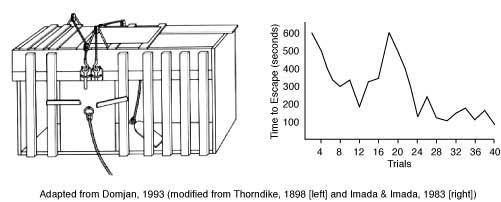
For his dissertation (Thorndike, 1898), Thorndike built puzzle boxes. These were crates fitted with a latch, lever or loop that a confined animal had to operate to spring the door. A hungry cat went inside, with food visible just outside.
To get the food, the cat had to accidentally perform a specific action, like pressing a lever or pulling a string, which would open the door.
He then timed how long it took the cat to escape over multiple trials to see how quickly it learned.
Results
- At first, cats behaved randomly: scratching, biting, and wandering with no clear pattern.
- Thorndike placed food outside as a reward, and the cats tried different ways to reach it.
- Eventually a cat stumbled on the lever by accident, opening the door. Each escape time was timed and recorded.
- Across trials, cats learned that pressing the lever brought favorable consequences, so they pressed it faster and faster.
- After roughly ten to twenty trials, the average first-escape time of about five minutes fell to around five seconds.
What is the learning curve in Thorndike’s experiment?
In Thorndike’s puzzle box experiments, the learning curve was a graph. It plotted the time the cat took to escape (the Y-axis) against the number of trials (the X-axis).
The key finding was the shape of this curve.

The learning curve was gradual, not sudden.
-
At First: On early trials, the cat took a long time to escape, performing random, useless behaviors until it accidentally hit the lever.
-
Over Time: With each trial, escape time decreased, but only by small, incremental amounts.
-
The Result: The graph showed a jagged but steady downward slope that flattened out as the cat mastered the task.
What did the puzzle box experiments prove about animal learning?
The experiments proved that animals, in this case, cats, don’t learn through sudden moments of “insight” or human-like reasoning.
Instead, they learn by gradually connecting a specific action with a rewarding outcome.
Over time, the accidental, successful behaviors became more frequent, while the useless ones, like scratching at the bars, faded away.
Why was the “trial-and-error” finding so important?
This finding was so important because it provided the first scientific evidence for a new type of learning, which he called “trial-and-error.”
It showed that learning is a gradual process of stamping in successful responses and stamping out unsuccessful ones.
This simple, mechanical process, not high-level thinking, was the key to forming new habits.
Critical Evaluation
Strengths
Thorndike (1905) introduced the concept of reinforcement and was the first to apply psychological principles to the area of learning.
His research led to many theories of learning, and Skinner (1938) built directly on it to develop operant conditioning.
Thorndike’s theory also has clear teaching implications. It supports preparing students mentally, using drills and repetition, giving feedback and rewards, and structuring material from simple to complex.
Skinner took the idea further. His work involved the systematic study of how the consequences of a behavior influence its frequency in the future. He introduced the concepts of reinforcement (both positive and negative) and punishment to describe how consequences can modify behavior.
Hull (1935) later synthesized the learning theories of Thorndike and Pavlov. Thorndike’s research drove comparative psychology for fifty years. It influenced countless psychologists in that time, and it still does today.
Before exploring each critique in detail, here are the main concerns raised about Thorndike’s theory:
- Revised Law of Exercise: Thorndike himself found that repetition without feedback barely improves learning.
- Oversimplification: Critics say the theory is too simple to explain real-world human learning.
- Too Mechanistic: The theory reduces learners to machines that just react, with no room for thought.
- Limited Generalisability: A hungry cat in a box is a poor model for complex human learning.
1. Why did Thorndike decide repetition alone is not enough?
Thorndike also significantly revised his Law of Exercise. His original law stated that mere repetition (Law of Use) would strengthen a connection.
However, his later work showed this was incorrect. He found that repetition without feedback or reward had almost no effect on learning.
The Original Theory: “Practice Makes Perfect”
Thorndike’s original Law of Exercise (pre-1930) had two parts:
-
The Law of Use: Repeating a response in a situation strengthens the connection between them.
-
The Law of Disuse: Not using a response weakens that connection (i.e., you forget).
This was the classic “drill and practice” model. He believed, like his puzzle-box experiments suggested, that sheer repetition “stamped in” the correct habit.
The Revision: “Practice with Reward Makes Perfect”
When Thorndike ran new experiments on human learning, he discovered his original law was wrong.
In one famous experiment, Thorndike (1932) had subjects draw a 4-inch line with their eyes closed, thousands of times in a row.
-
The Setup: The subjects repeated the action (practice), but they were given no feedback on whether they were close to 4 inches or not (no reward/satisfaction).
-
The Result: After all those trials, their accuracy did not improve at all.
-
They were just as bad at drawing the 4-inch line on the 3,000th attempt as they were on the first.
This experiment demonstrated that mere repetition (Law of Use) is useless for learning. Practicing the wrong thing, or practicing without knowing you’re doing it right, has no effect.
The New Conclusion
Thorndike concluded that the Law of Effect (the law of reward) was far more important than the Law of Exercise.
He essentially discarded the Law of Exercise as a primary law of learning.
He revised his stance to say that repetition is only effective because it gives the Law of Effect more opportunities to operate.
-
Old Idea: Repetition + Repetition + Repetition = Learning
-
New Idea: Repetition (with reward) + Repetition (with reward) + Repetition (with reward) = Learning
In short, practice doesn’t make perfect.
Only perfect practice, where you are rewarded or at least know you are performing correctly (which is its own reward), leads to learning.
2. What are the main arguments against Thorndike’s theories?
The main arguments against Thorndike are that his theories are far too simplistic to explain real-world human learning.
Critics, especially from the cognitive and Gestalt psychology schools, argue that he completely ignores the most important parts of learning: thinking, understanding, and insight.
His theory treats the learner as a passive “black box,” where a stimulus goes in and a response comes out, with the connection just being “stamped in” by a reward.
This fails to explain how someone understands a concept. Furthermore, Thorndike himself had to revise his own laws.
He later admitted that practice without feedback (his Law of Exercise) is mostly useless. He also revised his stance on punishment: it does not erase a connection the way reward strengthens one.
Punishment mainly prompts the learner to try something else, which makes it a weaker, less reliable tool for changing behavior.
3. Why do some critics say his theory is too mechanistic?
This is the single biggest criticism. “Mechanistic” means his theory reduces learners to simple machines, like an animal or a robot, who just react to the environment.
In Thorndike’s model, learning isn’t a process of thinking or understanding. It’s just the automatic, mechanical “stamping in” of a habit, or S-R bond, because a reward followed.
It’s a very passive process.
Gestalt psychologists, like Wolfgang Köhler, directly attacked this. Köhler’s experiments with chimpanzees showed that they could solve a problem all at once in a flash of “insight,” not just by gradual trial-and-error.
This suggests a complex, internal cognitive process, a “mental map,” which Thorndike’s mechanistic model completely ignores.
4. Does his animal-based research apply to complex human learning?
Critics argue that his animal research does not apply well to complex human learning. Here’s why:
A hungry cat in a puzzle box is learning a simple, physical task by trial and error. Its reward is a basic survival need: food.
This is a very poor model for how a human learns something abstract, like physics, history, or philosophy.
Human learning is driven by language, social motivation, and intrinsic curiosity, not just external rewards.
For example, Thorndike’s theory can explain how a student memorizes a multiplication table using drills. It cannot explain understanding the concept itself. Nor can it explain how a student might apply that concept creatively to a totally new problem.
Application to Students’ Learning
Thorndike’s theory points to several key factors in student learning:
- The role of the learning environment
- Breaking tasks into smaller parts
- The importance of student responses
- Building stimulus-response connections
- Utilizing prior knowledge
- Repetition through drills and exercises
- Giving rewards and praise
How are Thorndike’s learning theories applied in classrooms today?
You see Thorndike’s theories everywhere in modern classrooms, especially in how we structure lessons and manage behaviour.
- Law of Effect: Rewards such as verbal praise, good grades, sticker charts, and “token economies” all reinforce good behavior.
- Law of Exercise: The “practice makes perfect” rule underlies homework and drilling. Students repeat multiplication tables or use software until they master a skill.
- Connectionism: Teachers break complex subjects into smaller, sequential steps so a student masters one concept before moving to the next.
What are the benefits of using drills and repetition in learning?
The main benefit of drills and repetition, which Thorndike called the “Law of Exercise,” is to achieve automaticity.
When you practice a foundational skill, like basic maths facts or spelling, you strengthen that stimulus-response bond so much that it becomes effortless and automatic.
This is a massive cognitive benefit. It dramatically reduces a student’s cognitive load, which means their working memory is freed up.
Instead of wasting mental energy remembering “what’s 7 times 8?”, students can dedicate their brainpower to the harder, multi-step problem that uses that fact.
Why is providing immediate feedback and rewards important, according to this theory?
Immediate feedback is the most critical part of Thorndike’s Law of Effect. It’s all about timing.
The “satisfying” feeling of a reward, like praise or a correct answer on a screen, must happen immediately after the correct response.
This immediacy is the “glue” that fuses that specific action to that specific stimulus.
Delay muddies the link. The student may not remember what they did to get the right answer. Worse, their brain might link the reward to a different, unrelated behavior instead.
Immediacy ensures you are strengthening the correct bond.
Thorndike’s Other Contributions: Educational Psychology and the Halo Effect
Beyond the law of effect, Thorndike shaped two other fields. Educational psychology and the study of ratings both bear his mark. He wrote an estimated 500 books and articles in total.
Transfer of Training and Educational Measurement
From around 1900, Thorndike turned his quantitative approach to human learning and schooling, effectively founding educational psychology as a discipline.
With Robert Woodworth, he tested a popular idea. It was called “formal discipline”: the belief that training one mental faculty, such as memory, transfers wholesale to other tasks.
Their experiments found otherwise. Improvement on one mental function only carried over to another when the two tasks shared identical elements (Thorndike & Woodworth, 1901).
Not all learning transfers. This finding reshaped curriculum theory. It showed that drilling students in Latin, for example, would not automatically sharpen their reasoning in unrelated subjects.
Debates over whether “learning to learn” truly generalises across subjects still trace back to Thorndike’s identical-elements theory.
Thorndike’s three-volume Educational Psychology (1913–1914) codified the new field. His Introduction to the Theory of Mental and Social Measurements (1904) helped establish psychometrics, the discipline of psychological measurement.
He believed that “whatever exists at all exists in some amount” and so can in principle be measured.
He built tools too. He also devised widely used instruments, including a graded handwriting scale, an intelligence scale, and word-frequency books that shaped reading instruction for decades. Generations of textbook writers used his word counts to decide which words were simple enough for young readers.
The Halo Effect in Ratings
Thorndike’s measurement work produced a durable finding too. It exposed a common pitfall in how we rate people.
In 1920, he ran a key study (Thorndike, 1920). He had army officers grade soldiers on separate qualities: physique, intellect, leadership, and character. The ratings correlated far more closely than genuinely independent judgements should.
It was as if each officer formed one overall impression of a “good” or “poor” man and let it colour every specific score.
Thorndike named this distortion the halo effect. It became a foundational concept in social and workplace psychology, and it remains a standard caution in job interviews, performance reviews, and survey design today.
A teacher who rates a well-behaved student as also more intelligent, without separate evidence, is falling for the same halo effect Thorndike first measured.
Interviewers and managers are trained to watch for it precisely because Thorndike first proved it happens.
Thorndike’s Key Works
Thorndike’s major works trace his move from animal learning to education and measurement:
- Animal Intelligence (1898): His doctoral dissertation. It reported the puzzle-box experiments and the first statement of trial-and-error learning (Thorndike, 1898).
- Transfer Studies (1901): With Woodworth, he showed that training transfers only through identical elements, which undercut formal discipline (Thorndike & Woodworth, 1901).
- Mental and Social Measurements (1904): A foundational text of psychometrics and educational measurement (Thorndike, 1904).
- The Elements of Psychology (1905): His general textbook. It introduced the language of reinforcement and applied psychological principles to learning (Thorndike, 1905).
- Experimental Studies (1911): The book-length statement of the law of effect and the stimulus-response account of learning (Thorndike, 1911).
- Educational Psychology (1913–1914): Three volumes that systematically founded educational psychology (Thorndike, 1913–1914).
- The Fundamentals of Learning (1932): The experiments that led him to revise the law of exercise and downgrade repetition without reward (Thorndike, 1932).
Who Was Edward Thorndike?
Edward Lee Thorndike was born on August 31, 1874, in Williamsburg, Massachusetts, the son of a Methodist minister. The family moved often between New England parishes. A serious, competitive scholarliness ran through the household, and two of his brothers also became distinguished academics.
Education and the Move to Animal Learning
Thorndike took his first degree at Wesleyan University in 1895. A reading of William James‘s Principles of Psychology turned him toward the new science of mind.
He went on to Harvard to study under James. There he began the animal research that would define him.
Denied laboratory space for his chicks, he ran them through mazes improvised from stacked books in the basement of James’s own home. This early habit of building his own equipment stayed with him throughout his career.
Offered a fellowship, Thorndike moved to Columbia University to work under James McKeen Cattell, the pioneer of mental testing. There he switched from chicks to cats and dogs.
His doctoral dissertation, Animal Intelligence (1898), reported the puzzle-box experiments described above. It is regarded as the first true experiment in comparative psychology.
Career at Columbia and Later Life
After a brief spell teaching at Western Reserve University, Thorndike returned to Columbia in 1899 to join Teachers College. He remained there for his entire career, retiring in 1940.
He married Elizabeth Moulton in 1900. Their son, Robert Ladd Thorndike, became a leading psychometrician in his own right.
Thorndike died on August 9, 1949, in Montrose, New York. His four decades at Teachers College made him a founder of educational psychology and psychometrics.
He served as president of the American Psychological Association in 1912, and of the American Association for the Advancement of Science in 1934. Columbia later named him one of its most influential professors.
His scales, tests, and word-frequency dictionaries kept shaping American classrooms long after he retired in 1940.
Controversial Legacy: Hereditarian Views
Thorndike’s legacy is not unqualified. Like many contemporaries in the mental-testing movement, he held strongly hereditarian views: he treated intelligence and much of character as largely inborn.
He also ranked human worth in troubling ways. In Human Nature and the Social Order (Thorndike, 1940), he argued that society should be guided by its naturally most able members.
These positions sit close to the eugenics thinking (the movement to “improve” populations by controlling who has children) common in early twentieth-century psychology. They have drawn sustained criticism. In 2020, Teachers College, Columbia University, removed his name from a campus building on those grounds.
Both facts belong to the record. Thorndike was a pioneering measurement scientist whose hereditarianism reflected, and helped lend scientific authority to, the prejudices of his era.
References
Gray, P. (2011). Psychology (6th ed.) New York: Worth Publishers.
Hull, C. L. (1935). The conflicting psychologies of learning—A way out. Psychological Review, 42(6), 491–516. https://doi.org/10.1037/h0058665
Skinner, B. F. (1938). The behavior of organisms: An experimental analysis. New York: Appleton-Century.
Thorndike, E. L. (1898). Animal intelligence: An experimental study of the associative processes in animals. Psychological Monographs: General and Applied, 2(4), i-109.
Thorndike, E. L. (1904). An introduction to the theory of mental and social measurements. Science Press.
Thorndike, E. L. (1905). The elements of psychology. New York: A. G. Seiler.
Thorndike, E. L. (1911). Animal intelligence: Experimental studies. Macmillan.
Thorndike, E. L. (1913–1914). Educational psychology (Vols. 1–3). Teachers College, Columbia University.
Thorndike, E. L. (1920). A constant error in psychological ratings. Journal of Applied Psychology, 4(1), 25–29. https://doi.org/10.1037/h0071663
Thorndike, E. L. (1932). The fundamentals of learning. Teachers College, Columbia University.
Thorndike, E. L. (1940). Human nature and the social order. Macmillan.
Thorndike, E. L., & Woodworth, R. S. (1901). The influence of improvement in one mental function upon the efficiency of other functions. Psychological Review, 8(3), 247–261. https://doi.org/10.1037/h0074898

BSc (Hons) Psychology, MSc Psychology of Education
Associate Editor for Simply Psychology
Olivia Guy-Evans is a writer and associate editor for Simply Psychology, where she contributes accessible content on psychological topics. She is also an autistic PhD student at the University of Birmingham, researching autistic camouflaging in higher education.

Chartered Psychologist (CPsychol)
BSc (Hons) Psychology, MRes, PhD, University of Manchester
Saul McLeod, PhD, is a qualified psychology teacher with over 18 years of experience in further and higher education. He has been published in peer-reviewed journals, including the Journal of Clinical Psychology.