A Skinner box, or operant conditioning chamber, is an enclosed apparatus B. F. Skinner built to study how reinforcement and punishment shape behavior.
An animal presses a lever or pecks a key inside the box, and an automatic recorder measures the response, replacing guesswork with objective data.
This shift to observable, measurable behavior revolutionized behavioral psychology.

Key Components
The interior of a standard Skinner box contains several mechanisms designed to interact with the animal:
- A behavior indicator, such as a lever for rats or an illuminated disk (pecking key) for pigeons, which the animal can voluntarily manipulate.
- A food dispenser that delivers positive reinforcement, like a food pellet, when the animal performs the desired behavior.
- Speakers and lights that act as discriminative stimuli, signaling when a behavior will be reinforced.
- An electrified floor that can be used to deliver a mild electric shock in order to study punishment or negative reinforcement.
- A cumulative recorder plots every response as a step upward on a moving paper roll, so the line’s slope shows the animal’s response rate.
How Does It Work?
Inside the chamber, the animal’s own actions trigger the equipment that delivers reinforcement or punishment.
Within this chamber, there is usually a lever or key that an individual animal can operate to obtain a food or water source within the chamber as a reinforcer.
The chamber is connected to electronic equipment that records the animal’s lever pressing or key pecking, allowing for the precise quantification of behavior.

Before the works of Skinner, the namesake of the Skinner box, instrumental learning was typically studied using a maze or puzzle box.
Learning in these settings is well-suited to examining discrete trials or episodes of behavior instead of a continuous stream of behavior.
The Skinner box, meanwhile, was designed as an experimental environment better suited to examine the more natural flow of behavior in animals.
Example Experiment
In a typical experiment, a hungry rat is placed inside the chamber and allowed to wander and explore the space randomly.
Eventually, the rat will accidentally press the lever, causing a food pellet to drop into the dispenser.
At first, the rat does not understand the connection. After a few more accidents, though, it learns that pressing the lever (the behavior) leads to food (a satisfying consequence).
Once this association is learned, the rat will deliberately and continually press the lever to satisfy its hunger.
Because the animal must actively participate and “operate” on its environment to attain a reward this process is known as operant (or instrumental) conditioning.
The “Superstitious” Pigeon Experiment
Not every response inside the chamber is deliberately trained. Skinner (1948) ran a classic demonstration of what happens when reinforcement arrives regardless of behavior.
- Aim: Skinner wanted to see what happens when food arrives on a fixed schedule, independent of anything the pigeon does.
- Method: Hungry pigeons received a food pellet at fixed time intervals no matter what they were doing: a procedure called non-contingent reinforcement, reward delivered regardless of behaviour.
- Results: Six of the eight pigeons developed their own ritual. One turned counter-clockwise between deliveries; another thrust its head into a corner.
- Conclusion: Skinner drew a direct parallel to human superstition, the lucky charm or pre-performance ritual believed to influence an outcome it cannot actually affect.
This classic finding has since been directly retested with modern methods (see Contemporary Research below).
Psychological Principles
Skinner built his research on Edward Thorndike’s “law of effect.” It states that behaviors followed by satisfying consequences are repeated more often, while those followed by unpleasant consequences occur less.
Skinner used the operant conditioning chamber to systematically study and expand upon several related behavioral concepts:
- Positive Reinforcement: a direct reward for performing a certain behavior. For instance, the rat could be rewarded with a pellet of food for pushing the lever.
- Positive Punishment: an unpleasant outcome that follows a behavior to weaken it. Skinner used this to stop lever-pressing by electrifying the floor each time the rat pressed it.
- Negative Reinforcement: removing an unpleasant stimulus after a behavior, which increases that behavior. Skinner switched off a mild floor shock the moment the rat pressed the lever.
- Negative Punishment: removing a pleasant stimulus after a behavior, which decreases it. Skinner could withhold an expected food pellet whenever the rat pressed the lever.
- Extinction: the behavior gradually stops once it no longer pays off. If pressing the lever stops producing food, the rat’s pressing declines and eventually stops (Skinner, 1938).
- Stimulus Control: A light or sound can signal reinforcement. If lever-pressing only pays off while a light is on, the rat learns to press only then.
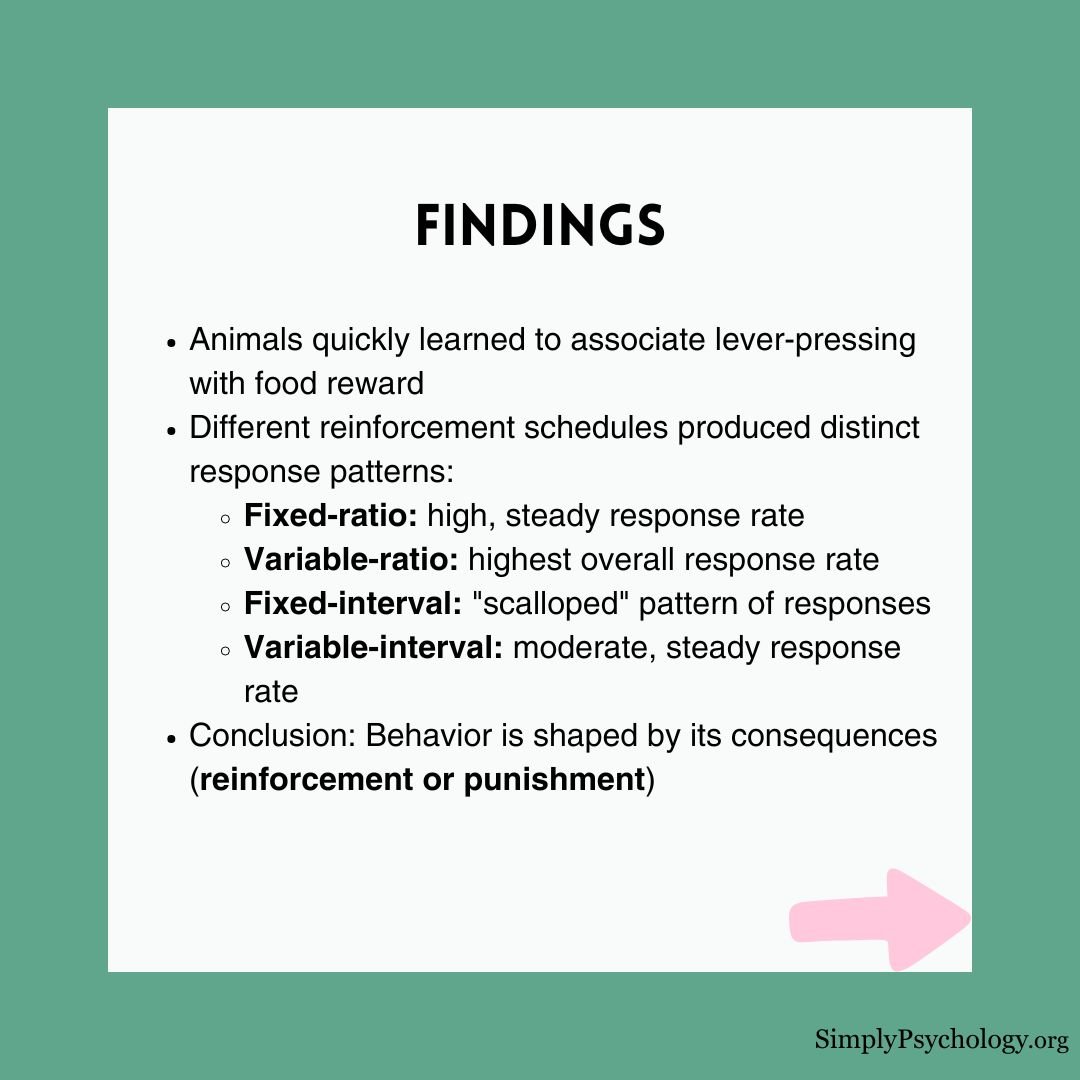
- Schedules of Reinforcement: the pattern of when rewards arrive. Continuous reinforcement, rewarding every press, teaches a new behavior fastest. Partial reinforcement, rewarding only some presses, builds a habit that resists extinction far longer.
- Shaping: researchers reward “successive approximations” of a behavior an animal would never do by chance. This let Skinner teach pigeons unusual tasks, such as turning in circles or playing ping pong.
Applications of the Skinner Box
The chamber isolates manipulable variables, reinforcers, punishers, discriminative stimuli and schedules, that reliably change behaviour. This let its methods seed several applied fields far beyond the laboratory rat and pigeon (Staddon & Cerutti, 2003).
The sections below cover the science of behaviour itself, and how the same logic now shapes drug research, applied behaviour change and technology design.
- The Science of Behaviour and Drug Research: the chamber founded a whole research discipline and, fitted with a drug-delivery lever, the standard model of drug self-administration.
- Token Economies, Training and Technology: the same reinforcement principles now run token economies, clinical practice, animal training and the variable-reward design behind apps and games.
The Experimental Analysis of Behaviour and Drug Research
The Skinner box founded the experimental analysis of behaviour (EAB).
EAB studies the lawful relations between behaviour and the variables that control it, using single-subject, free-operant designs and cumulative records rather than group averages (Skinner, 1938, 1963).
It supplied the standardised, automated method on which the whole discipline of behaviour analysis was built. Every later technique in the field still uses it.
The same experimental logic now drives drug research.
Fitting the chamber with a lever that delivers a drug dose turns it into a drug self-administration apparatus. This is the standard laboratory model of reinforcement by drugs of abuse.
A progressive-ratio schedule raises the response requirement after each reward.
The point where an animal stops working is its “break point”, which indexes how hard it will work for a dose. The method remains the standard way to test a drug’s reinforcing efficacy and abuse liability.
Token Economies, Animal Training and Technology Design
The same principles underpin token economies, where desired behaviours earn tokens later exchanged for rewards, used in psychiatric, educational and special-needs settings (Skinner, 1953).
The same logic runs deeper than token economies.
It underlies broader behaviour-modification practice in clinics and schools.
Clicker training of dogs, marine mammals and companion animals follows the identical method. Reinforce the behaviour continuously, mark the exact moment with a conditioned sound, then thin the schedule to make it durable (Skinner, 1951).
The same variable-reward logic now engineers apps, social media and games.
The pattern is a slot machine.
Unpredictable likes, notifications and feed refreshes reproduce the same steady, hard-to-extinguish responding.
Critics see the same design.
Researchers now analyse smartphone and video-game overuse as reinforcement- and habit-driven behaviour of exactly this kind (Chen et al., 2019).
Few pieces of psychological apparatus have proved this generative, reaching from the psychiatric ward to the smartphone in a pocket. The same reinforcement logic that shaped a hungry rat’s lever-press now shapes a thumb scrolling a feed.
Comparison with Classical Conditioning and Cognitive Alternatives
The Skinner box is often set beside other approaches to learning, and the contrast sharpens what the chamber actually shows. Three challenges, from physiology, cognition and ethology, mark out its real boundaries: Pavlov’s respondent conditioning, Tolman’s cognitive maps, and the Brelands’ instinctive drift.
- Pavlov and Tolman: a reflex-driven alternative and a cognitive alternative to the “purely operant” story.
- The Brelands’ Instinctive Drift: evolutionary history limiting what any reinforcement schedule can achieve.
Pavlov and Tolman: Respondent and Cognitive Alternatives
Pavlov’s classical-conditioning method restrains the animal and pairs a neutral stimulus with one that already triggers a reflex, such as salivation (Pavlov, 1927).
The Skinner box instead lets the animal move freely and emit a voluntary response, measuring its rate rather than an automatic reflex.
The line is not absolute.
A pigeon in the chamber will spontaneously peck a key merely paired with free food, a classically-conditioned response called autoshaping (Brown & Jenkins, 1968).
Autoshaping intrudes on the box’s “purely operant” measure.
Edward Tolman made a different challenge: maze-learning rats, he argued, build an internal cognitive map rather than simply accumulating strengthened stimulus-response habits (Tolman, 1948).
On this view, a rising lever-press rate fits a rat that has learned “pressing leads to food” just as well as one merely strengthened by its consequence.
Either explanation fits the data.
The Brelands’ Instinctive Drift
Keller and Marian Breland, two of Skinner’s own former students, trained animals commercially using standard operant methods. They found species repeatedly drifted from a well-reinforced trained response back to instinctive, species-typical behaviour, even when this cost the animal its reward (Breland & Breland, 1961).
A raccoon trained to deposit a coin instead “washed” it repeatedly between its paws, exactly as it would treat food in the wild.
Training could not override instinct.
Evolutionary history, the Brelands concluded, sets real limits on what any schedule of reinforcement can achieve.
Their finding challenged the assumption that any species could learn any response through the same general process of reinforcement.
None of these challenges overturns what the chamber demonstrates. Each instead marks a boundary condition: cognition, physiology and evolutionary history all shape what any schedule of reinforcement can achieve.
Strengths of the Skinner Box
- Total Environmental Control: Researchers control every antecedent, like lights or sounds, and every consequence, like food or shocks. This isolates cause and effect precisely.
- Scientific Objectivity and Credibility: Before behaviorism, psychology relied on subjective methods like introspection. Counting exact lever-presses gave psychology objective, measurable data and scientific credibility.
- Minimization of Human Confounding Variables: Rats and pigeons cannot guess an experiment’s purpose or try to please the researcher. This removes the “demand characteristics” that complicate human studies.
- Practical, Real-World Applications: Operant principles now underpin behavior therapy, programmed learning, biofeedback, and “token economies” used in psychiatric wards and prisons.
Limitations of the Skinner Box
- Ethical Concerns: Keeping animals in confined spaces, motivating them with food deprivation, and using aversive stimuli like electric shocks all raise animal-welfare questions.
- Methodology Directing Theory: Counting lever presses as “response rate” ignores the intensity, duration, and quality of behavior. Critics argue this lets the method narrow the theory itself.
- Ecological Validity: The chamber is a deliberately artificial, impoverished space. Du Boulay (2019) argues that behavior produced under such tight control may not generalize to complex, real-world settings.
- Generalizability to Humans: Rats and pigeons cannot stand in for people. Human learning is shaped by language, culture, and social factors an isolated box cannot replicate (Chomsky, 1959).
- Reductionism and the Rejection of Cognition: The radical behaviorist approach treats the mind as a “black box,” setting aside thoughts, emotions, and internal cognition. This creates several explanatory gaps:
- It cannot account for spontaneous human creativity in fields like music, literature, and science.
- It cannot explain the productivity and innovative nature of human language, which is not merely a repeated set of reinforced behaviors (Chomsky, 1959).
- Even in animals, the box oversimplifies learning. “Latent learning” and the “reinforcer devaluation effect” show that animals use cognitive processes to weigh consequences, not just repeat reinforced actions.
- Insight Learning: Köhler (1924) found that chimpanzees solve problems through sudden insight, not just trial-and-error.
- Observational Learning: Bandura (1977) showed that people learn new behavior by watching others, without needing direct reinforcement themselves.
Contemporary Research
Retesting Skinner’s Own Classic Study
The chamber’s own founding demonstration has itself been retested with modern methods, not just extended by new technology.
- Aim: Fernandez and Timberlake (2020) retested whether birds develop individually unique “superstitious” rituals, as Skinner proposed, or converge on a shared species-typical pattern instead.
- Method: Four experiments repeated Skinner’s fixed-time food-delivery procedure across male and female pigeons, then extended it to roller pigeons, ring-necked doves and bantam chickens.
- Results: No species developed the idiosyncratic rituals Skinner reported. Each species converged on its own typical food-getting behaviour instead; bantam chickens, for example, mostly scratched and pecked the floor.
- Conclusion: The results favour species-typical, food-elicited behaviour over an arbitrary operant accidentally strengthened by chance pairing, revising the mechanism behind Skinner’s original claim.
This does not overturn the wider finding that reinforcement delivered independently of behaviour can shape a stable response pattern. It revises Skinner’s explanation of why, showing the field correcting its own founding demonstration with the very apparatus that produced it.
Modern chambers are now computer-controlled. They combine with optogenetics, chemogenetics, and brain-imaging tools to record neural activity during an operant task, linking specific reinforcement events to the brain’s reward circuits.
High-throughput touchscreen chambers and automated home-cage systems now run standardized operant tests with little human handling. This supports large-scale behavioral phenotyping of genetic and disease models in modern neuroscience.
Dezfouli and Balleine (2012) reviewed evidence on habit formation. They argued operant behavior reflects two computational systems: goal-directed choice and automatic habit. Skinner-box data on reinforcement and habit now serve as a testbed for these reinforcement-learning models of decision-making.
The same variable-reward logic now drives technology design. Chen et al. (2019) found that smartphone addiction is driven by dual mechanisms, reinforcement reward and habit, tied to specific app features. The Skinner box’s logic now operates through the phone in a user’s hand.
Skinner Box Myths
The Air Crib: A Baby Tender, Not a Skinner Box
In 1945, B. F. Skinner invented the air crib. It was a metal crib with a removable safety-glass ceiling, walls, and front pane, built on legs so it could be moved easily.
Skinner designed the crib to give infants a climate-controlled, healthier environment. It was not commercially successful, though it drew media attention.
Time magazine covered it in 1947, calling it a “baby tender” that would “give infant care a new scientific basis” (Joyce & Faye, 2010).
The lack of publicity fed a myth. People believed the air crib was a Skinner box, and that Skinner’s infants were being conditioned inside it.
In reality, it was simply a bassinet with a few features that made infant care easier for parents. No evidence shows Skinner used it to condition children, and he later said that was never his intention.
One persistent myth involves Skinner’s daughter, Deborah. It claims she was raised inside a Skinner box.
The story goes further: that she became mentally ill, sued her father, and later died by suicide. These rumors persisted until Deborah Skinner publicly denied them herself, in 2004 (Joyce & Faye, 2010).
Key Takeaways
- Definition: The Skinner box, or operant conditioning chamber, is an enclosed apparatus B. F. Skinner built to study how consequences change behavior through reinforcement and punishment.
- How It Works: An animal presses a lever or pecks a key, and an automatic dispenser delivers food, water, or a mild shock as the consequence.
- Response Rate: A cumulative recorder plots every response as it happens, so the slope of the line shows how fast the animal is responding.
- Key Principles: The same chamber demonstrates reinforcement, punishment, shaping, stimulus control, and schedules of reinforcement.
- Air Crib Myth: Skinner’s daughter was not raised in a Skinner box. She grew up in the “air crib,” a separate climate-controlled bassinet.
- Modern Use: Today’s chambers pair operant tasks with brain-imaging and genetic tools, and the same reward logic shapes app and game design.
References
Bandura, A. (1977). Social learning theory. Englewood Cliffs, NJ: Prentice Hall.
Breland, K., & Breland, M. (1961). The misbehavior of organisms. American Psychologist, 16(11), 681-684. https://doi.org/10.1037/h0040090
Brown, P. L., & Jenkins, H. M. (1968). Auto-shaping of the pigeon’s key-peck. Journal of the Experimental Analysis of Behavior, 11(1), 1-8.
Dezfouli, A., & Balleine, B. W. (2012). Habits, action sequences and reinforcement learning. European Journal of Neuroscience, 35(7), 1036-1051.
Du Boulay, B. (2019). Escape from the Skinner Box: The case for contemporary intelligent learning environments. British Journal of Educational Technology, 50(6), 2902-2919.
Chen, C., Zhang, K. Z. K., Gong, X., & Lee, M. (2019). Dual mechanisms of reinforcement reward and habit in driving smartphone addiction: the role of smartphone features. Internet Research, 29(6), 1551-1570.
Chomsky, N. (1959). A review of B. F. Skinner’s Verbal Behavior. Language, 35(1), 26-58.
Dad, H., Ali, R., Janjua, M. Z. Q., Shahzad, S., & Khan, M. S. (2010). Comparison of the frequency and effectiveness of positive and negative reinforcement practices in schools. Contemporary Issues in Education Research, 3(1), 127-136.
Diedrich, J. L. (2010). Motivating students using positive reinforcement (Doctoral dissertation).
Dozier, C. L., Foley, E. A., Goddard, K. S., & Jess, R. L. (2019). Reinforcement. The Encyclopedia of Child and Adolescent Development, 1-10.
Fernandez, E. J., & Timberlake, W. (2020). Superstition revisited: Sex, species, and adventitious reinforcement. Behavioural Processes, 170, Article 103979. https://doi.org/10.1016/j.beproc.2019.103979
Ferster, C. B., & Skinner, B. F. (1957). Schedules of reinforcement. New York: Appleton-Century-Crofts.
Gunter, P. L., & Coutinho, M. J. (1997). Negative reinforcement in classrooms: What we’re beginning to learn. Teacher Education and Special Education, 20(3), 249-264.
Joyce, N., & Faye, C. (2010). Skinner Air Crib. APS Observer, 23(7).
Kamery, R. H. (2004, July). Motivation techniques for positive reinforcement: A review. In Allied Academies International Conference. Academy of Legal, Ethical and Regulatory Issues. Proceedings (Vol. 8, No. 2, p. 91). Jordan Whitney Enterprises, Inc.
Kohler, W. (1924). The mentality of apes. London: Routledge & Kegan Paul.
Pavlov, I. P. (1927). Conditioned reflexes: An investigation of the physiological activity of the cerebral cortex. Oxford University Press.
Staddon, J. E., & Niv, Y. (2008). Operant conditioning. Scholarpedia, 3(9), 2318.
Skinner, B. F. (1938). The behavior of organisms: An experimental analysis. New York: Appleton-Century.
Skinner, B. F. (1948). Superstition in the pigeon. Journal of Experimental Psychology, 38, 168-172.
Skinner, B. F. (1951). How to teach animals. Freeman.
Skinner, B. F. (1953). Science and human behavior. Macmillan.
Skinner, B. F. (1963). Operant behavior. American Psychologist, 18(8), 503.
Smith, S., Ferguson, C. J., & Beaver, K. M. (2018). Learning to blast a way into crime, or just good clean fun? Examining aggressive play with toy weapons and its relation with crime. Criminal Behaviour and Mental Health, 28(4), 313-323.
Staddon, J. E., & Cerutti, D. T. (2003). Operant conditioning. Annual Review of Psychology, 54(1), 115-144.
Thorndike, E. L. (1898). Animal intelligence: An experimental study of the associative processes in animals. Psychological Monographs: General and Applied, 2(4), i-109.
Tolman, E. C. (1948). Cognitive maps in rats and men. Psychological Review, 55(4), 189-208. https://doi.org/10.1037/h0061626
Vu, D. (2017). An Analysis of Operant Conditioning and its Relationship with Video Game Addiction.
Watson, J. B. (1913). Psychology as the behaviorist views it. Psychological Review, 20, 158-177.