Cognitive bias is a systematic error in thinking, affecting how we process information, perceive others, and make decisions. It can lead to irrational thoughts or judgments and is often based on our perceptions, memories, or individual and societal beliefs.
Instead of running exhaustive logical analysis for every decision, people rely on heuristics: mental shortcuts, or “rules of thumb,” that simplify complex problems.
These shortcuts are usually efficient and adaptive for survival, but they reliably produce predictable errors that skew our perception of reality, because they trade accuracy for speed.
Dual Process Theory: System 1 & System 2
The dual process model explains cognitive biases through the interaction of two distinct neurological systems.
Nobel laureate Daniel Kahneman defined these systems based on their speed and effort requirements. System 1 constitutes the primary source of biased judgment due to its reflexive nature.
-
System 1 (Intuitive): This system is fast, instinctive, and emotional. It operates automatically with little or no sense of voluntary control.
-
System 2 (Deliberate): This system is slow, effortful, and logical. It handles complex computations and provides the necessary oversight to correct System 1 errors.
Conflict arises because System 2 is inherently “lazy.”
It requires significant metabolic energy to function.
Consequently, System 2 often accepts the intuitive suggestions of System 1 without critical evaluation.
This failure of oversight allows biases to influence high-stakes decisions in law, medicine, and finance.
WYSIATI: What You See Is All There Is
Kahneman (2011) traced many System 1 errors to one deeper habit of mind: WYSIATI, “what you see is all there is.” System 1 builds the most coherent story it can from only the information currently active in mind. Nothing else gets weighed.
As Kahneman explains, information “that is not retrieved (even unconsciously) from memory might as well not exist” for that story (Kahneman, 2011). A judgment can feel confident even when it rests on very little evidence.
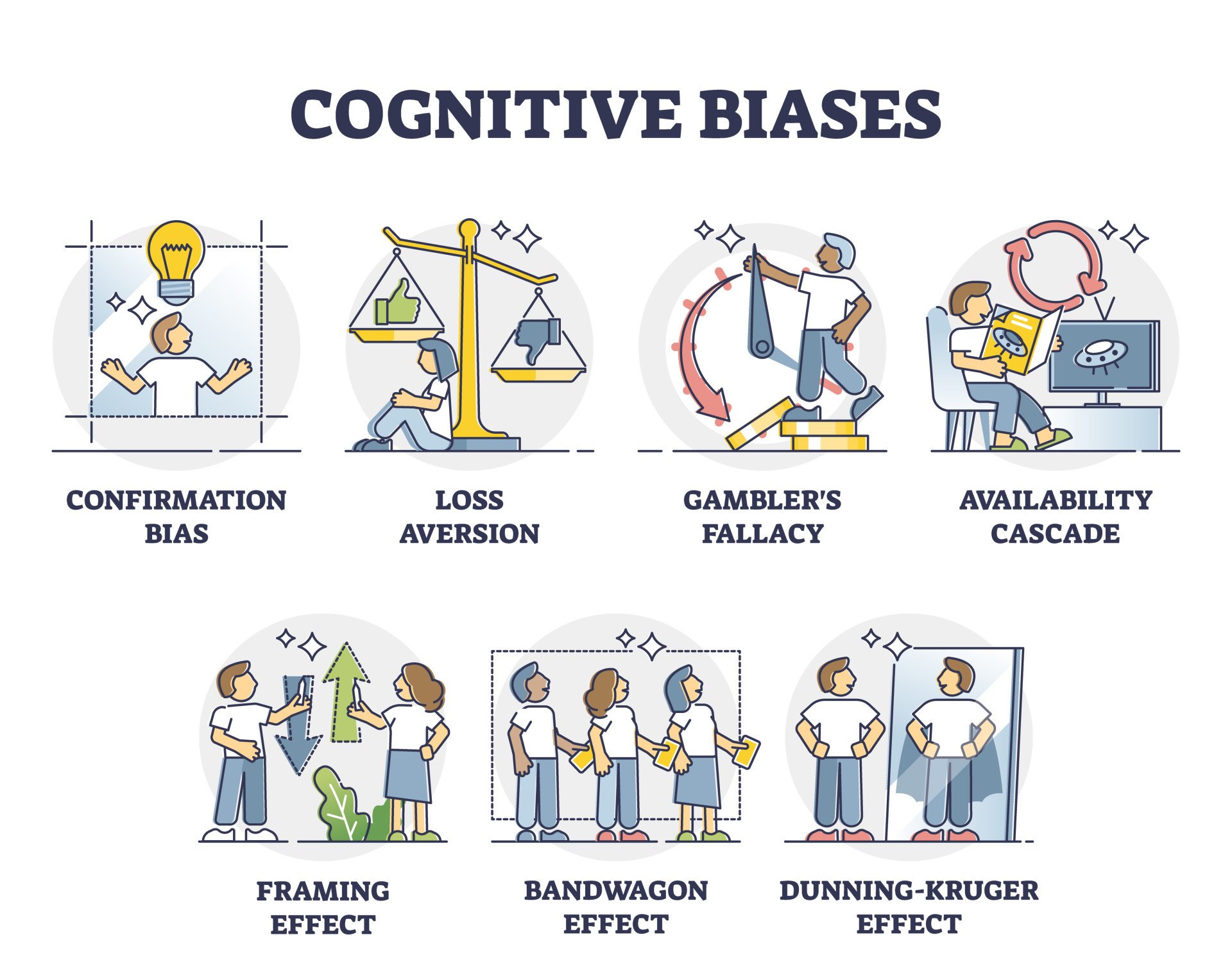
Confirmation Bias: The Preservation of Preexisting Beliefs
Confirmation bias is the tendency to selectively process information that validates one’s current worldview while disregarding contradictory data.
This bias acts as a filter that reinforces “echo chambers,” particularly in digital environments where algorithms prioritize content based on user preference.
This mechanism provides a motivational benefit by protecting self-esteem.
Admitting error creates psychological discomfort, so the brain prioritizes “desired conclusions” to maintain a sense of security and intellectual competence.
From a cognitive perspective, confirmation bias occurs because the mind struggles with parallel processing (Nickerson, 1998).
Parallel processing is the ability of the brain to simultaneously evaluate multiple, competing hypotheses.
Nickerson (1998) titled his review “a ubiquitous phenomenon.”
Because this is cognitively taxing, the brain defaults to a single, consistent narrative.
This can be particularly dangerous in criminal investigations, where a detective may focus only on evidence that implicates a specific suspect while ignoring exonerating facts.
Empirical Validation: The Wason Rule Discovery Test
Wason (1960) provided the foundational evidence for this bias through a numerical reasoning task.
-
Aim: To investigate whether people seek to confirm or falsify their hypotheses when testing a rule.
-
Procedure: Participants were given the sequence “2-4-6” and told it followed a specific rule. They had to generate their own triples to discover the rule, receiving “yes” or “no” feedback.
-
Findings: Most participants assumed the rule was “even numbers increasing by two” and only tested sequences that fit this narrow theory (e.g., 8-10-12). They rarely tested sequences that could falsify their theory (e.g., 2-4-7).
-
Conclusions: People have a natural tendency to seek confirming evidence rather than attempting to disprove their own assumptions. The actual rule was simply “any three ascending numbers.”
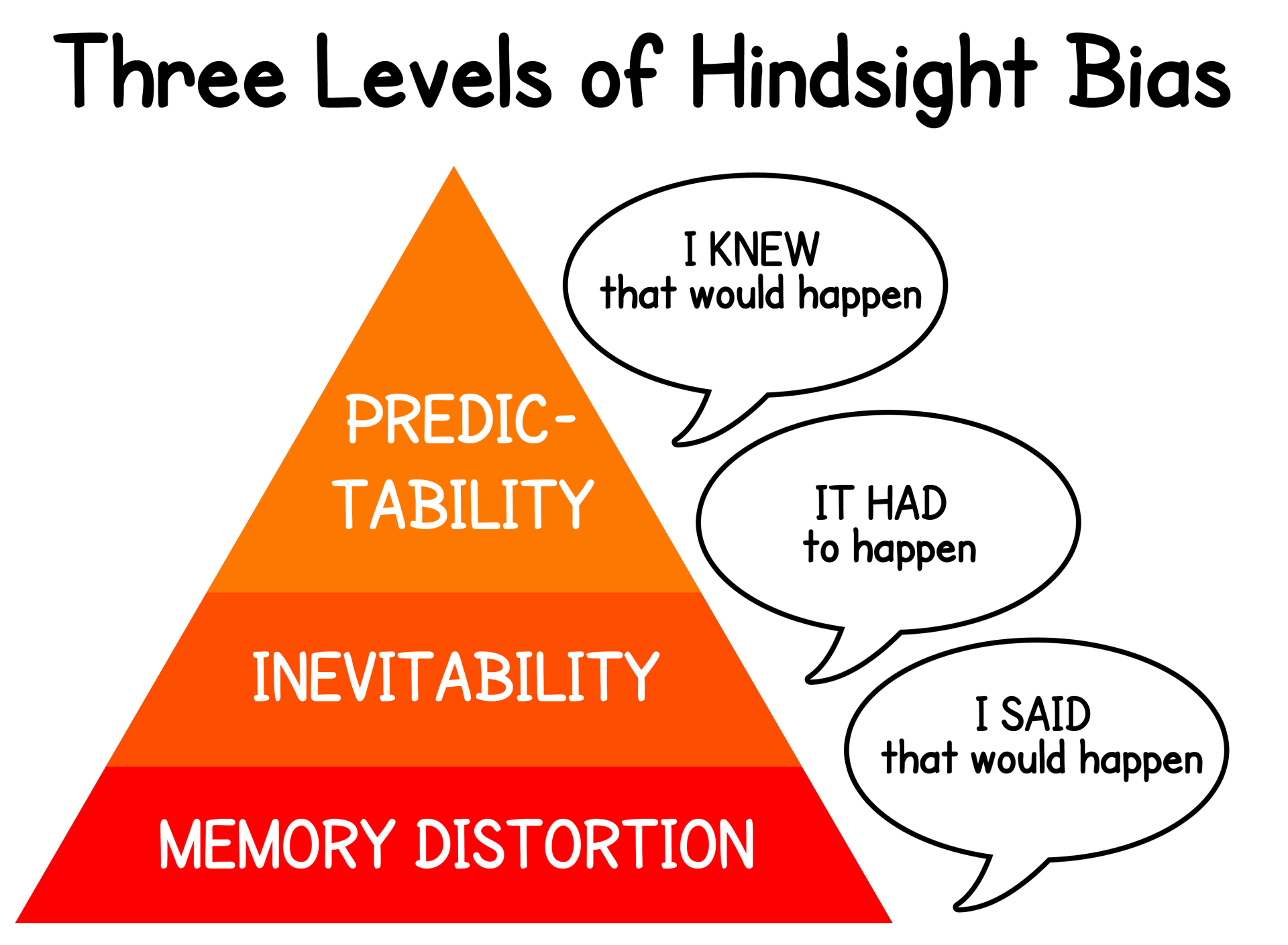
Hindsight Bias: The Illusion of Predictability
Hindsight bias, or the “I-knew-it-all-along” effect, is the tendency to perceive past events as having been more predictable than they actually were.
Once an outcome is known, the brain reorganizes its memory of the event to make the result seem inevitable.
Roese and Vohs (2012) reviewed decades of hindsight-bias research.
This distortion occurs because current knowledge is highly “accessible” in the mind, making it difficult to recall the state of uncertainty that existed before the event occurred.
This bias serves a motivational function by making the world feel orderly and predictable.
When unexpected events occur, they violate our expectations and cause anxiety.
Fischhoff (1975) first documented the effect.
By convincing ourselves we “saw it coming,” we regain a sense of control over our environment.
However, this overconfidence can lead to risky future decisions, as individuals overestimate their ability to forecast complex outcomes in sports, politics, or finance.
Empirical Validation: The Nixon Visit Study
Fischhoff and Beyth (1975) conducted the first direct investigation into this phenomenon using real-world political events.
-
Aim: To determine if knowing an outcome changes a person’s memory of their initial predictions.
-
Procedure: Before President Nixon’s historic 1972 trip to China and the USSR, participants assigned probabilities to various outcomes. After the trip, they were asked to recall their original predictions.
-
Findings: Participants consistently remembered giving higher probabilities to the events that actually happened and lower probabilities to the events that did not.
-
Conclusions: Knowledge of the present outcome automatically and unconsciously contaminates our memory of the past.
Self-Serving Bias: Attribution and Ego Defense
The self-serving bias is a social-cognitive distortion where individuals attribute success to internal factors and failure to external factors.
This bias differs from the Fundamental Attribution Error because it specifically focuses on “valence.” Valence refers to the intrinsic goodness or badness of an event.
By taking credit for wins and blaming the environment for losses, individuals maintain a positive self-image and high levels of self-esteem.
In the workplace, this manifests as employees attributing promotions to their talent while blaming a “difficult boss” for a poor performance review.
This bias is not universal, though. It weakens or even reverses in people with depression, who often blame themselves for setbacks instead of external factors (Mezulis, Abramson, Hyde, & Hankin, 2004). Protecting self-image still comes at a cost: leaning on external blame can stall personal growth.
Overcoming this requires “self-compassion.” Self-compassion is the practice of treating oneself with kindness and objective understanding during failures, reducing the need for defensive externalization.
Anchoring Bias: The Power of First Impressions
Anchoring bias occurs when a person relies too heavily on the first piece of information offered, known as the “anchor,” during decision-making.
Once an anchor is set, all subsequent negotiations or estimates are adjusted relative to that initial value.
This is a common tactic in retail and real-world negotiations, where an initial high price makes all lower prices seem like bargains, regardless of the item’s actual market value.
The phenomenon is explained by “selective accessibility.”
This theory suggests that when we see an anchor, our brain automatically searches for information that is consistent with that value.
This makes the anchor more mentally prominent, biasing our final judgment.
Susceptibility to anchoring increases under high “cognitive load,” which is the total amount of mental effort being used in the working memory at one time.
A famous experiment shows why. Tversky and Kahneman (1974) demonstrated this with a rigged “wheel of fortune” that always stopped at either 10 or 65. They then asked participants what percentage of United Nations members were African countries.
People who saw the wheel land on 10 gave a median guess of 25%. Those who saw 65 guessed 45%. A random number swayed judgments about world geopolitics.
As Daniel Kahneman explains in Thinking, Fast and Slow, anchoring works through two separate mechanisms.
A deliberate but incomplete adjustment away from the anchor reflects “a weak or lazy System 2” (Kahneman, 2011). An automatic priming effect also occurs: System 1 searches for anchor-consistent evidence and “tries its best to construct a world in which the anchor is the true number” (Kahneman, 2011).
Availability Bias: Recency and Vividness in Judgment
The availability bias (or availability heuristic) involves estimating the frequency of an event based on how easily examples can be recalled.
Information that is “available” (meaning it is recent, vivid, or emotionally charged) exerts a disproportionate influence on our perception of risk.
This explains why people often fear rare, sensationalized events like shark attacks or plane crashes more than statistically common dangers like heart disease or car accidents.
This bias lets the brain skip a hard task. That task is calculating exact “statistical probabilities.”
Statistical probability is the objective likelihood of an event based on data.
Instead, the brain uses the ease of memory retrieval as a proxy for frequency. If you can think of it easily, your brain assumes it must happen often.
Consider a simple test of this.
Tversky and Kahneman (1973) tested this by asking whether English words are more likely to start with the letter k, or to have k as their third letter. Most people say k is more common first, because words like king and kitchen come to mind easily.
In reality, k appears more often as the third letter of a word. Ease of retrieval drove the judgment, not real frequency.
Inattentional Blindness: The Limits of Focused Attention
Inattentional blindness occurs when a person fails to perceive an unexpected stimulus that is in plain sight because their attention is focused elsewhere.
This is not a visual deficit but a cognitive one. It results from “attentional capacity” limits.
This concept describes the finite amount of mental energy available for processing sensory information.
When we focus intensely on one task, the brain “filters out” irrelevant information to prevent sensory overload.
Empirical Validation: The Invisible Gorilla Study
Most et al. (2001) famously demonstrated the severity of this selective attention.
-
Aim: To test if intense focus on a task causes people to miss highly visible but unexpected stimuli.
-
Procedure: Participants watched a video of people passing a basketball and were told to count the passes made by the “white team.” Midway through, a person in a gorilla suit walked through the scene.
-
Findings: Approximately 50% of participants failed to notice the gorilla entirely.
-
Conclusions: Conscious perception requires attention; if the mind is fully occupied, even a large, distinct stimulus can remain “invisible” to the observer.
Preventing Cognitive Bias
As we know, recognizing these biases is the first step to overcoming them. Awareness alone is not enough. But there are other small strategies we can follow to train our unconscious mind to think in different ways.
From strengthening our memory and minimizing distractions to slowing down our decision-making and improving our reasoning skills, we can work towards overcoming these cognitive biases.
An individual can evaluate his or her own thought process, also known as metacognition (“thinking about thinking”), which provides an opportunity to combat bias (Flavell, 1979).
This multifactorial process involves (Croskerry, 2003):
(a) acknowledging the limitations of memory,
(b) seeking perspective while making decisions,
(c) being able to self-critique,
(d) choosing strategies to prevent cognitive error.
Many strategies used to avoid bias that we describe are also known as cognitive forcing strategies, which are mental tools used to force unbiased decision-making.
Critical Evaluation
The heuristics-and-biases programme has shaped decades of research, but it has also drawn serious, constructive criticism.
The Ecological Rationality Critique
Gerd Gigerenzer and colleagues reject the idea that these effects are simple thinking errors.
They argue that many so-called biases reflect ecological rationality instead: a good fit between a simple mental shortcut and the structure of the real environment a person actually lives in.
Simple heuristics are not broken tools on this view. They are adaptive ones, tuned to recurring, real-world problems.
Gigerenzer and Goldstein (1996) showed that “fast-and-frugal” heuristics, which deliberately ignore most of the available information, can match or even beat complex statistical models in realistic settings.
Judging a shortcut against an abstract logical rule can therefore misclassify a well-adapted tool as an “error.”
That reframes the whole debate. It becomes a question of which normative standard is the right one to apply, not simply whether people reason “correctly.”
Do Biases Disappear With the Right Format?
A related challenge concerns how a problem is presented, not just how people reason about it.
Gigerenzer and Hoffrage (1995) tested notoriously difficult Bayesian problems, such as estimating the probability of disease from a positive test result.
People show gross errors, known as base-rate neglect, when this information is given as single-event probabilities.
The fix is surprisingly simple.
Accuracy improves sharply when the same facts are presented as natural frequencies instead, such as “8 out of every 1,000 women,” rather than a percentage.
If irrationality evaporates with a change of format, the deficit may lie in the artificial framing of the task.
It may not lie in the reasoner at all. Real-world judgments, where information often arrives in more natural forms, may be less biased than laboratory studies suggest.
How Robust Are These Effects? The Replication Crisis
Like much of psychology, some classic bias findings have been re-examined in the replication crisis.
The picture that emerges is mixed, not damning.
Klein and colleagues (2014) ran a large, multi-lab replication project testing many classic effects at once, across a large number of independent samples worldwide.
Anchoring held up strongly, replicating with large effect sizes across many samples.
Not every effect fared as well.
Other, more fragile effects proved much harder to reproduce, or showed substantial variation in size from one context to the next. Claims about ego depletion, and about exactly when a given bias should dominate a decision, faced some of the toughest replication challenges of all.
Context clearly matters here.
The safest conclusion is that the core heuristics are well established. The size and boundaries of individual effects, though, remain under active revision.
Contemporary Research
Recent work has both tested classic biases at scale and identified a second, related source of error.
Measuring the Self-Serving Bias in Sport
Allen, Robson, Martin, and Laborde (2020) conducted a systematic review and meta-analysis of the self-serving attribution bias across many studies conducted in competitive sport. Pooling results this way let them quantify how strong the bias is, and where it weakens.
Noise: A Second Source of Error
Kahneman, Sibony, and Sunstein (2021) drew attention to noise: unwanted variability in judgements that should be identical, such as different judges reaching different verdicts on similar cases.
They argue noise is often larger than bias, yet gets far less attention.
That distinction matters.
Structured decision procedures, and in some cases algorithms, frequently reduce this variability.
As machine-learning systems take on more decisions, researchers now draw parallels between human cognitive bias and algorithmic bias: models trained on human data can absorb, and even amplify, human biases.
History of Cognitive Bias
Israeli psychologists Amos Tversky and Daniel Kahneman first coined the term cognitive bias in the 1970s. They used it to describe people’s flawed thinking in judgment and decision problems (Tversky & Kahneman, 1974).
Their research program, the heuristics and biases program, studied how people decide with limited resources. One clear example is choosing a meal in a hurry. People then lean on heuristics, quick mental shortcuts that substitute for careful analysis.
To test this, Tversky and Kahneman gave participants reasoning problems with a computed, normative answer. They compared each answer to the predetermined solution, which revealed systematic deviations in judgment.
Running many such problems revealed numerous norm violations. These violations show how much people rely on cognitive biases when they decide and judge (Wilke & Mata, 2012).
Key Takeaways
- Definition: Cognitive biases are unconscious, systematic errors in thinking that distort memory, attention, and judgment.
- Why They Happen: The brain relies on heuristics, or mental shortcuts, to simplify an overwhelming amount of information.
- Common Examples: Well-known biases include confirmation bias, hindsight bias, self-serving bias, the base rate fallacy, anchoring bias, availability bias, the framing effect, inattentional blindness, the mere exposure effect, the false consensus effect, and the ecological fallacy.
- Real-World Impact: These biases shape safety, relationships, and everyday decisions, often without our awareness.
- Reducing Bias: Small strategies, such as slowing down and seeking other perspectives, can help people manage these biases.
- Noise: Kahneman, Sibony, and Sunstein (2021) show that unwanted variability between judgements, called noise, is a separate and often larger source of error than bias itself.
References
Allen, M. S., Robson, D. A., Martin, L. J., & Laborde, S. (2020). Systematic review and meta-analysis of self-serving attribution biases in the competitive context of organized sport. Personality and Social Psychology Bulletin, 46 (7), 1027-1043.
Casad, B. (2019). Confirmation bias. Retrieved from https://www.britannica.com/science/confirmation-bias
Cherry, K. (2019). How the availability heuristic affects your decision-making. Retrieved from https://www.verywellmind.com/availability-heuristic-2794824
Cherry, K. (2020). Inattentional blindness can cause you to miss things in front of you. Retrieved from https://www.verywellmind.com/what-is-inattentional-blindness-2795020
Dietrich, D., & Olson, M. (1993). A demonstration of hindsight bias using the Thomas confirmation vote. Psychological Reports, 72 (2), 377-378.
Fischhoff, B. (1975). Hindsight is not equal to foresight: The effect of outcome knowledge on judgment under uncertainty. Journal of Experimental Psychology: Human Perception and Performance, 1 (3), 288.
Fischhoff, B., & Beyth, R. (1975). I knew it would happen: Remembered probabilities of once-future things. Organizational Behavior and Human Performance, 13 (1), 1-16. https://doi.org/10.1016/0030-5073(75)90002-1
Furnham, A. (1982). Explanations for unemployment in Britain. European Journal of social psychology, 12(4), 335-352.
Gigerenzer, G., & Goldstein, D. G. (1996). Reasoning the fast and frugal way: Models of bounded rationality. Psychological Review, 103 (4), 650-669.
Gigerenzer, G., & Hoffrage, U. (1995). How to improve Bayesian reasoning without instruction: Frequency formats. Psychological Review, 102 (4), 684-704.
Heider, F. (1982). The psychology of interpersonal relations. Psychology Press.
Inman, M. (2016). Hindsight bias. Retrieved from https://www.britannica.com/topic/hindsight-bias
Kahneman, D. (2011). Thinking, fast and slow. Farrar, Straus and Giroux.
Kahneman, D., Sibony, O., & Sunstein, C. R. (2021). Noise: A flaw in human judgment. Little, Brown Spark.
Klein, R. A., Ratliff, K. A., Vianello, M., Adams, R. B., Jr., Bahník, Š., Bernstein, M. J., … Nosek, B. A. (2014). Investigating variation in replicability: A “many labs” replication project. Social Psychology, 45 (3), 142-152.
Lang, R. (2019). What is the difference between conscious and unconscious bias? : Faqs. Retrieved from https://engageinlearning.com/faq/compliance/unconscious-bias/what-is-the-difference-between-conscious-and-unconscious-bias/
Luippold, B., Perreault, S., & Wainberg, J. (2015). Auditor’s pitfall: Five ways to overcome confirmation bias. Retrieved from https://www.babson.edu/academics/executive-education/babson-insight/finance-and-accounting/auditors-pitfall-five-ways-to-overcome-confirmation-bias/
Mezulis, A. H., Abramson, L. Y., Hyde, J. S., & Hankin, B. L. (2004). Is there a universal positivity bias in attributions? A meta-analytic review of individual, developmental, and cultural differences in the self-serving attributional bias. Psychological Bulletin, 130 (5), 711.
Miller, D. T., & Ross, M. (1975). Self-serving biases in the attribution of causality: Fact or fiction?. Psychological Bulletin, 82 (2), 213.
Most, S. B., Simons, D. J., Scholl, B. J., Jimenez, R., Clifford, E., & Chabris, C. F. (2001). How not to be seen: The contribution of similarity and selective ignoring to sustained inattentional blindness. Psychological Science, 12 (1), 9-17.
Mussweiler, T., & Strack, F. (1999). Hypothesis-consistent testing and semantic priming in the anchoring paradigm: A selective accessibility model. Journal of Experimental Social Psychology, 35 (2), 136-164.
Neff, K. (2003). Self-compassion: An alternative conceptualization of a healthy attitude toward oneself. Self and Identity, 2 (2), 85-101.
Nickerson, R. S. (1998). Confirmation bias: A ubiquitous phenomenon in many guises. Review of General Psychology, 2 (2), 175-220.
Norris, S., Salgado, F., Murray, S., Amen, D., & Keator, D. B. (2025). The Role of Negativity Bias in Emotional and Cognitive Dysregulation: A Neuroimaging Study in Anxiety Disorders. Depression and Anxiety, 2025(1), 2739947.
Orzan, G., Zara, I. A., & Purcarea, V. L. (2012). Neuromarketing techniques in pharmaceutical drugs advertising. A discussion and agenda for future research. Journal of Medicine and Life, 5 (4), 428.
Pickel, K. L. (2015). Eyewitness memory. The handbook of attention, 485-502.
Pohl, R. F., & Hell, W. (1996). No reduction in hindsight bias after complete information and repeated testing. Organizational Behavior and Human Decision Processes, 67 (1), 49-58.
Roese, N. J., & Vohs, K. D. (2012). Hindsight bias. Perspectives on Psychological Science, 7 (5), 411-426.
Ross, L. (1977). The intuitive psychologist and his shortcomings: Distortions in the attribution process. In Advances in experimental social psychology (Vol. 10, pp. 173-220). Academic Press.
Tversky, A., & Kahneman, D. (1973). Availability: A heuristic for judging frequency and probability. Cognitive Psychology, 5 (2), 207-232.
Tversky, A., & Kahneman, D. (1974). Judgment under uncertainty: Heuristics and biases. Science, 185 (4157), 1124-1131.
Tversky, A., & Kahneman, D. (1983). Extensional versus intuitive reasoning: The conjunction fallacy in probability judgment. Psychological Review, 90(4), 293.
Tversky, A., & Kahneman, D. (1992). Advances in prospect theory: Cumulative representation of uncertainty. Journal of Risk and Uncertainty, 5 (4), 297-323.
Walther, J. B., & Bazarova, N. N. (2007). Misattribution in virtual groups: The effects of member distribution on self-serving bias and partner blame. Human Communication Research, 33 (1), 1-26.
Wason, Peter C. (1960), “On the failure to eliminate hypotheses in a conceptual task”. Quarterly Journal of Experimental Psychology, 12 (3): 129–40.
Wegener, D. T., Petty, R. E., Detweiler-Bedell, B. T., & Jarvis, W. B. G. (2001). Implications of attitude change theories for numerical anchoring: Anchor plausibility and the limits of anchor effectiveness. Journal of Experimental Social Psychology, 37 (1), 62-69.
Wilke, A., & Mata, R. (2012). Cognitive bias. In Encyclopedia of human behavior (pp. 531-535). Academic Press.
Further Information
Test Yourself for Bias
- Project Implicit (IAT Test) From Harvard University
- Implicit Association Test From the Social Psychology Network
- Test Yourself for Hidden Bias From Teaching Tolerance
Listen
- How The Concept Of Implicit Bias Came Into Being With Dr. Mahzarin Banaji, Harvard University. Author of Blindspot: hidden biases of good people5:28 minutes; includes transcript
- Understanding Your Racial Biases With John Dovidio, PhD, Yale University
From the American Psychological Association11:09 minutes; includes transcript - Talking Implicit Bias in Policing With Jack Glaser, Goldman School of Public Policy, University of California Berkeley21:59 minutes
- Implicit Bias: A Factor in Health Communication With Dr. Winston Wong, Kaiser Permanente19:58 minutes
- Bias, Black Lives and Academic Medicine Dr. David Ansell on Your Health Radio (August 1, 2015)21:42 minutes
Videos
- Uncovering Hidden Biases Google talk with Dr. Mahzarin Banaji, Harvard University
- Impact of Implicit Bias on the Justice System 9:14 minutes
- Students Speak Up: What Bias Means to Them 2:17 minutes
- Weight Bias in Health Care From Yale University16:56 minutes
- Gender and Racial Bias In Facial Recognition Technology 4:43 minutes
Journal Articles
- An implicit bias primer Mitchell, G. (2018). An implicit bias primer. Virginia Journal
of Social Policy & the Law, 25, 27–59. - Implicit Association Test at age 7: A methodological and conceptual review Nosek, B. A., Greenwald, A. G., & Banaji, M. R. (2007). The Implicit Association Test at age 7: A methodological and conceptual review. Automatic processes in social thinking and behavior, 4, 265-292.
- Implicit Racial/Ethnic Bias Among Health Care Professionals and Its Influence on Health Care Outcomes: A Systematic Review Hall, W. J., Chapman, M. V., Lee, K. M., Merino, Y. M., Thomas, T. W., Payne, B. K., … & Coyne-Beasley, T. (2015). Implicit racial/ethnic bias among health care professionals and its influence on health care outcomes: a systematic review. American journal of public health, 105 (12), e60-e76.
- Reducing Racial Bias Among Health Care Providers: Lessons
from Social-Cognitive Psychology Burgess, D., Van Ryn, M., Dovidio, J., & Saha, S. (2007). Reducing racial bias among health care providers: lessons from social-cognitive psychology. Journal of general internal medicine, 22 (6), 882-887. - Integrating implicit bias into counselor education Boysen, G. A. (2010). Integrating Implicit Bias Into Counselor Education. Counselor Education & Supervision, 49 (4), 210–227.
- Cognitive Biases and Errors as Cause—and Journalistic Best Practices as Effect Christian, S. (2013). Cognitive Biases and Errors as Cause—and Journalistic Best Practices as Effect. Journal of Mass Media Ethics, 28 (3), 160–174.
- Empathy intervention to reduce implicit bias in pre-service teachers Whitford, D. K., & Emerson, A. M. (2019). Empathy Intervention to Reduce Implicit Bias in Pre-Service Teachers. Psychological Reports, 122 (2), 670–688.


