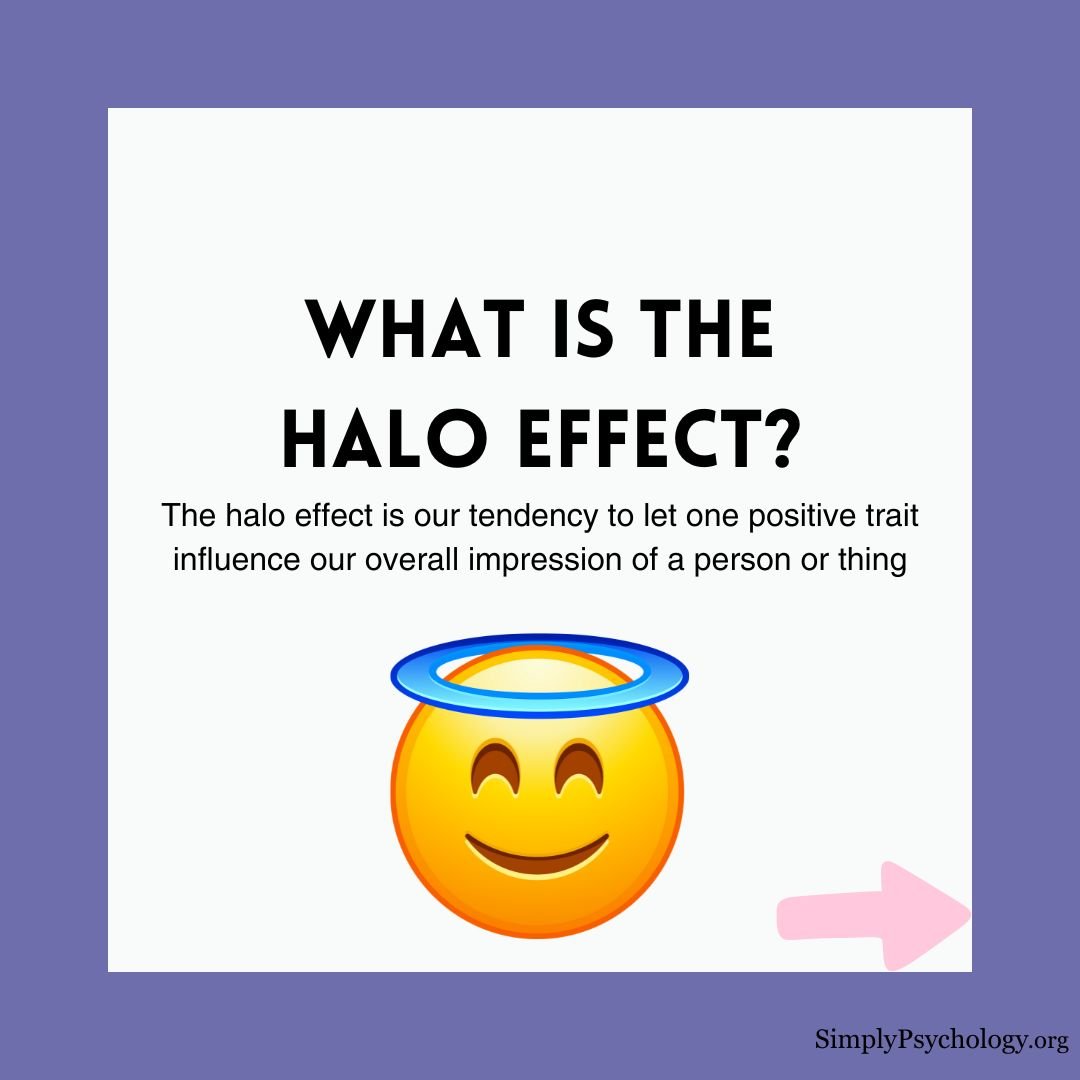
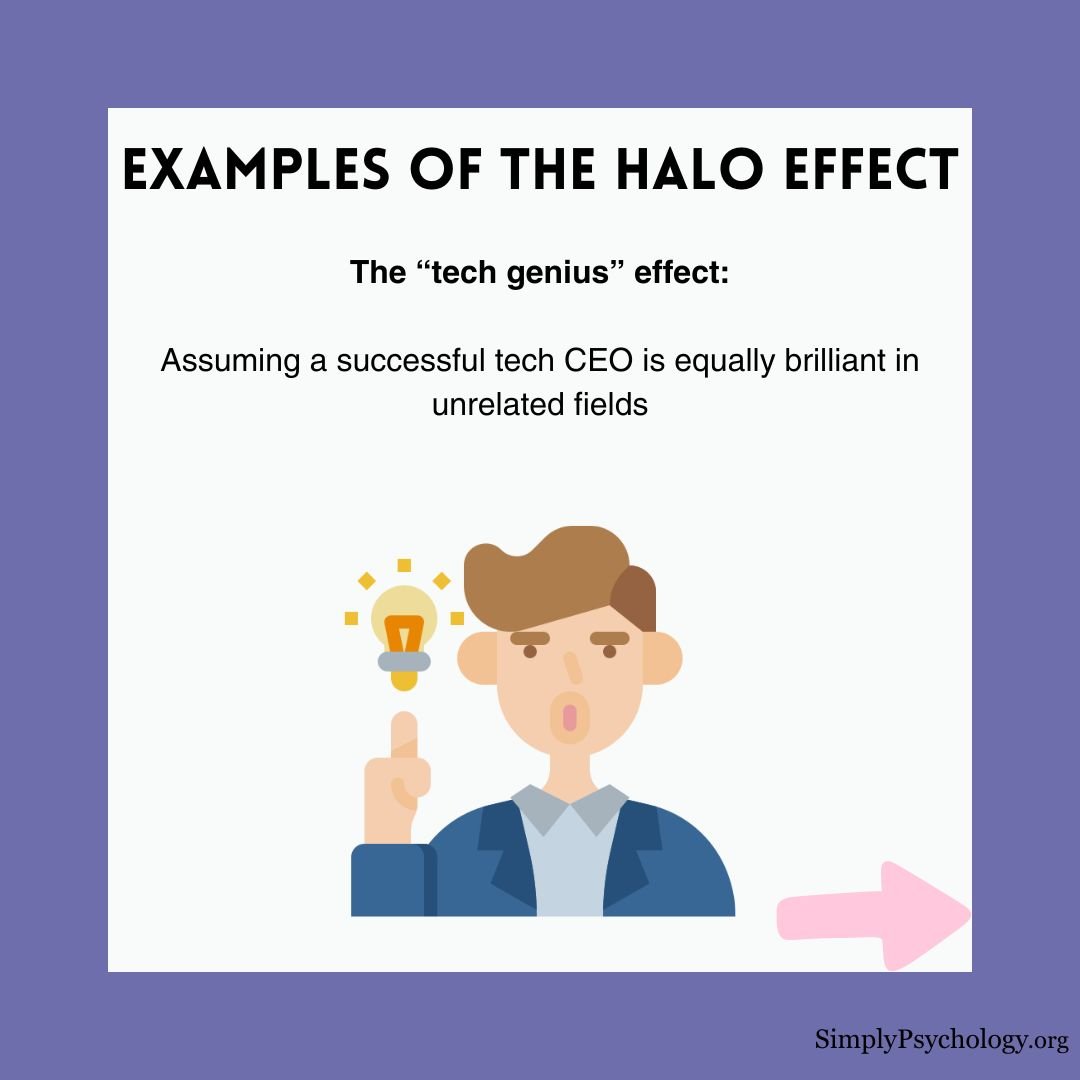
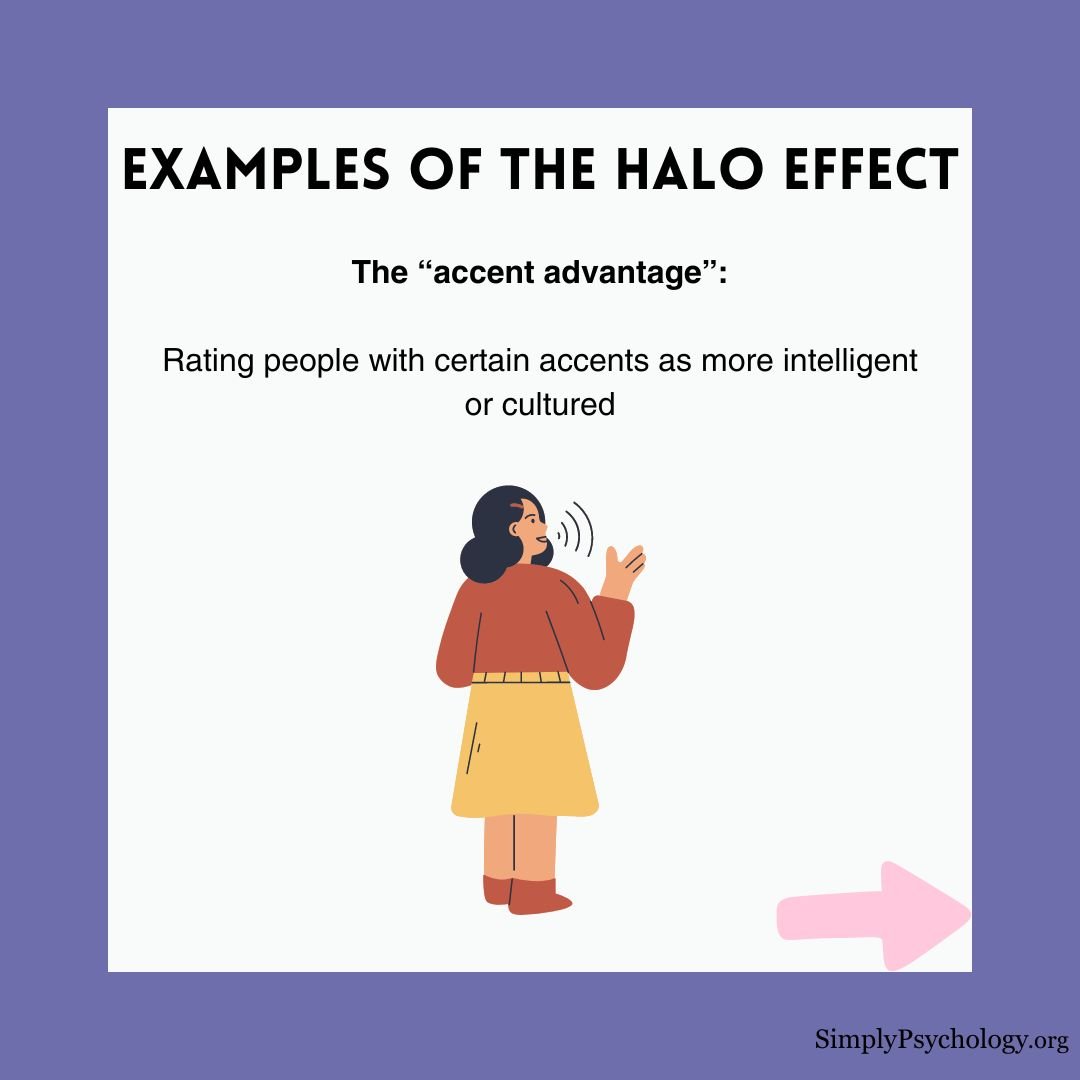
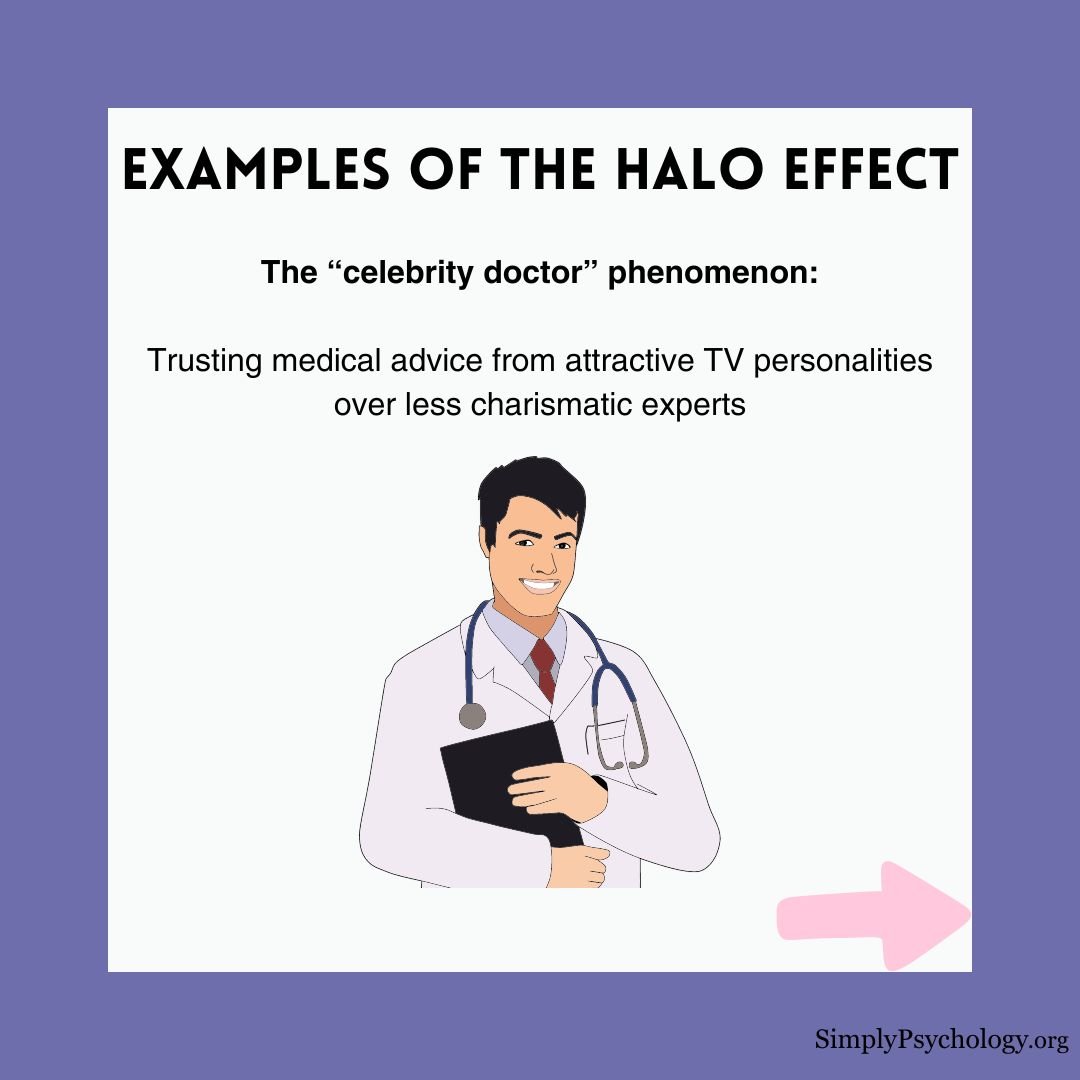
The halo effect refers to the tendency to allow one specific trait, or our overall impression of a person, company or product, to positively influence our judgment. That judgment then extends to their other, unrelated traits.

What Is the Halo Effect?
The halo effect is a cognitive bias: one specific trait, or an overall impression of a person, gets applied to unrelated traits without evidence (Ries, 2006). Suppose you perceive someone as warm and friendly.
You will then assume other traits about them, such as generosity, with no real knowledge that they are true.
The term borrows from religious art. A halo is a circle of light placed above or around the head of a holy figure, honouring their sanctity. Countless Middle Ages and Renaissance paintings depict notable figures this way, and the imagery leads viewers to judge those figures favourably.
The halo effect works the same way. One obvious trait leads an observer to a broader, unfounded conclusion about the whole person (Ellis, 2018). A single positive quality can create a positive predisposition toward every other aspect of that person.
One negative attribute can do the reverse. The positive version is the halo effect; the negative version, covered later, is the horn effect.
Examples
One classic study explains why attractiveness travels so far into unrelated judgements. It is the most-cited demonstration of the effect.
Aim: Dion, Berscheid and Walster (1972) tested whether physical attractiveness triggers a halo. They asked whether good-looking individuals are also assumed to have better personalities and life prospects.
Method: Participants were shown photographs of people pre-rated as attractive, average or unattractive. They judged each person’s traits.
They also predicted marital happiness, career success and overall life satisfaction.
Results: Attractive people were credited with more desirable personalities, such as being kinder and more interesting. They were also expected to have happier marriages and more prestigious jobs. Few areas favoured the unattractive group.
Conclusion: Physical attractiveness sets off a broad halo: the “what is beautiful is good” stereotype. One visible trait inflates judgements of unrelated qualities, and even predictions about a stranger’s future.
In the Classroom
In the classroom, teachers are prone to the halo effect error when evaluating their students. A teacher might assume a well-behaved student is also bright and motivated. That judgement often comes first.
It arrives before they have objectively evaluated the student’s actual ability. Clifford and Walster (1973) found that teachers develop expectations for a child partly from appearance, not just the school record.
Teachers were shown a child’s report card together with a photo of an attractive or unattractive child. Every teacher saw identical academic information.
Attractiveness still shaped their judgement. The teachers’ expectations for the child’s future, peer relationships and academic potential were all significantly linked to how attractive the child appeared.
Hernández-Julián and Peters (2017) tested a modern parallel: grading in traditional face-to-face classes against anonymously graded online courses, where instructors could not see the students.
Attractive students earned higher grades in person. That attractiveness premium disappeared once grading was anonymous online, showing that blind marking removes the bias rather than students’ underlying ability changing.
In the Workplace
A study by Parrett (2015) examined the impact of beauty on earnings based on the tipping data of restaurants in Virginia. He discovered that more attractive servers earned in tips nearly $1261 more annually than their unattractive counterparts.
The primary explanation stemmed from female customers’ tipping the better-looking females more than they did the unattractive females. The customer taste-based discrimination herein mattered more for females than for males.
Judge, Hurst and Simon (2009) found that physical attractiveness affects income both directly and indirectly, partly through education and people’s own self-evaluations.
Academics and Intelligence
Landy and Sigall (1974) tested the halo effect in academic grading. Sixty male undergraduates evaluated an essay supposedly written by a first-year female student, in either a well-written or a poorly-written version.
Twenty raters saw a photo of an unattractive author, 20 saw an attractive author, and 20 saw no photo. Each rated the prose quality and the writer’s competence.
Attractive authors were rated most favourably; unattractive authors, least favourably. The gap was largest for the poorly-written essay.
Male readers, in other words, forgave weak writing more readily when the author was attractive.
Moore, Filippou and Perrett (2011) asked a different question: do faces carry a genuine cue to intelligence, separate from attractiveness?
From over 300 British college students’ photos, the researchers built two composite faces: one from the highest-rated for perceived intelligence, one from the lowest. Each composite was split by sex.
Ninety-two male and 164 female raters then judged the composites for attractiveness and intelligence.
For the male composites, the high-intelligence face was rated notably more attractive than the low-intelligence face.
Both male and female raters agreed. It was also judged friendlier and funnier.
Intelligence, it seems, is itself a component of attractiveness in male faces.
On Sentencing for Crimes
A study by Michael G. Efran examined the effects of physical attractiveness on judgments of culpability and the severity of recommended sentences (Efran, 1974). Attractive criminals were likely to receive more lenient penalties than unattractive ones for the same crime.
According to the study, this discrepancy was accounted for by the societal perception that more attractive individuals have better future prospects.
However, another study on the same topic by Sigall and Ostrove demonstrated more nuanced evidence (Sigall & Ostrove, 1975).
The experiment evaluated a hypothetical burglary and a hypothetical swindle. The burglary involved a woman unlawfully procuring a key and embezzling $2200. The swindle involved a woman persuading a man to invest $2200 in a corporation that did not exist.
In the burglary (unrelated to the criminal’s attractiveness), the attractive defendant received a more lenient sentence than the unattractive one. However, in the swindle (wherein the crime was connected to the criminal’s attractiveness), the attractive defendant received the more severe sentence.
The customary leniency shown to attractive defendants was reversed once the crime itself involved their attractiveness.
The Health Halo
The halo effect also extends to consumer products, in what researchers call the health halo. A label such as “organic,” “low-fat,” “natural” or “gluten-free” makes a whole product seem healthier than the evidence supports.
One desirable-sounding attribute inflates judgements of the product’s calories, quality and healthiness, even when that inference is unwarranted. Shoppers under-estimate calories or over-consume. It is the “what is beautiful is good” logic applied to food rather than to people.
Research
The American psychologist Frederick L. Wells (1907) first identified the halo effect in a study of ratings of the literary merit of authors.
However, it was Edward Thorndike who first recognized it with empirical evidence. Thorndike was an early behaviorist who delved into the psychology of learning. He officially introduced the term ‘the halo error’ in 1920 in his article, “A Constant Error in Psychological Ratings”.
Thorndike described the halo effect as the bias whereby one aspect of a person shapes opinions of their other, unrelated qualities. He first used the term only for people, but its use has since expanded even to marketing.
In A Constant Error in Psychological Ratings, Thorndike (1920) sought to pin down this cognitive bias via replication.
He asked two commanding officers to rate their soldiers on four separate qualities:
- Intellect
- Physical qualities, such as voice, physique, energy, neatness and bearing
- Leadership skills
- Personal qualities, such as loyalty, selflessness, cooperation and dependability
The bias he suspected was confirmed, but it had nothing to do with attractiveness. Thorndike found that a single global impression, such as “this is a good soldier,” drove the ratings on every separate trait.
The correlations were striking. Physique correlated with character at .28, with intelligence at .31, and with leadership at .39.
A tendency to view a person as generally good or bad shaped every rating. Raters jumped to conclusions about a soldier’s other qualities from that first impression alone.
One high rating triggered a trend. A positive trait pulled every other rating upward; a negative trait pulled them all down.
A soldier’s ratings converged, whichever direction the initial trait pointed.
Halo Effect Experiment
One classic demonstration of the halo effect is Solomon Asch’s (1946) study of how a single trait can reorganise an entire impression of a person.
Aim: Asch tested whether we build impressions by adding up separate traits, or by organising them around a few dominant, central traits.
Method: Participants read a list of adjectives describing a hypothetical person, then rated that person on further traits. One group’s list included the word “warm”; an identical list for a second group swapped in “cold.” A further comparison swapped the peripheral pair “polite” and “blunt” instead.
Results: Changing “warm” to “cold” transformed the whole impression. The “warm” person was rated far more generous, happy, sociable and humorous, even though every other adjective stayed the same.
Swapping “polite” for “blunt” made little difference. Asch also found a primacy effect: the same adjectives produced a more favourable impression when the positive ones came first.
Conclusion: Impressions are not a simple sum of separate traits. Central traits like warm-cold organise the whole impression and spread to unrelated qualities, which is the process that drives the halo effect.
The Reverse Halo Effect
The horn effect is the halo effect’s mirror image: one negative trait unduly darkens the whole impression, so a single flaw overshadows real strengths.
The reverse halo effect, also called the horns effect, is a cognitive bias. A negative overall impression of a person darkens perception of their specific, unrelated traits. It is the opposite of the halo effect, where a positive impression leads to positive perceptions.
The reverse halo effect works the same way in miniature. Negative traits overshadow positive qualities, producing biased judgments and evaluations.
For instance, the horn effect may lead us to stereotype an overweight person as lazy. There is no evidence that morality is tied to appearance.
An experiment conducted by Joseph Forgas on 246 individuals bears this out. Participants first recalled a happy or sad event. They then read a philosophical essay attributed to a young female or an old male writer.
Those who had recalled sad events, and were therefore in a negative mood, rated the young female writer lower.
A negative mood seemed to reverse the halo effect.
Eagly et al.’s (1991) meta-analysis found the same pattern: the attractiveness stereotype is strongest for social traits and weaker for integrity (see Critical Evaluation, below).
As Sigall and Ostrove’s (1975) study noted above found, criminals who use their good looks to their advantage are more likely to receive harsher penalties than unattractive criminals.
Critical Evaluation
The halo effect is one of psychology’s most consistently replicated biases. Researchers still debate exactly how it works, how strong it is, and how to stop it.
A Robust, Century-Old Finding
The halo effect has replicated for more than a century. It runs from Wells’s (1907) ratings of literary merit and Thorndike’s (1920) study of military officers to modern findings on hiring, grading, marketing and the courtroom.
Eagly, Ashmore, Makhijani and Longo’s (1991) meta-analytic review confirmed this. The attractiveness stereotype is a reliable effect, not a one-study artefact.
Much of the classic evidence, though, comes from photographs or brief video clips rated under laboratory conditions. There, one cue is unusually salient. No competing information is available, and real, extended encounters give people richer, disconfirming information that can dilute an initial halo.
Field evidence helps settle how far the lab findings generalise. Studies of grading (Landy & Sigall, 1974), tipping (Parrett, 2015) and sentencing (Efran, 1974; Sigall & Ostrove, 1975) all show the bias surviving outside the laboratory. It is not merely a rating-scale artefact.
Contemporary Research
The classic evidence predates digital filters.
Aim: Gulati et al. (2024) tested whether an AI beauty filter that boosts only a face’s rated attractiveness also inflates ratings of its unrelated traits, intelligence and trustworthiness. They also asked whether the halo shrinks once a face is already artificially attractive.
Method: 2,748 participants rated facial images of 462 people in two versions: the original photo and the same photo after an AI beauty filter. Raters judged attractiveness alongside intelligence and trustworthiness for each image.
Results: The same faces scored higher on attractiveness, intelligence and trustworthiness once filtered. The halo was measurably weaker in the already-attractive condition than in the original photo.
Conclusion: Filters do not remove the bias. The attractiveness halo extends to digitally manufactured cues, not just natural photos, and inflates trust and intelligence ratings too. A face already rated highly has less room left for the halo to inflate further.
It Operates Outside Conscious Awareness
Aim: Nisbett and Wilson (1977) tested whether a global impression secretly changes judgements of a person’s specific traits. They asked whether people can even detect it happening.
Method: Students watched the same instructor on video. Half saw him behave warmly; half saw him behave coldly and distantly. Everyone then rated his appearance, mannerisms and accent, and said whether their overall liking had shaped those ratings.
Results: The warm version made his appearance, mannerisms and accent seem appealing. The cold version made the exact same features seem irritating. Almost no one noticed the real cause.
Conclusion: The halo effect works unconsciously. Good intentions are not enough to stop it, because people cannot reliably introspect on their own bias.
What Causes It? Competing Explanations
There is genuine debate about the mechanism behind the halo effect, and at least three accounts compete to explain it.
Asch’s (1946) configural account treats the halo as a by-product of forming one coherent impression. A central trait such as warm-cold reorganises the meaning of everything else and pulls unrelated judgements along with it.
A rival view is more elemental. It holds that people simply average the emotional tone of each piece of information they receive. A strongly positive item then drags the overall rating upward, regardless of any coherent story being told.
Two further accounts compete.
A third explanation invokes implicit personality theory: people carry stored, culturally shared beliefs about which traits go together, such as warmth with generosity (Schneider, 1973). Told that someone is warm, a perceiver looks up what warm people are usually like and supplies the rest without direct evidence.
Nisbett and Wilson’s (1977) unconscious-alteration finding adds a further ingredient. A global feeling can silently colour specific judgements without the perceiver noticing that any transfer has happened at all.
These accounts are not mutually exclusive. The halo effect may be produced by several of them operating together, which is one reason the bias is so hard to eliminate.
A Kernel of Truth, but a Bounded One
The halo effect is a bias, but not entirely fictional.
Moore, Filippou and Perrett (2011) built composite faces from over 300 British college students’ photos. They found a small, genuine link. Facial attractiveness weakly predicted measured intelligence.
People’s assumed link between looks and intelligence, though, is far stronger than this real one. The bias exaggerates a weak, genuine relationship into a confident, sweeping inference. That is exactly what makes it misleading rather than simply false.
The bias is also not uniform across judgements.
Eagly et al. (1991) showed it is strongest for social competence, such as being seen as more sociable and popular. It is much weaker for integrity, so “beautiful is good” really means “beautiful is socially good.”
Culture matters too.
The stereotype’s content also shifts across cultures. Comparing Korean and North American raters, Wheeler and Kim (1997) found that collectivist participants did not credit attractive people with greater potency, the trait North American samples reliably inflate.
They did credit them with greater integrity and concern for others, the reverse of the North American pattern. Stereotyping by appearance looks close to universal, but what a culture treats as “good” determines which specific traits the halo inflates (Wheeler & Kim, 1997).
The bias is bounded in direction too.
Sigall and Ostrove (1975) showed it can even flip into a penalty. Attractiveness earned leniency for a burglary unconnected to looks, but a harsher sentence once the crime looked like it exploited that same attractiveness.
Reducing the Bias
Because the halo effect operates largely outside conscious awareness (Nisbett & Wilson, 1977), willpower alone rarely stops it. Good intentions are not enough either.
The safeguards that work change how a judgement is made, not how hard the judge tries.
Structured, criterion-based rating scales spell out what each dimension means, rather than asking for one overall impression. That makes it harder for a single trait to drag every score the same way. More raters help too. Multiple independent raters, averaged together, dilute any one person’s halo.
Blind or anonymised evaluation removes the triggering cue altogether.
Hernández-Julián and Peters’s (2017) comparison of face-to-face and anonymously graded online courses found the attractiveness premium in grades disappeared once instructors could not see the students.
The common thread is decomposition. One global rating gets broken into separate, evidence-based judgements on each dimension, so a single impression cannot silently carry over into all the others.
Key Takeaways
- What It Is: The halo effect is a cognitive bias where a global impression of a person, good or bad, biases judgements of their specific, unrelated traits.
- Named by Thorndike: Edward Thorndike first demonstrated it in 1920, finding that military officers’ ratings of soldiers on separate traits were implausibly intercorrelated.
- Attractiveness Bias: The “what is beautiful is good” stereotype leads people to assume good-looking individuals also have more desirable personalities and better prospects (Dion et al., 1972).
- It Works Unconsciously: People show the bias yet cannot detect that a global impression shaped their specific judgements (Nisbett & Wilson, 1977).
- Wide-Ranging Consequences: It affects hiring, grading, marketing and courtroom decisions, and structured, criterion-based judgement is the best defence against it.
- Bounded, Not Universal: The halo can flip into a penalty when an attractive trait looks like it helped someone do wrong (Sigall & Ostrove, 1975), and it is stronger for some traits than others.
- The Horn Effect: Its mirror image, where one negative trait darkens the whole impression, is called the horn effect (or reverse-halo effect).
FAQs
What is the halo effect?
The halo effect refers to the cognitive bias where positive attributes or qualities in one aspect of a person (such as physical attractiveness) influence the perception of their other traits (such as intelligence or kindness). This occurs even without evidence supporting those assumptions.
What is the halo effect in organizational behavior?
The halo effect bias can influence how individuals are perceived and evaluated in the workplace, leading to unfair judgments and decisions. The halo effect can impact various aspects of organizational behavior, including performance appraisals, hiring decisions, and promotions.
What is the difference between stereotype and halo effect?
The main difference between stereotype and halo effect is the scope of application. Stereotype refers to a general perception or belief about a group of people based on their shared characteristics.
It is a broad generalization that may not apply to every individual within the group. On the other hand, halo effect is a cognitive bias that affects the perception of individuals, focusing on one positive or negative characteristic to form an overall impression, regardless of their group membership.
References
Asch, S. E. (1946). Forming impressions of personality. The Journal of Abnormal and Social Psychology, 41(3), 258.
Clifford, M. M., & Walster, E. (1973). The effect of physical attractiveness on teacher expectations. Sociology of education, 248-258.
Dion, K., Berscheid, E., & Walster, E. (1972). What is beautiful is good. Journal of Personality and Social Psychology, 24 (3), 285-290.
Eagly, A. H., Ashmore, R. D., Makhijani, M. G., & Longo, L. C. (1991). What is beautiful is good, but…: A meta-analytic review of research on the physical attractiveness stereotype. Psychological bulletin, 110 (1), 109.
Efran, M. G. (1974). The effect of physical appearance on the judgment of guilt, interpersonal attraction, and severity of recommended punishment in a simulated jury task. Journal of Research in Personality, 8 (1), 45-54.
Ellis, G. (Ed.). (2018). Cognitive Biases in Visualizations. New York, NY, USA: Springer.
Gulati, A., Martínez-García, M., Fernández, D., Lozano, M. A., Lepri, B., & Oliver, N. (2024). What is beautiful is still good: The attractiveness halo effect in the era of beauty filters. Royal Society Open Science, 11(11), 240882. https://doi.org/10.1098/rsos.240882
Hernández-Julián, R., & Peters, C. (2017). Student appearance and academic performance. Journal of Human Capital, 11 (2), 247-262.
Judge, T. A., Hurst, C., & Simon, L. S. (2009). Does it pay to be smart, attractive, or confident (or all three)? Relationships among general mental ability, physical attractiveness, core self-evaluations, and income. Journal of Applied Psychology, 94 (3), 742.
Landy, D., & Sigall, H. (1974). Beauty is talent: Task evaluation as a function of the performer’s physical attractiveness. Journal of Personality and Social Psychology, 29(3), 299.
Moore, F. R., Filippou, D., & Perrett, D. I. (2011). Intelligence and attractiveness in the face: Beyond the attractiveness halo effect. Journal of Evolutionary Psychology, 9 (3), 205-217.
Nisbett, R. E., & Wilson, T. D. (1977). The halo effect: Evidence for unconscious alteration of judgments. Journal of Personality and Social Psychology, 35 (4), 250-256.
Parrett, M. (2015). Beauty and the feast: Examining the effect of beauty on earnings using restaurant tipping data. Journal of Economic Psychology, 49, 34-46.
Ries, A. (2006). Understanding marketing psychology and the halo effect. Advertising Age, 17.
Rosenthal, R., & Jacobson, L. (1968). Pygmalion in the classroom. The Urban Review, 3 (1), 16-20.
Schneider, D. J. (1973). Implicit personality theory: A review. Psychological Bulletin, 79(5), 294–309. https://doi.org/10.1037/h0034496
Sigall, H., & Ostrove, N. (1975). Beautiful but dangerous: effects of offender attractiveness and nature of the crime on juridic judgment. Journal of Personality and Social Psychology, 31 (3), 410.
Thorndike, E. L. (1920). A constant error in psychological ratings. Journal of applied psychology, 4 (1), 25-29.
Wells, F. L. (1907). A Statistical Study of Literary Merit. (Columbia Univ. Cont. to Phil. & Psych., 16, 3.). Archives of Psychology.
Wheeler, L., & Kim, Y. (1997). What is beautiful is culturally good: The physical attractiveness stereotype has different content in collectivist cultures. Personality and Social Psychology Bulletin, 23(8), 795–800. https://doi.org/10.1177/0146167297238001