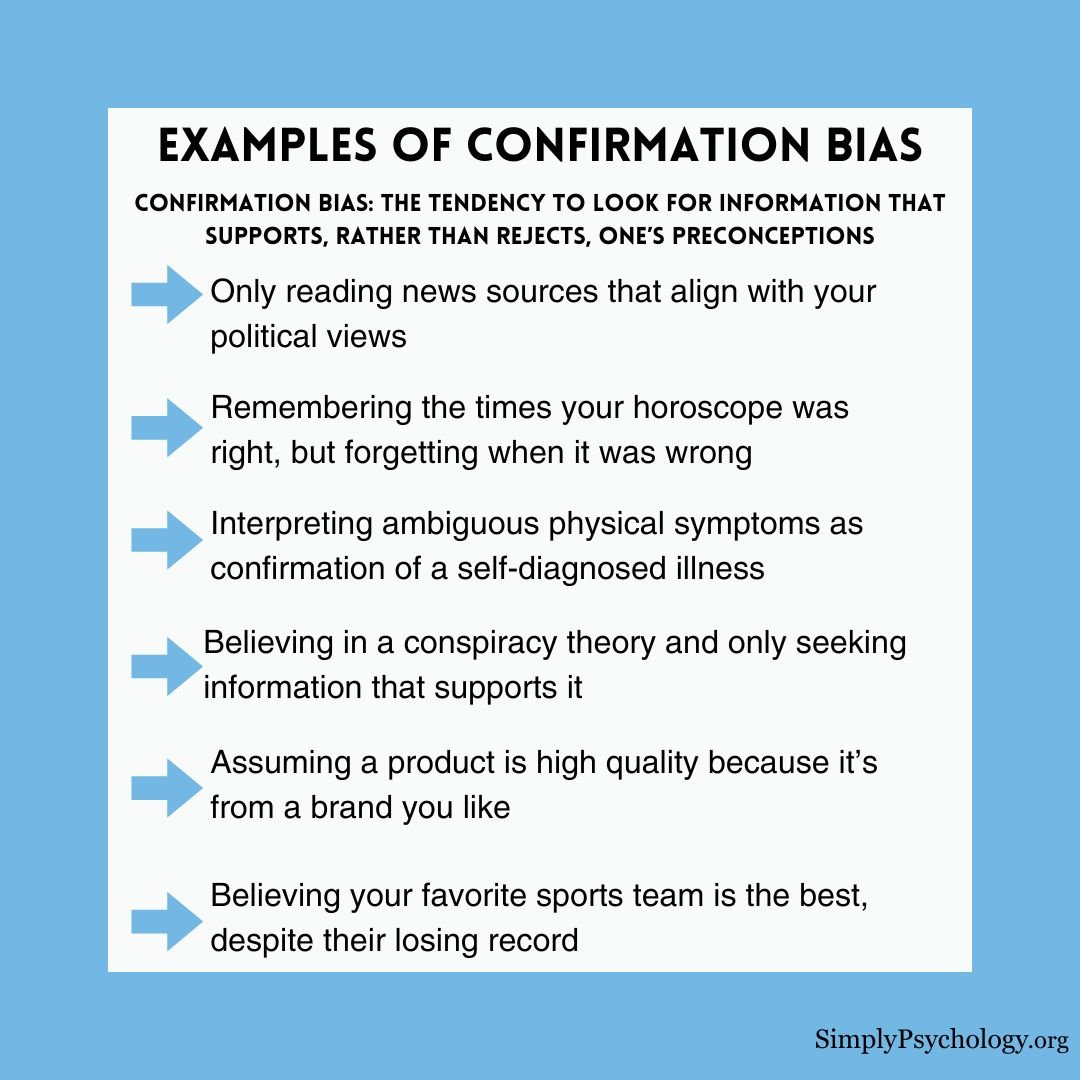
Confirmation bias is the tendency to look for information that supports, rather than rejects, one’s preconceptions (American Psychological Association). People with this bias interpret evidence to confirm their existing beliefs while rejecting or ignoring anything that conflicts with them.
One of the earliest demonstrations of confirmation bias appeared in an experiment by Peter Wason (1960). Participants had to discover the experimenter’s rule for sequencing numbers.
Participants mostly tested hypotheses with triples that fit them. They rarely tried a triple that could prove them wrong. Only 6 of 29 named the correct rule without first announcing a wrong one (Wason, 1960).
Evidence of confirmation bias has appeared throughout psychological literature for a long time. The term itself is more recent: researchers first used ‘confirmation bias’ in a 1977 paper on scientific inference (Mynatt, Doherty, & Tweney, 1977).
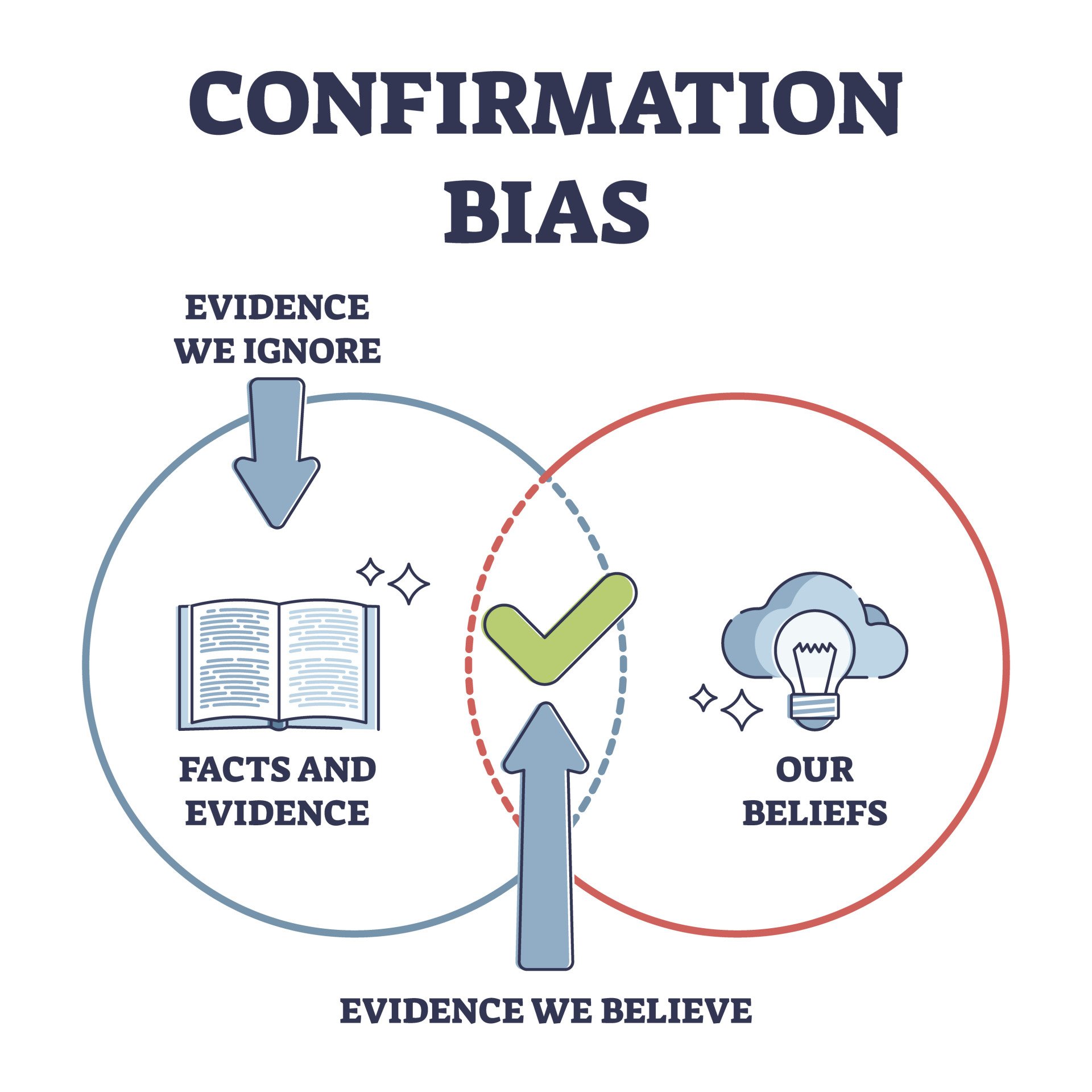
Types of Confirmation Bias
Biased Search for Information
This type of confirmation bias explains people’s search for evidence in a one-sided way to support their hypotheses or theories.
Experiments show that people design tests and questions to yield “yes” when their favored hypothesis is true. They tend to ignore alternative hypotheses that would give the same result.
This is the congruence heuristic (Baron, 2000, p.162-64). Preference for affirmative questions may not itself be biased. Even so, experiments show that congruence bias does exist.
For Example:
If you were to search “Are cats better than dogs?” in Google, all you would get are sites listing the reasons why cats are better.
However, if you were to search “Are dogs better than cats?” google will only provide you with sites that believe dogs are better than cats.
This shows that phrasing questions in a one-sided way (i.e., affirmative manner) will assist you in obtaining evidence consistent with your hypothesis.
In Conversation: Snyder and Swann (1978)
Snyder and Swann (1978) showed that the same search bias shapes social interaction. Participants interviewed another person to test whether that person was an extravert, or, in another condition, an introvert.
Interviewers chose questions whose answers would confirm the trait. Those testing for extraversion asked, “What would you do to liven up a party?” Those testing for introversion asked, “What factors make it hard to open up to people?”
Such questions draw out trait-consistent answers whatever the person is really like. The interviewers therefore came away with their hypothesis seemingly confirmed. The search had manufactured its own evidence.
A Classic Test: Wason’s 2-4-6 Task
Peter Wason (1960) devised the first experimental test of this tendency.
- Aim: To test whether people try to disprove a working hypothesis or keep seeking evidence that confirms it.
- Method: Participants were told that 2-4-6 fitted a hidden rule. They proposed their own triples, and the experimenter said only whether each one fitted.
- Results: Participants typically guessed “even numbers ascending by two” and tested triples that fit it, such as 8-10-12. Only 6 of 29 named the correct rule without first announcing a wrong one.
- Conclusion: The true rule was “any three numbers in ascending order,” so confirming tests could never expose the error. Left alone, people seek confirmation rather than disproof.
Critics note that Wason’s rule was unusually broad, a point developed under Critical Evaluation below.
A Classic Test: The Wason Selection Task
Peter Wason (1968) tightened the test.
- Aim: To see whether people spontaneously test a rule by trying to disprove it, not just confirm it.
- Method: Four cards showed A, K, 4 and 7, each with a letter on one side and a number on the other. Participants had to say which cards to turn over to test the rule “if a vowel, then an even number.”
- Results: Most people correctly chose A, but also chose 4, which can only confirm the rule. Very few chose 7, the only card that could disprove it, and only about 10% got it fully right.
- Conclusion: People overwhelmingly reach for evidence that could confirm a rule, not evidence that could break it. It’s the same positive-test pattern seen above.
Some researchers read these card choices as rational rather than biased, as the Critical Evaluation section explains.
Biased Interpretation
This type of bias explains that people interpret evidence concerning their existing beliefs by evaluating confirming evidence differently than evidence that challenges their preconceptions.
Various experiments show that people rarely change their beliefs on complex issues, even after seeing new research. The reason lies in how they interpret the evidence.
People accept “confirming” evidence readily and at face value. They scrutinize “disconfirming” evidence and explain it away.
Taber and Lodge (2006) called this asymmetric skepticism disconfirmation bias. People spend far more effort rebutting arguments that threaten their position than arguments that support it.
When provided with the same evidence, people’s interpretations could still be biased.
For example:
Biased interpretation is shown in an experiment conducted by Stanford University on the topic of capital punishment. It included participants who were in support of and others who were against capital punishment.
All subjects were provided with the same two studies.
One study appeared to show that the death penalty deters crime, and the other that it does not. Both sides rated the study that agreed with their view as well conducted and convincing. They dismissed the opposing study as flawed (Lord, Ross, & Lepper, 1979).
The result was attitude polarisation. After reading identical, balanced evidence, the two camps ended up further apart than before.
Biased Memory
To confirm their current beliefs, people may remember/recall information selectively. Psychological theories vary in defining memory bias.
Some theories state that information confirming prior beliefs is stored in the memory while contradictory evidence is not (i.e., schema theory). Some others claim that striking information is remembered best (i.e., humor effect).
Memory bias also helps maintain stereotypes.
Experiments have shown that the mental association between expectancy-confirming information and the group label strongly affects recall and recognition memory.
A stereotype about a social group might not be true for a given individual. Even so, people tend to remember stereotype-consistent information better than any evidence that disconfirms it (Fyock & Stangor, 1994).
For example:
In one study, participants read a woman’s profile detailing both extroverted and introverted traits. They then assessed her suitability for a job as either a librarian or a real-estate salesperson.
Those assessing her as a salesperson better recalled extroverted traits, while the other group recalled more examples of introversion (Snyder & Cantor, 1979).
These experiments, along with others, offer insight into selective memory. They show that people search for, and better remember, evidence that confirms what they already believe.
Examples of Confirmation Bias
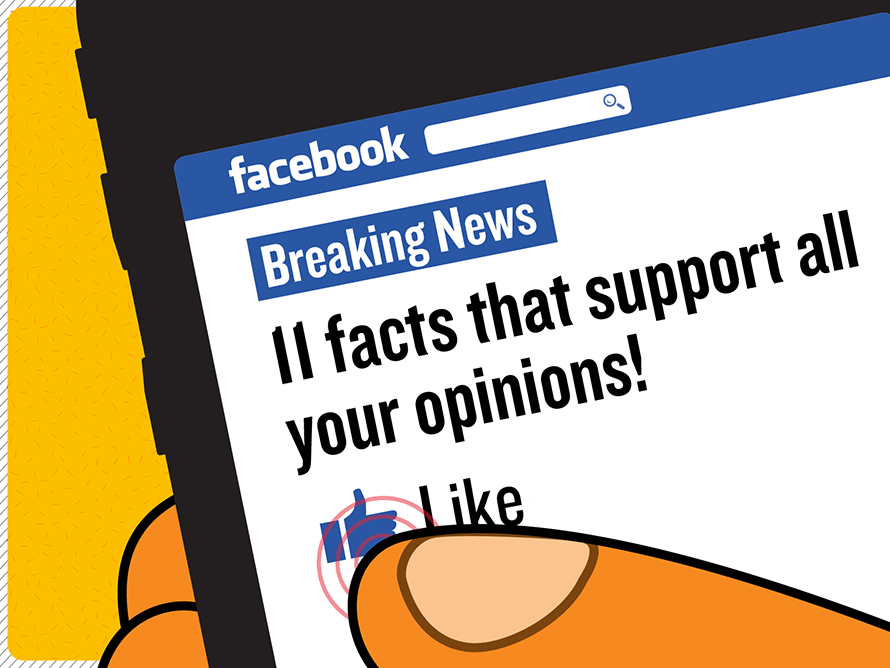
Social Media
Information on social media reflects both what users want to see and the platform designers’ own beliefs and values. Today, people face an overwhelming number of news sources, each varying in credibility.
People tend to read news that suits their views. News channels often cover the same issue differently, and some rely on sensational headlines and one-sided information. Racism and party politics are two examples.
Due to the biased coverage of topics, people only utilize certain channels/sites to obtain their information to make biased conclusions.
Religious Faith
People also tend to search for and interpret evidence with respect to their religious beliefs (if any).
On topics such as abortion and transgender rights, people whose religion opposes them interpret information differently from others. They look for evidence that validates what they already believe.
Similarly, those who religiously reject the theory of evolution will either gather information disproving evolution or hold no official stance on the topic.
Irreligious people may see the same events differently. What religious people call “miracles” or “tests of faith,” they may read as reinforcement of their own lack of belief.
Science, Medicine, Law and Finance
Confirmation bias also distorts high-stakes professional judgments. In every field below, an early belief steers which evidence is collected and how it is read.
The remedy is the same each time: treat the early belief as a hypothesis to test, not a conclusion to defend. The four examples below show how this plays out in practice, in science, medicine, law and finance.
Science
The bias is the psychological opposite of good scientific method. Popper (1959) argued that confirming instances can never prove a hypothesis, but a single counter-instance can disprove it.
Science should therefore proceed by bold conjecture and rigorous attempts at falsification. Controlled experiments, blinding, pre-registration and independent replication exist to force the disconfirming tests that individual reasoners avoid.
Medicine
A clinician who fixes on an early diagnosis may order tests that confirm it. Ambiguous findings get read as consistent with it. Data pointing elsewhere are discounted.
This links to premature closure and anchoring on a first impression. The antidote is to treat the working diagnosis as a hypothesis. Ask what else could explain the symptoms. Cognitive behavioral therapy trains patients to treat their own negative thoughts the same way.
Law
A detective who decides early that a suspect is guilty may attend mainly to incriminating evidence. Exonerating facts get overlooked or reinterpreted. This “forensic confirmation bias” can cause tunnel vision and wrongful conviction.
It can also contaminate forensic and eyewitness evidence. Knowing the expected answer can shape how an examiner reads an ambiguous fingerprint, or how a witness’s memory is reconstructed.
Finance
Investors tend to seek information confirming a prior conviction about a stock. They discount warning signs. This can sustain overconfidence in a failing position and lead to poorly timed decisions.
Why Confirmation Bias Occurs
Several explanations account for confirmation bias. It is an efficient way to process information, it protects self-esteem, and it minimizes cognitive dissonance, the discomfort of holding two conflicting beliefs (Festinger, 1957).
Information Processing
Confirmation bias serves as an efficient way to process information because of the limitless information humans are exposed to.
To form an unbiased decision, one would have to critically evaluate every piece of information present, which is unfeasible. Therefore, people only tend to look for information desired to form their conclusions (Casad, 2019).
One working hypothesis is cheaper to hold than several. Weighing evidence for competing hypotheses at once is demanding parallel processing, and the mind tends to avoid it.
Protect Self-esteem
People are susceptible to confirmation bias to protect their self-esteem (to know that their beliefs are accurate).
To make themselves feel confident, they tend to look for information that supports their existing beliefs (Casad, 2019).
This is a “hot” motivational route, not just a mental shortcut. Admitting that a cherished belief is wrong is uncomfortable.
Kunda (1990) called it motivated reasoning. When people want a particular conclusion, they search memory for beliefs and rules that would justify it. They must still build a justification that could persuade a neutral observer.
Disconfirmation bias fits this account. People work harder to rebut threatening evidence than supporting evidence (Taber & Lodge, 2006).
Minimize Cognitive Dissonance
Cognitive dissonance also explains why confirmation bias is adaptive.
Cognitive dissonance is a mental conflict that occurs when a person holds two contradictory beliefs and causes psychological stress or unease.
To minimize this dissonance, people adapt to confirmation bias by avoiding information that is contradictory to their views and seeking evidence confirming their beliefs.
Avoiding challenges and seeking reinforcement affect people’s thoughts and reactions differently. Disconfirming information triggers negative emotions, while reinforcing evidence does not (“The Confirmation Bias: Why People See What They Want to See”).
Dual-Process Theory and System 1
Psychologist Daniel Kahneman offers the most influential explanation for confirmation bias: dual-process theory. Two systems run the mind, he argues. A fast, automatic “System 1” handles most everyday thinking.
As Kahneman (2011) explains, System 1 builds the most coherent story it can from whatever information is active. He calls this tendency WYSIATI: “what you see is all there is.”
System 1 is primed to activate belief-consistent memories first. As Kahneman (2011) puts it, “the operations of associative memory contribute to a general confirmation bias.”
Doubting takes real effort. Kahneman (2011) puts it starkly: “System 1 is gullible and biased to believe, System 2 is in charge of doubting and unbelieving.” System 2, he adds, is often too busy or too lazy to check.
Even deliberate thought inherits the bias. As Kahneman (2011) explains, “a deliberate search for confirming evidence, known as positive test strategy, is also how System 2 tests a hypothesis.”
“Contrary to the rules of philosophers of science, who advise testing hypotheses by trying to refute them, people (and scientists, quite often) seek data that are likely to be compatible with the beliefs they currently hold.” (Kahneman, 2011)
On this account, confirmation bias is the default output of an efficient associative system that a lazy monitor rarely checks.
Implications of Confirmation Bias
Confirmation bias consistently shapes the way we look for and interpret information that influences our decisions in this society, ranging from homes to global platforms. This bias prevents people from gathering information objectively.
Politics
During the election campaign, people tend to look for information confirming their perspectives on different candidates while ignoring any information contradictory to their views.
This one-sided way of gathering information can breed overconfidence in a candidate. It can also cause voters to misread or overlook important facts, ultimately swaying their vote and the country’s leadership (Cherry, 2020).
Digital platforms intensify the pattern. Recommendation algorithms feed users more of the content they already engage with.
The result is echo chambers and filter bubbles, where people mostly meet views like their own. Disconfirming views are rarely seen, beliefs harden, and communities drift further apart.
Recruitment and Selection
Confirmation bias also affects employment diversity. Preconceived ideas about different social groups can introduce unconscious discrimination into the recruitment process (Agarwal, 2018).
A belief that one group is more competent than another helps explain why certain races and genders are over-represented in companies today. This bias can undermine a company’s efforts to diversify its workforce.
The bias works through the interview itself. A preconception about a candidate can shape which questions an interviewer asks and how the answers are read.
The same applies beyond hiring. Once we form a view of a person, we notice behaviour that fits it and explain away behaviour that does not.
Mitigating Confirmation Bias
Question Your Sources and Habits
To avoid being susceptible to confirmation bias, start questioning your research methods, and sources used to obtain their information.
Expanding the types of sources used in searching for information could provide different aspects of a particular topic and offer levels of credibility.
- Read Fully: Read entire articles rather than forming conclusions from headlines and pictures.
- Verify Evidence: Search for credible evidence presented in the article itself.
- Check Sources: Track the source of a claim to judge how trustworthy it is.
- Stay Conscious: Encourage yourself and others to gather information deliberately, not passively.
Consider Alternative Hypotheses
Confirmation bias occurs when people look for information that confirms their beliefs or hypotheses. Considering alternative hypotheses and their consequences can help reduce it.
Considering the possibility of beliefs/hypotheses other than one’s own could help you gather information in a more dynamic manner (rather than a one-sided way).
The best-supported technique is to ask, “Why might my judgment be wrong?” Lord, Lepper, and Preston (1984) found that instructing people to consider the opposite reduced biased assimilation. Simply urging them to be unbiased did not.
You can also test a belief by looking for evidence that could refute it, and give real weight to sources that disagree with you.
Critical Evaluation
Confirmation bias is one of psychology’s most heavily replicated effects, but recent scholarship has qualified how it should be interpreted. Before looking at each qualification, here is a short summary:
- Positive Testing Is Often Rational: the classic reasoning tasks may conflate seeking confirmation with a testing strategy that is usually sensible.
- Card Choices May Be Rational: an information-gain model explains the usual selection-task choices without invoking a bias.
- Mild Bias Can Be Adaptive: committing to a working hypothesis brings useful cognitive stability, not just error.
- The Mechanism Is Contested: researchers still debate how much of the bias is cold processing versus hot motivation, and how far lab tasks generalize.
Positive Testing Is Often Rational
Klayman and Ha (1987) argued that Wason’s 2-4-6 task conflates two different things. Seeking confirmation is a goal. Using a positive-test strategy, checking cases you expect to be positive, is just a method.
In most real environments, a hypothesised category is narrower than the true category. Testing positive cases is then an efficient way to expose errors. That is the key insight.
Wason’s task is unusual because the true rule, “any ascending triple,” is maximally general. Positive tests of a narrower hypothesis can never disconfirm a rule that broad.
Under ordinary conditions, the same positive-test strategy would quickly reveal a wrong rule. Not Wason’s task, though. What the classic tasks expose may be less a flaw in human reasoning. It looks more like a mismatch between an adaptive heuristic and an artificially rigged task.
That reframing matters.
Rational Analysis of the Selection Task
Oaksford and Chater (1994) offered the strongest rival to a confirmation-bias reading of Wason’s selection task. Their idea was simple. They modeled it as an optimal data-selection problem rather than a processing defect.
Suppose a reasoner assumes that the property named in the rule, such as being a vowel, is rare among possible cards. Under standard Bayesian assumptions, the cards with the most expected information gain closely match the A and 4 cards.
The usual choices then look rational. They can emerge from an information-maximizing strategy applied to plausible real-world assumptions.
This is a genuine rival account, not a mere qualification. The two accounts disagree on whether the classic selection-task data need a bias explanation at all.
Adaptive and Ecological Accounts
Some theorists treat a mild bias toward a current best hypothesis as adaptive. Committing provisionally to a working model provides useful cognitive stability.
It also avoids the paralysis of constantly re-litigating settled beliefs. Verifying instances is usually cheaper to obtain than decisive falsifiers, so seeking confirmation can be a reasonable default.
Nickerson’s (1998) landmark review took a balanced position. It is genuinely widespread and consequential, he concluded. But positive-test behaviour is not always the error it is sometimes portrayed as.
This reading does not deny that confirmation bias is real. It simply argues that a mild pull toward one’s working hypothesis served people well historically. Confirming evidence was often the only evidence readily available. That is a genuine strength, not just a flaw.
Cognitive vs Motivational Debate
Researchers still debate the cause. Is it a “cold” cognitive limitation, a by-product of associative processing? Or a “hot” motivational defence of self-esteem and worldview? The evidence indicates both contribute, weighted by how personally invested a reasoner is.
Kahneman (2011) locates the cause in memory and attention. Kunda’s (1990) motivated-reasoning account argues that part of the effect is goal-directed instead. Reasoners unconsciously build a case for a desired conclusion to protect self-esteem or identity.
These are rival explanations for overlapping data. As Nickerson (1998) noted, the field has not settled which does more of the work, so most accounts treat them as complementary.
A further caution concerns the tasks themselves. Many demonstrations rely on artificial, single-shot laboratory problems, and the effect can shrink once reasoners get feedback and real-world experience.
Neither account alone tells the full story. A complete picture of confirmation bias needs both the cognitive shortcut and the motivational defence, weighted differently from person to person and topic to topic. Real-world judgement, backed by feedback and experience, may end up less biased than a single laboratory task suggests.
That is the honest, unresolved state of the debate.
Contemporary Research
A striking finding from this period concerns motivated numeracy: people with more numerical skill use it to defend their political identity.
- Aim: To test whether persistent public conflict over evidence reflects weak reasoning skills or identity-protective reasoning.
- Method: Participants solved a hard problem that required drawing causal inferences from data, and their numeracy was measured. The same numbers were presented as a skin-rash treatment study or as a gun-control ban study.
- Results: Higher numeracy helped on the skin-rash version. On the gun-control version, answers split along political lines and became less accurate, and the split grew among the most numerate.
- Conclusion: Skill did not protect against biased reading of identity-relevant data. The most numerate used their quantitative ability selectively to reach the politically congenial answer.
This overturns a common assumption: that biased reasoning is simply a skills deficit more education would fix. On divisive, identity-relevant questions, cognitive sophistication can serve confirmation rather than counter it (Kahan et al., 2017).
Related Cognitive Biases
Confirmation bias sits at the centre of a cluster of belief-preservation effects, and many other cognitive biases overlap with it. Four of the closest are covered below.
Backfire Effect
The backfire effect occurs when contradictory evidence strengthens a person’s preexisting beliefs (Nyhan & Reifler, 2010). Disproving a misconception can therefore entrench it.
One piece of disconfirming evidence does not change people’s views, but a constant flow of credible refutations could correct misinformation/misconceptions.
Backfire relates to confirmation bias. It describes how people react to new information through their preexisting hypotheses.
More recent, larger studies suggest the backfire effect is rarer and less robust than early research implied. Most people do update their views toward a correction, at least somewhat. Backfire is possible. It is not the routine outcome.
For example:
A study by Brendan Nyhan and Jason Reifler (two researchers on political misinformation) explored the effects of different types of statements on people’s beliefs.
They compared two statements: “I am not a Muslim, Obama says” and “I am a Christian, Obama says.” The second, affirming statement proved more persuasive and changed more people’s beliefs, suggesting affirming statements correct incorrect views more effectively than simple denials (Silverman, 2011).
Halo Effect
The halo effect occurs when people use impressions from a single trait to form conclusions about other unrelated attributes. It is heavily influenced by the first impression.
American psychologist Edward Thorndike pioneered research on this effect. In 1920, he described how officers rated soldiers on different traits based on first impressions alone (Thorndike, 1920).
Experiments have shown that when positive attributes are presented first, a person is judged more favorably than when negative traits are shown first. It relates to confirmation bias because it lets us structure our thinking about other information using only initial evidence.
Belief Perseverance
Belief perseverance is the tendency to cling to a belief even after the evidence that first supported it has been discredited. It sits alongside confirmation bias in a wider cluster of belief-preservation effects.
Confirmation bias helps keep a perseverant belief alive. Biased memory keeps supporting details easy to recall, while biased interpretation keeps explaining away each new piece of disconfirming evidence.
Psychologists see this as a natural extension of the same search, interpretation and memory biases already explained in this article. A belief rarely falls apart just because its original evidence quietly disappears.
This has practical consequences. A jury that formed an early impression of a defendant’s guilt, for instance, may keep discounting later evidence that points the other way.
That persistence is the whole point.
Myside Bias
Myside bias is a closely related term from the reasoning literature. It describes evaluating evidence, generating arguments, and testing hypotheses in ways that favour one’s own prior opinions.
Some researchers use myside bias as a near-synonym for the motivated, self-protective side of confirmation bias.
The two terms overlap heavily in practice. Where confirmation bias covers search, interpretation and memory together, myside bias puts the spotlight on argument and hypothesis generation specifically.
Either way, the underlying pull is the same. People build a case for what they already believe, rather than testing it fairly against the alternatives.
This matters because myside reasoning can look rigorous. A person marshals real evidence and logical-sounding arguments; the bias lies in which side they chose to defend.
Learning Check
When does the confirmation bias occur?
- When an individual only researches information that is consistent with personal beliefs.
- When an individual only makes a decision after all perspectives have been evaluated.
- When an individual becomes more confident in one’s judgments after researching alternative perspectives.
- When an individual believes that the odds of an event occurring increase if the event hasn’t occurred recently.
The correct answer is A. Confirmation bias occurs when an individual only researches information consistent with personal beliefs. This bias leads people to favor information that confirms their preconceptions or hypotheses, regardless of whether the information is true.
Key Takeaways
- Definition: Confirmation bias is the tendency to favour information that confirms existing beliefs or hypotheses.
- Uneven Weighting: People give more weight to evidence that confirms their beliefs and undervalue evidence that could disprove it.
- Three Mechanisms: The bias shows up in how people search for, interpret, and remember information.
- Emotional Stakes: The effect is stronger for emotionally charged issues and deeply entrenched beliefs.
- Not Always Irrational: Newer research shows highly numerate people also twist statistics to fit their politics (Kahan et al., 2017).
References
Agarwal, P., Dr. (2018, October 19). Here Is How Bias Can Affect Recruitment In Your Organisation. https://www.forbes.com/sites/pragyaagarwaleurope/2018/10/19/how-can-bias-during-interviewsaffect-recruitment-in-your-organisation
American Psychological Association. (n.d.). APA Dictionary of Psychology. https://dictionary.apa.org/confirmation-bias
Baron, J. (2000). Thinking and Deciding (Third ed.). Cambridge University Press.
Casad, B. (2019, October 09). Confirmation bias. https://www.britannica.com/science/confirmation-bias
Cherry, K. (2020, February 19). Why Do We Favor Information That Confirms Our Existing Beliefs? https://www.verywellmind.com/what-is-a-confirmation-bias-2795024
Festinger, L. (1957). A theory of cognitive dissonance. Stanford University Press.
Fyock, J., & Stangor, C. (1994). The role of memory biases in stereotype maintenance. British Journal of Social Psychology, 33 (3), 331–343. https://doi.org/10.1111/j.2044-8309.1994.tb01029.x
Kahan, D. M., Peters, E., Dawson, E. C., & Slovic, P. (2017). Motivated numeracy and enlightened self-government. Behavioural Public Policy, 1(1), 54–86. https://doi.org/10.1017/bpp.2016.2
Kahneman, D. (2011). Thinking, fast and slow. Farrar, Straus and Giroux.
Klayman, J., & Ha, Y.-W. (1987). Confirmation, disconfirmation, and information in hypothesis testing. Psychological Review, 94 (2), 211–228.
Kunda, Z. (1990). The case for motivated reasoning. Psychological Bulletin, 108(3), 480–498. https://doi.org/10.1037/0033-2909.108.3.480
Lord, C. G., Lepper, M. R., & Preston, E. (1984). Considering the opposite: A corrective strategy for social judgment. Journal of Personality and Social Psychology, 47(6), 1231–1243.
Lord, C. G., Ross, L., & Lepper, M. R. (1979). Biased assimilation and attitude polarization: The effects of prior theories on subsequently considered evidence. Journal of Personality and Social Psychology, 37(11), 2098–2109. https://doi.org/10.1037/0022-3514.37.11.2098
Mynatt, C. R., Doherty, M. E., & Tweney, R. D. (1977). Confirmation bias in a simulated research environment: An experimental study of scientific inference. Quarterly Journal of Experimental Psychology, 29(1), 85–95. https://doi.org/10.1080/00335557743000053
Nickerson, R. S. (1998). Confirmation bias: A ubiquitous phenomenon in many guises. Review of General Psychology, 2 (2), 175–220.
Nyhan, B., & Reifler, J. (2010). When corrections fail: The persistence of political misperceptions. Political Behavior, 32(2), 303–330. https://doi.org/10.1007/s11109-010-9112-2
Oaksford, M., & Chater, N. (1994). A rational analysis of the selection task as optimal data selection. Psychological Review, 101(4), 608–631. https://doi.org/10.1037/0033-295X.101.4.608
Popper, K. R. (1959). The logic of scientific discovery. Hutchinson.
Silverman, C. (2011, June 17). The Backfire Effect . https://archives.cjr.org/behind_the_news/the_backfire_effect.php
Snyder, M., & Cantor, N. (1979). Testing hypotheses about other people: The use of historical knowledge. Journal of Experimental Social Psychology, 15(4), 330–342. https://doi.org/10.1016/0022-1031(79)90042-8
Snyder, M., & Swann, W. B. (1978). Hypothesis-testing processes in social interaction. Journal of Personality and Social Psychology, 36(11), 1202–1212.
Taber, C. S., & Lodge, M. (2006). Motivated skepticism in the evaluation of political beliefs. American Journal of Political Science, 50(3), 755–769. https://doi.org/10.1111/j.1540-5907.2006.00214.x
Thorndike, E. L. (1920). A constant error in psychological ratings. Journal of Applied Psychology, 4(1), 25–29. https://doi.org/10.1037/h0071663
Wason, P. C. (1960). On the failure to eliminate hypotheses in a conceptual task. Quarterly Journal of Experimental Psychology, 12(3), 129–140. https://doi.org/10.1080/17470216008416717
Wason, P. C. (1968). Reasoning about a rule. Quarterly Journal of Experimental Psychology, 20(3), 273–281.
Further Information
- What Is Confirmation Bias and When Do People Actually Have It?
- Confirmation Bias: A Ubiquitous Phenomenon in Many Guises
- The importance of making assumptions: why confirmation is not necessarily a bias
- Decision Making Is Caused By Information Processing And Emotion: A Synthesis Of Two Approaches To Explain The Phenomenon Of Confirmation Bias
-
Memory Bias and Belief Bias May Share a Common Brain Mechanism