Cognitive distortions are habitual, inaccurate thought patterns that can lead people to interpret situations more negatively than they really are. These distorted thoughts often arise automatically, especially during stress, anxiety, or depression. They may reflect deeper beliefs about the self, others, or the world.

Aaron Beck first identified cognitive distortions in 1963 (Beck, 1963). He described them as illogical thinking processes that lead people with emotional disorders to misperceive reality.
His original list included arbitrary inference, concluding with little or no evidence, and selective abstraction, judging a whole situation by one detail. They echo jumping to conclusions and mental filtering below.
The discovery came out of his work developing cognitive therapy, the direct precursor to modern CBT.
These distortions are now common contributors to emotional distress.
While occasional distorted thinking is normal, repeated patterns can reinforce mental health challenges and interfere with well-being.
These distortions often develop as coping responses to difficult or prolonged life experiences, but over time, they can become rigid and harmful.
People may believe these thoughts without questioning their accuracy, leading to increased anxiety, low mood, and unhelpful behaviors.
Key Takeaways
- Definition: Cognitive distortions are automatic, unhelpful thoughts that worsen anxiety, depression, and low self-esteem.
- Common Types: There are 13 common types, including catastrophizing, mind reading, and black-and-white thinking.
- Causes: These patterns often stem from stress, trauma, or mental health conditions like OCD and ADHD.
- Treatment: CBT helps people recognize and reframe distorted thoughts using tools like thought records and Socratic questioning (guided questions that help you re-examine your own thinking).
- Self-Help: Strategies include labeling behavior, replacing extreme language, and spotting positive aspects.
- Evidence: CBT has the largest evidence base of any psychological therapy, though benefits vary by disorder and whether they are shrinking is contested.
1. Overgeneralization
Overgeneralization involves drawing sweeping negative conclusions based on a single event.
A person might assume one bad experience defines all future outcomes.
Example: After an awkward first day at a new job, someone may think, “I’ll never succeed here.”
Phrases like “always” or “never” often signal this pattern. It’s common in depression and anxiety, and can reinforce helplessness and low self-worth.
2. Mental Filtering
Mental filtering means focusing exclusively on the negative parts of a situation while ignoring the positive.
Example: After a great date, you fixate on a minor disagreement and remember the evening as a failure.
This tunnel vision can distort perception, feeding depression, anxiety, and low self-esteem.
3. Discounting the Positive
This distortion minimizes or dismisses positive experiences as unimportant or undeserved.
Example: You ace a job interview but assume, “They were just being nice.”
It’s common in low self-esteem and depression and prevents people from internalizing success or feeling capable.
4. Jumping to Conclusions
Jumping to conclusions means assuming negative outcomes without evidence. It includes:
- Mind reading: “She didn’t text back, so she must be mad at me.”
- Fortune-telling: “I’ll mess up this presentation even though I’ve done well before.”
These patterns heighten anxiety and avoidance, especially in social or performance situations.
5. Magnification and Minimization
This distortion exaggerates flaws and downplays strengths, often flipping reality.
Example: You obsess over a small mistake (“I failed completely”) while dismissing praise (“It wasn’t a big deal”).
It’s like looking through a distorted lens: magnifying the bad and minimizing the good. This distortion contributes to anxiety, shame, and avoidance.
6. Emotional Reasoning
Emotional reasoning assumes feelings are facts. If you feel something is true, you believe it must be.
Example: “I feel like a failure, so I must be one.”
This thinking style can fuel anxiety and depression by turning temporary emotions into fixed beliefs.
7. ‘Should’ and ‘Must’ Statements
This distortion imposes rigid expectations on yourself or others, often leading to guilt, frustration, or resentment.
Example: “I should never make mistakes” or “They must know better.”
When these expectations aren’t met, they can create internal pressure or conflict in relationships.
8. Labeling
Labeling means assigning global, negative identities to yourself or others based on specific actions.
Example: You spill coffee and think, “I’m such an idiot,” or someone ignores you once and you decide, “They’re rude.”
It oversimplifies people and situations, damaging self-esteem and relationships.
9. Personalization and Blame
Personalization involves blaming yourself for things beyond your control, while blame shifts all responsibility to others.
Example: “It’s my fault the team failed,” even if others contributed.
This thinking is common after trauma or in depression, and it fosters guilt, shame, or resentment.
10. Catastrophizing
Catastrophizing is when you imagine the worst-case scenario, no matter how unlikely.
Example: You hear a noise at night and immediately think, “Someone’s breaking in.”
This distortion escalates fear and stress, especially in those with anxiety disorders.
11. Black-and-White Thinking (All-or-Nothing)
This thinking sees situations in extremes: success or failure, good or bad, with no in-between.
Example: A student who doesn’t get straight As thinks, “I’m a total failure.”
It leads to perfectionism, low resilience, and a distorted view of reality.
12. Mind Reading
Mind reading involves assuming you know what others are thinking, usually in a negative way, without any real evidence.
Example: A friend checks their phone while you’re talking, and you think, “They must find me boring.” They might just be waiting for a message.
It’s common in anxiety and can lead to misinterpreting others’ behavior, fueling unnecessary worry and self-doubt.
13. Predictive Thinking
Predictive thinking means expecting the worst about future events, often despite past success.
Example: Before a first date, you think, “It will go badly,” even though your last few dates went fine.
This distortion often appears in anxiety disorders and can lead to avoidance and heightened stress, reinforcing the fear cycle.
Why Do I Have Cognitive Distortions?
Cognitive distortions are common, automatic thinking patterns that can develop in response to stress, mental health conditions, or past experiences.
While everyone experiences distorted thoughts at times, certain conditions make them more frequent or intense.
Cognitive distortions sit between two other layers of thinking.
- Automatic thoughts: the fast, involuntary reactions to daily events that appear on the surface.
- Cognitive distortions: the errors of reasoning that make those automatic thoughts feel true.
- Core beliefs: deep assumptions about the self and the world formed early in life, such as “I am unlovable” or “the world is dangerous” (Beck, 1967).
A distortion often activates when a situation touches one of these older beliefs. CBT usually starts with the automatic thoughts and works downward toward the core beliefs.
Here’s how different factors can contribute:
Anxiety and Depression
These conditions often fuel and are fueled by cognitive distortions.
- In anxiety disorders, distortions like catastrophizing (“What if the worst happens?”) or mind reading (“They must be judging me”) amplify fear and avoidance.
- In depression, patterns like all-or-nothing thinking or discounting the positive reinforce feelings of failure, hopelessness, and low self-worth.
Beck (1976) showed that each disorder has its own characteristic thinking. Depression centers on loss and worthlessness, anxiety on threat and danger, and panic on catastrophic misreadings of bodily sensations.
Obsessive-Compulsive Disorder (OCD)
While not a formal symptom, distorted thinking is deeply involved in OCD.
People with OCD may overestimate danger, fear uncertainty, or believe their thoughts can cause harm (known as thought-action fusion).
These distortions drive obsessions and compulsions aimed at regaining control or certainty.
CBT for OCD therefore combines two things. Exposure and response prevention (ERP) means confronting a trigger without performing the compulsion. Cognitive work then targets inflated responsibility and the over-importance of thoughts.
Trauma and PTSD
Traumatic experiences can lead to lasting cognitive distortions.
For example, a person might develop beliefs like “I’m not safe” or “It was all my fault.”
These thoughts often become automatic and persist long after the trauma, reinforcing fear, guilt, or hypervigilance.
Trauma-focused CBT targets these beliefs directly. It pairs cognitive restructuring of beliefs about danger, guilt, and self-blame with exposure to the trauma memory. A closely related form is cognitive processing therapy.
ADHD (Attention-Deficit/Hyperactivity Disorder)
ADHD doesn’t cause cognitive distortions directly, but it can contribute through repeated challenges with focus, follow-through, and emotional regulation.
Many people with ADHD develop beliefs like “I’m lazy” or “I always mess things up.”
These distortions often stem from years of frustration or negative feedback, and can intensify shame, anxiety, or perfectionism.
A 2026 study adds detail. It found ADHD traits linked to two kinds of unhelpful thought in emerging adults. One was ordinary negative automatic thoughts, such as “it’s pointless.” The other was overly positive thinking that excuses procrastination: “I work better closer to the deadline” (Pickel & Wymbs, 2026).
Both links held after accounting for depression and anxiety. They ran mainly through deeper beliefs. A belief of insufficient self-control was tied to both kinds of thought. A belief of failing to achieve was tied to the negative thoughts only. This fits the layered model above.
Cognitive distortions often reflect learned ways of interpreting the world. Stress, trauma, and unmet needs shape them most.
Consequences of Cognitive Distortions
Cognitive distortions can quietly shape how we see ourselves, others, and the world, often with real-life consequences.
Relationships, Decisions, and Social Media
Distorted thinking affects three everyday areas:
- Relationships: Distortions fuel conflict, miscommunication, and emotional reactivity. Mind reading or “should” statements can create tension, especially in codependent or insecure attachment patterns.
- Decisions: Jumping to conclusions or catastrophizing may lead to impulsive choices, avoidance, or missed opportunities.
- Social media: It can amplify distortions like comparison and labeling, increasing anxiety, self-doubt, and unrealistic expectations.
Anxiety, Depression, and Self-Esteem
In anxiety, especially generalized anxiety disorder (GAD), distortions such as threat appraisal, intolerance of uncertainty, and catastrophic thinking drive excessive worry. They also encourage safety behaviors. These are small protective acts that keep you from testing the fear.
Similarly, in depression, distortions align with Beck’s cognitive triad: viewing the self, world, and future negatively.
They contribute to low mood, rumination, and feelings of hopelessness or anhedonia.
The cycle is self-maintaining.
Which comes first is contested. Longitudinal evidence has questioned whether depressive thoughts come before low mood or follow it (Lewinsohn et al., 1981). Depression itself distorts thinking. So the link probably runs both ways. Beck himself moved toward that view.
Cognitive distortions also erode self-esteem by shaping a negative self-concept and reinforcing limiting core beliefs.
People may underestimate their capabilities (low self-efficacy), compare themselves harshly to others, and struggle to feel a sense of self-worth.
Over time, these thinking patterns can limit emotional well-being, damage relationships, and hold people back from pursuing goals or connecting with others authentically.
How Are Cognitive Distortions Treated?
Cognitive distortions are most commonly treated using Cognitive Behavioral Therapy (CBT), a short-term, evidence-based approach that helps people identify, challenge, and reframe unhelpful thought patterns.
At the heart of CBT is the idea that our thoughts shape how we feel and behave.
CBT pictures thoughts, feelings, and behaviors as a triangle. Each corner influences the other two. When distorted thoughts dominate, the triangle becomes a vicious cycle that leads to anxiety, depression, and other difficulties. A socially anxious person shows how:
- Thought: predicts humiliation at a party.
- Feeling: dread.
- Behavior: avoids the party.
- Outcome: never learns the prediction was false, so the belief and the anxiety grow stronger.
Behavior feeds back into belief. So CBT changes what people do as well as what they think.
CBT teaches people to recognize these distortions and replace them with more realistic, balanced thinking.
How does CBT challenge cognitive distortions?
CBT focuses on the present and uses structured techniques to question and reshape unhelpful thoughts.
Clients learn to notice their automatic thoughts and label distortions such as catastrophizing or mind reading. They then evaluate whether each thought is accurate or helpful.
Beck and colleagues (1979) called this stance collaborative empiricism: therapist and client work as equal partners, investigating the client’s distress together.
As Beck explains, CBT works to modify the “dysfunctional beliefs and faulty information processing” behind a disorder (Beck, 1993). Therapist and client treat thoughts as testable hypotheses, not settled facts.
What are Socratic questions in CBT?
Therapists often use Socratic questioning, a guided form of inquiry that encourages the client to think critically about their beliefs.
For example, they may ask, “What’s the evidence for this thought?” or “What might you say to a friend who thought this?”
These questions help the client examine and soften rigid thinking.
The aim is guided discovery: the client reaches the new conclusion themselves, so it feels less like being told what to think. Another standard question asks for the worst, best, and most likely outcome.
How do therapists reframe distorted thoughts?
Reframing involves helping the client develop alternative, more balanced interpretations of events.
A therapist might help someone replace “I always fail” with “I struggled this time, but I’ve succeeded before.”
Over time, this process reduces distress and builds mental flexibility.
One participant in a small interview study of young people who had completed CBT for depression described the habit lasting beyond therapy.
“I was able to step back and shift that in to ‘where are these thoughts coming from’… recognising when they come and understanding why they come and move on in a not negative way” (Ferguson et al., 2023).
That is one person’s account, not a representative result.
Effort is not the whole story. In one study of socially anxious adults, poorer cognitive shifting predicted poorer alternative thoughts during a restructuring exercise (Holder et al., 2021). Cognitive shifting is the ability to move between different ways of seeing the same thing.
So when a client struggles with this step, the obstacle may be flexibility rather than resistance. Socratic questioning may need to do more.
The Downward-Arrow Technique
Distortions often point to a deeper belief. In the downward-arrow technique (Burns, 1980), the therapist takes one automatic thought and repeatedly asks what it would mean if it were true. The therapist writes each answer beneath the last until the chain ends in a global, absolute statement.
For example, a client starts with the thought “I gave a bad presentation.” Asking what each answer would mean leads down this chain:
- “My colleagues think I’m incompetent.”
- “I’ll never be trusted with important work.”
- “I am not good enough.”
That last line is the core belief the first thought was expressing. It can now be tackled directly. The same Socratic questioning and evidence-testing apply, instead of treating each automatic thought as a separate event.
How does CBT work?
CBT is typically structured, goal-oriented, and time-limited (often 5–20 sessions), with homework assignments to practice skills outside therapy.
Each session follows an agenda. The therapist reviews last week’s homework, works on one focal problem, then sets new homework. Specific, measurable goals agreed at the start give a built-in way to track progress.
A large review of meta-analyses found CBT broadly effective for anxiety, depression, OCD, PTSD, and other conditions (Hofmann et al., 2012). The strength of evidence varies by disorder.
While CBT isn’t suitable for everyone, it remains one of the most widely recommended treatments for cognitive distortions.
How Effective Is CBT for Cognitive Distortions?
CBT has the largest evidence base of any psychological therapy. It remains the most widely recommended treatment for the distorted thinking described above.
The evidence is not one-sided, though: newer research has also questioned how durable and universal its benefits really are.
Effectiveness Evidence
A comprehensive 2023 meta-analysis of CBT for depression pooled 409 trials and 52,702 patients (Cuijpers et al., 2023).
It confirmed that CBT outperforms control conditions and is broadly comparable to antidepressant medication, with combined treatment often working best.
Earlier reviews reached a similar verdict.
A synthesis of 14 meta-analyses found that around 80% of adults benefit from cognitive therapy (Butler & Beck, 2000). Relapse was lower than with drug treatment alone.
For moderate-to-severe depression, CBT can work as well as antidepressant medication, according to a purpose-built trial (DeRubeis et al., 2005).
- Aim: To test whether cognitive therapy could match antidepressant medication for moderate-to-severe depression, using a genuine placebo arm.
- Method: 240 adult outpatients at two US university clinics were randomly assigned to 16 weeks of paroxetine, 16 weeks of individual cognitive therapy, or 8 weeks of placebo. Severity was tracked on the Hamilton Depression Rating Scale.
- Results: By 16 weeks, response rates were 58% for both treatments, and remission rates were similar (46% medication, 40% cognitive therapy). Medication won only at the Vanderbilt site, a gap linked to patient mix and therapist experience.
- Conclusion: Cognitive therapy can match medication for moderate-to-severe depression, but this may depend on a high level of therapist experience.
The placebo arm is the design’s strength: it shows cognitive therapy beats a credible inert control, not just no treatment. But the site difference limits generalizability. The trial shows CBT can rival medication, not that it always will.
Its benefits also tend to outlast treatment, since medication only works while it is being taken (Hollon & Beck, 1994).
Successful CBT is even linked to measurable brain changes.
Medication may shift activity in deeper, subcortical regions, while CBT may produce “top-down” changes in the cortex (DeRubeis et al., 2008).
Changing how someone thinks, in other words, may change how their brain works.
Limitations and Criticisms
CBT’s evidence base is strong, but real limitations qualify it. Relapse remains common: some studies report that roughly 40% of clients relapse within six months of ending treatment, and around half within a year.
This has fed the “dodo bird verdict,” the finding that different legitimate psychotherapies tend to produce similarly good outcomes. Rosenzweig (1936) coined the term.
Some researchers argue that much of CBT’s benefit comes from shared factors, such as a warm therapeutic relationship, a credible rationale, and hope of improvement.
A 2015 review finds these common factors matter alongside, not instead of, specific techniques (Wampold, 2015).
Dismantling studies test this by splitting a therapy into parts. In one trial, depressed outpatients received behavioral activation (scheduling rewarding activities) alone, plus automatic-thought training, or the full package (Jacobson et al., 1996).
All three conditions improved equally. The full package was no more effective than behavioral activation alone. Clinical research has often failed to show that cognitive change drives symptom relief. That is why some question cognitive restructuring itself, the work of testing distorted thoughts against evidence.
Effect sizes may also be shrinking, though this is contested. One widely cited meta-analysis reported a decline in CBT’s antidepressant effect over time, but a tighter re-analysis challenged it.
- Aim: Johnsen and Friborg (2015) tested whether the antidepressant effect of CBT for unipolar depression has changed since the therapy was introduced.
- Method: They meta-analyzed 70 eligible trials published between 1977 and 2014, testing publication year as a predictor of effect size.
- Results: Overall effect sizes were large (g = 1.58 on the Beck Depression Inventory), but they declined significantly and steadily with publication year.
- Conclusion: Modern CBT trials appear to give less relief from depressive symptoms than the therapy’s early seminal trials.
A later re-analysis used only randomized controlled trials, added 30 further trials, and modeled study quality and country of origin (Cristea et al., 2017). The decline was inconsistent across measures and mostly confined to US studies.
Its authors concluded the original fall was most likely spurious, a product of unmodeled differences between studies. The debate over depression remains open.
By focusing on the present, CBT can be criticized for paying too little attention to a client’s history and relationships. Attachment theorists in the tradition of John Bowlby argue that childhood experience shapes how adults expect relationships to work.
A purely present-focused approach can leave clients feeling unseen. The critique carries real force.
CBT can also be accused of locating the problem too much in the individual. By focusing on faulty thinking, it risks downplaying real social and economic causes of distress, such as poverty or discrimination.
That can feel invalidating when someone’s distress is driven by genuine hardship rather than distorted thinking.
Culture matters too. CBT was largely developed by clinicians of European and North American background. Its core values of rationality, individualism, and independence may not travel well to collectivist cultures.
A therapist who rigidly judges a belief as “irrational” risks pathologizing thinking that is normal in the client’s culture. Who decides what counts as a distortion?
Complex cases fare worse.
The approach also assumes a client can engage with homework and structured reasoning. That makes standard CBT a weaker fit for clients who are severely unwell, poorly motivated, or facing entrenched, longer-standing difficulties.
Another participant in the same small study spoke candidly about the effort CBT asks of a depressed client.
“it was so much effort and motivation for me to get there” (Ferguson et al., 2023).
One person’s words are illustrative, not proof of how CBT works for everyone.
Contemporary Research
The depression debate above has a counterpart in anxiety disorders, where researchers have tested the same question directly.
- Aim: Hofmann, Kasch, and Reis (2025) asked whether CBT’s effect sizes for anxiety disorders have changed over 30 years.
- Method: They meta-analyzed 49 randomized trials (3,645 participants) across six anxiety-related conditions, testing publication year as a predictor of effect size.
- Results: CBT beat control conditions overall (Hedges’ g = 0.51), with efficacy varying by disorder, largest for OCD and smallest for PTSD. Effect sizes showed no significant change with publication year.
- Conclusion: Unlike the disputed decline reported for depression, CBT’s efficacy for anxiety disorders has neither improved nor worsened over three decades.
Read together, the depression and anxiety findings caution against sweeping claims about CBT’s trajectory. A decline across all disorders is not well established, but neither is steady improvement.
How to Manage Cognitive Distortions
Cognitive distortions can feel automatic and convincing. But they can be challenged.
With consistent practice and the right tools, you can learn to recognize these thought patterns and replace them with more balanced, realistic thinking.
Below are evidence-based strategies used in cognitive behavioral therapy (CBT) and self-help approaches.
1. Identify the Distortion
Start by noticing when a thought triggers anxiety, shame, or low mood. Ask yourself:
- What am I thinking right now?
- What emotion is connected to this thought?
- Which cognitive distortion could this be: catastrophizing, black-and-white thinking, mind reading?
Using a thought record or CBT worksheet can help you track recurring patterns and become more aware of your internal dialogue.
A thought record is simply a written log: the situation, the automatic thought it triggered, the emotion, and the evidence for and against the thought.
The rating matters. For example, someone who texts a friend and gets no reply might think, “She’s ignoring me because no one likes me,” rating the belief 90%.
Listing the evidence against it, such as a warm reply the week before, often drops that rating significantly.
2. Reframe the Thought
Once you’ve identified a distortion, try looking at the situation from another perspective.
Ask yourself:
- What’s another way to see this?
- What would I say to a friend with this thought?
- Is there a more balanced or helpful way to think about this?
This process, called cognitive restructuring, is a key part of CBT and helps reduce emotional distress.
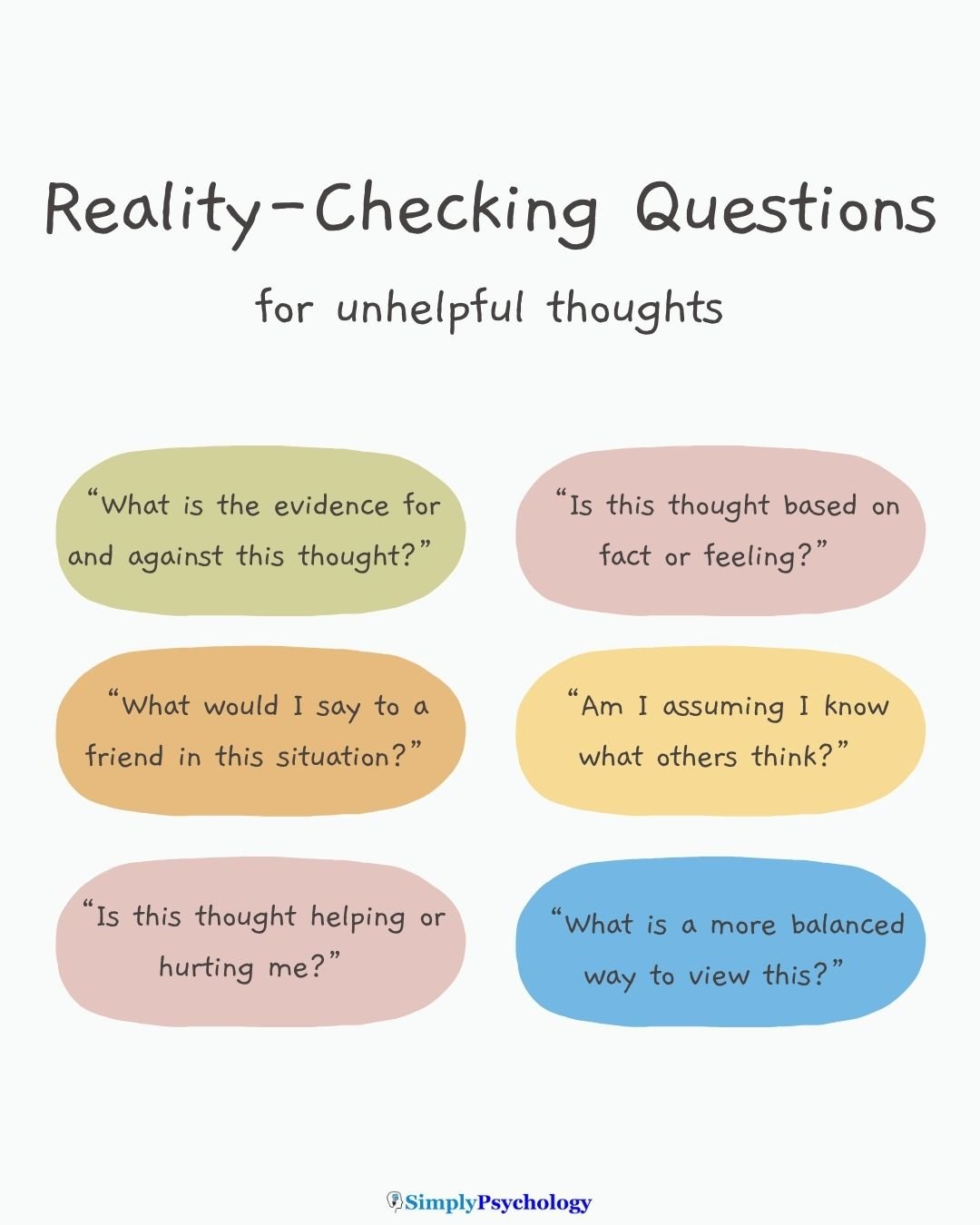
3. Use Socratic Questions
Challenge the thought by questioning its validity. Examples include:
- What evidence supports this thought?
- What evidence goes against it?
- Am I confusing a feeling with a fact?
- Am I jumping to conclusions or assuming what others think?
- What are the worst, best, and most likely outcomes?
This reflective questioning helps you pause and assess your thoughts more objectively. Because you reach the answer yourself, it feels less like being told what to think.
4. Do a Cost-Benefit Analysis
Unhelpful thought patterns sometimes serve a purpose, such as creating a sense of control or avoiding discomfort. Ask yourself:
- How has this thought helped me cope in the past?
- How is it limiting me now?
- What do I gain or lose by holding onto this belief?
Evaluating the pros and cons can create motivation to change and increase psychological flexibility.
5. Replace Absolute Language
Distortions often include extreme terms like “always,” “never,” or “everyone.” Replacing these with more moderate language helps shift your thinking toward nuance and accuracy.
For example:
- “I always mess up” becomes “Sometimes I make mistakes, but I also succeed.”
- “No one cares” becomes “Some people may not show it, but others do care.”
This technique reduces emotional intensity and improves self-talk.
6. Label the Behavior, Not the Person
Instead of saying, “I’m a failure,” describe the situation factually: “I missed a deadline.”
This small shift reduces self-blame and encourages a growth mindset, helping you focus on specific actions rather than global judgments.
7. Find the Evidence
Before believing a negative thought, examine the evidence. Ask:
- Is this based on facts or just how I feel?
- What are the facts that support or contradict this thought?
- Am I overlooking any alternative explanations?
Writing down evidence for and against a thought can help you step back and evaluate how realistic it truly is.
You can also gather new evidence. In a behavioral experiment, you write down a prediction, act on it, and compare the result. For example, if you fear a friend finds you boring, meet for a drink and note what actually happens.
8. Search for Positive Aspects
When you catch yourself focusing on what went wrong, challenge yourself to identify things that went right.
This strengthens cognitive balance and reduces mental filtering. You might try:
- Naming three things that went well today
- Recognizing a small personal win
- Noting one strength you showed in a tough moment
Over time, this practice can help rewire your brain to notice both the positive and the negative more evenly.
9. Practice Mindfulness and Self-Compassion
Mindfulness helps you observe your thoughts without reacting or judging them, while self-compassion reminds you that being imperfect is part of being human.
Together, these practices make it easier to acknowledge distorted thinking without believing everything your mind tells you.
Third-wave therapies build on this idea. They shift the focus from the content of a thought to your relationship with it.
Mindfulness-based cognitive therapy (MBCT) combines mindfulness training with cognitive therapy to prevent depressive relapse (Segal et al., 2002). Acceptance and commitment therapy (ACT) teaches defusion, or stepping back from thoughts instead of arguing with them (Hayes et al., 1999).
Do you or a loved one need mental health help?
USA
Contact the National Suicide Prevention Lifeline for support and assistance from a trained counselor. If you or a loved one are in immediate danger: https://suicidepreventionlifeline.org/
1-800-273-8255
UK
Contact the Samaritans for support and assistance from a trained counselor: https://www.samaritans.org/; email jo@samaritans.org .
Available 24 hours a day, 365 days a year (this number is FREE to call):
116-123
Rethink Mental Illness: rethink.org
0300 5000 927
References
Beck, A. T. (1963). Thinking and depression: I. Idiosyncratic content and cognitive distortions. Archives of General Psychiatry, 9(4), 324–333. https://doi.org/10.1001/archpsyc.1963.01720160014002
Beck, A. T. (1967). Depression: Causes and treatment. University of Pennsylvania Press.
Beck, A. T. (1976). Cognitive therapy and the emotional disorders. International Universities Press.
Beck, A. T. (1993). Cognitive therapy: Past, present, and future. Journal of Consulting and Clinical Psychology, 61(2), 194–198. https://doi.org/10.1037/0022-006X.61.2.194
Beck, A. T., Rush, A. J., Shaw, B. F., & Emery, G. (1979). Cognitive therapy of depression. Guilford Press.
Binnie, J., & Blainey, S. (2013). The use of cognitive behavioural therapy for adults with autism spectrum disorders: a review of the evidence. Mental Health Review Journal, 18(2), 93-104.
Burns, D. D. (1980). Feeling good: The new mood therapy. Signet.
Butler, A. C., & Beck, J. S. (2000). Cognitive therapy outcomes: A review of meta-analyses. Journal of the Norwegian Psychological Association, 37, 1–9.
Carpenter, J. K., Andrews, L. A., Witcraft, S. M., Powers, M. B., Smits, J. A., & Hofmann, S. G. (2018). Cognitive behavioral therapy for anxiety and related disorders: A meta‐analysis of randomized placebo‐controlled trials. Depression and anxiety, 35(6), 502-514.
Cristea, I. A., Stefan, S., Karyotaki, E., David, D., Hollon, S. D., & Cuijpers, P. (2017). The effects of cognitive behavioral therapy are not systematically falling: A revision of Johnsen and Friborg (2015). Psychological Bulletin, 143(3), 326–340. https://doi.org/10.1037/bul0000062
Cuijpers, P., Miguel, C., Harrer, M., Plessen, C. Y., Ciharova, M., Ebert, D., & Karyotaki, E. (2023). Cognitive behavior therapy vs. control conditions, other psychotherapies, pharmacotherapies and combined treatment for depression: A comprehensive meta-analysis including 409 trials with 52,702 patients. World Psychiatry, 22(1), 105–115. https://doi.org/10.1002/wps.21069
DeRubeis, R. J., Hollon, S. D., Amsterdam, J. D., Shelton, R. C., Young, P. R., Salomon, R. M., O’Reardon, J. P., Lovett, M. L., Gladis, M. M., Brown, L. L., & Gallop, R. (2005). Cognitive therapy vs medications in the treatment of moderate to severe depression. Archives of General Psychiatry, 62(4), 409–416. https://doi.org/10.1001/archpsyc.62.4.409
DeRubeis, R. J., Siegle, G. J., & Hollon, S. D. (2008). Cognitive therapy versus medication for depression: Treatment outcomes and neural mechanisms. Nature Reviews Neuroscience, 9(10), 788–796. https://doi.org/10.1038/nrn2345
Ferguson, N., Rice, S., Gleeson, J., Davey, C. G., & Hetrick, S. E. (2023). The experience of young people receiving cognitive behavioural therapy for major depression: A qualitative study. Early Intervention in Psychiatry, 17(1), 47–56. https://doi.org/10.1111/eip.13290
Hayes, S. C., Strosahl, K. D., & Wilson, K. G. (1999). Acceptance and commitment therapy: An experiential approach to behavior change. Guilford Press.
Hofmann, S. G., Asnaani, A., Vonk, I. J., Sawyer, A. T., & Fang, A. (2012). The efficacy of cognitive behavioral therapy: A review of meta-analyses. Cognitive Therapy and Research, 36(5), 427–440. https://doi.org/10.1007/s10608-012-9476-1
Hofmann, S. G., Kasch, C., & Reis, A. (2025). Effect sizes of randomized-controlled studies of cognitive behavioral therapy for anxiety disorders over the past 30 years. Clinical Psychology Review, 117, 102553. https://doi.org/10.1016/j.cpr.2025.102553
Holder, L. J., Prasad, A., Han, J., Torok, M., & Wong, Q. J. J. (2021). Shifting as a key executive function underlying cognitive restructuring for individuals with elevated social anxiety. Psychology and Psychotherapy: Theory, Research and Practice, 94(2), 217–230. https://doi.org/10.1111/papt.12301
Hollon, S. D., & Beck, A. T. (1994). Cognitive and cognitive-behavioral therapies. In A. E. Bergin & S. L. Garfield (Eds.), Handbook of psychotherapy and behavior change (pp. 428–466). Wiley.
Jacobson, N. S., Dobson, K. S., Truax, P. A., Addis, M. E., Koerner, K., Gollan, J. K., Gortner, E., & Prince, S. E. (1996). A component analysis of cognitive-behavioral treatment for depression. Journal of Consulting and Clinical Psychology, 64(2), 295–304. https://doi.org/10.1037/0022-006X.64.2.295
Johnsen, T. J., & Friborg, O. (2015). The effects of cognitive behavioral therapy as an anti-depressive treatment is falling: A meta-analysis. Psychological Bulletin, 141(4), 747–768. https://doi.org/10.1037/bul0000015
Lam, D. H., Bright, J., Jones, S., Hayward, P., Schuck, N., Chisholm, D., & Sham, P. (2000). Cognitive therapy for bipolar illness—a pilot study of relapse prevention. Cognitive therapy and research, 24, 503-520
Lewinsohn, P. M., Steinmetz, J. L., Larson, D. W., & Franklin, J. (1981). Depression-related cognitions: Antecedent or consequence? Journal of Abnormal Psychology, 90(3), 213–219. https://doi.org/10.1037/0021-843X.90.3.213
Lopes, R. T., Gonçalves, M. M., Machado, P. P., Sinai, D., Bento, T., & Salgado, J. (2014). Narrative Therapy vs. Cognitive-Behavioral Therapy for moderate depression: Empirical evidence from a controlled clinical trial. Psychotherapy Research, 24(6), 662-674.
Mendes, D. D., Mello, M. F., Ventura, P., de Medeiros Passarela, C., & de Jesus Mari, J. (2008). A systematic review on the effectiveness of cognitive behavioral therapy for posttraumatic stress disorder. The International Journal of Psychiatry in Medicine, 38(3), 241-259.
Nathan, P., Rees, C., Lim, L., & Correia, H. (2003). Back from the Bluez. Perth, Western Australia: Centre for Clinical Interventions.
Pickel, C. T., & Wymbs, B. T. (2026). ADHD symptoms, maladaptive schemas, and dysfunctional automatic thoughts: Exploring theorized relationships in emerging adults. Journal of Attention Disorders. Advance online publication. https://doi.org/10.1177/10870547261478353
Rosenzweig, S. (1936). Some implicit common factors in diverse methods of psychotherapy. American Journal of Orthopsychiatry, 6(3), 412–415. https://doi.org/10.1111/j.1939-0025.1936.tb05248.x
Salla, M., Aguilera, M., Paz, C., Moya, J., & Feixas, G. (2025). The effect of cumulative trauma and polarised thinking on severity of depressive disorder. Psychology and Psychotherapy: Theory, Research and Practice.
Scott, J., Garland, A., & Moorhead, S. (2001). A pilot study of cognitive therapy in bipolar disorders. Psychological medicine, 31(3), 459-467.
Segal, Z. V., Williams, J. M. G., & Teasdale, J. D. (2002). Mindfulness-based cognitive therapy for depression: A new approach to preventing relapse. Guilford Press.
Sizoo, B. B., & Kuiper, E. (2017). Cognitive behavioural therapy and mindfulness based stress reduction may be equally effective in reducing anxiety and depression in adults with autism spectrum disorders. Research in developmental disabilities, 64, 47-55.
Velthorst, E., Koeter, M., Van Der Gaag, M., Nieman, D. H., Fett, A. K., Smit, F., Staring, ABP, Meijer, C. & De Haan, L. (2015). Adapted cognitive–behavioural therapy required for targeting negative symptoms in schizophrenia: meta-analysis and meta-regression. Psychological medicine, 45(3), 453-465.
Wampold, B. E. (2015). How important are the common factors in psychotherapy? An update. World Psychiatry, 14(3), 270–277. https://doi.org/10.1002/wps.20238
Further Information
Information Sheets on the Unhelpful Thinking Styles – Centre For Clinical Interventions (CCI)