Implicit bias refers to the beliefs and attitudes that affect our understanding, actions and decisions in an unconscious way.
Key Takeaways
- Unconscious: Implicit biases are unconscious attitudes and stereotypes that can shape actions and decisions in the criminal justice system, workplace, school setting, and healthcare system.
- Also Called: Implicit bias is also known as unconscious bias or implicit social cognition.
- Wide Ranging: Examples span race, gender, age, weight, disability, and sexual orientation.
- Origins: These biases often arise from pattern-seeking under a flood of social information. Culture, media, and upbringing also shape them.
- Reduction: Removing these biases is a challenge, since most people don’t know they hold them, but some interventions show durable effects and U.S. levels have moved toward neutrality over time.
- IAT Reliability: The field’s own dominant test, the IAT, has only modest test-retest reliability and is a weak predictor of individual discriminatory behavior; it is best read as a group-level research tool, not an individual diagnosis.
The term implicit bias was first coined in 1995 by psychologists Mahzarin Banaji and Anthony Greenwald (Greenwald & Banaji, 1995). They argued that social behavior is largely influenced by unconscious associations and judgments.
Specifically, implicit bias refers to attitudes or stereotypes that affect our understanding, actions, and decisions in an unconscious way, making them difficult to control.
Since the mid-90s, psychologists have extensively researched implicit biases, revealing that, without even knowing it, we all possess our own implicit biases.
Implicit bias is best understood as the automatic, unconscious component of the wider phenomenon of prejudice and discrimination.
System 1 and System 2 Thinking
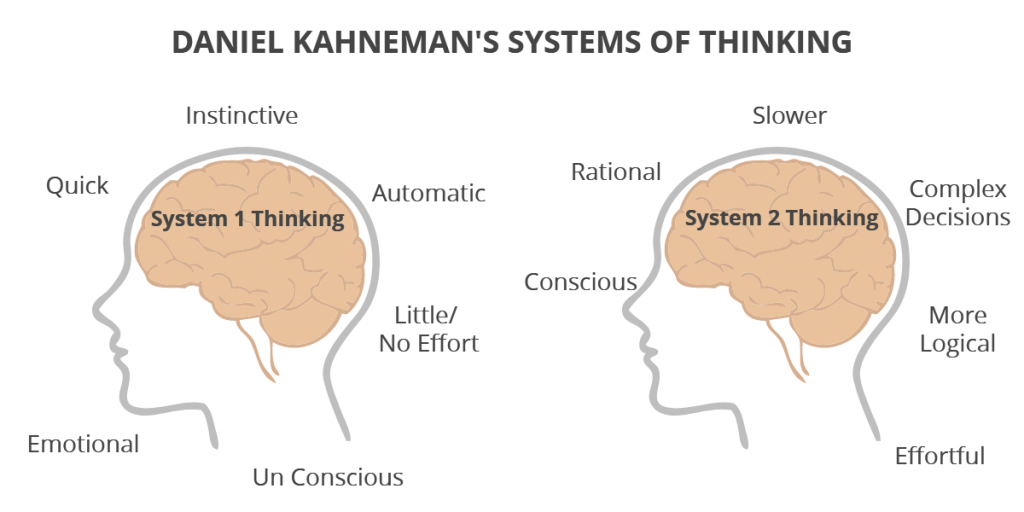
Kahneman (2011) distinguishes between two types of thinking: system 1 and system 2.
- System 1 is the brain’s fast, emotional, unconscious thinking mode. This type of thinking requires little effort, but it is often error-prone. Most everyday activities (like driving, talking, cleaning, etc.) heavily use the type 1 system.
- System 2 is slow, logical, effortful, conscious thought, where reason dominates.
Implicit Bias vs. Explicit Bias
| Implicit Bias | Explicit Bias | |
|---|---|---|
| Definition | Unconscious attitudes or stereotypes that affect our understanding, actions, and decisions. | Conscious beliefs and attitudes about a person or group. |
| How it manifests | Can influence decisions and behavior subconsciously. | Usually apparent in a person’s language and behavior. |
| Example | A hiring manager unknowingly favors candidates who went to the same university as them. | A person making a conscious decision not to hire someone based on their ethnicity. |
| Role in Discrimination | Can lead to unintentional discrimination and bias in many areas like hiring, law enforcement, healthcare, etc. | Can lead to intentional discrimination, such as openly refusing to hire, serve, or promote someone because of their group membership. |
| Measurement | Measured using implicit association tests and other indirect methods. | Can be assessed directly through surveys, interviews, etc. |
| Prevalence in Society | Very common, as everyone holds unconscious biases to some degree. | Less common, as societal norms have shifted to view explicit bias as unacceptable. |
| How to Avoid | Improve self-awareness, undergo bias training, diversify your experiences and interactions. | Education, awareness, promoting inclusivity and diversity. |
What is meant by implicit bias?
Implicit bias (unconscious bias) refers to attitudes and beliefs outside our conscious awareness and control. Implicit biases are an example of system one thinking, so we are unaware they exist (Greenwald & Krieger, 2006).
An implicit bias may counter a person’s conscious beliefs without realizing it. For example, someone might explicitly like a social group or approve of an action while being biased against that same group or action unconsciously.
Therefore, implicit and explicit biases might differ for the same person.
Implicit biases can become explicit once you notice them. This happens when you become consciously aware of your own prejudices and beliefs. They surface in your mind, and you choose whether to act on them.
What is meant by explicit bias?
Explicit biases are biases we are aware of on a conscious level (for example, feeling threatened by another group and delivering hate speech as a result). They are an example of system 2 thinking.
Explicit bias is measured directly, through surveys, interviews, and self-report, and it typically leads to intentional discrimination when a person acts on it.
Your implicit and explicit biases may also differ from a neighbor’s, friend’s, or family member’s. Many factors shape how such biases develop.
What Are the Implications of Unconscious Bias?
Implicit biases become evident in many different domains of society. On an interpersonal level, they can manifest in simple daily interactions.
This occurs through microaggressions: subtle, often unintentional actions that make others feel uncomfortable or aware of the prejudice behind them.
Unconscious bias shows up across several areas of life:
- Prejudice: automatic stereotypes that shape perception even in people who consciously reject bias.
- Gender: associations that link fame, competence, or subjects like maths more strongly with one gender.
- Health care: less accurate diagnoses and pain management for minority and female patients.
- LGBTQ+ bias: the automatic default assumption that someone is heterosexual.
- The legal system: faster “shoot” decisions and harsher treatment for Black suspects and defendants.
- The workplace: fewer callbacks and less favorable impressions for applicants with Black-sounding or non-Anglicized names.
Implicit Prejudice
Implicit prejudice is the automatic, unconscious attitudes or stereotypes that influence our understanding, actions, and decisions. Unlike explicit prejudice, which is consciously controlled, implicit prejudice can occur even in individuals who consciously reject prejudice and strive for impartiality.
Unconscious racial stereotypes are a major example of implicit prejudice: an automatic preference for one race over another that a person is not aware of.
This bias can manifest in small interpersonal interactions and has broader implications in society’s legal system and many other important sectors.
Examples include the stereotype that Black individuals are violent. As a result, you might cross the street at night when a Black man walks toward you. You may not even realize why.
A microaggression is a subtle, automatic, and often nonverbal act that communicates hostile or derogatory prejudice toward a group (Pierce, 1970). Crossing the street communicates an implicit prejudice, even if you are not aware of it.
Another example: a teacher compliments a Latino student on speaking perfect English, assuming he is not a native English speaker.
Gender Stereotypes
Gender bias is a common form of implicit bias. It shapes how we judge men and women against traditional masculine and feminine traits.
Banaji and Greenwald (1995) found that people more readily attributed fame to male names than to female names. This reveals a subconscious bias favoring men. Whether you say it aloud or not, bias remains. It quietly favors men over women in perceived fame.
Another common implicit gender bias regards women in STEM (science, technology, engineering, and mathematics).
Steffens and Jelenec (2011) found implicit associations linking males with math and females with language. This ability stereotype can steer girls away from STEM subjects well before they consciously choose a career path.
Even if you say men and women are equally good at math, you might still subconsciously link math more strongly with men.
Implicit Bias in Health Care
Healthcare is another setting where implicit biases are very present. Racial and ethnic minorities and women are subject to less accurate diagnoses, curtailed treatment options, less pain management, and worse clinical outcomes (Chapman, Kaatz, & Carnes, 2013).
Additionally, Black children are often not treated as children or given the same compassion or level of care provided for White children (Johnson et al., 2017).
Implicit biases clearly infiltrate the most common sectors of society, which raises an urgent question: how can we remove them?
LGBTQ+ Community Bias
Similar to implicit racial and gender biases, individuals may hold implicit biases against members of the LGBTQ+ community. These biases are not necessarily voiced aloud, or even consciously recognized by the person who holds them.
Rather, these biases are unconscious. A simple example: asking a female friend if she has a boyfriend assumes her sexuality and treats heterosexuality as the default.
Instead, you could ask your friend if she is seeing someone. Implicit biases take many other forms too, spanning categories from weight to ethnicity to ability.
Implicit Bias in the Legal System
Both law enforcement and the legal system shed light on implicit biases. Reaction-time lab studies show a “shooter bias.” Participants are reliably faster to decide to shoot Black than White targets, a pattern first documented by Plant and Peruche (2005).
The evidence is more mixed than it first appears.
Mekawi and Bresin’s (2015) meta-analysis found a more complicated picture: participants did shoot armed Black targets faster than armed White targets.
But the evidence that they made more erroneous shooting decisions against unarmed Black targets was weaker and less consistent across studies. This is a caution against over-reading a single lab paradigm as proof of real-world shooting outcomes.
This bias has been repeatedly tested in the laboratory setting, revealing an implicit bias against Black individuals. Black people are also disproportionately arrested and given harsher sentences, and Black juveniles are tried as adults more often than their White peers.
Black boys are seen as less childlike. They are also seen as less innocent, more culpable, and more often targeted for police violence (Goff, 2014).
Together, these unconscious stereotypes, which are not rooted in truth, form an array of implicit biases that are extremely dangerous and utterly unjust.
Implicit Bias in the Workplace
Implicit biases are also visible in the workplace. Bertrand and Mullainathan’s (2004) résumé audit sent identical CVs under stereotypically White and Black names. Applications with White-sounding names received about 50% more callbacks, regardless of industry.
This reveals another form of implicit bias: the hiring bias. Watson, Appiah, and Thornton (2011) found that applicants with Anglicized names received more favorable pre-interview impressions than those with other ethnic names.
Causes of Implicit Bias
We’re susceptible to bias because of these tendencies:
We tend to seek out patterns
Our brains have a natural tendency to look for patterns. This pattern-seeking helps us make sense of a very complicated world, and it is a key reason such biases develop.
Research shows that even before kindergarten, children already use group membership, such as race, gender, or age, to guide inferences about psychological and behavioral traits.
At such a young age, they have already begun seeking patterns and recognizing what distinguishes them from other groups (Baron, Dunham, Banaji, & Carey, 2014).
Children don’t just notice what sets them apart from other groups. Cameron, Alvarez, Ruble, and Fuligni (2001) found they also come to believe that “what is similar to me is good, and what is different from me is bad.”
Children aren’t just noticing how similar or dissimilar they are to others. They actively dislike those who seem different (Aboud, 1988).
This automatic favoring of one’s own group ties closely to social identity theory. Recognizing what sets you apart from other groups, then forming negative opinions about those “outgroups,” contributes to implicit bias.
We like to take shortcuts
Another explanation is that the development of these biases is a result of the brain’s tendency to try to simplify the world.
Mental shortcuts make it faster and easier for the brain to sort through the overwhelming data and stimuli we face every second of the day.
Implicit bias is a result of taking one of these cognitive shortcuts inaccurately. As a result, we incorrectly rely on these unconscious stereotypes to provide guidance in a very complex world.
Disability status is one such shortcut. Rynders (2019) argues that implicit bias distorts how schools assess the needs of students with disabilities under special-education law. The effect compounds when the student is also a racial minority.
Wigboldus, Sherman, Franzese, and Knippenberg (2004) found that spontaneous stereotyping increases under cognitive load, the mental effort currently occupying working memory.
Under high stress, we lean on these biases instead of examining the relevant surrounding information.
Social and Cultural influences
Influences from media, culture, and your individual upbringing can also contribute to the rise of implicit associations that people form about the members of social outgroups. Media has become increasingly accessible, and while that has many benefits, it can also lead to implicit biases.
The way TV portrays individuals or the language journal articles use can ingrain specific biases in our minds.
For example, they can lead us to associate Black people with criminals or females as nurses or teachers. Upbringing matters too. One research study found that parental racial attitudes can influence children’s implicit prejudice (Sinclair, Dunn, & Lowery, 2005).
And parents are not the only figures who can influence such attitudes. Siblings, the school setting, and the culture in which you grow up can also shape your explicit beliefs and implicit biases.
Implicit Association Test (IAT)
What sets implicit biases apart from other forms is that they are subconscious. We don’t know if we have them.
Researchers have developed the Implicit Association Test, or IAT, to help reveal such biases.
Its logic is simple: the more strongly two concepts are linked in someone’s mind, the faster they can sort them onto the same key. The test therefore measures the relative speed with which someone pairs a social category with positive or negative words.
Faster pairing counts as evidence of a stronger underlying association.
How the Test Works
The IAT measures how quickly a person associates a social category, such as race or gender, with positive or negative attributes. A stronger automatic association produces a faster, more accurate pairing.
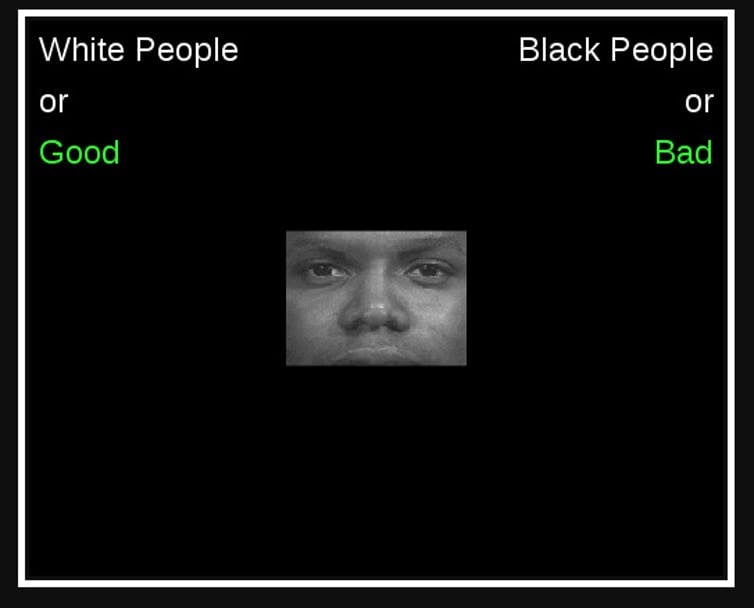
The IAT requires participants to categorize negative and positive words together with either images or words (Greenwald, McGhee, & Schwartz, 1998).
The full test runs through four stages, using two response keys, such as E (left) and I (right).
- Practice, categories: sort faces alone, pressing E for a Black face and I for a White face.
- Practice, attributes: sort words alone, pressing E for a bad word (e.g. agony, hurt) and I for a good word (e.g. joy, peace).
- Combined block A: the tasks share the same keys, so E means Black or bad, and I means White or good.
- Combined block B: the key mappings for faces are swapped, so E now means White or bad, and I means Black or good.
Participants complete the test online. Speed matters. The faster someone categorizes words or faces from a given category, the stronger their bias toward that category is assumed to be.
The Race IAT works the same way. Participants sort White faces, Black faces, and positive and negative words onto shared keys. The relative speed of pairing Black faces with negative words becomes the measure of anti-Black bias.
- Aim: Greenwald, McGhee, and Schwartz (1998) set out to validate a new reaction-time method, the Implicit Association Test. They tested whether it could detect socially sensitive attitudes people might be unwilling to report directly.
- Method: Across three studies, participants sorted stimulus words or names onto two shared response keys, once in a matching block and once with the pairings reversed. The racial-names study also compared IAT scores against a parallel self-report measure.
- Results: All three studies produced large, reliable IAT effects. In the Black/White names study, White participants preferred White names more strongly than their self-reports suggested, and the two measures correlated only weakly.
- Conclusion: The IAT provides a sensitive way to measure automatic associations that self-report cannot reliably access, turning implicit social cognition from a theory into something measurable.
Scoring: The D Score
Raw millisecond differences are not comparable across people. Each person has a different overall processing speed. The IAT corrects for this with a standardized statistic called the D score.
The D score divides the timing difference between the two combined test blocks by the spread of a person’s own response times. A D around 0.15 counts as slight, 0.35 as moderate, and 0.65 as strong. Bigger numbers mean a stronger bias.
This standardization matters because raw reaction times vary enormously between people who are simply faster or slower responders in general. Converting to a D score puts everyone on the same scale, which is what lets researchers compare bias estimates across entire populations.
This article reports findings as D scores throughout. That is simply the field’s shared comparison unit.
What Large-Scale Data Show
Nosek, Greenwald, and Banaji (2007) reviewed IAT results gathered through the public Project Implicit website. Their dataset covered more than 700,000 respondents.
The pattern was striking. More than 70% of White subjects more easily associated White faces with positive words and Black faces with negative words. The researchers read this as evidence of pervasive implicit racial bias.
IATs now exist for many other domains too. These include gender, age, weight, disability, sexuality, and nationality.
That range makes the test a general-purpose instrument for probing automatic social associations.
Outside a testing context, it is hard to know whether a person holds a given bias. The association leaves no conscious trace. That is part of what makes it consequential in real-world, split-second decisions.
Critical Evaluation of the IAT
Implicit bias is one of psychology’s most influential ideas. It is also the subject of a serious, still-live scientific debate.
Strengths of the Concept
Implicit bias is not just an interesting idea. The concept names a real gap between the equality people say they believe in and the automatic responses they cannot fully control. Self-report surveys cannot capture that gap; the IAT can.
The IAT is also robust as a group-level measure.
Across huge samples, the average associations show up reliably and in consistent patterns, which is valuable for tracking population attitudes over time.
The framework has also proven unusually productive. It has generated a large research programme and helped shift discussion of discrimination beyond conscious animus to include automatic processes that people cannot simply choose to switch off.
None of these strengths make the IAT beyond criticism, though. The next two sections cover where the science pushes back hardest.
Reliability: Unstable at the Individual Level
A test used to label one person needs to give a similar answer each time. The IAT does not clear that bar.
Test-retest reliability, whether a test gives a similar score when the same person is tested again, sits around r = .5 for the IAT.
That is well below good self-report scales. A person can score “moderately biased” one week and “neutral” the next.
Good self-report scales are considerably more stable than that. That instability matters most exactly where the test tends to get used: to characterize one specific person, such as a job candidate or a trainee evaluated after a single workshop.
Nosek, Greenwald, and Banaji (2007) acknowledged these limits in their own review. Their conclusion was blunt: the IAT is not built to diagnose or label a specific individual. Its scores mean the most in aggregate.
Predictive Validity: Does It Predict Behavior?
The central question is simple: do IAT scores predict discriminatory behavior? The gap between reputation and evidence is wide.
Even the method’s own defenders found only modest links.
Greenwald, Poehlman, Uhlmann, and Banaji’s (2009) meta-analysis found the IAT out-predicted explicit measures in sensitive situations, but the effect sizes were small.
Oswald, Mitchell, Blanton, Jaccard, and Tetlock (2013) ran a competing meta-analysis and reached a harsher verdict. IAT scores were poor predictors of discriminatory behavior. They were no better, and sometimes worse, than simply asking people what they think.
Forscher, Lai, Axt, Ebersole, Herman, Devine, and Nosek (2019) went further, reviewing hundreds of studies designed to change implicit measures. Scores could shift, but the shifts rarely changed behavior in any lasting way.
The Overreach Critique
Put these findings together and a common overreach appears. A finding that a group shows aggregate bias on the IAT gets stretched into something bigger.
The claim becomes that the IAT proves what causes real-world discrimination, and that lowering IAT scores will fix it. That chain has weak links at both ends.
Individual IAT scores predict individual behavior only weakly. Changing those scores does not reliably change behavior either. Critics argue the test has, at times, been oversold to courts and employers as a diagnostic tool it was never built to be.
None of this means implicit bias is fake. Discrimination is real, and other evidence documents it extensively.
What the debate shows is narrower: a single reaction-time test is a limited way to judge one person, or to certify that a training worked.
Contemporary Research
The field has largely accepted a narrower role for the IAT. It’s a group-level research tool, not an individual diagnostic. Reducing implicit scores is not a proven route to reducing biased behavior.
Attention has shifted toward structural fixes instead. Blind auditions, standardized criteria, and decision checklists now constrain biased behavior directly.
Charlesworth and Banaji (2019) tracked millions of Project Implicit records from 2007 to 2016. Attitudes about sexual orientation, race, and skin tone moved markedly toward neutrality.
Attitudes about age, disability, and body weight did not. Some even moved further from neutrality.
The takeaway is not that implicit bias is disappearing on its own. It is that these attitudes respond to cultural change, unevenly, across different social categories.
Rival Accounts of Automatic Prejudice
The implicit-bias/IAT framework is not the only account of how well-intentioned people act in biased ways without consciously endorsing prejudice. Two rival theories offer different explanations.
Aversive Racism Theory
Dovidio and Gaertner (2004) describe a more specific conflict. A person may sincerely hold egalitarian values, yet still carry negative feelings about a racial out-group, absorbed through ordinary cultural exposure and operating outside conscious awareness.
Unlike the IAT model, which treats bias as a broad trait detectable in almost any comparison, aversive racism theory predicts that discrimination surfaces selectively. It appears in ambiguous, race-neutral-looking situations.
There, a person can attribute the unequal treatment to another factor. Their self-image stays nonprejudiced.
The Bias-of-Crowds Account
Payne, Vuletich, and Lundberg (2017) challenge an assumption behind the standard reading of IAT scores: that a stable “implicit bias” belongs to the individual being tested.
They argue instead that implicit bias is better understood as a property of situations and places. Regional features, such as segregation and structural inequality, generate a population-level “climate” of bias that most residents of an area partly express.
Context matters as much as the person.
On this view, the IAT’s modest test-retest reliability partly reflects a genuine, state-like sensitivity to context. The aggregated, crowd-level score is what tracks real-world disparities, such as regional differences in police use of force.
How to Reduce Implicit Bias
Because of the harmful nature of implicit biases, it is critical to examine how we can begin to remove them.
Meditation
Practicing mindfulness is one potential way, as it reduces the stress and cognitive load that otherwise leads to relying on such biases.
A 2016 study found that brief meditation decreased unconscious bias against Black people and elderly people (Lueke & Gibson, 2016). This effect plausibly works by weakening the automatic link between the prime and the biased response, rather than by giving people better self-control.
Adjust your perspective
Another method is perspective-taking – looking beyond your own point of view so that you can consider how someone else may think or feel about something.
Researcher Belinda Gutierrez implemented a videogame called “Fair Play,” in which players assume the role of a Black graduate student named Jamal Davis.
As Jamal, players experience subtle race bias while completing “quests” to obtain a science degree.
Gutierrez hypothesized that playing the game would build more empathy for Jamal and lower implicit race bias than simply reading narrative text about his experience (Gutierrez, 2014). The hypothesis was supported. Active perspective-taking increased empathy toward outgroup members more than passive reading did.
Training
Specific implicit bias training has been incorporated in different educational and law enforcement settings. Jackson, Hillard, and Schneider (2014) found that implicit-bias training improved attitudes toward women in STEM among the men who took it.
Training programs designed to target and help overcome implicit biases may also be beneficial for police officers (Plant & Peruche, 2005). However, evidence for this is inconclusive. One pitfall of such training is a potential rebound effect.
Actively trying to suppress a stereotype can backfire: the stereotype rebounds and becomes more accessible than if it had never been suppressed (Macrae, Bodenhausen, Milne, & Jetten, 1994). Psychology curricula often call this the white bear problem.
This concept refers to the psychological process whereby deliberate attempts to suppress certain thoughts make them more likely to surface (Wegner & Schneider, 2003).
The One Intervention That Lasts
Most interventions that lower implicit bias scores don’t stay lowered. Lai and colleagues tested 17 different interventions and found several worked immediately (Lai et al., 2014). A follow-up found something less encouraging: none of those effects survived a delay of hours to days (Lai et al., 2016).
One approach is different. Devine, Forscher, Austin, and Cox (2012) treat bias as a breakable habit rather than a one-off fix. Participants learn what implicit bias is, then practice a toolkit: replacing stereotypes, imagining counter-examples, individuating people, taking their perspective, and seeking cross-group contact.
The results held up. Reduced implicit race bias and heightened concern about discrimination persisted for weeks to months, well past the short shelf life of most lab interventions.
Education
Education is crucial. Understanding what implicit biases are, how they arise, and how to recognize them in yourself and others all support the work of overcoming such biases.
Learning about other cultures or outgroups and what language and behaviors may come off as offensive is critical as well. Education is a powerful tool that can extend beyond the classroom through books, media, and conversations.
On the bright side, implicit biases in the United States have been improving.
Some biases have grown more neutral since 2007. This shows they are not fixed (Charlesworth & Banaji, 2019).
Books for further reading
As mentioned, education is extremely important. Here are a few places to get started in learning more about implicit biases:
- Biased: Uncovering the Hidden Prejudice That Shapes What We See Think and Do by Jennifer Eberhardt
- Blindspot by Anthony Greenwald and Mahzarin Banaji
- Implicit Racial Bias Across the Law by Justin Levinson and Robert Smith
Keywords and Terminology
To find materials on implicit bias and related topics, search databases and other tools using the following keywords:
| “implicit bias” | “implicit gender bias” |
| “unconscious bias” | “implicit prejudices” |
| “hidden bias” | “implicit racial bias” |
| “cognitive bias” | “Implicit Association Test” or IAT |
| “implicit association” | “implicit social cognition” |
| bias | prejudices |
| “prejudice psychological aspects” | stereotypes |
FAQs
Is unconscious bias the same as implicit bias?
Yes, unconscious bias is the same as implicit bias. Both terms refer to the biases we carry without awareness or conscious control, which can affect our attitudes and actions toward others.
In what ways can implicit bias impact our interactions with others?
Implicit bias can impact our interactions with others by unconsciously influencing our attitudes, behaviors, and decisions. This can lead to stereotyping, prejudice, and discrimination, even when we consciously believe in equality and fairness.
It can affect various domains of life, including workplace dynamics, healthcare provision, law enforcement, and everyday social interactions.
What are some implicit bias examples?
Some examples of implicit biases include assuming a woman is less competent than a man in a leadership role, associating certain ethnicities with criminal behavior, or believing that older people are not technologically savvy.
Other examples include perceiving individuals with disabilities as less capable or assuming that someone who is overweight is lazy or unmotivated.
References
Aboud, F. E. (1988). Children and prejudice. B. Blackwell.
Banaji, M. R., & Greenwald, A. G. (1995). Implicit gender stereotyping in judgments of fame. Journal of Personality and Social Psychology, 68 (2), 181.
Baron, A. S., Dunham, Y., Banaji, M., & Carey, S. (2014). Constraints on the acquisition of social category concepts. Journal of Cognition and Development, 15 (2), 238-268.
Bertrand, M., & Mullainathan, S. (2004). Are Emily and Greg more employable than Lakisha and Jamal? A field experiment on labor market discrimination. American economic review, 94 (4), 991-1013.
Cameron, J. A., Alvarez, J. M., Ruble, D. N., & Fuligni, A. J. (2001). Children’s lay theories about ingroups and outgroups: Reconceptualizing research on prejudice. Personality and Social Psychology Review, 5 (2), 118-128.
Chapman, E. N., Kaatz, A., & Carnes, M. (2013). Physicians and implicit bias: how doctors may unwittingly perpetuate health care disparities. Journal of general internal medicine, 28 (11), 1504-1510.
Charlesworth, T. E., & Banaji, M. R. (2019). Patterns of implicit and explicit attitudes: I. Long-term change and stability from 2007 to 2016. Psychological science, 30(2), 174-192.
Devine, P. G., Forscher, P. S., Austin, A. J., & Cox, W. T. L. (2012). Long-term reduction in implicit race bias: A prejudice habit-breaking intervention. Journal of Experimental Social Psychology, 48 (6), 1267-1278.
Dovidio, J. F., & Gaertner, S. L. (2004). Aversive racism. In M. P. Zanna (Ed.), Advances in experimental social psychology (Vol. 36, pp. 1-52). Elsevier. https://doi.org/10.1016/S0065-2601(04)36001-6
Forscher, P. S., Lai, C. K., Axt, J. R., Ebersole, C. R., Herman, M., Devine, P. G., & Nosek, B. A. (2019). A meta-analysis of procedures to change implicit measures. Journal of Personality and Social Psychology, 117 (3), 522-559.
Goff, P. A., Jackson, M. C., Di Leone, B. A. L., Culotta, C. M., & DiTomasso, N. A. (2014). The essence of innocence: consequences of dehumanizing Black children. Journal of personality and socialpsychology,106(4), 526.
Greenwald, A. G., & Banaji, M. R. (1995). Implicit social cognition: attitudes, self-esteem, and stereotypes. Psychological review, 102(1), 4.
Greenwald, A. G., McGhee, D. E., & Schwartz, J. L. (1998). Measuring individual differences in implicit cognition: the implicit association test. Journal of personality and social psychology, 74(6), 1464.
Greenwald, A. G., & Krieger, L. H. (2006). Implicit bias: Scientific foundations. California Law Review, 94 (4), 945-967.
Greenwald, A. G., Poehlman, T. A., Uhlmann, E. L., & Banaji, M. R. (2009). Understanding and using the Implicit Association Test: III. Meta-analysis of predictive validity. Journal of Personality and Social Psychology, 97 (1), 17-41.
Gutierrez, B., Kaatz, A., Chu, S., Ramirez, D., Samson-Samuel, C., & Carnes, M. (2014). “Fair Play”: a videogame designed to address implicit race bias through active perspective taking. Games for health journal, 3 (6), 371-378.
Jackson, S. M., Hillard, A. L., & Schneider, T. R. (2014). Using implicit bias training to improve attitudes toward women in STEM. Social Psychology of Education, 17 (3), 419-438.
Johnson, T. J., Winger, D. G., Hickey, R. W., Switzer, G. E., Miller, E., Nguyen, M. B., … & Hausmann, L. R. (2017). Comparison of physician implicit racial bias toward adults versus children. Academic pediatrics, 17 (2), 120-126.
Kahneman, D. (2011). Thinking, fast and slow. Macmillan.
Lai, C. K., Marini, M., Lehr, S. A., Cerruti, C., Shin, J.-E. L., Joy-Gaba, J. A., … Nosek, B. A. (2014). Reducing implicit racial preferences: I. A comparative investigation of 17 interventions. Journal of Experimental Psychology: General, 143 (4), 1765-1785.
Lai, C. K., Skinner, A. L., Cooley, E., Murrar, S., Brauer, M., Devos, T., … Nosek, B. A. (2016). Reducing implicit racial preferences: II. Intervention effectiveness across time. Journal of Experimental Psychology: General, 145 (8), 1001-1016.
Lueke, A., & Gibson, B. (2016). Brief mindfulness meditation reduces discrimination. Psychology of Consciousness: Theory, Research, and Practice, 3 (1), 34.
Macrae, C. N., Bodenhausen, G. V., Milne, A. B., & Jetten, J. (1994). Out of mind but back in sight: Stereotypes on the rebound. Journal of personality and social psychology, 67 (5), 808.
Mekawi, Y., & Bresin, K. (2015). Is the evidence from racial bias shooting task studies a smoking gun? Results from a meta-analysis. Journal of Experimental Social Psychology, 61, 120-130.
Nosek, B. A., Greenwald, A. G., & Banaji, M. R. (2007). The Implicit Association Test at age 7: A methodological and conceptual review. Automatic processes in social thinking and behavior, 4, 265-292.
Oswald, F. L., Mitchell, G., Blanton, H., Jaccard, J., & Tetlock, P. E. (2013). Predicting ethnic and racial discrimination: A meta-analysis of IAT criterion studies. Journal of Personality and Social Psychology, 105 (2), 171-192.
Payne, B. K., Vuletich, H. A., & Lundberg, K. B. (2017). The bias of crowds: How implicit bias bridges personal and systemic prejudice. Psychological Inquiry, 28 (4), 233-248. https://doi.org/10.1080/1047840X.2017.1335568
Pierce, C. (1970). Offensive mechanisms. The black seventies, 265-282.
Plant, E. A., & Peruche, B. M. (2005). The consequences of race for police officers’ responses to criminal suspects. Psychological Science, 16 (3), 180-183.
Rynders, D. (2019). Battling Implicit Bias in the IDEA to Advocate for African American Students with Disabilities. Touro L. Rev., 35, 461.
Sinclair, S., Dunn, E., & Lowery, B. (2005). The relationship between parental racial attitudes and children’s implicit prejudice. Journal of Experimental Social Psychology, 41 (3), 283-289.
Steffens, M. C., & Jelenec, P. (2011). Separating implicit gender stereotypes regarding math and language: Implicit ability stereotypes are self-serving for boys and men, but not for girls and women. Sex Roles, 64(5-6), 324-335.
Watson, S., Appiah, O., & Thornton, C. G. (2011). The effect of name on pre‐interview impressions and occupational stereotypes: the case of black sales job applicants. Journal of Applied Social Psychology, 41 (10), 2405-2420.
Wegner, D. M., & Schneider, D. J. (2003). The white bear story. Psychological Inquiry, 14 (3-4), 326-329.
Wigboldus, D. H., Sherman, J. W., Franzese, H. L., & Knippenberg, A. V. (2004). Capacity and comprehension: Spontaneous stereotyping under cognitive load. Social Cognition, 22 (3), 292-309.
Further Information
Test Yourself for Bias
- Project Implicit (IAT Test) From Harvard University
- Implicit Association Test From the Social Psychology Network
- Test Yourself for Hidden Bias From Teaching Tolerance
Listen
- How The Concept Of Implicit Bias Came Into Being With Dr. Mahzarin Banaji, Harvard University. Author of Blindspot: hidden biases of good people5:28 minutes; includes a transcript
- Understanding Your Racial Biases With John Dovidio, Ph.D., Yale University
From the American Psychological Association11:09 minutes; includes a transcript - Talking Implicit Bias in Policing With Jack Glaser, Goldman School of Public Policy, University of California Berkeley21:59 minutes
- Implicit Bias: A Factor in Health Communication With Dr. Winston Wong, Kaiser Permanente19:58 minutes
- Bias, Black Lives and Academic Medicine Dr. David Ansell on Your Health Radio (August 1, 2015)21:42 minutes
Videos
- Uncovering Hidden Biases Google talk with Dr. Mahzarin Banaji, Harvard University
- Impact of Implicit Bias on the Justice System 9:14 minutes
- Students Speak Up: What Bias Means to Them 2:17 minutes
- Weight Bias in Health Care From Yale University16:56 minutes
- Gender and Racial Bias In Facial Recognition Technology 4:43 minutes
Journal Articles
- An implicit bias primer Mitchell, G. (2018). An implicit bias primer. Virginia Journal
of Social Policy & the Law, 25, 27–59. - Implicit Association Test at age 7: A methodological and conceptual review Nosek, B. A., Greenwald, A. G., & Banaji, M. R. (2007). The Implicit Association Test at age 7: A methodological and conceptual review. Automatic processes in social thinking and behavior, 4, 265-292.
- Implicit Racial/Ethnic Bias Among Health Care Professionals and Its Influence on Health Care Outcomes: A Systematic Review Hall, W. J., Chapman, M. V., Lee, K. M., Merino, Y. M., Thomas, T. W., Payne, B. K., … & Coyne-Beasley, T. (2015). Implicit racial/ethnic bias among health care professionals and its influence on health care outcomes: a systematic review. American Journal of public health, 105 (12), e60-e76.
- Reducing Racial Bias Among Health Care Providers: Lessons
from Social-Cognitive Psychology Burgess, D., Van Ryn, M., Dovidio, J., & Saha, S. (2007). Reducing racial bias among health care providers: lessons from social-cognitive psychology. Journal of general internal medicine, 22 (6), 882-887. - Integrating implicit bias into counselor education Boysen, G. A. (2010). Integrating Implicit Bias Into Counselor Education. Counselor Education & Supervision, 49 (4), 210–227.
- Cognitive Biases and Errors as Cause—and Journalistic Best Practices as Effect Christian, S. (2013). Cognitive Biases and Errors as Cause—and Journalistic Best Practices as Effect. Journal of Mass Media Ethics, 28 (3), 160–174.
- Empathy intervention to reduce implicit bias in pre-service teachers Whitford, D. K., & Emerson, A. M. (2019). Empathy Intervention to Reduce Implicit Bias in Pre-Service Teachers. Psychological Reports, 122 (2), 670–688.


