Automatic processing in psychology refers to cognitive activities that are relatively fast and require few cognitive resources. It runs below conscious awareness. This makes it different from focused, effortful attention, and it is common when carrying out familiar, highly practiced tasks.
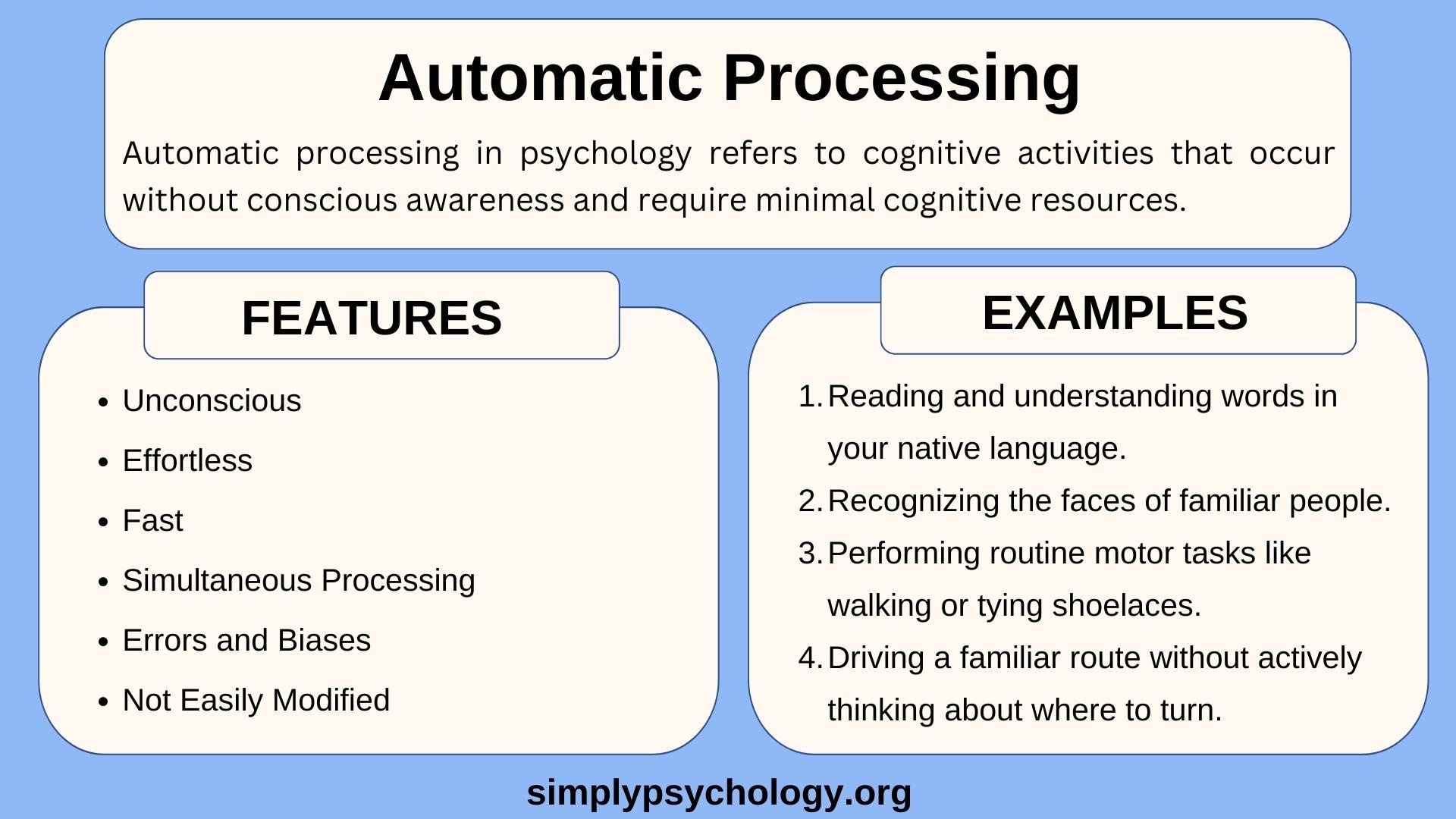
These tasks or mental processes have become automatic through repetition and learning, meaning they no longer require focused attention to be successfully completed.
We do this without conscious intention. Automatic processing simply takes over once a task becomes familiar enough.
For example, these include carrying out familiar tasks like reading, driving, cycling, playing a game, or observing things. They do not need much cognitive effort and are relatively easy to perform.
Key Features
Automatic processing is a critical component of cognitive functioning, allowing us to handle a multitude of tasks without overloading our cognitive resources. Here are some more detailed characteristics of automatic processing:
- Unconscious: Automatic processes do not require conscious awareness or control. We have performed these tasks so often that they have become habitual or ingrained, and we can do them without actively thinking about them.
- Effortless: Automatic processes require minimal mental effort. This is because they are typically well-learned tasks we have practiced extensively, so they do not demand the same cognitive resources as tasks we’re less familiar with.
- Fast: Automatic processes are quick and efficient. They enable us to respond rapidly to familiar stimuli or carry out routine tasks at high speed.
- Simultaneous Processing: Automatic processing is typically fast and efficient and can occur simultaneously with other cognitive tasks without causing significant interference. This is because automatic processes require less limited cognitive resources than controlled processes.
For example, we might be able to walk (an automatic motor task), talk (an automatic language task), and recognize a familiar face (an automatic perceptual task) all at the same time. - Not Easily Modified: Once an automatic process has been learned, it can be difficult to change or unlearn. This can be advantageous when the response is appropriate but problematic when circumstances change and the automatic response is no longer the best.
- Errors and Biases: Automatic processing can sometimes lead to errors or biases, especially when the task or situation changes unexpectedly or heuristics (mental shortcuts) lead to incorrect judgments or decisions.
The Landmark Search Study
Here is the classic evidence.
Aim: Schneider and Shiffrin (1977) tested whether a slow, capacity-limited controlled process and a fast, capacity-free automatic process could be told apart within a single search task.
The design was simple.
Method: On each trial, participants first memorised a small set of target letters or digits, then scanned a brief display for a match.
Under consistent mapping, targets and distractors came from separate categories and never swapped roles. Under varied mapping, the same items switched between being targets and distractors from trial to trial.
The results were striking.
Results: Under varied mapping, decision time rose steeply as the number of items increased: a controlled, one-at-a-time search. Under consistent mapping, decision time stayed fast and almost flat regardless of load, the signature of automatic, parallel detection.
The takeaway is clear.
Conclusion: Practice on a consistent mapping builds a genuinely automatic detection process, while an inconsistent mapping never does, however much it is practised (Schneider & Shiffrin, 1977). This gave psychology both the theoretical distinction and a method for testing which mode is in play.
Automatic Processing Examples
There are many examples of automatic processing that humans undergo in our daily life, such as:
- Reading and understanding words in your native language.
- Recognizing the faces of familiar people.
- Performing routine motor tasks like walking or tying shoelaces.
- Driving a familiar route without actively thinking about where to turn.
- Quickly deciding the meaning of a simple sentence.
Other examples include:
Stroop Effect
The Stroop Effect is a psychological phenomenon that demonstrates automatic processing. It is one of psychology’s most famous demonstrations.
In a standard Stroop task, participants see color words, such as “red,” “blue,” and “green,” printed in colored ink. The catch: the ink colour does not match the word’s meaning, so “red” might appear in blue ink.
They must name the ink colour, not read the word.
This is hard because reading is deeply automatic, practiced since childhood. Naming colors is different: it stays more controlled and deliberate.
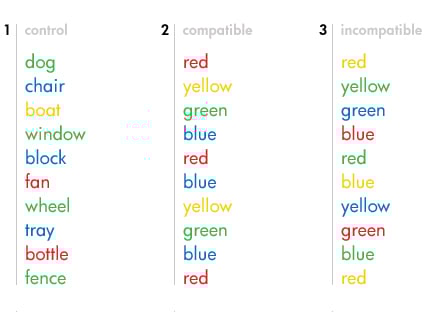
When people see a colored word, their automatic processing system reads it without conscious effort.
Naming the ink colour instead requires controlled processing, the slower and more effortful mode of conscious thought, so they must suppress that automatic response.
The clash slows response times and raises the error rate.
In fact, naming the ink colour of a mismatched word takes around 74% longer than naming plain coloured squares (Stroop, 1935).
The Stroop Effect is thus a clear example of automatic processing: reading intrudes on the controlled task of naming colors. It also shows how hard an automatic response is to inhibit once triggered.
Heuristics
Heuristics are mental shortcuts or “rules of thumb” that we use to make decisions or judgments quickly and efficiently.
They are often used when we need to make a decision but don’t have the time, resources, or information to go through a full, logical decision-making process.
- Availability Heuristic: We estimate the likelihood of an event based on how easily examples of it come to mind. For instance, if you can easily recall news stories about plane crashes, you might overestimate the risk of air travel.
- Halo Effect: The halo effect is a cognitive bias where our impression of someone or something in one area influences our perception of them in other areas. For instance, viewing someone as attractive might also lead us to unconsciously judge them as being more kind or intelligent.
- Anchoring Heuristic: We rely too heavily on the first piece of information (the “anchor”) we receive when making decisions. For example, if the first car at a dealership is listed at a very high price, that might influence how you perceive the prices of subsequent cars.
Motor skills
Motor skills are a form of automaticity. They can be defined as a state where other ongoing tasks do not significantly impact the performance of a primary task.
This means the primary task can be carried out without conscious effort or attention. The brain becomes accustomed to it through repeated exposure and practice (Poldrack et al., 2005).
Walking, jumping, and riding a bicycle are common examples. You may notice that breaking up your walking steps is very difficult; the brain does not consciously plan each step.
Instead, hours and hours of practice and repetition wire the task into our central nervous system, making the processes automatic.
Implicit Biases
Implicit bias (unconscious bias) is a form of bias that occurs automatically and unintentionally yet still impacts our judgments, decisions, and behaviors.
Implicit biases are an example of system 1 thinking, so we are unaware they exist (Greenwald & Krieger, 2006).
It could be against certain racial groups or any group in general. It is said to be shaped by the learned associations between certain qualities and social categories and is a part of implicit social cognition.
This is one example. It shapes perceptions, attitudes, and stereotypic thoughts without conscious acknowledgment or intention. This makes implicit bias part of automatic processing (Greenwald & Krieger, 2006).
Cognitive Distortions
Cognitive distortions are irrational, inflated, or inaccurate thoughts and beliefs that distort our perception of reality, often contributing to mental health disorders such as anxiety and depression.
Cognitive distortions are automatic because they typically operate outside our conscious awareness. They are habitual ways of responding to certain situations or stimuli based on our past experiences, beliefs, and conditioning. They often influence our perceptions and decision-making processes without us realizing it.
Here are a few examples of common cognitive distortions:
- All-or-Nothing Thinking: Viewing things in black-and-white categories with no middle ground (e.g., “If I’m not perfect, I’m a failure”).
- Overgeneralization: Applying the outcome of one event to all similar events (e.g., “I failed this test, so I’m bad at all tests”).
- Catastrophizing: Expecting the worst-case scenario to happen.
- Personalization: Assuming excessive personal responsibility for events outside of your control (e.g., “It’s my fault that my friend is upset”).
- Mental Filter: Focusing exclusively on the negative aspects of a situation while ignoring the positive.
Priming
Another example of automatic processing is priming. Exposure to one stimulus quietly speeds up how we respond to a related stimulus later, without our awareness.
Priming is often described as implicit, or non-declarative, memory. People are unaware that an earlier stimulus is shaping their current behaviour or response.
For instance, someone exposed to the word “yellow” will respond more quickly to “banana” than to an unrelated word like “television.” Yellow and banana are closely linked in memory, so the second word is processed faster once the first has primed it (Higgins & Bargh, 1987).
Evidence: The Cost-Benefit Priming Study
Aim: Posner and Snyder (1975) set out to test whether the speed-up produced by a prime reflects a fast, automatic spread of activation or a slower, conscious attentional strategy.
Method: Participants judged targets, such as whether two letters matched, after seeing a prime.
Trials were compared against a neutral baseline: valid trials, where the prime correctly predicted the target, and invalid trials, where it pointed to the wrong one. The interval between prime and target was also varied.
Results: The pattern flipped with time.
At short intervals, priming gave a speed benefit with little or no cost when misleading. At longer intervals, a cost on invalid trials also appeared, the sign of a slower, conscious strategy.
Conclusion: Priming works two ways. A fast, automatic spread of activation explains the benefit with no cost at short intervals. A slower, conscious strategy explains the added cost at longer ones, because it draws on limited attentional capacity.
Advantages
Automatic processing has clear advantages. It is functional and robust under high-stress levels.
Functions Under Stress
It can be hard to “think straight” under stress. Automatic processing comes in handy here, since it does not require as much mental capacity or guidance, and people can act on instinct instead.
As people gain more experience, automatic processing helps them feel comfortable in their environment. It also makes people robust under stress or distraction. Repeated exposure to events and outcomes helps people anticipate probable outcomes in familiar settings, without draining much mental energy.
Facial recognition and surrounding observation are also automatic.
Our eyes and ears take in information automatically, without conscious awareness. Sight works the same way. We do not think about how we see, or about walking, breathing, and blinking; the brain simply handles all of this automatically.
Parallel Processing
Automatic processing also allows many processes to occur in parallel. Riding a bike is a good example.
When people ride a bike, they don’t think about how their legs pedal or the mechanics of the bike. They just “know” how to do it.
This frees people to stay aware of the surrounding environment while biking and focus on more important things. It increases productivity and helps people focus on urgent needs (Schneider & Chein, 2003).
There is a reason for this. Automatic processing is not capacity-limited, unlike controlled processing, so an over-learned process does not compete for the same limited attentional resources that a controlled task needs (Schneider & Shiffrin, 1977).
This is also why an experienced driver can hold a conversation while driving, something a learner cannot do.
Disadvantages
The convenience of automatic processing comes with disadvantages too.
Prone to Errors
Automatic processing is more prone to mistakes than controlled processing. This is because an automatic response fires whenever its usual trigger appears, whether or not that is still the right response, rather than being chosen deliberately.
Driving shows this well.
People rely on automatic processing for routine actions like changing lanes or turning. A tired or distracted driver’s automatic response can still lead to mistakes that cost lives.
Road changes are a good example. Suppose a driver is used to turning left at a junction, but the layout changes so only a right turn is allowed. A tired or distracted driver’s automatic response may still turn left, leading to a potentially fatal collision.
This is a case of an automatic habit misfiring when the situation has changed.
Hard to Modify
Automatic processing is also less easy to change once established. It takes time to wire a process into the brain, so once it is wired, an unhelpful habit or mistake can be hard to undo.
This inflexibility is the flip side of automaticity’s efficiency. A response that fires without being chosen cannot easily be redirected when the old routine no longer fits.
This cost is not just anecdotal. In the lab, reversing a well-learned pattern can take nearly 1,000 trials before performance even returns to where it started (Shiffrin & Schneider, 1977).
For example, someone used to typing with one finger may find it difficult to switch to the correct technique later. Nail-biting and procrastination are similar: both are hard to break once the brain has wired them in as automatic responses.
System 1 Thinking
In cognitive psychology, automatic processing maps onto Daniel Kahneman’s concept of System 1 thinking, from his book “Thinking, Fast and Slow.” System 1 is fast, effortless, and largely unconscious, just like automatic processing itself.
What Is System 1?
System 1 is the brain’s fast, emotional, unconscious thinking mode. It requires little effort, but it is often error-prone. Most everyday activities, such as driving, talking, and cleaning, make heavy use of System 1.
System 1 thinking is our intuitive system: fast, automatic, immediate, and effortless. It often involves mental shortcuts and is driven more by the subconscious mind.
System 2 thinking is the opposite. It is slower, more deliberate, more effortful, and used for complex decision-making, problem-solving, and reasoning.

When We Rely on Each System
We rely on System 2 thinking for unfamiliar situations, since it is less prone to error. System 1 relies on mental shortcuts called heuristics, which can lead to illogical decisions.
System 2 is slow and cognitively taxing. We cannot rely on it all the time, so System 1 handles most of our daily tasks and decisions instead.
System 1 also includes the “fight or flight” response and other instinctive reactions critical for survival. These responses are fast and automatic, letting us react quickly to threats.
Critical Evaluation
The automatic/controlled distinction is well supported, but it is not beyond challenge. Three criticisms are worth weighing:
- Not Fully Attention-Free: Allegedly automatic tasks still interfere with other tasks, and the Stroop effect itself can be reduced by manipulating attention.
- A Matter of Degree: The features said to define automaticity do not reliably occur together, so most processes are a blend rather than purely one or the other.
- Descriptive, Not Explanatory: Saying practice creates automaticity does not explain how a slow, serial process becomes fast and parallel.
Not Fully Attention-Free
Hampson (1989) found that tasks assumed to be automatic still interfered with a second task. This challenged the classic claim that automatic processing consumes no attentional capacity at all. The Stroop effect adds a second complication.
If reading were purely automatic, attention should not matter to how strongly it interferes with colour naming. But it does. When the conflicting word sits away from the colour patch it names, Stroop interference drops substantially (Kahneman & Chajczyk, 1983).
Even Schneider and Shiffrin’s own consistent-mapping search was not perfectly flat at the highest loads tested. Automatic search, it turns out, still carries some small cost.
None of this overturns the automatic/controlled distinction. It does soften the strongest version of the claim: automaticity makes few demands on attention, not none at all.
A Matter of Degree
Moors and De Houwer (2006) took apart the features researchers had used to define automaticity: goal-independence, unconsciousness, efficiency, and speed. They found these features do not reliably travel together. A process can be fast without being unconscious. It can be efficient without being fully uncontrollable.
So automaticity turns out to be graded rather than all-or-none.
Most real mental processes are a blend of automatic and controlled elements. The honest claim about any one process is usually comparative: process X is more automatic than process Y, not simply “automatic” full stop (Moors & De Houwer, 2006).
This componential view has since become the mainstream position (Moors, 2016). It reframes the whole debate. Instead of sorting processes into two bins, researchers now ask, feature by feature, in what respects and to what degree a given process is automatic.
Descriptive, Not Explanatory
This is the deepest criticism of the three.
Schneider and Shiffrin’s own account has a well-known gap. It shows THAT practice produces automatic detection, but not HOW a slow, serial, capacity-limited process turns into a fast, parallel, capacity-free one (Shiffrin & Schneider, 1977).
Logan’s (1988) instance theory is the leading attempt to fill that gap. It proposes that automaticity is really a memory phenomenon: with repetition, a stored past answer is retrieved rather than freshly computed.
With repetition, a stimulus stops being computed step by step. Instead, it comes to retrieve a stored past solution directly from memory, in a single step.
Logan summed this up neatly: “only the knowledge base changes with practice” (Logan, 1988). The theory explains automaticity’s speed, its low attentional demand, and its unconscious character all at once.
But it has a weakness. Single-step retrieval is both Logan’s definition of automaticity and his explanation of it, which verges on circular.
Contemporary Research
Recent work asks a sharper question.
Once an automatic association is learned, can it be deliberately changed?
Forscher and colleagues (2019) tackled it at scale.
Aim: They set out to determine, across the whole experimental literature, how much implicit associations can be changed. They also asked whether shifting an implicit measure changes explicit attitudes or behaviour.
The scale was large.
Method: The team pooled 492 independent studies with more than 87,000 participants, covering every major procedure used to shift implicit measures such as the Implicit Association Test. Each study was coded for the type of intervention and any resulting change in explicit attitudes or behaviour.
The pattern was clear.
Results: Implicit associations could be shifted, but the effects were generally weak, and most procedures produced little durable change. Crucially, changes in implicit measures did not reliably translate into changes in explicit attitudes or behaviour.
The upshot is sobering.
Conclusion: Automatic associations are malleable in the short term but resistant to lasting change; manipulating them is not a reliable route to changing behaviour (Forscher et al., 2019). This vindicates an old claim: automatic processes, once established, are hard to modify (Schneider & Shiffrin, 1977).
This is a big piece of evidence.
As a synthesis of nearly 500 studies, it sits near the top of the evidence hierarchy. Its message is sobering: the automatic layer is far less tractable than early bias-reduction work assumed.
Key Takeaways
- Fast & Effortless: Automatic processing is quick, needs little mental effort, and runs largely outside conscious awareness.
- Built by Practice: Repetition and consistent practice turn an effortful, controlled task into an automatic one.
- Parallel Processing: Because it costs so little, automatic processing can run alongside other tasks at the same time.
- Hard to Modify: Once learned, an automatic response is difficult to modify, which is why it can misfire when circumstances change.
- Not Fully Attention-Free: Modern research shows automatic processing is not entirely independent of attention; it makes few demands on attention, not none.
- System 1: Automatic processing maps onto Kahneman’s fast, intuitive System 1, contrasted with the slower, deliberate System 2.
- Resistant to Intervention: A large 2019 meta-analysis found automatic associations, once formed, resist lasting change even under deliberate intervention.
References
Evans, J. S. B., & Stanovich, K. E. (2013). Dual-process theories of higher cognition: Advancing the debate. Perspectives on psychological science, 8(3), 223-241.
Greenwald, A. G., & Krieger, L. H. (2006). Implicit bias: Scientific foundations. California Law Review, 94(4), 945-967.
Higgins, E. T., & Bargh, J. A. (1987). Social cognition and social perception. Annual Review of Psychology, 38, 369-425.
Kahneman, D. (2011). Thinking, fast and slow. Farrar, Straus and Giroux.
Kendra Cherry, Mse. (2021, June 18). How priming affects the psychology of memory. Verywell Mind. https://www.verywellmind.com/priming-and-the-psychology-of-memory-4173092
Poldrack, R. A., Sabb, F. W., Foerde, K., Tom, S. M., Asarnow, R. F., Bookheimer, S. Y., & Knowlton, B. J. (2005). The neural correlates of motor skill automaticity. The Journal of Neuroscience: the official journal of the Society for Neuroscience, 25(22), 5356–5364.
Posner, M. I., & Snyder, C. R. R. (1975). Attention and cognitive control. In R. L. Solso (Ed.), Information processing and cognition: The Loyola symposium (pp. 55–85). Erlbaum.
Schacter, D. L., & Buckner, R. L. (1998). Priming and the brain. Neuron, 20(2), 185-195.
Schneider, W., & Chein, J. M. (2003). Controlled & Automatic Processing: Behavior, theory, and Biological Mechanisms. Cognitive Science, 27(3), 525–559.
Schneider, W., & Pimm-Smith, M. (1997). Consciousness as a message aware control mechanism to modulate cognitive processing. In J. Cohen & J. Schooler (Eds.), Scientific approaches to consciousness: 25th Carnegie symposium on cognition (pp. 65–80). Mahwah, NJ: Lawrence Erlbaum
Schneider, W., & Shiffrin, R. M. (1977). Controlled and automatic human information processing: I. Detection, search, and attention. Psychological Review, 84(1), 1-66.
Stanovich, K. E., & West, R. F. (2000). Individual differences in reasoning: Implications for the rationality debate Behavioral and Brain Sciences, 23(5), 645–665.
Stroop, J. R. (1935). Studies of interference in serial verbal reactions. Journal of Experimental Psychology, 18(6), 643–662.
van der Linden, D., Frese, M., & Meijman, T. F. (2003). Mental fatigue and the control of cognitive processes: effects on perseveration and planning. Acta psychologica, 113(1), 45–65.