Controlled processing is a conscious, intentional, and effortful method of information processing used when dealing with novel or complex situations or learning new skills (Schneider & Shiffrin, 1977).
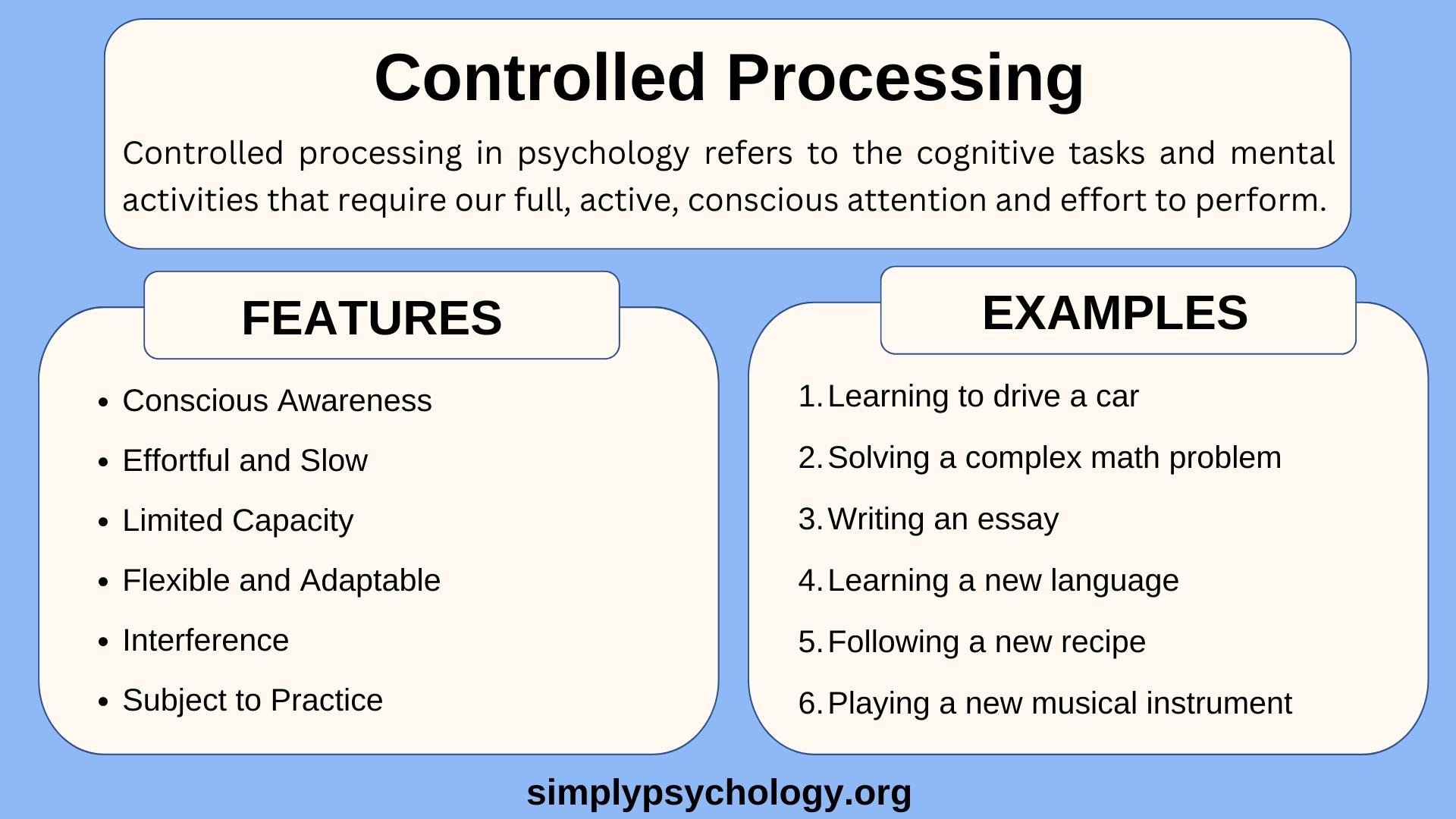
This type of processing requires full attention and cognitive resources. It is often slower and mentally taxing. We rely on it when facing unfamiliar or complex situations that call for careful, logical reasoning.
Controlled processing allows us to adapt and respond to new and unique situations that automatic (unconscious) processing cannot handle.
Humans use controlled processing constantly in daily life. It demands real cognitive effort and engagement in the thinking process. Solving a complex math problem, engaging in a lively debate, or piecing together a complicated puzzle: each requires us to weigh the available information before deciding.
Key Features of Controlled Processing
- Conscious Awareness: The tasks or activities requiring controlled information processing require conscious attention and effort.
- Effortful and Slow: Controlled processing requires cognitive effort, is slower, and can be mentally exhausting.
- Limited Capacity: As it requires a significant amount of cognitive resources, we can only handle a limited number of controlled processing tasks simultaneously. This is often called cognitive load or the capacity of our working memory.
- Flexible and Adaptable: Controlled processing allows flexibility and adaptability in unfamiliar or changing situations.
- Interference: Given the limited capacity of our cognitive resources, simultaneous controlled processes can interfere with each other, reducing overall performance.
- Subject to Practice: With practice and repetition, tasks initially requiring controlled processing can become automatic, faster, less effortful, and can be performed unconsciously.
Examples of Controlled Processing
Controlled processing in psychology is a form of information processing that requires active conscious attention and effort. These tasks often involve new or complex situations that our automatic processing systems cannot handle.
Schneider and Shiffrin (1977) defined controlled processing as “a temporary sequence of nodes activated under control of, and through attention by, the subject.”
Here are some examples:
- Learning a New Language: Learning a new language involves intense cognitive processing to understand vocabulary, grammar rules, pronunciation, etc., which requires controlled processing.
- Solving Math Problems: Controlled processing is needed when doing math problems, especially complex ones that involve multiple steps and different areas of math knowledge.
- Learning to Drive: As a beginner, driving requires full attention, such as changing gears, steering, looking at mirrors, watching for traffic signals, etc. This is a perfect example of controlled processing.
- Playing a New Musical Instrument: Learning to play a new instrument requires controlled processing, focusing on finger placement, reading sheet music, and listening to the sounds produced.
- Navigating an Unfamiliar Area: Walking or driving through a new city or area that one is unfamiliar with requires active, conscious processing to understand the directions and to remember landmarks.
- Learning a New Sport: When first learning the rules, techniques, and strategies of a new sport, you use controlled processing.
- Writing a Research Paper: Controlled processing is used when one needs to organize thoughts, write understandably, provide a logical argument, and avoid plagiarism.
- Preparing a Presentation: Completing a complex presentation requires attention to detail, information structuring, and audience engagement planning. All of this requires controlled processing.
- Cooking a New Recipe: Following a new recipe, especially a complex one, requires controlled processing. One has to pay attention to the instructions, measure ingredients accurately, and manage the cooking process.
Remember that with practice, many tasks that initially require controlled processing can become automatic, requiring less conscious attention and effort.
Advantages
The advantages of controlled processing are complementary to the disadvantages of automatic processing.
It is less prone to mistakes, easily altered and learned, and performs better in novel situations than automatic processing (Schneider & Chein, 2003).
- Accuracy: Carefully weighing the available information leads to more reliable conclusions and fewer careless mistakes than automatic processing produces.
- Adaptability: New skills can be learned quickly and altered easily as context changes, such as adjusting language use with growing fluency.
- Transfer and Planning: Learning can pass between people through observation or instruction, and goal-directed behaviors can be planned and carried out accordingly.
For example, when writing a paper for class, controlled processing helps you review and analyze data with attention to detail. You are less likely to leave out important information or misinterpret data.
Learning a new language, for instance, requires considerable effort at first. Fluency changes that. As a person becomes more proficient, they can adjust their language use to suit the context.
Disadvantages
The disadvantages of controlled processing are also clear. They include long execution time, high effort, vulnerability to stress, and an inability to run in parallel with other tasks.
- Cognitive Load: Controlled processing demands more brain power, time, and effort, so people can only handle a limited number of stimuli at once.
- Fatigue: A constantly high cognitive load leaves the brain tired and impairs performance. Van der Linden et al. (2003) found this leads to more errors on demanding tasks.
- Stress Sensitivity: Performance decreases as stress increases (Schneider & Chein, 2003), which is why exam-level stress can impair scores.
This can be a problem when a task needs undivided attention but people cannot perform at their best. To conclude: automatic and controlled processing both play key roles in daily life. Used together, they make behavior more efficient.
System 2 Thinking
Controlled processing is slow, effortful, and conscious. In cognitive psychology, it maps onto System 2 thinking, the concept Daniel Kahneman describes in his book Thinking, Fast and Slow.
This thinking typically comes into play when working on complex problems, making decisions, or evaluating options.
Kahneman’s theory is considered a dual-process theory because it posits these two distinct systems for processing information:
- System 1: Fast, automatic, intuitive, and largely unconscious. It’s the thinking you use when walking, engaging in a practiced skill, or quickly calculating a simple sum.
- System 2: Slow, effortful, logical, conscious, and often associated with the subjective experience of concentration. An example might be calculating a complex math problem or deciding where to invest money.

System 2 can follow rules, compare objects on several attributes, and make deliberate decisions. It reflects agency, choice, and concentration. Because it draws on more mental energy than System 1, it is slower and more deliberate.
We rely on System 2 thinking in unfamiliar situations because it is less prone to error. System 1 thinking, by contrast, relies on mental shortcuts called heuristics, which can lead to illogical decisions.
System 2 is effortful. It is also essential for reasoned judgment, helping us override potentially biased or impulsive responses that System 1 can produce.
But because System 2 is cognitively taxing and slow, we cannot rely on it constantly, so System 1 handles most day-to-day tasks and decisions.
Critical Evaluation
The automatic/controlled distinction is well supported, but two criticisms are worth taking seriously.
Descriptive, Not Explanatory
Showing that practice produces automatic processing does not, by itself, explain how a slow, serial, capacity-limited controlled process becomes fast and capacity-free (Shiffrin & Schneider, 1977).
The classic account is silent on mechanism.
Logan’s (1988) instance theory is the leading attempt to fill this gap, proposing that practice shifts performance from step-by-step computation to direct memory retrieval.
Its central claim is circular. Automaticity, on this account, simply is single-step retrieval, the very thing the theory sets out to explain.
Independent evidence, not the theory alone, has driven this progress. As a skill automatizes, brain-imaging studies show a real drop in prefrontal control-network activity and a shift toward efficient subcortical circuitry (Poldrack et al., 2005). This gives “freeing up attention” a physical basis.
A Graded Alternative: The Supervisory Attentional System
Not every theorist accepts a strict either/or split.
Norman and Shallice (1986) proposed a different kind of model, one that replaces the sharp controlled/automatic split with graded control. Well-learned actions are governed by schemas, organized routines that can operate at three different levels.
At the lowest level, schemas run with little conscious awareness.
Several schemas can be triggered at once and conflict, so a process called contention scheduling arbitrates between them without deliberate control, producing partially automatic processing.
At the highest level sits the supervisory attentional system (SAS), which intervenes in novel situations, decision-making, and troubleshooting. This is, in effect, the model’s version of controlled processing. It maps closely onto the central executive of the working memory model.
On Baddeley’s (1997) reading, the SAS is something like the exercise of will. Contention scheduling, by contrast, works deterministically, without it.
This links the model to debates about free will versus determinism. Its main strength is that it naturally accommodates degrees of automaticity. Its main limitation is that it is less precisely specified and tested than Schneider and Shiffrin’s original account.
Key Takeaways
- Definition: Controlled processing is the conscious, effortful, and flexible way we handle new, complex, or unfamiliar tasks, in contrast to fast, automatic processing.
- Key Features: It is slow, effortful, capacity-limited, and adaptable, letting us monitor and adjust as a situation unfolds.
- Advantages: Controlled processing is accurate and flexible; it catches errors and adapts easily to new or changing situations.
- Disadvantages: It is slow, tiring, easily disrupted by stress, and cannot run two demanding tasks in parallel.
- System 2: Controlled processing maps onto Kahneman’s System 2, the slow, deliberate thinking that checks and overrides fast, automatic System 1 responses.
- Not All-or-Nothing: Modern models like Norman and Shallice’s supervisory attentional system treat control as a matter of degree, not a strict either/or category.
References
Baddeley, A. D. (1997). Human memory: Theory and practice (Rev. ed.). Psychology Press.
Evans, J. S. B., & Stanovich, K. E. (2013). Dual-process theories of higher cognition: Advancing the debate. Perspectives on psychological science, 8(3), 223-241.
Greenwald, A. G., & Krieger, L. H. (2006). Implicit bias: Scientific foundations. California Law Review, 94(4), 945-967.
Higgins, E. T., & Bargh, J. A. (1987). Social cognition and social perception. Annual Review of Psychology, 38, 369-425.
Kahneman, D. (2011). Thinking, fast and slow. Farrar, Straus and Giroux.
Kendra Cherry, Mse. (2021, June 18). How priming affects the psychology of memory. Verywell Mind. https://www.verywellmind.com/priming-and-the-psychology-of-memory-4173092
Logan, G. D. (1988). Toward an instance theory of automatization. Psychological Review, 95(4), 492–527.
Norman, D. A., & Shallice, T. (1986). Attention to action: Willed and automatic control of behaviour. In R. J. Davidson, G. E. Schwartz, & D. Shapiro (Eds.), Consciousness and self-regulation (Vol. 4, pp. 1–18). Plenum Press.
Poldrack, R. A., Sabb, F. W., Foerde, K., Tom, S. M., Asarnow, R. F., Bookheimer, S. Y., & Knowlton, B. J. (2005). The neural correlates of motor skill automaticity. The Journal of Neuroscience: the official journal of the Society for Neuroscience, 25(22), 5356–5364.
Posner, M. I., & Snyder, C. R. R. (1975). Attention and cognitive control. In R. L. Solso (Ed.), Information processing and cognition: The Loyola Symposium (pp. 55–85). Erlbaum.
Schacter, D. L., & Buckner, R. L. (1998). Priming and the brain. Neuron, 20(2), 185-195.
Schneider, W., & Chein, J. M. (2003). Controlled & Automatic Processing: Behavior, theory, and Biological Mechanisms. Cognitive Science, 27(3), 525–559.
Schneider, W., & Pimm-Smith, M. (1997). Consciousness as a message aware control mechanism to modulate cognitive processing. In J. Cohen & J. Schooler (Eds.), Scientific approaches to consciousness: 25th Carnegie symposium on cognition (pp. 65–80). Mahwah, NJ: Lawrence Erlbaum
Schneider, W., & Shiffrin, R. M. (1977). Controlled and automatic human information processing: I. Detection, search, and attention. Psychological Review, 84(1), 1-66.
Shiffrin, R. M., & Schneider, W. (1977). Controlled and automatic human information processing: II. Perceptual learning, automatic attending and a general theory. Psychological Review, 84(2), 127–190.
Stanovich, K. E., & West, R. F. (2000). Individual differences in reasoning: Implications for the rationality debate. Behavioral and Brain Sciences, 23(5), 645–665.
van der Linden, D., Frese, M., & Meijman, T. F. (2003). Mental fatigue and the control of cognitive processes: Effects on perseveration and planning. Acta psychologica, 113(1), 45–65.

