Anchoring bias is the tendency to rely too heavily on the first piece of information you encounter, the anchor, when making an estimate or decision. Tversky and Kahneman (1974) first identified it, and it persists even when the anchor is completely random (Tversky & Kahneman, 1974).
Take-home Messages
- Definition: Anchoring bias is a faulty heuristic where people rely too heavily on the first piece of information they encounter.
- How It Works: People make inaccurate final estimates because they adjust too little away from that initial value.
- Everyday Examples: Anchoring shows up in medical diagnoses, relationships, pricing, and salary negotiations.
- Key Factors: Mood, personality, and experience can all make anchoring stronger or weaker.
- Reducing It: Learning about the bias, staying in a positive mood, being open to experience, and practising a task can all help (Englich & Soder, 2009; Caputo, 2014; Welsh et al., 2014).
- Modern Evidence: Well-powered replications suggest anchoring’s direction is robust, but its size is often smaller than early, underpowered studies reported (Li et al., 2025).
Anchoring Bias Heuristic
Anchoring bias heuristic is a cognitive bias that involves relying heavily on the first piece of information (the “anchor”) encountered when making decisions or estimates, often leading to insufficient adjustments from this initial value.
The idea of the anchoring bias comes from Amos Tversky and Daniel Kahneman’s landmark 1974 paper, Judgment under Uncertainty: Heuristics and Biases (Tversky & Kahneman, 1974). It identified three heuristics people use under uncertainty: representativeness, availability, and anchoring-and-adjustment.
Aim: Tversky and Kahneman set out to show that people estimate uncertain quantities by starting from an initial value and adjusting away from it. They designed two demonstrations to show this adjustment is typically too small.
Method: Participants watched a wheel of fortune rigged to stop on either 10 or 65. They judged whether the percentage of African countries in the United Nations was higher or lower than that number, then gave their own estimate (Tversky & Kahneman, 1974, p. 1128).
Two groups of students then had five seconds to estimate a multiplication product, too little time to calculate the true answer.
One group saw 8 x 7 x 6 x 5 x 4 x 3 x 2 x 1; the other saw the identical sequence reversed, 1 x 2 x 3 x 4 x 5 x 6 x 7 x 8.
Results: The wheel’s number swayed estimates even though everyone had watched it spin at random. Participants who saw 10 gave a median estimate of 25%, versus 45% for those who saw 65 (Tversky & Kahneman, 1974).
In the multiplication task, the descending group’s median estimate was 2,250, more than four times the ascending group’s median of 512, even though both sequences multiply to the same true answer (Tversky & Kahneman, 1974).
Conclusion: People anchor on an initial value, whether it is handed to them at random or generated during their own calculation, and then adjust away from it too little.
As Tversky and Kahneman put it, “people may perform a few steps of computation and estimate the product by extrapolation or adjustment” (Tversky & Kahneman, 1974, p. 1128).
Because the wheel’s number carried no real information, the study showed anchoring is a genuine bias, not sensible use of a relevant clue.
How the Anchoring Bias Works
Two explanations compete for why anchors pull judgements towards them, and modern research suggests both play a role, depending on where the anchor comes from.
Anchoring-and-Adjustment
Tversky and Kahneman’s original account is a two-step process. People start from an anchor, then adjust away from it until they reach a plausible answer, but the adjustment is effortful and usually stops too soon.
This is easiest to see with self-generated anchors. Asked when George Washington was elected, most people anchor on 1776, a date they already know, and adjust upward from there, moving in the right direction but not far enough (Epley & Gilovich, 2006).
Because adjustment relies on effortful thinking, it weakens under a memory load, time pressure, or distraction (Epley & Gilovich, 2006).
Selective Accessibility: Strack and Mussweiler (1997)
The adjustment story struggles to explain one thing: anchoring occurs even when an anchor is obviously random and no one feels like they are adjusting at all.
Aim: Strack and Mussweiler tested a different explanation. They proposed that considering an anchor makes people retrieve memories consistent with it, biasing any later estimate.
Method: Participants answered pairs of questions about real targets, such as the height of the Brandenburg Gate. Each pair opened with a comparative judgement, asking whether the target was above or below a given anchor, followed by an absolute estimate of the true value.
Results: Estimates assimilated strongly to the anchors, and the effect was strongest when the comparison and the estimate concerned the same dimension, exactly as a memory-based account predicts (Strack & Mussweiler, 1997). Even implausibly extreme anchors still moved people’s estimates.
Conclusion: Testing whether the target equals the anchor makes anchor-consistent evidence more accessible in memory, and that biased sample of evidence then shapes the final estimate (Strack & Mussweiler, 1997).
Externally supplied anchors, like a stranger’s price tag or a rigged wheel, tend to work through this selective-accessibility route. That is why even a number everyone knows is random can still bias a judgement.
The Primacy Effect
A related, simpler idea is the primacy effect: information encountered first is weighted more heavily than information that comes later (Stewart et al., 2004). This does not fully explain anchoring, but it captures part of the intuitive pull an early number has over a later judgement.
Examples of the Anchoring Bias
Medicine
Doctors can anchor on a patient’s initial symptoms and underweight evidence that points elsewhere. This risks misdiagnosis when the first impression turns out to be wrong.
During the COVID-19 pandemic, researchers warned that fixating on a suspected COVID-19 diagnosis could cause clinicians to miss other conditions with similar symptoms (Yousaf et al., 2020).
Relationships
Anchoring also shapes how we judge relationships. A strong first impression, positive or negative, tends to colour how we read everything that follows.
This matters most in long-term relationships. Someone may stay in an unhealthy relationship simply because it began on a positive note, even once the relationship turns toxic.
Money
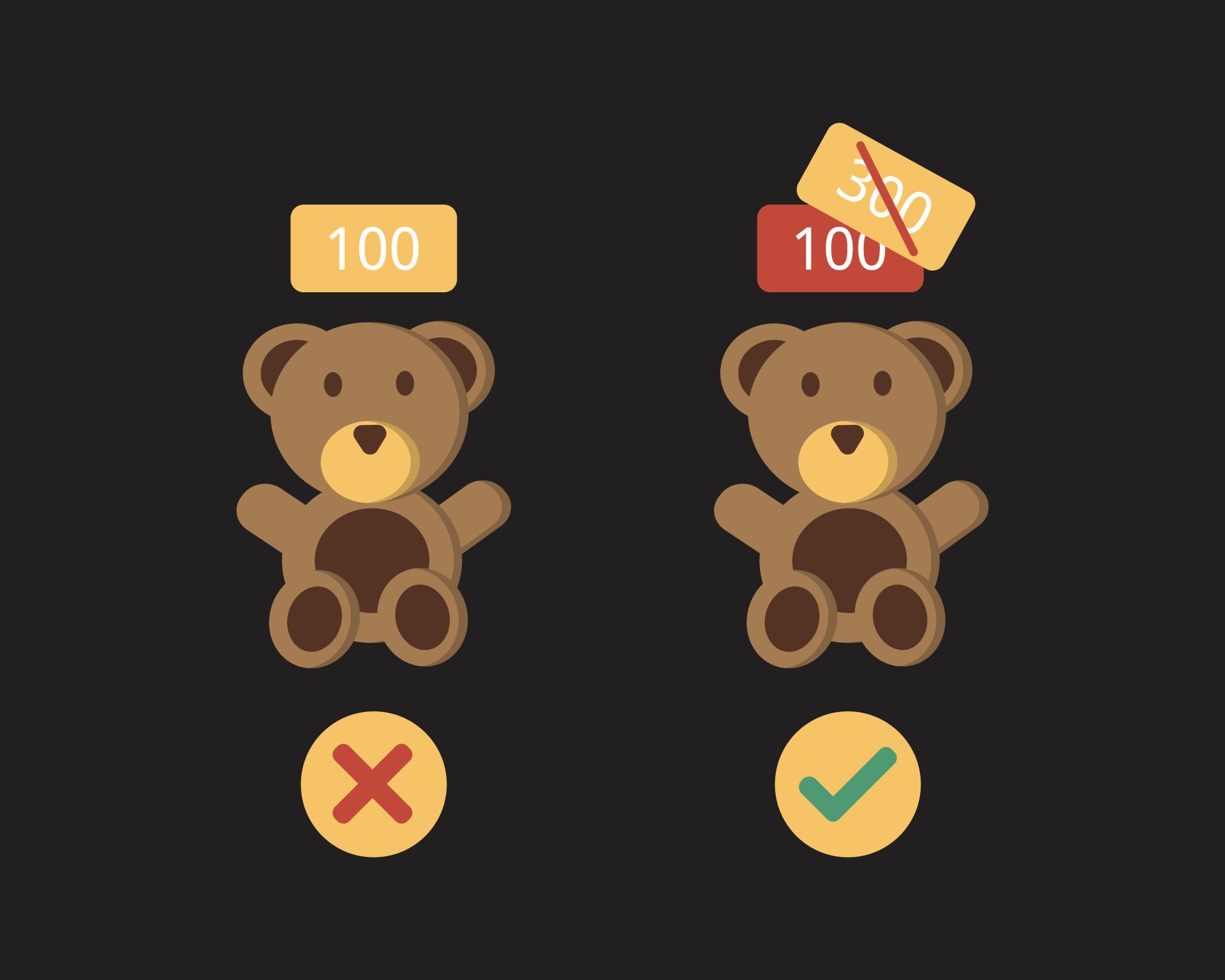
Money decisions are a classic anchoring playground. A high “recommended retail price” or a struck-through “was” price can make a sale price feel like a bargain, even when the anchor has nothing to do with what the product is really worth.
Even a number with no connection to value can anchor behaviour. A supermarket sign reading “limit 12 per person” led shoppers to buy far more tins of soup than an identical promotion with no purchase limit (Kahneman, 2011).
Salary negotiations work the same way. If your employer opens with a low initial offer, you are more likely to settle for less than if they had opened high, simply because their opening figure anchors the whole discussion.
Expert Judgment: Real Estate and the Courtroom
Anchoring is not just a quirk of guessing games. It also shapes decisions made by trained professionals doing their actual jobs.
Real estate. Northcraft and Neale (1987) had estate agents and business students tour an actual house for sale. Each participant got the same information packet except for one detail: the listing price, set well above or below the home’s true appraised value.
The arbitrary listing price moved every valuation participants made, and the professionals were affected almost as much as the students. Most agents insisted the price had played no part in their thinking, even though their own numbers said otherwise (Northcraft & Neale, 1987).
Sentencing. Englich, Mussweiler, and Strack (2006) asked experienced German judges and prosecutors to read a real case file, then roll a pair of dice loaded to land on a low or high total. Told to treat that number as a hypothetical sentencing demand, the judges then set their own sentence.
Judges who rolled the high number recommended noticeably longer sentences than those who rolled low, even though everyone knew the dice were random (Englich et al., 2006).
Both studies show that expertise does not protect against anchoring, and that professionals are often unaware it has swayed them at all.
Factors That Influence the Anchoring Bias
The anchoring bias can be influenced by a variety of factors, including mood, personality, and experience. The effect of this bias can be either increased or decreased by different aspects of these factors.
Mood
Mood changes how susceptible people are to anchoring. A positive mood reduces the bias, while a sad mood increases it (Englich & Soder, 2009; Bodenhausen et al., 2000).
One study found this mood effect only appeared when participants were not also under a heavy cognitive workload, hinting that mood and mental effort interact (Chen, 2013).
Personality
Personality also shapes susceptibility to anchoring. People who score higher on agreeableness or openness to experience tend to be less prone to the bias (Caputo, 2014).
Openness may help because it makes people consider new information more thoroughly, so they weigh it more heavily instead of relying so much on the initial anchor.
Experience
Experience also reduces anchoring. In a card-game task, participants’ performance improved with practice, and their susceptibility to anchoring fell as their experience grew (Welsh et al., 2014).
How to Avoid the Anchoring Bias
Anchoring cannot be eliminated, but a few evidence-backed habits can shrink it.
The first step is simply knowing the bias exists. Once you recognise a number as a potential anchor, an opening offer, an asking price, a “typical” figure, you are more likely to catch yourself leaning on it.
Consider the opposite. Deliberately generating reasons the anchor might be too high or too low is the technique with the strongest research support (Galinsky & Mussweiler, 2001).
It works because it forces you to retrieve information that contradicts the anchor, balancing out the one-sided evidence your memory would otherwise serve up.
Mood and experience matter too. A positive mood makes anchoring less likely, while a sad mood makes it worse (Englich & Soder, 2009). Practising a task repeatedly also reduces anchoring over time, though it rarely removes it completely (Welsh et al., 2014).
Critical Evaluation
Anchoring is one of the most replicated findings in psychology, but researchers now ask sharper questions than simply whether it exists: how large is the effect once studies are properly powered, and how well does it hold up outside the lab?
Contemporary Research
Aim: Li, Weigel, Ferraro, and Messer (2025) noticed that much of the anchoring literature, including earlier replications, relies on samples too small to estimate the effect precisely. Small samples tend to inflate the size of any effect that clears the bar for statistical significance.
Method: The authors first estimated the statistical power of typical anchoring studies and found most fall below 30%.
They then ran a high-powered replication of a classic anchoring study that had reported a 31% shift in participants’ monetary bids. The new design raised statistical power from 46% to 96%.
Results: The well-powered replication did not reproduce the large original effect. Instead of a 31% shift, the anchor produced only about a 3.4% increase, with a confidence interval that included zero (Li et al., 2025).
Conclusion: For this task, the true anchoring effect on bids is far smaller than the underpowered literature had suggested. Li and colleagues argue that low statistical power has led researchers to overstate how strongly anchors move behaviour.
This does not mean anchoring is unreal.
Large multi-laboratory replications running thousands of participants across many samples have recovered clear anchoring effects, making it one of the more reproducible findings in the field (Klein et al., 2014).
The direction of the effect is robust; it is the size of any single reported number that deserves caution.
Real-World Validity
Anchoring is not confined to trivia questions. Estate agents pricing real houses and judges sentencing on realistic case files were both swayed by numbers they knew to be arbitrary, while insisting the numbers had no effect on them (see Expert Judgment: Real Estate and the Courtroom, above).
Negotiation shows the same pattern. An aggressive opening offer drags the final agreement towards it, because the figure makes offer-consistent information more accessible to both sides (Galinsky & Mussweiler, 2001).
Can Anchoring Be Reduced?
Anchoring resists simple fixes. Merely warning people about the bias, or offering a reward for accuracy, does little to shrink it.
The strategy with the best evidence behind it is deliberately generating reasons the anchor might be wrong. This forces retrieval of anchor-inconsistent information, offsetting the biased memory search that drives the effect (Galinsky & Mussweiler, 2001).
See How to Avoid the Anchoring Bias, below, for how to put this into practice.
References
Bodenhausen, G. V., Gabriel, S., & Lineberger, M. (2000). Sadness and susceptibility to judgmental bias: The case of anchoring. Psychological Science, 11 (4), 320-323. https://doi.org/10.1111%2F1467-9280.00263
Caputo, A. (2014). Relevant information, personality traits and anchoring effect. International Journal of Management and Decision Making, 13 (1), 62-76.
Chen, Q. (2013). The Influence of Mood States on Anchoring Effects (Doctoral dissertation, The Ohio State University). https://kb.osu.edu/handle/1811/54481
Englich, B., Mussweiler, T., & Strack, F. (2006). Playing dice with criminal sentences: The influence of irrelevant anchors on experts’ judicial decision making. Personality and Social Psychology Bulletin, 32(2), 188-200. https://doi.org/10.1177/0146167205282152
Englich, B., & Soder, K. (2009). Moody experts—How mood and expertise influence judgmental anchoring. Judgment and Decision making, 4 (1), 41. http://sjdm.cybermango.org/journal/71130/jdm71130.pdf
Epley, N., & Gilovich, T. (2006). The anchoring-and-adjustment heuristic: Why the adjustments are insufficient. Psychological science, 17 (4), 311-318. https://doi.org/10.1111%2Fj.1467-9280.2006.01704.x
Galinsky, A. D., & Mussweiler, T. (2001). First offers as anchors: The role of perspective-taking and negotiator focus. Journal of Personality and Social Psychology, 81(4), 657-669. https://doi.org/10.1037/0022-3514.81.4.657
Kahneman, D. (2011). Thinking, fast and slow. Farrar, Straus and Giroux.
Klein, R. A., Ratliff, K. A., Vianello, M., Adams, R. B., Jr., Bahník, Š., Bernstein, M. J., … Nosek, B. A. (2014). Investigating variation in replicability: A “many labs” replication project. Social Psychology, 45(3), 142-152. https://doi.org/10.1027/1864-9335/a000178
Li, T., Weigel, C., Ferraro, P., & Messer, K. D. (2025). Underpowered studies and exaggerated effects: A replication and re-evaluation of the magnitude of anchoring effects. Economic Inquiry, 63(2), 387-402. https://doi.org/10.1111/ecin.13279
Northcraft, G. B., & Neale, M. A. (1987). Experts, amateurs, and real estate: An anchoring-and-adjustment perspective on property pricing decisions. Organizational Behavior and Human Decision Processes, 39(1), 84-97. https://doi.org/10.1016/0749-5978(87)90046-X
Stewart, D. D., Stewart, C. B., Tyson, C., Vinci, G., & Fioti, T. (2004). Serial Position Effects and the Picture-Superiority Effect in the Group Recall of Unshared Information. Group Dynamics: Theory, Research, and Practice, 8 (3), 166. https://psycnet.apa.org/doi/10.1037/1089-2699.8.3.166
Tversky, A., & Kahneman, D. (1974). Judgment under uncertainty: Heuristics and biases. Science, 185 (4157), 1124–1131. https://doi.org/10.1126/science.185.4157.1124
Welsh, M. B., Delfabbro, P. H., Burns, N. R., & Begg, S. H. (2014). Individual differences in anchoring: Traits and experience. Learning and Individual Differences, 29, 131-140. https://doi.org/10.1016/j.lindif.2013.01.002
Yousaf, Z., Siddiqui, M. Y. A., Mushtaq, K., Feroz, S. E., Aboukamar, M., Mohamedali, M. G. H., & Chaudhary, H. (2020). Avoiding anchoring bias in the times of the pandemic! Case Reports in Neurology, 12 (3), 359-364. https://doi.org/10.1159/000509345

