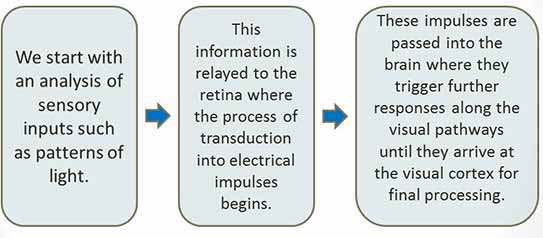
Visual perception is how the brain interprets sensory input from the eyes to build a meaningful picture of the world. Sense organs relay raw visual data to the brain.
Psychologists disagree on how directly perception depends on that data versus the perceiver’s expectations and prior knowledge.
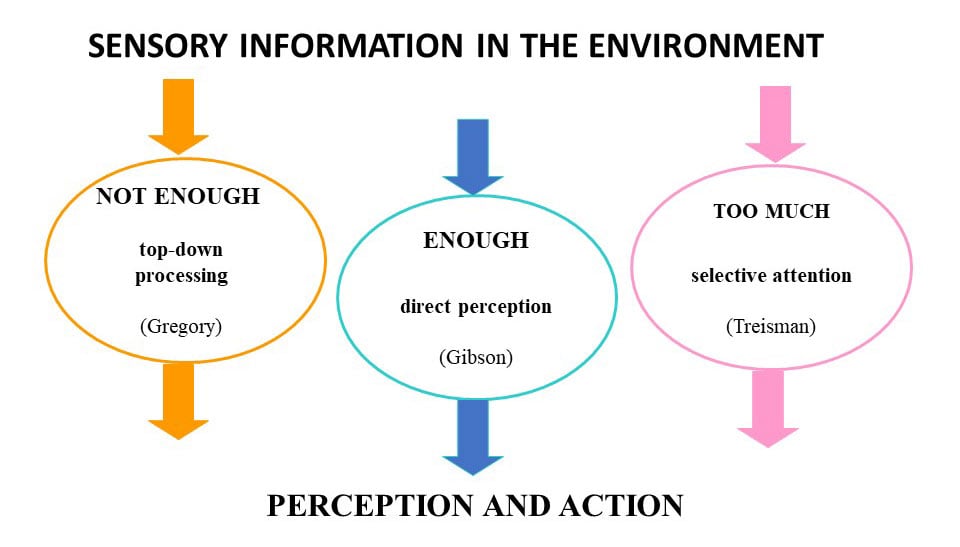
This debate centers on two influential theories. Gibson’s (1966) theory holds that perception is direct, or “bottom-up.” Gregory’s (1970) theory holds that it is constructive, or “top-down.”
Bottom-up processing is also known as data-driven processing because perception begins with the stimulus itself. Processing runs in one direction, from the retina to the visual cortex. Each successive stage in the visual pathway carries out an increasingly complex analysis of the input.
Top-down processing refers to the use of contextual information in pattern recognition. For example, understanding difficult handwriting is easier when reading complete sentences than reading single and isolated words. This is because the meaning of the surrounding words provides a context to aid understanding.
Key Takeaways
Two Theories: Gregory’s top-down theory says perception relies on inference from past knowledge; Gibson’s bottom-up theory says perception picks up information directly from the environment.
Hypothesis Testing: Gregory viewed perception as a hypothesis based on prior experience, explaining why illusions like the Necker cube can flip between two interpretations.
Direct Pick-Up: Gibson argued the optic array carries enough invariant information, like texture gradients and affordances, for us to perceive the world directly, without inference.
Viewing Conditions: Bottom-up processing works best in good, information-rich conditions; top-down processing matters more when a stimulus is brief or ambiguous.
Cross-Cultural Evidence: Classic studies suggested illusion susceptibility varies by upbringing, but a 2025 re-examination found the Müller-Lyer illusion is likely a universal feature of perception.
Real-World Uses: Both theories inform practical fields, from cockpit-display design in aviation to collision-warning systems in cars.
Predictive Processing: Modern research recasts Gregory’s “hypothesis testing” as a measurable balance between prior expectation and sensory evidence, one that shifts further toward priors in psychosis.
Psychologist Richard Gregory (1970) argued that perception is a constructive process that relies on top-down processing.
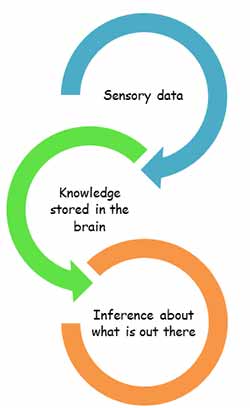
Stimulus information from our environment is often ambiguous. To interpret it, we draw on past experience and stored knowledge to make inferences about what we perceive. Helmholtz called it the ‘likelihood principle’.
For Gregory, perception is a hypothesis which is based on prior knowledge. In this way, we are actively constructing our perception of reality based on our environment and stored information.
Summary
Information Loss: A lot of information reaches the eye, but much is lost by the time it reaches the brain.
Hypothesis Testing: Gregory proposed that we construct our perception of reality by testing hypotheses about what we see, based on past experience and stored knowledge.
Sensory Input: Sensory receptors send information from the environment, which combines with knowledge we’ve built up through experience.
Errors of Perception: Incorrect hypotheses cause perceptual errors, such as visual illusions like the Necker cube.
Evidence for Gregory’s Theory: Illusions and Perceptual Set
Gregory (1983) grouped illusions into four types:
Distortions: geometric illusions such as the Müller-Lyer and Ponzo figures, where a shape is misjudged.
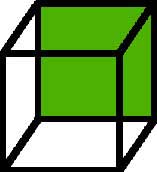
Ambiguous figures: a single pattern that flips between two interpretations, such as the Necker cube.
Paradoxical figures: “impossible” objects, such as the Penrose triangle, that cannot exist in three dimensions.
Fictions: subjective contours, where the brain perceives a boundary that is not physically there.
Highly unlikely objects tend to be mistaken for likely objects. Gregory has demonstrated this with a hollow mask of a face.
Such a mask is generally seen as normal, even when one knows and feels the real mask.
There seems to be an overwhelming need to reconstruct the face, similar to Helmholtz’s description of “unconscious inference.” An assumption based on past experience.
Perceptions can be ambiguous.
The Necker cube is a good example of this. When you stare at the crosses on the cube, the orientation can suddenly change or “flip.”
It becomes unstable, and a single physical pattern can produce two perceptions. The image itself never changes.
Gregory argued that this object appears to flip between orientations because the brain develops two equally plausible hypotheses and is unable to decide between them.
When the perception changes though there is no change in the sensory input, so the change of appearance cannot be due to bottom-up processing. It must be set downwards by the prevailing perceptual hypothesis of what is near and what is far. The brain decides.
Perception allows behavior to be generally appropriate to non-sensed object characteristics.
We respond to certain objects as though they are doors, even when we can only see a long, narrow rectangle because the door is ajar. This confirms that we interpret sensory information rather than simply receiving it: perception is a top-down process.
Misapplied size constancy explains illusions like the Müller-Lyer figure
In the Müller-Lyer illusion, one line has arrow fins pointing inward and the other has fins pointing outward, yet the lines are the same length.
The inward fins resemble the outside corner of a building, making that line seem closer. The outward fins resemble the inside corner of a room, making that line seem farther away.
Because both lines cast the same size retinal image, but one “must” be farther away, size constancy makes the seemingly farther line look longer.
The same logic explains the similar Ponzo illusion, often drawn as a receding railway track.
A problem remains for this account. The illusion persists even when the perspective cues are removed, so apparent size might cause the perceived distance difference rather than the other way around (Robinson, 1972).
Allport (1955) defined perceptual set as a bias or readiness to perceive particular features of a stimulus. Vernon (1955) argued this set acts as both a selector and an interpreter of incoming information. It works both ways.
Our emotions, motivations, and expectations can bias perception through this set. Thirsty people, for example, judge a glass of water to be bigger than it is (Veltkamp et al., 2008).
Similarly, poorer children perceive coins as physically larger than wealthier children do (Bruner & Goodman, 1947), showing that what we need or value can shape what we see.
Critical Evaluation of Gregory’s Theory
1. The Nature of Perceptual Hypotheses
If perception involves hypothesis testing, what kind of hypotheses are they?
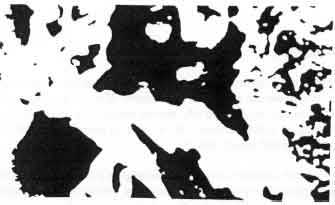
Scientists revise a hypothesis based on the evidence they find. Are perceivers able to revise their hypotheses in the same way? In some cases, the answer is yes, as the figure below shows:
This probably looks like a random arrangement of black shapes. Look closely: there is a hidden face, looking straight ahead from the top half of the picture, in the center.
Can you see it? The figure is strongly lit from the side and has long hair and a beard.
Once you spot the face, rapid perceptual learning takes place. The ambiguous picture now obviously contains a face every time you look at it, because you have learned to perceive the stimulus differently.
Modifying a hypothesis does not always change perception, though. Illusions can persist even when we have full knowledge of them, as with the inverted face (Gregory, 1974).
We might expect that learning the mask is not a “normal” face, for example by touching it, would adaptively update our hypotheses.
Hypothesis-testing theories cannot explain why this learning fails to change what we perceive.
2. Perceptual Development
A perplexing question for constructivists, who see perception as essentially top-down, is “how can the neonate ever perceive?”
If we each construct our own world from past experience, why are our perceptions so similar, even across cultures?
Relying on individual constructs to make sense of the world makes perception a highly individual, chancy process.
The constructivist approach stresses the role of knowledge in perception and therefore is against the nativist approach to perceptual development.
However, substantial evidence favors the nativist approach. Newborn infants show shape constancy (Slater & Morison, 1985). They also prefer their mother’s voice to unfamiliar voices (DeCasper & Fifer, 1980).
Gibson’s own research offers an even more direct nativist demonstration. In the classic visual cliff studies, Gibson and Walk (1960) placed crawling infants on a sheet of thick glass laid over an apparent sudden drop.
Infants refused to cross onto the “deep” side even when their mothers called from across it. Young animals of many species avoided it from virtually their first chance to move about.
3. Sensory Evidence
Perhaps the major criticism of constructivists is that they underestimate the richness of sensory evidence available in the real world. Much of their evidence instead comes from artificial laboratory settings.
Constructivists like Gregory often use size constancy as an example. We correctly perceive an object’s size even though its retinal image shrinks as it recedes.
They argue sensory evidence from other sources must be available to make this possible.
In the real world, though, retinal images are rarely seen in isolation, unlike in the laboratory. A rich array of sensory information, including other objects, background, the horizon, and movement, surrounds every retinal image.
This richness matters for the second major theory of perception: Gibson’s direct approach.
Gibson argues strongly against top-down processing. He criticizes Gregory’s use of visual illusions as evidence, since illusions are artificial and rarely occur in our normal visual environment.
This is crucial because Gregory accepts that misperceptions are the exception rather than the norm. Illusions may be interesting phenomena, but they might not be that informative about the debate.
4. Contemporary Research
Gregory’s idea that “a perceived object is a hypothesis” anticipated a modern research program called predictive processing, or the Bayesian brain hypothesis.
In this view, the brain continuously predicts the causes of its sensory input. It updates those predictions based on the mismatch, or prediction error, with the data it actually receives.
Aim: to test whether people with early psychosis rely more heavily on prior knowledge than sensory evidence when perceiving, a direct test of the predictive-processing extension of Gregory’s theory (Teufel et al., 2015).
Method: participants with early psychosis, psychosis-prone individuals, and healthy controls viewed heavily degraded “Mooney” images, then briefly saw the clear version before viewing the degraded image again.
Results: prior exposure to the clear image boosted recognition of the degraded image far more in the psychosis and psychosis-prone groups than in healthy controls.
Conclusion: perception in early psychosis is shifted toward prior expectation and away from the sensory evidence actually present. This fits computational models in which hallucinations reflect an exaggeration of this normally adaptive process.
This updates Gregory’s account rather than simply confirming it.
Perception is still a weighted guess, but now a measurable, graded balance between prior expectation and incoming evidence. That balance can misfire dramatically, whether briefly in a visual illusion or persistently in a clinical population.
Gibson (1966) and Bottom-Up Processing
Gibson’s bottom-up theory suggests that perception involves innate mechanisms forged by evolution and that no learning is required.
This suggests that perception is necessary for survival – without perception, we would live in a very dangerous environment.
Our ancestors needed it to escape predators. This suggests perception evolved.
James Gibson (1966) argues that perception is direct and not subject to hypothesis testing, as Gregory proposed. There is enough information in our environment to make sense of the world in a direct way.
His theory is sometimes known as the ‘Ecological Theory’ because of the claim that perception can be explained solely in terms of the environment.
For Gibson, sensation just is perception. What you see is what you get. The information we receive about size, shape, and distance is detailed enough for us to interact directly with the environment, with no need for interpretation.
Gibson (1972) argued that perception is a bottom-up process. Sensory information is analyzed in one direction, from simple raw data to increasingly complex processing through the visual system.
Features of Gibson’s Theory
The Optic Array
Gibson’s theory starts with the optic array: the pattern of light reaching the eye. This array contains all the visual information needed for perception, and it is rich in detail.
It gives unambiguous information about the layout of objects in space. Light rays reflect off surfaces and converge into the cornea.
Perception is simply “picking up” this rich information directly, with little or no additional processing. The array changes constantly. It shifts with every movement and with changing light.
According to Gibson, the visual system is built to interpret this shifting input, so we still experience a stable, meaningful world.
The pattern of flow itself carries information about movement. It flows either away from a fixed point or towards it. That point is the array’s invariant.
Flow moving away from the point means you are heading towards it. Flow moving towards the point means you are moving away.
Invariant Features
The optic array contains invariant information that remains constant as the observer moves. Invariants are aspects of the environment that don’t change. They supply us with crucial information.
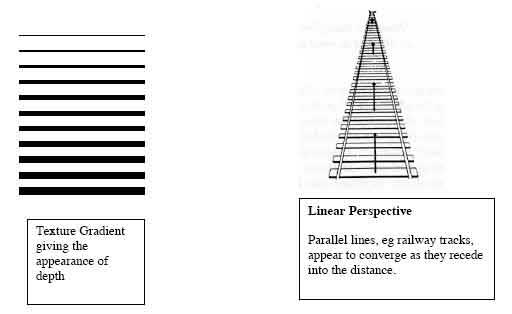
Two good examples of invariants are texture and linear perspective.
Another invariant is the horizon-ratio relation. The ratio above and below the horizon is constant for objects of the same size standing on the same ground.
Gibson also identified several pictorial cues that give direct information about depth and distance.
Relative brightness: objects with brighter, clearer images are perceived as closer.
Texture gradient: the grain of a texture gets smaller as the object recedes, creating an impression of surfaces receding into the distance.
Relative size: as an object moves further away, its image gets smaller, so smaller images are seen as more distant.
Superimposition: if one object’s image blocks another’s, the first object is seen as closer.
Height in the visual field: objects further away generally appear higher in the visual field.
Gibson also proposed affordances: the directly perceivable potential uses an object offers, such as a chair being sit-on-able or a handle being graspable. Affordances let us perceive an object’s function directly, without needing to interpret it.
Evaluation of Gibson’s (1966) Direct Theory of Perception
Gibson’s theory is a highly ecologically valid theory as it puts perception back into the real world.
A large number of applications can be applied in terms of his theory, e.g., training pilots, runway markings, and road markings. It is an excellent explanation for perception when viewing conditions are clear, and it highlights the richness of information in the optic array.
It also explains perception in animals, babies, and humans.
His theory is reductionist. It explains perception solely in terms of the environment, with no role for memory or inference. Marr (1982) argued this seriously underrates the difficulty of the problem: detecting invariants in the optic array is itself a hard information-processing task, not a simple “pick-up.”
Fodor and Pylyshyn (1981) made a related point. Gibson’s theory explains how we see, but not how we see an object as something. Recognizing a pen as writable, for example, requires cultural knowledge no optic array alone can supply. On this point, Gregory’s theory looks more plausible.
Gibson’s theory only supports the nature side of the nature-nurture debate.
Gregory’s theory seems more plausible here. It argues that what we see is not enough on its own; we also draw on stored knowledge, engaging both sides of the debate.
Visual Illusions
Gibson’s emphasis on DIRECT perception provides an explanation for the (generally) fast and accurate perception of the environment. However, his theory cannot explain why perceptions are sometimes inaccurate, e.g., in illusions.
He dismissed experimental illusions as artificial and unlikely to occur in the real world. This dismissal, however, cannot realistically apply to all illusions.
For example, Gibson’s theory cannot account for perceptual errors like the general tendency for people to overestimate vertical extents relative to horizontal ones.
Neither can Gibson’s theory explain naturally occurring illusions. If you stare at a waterfall and then look at a stationary object, for example, the object appears to move in the opposite direction.
Bottom-up or Top-down Processing?
Neither direct nor constructivist theories of perception seem capable of explaining all perceptions all of the time.
Eysenck and Keane (1995) suggest the balance between the two processes depends on the viewing conditions. Bottom-up processing may dominate when conditions are good, while top-down processing becomes important with brief or ambiguous stimuli.
Marr’s (1982) computational theory takes a middle path between the two views, starting by asking what the visual system is actually for.
Gibson’s theory assumes ideal viewing conditions, where stimulus information is plentiful and available for long enough to use. Constructivist theories, like Gregory’s, typically involve viewing under less-than-ideal conditions.
Research by Tulving et al. (1964) manipulated both the clarity of the stimulus input and the impact of the perceptual context in a word identification task. As the clarity of the stimulus (through exposure duration) and the amount of context increased, so did the likelihood of correct identification.
Both factors mattered.
However, as exposure duration increased, the impact of context was reduced. This suggests that when stimulus information is high, the need for other sources of information drops.
Neisser (1976) proposed one theory of how top-down and bottom-up processes interact to produce the best interpretation of a stimulus. He called it the “Perceptual Cycle.”
The Gestalt Approach to Perceptual Organisation
Both Gregory and Gibson had to deal with a question neither theory was built to answer: why does the brain group raw visual elements into organised wholes at all?
Von Ehrenfels (1890) argued that a group of stimuli acquires a pattern quality greater than the sum of its parts.
Wertheimer, Koffka, and Köhler were the Gestalt psychologists. They believed this organisation is largely innate.
One clear example is figure and ground, as in Rubin’s (1915) vase.
The strongest factor deciding which region looks like the figure is simply which one is surrounded by the other.
Koffka (1935) called this the law of prägnanz.
Perceptual organisation, he argued, will always be as good as the prevailing conditions allow.
Roth (1986) called it the most comprehensive account of grouping. Gordon (1989) described it as part of our permanent knowledge of perception.
The laws are not without problems, though.
Greene (1990) called them descriptive, imprecise, and hard to measure. Eysenck (1993) found they do not consistently hold for three-dimensional objects.
Historical Roots of the Debate
Gestalt psychology grew up in early-1900s Germany.
It arose as a revolt against two rival camps.
One was Wundt’s molecularism, which tried to break conscious experience into elementary sensory atoms.
The other was behaviourism, which treated perception as a passive, stimulus-driven affair.
Against both, the Gestaltists insisted the mind actively imposes structure, so we see a meaningful whole rather than a heap of separate dots and lines.
Wholes come first, not parts.
This is usually summed up as “the whole is greater than the sum of its parts.”
The movement’s founding experiment was Max Wertheimer’s (1912) study of apparent motion, the phi phenomenon.
Wolfgang Köhler co-founded the school with Wertheimer and Koffka.
He extended the idea from static form to problem-solving.
His chimpanzee studies (Köhler, 1925) showed animals pausing, apparently restructuring the situation, then reaching a solution in a flash of insight rather than by trial and error.
This matters for the direct/indirect debate because it locates organisation itself as the thing in dispute.
Constructivists treat organisation as something the brain adds. Gibson treated much of it as already given in the optic array.
The Gestalt tradition later fed into the cognitive revolution that produced today’s information-processing theories of perception, including Gregory’s and Gibson’s own.
Cross-Cultural Evidence
If perception is partly a matter of learned inference, as Gregory claims, people raised in different visual environments should perceive some illusions differently.
This prediction has driven over a century of cross-cultural research into visual illusions.
The Carpentered World Hypothesis
Segall, Campbell, and Herskovits (1963) proposed the carpentered world hypothesis. People raised around the straight lines and right angles of Western buildings learn to read flat, two-dimensional cues as three-dimensional corners. The fins of the Müller-Lyer illusion are exactly this kind of cue.
Aim: to test whether people from different visual environments are differently susceptible to geometric illusions, as predicted by the carpentered world hypothesis.
Method: Segall and colleagues compared about 1,800 participants across more than a dozen societies on their susceptibility to the Müller-Lyer and horizontal-vertical illusions.
Results: Western samples were more susceptible to the Müller-Lyer illusion than several African and Filipino samples. Susceptibility to the horizontal-vertical illusion tracked a different factor: exposure to open, vertical vistas.
Conclusion: perceptual “inference habits” appear tuned by the visual environment a perceiver actually lives in, a pattern directly supportive of Gregory’s constructivism. It does not, by itself, prove that inference habits are learned rather than innate.
Overturning the Carpentered World Hypothesis
For decades, this was treated as definitive proof that culture shapes basic visual perception. But later replications proved inconsistent, casting doubt on the strict version of the carpentered world hypothesis.
A comprehensive modern re-examination by Amir and Firestone (2025) has since overturned the strong version of this claim.
Drawing on cross-species comparisons, the statistics of natural scenes, and studies of congenitally blind and cross-modal perceivers, they re-analyzed the original cross-cultural data.
They concluded the Müller-Lyer illusion is better explained as an early, universal feature of perception than as something learned from a carpentered environment.
The evidence here cuts both ways for the direct/indirect debate.
Genuine cross-cultural variation in illusion susceptibility is exactly what Gregory’s theory needs, since a purely hard-wired illusion should not differ by upbringing.
But the classic findings proved unreliable, and the effect survives even in situations where cultural learning could not operate. This evidence should be weighed cautiously, not treated as decisive support for constructivism.
Real-World Applications
Both Gregory’s and Gibson’s theories have shaped practical work far beyond the psychology laboratory.
Four fields put this to direct use:
Aviation: cockpit displays present optic flow so pilots can judge closing speed and glide angle directly. Without it, pilots can misjudge height at night.
Driving: a single optical variable, tau, lets drivers judge time-to-collision directly from optic flow. It now informs forward-collision warnings and automatic braking.
Art and Visual Media: painters, printmakers and filmmakers use pictorial depth cues, such as perspective and overlap, to create convincing three-dimensional depth on a flat surface.
Robotics and Computer Vision: a flying robot guided only by optic-flow sensors, with no distance sensors or internal map, can still avoid obstacles and land safely.
Aviation
Gibson’s own theorizing began with wartime pilot-training films that analyzed optic flow, and the same logic still guides cockpit-display design today.
Making the flow of texture and the point of expansion as informative as possible helps pilots judge their closing speed and glide angle directly.
Kraft (1978) used flight simulators to study the “black hole” illusion. Pilots making a night approach over dark, featureless terrain, with only the runway lights visible, systematically misjudge their height and fly a dangerously low approach.
The sparse, ambiguous optic array is filled in by an inappropriate hypothesis about height and distance. It shows how Gregory’s and Gibson’s theories converge.
The pilot’s visual system picks up optic flow exactly as Gibson describes, but when the environment fails to supply enough information, prior expectations mislead the pilot.
Driving
Lee (1976) showed that a single optical variable, called tau, specifies how much time a driver has before colliding with a hazard.
Tau is the ratio of an object’s retinal image size to its rate of expansion. This lets drivers judge time-to-collision directly from the pattern of optic flow, without computing absolute distance or speed.
No other calculation is needed. This is a thoroughly Gibsonian account of braking: the driver does not consciously calculate distance or speed at all. Tau is picked up directly from the changing pattern of light, exactly the invariant, information-rich variable Gibson’s theory predicts perceivers can use without inference.
This same optical variable, closing rate rather than absolute distance, now informs forward-collision warnings and automatic emergency braking in modern vehicles.
Art and Visual Media
Painters, printmakers, and filmmakers exploit pictorial depth cues, such as linear perspective, overlap, and texture gradient, to create a convincing sense of three-dimensional depth on a flat surface. This runs from Renaissance perspective painting to forced-perspective film sets.
Cutting (1997) analyzed how the depth information in a picture, stereoscopic display, or virtual-reality scene differs from that in ordinary full-cue vision.
Some cues, like perspective and overlap, are preserved, but others, like motion parallax and true binocular disparity, are distorted or missing.
Trompe l’oeil paintings push this furthest, using perspective and shading so precisely that a flat wall can appear to open onto a three-dimensional space.
Both theories have something to say here: Gibson’s cues supply the raw information, while Gregory’s constructive inference explains why the illusion can look like real space.
This is why pictures and virtual environments support surprisingly accurate depth perception, but of a qualitatively different kind from seeing the real three-dimensional world.
Robotics and Computer Vision
Gibson’s claim that action-guiding information can be picked up directly from optic flow, without building a full 3D internal model, has directly inspired robotics.
Franceschini, Ruffier, and Serres (2007) built a small flying robot guided purely by optic-flow sensors modeled on the compound eye of flying insects.
With no distance sensors, GPS, or internal map, the robot took off, cruised between obstacles, and landed using optic flow alone. The insect analogy held. This showed that visually guided behavior can work exactly as Gibson proposed.
This success does not fully settle Marr’s (1982) objection that detecting invariants is itself a hard information-processing problem.
But it shows that, for a genuinely simple visual task like collision avoidance, an insect-like optic-flow strategy can outperform a system built around constructing an internal three-dimensional model.
References
Allport, F. H. (1955). Theories of perception and the concept of structure. Wiley.
Amir, D., & Firestone, C. (2025). Is visual perception WEIRD? The Müller-Lyer illusion and the cultural byproduct hypothesis. Psychological Review. Advance online publication. https://doi.org/10.1037/rev0000549.
Bruner, J. S., & Goodman, C. C. (1947). Value and need as organising factors in perception. Journal of Abnormal and Social Psychology, 42(1), 33–44.
Cutting, J. E. (1997). How the eye measures reality and virtual reality. Behavior Research Methods, Instruments, & Computers, 29(1), 27–36.
Eysenck, M. W., & Keane, M. T. (1995). Cognitive psychology: A student’s handbook (3rd ed.). Lawrence Erlbaum.
Fodor, J. A., & Pylyshyn, Z. W. (1981). How direct is visual perception? Some reflections on Gibson’s “ecological approach”. Cognition, 9(2), 139–196.
Franceschini, N., Ruffier, F., & Serres, J. (2007). A bio-inspired flying robot sheds light on insect piloting abilities. Current Biology, 17(4), 329–335.
Gibson, J. J. (1966). The Senses Considered as Perceptual Systems. Boston: Houghton Mifflin.
Gibson, J. J. (1972). A Theory of Direct Visual Perception. In J. Royce, W. Rozenboom (Eds.). The Psychology of Knowing. New York: Gordon & Breach.
Gregory, R. (1970). The Intelligent Eye. London: Weidenfeld and Nicolson.
Gregory, R. (1974). Concepts and Mechanisms of Perception. London: Duckworth.
Kraft, C. L. (1978). A psychophysical contribution to air safety: Simulator studies of visual illusions in night visual approaches. In H. L. Pick et al. (Eds.), Psychology: From research to practice (pp. 363–385). Plenum Press.
Lee, D. N. (1976). A theory of visual control of braking based on information about time-to-collision. Perception, 5(4), 437–459.
Marr, D. (1982). Vision: A computational investigation into the human representation and processing of visual information. W. H. Freeman.
Neisser, U. (1976). Cognition and reality: Principles and implications of cognitive psychology. W. H. Freeman.
Robinson, J. O. (1972). The psychology of visual illusion. Hutchinson.
Segall, M. H., Campbell, D. T., & Herskovits, M. J. (1963). Cultural differences in the perception of geometric illusions. Science, 139(3556), 769–771.
Slater, A., & Morison, V. (1985). Shape constancy and slant perception at birth. Perception, 14(3), 337-344.
Teufel, C., Subramaniam, N., Dobler, V., Perez, J., Finnemann, J., Mehta, P. R., Goodyer, I. M., & Fletcher, P. C. (2015). Shift toward prior knowledge confers a perceptual advantage in early psychosis and psychosis-prone healthy individuals. Proceedings of the National Academy of Sciences, 112(43), 13401–13406.
Tulving, E., Mandler, G., & Baumal, R. (1964). Interaction of two sources of information in tachistoscopic word recognition. Canadian Journal of Psychology, 18(1), 62–71.
Veltkamp, M., Aarts, H., & Custers, R. (2008). Perception in the service of goal pursuit: Motivation to attain goals enhances the perceived size of goal-instrumental objects. Social Cognition, 26(6), 720–736.
Vernon, M. D. (1955). The functions of schemata in perceiving. Psychological Review, 62(3), 180–192.
BSc (Hons) Psychology, MSc Psychology of Education
Associate Editor for Simply Psychology
Olivia Guy-Evans is a writer and associate editor for Simply Psychology, where she contributes accessible content on psychological topics. She is also an autistic PhD student at the University of Birmingham, researching autistic camouflaging in higher education.
BSc (Hons) Psychology, MRes, PhD, University of Manchester
Saul McLeod, PhD, is a qualified psychology teacher with over 18 years of experience in further and higher education. He has been published in peer-reviewed journals, including the Journal of Clinical Psychology.