Perceptual set in psychology refers to a mental predisposition or readiness to perceive stimuli in a particular way based on previous experiences, expectations, beliefs, and context. It influences how we interpret and make sense of sensory information, shaping our perception and understanding of the world.
Perceptual set theory stresses the idea of perception as an active process involving selection, inference, and interpretation (known as top-down processing).
Perceptual set is a tendency to perceive or notice some aspects of the available sensory data and ignore others. According to Vernon (1955), perceptual set works in two ways:
- Selector: the function of set that directs attention to particular aspects of the sensory data. Expectations act as a filter on the input.
- Interpreter: the function of set that makes sense of what was selected. The perceiver classifies it, names it and draws inferences from it.
A doctor reading an X-ray shows both functions at work. Years of training send the doctor’s attention straight to the clinically relevant region. The doctor then classifies the pattern as a fracture, a shadow or normal tissue. A layperson sees only grey noise.
It has been found that a number of variables, or factors, influence perceptual set, and set in turn influences perception. The factors include:
- Perceiver variables: internal to the perceiver, such as expectation, motivation, emotion, past experience, culture and individual differences.
- Stimulus variables: external factors, such as the context of a display and the instructions given.
Both types act on perception indirectly. Context and instructions first shape the perceiver’s set, and set then shapes what is perceived.
Expectation and Perceptual Set
(a) Bruner and Minturn (1955) showed that context creates an expectation. They placed one ambiguous figure among letters, then among numbers (see below).
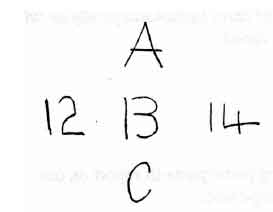
The physical stimulus is the same in both rows, yet people see it differently.
- Aim: To test whether the surrounding context alone decides how an ambiguous figure is categorised.
- Method: Participants briefly saw the same character flanked by letters or flanked by numbers. They reported what they saw.
- Results: The character was read as the letter B among letters and as the number 13 among numbers.
- Conclusion: The input never changed, so the perceiver generated the difference. Context created an expectation: a letter among letters, a number among numbers.
(b) We may fail to notice printing/writing errors for the same reason. For example:
1. “The Cat Sat on the Map and Licked its Whiskers”.
2.
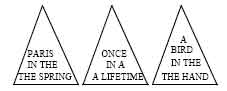
(a) and (b) are examples of interaction between expectation and past experience.
(c) Bugelski and Alampay (1961) also showed expectation inducing set. They used the “rat-man” figure. It is an ambiguous drawing that can be seen as a rat or as a bald, bespectacled man’s face.
One group of participants first saw a series of animal pictures. A control group saw neutral pictures instead. Both groups then viewed the ambiguous figure.
Participants who had seen the animal pictures were significantly more likely to see a rat. Set can form within minutes, from very recent experience alone.

Bruner and Postman (1949): Anomalous Playing Cards
Familiar objects set strong expectations. Bruner and Postman (1949) tested how those lifelong expectations shape the perception of stimuli that quietly break them.
- Aim: To investigate how expectations built from experience with playing cards affect perception of cards that violate them.
- Method: Participants viewed cards one at a time for increasingly longer exposures. Hidden among normal cards were trick cards with colour and suit swapped, such as a red six of spades.
- Results: Most participants “normalised” the trick cards without noticing anything wrong, and 27 of 28 did so on at least one card. Trick cards needed longer exposures than normal cards.
- Conclusion: Perception resists information that conflicts with expectation. Only when the mismatch becomes too large does the correct percept break through.
The study has been challenged. Horner and Tung (2011) replicated it and found that participants identified trick and regular cards equally well when each type appeared in its own set. They argued that this is inconsistent with resistance to incongruity.
Motivation / Emotion and Perceptual Set
Allport (1955) has distinguished 6 types of motivational-emotional influence on perception:
(i) bodily needs (e.g. physiological needs)
(ii) reward and punishment
(iii) emotional connotation
(iv) individual values
(v) personality
(vi) the value of objects.
Hunger and Perceptual Set
(a) Sanford (1936) deprived participants of food for up to about four hours, then showed them ambiguous pictures. The longer participants had gone without food, the more likely they were to describe the pictures in food-related terms.
A bodily need shaped what people saw in ambiguous material.
Similarly Gilchrist & Nesberg (1952), found participants who had gone without food for the longest periods were more likely to rate pictures of food as brighter. This effect did not occur with non-food pictures.
Wishful Seeing
Motivation can even change perceived distance. Picture two people judging how far away a bottle of water is. One is thirsty after eating salty pretzels, the other is not. The thirsty person reliably judges the bottle to be closer.
- Aim: To test whether desire for an object distorts its perceived physical distance, not only its later interpretation.
- Method: Across five experiments, participants judged the distance to desirable and less desirable objects, such as water for thirsty participants and money they could win. Judgements were verbal or behavioural, such as underthrowing a beanbag.
- Results: Desired objects were consistently judged to be closer than less desired objects, in words and in actions.
- Conclusion: Goal states shape perception itself. Seeing desired objects as closer may energise people to approach them.
Balcetis (2014) describes wishful seeing as robust. It occurs outside conscious control, and “wishes, hopes and desires affect what people see quickly and without their awareness.”
Related findings point the same way:
- Poverty: coins appear larger to poor people (Bruner & Goodman, 1947).
- Powerlessness: money looms larger to the powerless (Dubois et al., 2010).
- Goal pursuit: people most motivated to reach a finish line or a mountain top see the environment as less extreme (Cole et al., 2013).
Emotion Without Awareness: Kunst-Wilson and Zajonc (1980)
(b) Kunst-Wilson and Zajonc (1980) studied how emotion affects perception below the level of awareness. They repeatedly showed participants geometric figures too briefly for anyone to recognise them.
- Aim: To test whether liking for a stimulus can arise even when the stimulus cannot be consciously recognised.
- Method: Participants repeatedly saw geometric shapes too briefly to be recognised. On test trials they saw one old and one new shape, and judged which was old (recognition) and which was more attractive (feeling).
- Results: Participants could not tell old shapes from new ones. They still preferred the old shapes significantly more often than chance.
- Conclusion: Information unavailable for conscious recognition seems to be available to an unconscious system linked to affect and emotion.
The hypothesis drew on the mere exposure effect. The more we are exposed to a stimulus, the more familiar we become with it and the more we like it. This study showed that the liking can arise without any recognition.
Stereotypes as Perceptual Set: Payne (2001)
A stereotype can act as a perceptual set. Payne (2001) tested whether a racial stereotype biases the split-second identification of an object as a weapon.
- Aim: To test whether racial primes bias the rapid identification of guns versus tools, and whether any bias is automatic or controlled.
- Method: Participants saw a Black or White face, then a handgun or hand tool, and decided as fast as possible which it was. In Experiment 2 they responded under time pressure.
- Results: Guns were identified faster after a Black face (Experiment 1). Under time pressure, tools were mistaken for guns more often after a Black face (Experiment 2).
- Conclusion: The prime shaped automatic processing, not deliberate control. A stereotype can bias perceptual categorisation automatically and rapidly.
This matters outside the laboratory. Eyewitnesses and police officers often judge ambiguous objects under stress and time pressure. That leaves little room for controlled processing to override an automatic set.
Culture and Perceptual Set
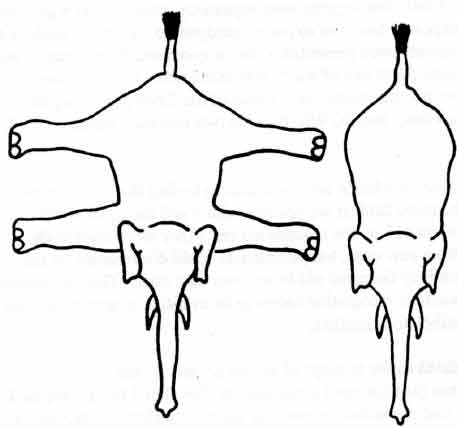
Elephant drawing split-view and top-view perspective. The split elephant drawing was generally preferred by African children and adults .
Split-Style Drawings: Deregowski (1972)
(a) Deregowski et al. (1972) investigated whether pictures are seen and understood in the same way in different cultures. Their findings suggest that perceiving perspective in drawings is a specific cultural skill. It is learned, not automatic.
Participants from several cultures preferred drawings that don’t show perspective. Instead, these split-style drawings show both sides of an object at the same time.
One study found a fairly consistent preference among African children and adults for split-type drawings over perspective drawings. Split-type drawings show all the important features of an object, even ones that could not normally be seen at once. Perspective drawings give just one view.
Deregowski argued that split-style representation is universal. European children use it too, before they are taught differently.
Pictorial Depth Perception: Hudson (1960)
(b) Hudson (1960) noted difficulties among South African Bantu workers in interpreting depth cues in pictures.
Depth cues convey spatial relationships between objects. A person who uses them extracts a different meaning from a picture than a person who does not.
Hudson tested pictorial depth perception with a picture like the one below. It contains two depth cues. These are overlapping objects and the known size of objects.
A correct interpretation is that the hunter is trying to spear the antelope, which is nearer to him than the elephant. An incorrect interpretation is that the elephant is nearer and about to be speared.
Questions were asked in the participants’ native language, such as:
What do you see?
Which is nearer, the antelope or the elephant?
What is the man doing?
The results indicated that both children and adults found it difficult to perceive depth in the pictures. Performance improved with schooling and exposure to pictures.

The cross-cultural studies seem to show that history and culture shape how we perceive our environment.
Perceptual set concerns the active nature of perception. The factors that affect it, and the strength of their effect, may therefore differ between cultures.
Evaluation and Applications of Perceptual Set
Perceptual Set and Theories of Perception
Perceptual set is a clear example of top-down processing. Knowledge, expectation and motivation shape what we see, exactly as Gregory’s (1966) constructivist theory requires. It is one of the strongest lines of support for that indirect view of perception.
The findings are harder for Gibson’s (1979) direct theory. Gibson argued that the pattern of light reaching the eye holds enough information for direct perception. Yet a thirsty and a non-thirsty person viewing the same bottle do not judge the same distance.
A direct theorist can reply that set effects concentrate in brief, ambiguous or degraded displays. Gibson’s theory was never meant to cover those.
Neisser’s (1976) perceptual-cycle model offers a middle position. An existing schema directs exploration, the sensory sample then modifies the schema, and the updated schema directs the next exploration. Bottom-up sampling and top-down set become two phases of one loop.
This fits the playing-card results. An established set resists the anomalous card until enough disconfirming evidence forces the schema to update.
Limits of the Classic Evidence
The classic demonstrations use brief, deliberately impoverished stimuli, unlike the information-rich scenes of everyday life. Critics argue that relying on them makes perception look more unreliable than it is.
Set distortions may be largely confined to ambiguous, brief or degraded stimuli. There, bottom-up information is weakest. Top-down expectation therefore has the most work to do.
The criticism is only partial. Pammer et al. (2018, below) found a comparable set-driven detection failure in realistic photographs of driving scenes.
The cross-cultural evidence needs care too. Early picture-perception studies risked treating an unfamiliar test format as a perceptual deficit. Jahoda and McGurk (1974) replicated pictorial depth-perception tasks across cultures. Their results suggest that much of the apparent difficulty reflects unfamiliarity with picture testing itself.
Performance improved with familiarisation and varied with schooling. The more defensible reading is that perceptual set is culturally acquired. It does not show one culture’s perception to be more accurate than another’s.
Contemporary Research
Two recent literatures update the classic demonstrations. One pools dozens of studies on stereotype-driven bias. The other extends set research to a high-stakes, real-world detection failure.
Shooter Bias: Mekawi and Bresin (2015)
Payne’s (2001) priming study prompted many first-person shooting simulations. These test whether a target’s race biases the speed and accuracy of shoot or don’t-shoot decisions. Mekawi and Bresin (2015) meta-analysed this inconsistent literature.
- Aim: To establish how robust the effect of target race is across the shooter-bias literature, and what moderates it.
- Method: A meta-analysis of 42 studies using shooting tasks. It analysed reaction time, response threshold and error rates separately, and tested moderators such as state gun laws and local racial composition.
- Results: Participants were quicker to shoot armed Black than armed White targets, and slower to withhold shooting at unarmed Black targets. They did not falsely shoot unarmed Black targets significantly more often.
- Conclusion: Racial stereotypes reliably speed and shift threat-related decisions. They produce outright misidentification less consistently.
The pooled picture is more qualified than any single dramatic demonstration. A meta-analysis that reveals genuine variation is worth more than a head-count of striking findings.
Looked but Failed to See: Pammer et al. (2018)
Set also shapes everyday, safety-critical detection. Pammer, Sabadas and Lentern (2018) asked whether inattentional blindness explains “looked but failed to see” motorcycle crashes. Inattentional blindness is failing to notice a visible object because attention is elsewhere.
- Aim: To test whether inattentional blindness explains crashes in which drivers look directly at a motorcycle but fail to see it.
- Method: Participants viewed photographs of driving scenes in which an extra object, a taxi or a motorcycle, sometimes appeared. Later experiments varied the object’s threat value.
- Results: Participants were twice as likely to miss a motorcycle as a taxi. When the threat value rose, they adjusted their attention and detected motorcycles better.
- Conclusion: Motorcycles rank low in a typical driver’s attentional set, so drivers often miss them. Changing road users’ expectations could reduce these crashes.
Real-World Examples of Perceptual Set
The same mechanism operates outside the laboratory:
- Eyewitness testimony: expectation, stereotype or recent priming can bias how a witness or officer interprets an ambiguous object under stress and with little exposure time.
- Clinical diagnosis: in Rosenhan’s (1973) study, staff read pseudopatients’ ordinary behaviour, such as note-taking, through the diagnostic label.
- Advertising: Karremans et al. (2006) found that subliminal brand priming raised choice of that brand only among thirsty participants. Motivation gated whether the marketing stimulus worked at all.
- Road safety: drivers look at motorcycles without seeing them, so campaigns aim to raise motorcycles’ salience rather than telling drivers to look harder.
Forensic reforms, such as slower identification decisions and structured lineups, aim to give controlled processing time to override an automatic set.
Key Takeaways
- Definition: perceptual set is a readiness to perceive some features of a stimulus and ignore others, shaped by experience, expectation, motivation and context.
- Two Functions: Vernon (1955) proposed that set selects what we attend to and then interprets it.
- Expectation: the same ambiguous figure reads as a letter among letters and a number among numbers (Bruner & Minturn, 1955).
- Motivation: hunger and thirst change what people see, and desired objects look closer (Sanford, 1936; Balcetis & Dunning, 2010).
- Culture: reading perspective and depth cues in pictures is learned, not automatic (Hudson, 1960; Deregowski et al., 1972).
- Examples: set helps explain why drivers miss motorcycles and why stereotypes can bias weapon identification.
- Modern Evidence: a meta-analysis found racial stereotypes speed threat decisions more reliably than they cause misidentification (Mekawi & Bresin, 2015).
References
Allport, F. H. (1955). Theories of perception and the concept of structure. Wiley.
Balcetis, E. (2014). Wishful seeing. The Psychologist, 27(1), 22–25.
Balcetis, E., & Dunning, D. (2010). Wishful seeing: More desired objects are seen as closer. Psychological Science, 21(1), 147–152. https://doi.org/10.1177/0956797609356283
Bruner, J. S., & Goodman, C. C. (1947). Value and need as organizing factors in perception. Journal of Abnormal and Social Psychology, 42(1), 33–44. https://doi.org/10.1037/h0058484
Bruner, J. S., & Minturn, A. L. (1955). Perceptual identification and perceptual organization. Journal of General Psychology, 53(1), 21–28. https://doi.org/10.1080/00221309.1955.9710133
Bruner, J. S., & Postman, L. (1949). On the perception of incongruity: A paradigm. Journal of Personality, 18(2), 206–223. https://doi.org/10.1111/j.1467-6494.1949.tb01241.x
Bugelski, B. R., & Alampay, D. A. (1961). The role of frequency in developing perceptual sets. Canadian Journal of Psychology, 15(4), 205–211. https://doi.org/10.1037/h0083443
Cole, S., Balcetis, E., & Zhang, S. (2013). Visual perception and regulatory conflict: Motivation and physiology influence distance perception. Journal of Experimental Psychology: General, 142(1), 18–22. https://doi.org/10.1037/a0027882
Deregowski, J. B., Muldrow, E. S., & Muldrow, W. F. (1972). Pictorial recognition in a remote Ethiopian population. Perception, 1(4), 417–425. https://doi.org/10.1068/p010417
Dubois, D., Rucker, D. D., & Galinsky, A. D. (2010). The accentuation bias: Money literally looms larger (and sometimes smaller) to the powerless. Social Psychological and Personality Science, 1(3), 199–205. https://doi.org/10.1177/1948550610365170
Gibson, J. J. (1979). The ecological approach to visual perception. Houghton Mifflin.
Gilchrist, J. C., & Nesberg, L. S. (1952). Need and perceptual change in need-related objects. Journal of Experimental Psychology, 44(6), 369–376. https://doi.org/10.1037/h0061823
Gregory, R. L. (1966). Eye and brain: The psychology of seeing. Weidenfeld & Nicolson.
Horner, J. M., & Tung, S. K. (2011). Playing cards with Thomas Kuhn: A critical reexamination of the Bruner and Postman (1949) experiment. Review of General Psychology, 15(2), 175–185. https://doi.org/10.1037/a0023597
Hudson, W. (1960). Pictorial depth perception in sub-cultural groups in Africa. Journal of Social Psychology, 52(2), 183–208. https://doi.org/10.1080/00224545.1960.9922077
Jahoda, G., & McGurk, H. (1974). Development of pictorial depth perception: Cross-cultural replications. Child Development, 45(4), 1042–1047. https://doi.org/10.2307/1128092
Karremans, J. C., Stroebe, W., & Claus, J. (2006). Beyond Vicary’s fantasies: The impact of subliminal priming and brand choice. Journal of Experimental Social Psychology, 42(6), 792–798. https://doi.org/10.1016/j.jesp.2005.12.002
Kunst-Wilson, W. R., & Zajonc, R. B. (1980). Affective discrimination of stimuli that cannot be recognized. Science, 207(4430), 557–558. https://doi.org/10.1126/science.7352271
Mekawi, Y., & Bresin, K. (2015). Is the evidence from racial bias shooting task studies a smoking gun? Results from a meta-analysis. Journal of Experimental Social Psychology, 61, 120–130. https://doi.org/10.1016/j.jesp.2015.08.002
Necker, L. (1832). LXI. Observations on some remarkable optical phenomena seen in Switzerland; and on an optical phenomenon which occurs on viewing a figure of a crystal or geometrical solid . The London and Edinburgh Philosophical Magazine and Journal of Science, 1 (5), 329-337.
Neisser, U. (1976). Cognition and reality: Principles and implications of cognitive psychology. W. H. Freeman.
Pammer, K., Sabadas, S., & Lentern, S. (2018). Allocating attention to detect motorcycles: The role of inattentional blindness. Human Factors, 60(1), 5–19. https://doi.org/10.1177/0018720817733901
Payne, B. K. (2001). Prejudice and perception: The role of automatic and controlled processes in misperceiving a weapon. Journal of Personality and Social Psychology, 81(2), 181–192. https://doi.org/10.1037/0022-3514.81.2.181
Rosenhan, D. L. (1973). On being sane in insane places. Science, 179(4070), 250–258. https://doi.org/10.1126/science.179.4070.250
Sanford, R. N. (1936). The effects of abstinence from food upon imaginal processes: A preliminary experiment. Journal of Psychology, 2(1), 129–136. https://doi.org/10.1080/00223980.1936.9917447
Vernon, M. D. (1955). The functions of schemata in perceiving. Psychological Review, 62(3), 180–192. https://doi.org/10.1037/h0042425
Why people should be skeptical when evaluating the accuracy of their perceptual set?
People should be skeptical when evaluating the accuracy of their perceptual set because it can lead to biased and subjective interpretations of reality. It can limit our ability to consider alternative perspectives or recognize new information that challenges our beliefs. Awareness of our perceptual sets and actively questioning them allows for more open-mindedness, critical thinking, and a more accurate understanding of the world.

