Iconic memory is the visual sensory memory register which stores visual images after the extinction of a physical stimulus. While iconic memory contains a huge capacity, it declines rapidly.
Information stored in iconic memory generally disappears within half a second (depending on the brightness).
Iconic memory is a sensory memory component involving a fast-decaying visual information store (Sperling, 1960). It provides a coherent yet fleeting representation of our visual perception (Pratte, 2018).
Aristotle was among the earliest individuals to have documented the persistence of a visual representation of an object following its physical extinction (Allen, 1926). He pointed out that experiencing a dream involves afterimages.
In the 18th and 19th centuries, the trail of light left by a glowing ember on a moving stick fascinated many researchers. They studied the effect closely. It was later called visible persistence (Coltheart, 1980).
In 1960, the American cognitive psychologist George Sperling confirmed, through several experiments, the capacity and duration of visual sensory memory (Sperling, 1960).
Seven years later, Ulric Neisser introduced the term ‘iconic memory’ to refer to this fast-decaying store of memory (Neisser, 1967).
Today, researchers treat two kinds of persistence as fundamentally distinct. Visible persistence is the lingering impression of an image. Informational persistence is the stored content that can still be read out. It is thought to feed visual short-term memory (Coltheart, 1980; Irwin & Yeomans, 1986).
Examples of Iconic Memory
Following are some examples of iconic memory:
- Lights Out: After you switch off a bedroom light, the room seems to linger for a split second. That fading impression is iconic memory.
- Passing Billboard: Driving past a huge billboard, you take in more than you can report. Only what you attend to reaches short-term memory.
- Train Window: A lamb grazing in a meadow flashes past the window. For a moment you hold the whole scene, though only a few details last.
- Lightning Flash: A flash of lightning lights up a dark, rainy night. The scene stays vivid for a moment, then fades unless you attend to it.
- Sparkler Trail: Swing a lit sparkler in the dark and you see a trail of light, not a single point, because each position lingers into the next.
- Number Plate: Glancing at a fast-moving car, you can read off a digit or two more of its number plate than you consciously registered, before the trace fades.
In each case, the image fades within about half a second unless attention picks out part of it.
Sperling’s Experiments
In 1960, Sperling flashed arrays of letters for about 50 milliseconds (Sperling, 1960). He used a tachistoscope, a device that shows images for precisely controlled, very short times.
Observers felt they had seen far more. Yet they could name only four or five items. Was that a limit on what is taken in, or on what can be read out before the image fades?
Whole Report vs Partial Report
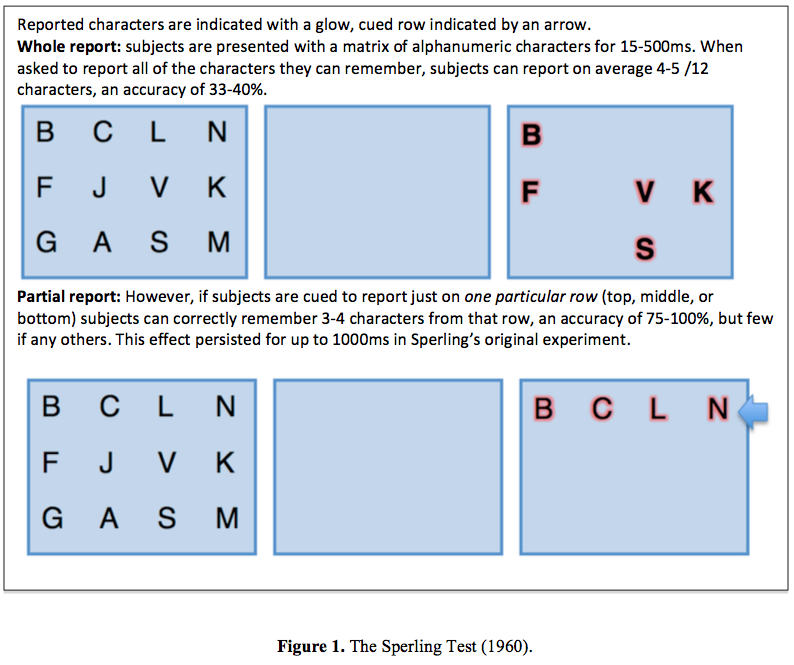
Sperling compared two conditions. In the whole report condition, participants had to recall elements according to their original spatial positions.
In the partial report condition, participants reported only one row. A high, medial, or low tone sounded just after the display vanished, signalling the top, middle or bottom row. Sperling also varied how long the tone was delayed.
The tone came after the display had gone.
Participants could not know which row they would need, so they had to hold every row. Accuracy on the cued row was therefore a random sample of their memory for the whole display.
That design sidesteps the read-out problem. Whole report forces observers to name letters one at a time while the image decays.
What Sperling’s Results Showed
- Aim: To measure how much visual information is available just after a brief display, and whether the 4–5 item limit reflects storage or read-out.
- Method: Observers saw 12 letters (three rows of four) for about 50 milliseconds. A tone then cued the top, middle or bottom row, at delays from 0 to about 1 second.
- Results: Whole report gave about 4–5 letters (35%), but immediate partial report reached about 75% on the cued row: roughly 9 of 12 letters available. The advantage faded within a quarter to half a second.
- Conclusion: A large-capacity visual store briefly holds far more than can be reported. The 4–5 item limit reflects slow read-out, not what was registered.
Under whole report, participants recalled about 35% of the characters on display (Sperling, 1960). That suggests whole report is restricted by a memory system with a capacity of 4 to 5 objects.
Under partial report, participants correctly reported about 75% of the letters in whichever row was cued, roughly three of four. The cue was unpredictable. So three-fourths of the whole display must have remained accessible to memory.
That outcome signified a manifest increase in iconic memory’s hypothesized capacity. By the time participants had named four or five letters, the rest of the image had decayed.
Partial report was a clever solution to a measurement problem. It samples the store before it decays. Researchers have replicated it for more than sixty years.
The method has limits, though. Naming letters is slow, so it may underestimate how long the information lasts. With a simpler same/different judgement, integrated visual information stayed usable for up to about 1,600 milliseconds (Landman, Spekreijse & Lamme, 2003).
Later Experiments on Iconic Memory
Sperling’s method was soon extended. Later experiments showed that the icon can be erased, and that “the icon” is not one thing.
Averbach and Coriell’s Bar-Probe Study
Sperling cued a whole row with a tone. Averbach and Coriell (1961) cued a single letter with a visual marker. They found that the icon can be wiped out as well as fade.
- Aim: To measure the visual store’s duration more precisely, and to test how a following stimulus affects an item held in the icon.
- Method: Observers saw 16 letters (two rows of eight) for 50 milliseconds. A marker then indicated one letter, either a bar above its position or a circle around it, at varying delays.
- Results: With the bar, accuracy fell as the delay lengthened, implying letters stayed available for about 250 milliseconds. The circle often “erased” the letter it enclosed, most strongly at short but non-zero delays.
- Conclusion: The icon lasts about a quarter of a second and is maskable: a later stimulus in the same place can overwrite it.
This erasure is now called metacontrast masking: a later stimulus suppresses an earlier one. The icon is a buffer that fresh input updates.
That updating helps explain why we rarely notice the disruption caused by our own eye movements. A blank can hide a change for the same reason.
Like Sperling’s, the method relies on artificial brief displays. Its duration estimate also depends on stimulus brightness and masking conditions.
Visible vs Informational Persistence
Coltheart (1980) argued that Sperling’s “icon” had fused two properties that should be measured separately.
- Visible persistence: the felt experience that a bright stimulus keeps being seen for a moment after it stops, like a sparkler’s trail.
- Informational persistence: the continued availability of readable content that a cue can still pull out. This drives partial-report superiority.
The two come apart on the inverse-duration effect. A longer or brighter stimulus produces a shorter visible afterimage, the opposite of what a simple “the image fades away” account predicts.
Informational persistence shows no such effect. If two properties obey different laws, they cannot be the same store.
Partial-report superiority therefore reflects informational persistence. The everyday sense of a lingering picture is a separate phenomenon, closer to early sensory processing than to memory. Much later work avoids the single word “icon” and speaks of separable forms of visual persistence.
Di Lollo’s Temporal Integration Studies
Di Lollo (1980) independently found the inverse-duration effect. He tied it to neural processing rather than passive storage.
- Aim: To test whether visible persistence decays with time since the stimulus ended, or depends on the duration of the stimulus itself.
- Method: Observers combined two halves of a dot pattern shown in quick succession (temporal integration), or saw a target after a leading mask (forward masking). The leading display’s duration varied.
- Results: Longer leading displays produced shorter persistence in both tasks. Integration broke down once the leading half exceeded about 100 milliseconds, and forward masking weakened as the mask lengthened.
- Conclusion: Visible persistence reflects ongoing neural processing triggered by stimulus onset, not the draining of a passive store.
With Coltheart (1980), Di Lollo split “the icon” in two. One part is a brief, onset-locked visible persistence that behaves like early neural activity. The other is a longer, more abstract informational persistence that feeds visual short-term memory.
Like the rest of the field, these studies used simple laboratory patterns rather than natural scenes.
Iconic Memory and Change Blindness
Change blindness is the phenomenon whereby an alteration to a visual scene escapes the observer’s notice (Becker, Pashler & Anstis, 2000). In experiments, two versions of a scene appear in quick succession, and the second is slightly altered. The gap between them is the interstimulus interval.
The longer that interval, the more the icon fades. Iconic memory is what enables the detection of changes in a visual scene (Persuh, Genzer & Melara, 2012), so lapses become more likely as the interval grows.
Becker et al. (2000) tested this directly.
Change detection across a blank interval improved markedly when the changed location was cued during the blank. This implies that a rich copy of the first scene is briefly held, but the second scene overwrites it unless attention protects it.
Neurology Related to Iconic Memory
The retina’s photoreceptors, the retinal ganglion cells, the middle occipital gyrus, proteins in the brain and various genetic factors impact the functioning of iconic memory.
The visual sensory pathway plays a vital role in iconic memory. Persistence occurs at several stages, from the retina to the visual cortex.
The retina’s photoreceptors, namely rods and cones, remain active beyond a stimulus’ physical offset (Irwin & Thomas, 2008). Retinal ganglion cells keep responding too. In cats, a ganglion cell responds for roughly 50 to 70 milliseconds however brief the flash (Levick & Zacks, 1970).
The transient M-type cells and the sustained P-type cells of the retinal ganglion cells are also involved (Levick & Zacks, 1970). While the former are active solely during stimulus onset and offset, the latter are active even in between.
This retinal activity supports the lingering visual impression.
The earliest, richest phase of iconic memory disappears under isoluminant conditions, where a stimulus and its background match in brightness. A bright light mask has the same effect. Both suppress the afterimage (Sligte, Scholte & Lamme, 2008).
The cortex keeps a trace too.
In the primary visual cortex, information about a brief stimulus can still be read from neural activity several hundred milliseconds after it ends. A new stimulus does not immediately erase it (Nikolić, Häusler, Singer & Maass, 2009).
The middle occipital gyrus, another occipital region, is also implicated in the change detection that iconic memory supports.
Genes matter too. A common variant of the BDNF gene (Val66Met) affects how brain cells release a protein that supports neural signalling.
It is linked to differences in how stable stored information is over time. People with the Val/Val genotype show more stable storage (Beste, Schneider, Epplen & Arning, 2011).
Critical Evaluation of Iconic Memory
Iconic memory is one of the most securely established ideas in cognitive psychology. Its difficulties mostly arise from its position on the border between perception and memory.
Strengths of the Evidence
The evidence rests on several methods that agree, not on a single paradigm.
- Elegant core evidence: Sperling’s (1960) partial-report technique recovers the store’s true capacity by sampling it before it decays. It has been replicated and extended for over sixty years.
- Converging methods: Partial report (Sperling, 1960), bar-probe and masking (Averbach & Coriell, 1961), temporal integration (Di Lollo, 1980) and change-detection cueing (Becker et al., 2000) point the same way.
- Neural recordings: Retinal ganglion cells and visual cortex both show signals that outlast the stimulus (Levick & Zacks, 1970; Nikolić et al., 2009).
That convergence is why the existence of a brief visual store is rarely disputed. The live arguments concern its structure, its limits and what it should be called.
Measurement and Ecological Validity
Sperling’s genius was to separate what is stored from what can be reported. Yet reading out the store is itself slow, and it may distort the estimate.
Naming letters is effortful and serial, so it can underestimate how long usable information persists. Landman et al. (2003) used a simpler same/different response. They found integrated visual information available for up to about 1,600 milliseconds.
The classic figure is about 250 milliseconds. Even the store’s duration therefore depends partly on how it is probed.
The paradigms are also artificial. Tachistoscopic arrays of unrelated letters and cued single-item read-out bear little resemblance to natural viewing of meaningful, cluttered, moving scenes. It is unclear how far the neat duration estimates generalise.
The same caution applies to a popular claim about film. Films do not look continuous simply because images persist on the retina.
Persistence and flicker fusion (the point at which rapid flashes blur into steady light) help remove flicker. But specialised motion detectors are now credited with apparent motion.
Memory, Perception or Attention?
A deeper worry is whether iconic memory is a true memory store at all. It may be the tail end of perception: receptors and early visual neurons that keep firing after the stimulus stops.
Several features support that view. The icon resembles a retinal afterimage (Levick & Zacks, 1970; Sligte et al., 2008). It is pre-categorical, cannot be rehearsed and lies outside voluntary control. Coltheart (1980) added that the lingering picture and the readable information obey different laws.
Memory or perception? It is partly a matter of definition.
Attention complicates the picture further. Sperling treated the icon as a complete, automatic snapshot. Yet heavy attentional load during the display pushes detailed content to near chance in partial report and change detection (Persuh, Genzer & Melara, 2012). Only a coarse gist survives.
This suggests that building a rich, reportable icon requires attention. The truly pre-attentive trace is coarser than the “literal copy” metaphor implies.
Contemporary Research
Modern work no longer asks whether a brief visual store exists. It asks how information is lost from the icon, and what modulates it. Most of this evidence comes from small-sample laboratory studies, not meta-analyses or large replications. So individual findings carry less weight than a meta-analysis would.
Sudden Death, Not Gradual Fading
Pratte (2018) challenged the intuitive idea that the icon simply fades.
- Aim: To test whether iconic memory is lost by gradual loss of precision across all items, or by the sudden, all-or-none loss of whole items.
- Method: Observers viewed arrays of simple oriented items and, after variable delays, reported a probed item’s feature on a continuous scale. Mixture modelling, a statistical technique, separated the probability an item was retained from the precision of retained items.
- Results: As the delay lengthened, whole items were lost and capacity fell sharply. The precision of the surviving items was only marginally affected.
- Conclusion: Iconic decay is the discrete loss of individual items, not the graceful degradation of a continuous trace.
This is rigorous, model-based work. Its continuous-report design answers the objection that verbal read-out contaminates the estimate.
Its limits are simple, artificial arrays and a modest sample. It also bears on, rather than settles, the debate over whether visual working memory has a discrete-capacity limit or a continuous resource.
A Componential Trace
A parallel strand argues that the visual register has parts. Cappiello and Zhang (2016) compared models on continuous-estimation data.
A dual-trace account fit better than a single trace plus guessing. It proposes a fine-grained trace carrying continuous perceptual detail and a coarse-grained trace carrying categorical information, decaying at different rates.
This echoes Sligte et al. (2008), who found three separable stages. Iconic memory is overwritten by light masks. Fragile visual short-term memory lasts about 4 seconds and is overwritten by pattern masks but not light. Robust visual working memory holds about four items.
Read with Pratte (2018), this suggests visual information is lost in components. Item availability, item precision, and fine and coarse detail are shed separately.
Iconic content is also not a fixed snapshot. Attentional load (Persuh et al., 2012) and individual genetics (Beste et al., 2011) both modulate it.
Key Takeaways
- Definition: Iconic memory is the visual sensory register, a brief, high-capacity store of images that fades within about half a second.
- Duration: A visual impression persists for up to several hundred milliseconds after the stimulus ends, depending on brightness and contrast.
- Sperling (1960): Cued partial report showed roughly 9 of 12 letters were briefly available, though observers could report only 4 to 5.
- Influences: Research has examined how luminance, duration, contrast and background level affect the clarity and duration of the stored image.
FAQs
What does iconic memory store?
Iconic memory stores visual information from the environment, allowing for brief and temporary retention of visual stimuli. It is responsible for holding a visual snapshot of the sensory input before further processing and interpretation occur.
What is the duration of iconic memory?
The duration of iconic memory is very brief, typically a quarter to half a second, depending on the stimulus brightness and contrast. It is a fleeting form of memory that quickly decays or is overwritten by new incoming stimuli.
References
Allen, F. (1926). The persistence of vision. American Journal of Physiological Optics, 7, 439–457.
Averbach, E., & Coriell, A. S. (1961). Short-term memory in vision. Bell System Technical Journal, 40(1), 309–328. https://doi.org/10.1002/j.1538-7305.1961.tb03987.x
Becker, M. W., Pashler, H., & Anstis, S. M. (2000). The role of iconic memory in change-detection tasks. Perception, 29(3), 273–286. https://doi.org/10.1068/p3035
Beste, C., Schneider, D., Epplen, J. T., & Arning, L. (2011). The functional BDNF Val66Met polymorphism affects functions of pre-attentive visual sensory memory processes. Neuropharmacology, 60(2–3), 467–471. https://doi.org/10.1016/j.neuropharm.2010.10.028
Cappiello, M., & Zhang, W. (2016). A dual-trace model for visual sensory memory. Journal of Experimental Psychology: Human Perception and Performance, 42(11), 1903–1922. https://doi.org/10.1037/xhp0000274
Coltheart, M. (1980). Iconic memory and visible persistence. Perception & Psychophysics, 27(3), 183–228. https://doi.org/10.3758/BF03204258
Dick, A. O. (1974). Iconic memory and its relation to perceptual processing and other memory mechanisms. Perception & Psychophysics, 16(3), 575–596. https://doi.org/10.3758/BF03198590
Di Lollo, V. (1980). Temporal integration in visual memory. Journal of Experimental Psychology: General, 109(1), 75–97. https://doi.org/10.1037/0096-3445.109.1.75
Irwin, D., & Thomas, L. (2008). Neural basis of sensory memory. Visual memory, 32-35.
Irwin, D. E., & Yeomans, J. M. (1986). Sensory registration and informational persistence. Journal of Experimental Psychology: Human Perception and Performance, 12(3), 343–360. https://doi.org/10.1037/0096-1523.12.3.343
Landman, R., Spekreijse, H., & Lamme, V. A. F. (2003). Large capacity storage of integrated objects before change blindness. Vision Research, 43(2), 149–164. https://doi.org/10.1016/S0042-6989(02)00402-9
Levick, W. R., & Zacks, J. L. (1970). Responses of cat retinal ganglion cells to brief flashes of light. The Journal of Physiology, 206(3), 677–700. https://doi.org/10.1113/jphysiol.1970.sp009037
Neisser, U. (1967). Cognitive psychology. Appleton-Century-Crofts.
Nikolić, D., Häusler, S., Singer, W., & Maass, W. (2009). Distributed fading memory for stimulus properties in the primary visual cortex. PLoS Biology, 7(12), Article e1000260. https://doi.org/10.1371/journal.pbio.1000260
Persuh, M., Genzer, B., & Melara, R. D. (2012). Iconic memory requires attention. Frontiers in Human Neuroscience, 6, Article 126. https://doi.org/10.3389/fnhum.2012.00126
Pratte, M. S. (2018). Iconic memories die a sudden death. Psychological Science, 29(6), 877–887. https://doi.org/10.1177/0956797617747118
Sligte, I. G., Scholte, H. S., & Lamme, V. A. F. (2008). Are there multiple visual short-term memory stores? PLoS ONE, 3(2), Article e1699. https://doi.org/10.1371/journal.pone.0001699
Sperling, G. (1960). The information available in brief visual presentations. Psychological Monographs: General and Applied, 74(11), 1–29. https://doi.org/10.1037/h0093759
Further Reading