Sensory memory in psychology refers to the short-term retention of sensory information, like sights, sounds, and smells, immediately following stimuli input.
It’s a crucial stage in memory processing that briefly stores vast amounts of sensory data before it’s selectively filtered into conscious awareness as working memory.
Key Takeaways
- Very Brief Store: Sensory memory holds sensory information for a fraction of a second to a few seconds, depending on the modality, before it fades or is lost.
- First Store: It is the first stage of the multi-store model of memory, feeding selected information into short-term memory.
- Sensory Registers: It is divided into separate registers, including iconic, echoic, haptic, olfactory, and gustatory memory.
- Modality-Specific: Iconic memory (the visual register) handles vision, echoic memory (the auditory register) handles hearing, and haptic memory (the touch register) handles touch.
- Sperling’s Experiments: George Sperling’s 1960 partial-report studies gave the first evidence that the visual register holds far more than we can report.
- Modern Evidence: Recent research (Pratte, 2018) shows iconic memory disappears through the sudden loss of whole items, not a gradual fade.

What is Sensory Memory?
Sensory memory is a brief storage of information in humans wherein information is momentarily registered until it is recognized and perhaps transferred to short-term memory (Tripathy & Öǧmen, 2018).
Sensory memory allows for retaining sensory impressions following the cessation of the original stimulus (Coltheart, 1980).
Throughout our lives, we absorb tremendous information via our visual, auditory, tactile, gustatory, and olfactory senses (Coltheart, 1980).
We cannot permanently register every impression these senses capture. Instead, as we focus on one detail in our environment, sensory memory registers a brief snapshot of it. This snapshot lasts only a few hundred milliseconds.
Attention is the first step in remembering something. If a person’s attention focuses on one of the sensory stores, the data transfers to short-term memory.
Core Properties of Sensory Memory
Across the different senses, sensory memory shares five defining features:
- Modality-specific: There is a separate register for each sense, each with its own timing, rather than one general-purpose store.
- High capacity: The register briefly captures far more than we can ever report. Sperling’s (1960) work implies that almost the whole visual field is momentarily available.
- Rapid decay: Duration ranges from a fraction of a second (iconic) to a few seconds (echoic). Without attention, the trace is gone almost at once.
- Pre-categorical: The stored trace is a raw copy of the stimulus. It is not yet identified, named, or given meaning.
- Pre-attentive: The register fills automatically, just from the senses operating. That is exactly what makes it available for attention to select from.
How Sensory Memory Works
In the multi-store model (Atkinson & Shiffrin, 1968), sensory memory is the gateway between the outside world and the rest of the memory system. Perception and attention are simply too slow to work on raw, ever-changing sensory input directly.
The register solves this by holding a brief copy of everything the senses take in. That copy buys time.
Attention can then shift to the most relevant part of it, and perceptual processes can read out and interpret the content before it is overwritten by the next input. Nothing is added or transformed yet; the register simply waits to be read.
The payoff is real.
Two things follow from this. Attention does not filter the world directly. It samples from the brief, high-capacity buffer instead. That is why an unpredictable cue, like Sperling’s tone, can still pull out the right information a fraction of a second after a stimulus has gone.
The register also underwrites perceptual continuity. In vision, the icon bridges the brief blackouts caused by saccades, rapid eye movements, so the world looks stable across successive glances rather than lurching and blanking. In hearing, the echoic store binds successive sounds into speech and melody.
Types of Sensory Memory
Sensory memory can be divided into subsystems called the sensory registers: such as iconic, echoic, haptic, olfactory, and gustatory.

Iconic Memory
Iconic memory is the visual sensory register that stores a brief image of a scene just after it disappears (Pratte, 2018). Ulric Neisser (1967) coined the term. It holds a huge amount of visual detail, but that detail decays rapidly (Sperling, 1960).
Information stored in iconic memory generally disappears within half a second, depending on the brightness of the display.
Brighter scenes tend to linger a little longer.
This fleeting storage lets the brain process visual information before the next glance arrives. The name fits. It comes from “iconic,” meaning image-like.
Activity
Close your eyes for one minute, and hold your hand about 25cm from your face, and then open and close your eyes. You should see an image of your hand that fades away in less than a second (Ellis, 1987).
Examples of Iconic Memory
- Seeing an ant on the wall
- Seeing an aircraft in the sky as you walk down the road
- Seeing the change in traffic lights
Averbach and Coriell (1961): Masking the Icon
Aim: Averbach and Coriell (1961) wanted to measure the visual store’s duration more precisely. They also tested how a stimulus appearing just after the display affects an item already held in it.
Method: Observers viewed 16 letters arranged in two rows of eight for 50 milliseconds. A marker then indicated which single letter to report.
In one condition, a bar appeared just above the target; in another, a circle flashed around it. The researchers also varied the delay between the letters and the marker.
Results: With the bar marker, accuracy was high right after the display and fell as the delay grew. The letters stayed available for about 250 milliseconds.
The circle marker behaved differently. Instead of marking the letter, it seemed to “erase” it. Observers often could not report it at all.
Conclusion: The visual store lasts only about a quarter of a second. Crucially, a later stimulus on the same spot can overwrite, or mask, an item before it is read out.
The icon is not static.
A recent study tested whether iconic memory holds one trace or two: a fine-grained trace and a separate coarse-grained trace (Cappiello & Zhang, 2016). Their two-trace model fit the data better than a single-trace model.
Echoic Memory
Echoic memory is the auditory sensory register: a brief, faithful “echo” of a sound that lingers after the sound itself has stopped. Ulric Neisser (1967) coined the term, by analogy with “iconic.”
The trace typically lasts about 2 to 4 seconds. That is noticeably longer than the visual icon.
The longer duration makes sense. Sound unfolds over time, so understanding speech or music means holding earlier fragments long enough to bind them with what follows. Echoic memory is what lets a listener stitch a stream of syllables into words, rather than hearing disconnected sounds.
Activity
Clap your hands together once and see how the sound remains for a brief time and then fades away.
Examples of Echoic Memory
- Hearing the bark of a dog
- Hearing the whistle of a police officer
- Hearing the horn of a car
Sound enters the organism as sound waves. These are sensed by the ears’ hair cells and processed afterward in the temporal lobe.
Darwin, Turvey and Crowder (1972) adapted Sperling’s method to hearing. Using headphones, they played three simultaneous streams of letters and digits that seemed to come from the left, right, and centre.
A visual cue told listeners which stream to report, at delays of up to about four seconds. Partial report beat whole report, just as with vision. This showed that hearing, too, briefly holds more than can be recalled.
The advantage shrank as the cue was delayed. It disappeared by about four seconds (Darwin, Turvey & Crowder, 1972).
Crowder and Morton (1969) found a related pattern in ordinary list recall. Spoken lists show a stronger recency effect than visual lists. They called this the modality effect.
The pattern was easy to demonstrate.
Adding a spoken “suffix,” like the word “zero,” to the end of a list wiped out that advantage. A non-speech tone did not.
Researchers call this the stimulus suffix effect. They explained both findings with a brief precategorical acoustic store (PAS), a raw echoic buffer that holds the last spoken items. A following spoken item enters the same store and overwrites the one before it.
The Mismatch Negativity (MMN) paradigm gives researchers a second, non-verbal way to study this store. No report is needed.
MMN is a brain-electrical response. It appears automatically when a rare “deviant” sound breaks an otherwise regular pattern, so it can probe echoic memory without asking anyone anything.
Using MEG and EEG recordings, this paradigm has revealed many characteristics of echoic memory (Sabri, Kareken, Dzemidzic, Lowe & Melara, 2004).
The method needs no words at all.
Consequently, language acquisition and change detection have been identified as crucial functions of echoic memory.
A single presentation of a sound is enough to shape a trace in echoic memory. That trace can then be compared against a later, different sound (Inui et al., 2010).
The effect is specific to speech.
A study of language acquisition indicates that children who start speaking late are likely to have an abridged echoic memory (Grossheinrich, Kademann, Bruder, Bartling & Suchodoletz, 2010).
Damage to the parietal lobe, the hippocampus, or the frontal lobe likely shortens echoic memory or slows its reaction time (Alain, Woods & Knight, 1998).
Haptic Memory
Haptic memory stores tactile sensations picked up through the skin’s sensory receptors, including pressure, temperature, and pain (Shih, Dubrowski, & Carnahan, 2009).
These memories tend to last for about two seconds.
It enables us to combine a series of touch sensations and to play a role in identifying objects we can’t see. E.g., Playing a song on the guitar or a sharp pencil on the back of the hand.
Touch is often overlooked next to vision and hearing.
Controlled demonstrations confirm haptic memory behaves like a genuine sensory buffer, not just a lingering sensation.
It briefly holds more tactile detail than can be consciously reported.
Sperling’s classic experiments showed the same pattern for vision.
That short window is what lets you sort your keys from loose coins in a pocket by feel alone.
Examples of Haptic Memory
- Feeling a raindrop on your skin
- Feeling a key while typing on the keyboard
- Feeling a string as you play the guitar
Touch information does not stay local for long.
It travels via the spinal cord’s afferent neurons to the somatosensory system.
From there it reaches the parietal lobe’s postcentral gyrus (Shih, Dubrowski & Carnahan, 2009; D’Esposito, Ballard, Zarahn & Aguirre, 2000).
The pathway is well mapped.
Brain-imaging studies suggest that certain neurons within the prefrontal cortex engage in motor preparation and sensory memory.
Motor preparation provides a significant link to haptic memory’s role in motor responses.
Olfactory Memory
Olfactory sensory memory involves the brief retention of smell stimuli.
It’s a type of sensory memory that allows us to retain and process odors momentarily.
This form of memory is powerful due to the strong links between olfaction and emotion and memory centers in the brain.
That link runs deep.
Olfactory memory is one of the least precisely measured sensory registers.
The visual and auditory stores have been timed to fractions of a second.
Sperling’s partial report is one such technique.
Smell has received far less controlled experimental attention.
Its exact duration remains an open question rather than a settled figure.
Both chemical senses route through the limbic system, the brain’s centre for emotion and memory.
That routing helps explain smell’s strong emotional pull.
Examples of Olfactory Memory
- Smelling the scent of chlorine and instantly remembering childhood spent at a public swimming pool.
- The scent of a specific soap brand triggers memories of a hotel stay during a memorable vacation.
- The aroma of fresh-cut grass evokes memories of playing in the backyard during summer.
- The smell of books evokes memories of studying in a library or a favorite reading spot.
- The smell of rain on dry soil, known as petrichor, triggers memories of rainy days.
Taste works much the same way.
Gustatory Memory
Gustatory sensory memory is the temporary storage and recall of taste information.
It refers to our ability to hold briefly and process tastes after we’ve experienced them.
This type of sensory memory is closely linked with olfactory (smell) memory due to the interconnected nature of taste and smell.
The overlap is not superficial.
It can powerfully evoke recollections of specific events, places, or experiences associated with certain tastes.
The trace fades quickly too.
Its exact duration has not been pinned down with the same precision as iconic or echoic memory, either.
Both chemical senses are thought to feed into the same emotion and memory circuitry.
That overlap runs deep, too.
That is why a single taste can carry as much autobiographical weight as a smell does.
Examples of Gustatory Memory
- Tasting a specific brand of ice cream and being reminded of your childhood when you used to eat it.
- The taste of a particular spice or ingredient in a dish reminds you of your grandmother’s cooking.
- Tasting an exotic fruit and recalling a trip to a foreign country.
- The flavor of a certain candy triggers memories of Halloween trick-or-treating.
- Tasting a type of wine and remembering a special occasion or celebration where it was served.
Sperling’s Experiments
Aim: George Sperling (1960) had a puzzle to solve. People insisted they could “see” far more than the four or five items they could report. Was this a real limit on what the eyes take in, or just a limit on how fast people could name what they saw?
Method: Sperling used a tachistoscope. This device flashes an image for one precisely timed instant. He showed participants a grid of 12 letters, arranged in three rows of four, for about 1/20th of a second (Sperling, 1960).
Participants tried to recall as many letters as possible. On average, they named only 4 or 5 of the 12 (Sperling, 1960). This is the whole-report method.
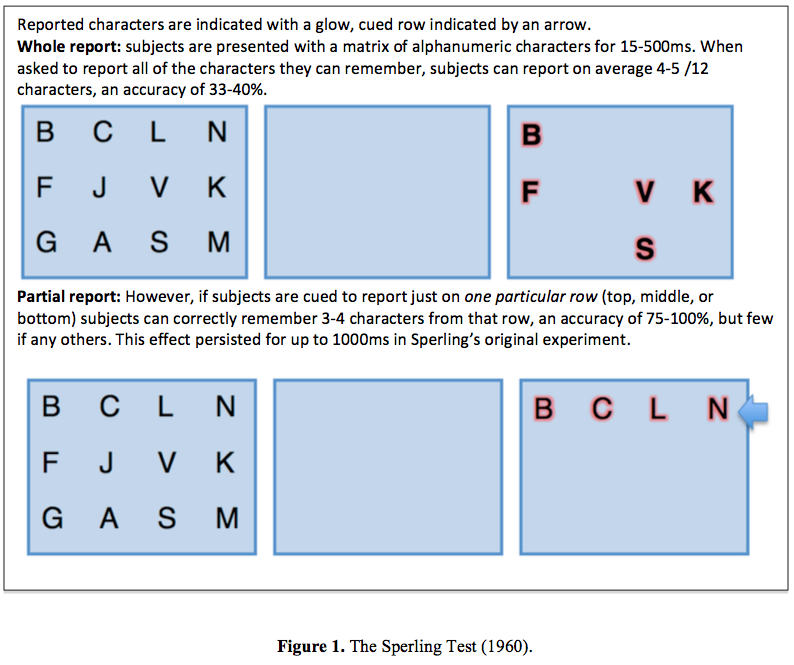
Afterward, Sperling ran a second experiment using his now-famous partial-report technique: cueing observers, after the display had vanished, to report only one row. As before, participants saw three rows of letters for about 1/20th of a second. This time, a tone sounded right after the display disappeared.
A high, medium, or low pitch told participants which row to report: top, middle, or bottom. Because the cue came after the letters vanished, participants could not know in advance which row to expect.
The logic was elegant.
Findings: Participants could recall the cued row if the tone sounded within about a third of a second of the display (Sperling, 1960). Beyond that delay, accuracy declined fast. Once a full second had passed, recall was almost impossible.
Because the cue was unpredictable, this meant roughly 9 or more of the 12 letters were available the instant the display ended. That is far more than the 4 or 5 letters whole report ever revealed.
Sperling had his answer.
Conclusion: A large-capacity visual store briefly holds far more information than people can report before it fades (Sperling, 1960). The limit is not in the eyes. It is a limit on how fast the trace empties while the observer is still naming the first few items.
Evaluation: The partial-report method is an elegant, much-replicated solution to an old measurement problem: it recovers the display’s true capacity by sampling it before the trace decays.
Its stimuli were brief, tachistoscopic letter arrays. These are far removed from natural scene viewing, which raises an ecological-validity concern discussed later in this article.
Real-World Applications
Because sensory memory sits at the junction of perception and cognition, its effects show up throughout everyday experience and applied design.
Reading, Perception, and Attention
Fluent reading depends on iconic memory bridging the gaps between fixations. As the eyes jump along a line of text, the icon holds each glimpse briefly.
The effect is seamless.
This lets the visual system integrate across those jumps, rather than perceiving a series of disconnected snapshots. The same integration underlies our stable perception of any moving scene.
The buffer helps attention too.
Brief exposure alone does not create a lasting memory. Anything not attended to within the register’s short lifespan leaves no trace at all.
This is why effective teaching directs a learner’s attention to the right detail before it disappears. Cueing works because it selects material from the sensory buffer while that material is still there to be read.
Film, TV, and Display Design
A movie is really a rapid sequence of still frames, traditionally around 24 per second, yet it looks like smooth motion. The visual register and flicker fusion help blend the frames together.
Screens work the same way.
They must refresh above the flicker-fusion threshold, roughly 50 to 90 Hz, so the eye fuses successive refreshes into one steady image instead of a visible flicker.
Motion is a different story.
The sense of motion itself comes mainly from dedicated motion-detecting mechanisms in the brain. It is not simply a lingering afterimage, as the popular “persistence of vision” explanation assumes.
Displays exploit the buffer too.
Warning lights and heads-up displays exploit its brief, pre-attentive availability to grab attention before a signal decays. The icon’s rapid decay also explains change blindness: the surprising failure to notice an obvious change between two scenes when a brief blank is inserted between them.
That matters for safety-critical design.
Clinical Assessment
The auditory register can be probed with the mismatch negativity (MMN) response, an automatic brain signal that needs no verbal report at all.
No behavior is required.
Because it needs no behavioral response, MMN can be recorded even from people who cannot follow verbal instructions. It is used to study echoic memory in young children, older adults, and people with certain neurological or developmental conditions.
Critical Evaluation
Sensory memory is one of the most secure ideas in cognitive psychology. Even so, it raises real debates about what the sensory registers actually store, and whether they count as memory at all.
Strengths of the Sensory Memory Model
Sperling’s (1960) partial-report technique remains a model of experimental ingenuity. It recovers a store’s true capacity by sampling it before the trace decays, and researchers have replicated and extended it for over sixty years.
The evidence also converges across methods. Partial report, backward masking, and the auditory suffix effect all point to the same brief, modality-specific buffer.
Brain-based measures back this up too. Mismatch negativity, an electrical brain response, confirms the echoic store exists without needing any verbal report at all.
The model also explains everyday puzzles, from perceptual continuity across eye movements to the auditory recency advantage and change blindness, all from one buffer concept.
Iconic Memory vs. Informational Persistence
Psychologist Max Coltheart (1980) raised the most influential challenge to Sperling’s account. He argued that “iconic memory” actually ran together two separate things.
Visible persistence is the felt experience that a bright stimulus lingers briefly after it disappears. Informational persistence is the continued availability of readable content that drives partial-report performance.
Coltheart showed the two behave differently. A brighter or longer stimulus produces a shorter-lasting visible afterimage, the opposite of what a simple fading-image account predicts.
Informational persistence does not show this pattern. This means partial-report superiority reflects available information, not a literal lingering picture, so many researchers now avoid the word “icon” altogether.
Is Sensory Memory Really “Memory”?
A deeper worry is whether sensory memory is a genuine memory store, or simply the tail end of perception, continued firing of the sense organs after a stimulus ends.
The trace is pre-categorical, cannot be rehearsed, and sits outside voluntary control, none of which resembles memory as usually understood. Whether it belongs to memory research or perception research remains partly a matter of definition.
Ecological Validity and Measurement
The classic paradigms use tachistoscopic arrays of unrelated letters and cued single-item recall. Both are far removed from how people actually use vision and hearing in daily life.
The concern is real. It is unclear how far the neat duration estimates generalize to cluttered, everyday scenes. Measurement is self-limiting too: reading the store out takes time, and that act can interfere with what is being measured.
Landman, Spekreijse, and Lamme (2003) tested this idea directly. Using a simpler same-or-different response instead of letter naming, they found that integrated visual information can remain available for up to 1,600 milliseconds. That is far longer than the classic quarter-second estimate.
The “Persistence of Vision” Myth
A popular claim holds that films look continuous because images “persist” on the retina. This is at best a half-truth.
Visible persistence and flicker fusion do help blend successive frames into a flicker-free image. Modern vision science, however, attributes the actual perception of motion mainly to specialised motion detectors, not to a lingering icon.
Contemporary Research
Recent work no longer asks if the sensory register exists. Sperling’s result is among the most secure in the field. Instead, researchers now ask a sharper question: how, exactly, does information get lost from the register as it decays?
Aim: Pratte (2018) tested whether iconic memory is lost through a gradual decline in the precision of stored items, or through a sudden, all-or-none loss of whole items.
The stakes were high.
Method: Using a continuous-report partial-report paradigm, observers viewed arrays of simple oriented stimuli.
After variable delays, they reported a probed item’s feature on a continuous scale. Mixture modelling then separated two things older methods had blurred together: whether an item was retained at all, and how precise the retained items were.
The pattern was stark. As the delay lengthened, iconic memory suffered a complete loss of whole items. The precision of items that survived was only marginally affected by time.
Items did not blur gradually. They dropped out abruptly, “dying a sudden death.”
Conclusion: Iconic decay is better described as the discrete loss of individual items, not the graceful fading of a continuous trace. This supports a discrete-capacity view of how iconic memory hands off to working memory.
This fits a wider pattern. Sensory loss looks componential. Cappiello and Zhang (2016) proposed that the visual register actually holds two traces: a fine-grained one and a separate coarse-grained one, each decaying at its own rate. This two-trace model fit the data better than a single-trace account.
Read together with Pratte’s finding, different kinds of information appear to be held, and lost, separately, rather than one trace fading as a single, uniform blur.
FAQs
Which process transfers information from sensory memory to short-term memory?
The process that transfers information from sensory memory to short-term memory is known as attention.
When we pay attention to a sensory stimulus, that information moves from sensory memory into short-term memory, also called working memory.
It then becomes part of our conscious awareness.
From there it can be processed and encoded for longer-term storage.
This selection step is not automatic.
Atkinson and Shiffrin’s (1968) multi-store model treats attention as the gatekeeper between sensory memory and short-term memory.
Most incoming information never gets that chance.
Each sensory register briefly holds far more than can ever be attended to.
That is a strict bottleneck.
It operates at every moment of waking life.
Whatever is not selected simply decays and is lost.
How long does information last in sensory memory?
The duration of information in sensory memory varies based on the type of sensory input.
Iconic (visual) memory lasts roughly 250-500 milliseconds.
Echoic (auditory) memory can last up to 3-4 seconds.
Haptic, olfactory, and gustatory memories have less defined durations, but they are generally brief too.
The gap between vision and hearing makes sense.
Sound unfolds over time.
Understanding speech or music means holding on to the last few fragments long enough to combine them with what follows.
Decay is not always passive fading, either.
Averbach and Coriell’s (1961) research found that a new stimulus in the same spot can actively overwrite information already sitting in sensory memory.
If attention is not focused on these impressions, they disappear quickly.
New sensory input replaces them right away.
What is the difference between iconic memory and echoic memory?
Iconic and echoic memory are both types of sensory memory, but they process different senses.
Iconic memory briefly retains visual information for roughly 250-500 milliseconds.
Echoic memory retains auditory information for longer, about 3-4 seconds.
In short, the two differ in which sense they handle: sight versus sound.
Both terms were coined by Ulric Neisser (1967).
He drew an analogy between a mental icon, meaning image, and an echo, meaning sound.
The classic evidence for each comes from a different experiment.
George Sperling’s (1960) partial-report technique demonstrated the visual store’s large capacity.
Darwin, Turvey, and Crowder (1972) adapted the same logic to hearing.
The two registers serve different everyday functions, too.
Iconic memory bridges the brief gaps caused by eye movements, so a scene appears stable rather than a series of disconnected snapshots.
Echoic memory lets us bind a string of spoken sounds into recognizable words and melodies.
In which memory store does information first have meaning?
Information first attains meaning in short-term memory, also known as working memory.
This is where conscious processing occurs.
Unlike sensory memory, which merely stores raw sensory input, short-term memory interprets and assigns meaning to these stimuli.
That is what lets us understand and respond to our environment.
The handoff matters because sensory memory itself is pre-categorical.
It holds a raw, unprocessed copy of a stimulus, not a recognized or interpreted one.
Meaning comes later.
Only once attention selects part of that trace does the brain start matching it against stored knowledge.
Encoding in working memory can also help transfer information to long-term memory for more permanent storage.
That is the final step.
It closes the loop from raw sensation to lasting record.
References
Alain, C., Woods, D. L., & Knight, R. T. (1998). A distributed cortical network for auditory sensory memory in humans. Brain Research, 812(1-2), 23-37.
Atkinson, R. C., & Shiffrin, R. M. (1968). Human memory: A proposed system and its control processes. In K. W. Spence & J. T. Spence (Eds.), The psychology of learning and motivation (Vol. 2, pp. 89-195). Academic Press. https://doi.org/10.1016/S0079-7421(08)60422-3
Averbach, E., & Coriell, A. S. (1961). Short-term memory in vision. Bell System Technical Journal, 40(1), 309-328. https://doi.org/10.1002/j.1538-7305.1961.tb03987.x
Cappiello, M., & Zhang, W. (2016). A dual-trace model for visual sensory memory. Journal of Experimental Psychology: Human Perception and Performance, 42(11), 1903-1922. https://doi.org/10.1037/xhp0000274
Coltheart, M. (1980). Iconic memory and visible persistence. Perception & Psychophysics, 27(3), 183-228. https://doi.org/10.3758/BF03204258
Crowder, R. G., & Morton, J. (1969). Precategorical acoustic storage (PAS). Perception & Psychophysics, 5(6), 365-373. https://doi.org/10.3758/BF03210660
Darwin, C. J., Turvey, M. T., & Crowder, R. G. (1972). An auditory analogue of the Sperling partial report procedure: Evidence for brief auditory storage. Cognitive Psychology, 3(2), 255-267. https://doi.org/10.1016/0010-0285(72)90007-2
D’Esposito, M., Ballard, D., Zarahn, E., & Aguirre, G. K. (2000). The role of prefrontal cortex in sensory memory and motor preparation: an event-related fMRI study. Neuroimage, 11(5), 400-408.
Grossheinrich, N., Kademann, S., Bruder, J., Bartling, J., & Von Suchodoletz, W. (2010). Auditory sensory memory and language abilities in former late talkers: a mismatch negativity study. Psychophysiology, 47(5), 822-830.
Inui, K., Urakawa, T., Yamashiro, K., Otsuru, N., Takeshima, Y., Nishihara, M., … & Kakigi, R. (2010). Echoic memory of a single pure tone indexed by change-related brain activity. BMC Neuroscience, 11(1), 1-10.
Landman, R., Spekreijse, H., & Lamme, V. A. F. (2003). Large capacity storage of integrated objects before change blindness. Vision Research, 43(2), 149-164. https://doi.org/10.1016/S0042-6989(02)00402-9
Neisser, U. (1967). Cognitive psychology. Appleton-Century-Crofts.
Pratte, M. S. (2018). Iconic memories die a sudden death. Psychological Science, 29(6), 877-887. https://doi.org/10.1177/0956797617747118
Sabri, M., Kareken, D. A., Dzemidzic, M., Lowe, M. J., & Melara, R. D. (2004). Neural correlates of auditory sensory memory and automatic change detection. Neuroimage, 21(1), 69-74.
Shih, R., Dubrowski, A., & Carnahan, H. (2009). Evidence for haptic memory. In World Haptics 2009-Third Joint EuroHaptics Conference and Symposium on Haptic Interfaces for Virtual Environment and Teleoperator Systems (pp. 145-149). IEEE. https://doi.org/10.1109/WHC.2009.4810867
Sperling, G. (1960). The information available in brief visual presentations. Psychological Monographs: General and Applied, 74(11), 1-29. https://doi.org/10.1037/h0093759
Tripathy, S. P., & Öǧmen, H. (2018). Sensory memory is allocated exclusively to the current event-segment. Frontiers in Psychology, 9, 1435. https://doi.org/10.3389/fpsyg.2018.01435
Further Information
- Sperling, G. (1960). The information available in brief visual presentations. Psychological monographs: General and applied, 74(11), 1.
- Öğmen, H., & Herzog, M. H. (2016). A new conceptualization of human visual sensory-memory. Frontiers in Psychology, 7, 830.
- Sligte, I. G., Vandenbroucke, A. R., Scholte, H. S., & Lamme, V. (2010). Detailed sensory memory, sloppy working memory. Frontiers in Psychology, 1, 175.