The temporal lobe is one of the four major lobes of the cerebral cortex.
A deep groove called the lateral fissure (also known as the Sylvian fissure) separates it from the frontal lobe in front and the parietal lobe above. It sits low on the head, near the temples.
Together, the two temporal lobes make up roughly a quarter of the brain’s total cortical surface. The lobe blends gradually into the occipital lobe rather than stopping at a clean line. There is no sharp boundary at the back.
It processes auditory information, forms memories, comprehends language, and regulates emotions through key structures like the hippocampus and primary auditory cortex.

Temporal Lobe Functions
The temporal lobe sits on the side and underside of the brain, near the temples.
It is primarily responsible for processing auditory information, comprehending language, storing memories, and interpreting emotions.
1. Auditory Processing and Language
- Auditory Cortex: Processes sound within the temporal lobe. It receives signals via the thalamus and picks out pitch and tone.
- Wernicke’s Area: Supports speech comprehension in the left temporal lobe for most people. Damage causes Wernicke’s aphasia: fluent but meaningless speech, with no understanding of others.
- Lateralization: The processing of sound is often lateralized; the left temporal lobe generally focuses on speech and verbal tasks, while the right temporal lobe is more involved in music and nonverbal sounds.
2. Visual Processing
While the occipital lobe handles primary vision, visual information is sent to the temporal lobe via the ventral stream (or “what pathway”).
- Object Identification: This pathway helps identify what an object is.
- Face Recognition: The fusiform gyrus, located on the bottom surface of the temporal lobes, supports face detection and recognition. Damage here can lead to prosopagnosia (face blindness).
Researchers have pinpointed exactly where this happens. Kanwisher et al. (1997) used brain imaging to find a small patch of the fusiform gyrus, since called the fusiform face area.
This patch reacted far more to faces than other objects. It held up even after the researchers controlled for low-level visual differences.
Face processing draws on its own dedicated patch of cortex, the finding suggests. It is not just about visual complexity in general.
3. Memory and Emotion
Deep within the temporal lobe lies the Medial Temporal Lobe (MTL), a system critical for memory and emotion.
- Hippocampus: This structure is essential for learning and memory consolidation (transferring new learning into long-term storage). It is also involved in spatial memory and navigation.
- Amygdala: Located near the hippocampus, the amygdala links sensory input to emotions like fear and aggression. It tags memories with emotional weight, shaping how strongly they are stored.
Lateralization
Although the two temporal lobes are physically symmetrical and share basic sensory functions, they exhibit significant hemispheric lateralization.
This means that each side has evolved specialized strengths to handle different types of information.
For most right-handed individuals, the left side is the analytical center for language, while the right side is the holistic center for nonverbal and emotional data.
| Feature | Left Temporal Lobe (Verbal) | Right Temporal Lobe (Nonverbal) |
| Primary Focus | Language and Logic | Creativity and Spatial Skills |
| Information Processing | Sequential/Analytic | Global/Holistic |
| Memory Focus | Names, facts, and words | Music, patterns, and faces |
| Language Role | Meaning and Comprehension | Tone, rhythm, and emotion |

Did you know? The specific temporal lobe roles can vary among individuals, especially between left-handed and right-handed people.
Left Temporal Lobe
In approximately 95% of right-handed people, the left temporal lobe is dominant for verbal competence.
It processes information sequentially, focusing on one piece of data at a time.
- Auditory Processing: It deciphers raw sounds into meaningful linguistic units, such as words.
- Language Comprehension (Wernicke’s Area): This critical region allows you to understand spoken and written words. Damage here leads to speech that sounds fluent but makes no sense.
- Verbal Memory: It is essential for learning and recalling facts, names, and any information that can be put into words (declarative memory).
- Speech Formation: While Broca’s area in the frontal lobe physically produces speech, the left temporal lobe provides the semantic “blueprint” to ensure that sentences are coherent and meaningful.
- Sequential Learning: It handles the early stages of processing melodies and rhythms that follow a specific order.
Right Temporal Lobe
The right hemisphere typically specializes in global processing, looking at the “big picture” rather than individual bits.
- Nonverbal Memory: It is the primary site for learning and memorizing information that isn’t language-based, such as drawings, complex visual patterns, and music.
- Auditory Perception of Environment: While the left side listens for words, the right side identifies environmental sounds (like a dog barking or a car door slamming) and recognizes different pitches and tones.
- Facial Recognition: This lobe is highly specialized for recognizing and interpreting human faces. Damage can result in prosopagnosia, the inability to recognize even familiar faces.
- Emotional Processing (Prosody): It identifies the “emotional color” of speech: the intonation or tone of voice that tells you if someone is happy, sarcastic, or angry.
- Spatial Processing: It helps you understand your body’s orientation in space and the layout of the environment around you.
Substructures of the temporal lobes
The temporal lobe houses several specialized structures that allow humans to interpret sensory input and consolidate experiences into long-term memory.
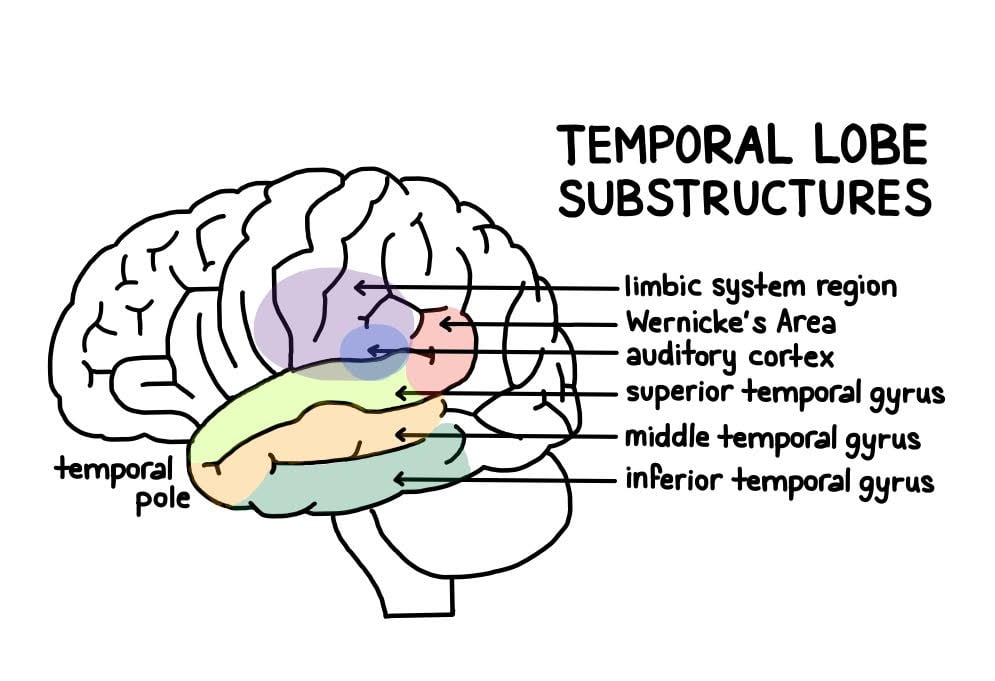
Superior Temporal Gyrus
The superior temporal gyrus (STG) is a prominent fold located at the very top of the temporal lobe, situated just above the ears.
It is a multitasking hub that bridges the gap between basic sensory input (hearing) and complex social understanding.
1. Anatomy and Location
- Lobe: Temporal Lobe.
- Physical Landmarks: It is the uppermost ridge (gyrus) of the temporal lobe, separated from the frontal and parietal lobes by the lateral fissure (also known as the Fissure of Sylvius).
2. Auditory and Language Specialized Functions
The STG is the primary “engine room” for sound.
Different sections of this ridge handle specific aspects of what we hear:
- Primary Auditory Cortex: Located within the STG, this area is responsible for basic sound processing.
- Frequency Mapping: It is tonotopically organized, meaning specific areas are “tuned” to certain pitches or combinations of frequencies.
- Pattern Recognition: Specialized regions within the STG detect changes in amplitude (volume) and frequency (pitch), allowing you to identify distinct sounds like a click or a whistle.
- Language Processing: It plays a vital role in speech. On the left side, it closely connects to Wernicke’s area, which is essential for understanding the meaning of words.
3. The “Social Brain” and Emotion
Beyond simple hearing, the STG is a key component of the social brain: the network that helps us navigate interactions with others.
- Social Cognition: The STG helps us represent the mental states of others, such as making inferences about their intentions or beliefs during a conversation.
- Biological Motion: The posterior (back) part of the STG region is critical for recognizing human movement, such as eye and hand gestures, to predict what someone might do next.
- Emotional Perception: It is involved in perceiving emotions from facial expressions. This allows you to quickly evaluate if someone is happy, sad, or threatening based on their subtle visual cues.
Auditory Cortex
The auditory cortex is the brain’s primary “hearing center.”
It is responsible for receiving and interpreting sound waves, transforming raw vibrations into meaningful experiences like music or conversation.
| Function | Description |
| Basic Processing | Identifying pitch, tone, and volume. |
| Language | Breaking down sounds into speech, words, and meaning (semantics). |
| Bilingualism | Helping the brain “switch” between different languages. |
| Higher Functions | Connecting sounds to complex thoughts and actions. |
1. Anatomy and Location
- Lobe: It is located within the temporal lobe (found on the sides of the brain, near your temples).
- Specific Landmark: It is situated within a fold called the superior temporal gyrus.
- Hemispheric Differences: In most right-handed people, the left temporal lobe specializes in language, while the right temporal lobe focuses on nonverbal sounds like music.
2. The Path of Sound (Input & Processing)
Sound does not reach the cortex instantly. It follows a specific relay system:
- The Ears: Pick up physical sound waves.
- Brainstem & Thalamus: Sound signals travel through the brainstem to the medial geniculate nucleus of the thalamus, which acts as a relay station.
- The Auditory Cortex: The signals finally arrive here for high-level interpretation.
Tonotopic Organization
Much like keys on a piano, the auditory cortex is tonotopically organized.
This means neighboring cells in the cortex are “tuned” to respond to similar sound frequencies.
One area might process high-pitched sounds, while another handles low-pitched tones.
This isn’t just a tidy theoretical gradient, either. Da Costa et al. (2011) used high-resolution brain imaging to map this pattern in real brains.
In each person, the tonotopic map followed the actual folded shape of their own Heschl’s gyrus, the ridge of cortex that holds the auditory cortex. Several frequency-tuned maps ran along its contours.
That means the brain’s sound map can be predicted from the fine anatomy of that individual’s own auditory cortex.
3. Key Functions
The auditory cortex performs several essential roles that allow us to interact with our environment:
- Basic Sound Identification: It identifies the fundamental building blocks of sound, such as pitch, tone, volume, and timbre.
- Language & Semantics: It breaks down complex speech into meaningful units like words and sentences.
- Bilingualism: This region is critical for the ability to switch between different languages.
- Sound Localization: It helps you determine the direction and origin of a sound, such as knowing which way to turn when someone calls your name.
4. Multisensory Integration (The “Party Effect”)
The auditory cortex is a master multitasker. It often blends what you hear with what you see, a process called multimodal perception.
Example:
In a noisy environment, like a crowded party, your brain uses “visual cues” (watching a speaker’s lip movements) to help you understand their speech better despite background noise.
This integration makes your perception of speech stronger than if you used only your ears.
Wernicke’s Area
Wernicke’s area is a critical region of the brain specialized for the comprehension of language.
While other parts of the brain help you physically produce sounds, this area allows you to understand what those sounds actually mean.
1. Anatomy and Location
- Lobe: It is located in the temporal lobe, which is situated on the side of the head near the temples.
- Specific Placement: It is found in the posterior (back) part of the temporal lobe, typically just behind the primary auditory cortex.
- Hemispheric Dominance: In approximately 95% of right-handed individuals, Wernicke’s area is located in the left hemisphere.
2. Key Functions: Making Sense of the World
Wernicke’s area acts as a “translator” that turns raw sensory input into meaningful concepts.
- Speech Comprehension: Its primary job is processing spoken words so you can understand a conversation.
- Reading and Writing: It is also involved in the comprehension of the written word, helping you translate text into meaning.
- Semantic Integration: This region also links sounds to other senses. Hearing the word “apple,” for example, calls up its color, shape, and remembered taste.
3. Clinical Significance: Wernicke’s Aphasia
When this area is damaged, often due to a stroke, a person develops Wernicke’s aphasia (also called “receptive aphasia”).
- The Symptom: Patients can still speak fluently and with normal rhythm, but their sentences often make no sense and may include made-up words.
- The Result: Because their “decoder” is broken, they struggle to understand others and are often unaware that their own speech is nonsensical.
Limbic System
The temporal lobe is a significant part of the limbic system.
The limbic system is a group of structures deep within the brain involved in processing and regulating emotions, memory, and motivation.

1. The Hippocampus: The Gateway to Memory
The hippocampus is a seahorse-shaped structure found within the medial temporal lobe. It is critical for the following functions:
- Memory Formation: It acts as an essential hub for learning and the creation of new declarative and episodic memories.
- Consolidation: It plays a central role in memory consolidation, which is the process of transforming new, temporary information into stable, long-term memories.
- Long-Term Storage: It handles the early storage of long-term memories before they are passed to the cerebral cortex for permanent storage.
- Spatial Navigation: It allows us to form “spatial memories” or cognitive maps, helping us navigate and remember our environment.
Aim: Scoville and Milner (1957) investigated what happens to memory after the hippocampus is removed on both sides of the brain.
Method: Patients being treated for severe epilepsy had the hippocampus and surrounding tissue surgically removed. Both hemispheres were affected.
Results: The surgery left patients unable to form new long-term memories. Their intelligence and personality, though, stayed intact.
Conclusion: The most studied of these patients is Patient HM, whose decades of testing reshaped memory research. Memory is not one single ability. It is several separate systems, some of which depend specifically on the medial temporal lobe.
Memory and recognition overlap directly in these structures. Recording single neurons in patients undergoing epilepsy monitoring, Quiroga et al. (2005) found hippocampal cells that fired for one specific familiar person. It didn’t matter how she was shown: as a photo, a sketch, or just her written name.
2. The Amygdala: The Emotional Center
The amygdala consists of two almond-shaped clusters located near the hippocampus. It serves as the brain’s “emotional computer”.
- Emotional Processing: It evaluates sensory information to quickly determine its emotional importance, particularly in relation to fear, anger, and reward.
- Fight-or-Flight Response: The amygdala is central to our experience of fear and helps trigger the body’s fight-or-flight response when we perceive a threat.
- Memory Modulation: It strengthens memories that are associated with strong emotions.
Freshman Pro-Tip: In essence, the more emotional arousal you feel during an event, the more likely the amygdala will signal your brain to store that memory vividly.
Damage to the Temporal Lobes
The temporal lobe is a multitasking hub for communication, memory, and emotion. When it is damaged by trauma, stroke, or disease, the following profound deficits can occur:
1. Symptoms of Temporal Lobe Damage
Communication & Language Issues:
- Wernicke’s Aphasia: Individuals can produce fluent-sounding speech that is actually nonsensical and lack the ability to understand spoken or written language.
- Word-Finding Difficulties: Pervasive deficits in finding the correct words (anomia) during conversation.
Memory Impairment:
- Anterograde & Retrograde Amnesia: Bilateral damage, especially to the hippocampus, can cause an inability to form new memories or retrieve memories of past events.
- Loss of Knowledge: Difficulty with semantic memory, such as general facts or language-based knowledge.
Perceptual Disturbances:
- Prosopagnosia: An inability to recognize familiar faces, even one’s own, while still being able to identify objects.
- Hallucinations: Experiences of hearing voices (auditory), seeing things that aren’t there (visual), or smelling phantom odors (olfactory).
- Auditory Processing Deficits: A significant reduction in the ability to identify or localize sounds.
Cognitive & Emotional Changes:
- Emotional Regulation: Changes in mood, personality, and behavior control, often due to connections with the limbic system.
- Spatial Orientation: Problems with spatial memory, navigation, and forming “cognitive maps” of the environment.
2. Common Causes
The temporal lobe can be damaged through various means:
- Physical Trauma: Head injuries from accidents or sports, which can cause surface contusions or deeper axonal damage.
- Stroke: Interruption of blood flow (ischemia) or bleeding into brain tissue (hemorrhage), most commonly involving the middle cerebral artery.
- Infections: Inflammation from viral or bacterial sources, such as Herpes simplex encephalitis or meningitis.
- Tumors: Both cancerous and benign space-occupying lesions that compress brain tissue.
- Seizures & Anoxia: Prolonged seizure activity (Status Epilepticus) or a lack of oxygen (anoxia) to the brain, which can selectively damage high-metabolism areas like the hippocampus.
3. Associated Conditions
Temporal lobe dysfunction is a hallmark of several major clinical disorders:
- Temporal Lobe Epilepsy: The most common form of epilepsy, impacting memory, executive functions, and language. It may also cause interictal behavioural changes between seizures (the Geschwind syndrome), a separate cluster from Klüver–Bucy syndrome (see below).
- Alzheimer’s Disease: Characterized by early deterioration in the medial temporal lobe, specifically the hippocampus. This explains why episodic memory loss is typically the first symptom.
- Autism Spectrum Disorders: Research identifies differences in the superior temporal sulcus, which is crucial for interpreting social cues and biological motion, explaining social cognition deficits.
- Schizophrenia: Structural abnormalities in the superior temporal gyrus are linked to key symptoms like auditory hallucinations and disorganized thinking.
Between seizures, some patients with chronic temporal-lobe epilepsy show a distinct personality change: increased religiosity, unusually intense relationships, and altered sexual interest, alongside compulsive writing. This compulsive writing is called hypergraphia. Waxman and Geschwind (1975) named this cluster the interictal behaviour syndrome, now often called the Geschwind syndrome.
Modern neuroimaging is increasingly used to map this cognitive burden and predict it before surgery (Allone et al., 2017). Hippocampal involvement also affects non-verbal memory: patients with more hippocampal damage perform worse specifically on visual object recognition tasks, not just verbal recall (Vannucci et al., 2003).
4. Klüver-Bucy Syndrome
Aim: Klüver and Bucy (1939) wanted to know what the temporal lobes actually do. Their method was simple: remove the lobes and watch what changes.
Method: The researchers surgically removed both temporal lobes, including the amygdala and hippocampus, from a series of rhesus monkeys. They watched closely. Researchers recorded how each animal responded to objects, food, other animals, and people, both before and after surgery.
Results: The operated monkeys became tame, losing their normal fear of people and threats. They mouthed objects indiscriminately and reacted to every sight around them. Sexual behavior increased sharply too.
Most strikingly, they approached snakes and flames without caution. Klüver and Bucy called this “psychic blindness.” Normal eyesight paired with no sense of what a sight means.
Conclusion: The temporal lobes are essential for attaching meaning and emotional value to what an animal sees. They also help regulate fear and appetite. This cluster of symptoms is now called Klüver-Bucy syndrome.
It later appeared in milder form in people with similar bilateral damage from disease, trauma, or surgery.
Evaluation: Because Klüver and Bucy removed several structures together, the study could not say which one caused which symptom. The amygdala? The hippocampus? The visual pathways? Later, more selective lesion work had to disentangle that question.
Protecting Your Temporal Lobes
While not all temporal lobe damage can be prevented, you can take several evidence-based steps to protect your brain health and support its vital functions.
1. Physical Protection from Trauma
Physical injuries are a primary cause of brain damage. Protecting the skull is essential since the brain is housed inside this thick bone.
- Wear Safety Gear: Use appropriate protective equipment, such as helmets, during sports or recreational activities to prevent traumatic head injuries.
- Vehicle Safety: Always use seatbelts and follow all vehicle safety guidelines to reduce the risk of injury from motor vehicle crashes.
2. Cardiovascular Health and Stroke Prevention
Stroke, caused by reduced blood flow to the brain, is a major cause of temporal lobe dysfunction.
- Maintain Healthy Blood Pressure: High blood pressure is a significant risk factor for cardiovascular disease and stroke. Regular monitoring and management can save lives.
- Aerobic Exercise: Regular physical activity increases blood flow to the brain and may promote neurogenesis: the growth of new brain cells in the hippocampus. It also helps maintain overall cardiovascular fitness.
3. Cognitive and Lifestyle Habits
How you live and rest directly impacts your brain’s ability to process and store information.
- Stay Mentally Active: Engaging in mentally stimulating activities, such as learning new skills or social engagement, can help preserve cognitive function and build “cognitive reserve” as you age.
- Prioritize Quality Sleep: During sleep, the brain organizes and stabilizes information into long-term memory through a process called memory consolidation. Chronic sleep deprivation can lead to significant memory deficits and impaired attention.
- Manage Stress Levels: Chronic stress can weaken the immune system and potentially impair brain circuitry. Using relaxation techniques, such as deep breathing, pleasant imagery, or meditation, can help reduce the physiological arousal associated with stress.
Critical Evaluation
The temporal lobe offers some of psychology’s clearest evidence that mental functions map onto specific brain tissue. A closer look complicates that picture, though.
Localisation vs Distributed Networks
Wernicke’s aphasia and the aphasia that follows damage to Broca’s area form a classic double dissociation. One impairs understanding but spares fluent speech. The other does the reverse.
This pairing supplied some of the earliest evidence that mental functions can be localized to specific brain regions.
Many temporal-lobe functions depend on wider networks, though. Understanding a sentence recruits the frontal and parietal lobes too, not just the temporal lobe.
Naming one area as the “seat” of a function is a useful shorthand. It is not a literal description.
Even the classic Wernicke-Broca model needs a connecting fiber tract between its two regions. Cut that tract and you get yet another distinct disorder. Wiring matters as much as the named regions.
Limits of Lesion Evidence
Much of what is known about the temporal lobe rests on lesion and case-study evidence: Klüver and Bucy’s animal studies, and Patient HM’s decades of testing, described above.
This method has real limits. A lesion shows what a region’s loss disrupts.
That is not automatically the same as what the region contributes when healthy, working alongside its usual partners.
Damage rarely respects the tidy boundaries drawn on an anatomical map. A single case can implicate several structures at once.
Modern statistical lesion-symptom mapping helps address this. It analyzes many patients’ lesions and deficits together, instead of relying on single dramatic cases (Bates et al., 2003).
Findings from a different species, too, may not generalize safely to humans. Even so, case-study evidence is what first revealed most of these functions at all.
A Rival View: Lashley’s Equipotentiality
Localisation is not the only way psychologists have tried to explain how the cortex works. Karl Lashley proposed a well-known rival account: equipotentiality. He developed it from his own lesion experiments in rats (Lashley, 1929).
Lashley tried lesion after lesion. He varied their size and location each time, but could not find one circumscribed region responsible for maze-learning ability. He concluded that the cortex involved in complex learning is more functionally interchangeable than a strict localisationist picture allows.
The total amount of tissue destroyed, not its exact location, best predicted the size of the resulting deficit. He called this the mass action principle.
Lashley’s caution against strict “one area, one function” thinking has aged well: even well-studied temporal-lobe functions depend on distributed networks, not a single centre acting alone. But his strongest claim has not held up.
Modern lesion-symptom mapping finds that damage confined to a small, reproducible patch of the posterior superior temporal gyrus, Wernicke’s area, produces a characteristic pattern of comprehension loss. That pattern shows up far more reliably than damage of the same size placed elsewhere in the temporal lobe.
Contemporary Research
Classic labels like “the hearing area” understate how dynamically the temporal lobe tracks moment-to-moment demands. One well-controlled brain-imaging study shows this directly.
Aim: Vander Ghinst et al. (2016) tested whether the left superior temporal gyrus tracks a listener’s chosen voice within a noisy, multi-talker scene. Or does it just register the overall mix of sound?
Method: Healthy adults listened to two speech streams at once. They tried to attend to one while ignoring the other.
Magnetoencephalography (MEG), a scanner that tracks the brain’s magnetic activity moment to moment, recorded how closely each brain region tracked the attended voice versus the ignored one.
Results: The left superior temporal gyrus tracked the attended voice far more closely than the ignored one. This selectivity was much weaker on the right side.
Conclusion: A region long treated as a passive sound analyzer turns out to be an active filter. It amplifies goal-relevant speech and damps down distractors.
This fits the left hemisphere’s own specialization for language.
This dynamic view extends to clinical imaging. Around a first psychotic episode, shrinking gray matter in the left superior temporal gyrus has been linked to hallucinations in schizophrenia (Kasai et al., 2003).
An enlarged right superior temporal gyrus, by contrast, has been reported in autistic children and adolescents (Jou et al., 2010). Size is not the whole story.
The fine detail of this one gyrus shapes attention, language, and social perception.
Key Takeaways
- Hearing Hub: The temporal lobe holds the primary auditory cortex, the first cortical stop for sound, plus Wernicke’s area for understanding language.
- Memory & Emotion: Its medial surface houses the hippocampus and amygdala, essential for forming new memories and tagging them with emotional weight.
- Face Recognition: The fusiform gyrus, on its underside, contains the fusiform face area; damage here can cause prosopagnosia.
- Lateralised: In most people the left side specialises in language and the right in music, faces, and emotional tone, though the two sides constantly communicate.
- Epilepsy Hotspot: The hippocampus’s high excitability makes the temporal lobe the most common site of focal epilepsy, sometimes with distinctive between-seizure personality changes.
- Modern Evidence: MEG recordings show the left superior temporal gyrus actively tunes into an attended voice in a noisy room, not just passively registering sound.
References
Allone, C., Buono, V. L., Corallo, F., Pisani, L. R., Pollicino, P., Bramanti, P., & Marino, S. (2017). Neuroimaging and cognitive functions in temporal lobe epilepsy: a review of the literature. Journal of the neurological sciences, 381, 7-15.
Bates, E., Wilson, S. M., Saygin, A. P., Dick, F., Sereno, M. I., Knight, R. T., & Dronkers, N. F. (2003). Voxel-based lesion-symptom mapping. Nature Neuroscience, 6(5), 448-450. https://doi.org/10.1038/nn1050
Da Costa, S., van der Zwaag, W., Marques, J. P., Frackowiak, R. S. J., Clarke, S., & Saenz, M. (2011). Human primary auditory cortex follows the shape of Heschl’s gyrus. Journal of Neuroscience, 31(40), 14067-14075. https://doi.org/10.1523/JNEUROSCI.2000-11.2011
Jou, R. J., Minshew, N. J., Keshavan, M. S., Vitale, M. P., & Hardan, A. Y. (2010). Enlarged right superior temporal gyrus in children and adolescents with autism. Brain research, 1360, 205–212.
Jung-Beeman, M., Bowden, E. M., Haberman, J., Frymiare, J. L., Arambel-Liu, S., Greenblatt, R., Reber, P. J. & Kounios, J. (2004). Neural activity when people solve verbal problems with insight. PLoS Biol, 2 (4), e97.
Kanwisher, N., McDermott, J., & Chun, M. M. (1997). The fusiform face area: A module in human extrastriate cortex specialized for face perception. Journal of Neuroscience, 17(11), 4302-4311. https://doi.org/10.1523/JNEUROSCI.17-11-04302.1997
Kasai, K., Shenton, M. E., Salisbury, D. F., Hirayasu, Y., Lee, C. U., Ciszewski, A. A., Yurgelun-Todd, D., Kikinis, R., Jolesz, F. A. & McCarley, R. W. (2003). Progressive decrease of left superior temporal gyrus gray matter volume in patients with first-episode schizophrenia. American Journal of Psychiatry, 160 (1), 156-164.
Klüver, H., & Bucy, P. C. (1939). Preliminary analysis of functions of the temporal lobes in monkeys. Archives of Neurology and Psychiatry, 42(6), 979-1000. https://doi.org/10.1001/archneurpsyc.1939.02270240017001
Lowndes, G., & Savage, G. (2007). Early detection of memory impairment in Alzheimer’s disease: a neurocognitive perspective on assessment. Neuropsychology review, 17(3), 193-202.
Redcay, E. (2008). The superior temporal sulcus performs a common function for social and speech perception: implications for the emergence of autism. Neuroscience & Biobehavioral Reviews, 32 (1), 123-142.
Scoville, W. B., & Milner, B. (1957). Loss of recent memory after bilateral hippocampal lesions. Journal of Neurology, Neurosurgery, and Psychiatry, 20(1), 11-21. https://doi.org/10.1136/jnnp.20.1.11
Vander Ghinst, M., Bourguignon, M., de Beeck, M. O., Wens, V., Marty, B., Hassid, S., Choufani, G., Jousmaki, V., Hari, R., Van Bogaert, P, Goldman, S. & De Tiege, X. (2016). Left superior temporal gyrus is coupled to attended speech in a cocktail-party auditory scene. Journal of Neuroscience, 36 (5), 1596-1606.
Vannucci, M., Dietl, T., Pezer, N., Viggiano, M. P., Helmstaedter, C., Schaller, C., Elger, C. E. & Grunwald, T. (2003). Hippocampal function and visual object processing in temporal lobe epilepsy. Neuroreport, 14 (11), 1489-1492.