If you’ve ever felt like you were the caretaker in your relationship with one or more of your parents, you’re not alone.
“I realized I wasn’t the problem when I understood that I was an only child to a two-parent household and they still couldn’t meet my needs.”
An emotionally immature parent struggles to regulate emotions, empathize with others, or take responsibility for their actions.
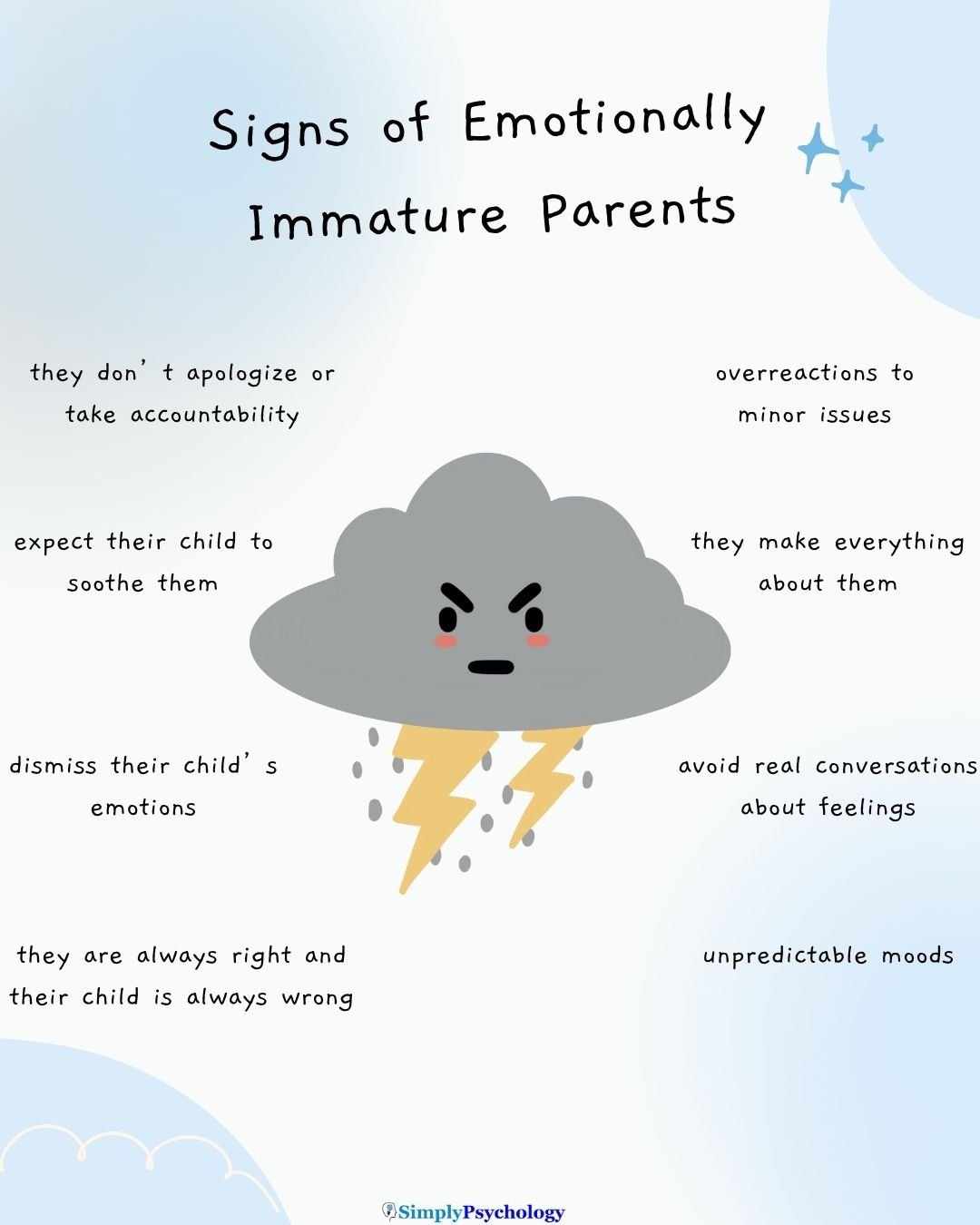
As psychologist Lindsay Gibson explains, they often behave more like impulsive, self-centered children than dependable adults.
They may love their kids, but consistently fail to meet their emotional needs.
This matters because growing up with an emotionally immature parent can leave lasting emotional scars.
Below, we’ll define emotional immaturity in parents, outline common signs, and explore its impact and what you can do to heal.
Key Takeaways
- Five Signs: Emotionally immature parents often overreact, avoid responsibility, center their own needs, struggle with closeness, and lean on their child for support.
- Loving But Inconsistent: These parents can love their children and still fail to meet their emotional needs: that mismatch is what leaves a mark.
- Lasting Effects: Adult children often struggle with boundaries, self-doubt, suppressed emotions, and a pull toward emotionally unavailable partners.
- Not Necessarily Abuse: Emotional immaturity tends to be inconsistent and unintentional, while abuse or narcissism is more deliberate and sustained.
- Coping Strategies: Boundaries, limited contact, outside support, reparenting yourself, and letting go of your parent’s approval can all help.
- Backed by Research: Parentification and a parent’s own emotion-regulation struggles are linked to higher rates of depression and relationship difficulty in adulthood.
Signs of Emotionally Immature Parents
Below are five common signs, with examples, that you may recognize from your own upbringing:
1. They Overreact and Struggle to Regulate Their Emotions
These parents have big reactions to small issues. They are easily angered, upset, or thrown into drama by minor inconveniences.
A simple request or a child’s mistake might trigger yelling, crying, or a days-long sulk. Because they can’t regulate their feelings, their emotions end up dominating the household.
There’s real science behind this. A 2022 analysis pooling 53 studies found that parents who struggle to manage their own emotions tend to parent in harsher, less supportive ways.
Their kids often follow suit. Children of these parents tend to develop the same difficulty regulating their own emotions, the research found.
You may have felt like you were walking on eggshells around your parent. For instance, if dinner was late or plans changed unexpectedly, they might explode in anger or melt down in self-pity.
2. They Avoid Responsibility and Blame Others
An emotionally immature parent finds it extremely hard to say “I’m sorry” or admit fault. Instead, they deflect blame onto others (often onto you or your siblings).
If you tried to confront them about something hurtful they said or did, they might respond with denial.
Sometimes it gets worse.
They might turn it back on you entirely: “Well, I wouldn’t have yelled if you kids weren’t so impossible!”
They may portray themselves as the victim, rather than take responsibility.
This can leave you, the child, constantly second-guessing yourself – you’re made to feel everything is your fault, when in reality the parent refuses to be accountable.
3. They Make Everything About Themselves
Conversations with emotionally immature parents inevitably wind back to their feelings, needs, or dramas.
If you come to them upset about a problem, they might dismiss it or compare it to their problems (“You think you’re stressed? Let me tell you what kind of day I had…”).
They expect emotional caretaking from their kids: comfort, a listening ear, even help mediating their conflicts.
But it’s rarely mutual. They’re unwilling or unable to offer that same empathy back to you.
They might even act as though being the parent entitles them to violate boundaries or be inconsiderate.
As Dr. Gibson puts it, such a parent behaves as if parenthood “exempts them from respecting boundaries or being considerate.”
4. They Can’t Handle Emotional Intimacy
Real, heart-to-heart emotional conversations are virtually impossible with emotionally immature parents.
Instead, interactions stay surface-level – talking about the weather, the chores, or their latest interest – but never about the feelings underlying anything.
If you try to share your deeper emotions or need comfort, they may shut down, change the subject, mock you, or even get angry.
As Dr. Gibson observes, “They might be very socially skilled… But when it comes to that kind of emotional closeness where you open up to each other, that’s where they really back up.”
The moment you start expressing vulnerable feelings, the parent may withdraw or act dismissive, reinforcing the message that your vulnerability is “too much” for them.
This has a name, too. Psychologists call it growing up in an invalidating environment: a home where a child’s emotional expressions are punished, ignored, or brushed aside instead of being taken seriously.
Over time, it takes a toll. A child raised this way can lose the ability to accurately read and manage their own emotions, since no one ever reflected those feelings back to them clearly.
5. They Parentified You
In an emotionally immature household, the flow of support can reverse: you end up acting like the parent (known as parentification).
Family therapists have a name for this: parentification. Boszormenyi-Nagy and Spark first described it in 1973, as a child pulled into meeting a parent’s emotional or practical needs well before they’re ready for it.
Perhaps you were expected to soothe your dad’s anxieties, or mediate your mom’s disputes, or take care of younger siblings because the parent wouldn’t.
You might have been praised for being “so mature and understanding,” but in truth you were deprived of a real childhood.
The role reversal takes a toll.
“My mom would vent to me about her relationship problems when I was 12, but if I cried about school, she’d say I was being dramatic.” — one forum user.
Being parentified often leads to a mix of resentment and guilt in the child.
There’s resentment at having to bear adult burdens, and guilt if you ever don’t step up to take care of your parent.
This isn’t just a private struggle.
As family therapist Esther Perel explains, the parentified child is often making an unconscious bargain. They take care of the parent, “sometimes hoping that if they parent the parent well, the parent will finally be able to parent them.”
Perel calls it “not an uncommon story.”
She has also observed that once a parent’s reality takes over a child’s attention completely, the child can lose “any awareness of any of your own needs.”
The guilt that comes with pulling back, she notes, is structural rather than personal: the whole family system is often arranged to keep everyone “in their place.”
Research backs up the complexity here.
A 2023 review of 95 studies on parentified children found that most struggle with anxiety or depression as adults.
But some describe real pride and growth from the role, especially when they felt it was chosen rather than forced on them.
How This Affects You in Adulthood
Growing up under these conditions can cast a long shadow. As an adult child of an emotionally immature parent, you might notice some of these lasting effects:
- Difficulty setting boundaries or saying no: You feel guilty or anxious when asserting your needs, because you’re used to catering to others (especially your parent).
- Feeling overly responsible for others: You habitually try to “fix” people’s problems or moods, a role you learned when you had to manage your parents’ emotions.
- Suppressing your own emotions to keep the peace: You tend to bottle up feelings or avoid conflict at all costs. This was how you coped in childhood to avoid triggering your parent.
- Chronic self-doubt or perfectionism: Growing up constantly blamed or trying to earn approval, you now second-guess yourself or strive to be perfect. Nothing you do ever feels good enough, and you’re harsh on yourself.
- Attracting emotionally unavailable partners: It’s common to gravitate toward familiar dynamics. Many adult children of immature parents find themselves in one-sided relationships as adults, often with partners who are distant or inconsiderate of their needs.
These patterns aren’t signs of weakness—they’re adaptive responses to an unpredictable environment. As Gibson notes, children of immature parents often learn to put others’ needs first “as the price of admission to a relationship.”
These effects aren’t just anecdotal.
Large studies on Adverse Childhood Experiences (ACEs), a standard list of childhood hardships that includes growing up with an emotionally unavailable parent, back this up.
They show a dose-response relationship: the more categories of adversity a person experienced, the higher their risk of anxiety, depression, and other health problems in adulthood.
A 2017 review pooling data from over 253,000 adults confirmed the pattern, with the strongest risks for poor mental health and risky behavior.
Why They Act This Way (But It’s Not Your Job to Fix It)
When you finally see your parents’ emotional immaturity, it’s natural to ask why.
Many such parents were raised by emotionally stunted or neglectful caregivers themselves. They may never have learned self-regulation or empathy because no one modeled it for them.
Attachment research helps explain why this pattern repeats across generations. It isn’t a conscious blueprint.
A caregiver’s early availability builds what psychologists call an internal working model: a template for what closeness and dependence should feel like, carried forward without conscious awareness.
A parent whose own caregiver was a source of both comfort and fear can develop what researchers call disorganized attachment: feeling pulled toward and scared of the same person. Without realizing it, they may go on to recreate that same “walking on eggshells” dynamic with their own child.
This understanding can bring compassion—but not obligation.
You can empathize with the child your parent once was without excusing their adult behavior. You didn’t cause their immaturity, and you can’t cure it.
Emotional growth is a choice only they can make. Your job isn’t to educate or heal them—it’s to protect and nurture yourself.
As Gibson explains, calling a parent “emotionally immature” can help identify the problem without demonizing them. But boundaries are still necessary. You needed a parent, not a project.
How to Cope With an Emotionally Immature Parent
Dealing with an emotionally immature parent is challenging, but there are healthy ways to protect yourself and find peace. Here are some coping strategies:
Set and enforce clear boundaries
Decide what you will not tolerate (e.g., yelling, unsolicited advice about your life, constant phone calls) and communicate your limits calmly.
You might say, “I’m not available to have this conversation when you’re screaming. Let’s talk when we’re calm,” and then stick to it.
Expect pushback, but remember: setting boundaries is key to breaking the old pattern of walking on eggshells.
She calls it differentiation. As family therapist Esther Perel explains, staying warm and connected while still holding your own ground is different from either giving in or shutting down.
Rather than a flat no, she suggests responding with warmth and consistency. A line like “I’m sure you’ll figure it out,” paired with genuine respect for how hard it is for them, can loosen the pattern without becoming rejecting.
It isn’t full compliance either.
Limit emotional exposure (low contact or “gray rock”)
If interactions with your parent often leave you drained or upset, it’s okay to minimize contact – even with family.
Gray rocking means responding to an emotional parent in a neutral, non-reactive way (like a gray rock) so they lose the fuel for drama.
For example, if your parent starts blaming or provoking you, you might reply with a brief, bland response and no emotional investment.
The goal is to make interactions less triggering for you (and less interesting for them if they’re seeking a reaction).
Build a support network (and lean on it)
One of the healthiest things you can do is find support outside the parent-child dynamic. Cultivate relationships where you can receive the empathy, validation, and listening ear that your parent couldn’t provide.
Talking with others who “get it” can be hugely validating.
You’ll realize you’re not the only one with this experience, and you’re not crazy for feeling the way you do.
The point is to seek validation and care from healthy sources. You no longer need to chase it from your parent.
As you connect with people who treat you with respect, it becomes easier to see that your parents’ behavior was a reflection of them, not your worth.
Practice reparenting and self-care
Since your parent wasn’t emotionally mature, you likely didn’t get some of the nurturing you deserved.
Part of healing is reparenting yourself: giving your inner child the care and attention it always needed.
For example, you might write a compassionate letter to your younger self or revisit an activity you loved as a kid.
Small routines matter too. A calming cup of tea at night, or a few kind words in the mirror, can be enough.
Treat yourself with the patience and validation a good parent would give. This isn’t selfish.
You might say to yourself, “It makes sense that I’m hurt — I deserved love, and I didn’t get enough of it.”
Over time, you can develop a stable inner voice that soothes and affirms you, even when your parent cannot.
Detach from their approval
Deep down, many adult children of immature parents continue to seek approval or acceptance from the parent – a holdover of trying to “earn” love as a child.
A crucial coping step is consciously letting go of that quest. Recognize that you may never get the validation or apology you crave from your parent, and that’s a reflection of their limitation, not your value.
Instead of hoping “maybe this time they’ll understand me”, accept that they might not be capable of it.
It doesn’t mean you don’t care about them; it means you release yourself from basing your self-worth on their reactions. Seek feedback from mentors, friends, or colleagues who appreciate you.
By reducing your dependence on your parents’ approval, you reclaim power over your own happiness.
Emotionally Immature vs. Abusive or Narcissistic: How to Tell
The line between emotional immaturity and abuse can be blurry. Intent and consistency often distinguish them.
- Intent: Abusive or narcissistic parents hurt to control; emotionally immature parents hurt out of ignorance or defensiveness.
- Consistency: Immature parents can be kind one day and cruel the next, while abusive parents show a more deliberate pattern of harm.
- Capacity for empathy: Immature parents may occasionally show remorse but rarely sustain change; narcissists typically don’t see a problem at all.
Ultimately, labels matter less than your experience. If your parent’s behavior left you anxious or unloved, your pain is valid.
Emotional immaturity isn’t an excuse for harm. You’re allowed to name your experience and set boundaries, regardless of whether they “meant it.”
When to Seek Help
Healing from an emotionally immature upbringing takes time—and often support. Therapy can help you understand your family dynamics, set boundaries, and reframe self-blame.
Consider seeking help if you:
- Struggle with guilt, anxiety, or depression tied to your upbringing
- Repeat unhealthy relationship patterns
- Feel paralyzed by conflict or boundary-setting
- Understand the problem, but can’t move past it emotionally
Therapies like schema therapy, internal family systems (IFS), or inner-child work can be especially helpful.
Group therapy or support groups for adult children of dysfunctional families can also reduce shame and help you feel understood.
Reaching out for help isn’t weakness—it’s courage. You’re not doomed to repeat your parent’s patterns.
With support, you can break the cycle, nurture yourself, and build relationships based on the emotional safety you always deserved.

