Perfectionism is the tendency to set unrealistically high standards for yourself or others, where self-worth feels tied to flawless performance and mistakes are seen as failures rather than opportunities to learn.
Striving for excellence can be motivating and rewarding. Perfectionism goes a step further. It makes self-worth feel conditional on flawless performance.
Perfectionism Reflection Sheet
If you’ve ever felt like nothing you do is good enough, you may relate to perfectionism. Many people do. It shows up in school, work, relationships, and everyday tasks.
At times, it can fuel achievement, persistence, and attention to detail. But when perfectionism becomes rigid, it can also lead to stress, procrastination, and burnout.
Perfectionism is not a diagnosis. But it can raise the risk of depression, anxiety, OCD, and eating disorders. Understanding how it can both help and harm is the first step toward a healthier balance.
Signs and Traits of Perfectionism
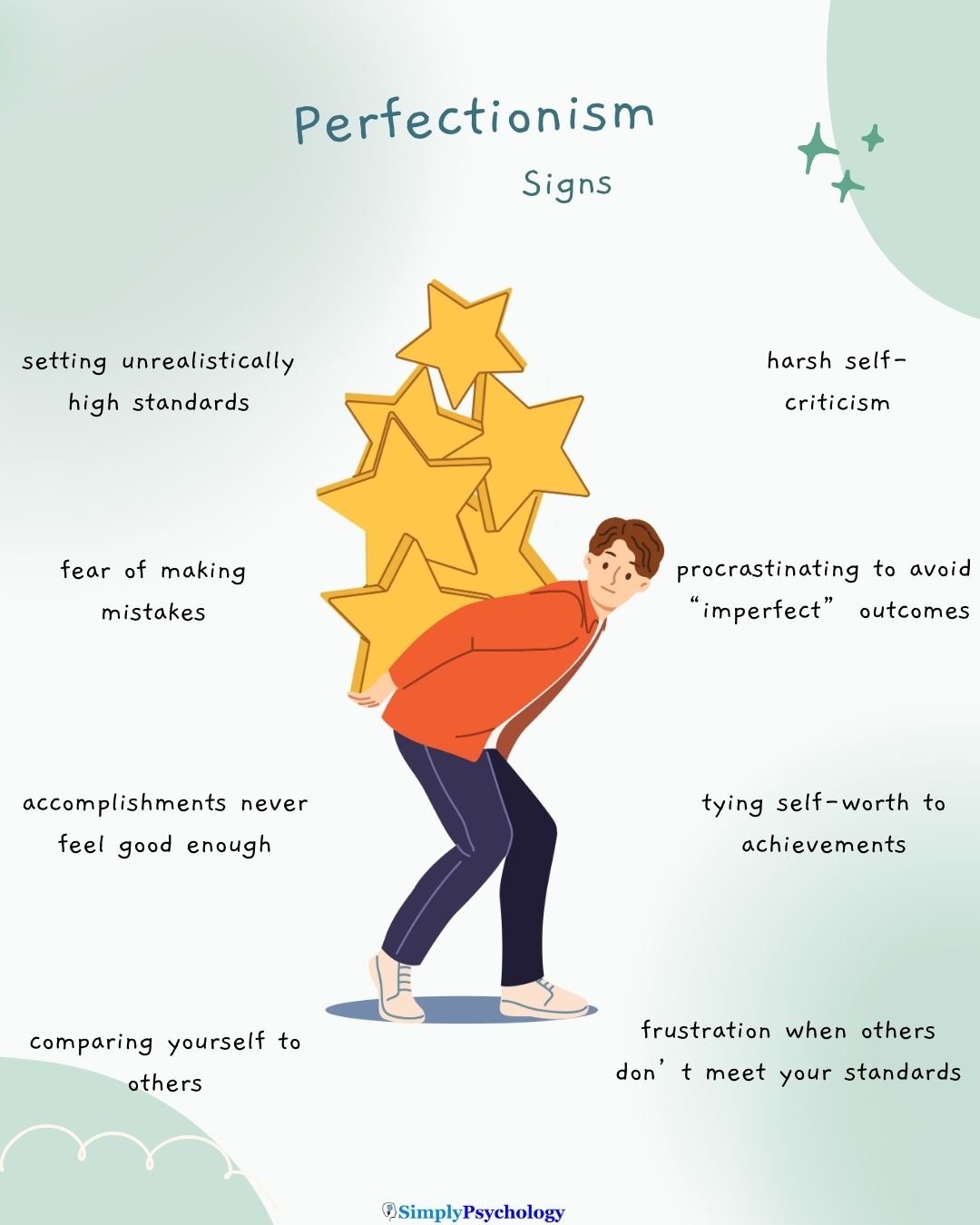
Here are some common characteristics people with perfectionistic tendencies often show:
- Overly critical inner voice – A harsh internal critic who focuses on flaws, magnifies mistakes, or ruminates over what “should have been better.” Perfectionists often evaluate themselves more on failures than achievements.
- Fear of mistakes or failure – Mistakes feel threatening, not just disappointing. Sometimes the fear of being judged prevents taking risks or starting tasks.
- Procrastination and avoidance – Ironically, the high standards themselves can lead people to delay beginning or completing tasks out of fear of not doing them perfectly. This avoidance is a way to avoid possible failure.
- Difficulty celebrating achievements – Even when success is achieved, there may be a sense that it’s not enough, or focus shifts immediately to what could have been better. Gratitude or satisfaction tends to be muted or short-lived.
- Link to self-worth – Self-esteem tends to be contingent: “If I don’t meet this standard, I’m not good enough.” Achievements are tightly tied to how one feels about themselves.
- Over-preparation – Some people prepare far more than a task needs, with a backup plan for the backup. Participants in one qualitative study over-prepared because they could not tolerate uncertainty (Zarandi et al., 2025).
Healthy Striving vs. Maladaptive Perfectionism
Healthy striving refers to setting high yet realistic goals, seeking growth, learning from mistakes, and valuing effort. It comes with flexibility, self-compassion, and enjoying the process.
For example, someone might aim to deliver excellent work, but accept that small errors are human and use feedback to improve.
Maladaptive perfectionism, on the other hand, involves rigid standards, harsh self-criticism, and seeing anything less than perfect as failure. It often leads to fear, procrastination, frustration, or burnout.
A person with maladaptive perfectionism might avoid starting a project because they worry they can’t do it perfectly, or dismiss their successes because they didn’t meet idealized expectations.
Researchers describe this split with two higher-order dimensions.
- Perfectionistic strivings – setting and pursuing very high standards for yourself and your performance.
- Perfectionistic concerns – fear of mistakes, doubts about your actions, harsh self-criticism, and the sense that others demand perfection.
The two usually go together. They relate differently to wellbeing, though. Some researchers conclude that strivings are positive when concerns are low (Stoeber & Otto, 2006).
Work research fits part of this. A meta-analysis of 28 samples (9,560 people) found that both dimensions go with longer working hours. Only strivings go with better work performance (Bellam & Curran, 2025).
For distress, the picture is less tidy. A synthesis of 416 studies found small positive correlations between strivings and depression, OCD, and most anxiety outcomes (Callaghan et al., 2024).
A meta-analysis of 45 studies also linked strivings to suicidal thoughts (Smith et al., 2018).
Context matters too. In a nine-month study of 183 trainee teachers, strivings went with lower wellbeing among those whose procrastination fell by an average amount or not at all. No significant link appeared among those whose procrastination fell more steeply (Lischetzke et al., 2025).
High standards alone are not the problem. The trouble starts when they join harsh self-judgement, self-worth that depends on results, and an inflexible response to falling short.
Types of Perfectionism
Here are the three major types as defined by Hewitt & Flett, and others:
- Self-oriented perfectionism
This involves imposing high standards upon oneself. A self-oriented perfectionist expects their own performance to be flawless, feels strong internal pressure, and is very self-critical when their own efforts fall short. - Socially prescribed perfectionism
In this type, an individual believes that others expect them to be perfect, that others will judge them harshly, and that acceptance is conditional on meeting those expectations. They perceive external pressure, often real or imagined, from parents, peers, and society. - Other-oriented perfectionism
Here, the perfectionism is directed outward: the person expects perfection from others, has strict standards for how others should behave or perform, may be critical of others’ imperfections, and can become frustrated or disappointed when others don’t meet their expectations.
Hewitt and Flett (1991) introduced these three dimensions. Their work showed that perfectionism is not one thing, and that each type relates differently to psychological difficulty.
The three types are separate. A person can be high on one and low on the others, and some people combine all three.
Three invented examples show the difference. They are illustrations, not data. Amira, a medical student, rewrites her revision notes four times because anything less than a complete set feels like negligence. That pressure comes from inside her, so it is self-oriented.
Daniel, a team leader, takes over his colleagues’ reports because “nobody checks the details properly”. That is other-oriented. Priya, a graduate trainee, is sure her manager is waiting for her first mistake, although her manager has never said so. That is socially prescribed.
What Causes Perfectionism?
Perfectionism doesn’t arise from a single source but is shaped by a mix of family influences, personality traits, cultural pressures, and genetics.
The evidence is mostly correlational, so these links are best read as “goes with”, not “causes”.
- Childhood: Parental expectations and criticism show the largest links with socially prescribed perfectionism (Curran & Hill, 2022).
- Personality: Perfectionism overlaps with neuroticism but is not simply neuroticism under another name (Smith et al., 2016).
- Culture: Perfectionism scores among American, Canadian, and British students have risen since 1989 (Curran & Hill, 2019).
- Genes: Twin studies point to a moderate genetic contribution, with most variation lying in environment (Iranzo-Tatay et al., 2015).
Childhood Experiences
One study of 119 children (mean age 11.67) and their parents found that parents’ and children’s perfectionism were related on most dimensions. Fathers’ perfectionism related to sons’ and mothers’ to daughters’ (Carmo et al., 2021).
Children who saw their parents as authoritarian, meaning high demands with little warmth, reported more maladaptive perfectionism.
The study shows associations, not development. Parents and children share genes as well as a home, and no one was followed over time.
Critical feedback can teach a child that approval must be earned. So can praise that feels conditional on achievement, or being expected to take on adult responsibilities too early (parentification). The lesson is the same: love depends on flawless performance.
Stronger evidence comes from two meta-analyses by Curran and Hill (2022). Parental expectations and criticism showed small-to-moderate links with self-oriented and other-oriented perfectionism. The links with socially prescribed perfectionism, the belief that others demand perfection of you, were large.
Interviews show what this feels like. In a study of 20 women with trichotillomania (hair pulling), participants recalled childhoods in which approval depended on meeting a high bar.
One participant, Mia, described ballet as a culture in which “you’re never kind of good enough” (Zarandi et al., 2025). These women were recruited for a study of one condition, so their accounts illustrate a pathway, not how common it is.
Personality Traits
Some people are naturally more vulnerable. Traits like conscientiousness (organization, diligence) or high sensitivity to mistakes may tip into perfectionism under pressure. The role of conscientiousness has not been tested in this research, so treat it as a plausible suggestion.
Perfectionism overlaps with neuroticism. But it is not simply neuroticism under another name.
A meta-analysis of 10 longitudinal studies (N = 1,758) found that each perfectionism dimension predicted small increases in depressive symptoms at follow-up. This held even after controlling for baseline depression and neuroticism (Smith et al., 2016).
Twin studies suggest some genetic influence. In a study of 1,022 female twins, identical pairs were more alike than non-identical pairs.
This held for personal standards, doubts about actions, and concern over mistakes (the tendency to treat an error as a failure). The authors suggested that concern over mistakes may be the core feature (Tozzi et al., 2004).
Cultural and Social Influences
Achievement-focused cultures and competitive school environments can amplify perfectionistic tendencies. Social media may add to this. Curated images of success invite constant comparison.
The best evidence for a cultural trend comes from two large cross-temporal meta-analyses. They compare the average scores of students of the same age in different years.
Between 1989 and 2016, self-oriented, socially prescribed, and other-oriented perfectionism all rose among American, Canadian, and British college students (Curran & Hill, 2019). The analysis pooled 164 samples and 41,641 students.
A 2026 update pooled 307 samples (82,939 students). Socially prescribed perfectionism accelerated from the early 2000s. Rising inequality went with steeper increases in perfectionistic concerns (Curran et al., 2026).
College students increasingly see others as excessively demanding.
These studies show that scores have risen. They do not show why. Both compare group averages across years, neither can isolate a single cause, and neither tests social media.
Nature and Nurture
Twin research points to a moderate genetic contribution.
A study of 258 pairs of adolescent Spanish twins estimated heritability for self-oriented perfectionism at 23% in boys and 30% in girls. For socially prescribed perfectionism, the estimates were 39% in boys and 42% in girls (Iranzo-Tatay et al., 2015).
That makes the socially prescribed form no less heritable. The authors said their findings cast doubt on the idea that genes shape self-oriented perfectionism while environment shapes the socially prescribed form.
For both forms, most of the variation lay with environment and measurement error.
The measure was the perfectionism subscale of the Eating Disorder Inventory, not a full perfectionism scale. Heritability describes differences within a group at one time. It does not set a limit on change.
Neither a purely genetic nor a purely environmental account is supported. Treatment trials show that perfectionism can change.
How Perfectionism Affects Mental Health
Perfectionism has wide-ranging effects on psychological well-being. Researchers call it a transdiagnostic process, meaning it contributes to several disorders rather than one (Egan et al., 2011).
It is elevated in anxiety disorders, depression, and eating disorders. It also helps maintain OCD, social anxiety, and depression, because it predicts treatment outcome.
The largest synthesis pooled 416 studies of 113,118 people (mean age 23.8). It found that the two dimensions relate differently to distress (Callaghan et al., 2024):
- Perfectionistic concerns (fear of mistakes, doubts about your actions, and harsh self-criticism) – medium correlations with anxiety, OCD, and depressive symptoms (r = .38 to .43).
- Perfectionistic strivings (high personal standards) – small correlations with OCD, depression, and most anxiety outcomes (r = .10 to .21), and none with social anxiety.
These are associations, not proof of cause. The studies cannot show whether perfectionism leads to symptoms, symptoms lead to perfectionism, or a third factor drives both.
Anxiety and Worry
Perfectionism often drives chronic worry and fear of failure. Socially prescribed perfectionism adds fear of criticism.
In the pooled evidence, perfectionistic concerns relate to general, social, and task anxiety (Callaghan et al., 2024).
A two-study investigation followed university students for 21 days. Self-oriented perfectionism predicted anxiety and stress. Socially prescribed perfectionism predicted depression and stress.
Mistake rumination, dwelling on your errors, predicted distress beyond trait perfectionism. It also carried the link from socially prescribed perfectionism to depression and anxiety (Philpot & Donachie, 2025).
The second study had 136 participants with a mean age of about 25. The sample is small. It is made up of adult university students.
Depression and Low Mood
When self-worth is tied to achievement, setbacks may trigger hopelessness and self-blame. Over time, the inability to feel “good enough” can erode resilience and mood.
Longitudinal evidence supports a link that runs forward in time. Across 10 studies that followed people over time, perfectionism predicted small increases in depressive symptoms. That held after controlling for baseline depression and neuroticism (Smith et al., 2016).
A later meta-analysis added a mechanism. Smith et al. (2020) pooled 18 longitudinal studies (N = 5,568). Concerns, such as fearing mistakes and social judgment, predicted depression through both stress and social disconnection (feeling cut off from others, or actually being so).
Two of the authors, Hewitt and Flett, helped develop this model. So the test was not carried out by neutral parties.
Perfectionism also shapes how people respond to treatment. Among 312 adults in group cognitive behavioural therapy (CBT) for depression, higher self-critical perfectionism predicted poorer progress. It predicted membership of a minimal-improvement class (odds ratio 1.49, 95% CI 1.03 to 2.19; Hawley et al., 2022).
The study had no control group. Its perfectionism scale also overlaps with depressive thinking.
Self-Esteem and Relationships
Perfectionists often experience contingent self-esteem, feeling valuable only when they succeed. This fragile sense of worth can make criticism feel devastating.
The clinical definition builds this in. Clinical perfectionism is an overdependence of self-evaluation on pursuing demanding standards, continued despite harmful consequences (Shafran et al., 2002).
The standards also move. After a success, the person re-judges the standard as not demanding enough, so success never counts. That helps explain why people with perfectionism often feel they have not arrived.
Some people also manage how they appear to others. Perfectionistic self-presentation has three facets: promoting your perfection, hiding visible signs of imperfection, and avoiding admitting imperfection in words. Hewitt and colleagues argued that this helps regulate self-esteem in company (Hewitt et al., 2003).
Relationships may also strain if perfectionists hold partners or friends to equally rigid standards, leading to tension or withdrawal.
OCD and Compulsions
Many people with obsessive-compulsive disorder (OCD) struggle with intrusive doubts about whether something has been done “just right.”
This can lead to checking, repeating, or ordering behaviors aimed at achieving a sense of perfection or preventing mistakes.
Perfectionistic concerns overlap with the beliefs that keep compulsions going. Examples include overestimating the cost of errors and needing certainty. A clinical review calls perfectionism a risk factor and a maintaining factor in OCD. Why? It predicts poorer treatment outcome (Egan et al., 2011).
The pooled correlation between perfectionistic concerns and OCD symptoms is in the medium range (Callaghan et al., 2024). In two large undergraduate samples, “not just right” experiences were more strongly related to OCD features than to worry or depression (Coles et al., 2003).
That shows a relationship. It does not show who will develop a disorder.
Eating Disorders and Burnout
Rigid standards raise the risk of eating disorders. This is especially so when body shape dominates self-evaluation.
The cognitive behavioural account sees anorexia nervosa and bulimia nervosa as often direct expressions of perfectionism. Self-worth rests on control over eating, shape, and weight (Shafran et al., 2002).
A meta-analysis of 23 studies of women found that those with anorexia nervosa scored higher on maladaptive perfectionism than non-clinical comparison groups (g = 1.00; Dahlenburg et al., 2019). Other psychiatric groups scored lower (g = 0.41). Publication bias may have affected one comparison.
In children and adolescents, a meta-analysis of 39 studies (N = 13,954) found links between perfectionism and eating disorder symptoms (r = .25). The links were larger for concerns (r = .31) than strivings (r = .21; Bills et al., 2023).
Most studies were cross-sectional, so cause cannot be inferred.
Perfectionism and Burnout
The relentless pursuit of achievement can also end in burnout, marked by exhaustion, cynicism, and reduced motivation.
A meta-analysis of 43 studies (N = 9,838) found that perfectionistic concerns had medium-to-large positive relationships with burnout (Hill & Curran, 2016). Strivings had small negative or non-significant links.
The authors call for longitudinal studies, so the direction of the link is still open.
Interviews show how this feels at work. One of 12 UK physiotherapists who had experienced burnout called the constant need to be perfect exhausting.
It felt like being “never good enough” (Skamagki et al., 2025). Perfectionism was one strand beside heavy workloads and thin support.
The Perfectionism–Procrastination–Paralysis Cycle
Fear of imperfection can fuel procrastination. Tasks are delayed or avoided, which raises anxiety and guilt and may lead to paralysis, being unable to act at all. This cycle traps people between unrealistic standards and the fear of not meeting them.
The evidence supports only half of this story. A meta-analysis found that perfectionistic concerns went with more procrastination (43 samples, N = 10,000; r = .23). Strivings went with less (38 samples; r = -.22; Sirois et al., 2017).
Opposite effects can cancel out. That is why earlier work, which treated perfectionism as one thing, found no link.
The negative link for strivings is not fully secure. A preregistered replication with 575 students found no evidence of an overall link between self-oriented perfectionism and academic procrastination (Williams & Edwards, 2021). It replicated the original study only partly.
Delay can also have other causes. In a qualitative study, two participants reported ADHD. The authors warned that planning and time-management differences could be mistaken for avoidance driven by fear of mistakes (Zarandi et al., 2025).
Perfectionism and Suicide Risk
Perfectionism is one of several factors linked to suicidal thinking. The link needs careful wording. A meta-analysis of 45 studies (N = 11,747) covered undergraduates, medical students, community adults, and psychiatric patients.
It found small-to-moderate positive associations between suicidal ideation and both perfectionistic concerns and perfectionistic strivings, as well as parental criticism and parental expectations (Smith et al., 2018). Socially prescribed perfectionism also predicted increases in ideation over time, beyond baseline levels.
These are population-level associations of small to moderate size. They do not mean perfectionism makes a person suicidal. They cannot predict who is at risk.
If you are having thoughts of ending your life, contact local emergency services or a crisis line, or talk to a health professional.
How to Overcome Perfectionism
Recognizing Perfectionistic Thoughts and Behaviors
The first step is becoming aware of when perfectionism shows up in your thinking.
Notice when you use “all-or-nothing” language, such as “everything must be perfect” or “if I fail, I’m worthless.” Mistakes that feel intolerable are another cue. So is avoiding tasks because you fear doing them badly.
Noticing is the starting point of CBT for perfectionism. It is not a tested treatment on its own. But a pattern you cannot see is a pattern you cannot test.
Journaling or thought-records can help you track these patterns.
Cognitive-Behavioral Strategies (Challenging All-or-Nothing Thinking)
Cognitive-Behavioral Therapy (CBT) has the most evidence. A meta-analysis of 15 randomised trials (N = 912, mean age 23) found medium to large effects on perfectionism.
These covered personal standards (g = 0.57), concern over mistakes (g = 0.89), and clinical perfectionism (g = 0.87). Effects on eating disorder symptoms (g = 0.61), depression (g = 0.60), and anxiety (g = 0.42) were smaller (Galloway et al., 2022).
Most trials compared CBT with a waiting list. They show it beats no treatment, not that it beats other therapies.
A 2025 randomised trial in South Korea assigned 101 people to a five-week unguided online programme or a waiting list. Concern over mistakes fell (d = -0.65), though only 61.4% completed both assessments (Oh et al., 2025).
The authors called the outcome perfectionistic strivings. The scale they measured was concern over mistakes.
CBT may help reduce both the cognitive distortions (like unrealistic standards) and emotional consequences (anxiety, depression) tied to perfectionism.
Techniques such as re-examining your standards, considering evidence for and against your harsh self-judgments, and testing out more flexible goals are useful here.
Behavioural experiments make this concrete. You might deliberately finish something to a “good enough” standard, then check whether the feared outcome follows. Packages designed for perfectionism often add a cost-benefit analysis of high standards, work on procrastination, and graded exposure to feared mistakes.
Relational and Group Therapy
A different tradition treats perfectionism as a relational pattern. It is a way of securing belonging and self-esteem that has an unmet need behind it. Therapy in this tradition looks at how a person’s perfectionism developed and what it protects them from.
A randomised trial of 80 highly perfectionistic adults compared 12 sessions of group dynamic-relational therapy with group psychodynamic supportive therapy. Both groups improved. The gains held at a six-month follow-up (Hewitt et al., 2023).
The relational therapy showed moderate to large advantages on self-oriented perfectionism, perfectionistic self-presentation, and work and social adjustment.
There are limits. The developers of the therapy ran the trial, so researcher allegiance is a concern. The comparison was another psychodynamic therapy, not CBT, and 80 people in ten groups is a modest sample.
With no untreated group, the study cannot show that both treatments worked. Direct trials against CBT for perfectionism are still missing.
Practicing Self-Compassion and Acceptance
Self-compassion means treating yourself with the kindness you would offer a friend. It is widely recommended for perfectionism. The idea is sound in principle. But the evidence is more modest than the advice suggests.
In two survey samples (541 Australian school students and 515 adults), the link between maladaptive perfectionism and depression was weaker at higher levels of self-compassion (Ferrari et al., 2018). The data were cross-sectional self-reports.
So this shows a pattern, not that self-compassion caused it.
The 2020 study by Umandap and Teh tested self-compassion as a mediator between perfectionism and personal growth initiative, not as a training programme (Umandap & Teh, 2020). The research reviewed here includes no trial of self-compassion training for perfectionism.
Some people also fear being kind to themselves. In a qualitative study of 37 women with anorexia nervosa, more than half feared that self-compassion would mean losing their high standards.
One worried about “losing the high standards I have” (Kelly et al., 2021).
The study did not measure perfectionism itself. It shows the barrier in that group, not in everyone with perfectionism.
In practice, present self-compassion as a way to keep standards that are sustainable. For related work on acceptance and values, see acceptance and commitment therapy.
Setting Realistic, Flexible Goals
Three habits help you set goals that are realistic and flexible:
- Break goals into steps. Draft an outline before the perfect final report. Small steps create momentum and ease the pressure to get it right all at once.
- Build in room for setbacks. Mistakes are part of learning, not proof of failure. Schedule time for review so improvement is expected, not a sign you “did it wrong.”
- Set flexible goals. Ask: Is this standard realistic? What would “good enough” look like? Adjust deadlines when circumstances change, rather than clinging to rigid plans.
These practices fit the clinical model, but none has been tested as a stand-alone intervention.
Tips for Everyday Life: Reframing Mistakes & Limiting Comparisons
- Reframe mistakes as learning opportunities, not proof of failure.
- Limit comparisons, especially on social media. Curated images are not whole stories.
- Celebrate small wins, even imperfect ones.
- Practice kindness in your self-talk: what would you say to a friend?
Limiting social media has some experimental support for wellbeing (Hunt et al., 2018). No trial has tested it for perfectionism itself.
When to Seek Professional Support
If perfectionism is causing persistent distress, interfering with daily functioning (work, school, relationships), or contributing to depression, anxiety, or burnout, therapy may be needed.
Also consider professional help if you’ve tried self-help steps (journaling, reframing, self-compassion) over several weeks without improvement.
Research supports a low threshold. A systematic review of 16 randomised trials found that higher perfectionism at the start often, but not always, went with poorer outcomes of treatment for other disorders. Clinicians are advised to assess perfectionism and address it when it hinders progress (Jiang et al., 2025).
If you have thoughts of self-harm or suicide, contact emergency services or a crisis line, or talk to a health professional straight away.
Evidence Check: How Strong Is the Research?
Verdict: Supported with qualifications.
The link between perfectionism and distress is secure, especially for perfectionistic concerns (fear of mistakes and harsh self-criticism). Several research groups have found it.
It covers depression, anxiety, OCD, and eating disorder symptoms. The idea that the high-standards half is simply healthy is not supported. Perfectionism can be reduced, but mostly in trials against waiting.
The largest synthesis pooled 416 studies (113,118 participants, mean age 23.8). Concerns correlated with anxiety, OCD and depressive symptoms at r = .38 to .43. That is a medium size.
Strivings correlated at r = .10 to .21. That is small. Social anxiety showed no association (Callaghan et al., 2024).
For time order, a meta-analysis of 10 longitudinal studies (N = 1,758) found small effects of perfectionism on later depressive symptoms. These held after controlling for baseline depression and neuroticism (Smith et al., 2016).
One of 18 longitudinal studies (N = 5,568) found concerns predicted depression through stress and social disconnection (Smith et al., 2020).
The weaknesses are substantial. Most association studies are cross-sectional self-report from young, often student, samples. Perfectionism and symptom scales can share wording, and r = .38 to .43 means only about 14% to 18% of shared variance. The finding is secure. It cannot settle direction.
Strivings are only partly healthy. A meta-analysis of 28 samples (N = 9,560) found both dimensions correlated with longer working hours, and only strivings with better performance (Bellam & Curran, 2025).
Across 43 studies (N = 9,838), strivings had small negative or non-significant links with burnout (Hill & Curran, 2016).
The picture is mixed. Strivings still showed small positive correlations with depression, OCD and anxiety (Callaghan et al., 2024). They also went with suicidal ideation across 45 studies (N = 11,747; Smith et al., 2018).
In 183 trainee teachers, the link between strivings and wellbeing depended on how procrastination changed over time (Lischetzke et al., 2025). So the answer depends on the outcome.
The estimates for “pure” strivings also rely on statistically separating strivings from concerns.
A meta-analysis of 15 randomised trials of cognitive behavioural therapy (CBT) (N = 912, mean age 23) found medium to large effects on perfectionism.
These were personal standards (g = 0.57), concern over mistakes (g = 0.89) and clinical perfectionism (g = 0.87). There was no publication bias (Galloway et al., 2022).
An independent meta-analysis of 10 randomised trials found medium effects on perfectionism, depression and anxiety (Suh et al., 2019).
A South Korean trial of 101 people found reduced concern over mistakes (d = -0.65) after an unguided programme (Oh et al., 2025). That makes the benefit over no treatment reasonably secure.
The weaknesses are the ones the authors report: few trials, young samples, mostly waiting-list comparisons, and heavy attrition in the Korean trial (61.4% completed both assessments).
Follow-up is mostly short. So CBT is shown to beat no treatment, not to beat other credible treatments.
FAQ
1. Do perfectionists ever feel like they’ve reached perfection?
In most cases, no. Many perfectionists rarely feel they’ve truly “arrived” because perfection standards are inherently ideal and often shifting.
As noted by Dr Bonnie Zucker, perfectionists set impossibly high standards. Those standards are almost always out of reach. Even when someone externally judges their work excellent, internally it may still feel flawed.
Research on clinical perfectionism adds that after a success the person re-judges the standard as too easy. The goalposts move (Shafran et al., 2002).
Because perfectionism tends to focus on what’s missing rather than what’s achieved, any success is often met with immediate critique or the thought: next time must be better.
2. How can I know if I am a perfectionist?
Here are some self-reflection questions you might ask yourself to see if perfectionism is part of your life:
- Do I often set impossible or extremely high standards for myself that are hard to meet?
- Do I harshly criticize myself when things don’t go perfectly, even if they’re good?
- Do I avoid starting or finishing a task because I’m afraid it won’t be perfect?
- Do I believe others expect me to be perfect, or worry a lot about judgment?
- When I achieve something, do I dismiss it or feel relief rather than pride? (i.e., it could have been better)
If you answer “yes” to several of these, perfectionism may be influencing your thoughts or behaviours. These questions are prompts for reflection, not a validated screening tool. A “yes” is a reason to look more closely, not a diagnosis.
3. Is perfectionism ever a good thing?
Yes, in its healthier form. Perfectionism (sometimes called “adaptive perfectionism” or “healthy striving”) can be beneficial.
When you set high but realistic goals, take pride in doing things well, and view mistakes as learning opportunities, perfectionistic traits can boost motivation, achievement, and personal growth.
The key is balance. Standards stay flexible, and self-worth is not entirely tied to outcomes.
The research is more mixed than the label suggests, though. High standards go with more work effort and sometimes better performance, but also with small costs for distress (Bellam & Curran, 2025; Callaghan et al., 2024).
Key Takeaways
- Definition: Perfectionism pairs very high standards with self-worth that depends on meeting them. It is a risk factor for several conditions, not a diagnosis.
- Two Dimensions: Strivings (high personal standards) and concerns (fear of mistakes and harsh self-criticism) behave differently. Concerns carry most of the link to depression, anxiety, OCD, and burnout.
- Healthy Striving: High standards alone are not the problem. Trouble starts when they join harsh self-judgement and self-worth that depends on results. Even strivings carry small costs for distress.
- Causes: No single cause explains perfectionism. Parenting, personality, genes, and culture all play a part, though most evidence is correlational.
- Procrastination: Concerns go with more procrastination, but strivings go with less. The popular cycle is only half right.
- What Helps: Cognitive behavioural therapy (CBT) designed for perfectionism works better than waiting, including online. Self-compassion is widely recommended, but its evidence is thin.
- Verdict: Supported with qualifications – the link to distress is secure, but most studies cannot show cause, and CBT has rarely been compared with other therapies.
Resources
Centre for Clinical Interventions: What Is Perfectionism?
Perfectionism: A Double-Edged Sword
References
Bills, E., Greene, D., Stackpole, R., & Egan, S. J. (2023). Perfectionism and eating disorders in children and adolescents: A systematic review and meta-analysis. Appetite, 187, Article 106586. https://doi.org/10.1016/j.appet.2023.106586
Callaghan, T., Greene, D., Shafran, R., Lunn, J., & Egan, S. J. (2024). The relationships between perfectionism and symptoms of depression, anxiety and obsessive-compulsive disorder in adults: A systematic review and meta-analysis. Cognitive Behaviour Therapy, 53(2), 121–132. https://doi.org/10.1080/16506073.2023.2277121
Carmo, C., Oliveira, D., Brás, M., & Faísca, L. (2021). The influence of parental perfectionism and parenting styles on child perfectionism. Children, 8(9), Article 777. https://doi.org/10.3390/children8090777
Coles, M. E., Frost, R. O., Heimberg, R. G., & Rhéaume, J. (2003). “Not just right experiences”: Perfectionism, obsessive–compulsive features and general psychopathology. Behaviour Research and Therapy, 41(6), 681–700. https://doi.org/10.1016/S0005-7967(02)00044-X
Curran, T., & Hill, A. P. (2019). Perfectionism is increasing over time: A meta-analysis of birth cohort differences from 1989 to 2016. Psychological Bulletin, 145(4), 410–429. https://doi.org/10.1037/bul0000138
Curran, T., & Hill, A. P. (2022). Young people’s perceptions of their parents’ expectations and criticism are increasing over time: Implications for perfectionism. Psychological Bulletin, 148(1–2), 107–128. https://doi.org/10.1037/bul0000347
Curran, T., Hill, A. P., & Pose, P. M. (2026). Perfectionism is accelerating over time: A cross-temporal meta-analytic review of 35 years of college student data. Psychological Bulletin, 152(3), 255–287. https://doi.org/10.1037/bul0000518
Dahlenburg, S. C., Gleaves, D. H., & Hutchinson, A. D. (2019). Anorexia nervosa and perfectionism: A meta-analysis. International Journal of Eating Disorders, 52(3), 219–229. https://doi.org/10.1002/eat.23009
Egan, S. J., Wade, T. D., & Shafran, R. (2011). Perfectionism as a transdiagnostic process: A clinical review. Clinical Psychology Review, 31(2), 203–212. https://doi.org/10.1016/j.cpr.2010.04.009
Ferrari, M., Yap, K., Scott, N., Einstein, D. A., & Ciarrochi, J. (2018). Self-compassion moderates the perfectionism and depression link in both adolescence and adulthood. PLOS ONE, 13(2), Article e0192022. https://doi.org/10.1371/journal.pone.0192022
Galloway, R., Watson, H., Greene, D., Shafran, R., & Egan, S. J. (2022). The efficacy of randomised controlled trials of cognitive behaviour therapy for perfectionism: A systematic review and meta-analysis. Cognitive Behaviour Therapy, 51(2), 170–184. https://doi.org/10.1080/16506073.2021.1952302
Hawley, L. L., Rappaport, L. M., Padesky, C. A., Hollon, S. D., Mancuso, E., Laposa, J. M., Brozina, K., & Segal, Z. V. (2022). Self-critical perfectionism, dependency and entropy during cognitive behavioural therapy for depression. British Journal of Clinical Psychology, 61(4), 911–928. https://doi.org/10.1111/bjc.12366
Hewitt, P. L., & Flett, G. L. (1991). Perfectionism in the self and social contexts: Conceptualization, assessment, and association with psychopathology. Journal of Personality and Social Psychology, 60(3), 456–470. https://doi.org/10.1037/0022-3514.60.3.456
Hewitt, P. L., Flett, G. L., Sherry, S. B., Habke, M., Parkin, M., Lam, R. W., McMurtry, B., Ediger, E., Fairlie, P., & Stein, M. B. (2003). The interpersonal expression of perfection: Perfectionistic self-presentation and psychological distress. Journal of Personality and Social Psychology, 84(6), 1303–1325. https://doi.org/10.1037/0022-3514.84.6.1303
Hewitt, P. L., Kealy, D., Mikail, S. F., Smith, M. M., Ge, S., Chen, C., Sochting, I., Tasca, G. A., Flett, G. L., & Ko, A. (2023). The efficacy of group psychotherapy for adults with perfectionism: A randomized controlled trial of dynamic-relational therapy versus psychodynamic supportive therapy. Journal of Consulting and Clinical Psychology, 91(1), 29–42. https://doi.org/10.1037/ccp0000787
Hill, A. P., & Curran, T. (2016). Multidimensional perfectionism and burnout: A meta-analysis. Personality and Social Psychology Review, 20(3), 269–288. https://doi.org/10.1177/1088868315596286
Hunt, M. G., Marx, R., Lipson, C., & Young, J. (2018). No more FOMO: Limiting social media decreases loneliness and depression. Journal of Social and Clinical Psychology, 37(10), 751–768. https://doi.org/10.1521/jscp.2018.37.10.751
Iranzo-Tatay, C., Gimeno-Clemente, N., Barberá-Fons, M., Rodriguez-Campayo, M. Á., Rojo-Bofill, L., Livianos-Aldana, L., Beato-Fernandez, L., Vaz-Leal, F., & Rojo-Moreno, L. (2015). Genetic and environmental contributions to perfectionism and its common factors. Psychiatry Research, 230(3), 932-939. https://doi.org/10.1016/j.psychres.2015.11.020
Jiang, Z., Egan, S. J., Greene, D., Frost, M., Ma, Y., & Shafran, R. (2025). The impact of perfectionism on treatment outcomes of mental health disorders: A systematic review of randomised controlled trials. Cognitive Behaviour Therapy, 55(6), 1039–1059. https://doi.org/10.1080/16506073.2025.2547199
Kelly, A. C., Katan, A., Sosa Hernandez, L., Nightingale, B., & Geller, J. (2021). Why would I want to be more self-compassionate? A qualitative study of the pros and cons to cultivating self-compassion in individuals with anorexia nervosa. British Journal of Clinical Psychology, 60(1), 99–115. https://doi.org/10.1111/bjc.12275
Lischetzke, T., Grommisch, G., Prestele, E., & Altstötter-Gleich, C. (2025). Are perfectionistic strivings beneficial or detrimental to well-being and achievement? Tests of procrastination and emotion regulation as moderators. Journal of Personality, 93(3), 614–632. https://doi.org/10.1111/jopy.12955
Oh, S., Cha, J. H., Joo, J., Lee, J. H., Lee, Y., Lee, H. J., Yoon, D. U., & Lee, J. (2025). Efficacy of Internet-based cognitive behavioral therapy for reducing perfectionistic strivings in the Republic of Korea: A randomized controlled trial. Internet Interventions, 41, 100851. https://doi.org/10.1016/j.invent.2025.100851
Philpot, N., & Donachie, T. C. (2025). Perfectionism and psychological distress in university students: The role of mistake rumination. Personality and Individual Differences, 246, 113368. https://doi.org/10.1016/j.paid.2025.113368
Shafran, R., Cooper, Z., & Fairburn, C. G. (2002). Clinical perfectionism: A cognitive–behavioural analysis. Behaviour Research and Therapy, 40(7), 773–791. https://doi.org/10.1016/S0005-7967(01)00059-6
Sirois, F. M., Molnar, D. S., & Hirsch, J. K. (2017). A meta-analytic and conceptual update on the associations between procrastination and multidimensional perfectionism. European Journal of Personality, 31(2), 137–159. https://doi.org/10.1002/per.2098
Skamagki, G., Blackburn, L., Biggs, D., Kolitsida, M., Black, C., & Shanmugam, S. (2025). Exploring burnout, perfectionism, and moral injury among UK physiotherapists: A qualitative study on professional fulfilment and well-being. PLOS ONE, 20(2), Article e0313730. https://doi.org/10.1371/journal.pone.0313730
Smith, M. M., Sherry, S. B., Chen, S., Saklofske, D. H., Mushquash, C., Flett, G. L., & Hewitt, P. L. (2018). The perniciousness of perfectionism: A meta-analytic review of the perfectionism–suicide relationship. Journal of Personality, 86(3), 522–542. https://doi.org/10.1111/jopy.12333
Smith, M. M., Sherry, S. B., Rnic, K., Saklofske, D. H., Enns, M., & Gralnick, T. (2016). Are perfectionism dimensions vulnerability factors for depressive symptoms after controlling for neuroticism? A meta-analysis of 10 longitudinal studies. European Journal of Personality, 30(2), 201–212. https://doi.org/10.1002/per.2053
Smith, M. M., Sherry, S. B., Vidovic, V., Hewitt, P. L., & Flett, G. L. (2020). Why does perfectionism confer risk for depressive symptoms? A meta-analytic test of the mediating role of stress and social disconnection. Journal of Research in Personality, 86, Article 103954. https://doi.org/10.1016/j.jrp.2020.103954
Stoeber, J., & Otto, K. (2006). Positive conceptions of perfectionism: Approaches, evidence, challenges. Personality and Social Psychology Review, 10(4), 295–319. https://doi.org/10.1207/s15327957pspr1004_2
Suh, H., Sohn, H., Kim, T., & Lee, D.-g. (2019). A review and meta-analysis of perfectionism interventions: Comparing face-to-face with online modalities. Journal of Counseling Psychology, 66(4), 473–486. https://doi.org/10.1037/cou0000355
Tozzi, F., Aggen, S. H., Neale, B. M., Anderson, C. B., Mazzeo, S. E., Neale, M. C., & Bulik, C. M. (2004). The structure of perfectionism: A twin study. Behavior Genetics, 34(5), 483–494. https://doi.org/10.1023/B:BEGE.0000038486.47219.76
Umandap, J. D., & Teh, L. A. (2020). Self-compassion as a mediator between perfectionism and personal growth initiative. Psychological Studies, 65(3), 227–238. https://doi.org/10.1007/s12646-020-00566-8
Williams, M. N., & Edwards, S. R. (2021). Conceptual replication of Seo (2008), “Self-efficacy as a mediator in the relationship between self-oriented perfectionism and academic procrastination.” Current Issues in Personality Psychology, 10(2), 98–111. https://doi.org/10.5114/cipp.2021.110948
Zarandi, A. L., Millar, J. F. A., Waites, E., & Stevenson, J. L. (2025). A qualitative study exploring the role of perfectionism in trichotillomania. Psychology and Psychotherapy: Theory, Research and Practice, 98(4), 901–917. https://doi.org/10.1111/papt.12597