A people pleaser is someone who consistently prioritizes the needs and wants of others over their own, often at the expense of their own well-being and happiness.
They have a strong desire to gain approval, avoid conflict, and make others happy, even if it means sacrificing their own interests or boundaries.
Signs of a people pleaser:
- Has difficulty saying no
- Seeks external validation
- Puts others first
- Overcommits themselves
- Fears rejection
- Neglects personal needs
- Avoids confrontation
- Over-apologizes or accepts fault even when not responsible
- Allows others to take advantage of them
- Has low self-esteem
- Has difficulty expressing opinions
- Holds oneself to unreasonably high standards

Examples of people-pleasing behaviors:
- Changing their personality and attitude depending on who they are with
- Agreeing with others’ opinions or decision by default
- Taking on extra work or responsibilities, often to the detriment of their own time and well-being
- Apologizing profusely, even when they haven’t done anything wrong, to make sure others don’t get upset
- Staying in friendships or relationships that don’t bring them joy
- Consistently putting their own needs, wants, and desires on the back burner in favor of catering to others
- Saying yes, even when they do not want to
- Withholding opinions to avoid disagreements or confrontations
- Having difficulty making decisions, especially when it involves choosing between their own needs and the desires of others
- Minimizing their strengths to avoid making others feel less successful
- Pretending to be happy or content even when they’re not, in order to maintain a positive image or not burden others with their feelings
- Offering excessive compliments or praise to others, sometimes insincerely, in an attempt to win favor
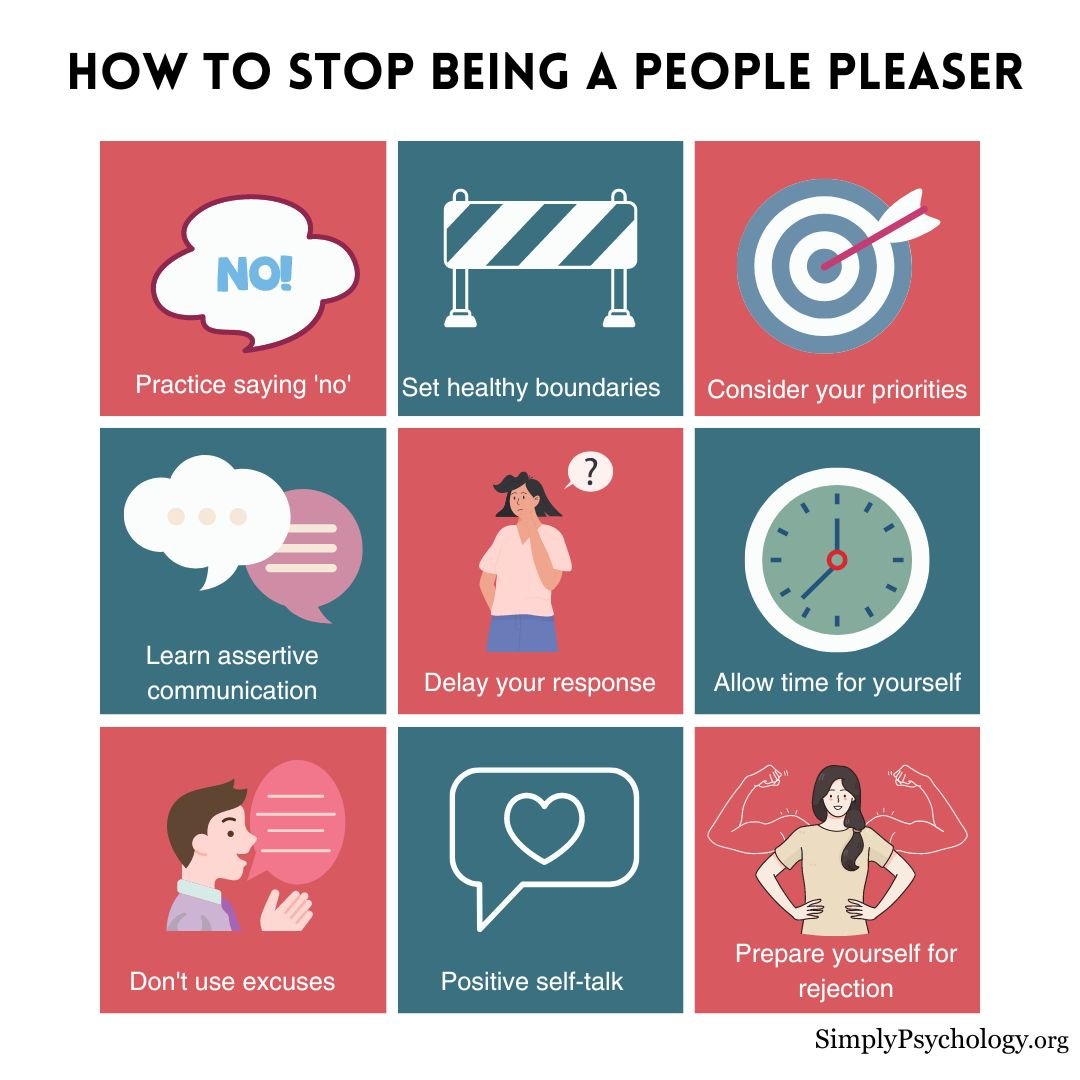
How to Stop Being a People Pleaser

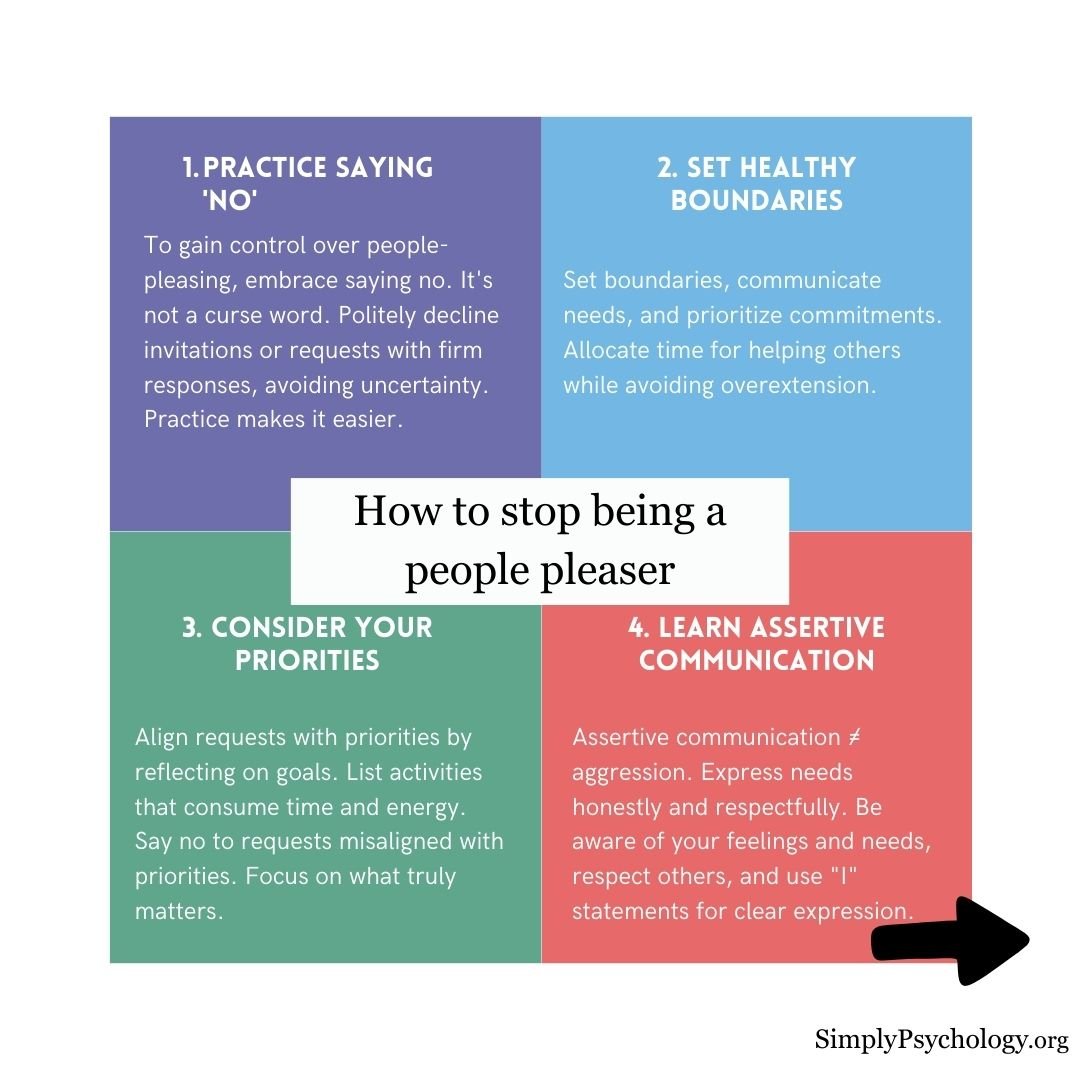
Practice Saying “No”
Learning to say no is a crucial skill to develop to break the habit of people pleasing.
When someone makes a request or asks for your help, take a moment to pause and assess the situation. Consider whether you genuinely have the time, energy, and desire to fulfill the request.
Saying yes can feel like the automatic response. It’s okay to prioritize your own needs instead: saying no is a healthy, necessary part of setting boundaries.
When you’re ready to respond, use assertive communication. Be clear, direct, and respectful in your response. You don’t need to provide a lengthy explanation or excuse for your decision as over-explaining can sometimes lead to giving in to the request.
To build your confidence in saying no, start with smaller, less consequential requests and gradually work your way up to more significant commitments.
And, if you’re unsure whether you can say yes or no right away, it’s okay to buy some time. You can say something like, “Let me check my schedule and get back to you” or “I need to think about it for a moment.”
Here are a few more tips when saying “no”:
- If you genuinely want to help but can’t fulfill the request as it was presented, you can offer alternatives. For example, if a friend invites you to lunch but you don’t have time, suggest rescheduling or meeting for a quick coffee near your office instead.
- Keep your response concise and to the point.
- Stay firm in your decision while remaining polite and respectful.
- Pay attention to how certain requests make you feel to identify requests that trigger stress.
- Understand that learning to say no is a process, and it’s okay to make mistakes along the way.
Set Healthy Boundaries
Author and motivational speaker Brené Brown says that “daring to set boundaries is about having the courage to love ourselves even when we risk disappointing others.”
Setting clear boundaries is another crucial part of breaking free from people-pleasing. A boundary defines how you want to be treated, and how you’ll interact with others.
Start by identifying your own boundaries: physical, emotional, mental, and interpersonal. Then communicate them clearly to the people in your life.
Setting and maintaining a boundary typically requires assertive communication. When a request conflicts with a boundary, say no firmly and respectfully.
Use “I” statements to convey a boundary without blaming the other person. For example: “I need some alone time in the evenings to recharge,” or “I prefer not to discuss that topic.”
Consider Your Priorities
People pleasing can get in the way of your own commitments and priorities.
People pleasers often feel guilty for prioritizing their own needs. But clinical psychologist Dr. L. Firestone says making time for your own well-being gives you more energy. It lets you be your best self for others.
Regularly reflect on your own needs, desires, and values, and ask what you truly want in each situation. Understanding your goals makes it easier to decline requests that don’t fit your priorities. Then you can focus on what matters most.
Reserve time for self-care activities that nourish your physical and emotional health, such as exercise, meditation, hobbies, or relaxation.
Learn Assertive Communication
People pleasers often have difficulty communicating assertively. They often avoid addressing issues or conflicts directly, as they fear it might upset someone or lead to disapproval.
They may also find it challenging to express their own opinions, preferences, or needs, especially if they differ from what they perceive others want.
However, assertive communication is not about being aggressive or rude. It’s about communicating your needs and opinions in an honest, direct, and respectful way.
Tips for learning assertive communication:
- Be aware of your own emotions, feelings, boundaries and needs.
- Show respect for the other person’s feelings, even if you disagree with them.
- Express your thoughts and feelings using “I” statements.
- Clearly and directly express your needs or concerns without being vague.
- Take deep breaths if you start to feel overwhelmed, and remind yourself that assertive communication is a healthy way to express yourself.
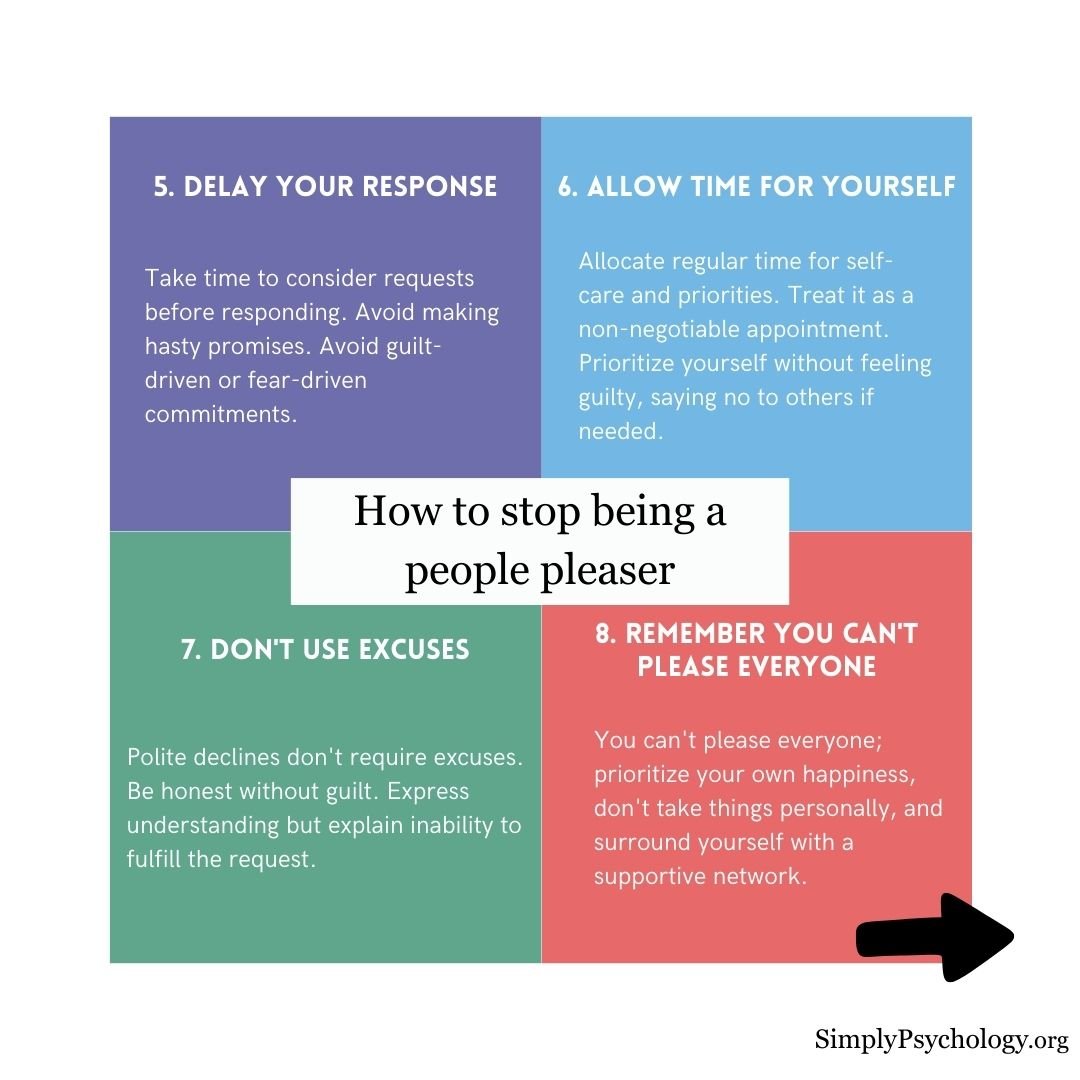
Delay Your Response
People-pleasers often have a tendency to say yes by default because of their desire to please others.
Delaying your response can be a helpful strategy in certain situations to break the habit of automatically saying yes and to give yourself time to consider what you truly want.
You can consider factors like your current commitments, energy levels, and whether fulfilling the request aligns with your own priorities and boundaries.
Time management expert Laura Vanderkam notes that “delaying your response allows you to take a step back and evaluate whether saying yes aligns with your own values and priorities, rather than automatically prioritizing the needs of others.”
After taking your time to assess, respond honestly and promptly. If you need to decline, use assertive communication to do so respectfully.
Allocate Time For Yourself
Taking time for self-care and personal well-being is a crucial step in breaking the cycle of constantly prioritizing others’ needs and wants over your own.
Clinical psychologist Dr. Ellen Hendriksen emphasizes that “taking time for yourself and practicing self-care isn’t selfish; it’s crucial.”
People pleasers often give so much to others that they become emotionally and physically drained. Allocating time for yourself gives you the opportunity to recharge and regain your energy.
Set aside time each day or each week to engage in self-care activities that nurture your physical, emotional, and mental well-being. This can include exercise, meditation, reading, hobbies, or simply relaxing and doing nothing.
This time can also be used to work toward your personal goals and aspirations, which may have been put on hold due to people-pleasing tendencies.
Make this time non-negotiable. Don’t let other people’s requests or demands take priority over your self-care time. It is perfectly reasonable to say no to other people’s requests to make time for yourself.
Don’t Make Excuses
People pleasers often resort to making excuses to justify their actions or decisions to avoid conflict. Avoiding excuses can help you assert yourself more effectively and communicate your boundaries and decisions more honestly.
Not using excuses encourages open and honest communication. This allows you to express yourself more clearly and directly, which can lead to healthier and more respectful interactions.
Additionally, without excuses, you take greater accountability for your actions and decisions. This helps you become more responsible for your choices and less likely to compromise your needs to please others.
Set Realistic Expectations
A fear of not living up to others’ expectations is a significant driver of people-pleasing.
Psychologists call this socially prescribed perfectionism: the belief that other people demand perfection of you and will withdraw approval if you fall short (Hewitt & Flett, 1991). Naming it as a belief, not a fact, is what makes it possible to challenge.
Guilt is a common emotion for people pleasers. It’s essential to accept that you can’t please everyone all the time. Taking care of yourself is not selfish.
Understand that setting realistic expectations for yourself and others is essential for maintaining balance in your life.
It is okay to prioritize your own well-being and needs and make your own happiness a priority.
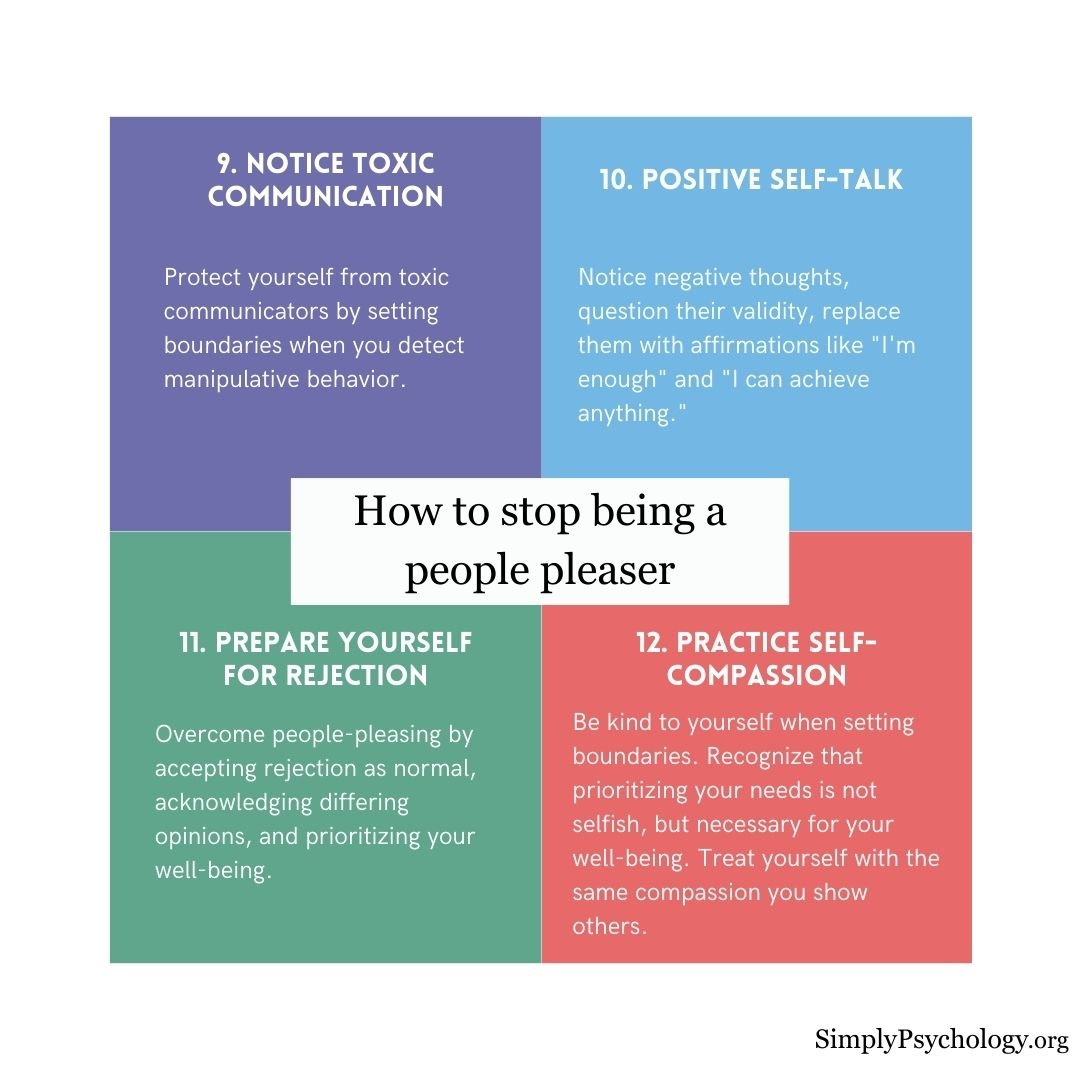
Identify Triggers and Toxic Communicators
Try to identify the situations, people, or circumstances that trigger your people-pleasing behavior. Knowing what prompts it helps you address it.
Toxic individuals use manipulative, controlling, or aggressive communication. They often target people pleasers, sensing both a willingness to prioritize others’ needs and a reluctance to assert themselves.
According to Stephanie Sarkis, Ph.D., toxic communicators drain the energy of people pleasers by constantly demanding attention, sympathy, or validation.
They may use guilt-tripping or passive-aggressive tactics to push through unreasonable requests. They are counting on you not refusing.
Recognizing the signs of a toxic individual is itself a skill. It, along with assertiveness and boundary-setting, protects you from manipulation.
Tips for recognizing when you’re being taken advantage of:
- Pay attention to your intuition and feelings. If something doesn’t feel right or you sense that you’re being used, trust your instincts.
- Listen to the words and phrases the person uses. Do they criticize, judge, or blame you?
- Is their tone of voice harsh, condescending, or demanding?
- Pay attention to their body language. Are they crossing their arms, rolling their eyes, or making other dismissive gestures?
- Reflect on your feelings and emotions. Are you often anxious, stressed, or unhappy after interacting with this person?
Use Positive Self-Talk
People pleasers often struggle with low self-esteem because they base their self-worth on external validation. Engaging in positive self-talk can help you build a healthier sense of self-esteem by reinforcing positive beliefs about yourself.
Using positive affirmations in your self-talk can reinforce positive beliefs about your worth, capabilities, and the importance of self-care.
Here are some tips for building your self-esteem with positive self-talk:
- Pay attention to the thoughts and messages you tell yourself, especially when facing challenges or setbacks.
- Challenge your self-critical or unhelpful thoughts. Ask yourself if there is evidence to support these thoughts or if they are based on unfounded assumptions or fears.
- Create and repeat positive affirmations that reinforce your self-worth and capabilities, such as “I’m good enough,” “I’m worthy of love,” and “I can do anything I set my mind to.”
- Treat yourself with the same kindness and understanding that you would offer to a friend facing a similar situation.
- Avoid self-deprecating language and negative self-labels. Instead of saying, “I’m such a failure,” rephrase it as, “I made a mistake, but I can learn from it.”
Be Prepared For Rejection
Many people pleasers fear rejection, criticism, or disapproval from others, which can lead them to prioritize others’ needs over their own.
Psychotherapist Amy Morin states that “one key aspect of overcoming people-pleasing tendencies is to recognize that rejection is a normal part of life. It’s important to develop a healthy mindset that understands that not everyone will always agree with you or appreciate your choices. By accepting this reality, you can better prepare yourself for potential rejection and focus on your own well-being.”
Tips for preparing yourself for rejection:
- Understand that rejection is a normal part of life and doesn’t define your worth as a person.
- Recognize that not everyone will agree with you, support your choices, or appreciate your boundaries.
- Concentrate on what you can control, such as your actions, choices, and responses.
- Build emotional resilience by developing coping strategies for handling rejection.
- Remember that your value as a person remains intact regardless of individual rejections.
What Happens When You Stop People Pleasing?
“When you stop living your life based on what others think of you, real life begins. At that moment, you will finally see the door of self-acceptance opened.”
Shannon L. Alder, Inspirational Author and Therapist.
As you start prioritizing your own well-being and needs, you begin to escape the pattern of relying on others for validation. You start to value yourself for who you are, not for how successfully you make everyone happy. Your worth was never really up to them.
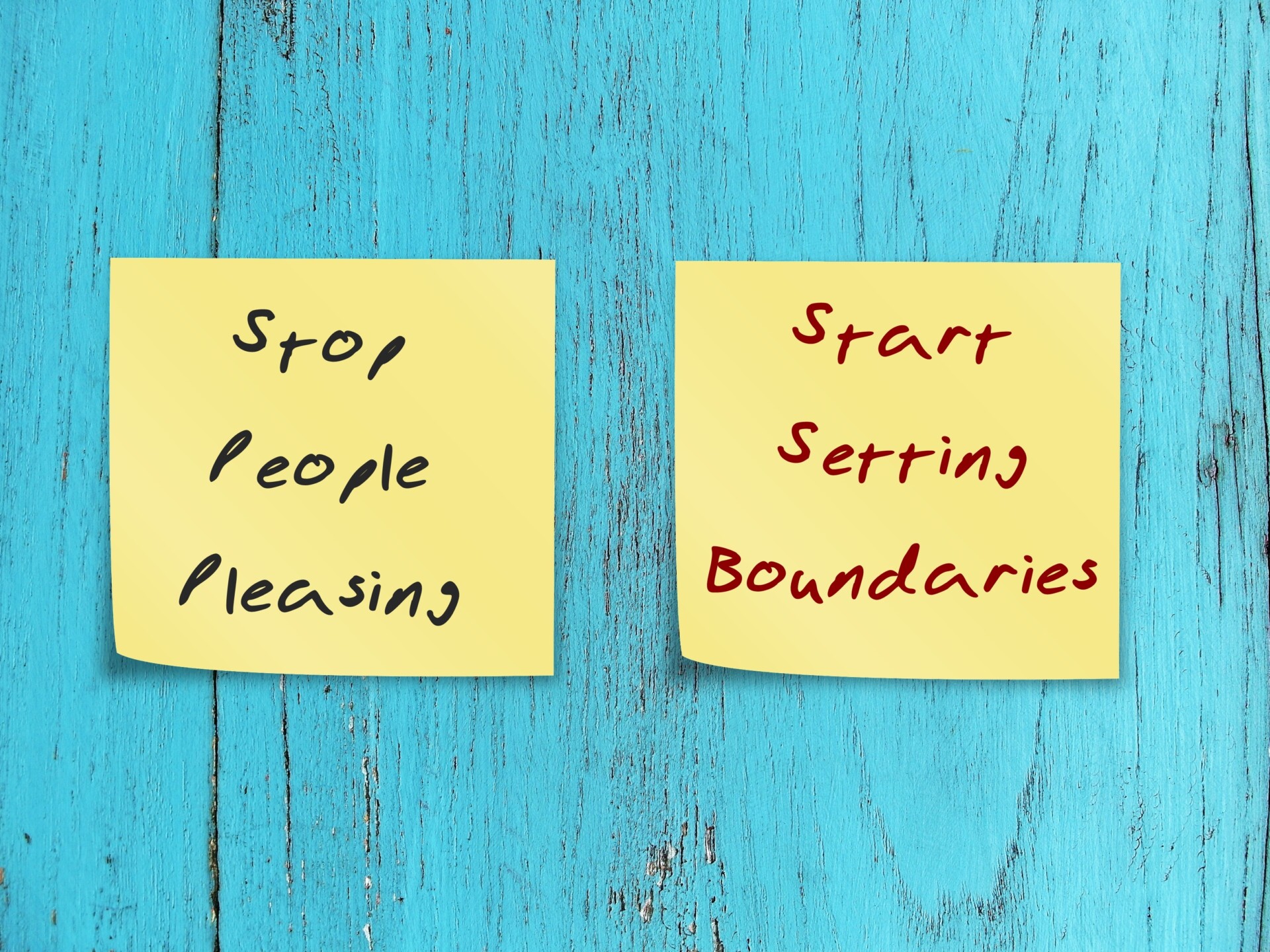
Learning to assertively decline requests is itself an act of self-respect. It also frees up time for your own goals and passions instead.
Your Relationships Become More Authentic
Your relationships also become more authentic, because you’re no longer pretending to please others. People are more likely to appreciate the real you and respect your ability to hold boundaries. This attracts healthier relationships built on mutual respect.
Dr. Judith Sills, a psychologist, explains that “when you do too much for others, you over-function in your relationships, which inevitably leads others to under-function.”
Stopping people-pleasing is a journey, not a single decision. Some people who are used to your automatic yes may resist the change. Still, the benefits of a more authentic, assertive life outweigh that friction.
Why Should You Stop Being a People Pleaser?
When you stop people-pleasing, you learn to value yourself for who you are. You build more genuine relationships, protect your well-being, and command more respect from others.
It Fuels Personal Growth
Overcoming people-pleasing can be a catalyst for personal growth. It forces you to confront fears, build resilience, and develop a stronger sense of self.
People pleasers find it difficult to assert their own needs, which traps them in a cycle of self-sacrifice and self-neglect. They put others’ expectations before their own.
Amy Morin, a licensed therapist, reminds us that “while being kind and helpful is generally a good thing, going too far to please others can leave you feeling emotionally depleted, stressed, and anxious.”
It Strengthens Your Boundaries and Relationships
As you align your actions with your true self, you experience greater happiness. Living a life that matches your own values and desires brings real fulfillment.
People pleasers often struggle to set and maintain healthy boundaries. Stopping people-pleasing lets you build boundaries that protect your well-being and stop others taking advantage of you.
By asserting your needs and boundaries, you command more respect from others. People value you more when they see that you value yourself. That’s real progress.
As the therapist Esther Perel explains, a partner’s people-pleasing rarely functions in isolation. It ties into the other partner’s own fears. Real change often has to happen on both sides of the relationship.
Stopping people-pleasing is essential for your own well-being, self-respect, and the quality of your relationships. It empowers a more authentic, fulfilling, balanced life built around your own needs and values.
Critical Evaluation of the People-Pleasing Concept
“People-pleasing” is a useful everyday label, but it is worth being clear-eyed about what it is and isn’t as a psychological concept.
Is People-Pleasing a Real Diagnosis?
“People-pleasing” is not a diagnosis in the DSM-5 or ICD-11, and no single questionnaire measures it directly. Psychology has studied genuinely overlapping patterns under other names instead.
These include Beck’s (1983) concept of sociotropy and Crowne and Marlowe’s (1964) approval motive. They also include Walker’s (2013) concept of fawning as a trauma response, and Hewitt and Flett’s (1991) socially prescribed perfectionism.
None of these traditions maps exactly onto everyday people-pleasing. A self-help quiz that calls someone “a people pleaser” borrows from several research literatures without saying which one applies.
No single questionnaire measures the everyday term itself.
Each foregrounds a different mechanism, from a stable personality trait to a learned survival response. That is why they are not simply interchangeable labels for the same behavior.
Contemporary Research
Recent research clarifies both the mechanism behind chronic approval-seeking and its relational costs. A study of 279 patients diagnosed with major depression or generalized anxiety tested whether rumination explains how sociotropy translates into symptoms (Martínez, Senra, Fernández-Rey, & Merino, 2020).
Brooding, a repetitive, self-critical style of dwelling on distress, consistently explained much of the link between sociotropy and both depressive and anxiety symptoms. The anxious, approval-dependent personality alone does not cause the distress. It is the rumination that follows a perceived loss of approval that does much of the work.
A second strand of evidence points to relational costs.
A large dyadic study of romantic couples found that higher codependency predicted less constructive joint coping, and lower relationship and life satisfaction for both partners (Happ et al., 2023).
A 2025 applied review reached a similar conclusion in the workplace: chronic people-pleasing was linked to reduced authenticity and lower productivity over time. The authors argued organizational culture, not just individual personality, helps determine whether it takes hold (Georgescu & Bodislav, 2025).
Culture and gender shape this picture too.
Cultural and Gender Bias
The construct also risks pathologizing behavior that is culturally normal. Markus and Kitayama’s (1991) work on independent versus interdependent self-construals shows that people in more interdependent cultures define themselves through belonging and consideration for others.
Individualist psychology can too readily read this as an anxious, approval-dependent personality. It rarely stops to ask whether the behavior is simply a different, culturally coherent way of relating to other people.
Treating the Western baseline as neutral is itself a bias.
Gender complicates the picture further. Social role theory holds that women and girls face a stronger cultural expectation to be accommodating from an early age (Eagly & Wood, 1999). The same behavior may be noticed, and labeled “people-pleasing,” more readily in a woman than in a man.
Frequently Asked Questions
Is it selfish to stop being a people pleaser?
No, it’s not selfish to stop being a people pleaser. In fact, breaking the pattern of people-pleasing is an important step toward self-care, self-respect, and healthier relationships.
Just as it’s important to take care of your physical health, it’s equally important to take care of your emotional and mental well-being.
NLP Master Practitioner Jo Ritchie says that “taking care of ourselves is the opposite of being selfish, as it strengthens us and enables us to support our loved ones better. We are no use to anyone if our energy is depleted because we have given every last bit of it away.”
It’s important to note that stopping people-pleasing doesn’t mean you become self-centered or disregard the feelings of others. It means finding a healthy balance between self-care and consideration for others.
Why do people become people pleasers?
People become people pleasers for a variety of reasons, often stemming from early life experiences, personality traits, and social conditioning.
Many people pleasers have a strong desire for approval and validation from others, and they believe that by constantly pleasing others, they can gain acceptance and love.
Individuals with low self-esteem may feel unworthy or unimportant. As such, they will seek external validation to compensate for their lack of self-worth and believe that pleasing others is the only way to feel valued.
Additionally, the fear of rejection or abandonment can drive people to become people pleasers. They go to great lengths to avoid conflict or rejection, even at the expense of their own needs and desires.
Lastly, people who have grown up in environments where they observed people-pleasing behavior in their caregivers or role models often will adopt similar patterns of behavior.
Or, individuals who have experienced trauma or abusive relationships may develop people-pleasing behaviors as a survival mechanism to avoid conflict and protect themselves.
How can I handle criticism or disapproval from others when I stop being a people pleaser?
It’s normal to feel hurt or defensive when someone criticizes or disapproves of you. You should allow yourself to feel and process these emotions, but don’t let them control you.
Try to separate criticism of your actions from your overall self-worth. Recognize that criticism is often a reflection of the critic’s perspective and not necessarily a judgment of your worth or character.
Take a moment to pause and gather your thoughts before responding to criticism. If you feel like you need to respond to the criticism, do so calmly and respectfully as reacting impulsively may lead to defensiveness or escalation.
Be mindful that not all criticism is negative or harmful. Be open to constructive feedback that can help you grow and improve, even if it challenges your choices.
If you’re struggling, surround yourself with supportive friends, family members, or a therapist who can provide encouragement and perspective when you face criticism.
What is the difference between being helpful and being a people pleaser?
Helpfulness is motivated by a desire to help, while people pleasing is motivated by fear of rejection or a need for approval.
Being helpful involves assisting others without compromising your own well-being.
Conversely, people pleasers prioritize meeting the expectations and demands of others at the expense of their own needs and well-being.
Here are some questions to ask yourself:
1. Am I doing this because I want to help or because I’m afraid of what will happen if I don’t?
2. Am I putting my own needs aside to help this person?
3. Do I feel resentful or used whilst helping this person?
If you answered yes to any of these questions, you’re likely exhibiting people pleasing behavior.
Julia Simkus edited this article.
Key Takeaways
- Definition: A people pleaser consistently prioritizes others’ needs over their own, driven by a fear of conflict or rejection rather than genuine kindness.
- Vs. Helpfulness: Helpfulness comes from wanting to help; people-pleasing comes from fear of what happens if you say no.
- Origins: The pattern usually develops from a need for approval, low self-esteem, modeling caregivers’ behavior, or as a survival response to past trauma.
- Key Strategies: Practicing assertive “no”s, setting clear boundaries, delaying automatic yeses, and identifying triggers are the most effective starting points.
- Benefits: Stopping the pattern builds more authentic relationships, and authenticity itself is robustly linked to greater well-being.
- Not Selfish: Prioritizing your own needs is self-care, not self-centeredness, and it tends to earn more respect from others, not less.
References
Huntington, C. People Pleasing: Definition, Quotes, & Psychology.
Edwards, V. (2020). 11 Expert Tips to Stop Being a People Pleaser and Start Doing You. Retrieved 3 July 2023, from https://www.scienceofpeople.com/people-pleaser/
Healthline. (n.d.). People Pleaser: 22 Signs and Tips. Retrieved June 27, 2023, from https://www.healthline.com/health/people-pleaser
Correa, M. (2021). How to Stop Being a People-Pleaser But Still Be Nice: 8 Secrets. Retrieved 3 July 2023, from https://joyfulstateofmind.com/8-ways-to-stop-being-a-chronic-people-pleaser/
Stop Being a People-Pleaser. (2012). Retrieved 3 July 2023, from https://hbr.org/2012/10/stop-being-a-people-pleaser
8 Ways to Stop Being a People-Pleaser. (2023). Retrieved 3 July 2023, from https://www.verywellmind.com/how-to-stop-being-a-people-pleaser-5184412
How to Stop People Pleasing and Start Taking Care of Yourself. (2023). Retrieved 4 July 2023, from https://www.elevatecounseling.com/blog-post/how-to-stop-people-pleasing-and-start-taking-care-of-yourself
How I Learned to Stop Being a People-Pleaser. (2023). Retrieved 3 July 2023, from https://www.psychologytoday.com/us/blog/your-emotional-meter/201803/how-i-learned-stop-being-people-pleaser
Stets, J. E., & Burke, P. J. (2014). Self-esteem and identities. Sociological Perspectives, 57(4), 409–433. https://doi.org/10.1177/0731121414536141
Hewitt, P. L., & Flett, G. L. (1991). Perfectionism in the self and social contexts: Conceptualization, assessment, and association with psychopathology. Journal of Personality and Social Psychology, 60(3), 456–470. https://doi.org/10.1037/0022-3514.60.3.456
Sutton, A. (2020). Living the good life: A meta-analysis of authenticity, well-being and engagement. Personality and Individual Differences, 153, 109645. https://doi.org/10.1016/j.paid.2019.109645
Why Toxic People Are So Harmful. (2023). Retrieved 3 July 2023, from https://www.psychologytoday.com/us/blog/here-there-and-everywhere/202306/why-toxic-people-are-so-harmful
14 Quotes to Inspire You to Ditch Your People-Pleasing Ways. (2023). Retrieved 3 July 2023, from https://psychcentral.com/blog/imperfect/2017/03/14-quotes-to-inspire-you-to-ditch-your-people-pleasing-ways#3
Bacon, I., McKay, E., Reynolds, F., & McIntyre, A. (2020). The lived experience of codependency: An interpretative phenomenological analysis. International Journal of Mental Health and Addiction, 18(3), 754–771. https://doi.org/10.1007/s11469-018-9983-8
Eagly, A. H., & Wood, W. (1999). The origins of sex differences in human behavior: Evolved dispositions versus social roles. American Psychologist, 54(6), 408–423. https://doi.org/10.1037/0003-066X.54.6.408
Georgescu, R. I., & Bodislav, D. A. (2025). The workplace dynamic of people-pleasing: Understanding its effects on productivity and well-being. Encyclopedia, 5(3), 95. https://doi.org/10.3390/encyclopedia5030095
Happ, Z., Bodó-Varga, Z., Bandi, S. A., Kiss, E. C., Nagy, L., & Csókási, K. (2023). How codependency affects dyadic coping, relationship perception and life satisfaction. Current Psychology, 42(18), 15688–15695. https://doi.org/10.1007/s12144-022-02875-9
Markus, H. R., & Kitayama, S. (1991). Culture and the self: Implications for cognition, emotion, and motivation. Psychological Review, 98(2), 224–253. https://doi.org/10.1037/0033-295X.98.2.224
Martínez, R., Senra, C., Fernández-Rey, J., & Merino, H. (2020). Sociotropy, autonomy and emotional symptoms in patients with major depression or generalized anxiety: The mediating role of rumination and immature defenses. International Journal of Environmental Research and Public Health, 17(16), 5716. https://doi.org/10.3390/ijerph17165716
Resources