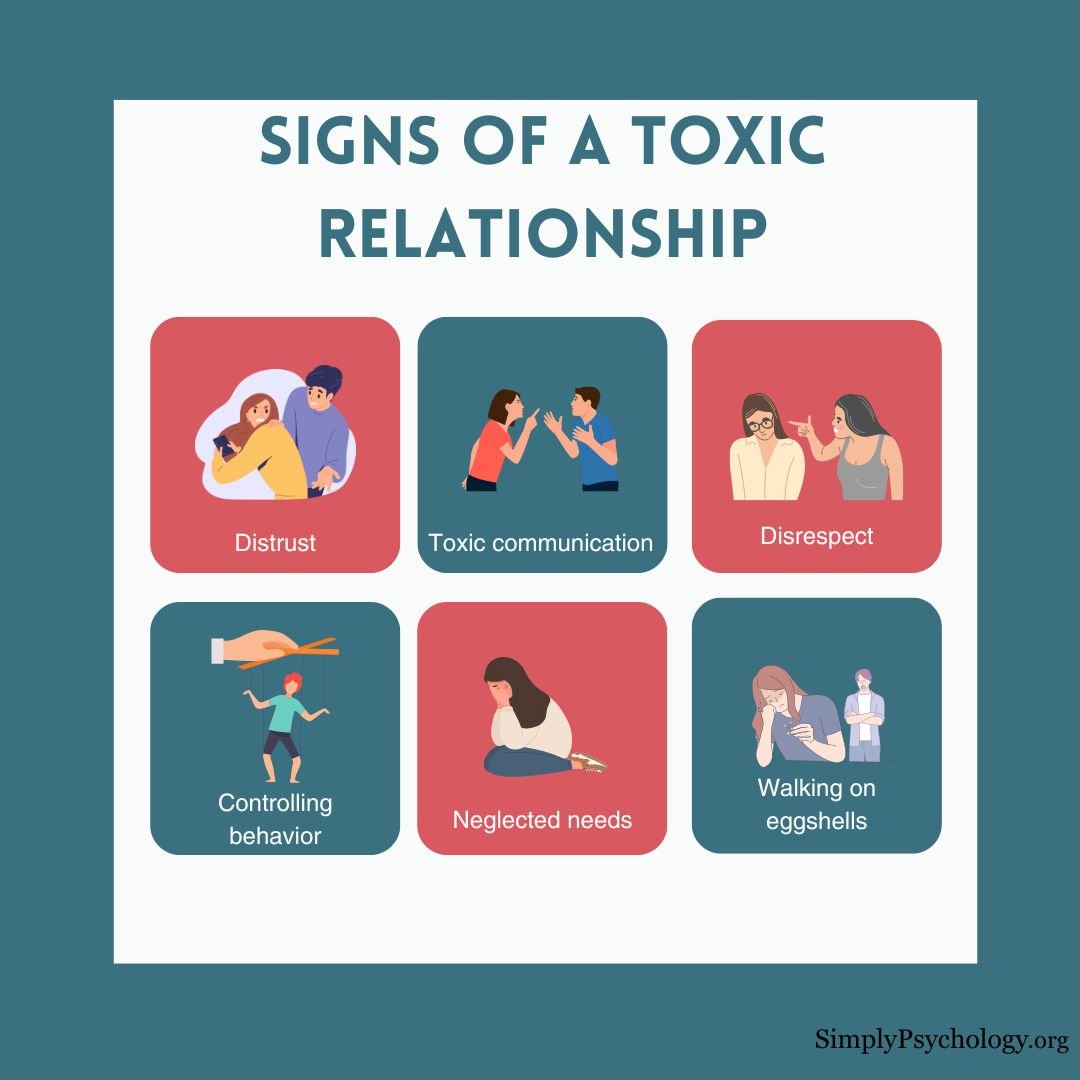
A toxic relationship refers to a detrimental and unhealthy connection characterized by behaviors that undermine one’s well-being, such as emotional manipulation, disrespect, control, and a lack of support.
You may feel unsupported, misunderstood, demeaned, or even attacked in these relationships.
Recognizing the signs early can help you set boundaries and build healthier connections.

7 Signs of a Toxic Relationship
While signs of abuse are toxic in any relationship, there are some more subtle ways in which a relationship can be toxic.
It may not always be apparent when someone is being toxic, so it is helpful to be aware of the warning signs.

-
Feeling unsupported
Relationships can become very negative if there is a lack of support from one or both sides.
A person in a toxic relationship may feel misunderstood and undermined in their relationship and may not feel encouraged to achieve their goals.
A toxic person may see every achievement of the other person as a competition and may always try to ‘one-up’ them.
You may feel there is no point in progressing towards your goals if it will never be enough for the other person to be proud of you.
You may be left feeling as if your successes and interests do not matter as much as theirs do.
-
Toxic communication
Often, you can recognize that someone is toxic in the way they communicate with you and others.
They may be very sarcastic and be very critical of you while covering it up by stating that they were ‘only joking.’
They may always find fault with everything you do and blame you for everything negative that happens, never accepting blame themselves.
They may also lie, be passive-aggressive, or gaslight you.
This can leave you confused and questioning your own sanity.
You can also observe how they treat others, especially those they don’t know. For instance, they may be unnecessarily rude to a waiter at a restaurant or pick a fight with someone who cuts in line.
Psychotherapist Esther Perel calls this a familiar pattern.
Gaslighting, she explains, often leaves a person feeling oversensitive, unclear, and unable to trust their own judgment. They question whether they are the problem, not the person mistreating them.
Perel disagrees with that framing. She notes that a gaslighter is never alone in the pattern: “for any gaslighter, there must be a person that is letting themselves be gaslit.”
-
Distrust
It is normal to feel a little envious early in a new romantic relationship.
But constant suspicion and mistrust can become draining for the other person.
That distinction matters.
A partner may never trust you even when you have given them no reason not to be trusted, which can prevent you from enjoying your relationship.
A partner may monitor your location and keep asking you to check in by text when you’re apart.
They may also question you if you are late back from work or a social event.
These patterns add up.
You may feel as though your behaviors are restricted because you do not want to do anything that your partner feels unhappy about.
You may feel as if your life is being micro-managed by someone who needs to know where you are and what you’re doing every minute of the day.
-
Disrespect
A toxic person can show disrespect in many ways.
This can be through embarrassment, criticism, and putting you down, especially in front of others.
They may not value boundaries and may try anything to make others look bad.
A toxic person may stonewall, meaning that they shut down and refuse to communicate with someone, especially when they are being confronted about their behavior.
They may refuse to acknowledge or listen when someone is expressing their feedback or wanting to share their emotions.
Disrespect can also be displayed through lying to the other person, name-calling, and being verbally unkind.
-
Controlling behavior
A toxic person may have a need to control another person in a relationship.
This is where there is an unequal power dynamic, usually with one person dominating another in a self-serving manner.
Some controlling behaviors can include wanting to always track your location and making comments about what you wear or do in a way to control.
For instance, they may say, ‘I don’t like when you wear that outfit. Don’t wear it again’.
The toxic person may always want to have things go their way, disregarding any other way.
They may even want you to spend all your free time with them.
This can isolate you from friends and family, and deprive you of your independence and other activities you enjoy.
-
Walking on eggshells
Someone who is in a relationship with a toxic person may try to do anything they can not to provoke the other person, avoiding any kind of conflict wherever possible.
You may never know what type of mood the toxic person will be in that day, and they may get extremely angry at the smallest thing.
If you are afraid of the response you will get, you may end up behaving in ways you don’t really want to.
You do this only to avoid their anger.
Likewise, you may hide your true feelings or unhappiness from someone.
You may worry they will become angry, or blame you for feedback you raised in good faith.
‘Some days, not often, he would be amazing, then others he would just be so mean, so horrible, it was confusing… one minute, I felt like he loved me, the next was like nothing but pure hatred. I felt like I was walking on eggshells all the time.’
‘Georgia,’ 32
-
Neglected needs
When you go along with whatever the toxic person wants to do, even if it goes against your comfort level or wishes can mean your own needs get neglected.
You may go above and beyond to ensure the other person is happy and safe, but they may not do the same for you.
You may try to raise your own needs.
But they turn it around, so you end up comforting them instead. There is a lack of emotional reciprocity.
You may not be offered what you need, whether this is some space on your own or more independence.
You may also feel too independent if the other person constantly neglects you, leaving you to deal with your troubles on your own.
Toxic Vs. Healthy Behavior
It is normal to have differing opinions in every kind of relationship. Having disagreements does not necessarily mean that the relationship is toxic.
If a relationship is caring, encouraging, and respectful, then it is probably healthy.
However, if there is a continuous pattern of selfish, negative, and disrespectful behavior, then this may indicate that the relationship is toxic.
| Healthy Relationship | Toxic Relationship |
|---|---|
| Mutual respect and equality | Lack of respect and power imbalances |
| Open and honest communication | Poor or manipulative communication |
| Trust and loyalty | Distrust and betrayal |
| Supportive and encouraging | Critical and demeaning |
| Independence and personal boundaries respected | Controlling and possessive |
| Emotional and physical safety | Abuse and violence |
| Compromise and collaboration | Manipulation and selfishness |
| Growth and personal development | Stagnation and suppression |
| Shared values and goals | Conflicting values and goals |
| Healthy conflict resolution | Escalation and unresolved conflicts |
Toxic behaviors in a relationship are often inherently unhealthy, damaging, emotionally draining and can damage others’ self-esteem and self-worth.
Healthy behaviors in a relationship, on the other hand, should positively contribute to self-esteem and emotional energy.
They are often inherently uplifting and secure and have an equal power dynamic.
What is the Impact of Toxic Relationships?
Toxic relationships can profoundly impact individuals, causing emotional distress, eroding self-esteem, and hindering personal growth. They can lead to a range of adverse effects, including increased anxiety, depression, and a diminished sense of self-worth.
Broader research on relationship quality backs this up. It links negative relationship dynamics to physical health, not just emotional wellbeing.
Chronic relationship stress has been connected to blood pressure changes in older couples (Birditt et al., 2016). Perceived social isolation carries documented “toxic effects” on health too (Cacioppo & Cacioppo, 2014).
Stress at different life stages affects physical health. Caregiving relationships can buffer some of that harm (Farrell et al., 2017). The quality of a person’s close relationships is itself recognized as a public-health concern (Umberson & Karas Montez, 2010).
‘My worth soon depended on his validation. My mood depended on his mood. It was exhausting. Every day going to battle… I now suffer with PTSD. I have very low self-esteem when it comes to my appearance due to the continuous negative remarks he would make… other people’s opinions of me can get to me.’
‘I get nightmares. Often, I’ll wake up after dreaming about an abusive situation.’
‘Georgia,’ 32
A study of 457 partners of people high in psychopathic traits found similar accounts.
“I lived on high alert trying to protect my children every moment of every day for 19 months.”
“I do not feel ‘human’. I desire closeness with another but can’t imagine being close to anyone.”
Forth et al. (2022)
Narcissists and Toxic Relationships
Narcissistic Traits and Manipulation Tactics
A narcissist can be highly toxic in a relationship due to their pervasive pattern of self-centeredness, lack of empathy, and manipulative behavior.
They possess an inflated sense of self-importance and believe they are entitled to special treatment and admiration from others.
This mindset often leads them to exploit and devalue their partner for personal gain and validation.
In a relationship, a narcissist tends to prioritize their own needs and desires above their partner’s, disregarding their feelings and boundaries.
They constantly seek attention, praise, and adoration, often engaging in grandiose displays to maintain their self-image.
Self-image drives most of it.
They may belittle and criticize their partner, eroding their self-esteem and manipulating them into believing they are inadequate or unworthy.
Narcissists are skilled manipulators who employ various tactics such as gaslighting, blame-shifting, and guilt-tripping to control their partner’s emotions and actions.
The Impact on Their Partner
They excel at creating a dynamic where their partner feels responsible for their happiness and well-being.
The blame never sticks to them.
The narcissist avoids accountability for their own mistakes.
Over time, being in a relationship with a narcissist can be emotionally draining, causing anxiety, depression, and a sense of powerlessness in their partner.
The toxic cycle of emotional abuse and manipulation perpetuated by a narcissist can lead to a deteriorated sense of self-worth and a loss of personal identity.
This is not to say that all people who engage in toxic behavior are narcissists, but toxic behavior is extremely common in most narcissists.
Dark Triad Personality Traits and Toxic Relationships
Narcissism is not the only personality pattern linked to relationship toxicity. Researchers often study it alongside two related traits, Machiavellianism and psychopathy, under the umbrella term Dark Triad: three overlapping traits that share a manipulative, self-serving, low-empathy core.
Why the Traits Can Be Hard to Spot Early
People high in Dark Triad traits tend to prefer short-term, casual relationships over sustained commitment. They also show a higher rate of dysfunctional romantic relationships generally.
The signs can be subtle at first.
Part of what makes this pattern hard to catch early is that the traits which predict later harm can look appealing at first. Pooling results across multiple studies, Holtzman and Strube (2010) found a small but consistent association between narcissism and how attractive a person is rated by others.
The authors link this to effective self-presentation, such as grooming and confidence, rather than to any quality that would make someone a good long-term partner.
That early appeal fades.
This is one way of describing love bombing: an intense early display of affection that can function as a tactic for gaining trust before less flattering traits surface.
The Research Linking Dark Triad Traits to Partner Abuse
The clearest evidence connecting Dark Triad traits to relationship harm, rather than just relationship dysfunction, comes from research on intimate partner violence.
Carton and Egan (2017) surveyed 128 adults. They used standard measures of the Dark Triad, general personality traits, and both psychological and physical abuse.
Low agreeableness and psychopathy, more than narcissism or Machiavellianism specifically, had the strongest and most consistent links to both types of abuse. Partners’ own reports of the same behavior lined up with participants’ self-reports too.
That matters.
It suggests the finding was not just a same-source self-report artifact. Two further studies point the same way.
Kiire (2017) found that psychopathy’s link to intimate partner violence runs through a broader pattern of impulsive, short-term-oriented behavior, distinct from how narcissism and Machiavellianism relate to relationship difficulty.
Westhead and Egan (2015) found that Dark Triad traits still predicted violence even after accounting for how much effort someone generally invests in pursuing and keeping partners.
Three studies now agree.
None of this means every narcissistic, Machiavellian, or psychopathic trait leads to abuse. It means the traits carry a measurable, replicated risk worth taking seriously in a relationship that otherwise feels confusing.
Who is More Vulnerable to Toxic Behavior?
Although anyone can fall victim to toxic behavior, certain types of people are more susceptible to toxic people.
Those who are high in empathy may be a target for a toxic person.
Their caring nature means they are likely to do as much as they can to keep other people happy.
Empaths are probably more likely to want to change someone’s toxic behavior as they can see the good traits in that person.
Likewise, people pleasers may be more vulnerable to toxic people. They may worry that they have no value unless they do something for someone else, which toxic people can take advantage of.
Growing up in a toxic household, such as with a gaslighting parent, or amid a chaotic upbringing, can also raise the risk.
This can mean toxic relationships continue into adulthood.
They may be so used to being around toxic behavior that they see this as normal. They may be suspicious of anyone who is not toxic and be looking out for what the catch is.
Recreating Familiar Patterns
Sometimes, people recreate patterns.
They may be drawn to someone who confirms what they think about themselves.
For example, if someone believes they don’t deserve to be heard, they may find it acceptable to be with someone who disrespects them or does not listen to them.
In this way, they are unintentionally triggering the emotions and responses they were used to having as a child or in a past relationship.
There is a reason for this. Bowlby’s (1969) concept of the internal working model gives this pattern a more precise mechanism. A child’s early relationships build a largely unconscious set of expectations about how trustworthy other people can be, and about their own worth in others’ eyes.
Those expectations carry forward into adulthood.
Bowlby (1973) described how a child whose caregiver was unpredictably available could develop what he termed anxious attachment. This means heightened vigilance toward the relationship, and difficulty feeling secure even when things are going well.
That history matters here.
An unpredictable partner, someone whose mood swings between warmth and hostility, can feel distressingly familiar rather than alarming to someone with this history. Recognizing toxicity in a relationship that echoes childhood patterns can be harder, not easier, than recognizing it in an unfamiliar one.
Toxicity Vs. Abuse
It is important to make the distinction between toxicity and abuse. Toxicity can include emotional and verbal abuse, but toxicity is not always abusive in nature and may not even be intentional.
The abuse stems from the desire to hold power over someone else and control their behavior.
Some signs that someone may be a victim of abuse include:
-
Diminished self-worth
-
Feeling very anxious and having self-doubt
-
Being isolated from family and friends
-
Feeling fearful and intimidated
-
Feeling put down and humiliated
-
Being gaslit – questioning sanity
-
Experiencing physical violence or threats of violence
If you relate to any of the signs of abuse, seek help as soon and as safely as possible.
This can be through a trusted friend or family member, a therapist, or a domestic abuse advocate.
Can I be Toxic Without Realizing?
People can be toxic unintentionally. In relationships, it helps to take a step back and reflect on your own behavior and whether what you are doing is toxic.
Below are some of the signs which may indicate that you are acting toxic:
-
You are always sarcastic – you may often mask your emotions behind humor instead of talking them through with someone.
-
You deal with conflict in a passive manner – you may present with sullen behavior, stubbornness to change, give subtle insults, or use passive aggression.
-
Everything is a competition – if someone shares an issue they have, you may tell them how you have it much worse than they do. This is different from relating to someone going through a tough situation. Likewise, if someone shares an accomplishment, you may not be able to help yourself from boasting about your own accomplishments.
-
You may secretly crave disaster because of the care and attention you receive – you may seek pity and comfort from others or want someone to give you advice, although you have no intention of following through with it.
-
You think that pointing out someone’s flaws will help them to change, but it will instead make them feel hurt.
How To Cope With A Toxic Relationship
If you notice that a relationship is toxic and want to work through the issues, then there are some steps you can take to address this.
Also, not every toxic relationship can be avoided, especially if you work with toxic people or have toxic family members that you live with.
Having healthy conversations, boundaries, and awareness may be able to help in some situations.
Acknowledgment
The first step to managing a toxic relationship is to acknowledge that there is a problem to be addressed. Usually, you can sense when something doesn’t feel right and that things need to change.
You may feel that the atmosphere is very negative and that your interactions with the person leave you feeling uncomfortable or decrease your self-esteem.
Identify the toxic behavior
It will be useful to determine what it is about the relationship that feels toxic. This could be how someone communicates to you, their jealousy, their controlling tendencies, or how they make you feel unsupported.
It may be one or many toxic behaviors that need to be tackled, but putting a name to the behavior can help to address it.
Take accountability
It may be that all the toxicity is coming from someone else. However, it is important to reflect inwards and see if there is anything that you are doing that is toxic toward the other person. It could be that both parties are equally as toxic towards each other.
That takes honesty.
Recognizing your own behavior and taking accountability is a necessary step to take to address the issues in the relationship.
This may also encourage the other person to reflect on their own behavior.
Accepting that you are part of the problem can help them feel less targeted for their toxicity too.
Communicate the issue
Once you have identified what you want to address with the toxic person, clearly and assertively communicate to them what the issue is.
The use of ‘I’ statements when describing your feelings and emotions should help keep the other person from feeling defensive.
Once you have addressed the issue and how it makes you feel, explain clearly what you need from them instead.
State the consequences if that need isn’t met.
An example of how to communicate this can be, ‘I felt bad about myself when you called me stupid. It made me feel worthless. Instead of doing this, I will need you to take a moment to calm down and think before you say things like this.
This is something I am not going to tolerate, and if this happens again, I worry that I will not be able to spend so much time with you.’
Notice any changes
After you have clearly communicated your needs, notice if their behavior changes. If they have made a clear effort to change and the toxic behavior is no longer present, then this was successful.
If not, you need to decide.
Decide whether this is something you can live with, or whether you need to end the relationship or set firmer boundaries.
Remember that you can only control your own behavior, so there is only so much you can do to make a positive change.
Set boundaries
If you can leave the toxic relationship safely, then this may be a consideration if you feel the toxic person is not going to change.
Suppose you cannot leave the toxic relationship because they may be your co-worker or a family member. In that case, you can put boundaries in place to ensure you are limiting the amount of toxic behavior you are exposed to.
For a toxic co-worker, ask your boss to relocate you.
Shifted break times can help too.
If the toxic person is a family member or friend, you could limit how often you visit them.
Texting or calling less often helps too.
Leaving a Toxic Relationship
If you decide that the relationship cannot be saved from someone’s toxic behavior, there are some ways in which you can safely leave:
Seek emotional support
Try to open up to your loved ones about what you are going through.
They may be able to give you suitable advice for how to cope with the toxic behavior, leave the situation, and can give insight from an outside perspective.
They may also be able to offer you a place to stay if you plan to move out of a home that is shared with a toxic person.
Get additional support
It may help to get support from a therapist or domestic violence advocate.
They can help you make a safety plan and identify other resources you may need to leave the relationship.
Bring a trusted person
As well as being able to give emotional support, a trusted friend or family member could come with you to end the relationship with the toxic person.
This is especially useful if you do not feel completely safe having this conversation with the toxic person.
If a trusted person is present, you may also be less likely to be swayed by the toxic person to stay in the relationship.
Stick to your boundaries
If you have decided that you are going to cut contact with the toxic person, then it is important to stick with your decision.
If you keep letting them back into your life after multiple chances, they may think they’ve gotten away with it.
They may believe there are no consequences.
Be assertive with the toxic person and clearly set out what you plan to do.
Change your phone number
If you think you might be tempted to get back in contact with the toxic person, it may be wise to change your number.
The same applies if you think they will bombard you with calls or texts. Blocking them can help too.
Seek therapeutic support afterward
It can feel very distressing to leave a toxic relationship. You may have lowered self-worth and confidence from being in a negative situation for a long time.
You can seek therapy to help build yourself back, increase your self-esteem, and make it less likely that the effects of the toxic relationship will follow you into new relationships.
New and Non-Romantic Relationships
Not every toxic relationship needs to end. With mutual effort and willingness to change, some relationships can genuinely improve using the steps described above.
Much depends on the circumstances, and on both people’s commitment.
Not every toxic relationship can be avoided in the first place, particularly with a toxic co-worker or a family member you live with. Toxicity is not limited to established romantic relationships either.
Warning Signs in a New Relationship
When starting a new relationship, warning signs worth watching for include excessive jealousy or possessiveness, a lack of respect for boundaries, and controlling behavior.
Dismissive treatment of others is another. So is inconsistent communication.
A refusal to take responsibility for one’s actions rounds out the list.
How someone handles conflict matters too, along with their level of empathy and whether they respect your autonomy and individuality.
Trust your instincts.
Don’t ignore any red flags that may point to future toxicity or incompatibility.
Trust that instinct.
A person can also become toxic later in a relationship, after a period that felt entirely positive. Love bombing, an excessive display of affection and attention right at the start, describes this pattern.
It often works as a trust-building tactic rather than a sign of real investment.
The mask slips eventually.
Once that early phase fades, a person’s true toxic traits, such as emotional manipulation, control, and abuse, may start to emerge.
A sudden shift toward toxicity is a red flag worth taking seriously. Judge someone by their behavior over time, not just the earliest weeks.
Toxicity in Family and Friendships
Toxicity is not exclusive to romantic relationships. Relationships with family members or friends can be just as toxic, and follow the same underlying pattern.
That pattern includes consistent disrespect, manipulation, emotional abuse, excessive control, and constant criticism.
Lack of support fits too, as does feeling drained or diminished after spending time with the person.
The setting changes; the pattern doesn’t.
Recognizing toxicity in these relationships means paying attention to the same patterns described throughout this article, rather than assuming they only apply to romantic partners.
The coping and boundary-setting steps described above apply here too, whether the relationship is with a parent, a sibling, or a close friend.
If you need to talk to someone…
USA
If you or a loved one are a victim of domestic violence, contact the National Domestic Violence Hotline for confidential assistance from trained advocates.
1-800-799-7233
or text “Start” to 88788.
UK
If you want to access support over the phone, you can call:
National Domestic Abuse Helpline – 0808 2000 247 – www.nationaldahelpline.org.uk/ (run by Refuge)
The Men’s Advice Line, for male domestic abuse survivors – 0808 801 0327 (run by Respect )
The Mix, free information and support for under 25s in the UK – 0808 808 4994
National LGBT+ Domestic Abuse Helpline – 0800 999 5428 (run by Galop)
Women’s Aid is a national charity working to end domestic abuse against women and children. We are a federation of over 180 organisations providing just under 300 lifesaving services to women and children across England – 1-800-799-7233
Key Takeaways
- Definition: A toxic relationship is a pattern of behavior, not one bad moment, that undermines wellbeing through manipulation, disrespect, control, or a lack of support.
- 7 Warning Signs: Feeling unsupported, toxic communication, distrust, disrespect, control, walking on eggshells, and neglected needs are the recurring patterns to watch for.
- Not Just Romantic: Family and friend relationships can be just as toxic as romantic ones, and follow the same pattern.
- Dark Triad Link: Narcissism, Machiavellianism, and psychopathy are personality traits research consistently links to relationship harm.
- Toxicity vs Abuse: Toxicity is not always intentional or abusive, but abuse specifically involves a desire to control another person.
- Self-Reflection: Honestly reflecting on your own behavior is part of addressing a toxic dynamic, since both people can contribute to it.
- Getting Help: Boundaries, honest communication, or professional support can help you manage or safely leave a toxic relationship.
References
Birditt, K. S., Newton, N. J., Cranford, J. A., & Ryan, L. H. (2016). Stress and negative relationship quality among older couples: Implications for blood pressure. Journals of Gerontology Series B: Psychological Sciences and Social Sciences, 71 (5), 775-785.
Bowlby, J. (1969). Attachment and loss: Vol. 1. Attachment. Basic Books.
Bowlby, J. (1973). Attachment and loss: Vol. 2. Separation: Anxiety and anger. Basic Books.
Cacioppo, J. T., & Cacioppo, S. (2014). Social relationships and health: The toxic effects of perceived social isolation. Social and personality psychology compass, 8(2), 58-72.
Carton, H., & Egan, V. (2017). The dark triad and intimate partner violence. Personality and Individual Differences, 105, 84-88. https://doi.org/10.1016/j.paid.2016.09.040
Farrell, A. K., Simpson, J. A., Carlson, E. A., Englund, M. M., & Sung, S. (2017). The impact of stress at different life stages on physical health and the buffering effects of maternal sensitivity. Health Psychology, 36 (1), 35.
Forth, A., Sezlik, S., Lee, S., Ritchie, M., Logan, J., & Ellingwood, H. (2022). Toxic relationships: The experiences and effects of psychopathy in romantic relationships. International Journal of Offender Therapy and Comparative Criminology, 66(15), 1627-1658. https://doi.org/10.1177/0306624X211049187
Holtzman, N. S., & Strube, M. J. (2010). Narcissism and attractiveness. Journal of Research in Personality, 44(1), 133-136. https://doi.org/10.1016/j.jrp.2009.10.004
Kiire, S. (2017). Psychopathy rather than Machiavellianism or narcissism facilitates intimate partner violence via fast life strategy. Personality and Individual Differences, 104, 401-406. https://doi.org/10.1016/j.paid.2016.08.043
Perel, E. (n.d.). Am I being gaslit? | Where should we begin? with Esther Perel [Video]. YouTube. https://www.youtube.com/watch?v=ZSuCS-5MSH0
Umberson, D., & Karas Montez, J. (2010). Social relationships and health: A flashpoint for health policy . Journal of health and social behavior, 51 (1_suppl), S54-S66.
Westhead, J., & Egan, V. (2015). Untangling the concurrent influences of the Dark Triad, personality and mating effort on violence. Personality and Individual Differences, 86, 222-226. https://doi.org/10.1016/j.paid.2015.05.031