The narcissist love bombing cycle is a term used to describe a pattern of behavior often exhibited by individuals with narcissistic traits in the context of relationships.
The cycle usually starts in a relationship’s earliest stages, as the narcissist works to win their partner over. It opens with love bombing. The narcissist showers their partner with intense affection and attention, creating a strong bond quickly.
This leads to idealization: the partner is placed on a pedestal, and a deep sense of connection forms fast. Then the shift begins. The narcissist grows critical, degrading, and distant.
This often culminates in discard, when the narcissist ends the relationship abruptly with little explanation. Sometimes there is no clean break.
Instead, the narcissist may “hoover”: drawing the partner back in through renewed love bombing and promises of change.
If the partner returns, the cycle usually repeats, moving again toward devaluation, when the early affection turns to criticism and distance, and discard.
Key Takeaways
- The Cycle: Narcissist relationships often move through four stages: love bombing, idealization, devaluation, and discard, sometimes followed by hoovering (a later attempt to win the partner back).
- Love Bombing: An early, overwhelming display of affection and attention used to build a strong bond quickly.
- Typical Duration: The love bombing phase usually lasts weeks to months, averaging around five months before devaluation sets in.
- Warning Signs: Rushed intimacy, extreme jealousy, isolation from friends and family, and pressure to commit quickly are red flags.
- Thin Evidence Base: “Love bombing” and “hoovering” are popular terms with limited direct research; the pattern is real but mostly supported by broader narcissism studies.
- Getting Support: A trusted friend, family member, or mental health professional can help if this cycle feels familiar.
What Happens During the Love Bombing Phase?
During the love bombing phase, the narcissist will shower their partner with an overwhelming amount of affection, compliments, and attention.
They may engage in excessive communication, buy lavish gifts, make future plans, or execute grand romantic gestures to make their partner feel special.
The goal is to create a sense of deep connection and dependency, making the partner more vulnerable to the narcissist’s manipulation and control tactics as the relationship progresses.
The tactic also serves the narcissist’s own psychology. A partner’s enthusiastic, adoring response to the pursuit feeds the narcissist’s inflated sense of self-worth, reinforcing an ego that depends on being seen as exceptional.
It’s often deliberate. Research links higher rates of narcissism to a greater likelihood of using these tactics on purpose, rather than simply being swept up in ordinary early-relationship excitement.
Narcissists can be incredibly charming and seductive, so it can be difficult for the partner to see the potential manipulative nature behind their behavior.
In a qualitative study by Day, Townsend, and Grenyer (2022) on the interpersonal dysfunction within narcissistic relationships, participants described the pattern of interactions with their partners.
Real examples, in their own words:
One woman noted:
“At first, it was great. He made it seem like he was my saviour. He was kind, loving and attentive.”
Another woman expressed:
“Our early relationship felt like a fairy tale; I’d never been adored and idealized before and was totally sucked in. [He] was very charming in the beginning.
He pursued me hard and fast and I didn’t quite know what was happening…He complimented me, put me on a pedestal, and told me he loved me really early on in the game. I was flattered.”
How Long Does the Love Bombing Phase Last With a Narcissist?
The duration of the love bombing phase varies. It depends on the narcissist’s tactics, the partner’s personality, and the specific circumstances of the relationship, and tends to be relatively short compared with the whole relationship.
It typically lasts anywhere from a few weeks to a few months, occasionally up to a year.
A survey of 500 love-bombing victims put the average duration at roughly five-and-a-half months when the narcissist was a man, and three-and-a-half months when a woman. The longest reported case lasted six months.
Narcissists use love bombing to quickly establish a strong emotional connection and gain control over their partner. Once they secure that attachment, they transition to devaluation, showing less interest and affection as manipulative behaviors begin.
What Comes After Love Bombing With a Narcissist?
As the relationship progresses, the narcissist’s behavior starts to change. After the love bombing phase with a narcissist comes the phase of devaluation.
Devaluation
The “devaluation” phase is when the dynamics of the relationship start to shift dramatically, and the intense affection and positive attention give way to more negative behaviors.
The narcissist will become critical, dismissive, and potentially even emotionally or verbally abusive towards their partner.
The narcissist may also use manipulative tactics, such as gaslighting or blame-shifting, to control the partner’s emotions and behavior.
The affection and intimacy that were abundant during the love bombing phase start to diminish, leaving the partner feeling isolated and unloved.
This abrupt shift can be deeply hurtful and confusing for the partner, who may struggle to understand where the relationship went wrong.
Discard or Hoovering
When the victim no longer serves a purpose or holds value for the narcissist, they often discard their victim. Sometimes it’s simpler than that. The narcissist may have simply found a new source of attention or validation instead.
During the discard phase of the narcissistic love pattern, the narcissist might abruptly end the relationship or pull away emotionally.
Below, two victims of narcissistic abuse share their experiences of how the idealization phase was inevitably followed by devaluation, and eventual discard:
“He pressured me into getting married very quickly. After we got married he changed [and] became prone to extreme anger if I didn’t compliment him enough. He is explosive, seems totally unemotional, and unstable.”
“When we first met he drew me in fast…I was so taken in with this guy. He made himself to be everything I had ever wanted.
After several months the lectures started…he would spend hours criticizing me, blaming me for everything. I had no local family or friends and the loneliness was horrible… Over the next years the lectures became more frequent and more harsh with increased name calling and blame.
Anytime he was in a bad mood or had a bad day, where something didn’t go his way, he would spend the rest of the night lecturing me. He would use sex as a means to get the lectures to stop, saying that he would stop talking if I sexually gratified him.”
Instead of a discard, the narcissist might engage in “hoovering,” which involves attempting to draw the partner back into the relationship after the devaluation (or discard) phase.
They may use manipulation, guilt-tripping, promises of change, or even renewed love bombing to regain the partner’s attention and control.
What Are the Warning Signs of Love Bombing?
Recognizing the warning signs of love bombing is crucial in identifying if you are in a manipulative and unhealthy relationship.
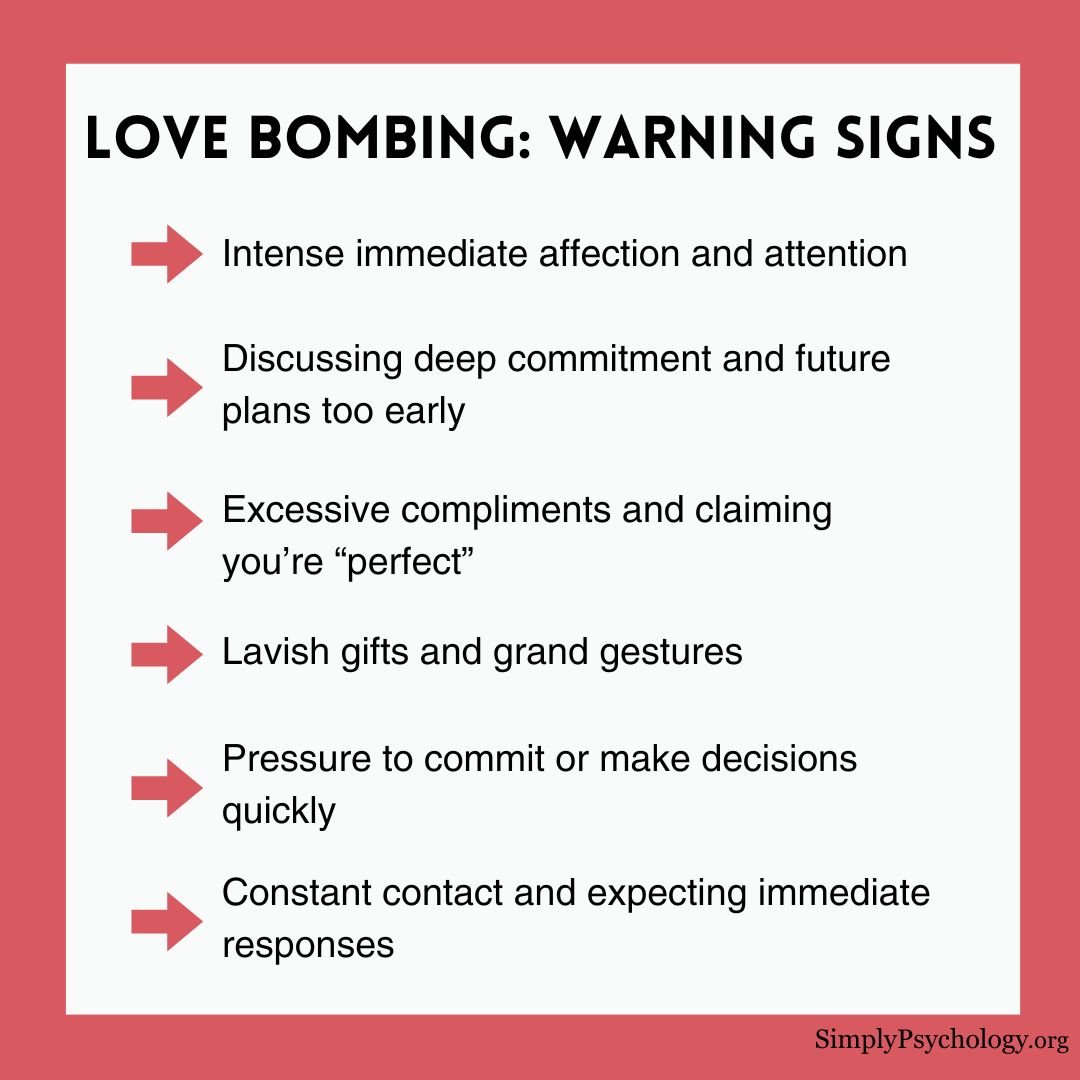
Signs of Love Bombing
- Intense Affection: Showering you with intense and immediate affection, compliments, and attention right from the start of the relationship
- Fast Commitment Talk: Talking about deep commitment, future plans, and being in love within a short period of knowing you
- Constant Contact: Constantly contacting you, whether through text, calls, or social media (and becoming upset if you don’t respond immediately)
- Excessive Praise: Telling you that you are perfect or the best thing that has ever happened to them
- Jealousy: Showing signs of extreme jealousy
- Isolation: Isolating you from your friends, family, or other relationships to make you more dependent on them
- Lavish Gifts: Presenting you with lavish gifts, extravagant outings, and other grand gestures
Things to Pay Attention to Within Yourself
To maintain emotional well-being and make informed decisions, it’s crucial to pay attention to your own feelings and reactions when dealing with potential love bombing or manipulation.
Here are some things to pay attention to within yourself:
- Emotional Swings: Experiencing intense highs and lows in your emotions due to the relationship
- Feeling Smothered: Feeling smothered or overwhelmed by your partner
- Obligation to Respond: Feeling obligated to spend time with them or to reply to every message immediately
- Withdrawing from Others: Spending less time with friends and family
- Pressure to Commit: Feeling pressured to commit or make decisions before you’re ready
- Growing Dependence: Becoming overly dependent on your partner emotionally, financially, or otherwise
- People-Pleasing: Constantly trying to meet their expectations
- Losing Yourself: Changing your habits, interests, or values to align more with theirs
If you suspect you’re in this cycle or are concerned about your relationship dynamics, seek support from a trusted friend, family member, or mental health professional.
A Therapist’s Perspective
Licensed couples therapist Esther Perel has worked directly with clients describing this exact pattern.
As Perel explains, being “chosen” so quickly by a new partner can feel uniquely meaningful.
But it can just as easily mean being selected to repeat a pattern the other person has used before, not evidence of a special connection.
Perel counsels healthy skepticism toward pace itself. When a new partner wants to move in after two months and promises the world, that intensity is worth meeting with curiosity, not certainty.
As Perel explains it, a caller on the same episode described being “lovebombed” and “elevated to the level of queen.” Then came the shift. Within months, growing criticism replaced the early admiration entirely.
Perel reframes what it can mean to have felt chosen. Being selected, she notes, doesn’t always reflect a partner’s own uniqueness.
It can mean being picked to enact a pattern the other person has repeated before, with someone else. The story just repeats.
As Perel puts it, there’s real relief in recognizing the outcome “wasn’t me — it just could be anybody and the story will be the same.” The pull to blame oneself instead is strong, even so.
According to Perel, that back-and-forth, between elevating a partner and then withdrawing that warmth entirely, has a cumulative effect. She describes it as “robbing a person of their identity.”
FAQs
Do Narcissists Enjoy Love Bombing?
Yes, narcissists often enjoy love bombing.
Love bombing is a tactic that aligns with many narcissists’ desire for attention, admiration, and control over others. It allows them to create an intense and seemingly perfect connection with their target, fostering dependency and emotional manipulation.
The partner’s enthusiastic response also feeds the narcissist’s own inflated sense of self-worth, which is part of why the tactic is so persistent.
Why do Narcissists Use Love Bombing?
Narcissists use love bombing as a strategic tactic to manipulate and control their targets.
Love bombing establishes a deep emotional connection and dependency, giving the narcissist control over their target’s emotions and decisions.
Additionally, successful love bombing reinforces the narcissist’s inflated sense of self-worth as the positive reactions from their targets feed their ego and emphasize their belief that they are exceptional.
Is Love Bombing Only Done by Narcissists?
Love bombing is generally associated with narcissistic behavior. It isn’t exclusive to narcissists, though.
Love bombing can be exhibited by people with various motivations and personality traits, not narcissism alone. Still, research has found that people with higher rates of narcissism are more likely to engage in love bombing.
Love bombing can also appear in people who are genuinely excited about a new relationship. That excitement alone isn’t manipulation. They may express intense feelings without any intent to control.
However, if these behaviors are persistent, extreme, and accompanied by other manipulative tactics or a lack of empathy, it could signal deeper issues.
Are Narcissists Aware of Love Bombing?
Narcissists are typically aware of their use of love bombing as a manipulative tactic.
Love bombing is a calculated behavior employed by narcissists to gain control, admiration, or emotional dependence from their targets.
Not all narcissists see this as a problem, though. They often rationalize it instead, framing love bombing as proof of how much they care. In the moment, they may genuinely believe the intensity of their feelings is real.
Alternative Explanations for the Cycle
The idealize-devalue-discard pattern isn’t the only lens for understanding this cycle. Several other frameworks describe similar dynamics, each adding a different piece of the picture:
- Walker’s Cycle of Abuse: Lenore Walker’s (1979) general model of domestic-abuse cycles, adapted here as a narcissism-flavored variant.
- Adult Attachment Theory: Hazan and Shaver’s (1987) account of why an anxiously attached partner may respond to inconsistent affection by pursuing harder.
- Clinical Splitting: Kernberg’s (1975) concept of holding “all-good” and “all-bad” images of a person separately, offered as one mechanism behind the sudden shift from idealization to devaluation.
- Intermittent Reinforcement and the Gain-Loss Effect: two general learning and attraction principles that help explain why an inconsistent reward pattern is so hard to walk away from.
Walker’s Cycle of Abuse
Lenore Walker’s (1979) cycle-of-abuse model describes domestic battering broadly, not narcissistic relationships specifically. It moves through tension-building, an incident, reconciliation, and calm.
The love-bombing cycle can be read as a narcissism-flavored variant of that same oscillation. One structural difference stands out, and it changes how the pattern first shows itself.
Walker’s model opens with tension-building. The narcissistic version instead opens with an unusually intense positive phase: love bombing.
Hoovering plays a role closer to Walker’s reconciliation phase than to a separate addition. It’s the make-up, not a new stage.
A fuller account of how this cycle maps onto Walker’s stage-by-stage model exists elsewhere on this site. That mapping is flagged explicitly as an extension by analogy, not a validated narcissism-specific model.
Adult Attachment Theory
A separate, partner-side explanation for why the cycle is hard to leave comes from attachment research. Hazan and Shaver (1987) proposed that romantic love works as an attachment process, shaped by a person’s attachment history.
Someone with a more anxious or preoccupied attachment style tends to respond to inconsistent affection with intensified pursuit rather than withdrawal. They chase rather than pull back.
That offers a complementary account of why the cycle can repeat, even after a first devaluation or discard.
This explanation sits at a different level than the narcissism-focused account above. It’s about the partner who stays.
It locates part of the cycle’s staying power in the recipient’s own attachment history, not only in the initiating partner’s traits. It doesn’t require the initiating partner to be narcissistic at all.
The same pursue-and-withdraw oscillation can arise between two partners, neither of whom is narcissistic, a pattern covered in more depth on this site’s page about attachment theory.
Clinical Splitting and NPD
“Love bombing,” “idealization,” “devaluation,” “discard,” and “hoovering” aren’t diagnostic terms in the DSM-5 or ICD-11.
Going through this cycle with a partner isn’t, by itself, evidence of Narcissistic Personality Disorder (NPD). It’s not a diagnosis.
What the popular narrative maps onto, loosely, is the clinical concept of splitting.
Splitting is a primitive defense in which a person holds “all-good” and “all-bad” images of another person separately, rather than integrating them (Kernberg, 1975). The two images never merge.
It offers one candidate mechanism for why an idealized partner can flip so completely into a devalued one, in the narcissistic partner’s own experience.
The fuller clinical picture, including the grandiose and vulnerable subtypes and the psychodynamic debate over narcissistic pathology, is covered on Simply Psychology’s Narcissistic Personality Disorder page.
Intermittent Reinforcement and the Gain-Loss Effect
Two further mechanisms don’t require narcissism as a precondition at all. Anyone can experience them.
Both help explain why an inconsistent-reward relationship can feel so compelling, even to a partner who isn’t with a narcissist. Intermittent reinforcement is a reward schedule in which a response is reinforced unpredictably rather than every time, a core finding from operant conditioning research.
Unpredictable rewards are stickier. It produces behavior that resists extinction far more than a consistent reward schedule does (Skinner, 1953).
That’s one reason a partner may keep trying to “earn back” the affection of the idealization phase, even as it grows rarer. The pull is subtle.
Separately, the gain-loss effect in interpersonal attraction describes a simple pattern.
A shift from negative to positive evaluation produces more liking than consistently positive evaluation. A shift from positive to negative produces more disliking than consistently negative evaluation (Aronson & Linder, 1965). That’s the sting of loss.
It’s a general reason why the cycle’s specific sequencing, intense positive regard followed by its withdrawal, binds more tightly than either phase would alone.
Real-World Applications
The idealize-devalue-discard pattern shows up well beyond pop psychology. Therapists, domestic-abuse advocates, and public-safety educators all put it to practical use.
Clinical and Therapeutic Use
Therapists working with clients recovering from a narcissistic relationship often use this framework as a teaching tool.
It helps a client see that the idealization phase wasn’t separate from the later harm. The two were connected from the start.
That framing can reduce self-blame. It also shortens the time a client spends working out what changed.
Research links pathological narcissism in a partner to documented relationship dysfunction, not just a subjective complaint (Day, Townsend, & Grenyer, 2022). A therapist can validate that account.
The other partner is rarely in the room to be formally assessed, and often never will be. The client’s account can stand on its own.
That’s a genuinely useful reframe. A confusing experience gets a recognizable name and shape.
Domestic-Abuse Advocacy
Domestic-violence hotlines and advocacy groups increasingly teach love-bombing language as part of coercive-control education.
The reasoning is simple. A target’s later compliance and self-doubt often get built during the relationship’s opening phase, not only its visibly abusive later one.
That’s a real shift in emphasis. Abuse-prevention education has traditionally focused public attention on the obviously abusive phase of a relationship.
Framing the earliest, most pleasant-seeming phase as a warning sign, rather than as reassurance, is one of the love-bombing framework’s more distinctive contributions to that education.
It teaches people to notice the setup, not just the fallout, instead of only recognizing the pattern once real damage has already been done.
That matters most while it’s happening. It can be the first sign something is wrong, long before it’s obvious.
Public Awareness and Screening
Checklists like the warning-signs list above, and similar ones published by therapists and domestic-abuse charities, work as a low-cost screening tool.
The pattern they screen for is otherwise hard to name while it’s happening.
Their real value is simple. They give someone who feels confused, or “crazy,” during the idealization phase a vocabulary for what’s happening to them.
That value comes with a caveat, covered in the Evaluation section below. Checklist-style tools like this can over-include ordinary early-relationship excitement alongside genuinely manipulative intensity.
This shows up outside romance too. The same idealize-then-devalue pattern has been described, less formally, in mentoring and manager relationships with a narcissistic superior.
An initial phase of praise and promised opportunity gives way to growing criticism once the junior person’s usefulness has been secured.
This workplace version is a plausible extension of the pattern, not a separately studied one.
Evaluation
Love bombing and hoovering are useful, plain-language labels for a real relationship pattern, but the strength of the science behind the labels is worth stating plainly.
A Thin Direct Evidence Base
Neither term appears in the DSM-5 or the ICD-11. No large study has directly tested either term.
Most of the supporting evidence comes from research on narcissism and relationship dysfunction more broadly, not from studies built around this popular vocabulary. The pattern itself is real and recognizable, but its wide use online is not the same thing as a large body of confirmatory science.
A more direct test hasn’t been done yet. Existing studies rarely measure the initiating partner’s narcissism with a validated scale from the very start of a relationship.
A prospective study could track both partners’ reports of relationship quality over the following year. That would show whether early intensity itself predicts later devaluation, or whether it is specifically the initiating partner’s narcissism that does the work.
More Than One Possible Mechanism
One large research program helps explain why a narcissistic partner’s early appeal and later cost can pull in opposite directions. Wurst and colleagues (2017) ran seven studies with more than 3,500 participants combined, using survey, speed-dating, and long-term couple data.
The researchers separated two sides of narcissism: admiration, a self-promoting drive to be seen as impressive, and rivalry, a more defensive, antagonistic style.
Admiration predicted being seen as attractive early on. Rivalry predicted the decline in relationship quality over time.
The two traits were only weakly linked.
A person high in one trait is not automatically high in the other, which is one reason the same partner can feel irresistible at first and corrosive later.
This split helps explain a pattern many partners describe: intense warmth at first, followed by a colder, more critical partner later. Nothing about the partner’s underlying narcissism necessarily changed in between.
Two other studies point the same direction. Interview data from people who had been with a pathologically narcissistic partner describe the same early-idealization-to-later-criticism arc, in their own words (Day, Townsend, & Grenyer, 2022).
A separate undergraduate-journal survey found higher self-reported narcissism linked to a greater likelihood of using love-bombing-like tactics early in a relationship (Strutzenberg, Wiersma-Mosley, Jozkowski, & Becnel, 2017).
The three don’t carry equal weight. Wurst and colleagues’ large, multi-study design sits highest on the evidence hierarchy and anchors the finding.
The interviews add lived-experience texture a trait study can’t. The single-sample undergraduate survey is the weakest link, and should be weighted accordingly.
Caution With Self-Report Data
The interview participants quoted earlier in this article had already identified their relationship as involving narcissistic traits.
They were recruited after the relationship’s harm was already apparent (Day, Townsend, & Grenyer, 2022). That’s a solid design for one purpose.
It describes how these relationships feel from the inside. It’s weaker for showing how common the pattern really is, or how it compares with relationships that started just as intensely but never progressed to devaluation.
The duration figures cited above come from a self-report survey. There was no independent check on whether the reported partner actually met criteria for narcissism, so the timelines rest on memory rather than verified data.
That survey also framed its results by the reported gender of the narcissistic partner.
It did not address how the pattern presents in same-sex relationships, or in relationships where a woman is the one using these tactics.
The warning-signs checklist above is a useful screening tool. But the same behaviors can also describe genuine early-relationship excitement, so persistence and other manipulative signs matter more than any single item on the list.
None of this means the pattern isn’t real. It means the popular vocabulary is more confident than the underlying research currently allows.
Sources
Akin, E. (2023). How Long Does the Love Bombing Phase Last? (Survey). Unfilteredd. https://unfilteredd.net/how-long-does-the-love-bombing-phase-last-case-study/
Day, N. J. S., Townsend, M. L., & Grenyer, B. F. S. (2022). Pathological narcissism: An analysis of interpersonal dysfunction within intimate relationships. Personality and Mental Health, 16(3), 204–216. https://doi.org/10.1002/pmh.1532
Strutzenberg, C. C., Wiersma-Mosley, J. D., Jozkowski, K. N., & Becnel, J. N. (2017). Love-bombing: A Narcissistic Approach to Relationship Formation. Discovery, The Student Journal of Dale Bumpers College of Agricultural, Food and Life Sciences, 18(1), 81-89.
Wurst, S. N., Gerlach, T. M., Dufner, M., Rauthmann, J. F., Grosz, M. P., Küfner, A. C. P., & Back, M. D. (2017). Narcissism and romantic relationships: The differential impact of narcissistic admiration and rivalry. Journal of Personality and Social Psychology, 112(2), 280–306. https://doi.org/10.1037/pspp0000113


