Orderliness and Symmetry OCD is a subtype of obsessive compulsive disorder (OCD) characterized by ongoing intrusive thoughts and compulsive behaviors surrounding sameness, orderliness, balance, and symmetry.
This subtype of OCD shares similar symptoms with Perfection (Just Right) OCD.
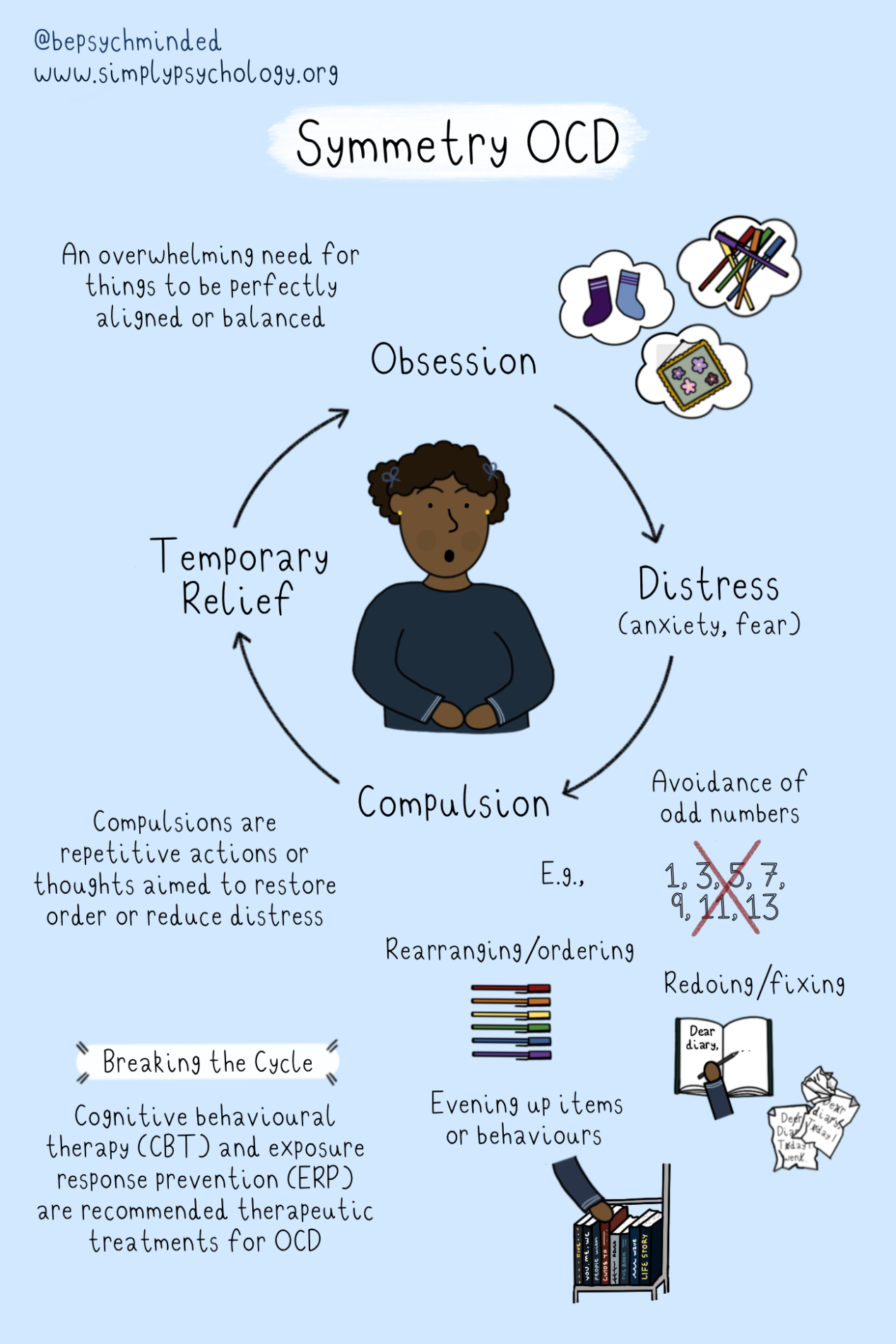
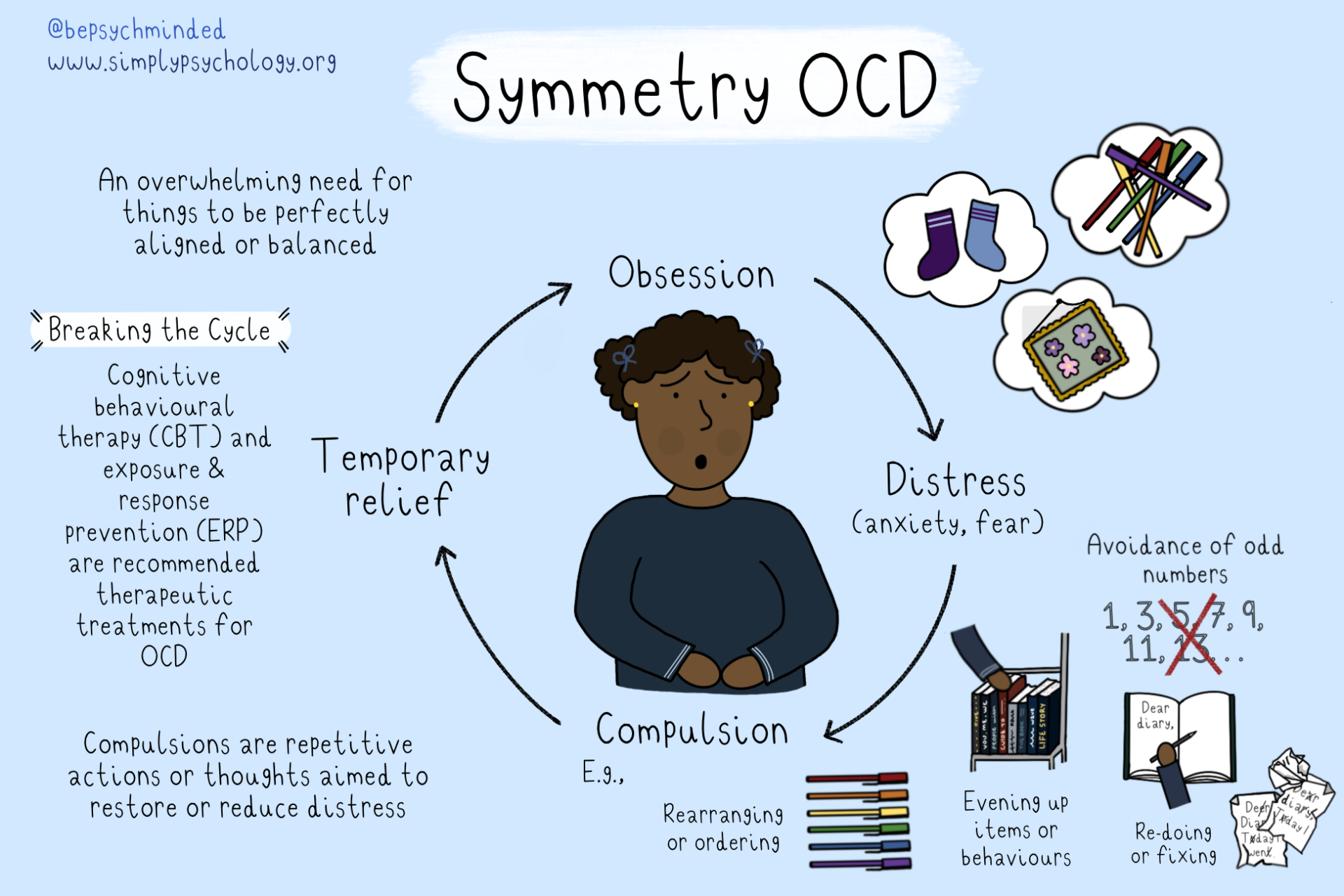
OCD is a mental disorder categorized by an endless cycle of obsessions, anxiety, and compulsions. Obsessions are unwanted, intrusive thoughts, images, or urges. Compulsions are repetitive behaviors or mental acts that ease the distress obsessions cause.
People with symmetry OCD will experience frequent obsessions around things not feeling symmetrical or ordered. They will become fixated on the position or arrangement of certain objects and will feel uncomfortable and distressed when items are not aligned correctly or appear in disarray.
“As a child if my left shoulder bumped into something I would focus (unhappily) on how my right shoulder felt weird or dirty until I could go back to the same spot and bump my right shoulder”.
People with this form of OCD may also struggle when written words are shaped imperfectly or are not correctly positioned along the lines on a page. These obsessions with symmetry tend to make individuals feel very uncomfortable and distressed with anything that does not meet their sense of order.
As a result, people with this form of OCD compulsively fix, order, or rearrange items. They want objects in a perfect and acceptable position. They may also rewrite handwritten words over and over until they look aligned.
Individuals might experience a sense of dread or unease that something bad will happen unless they engage in compulsive behavior to neutralize it.
Symmetry symptoms are common among people seeking help for OCD:
- 451 outpatients: 46.6% had primary symmetry symptoms (Lochner et al., 2016).
- 1,001 outpatients: 86.8% had experienced symmetry-dimension symptoms at some point (Vellozo et al., 2021).
These figures come from specialist clinics. They are not population estimates. Earlier studies that defined the pattern differently reported anything from 30.9% to 75.8% (Vellozo et al., 2021).
Researchers increasingly describe OCD in terms of symptom dimensions rather than separate subtypes, because attempts to validate hard categories have largely failed. Symmetry and ordering is one such dimension.
Symmetry OCD Obsessions
An obsession is an intrusive, unwanted thought or urge that can pop into one’s mind anytime. People with OCD will dwell on these intrusive thoughts and experience significant anxiety or distress.
Some common obsessions that occur with Symmetry OCD include:
- The urge to arrange and order things → Someone with this type of OCD will feel an overpowering urge to arrange objects in a symmetrical way.
For example, they might organize clothes in a closet, pillows on a bed, objects on a shelf, food in a refrigerator, or items in a drawer.
They might experience these urges in their own home, a friend’s house, a workplace, a restaurant, the supermarket, etc. People with this OCD subtype might also feel the need to touch or pick up items in a certain way or in a certain order.

- The need for balance → Individuals with Symmetry OCD also may experience a need to make their behaviors feel balanced.
For example, if they are walking, they might feel an urge to place the same amount of pressure on each foot, or if they are sitting at their desk and move one foot, they may experience a powerful urge to move their other foot in the exact same way.
Other examples can include needing to tie the shoe on their right foot to match the tension of the shoe on their left foot, or needing to touch their left shoulder if someone accidentally touches their right one to make it even.
- Intense fear and anxiety → Many people who experience Symmetry OCD obsessions face extreme fear and anxiety, usually because they fear something terrible will happen to themselves or someone they love if an object is uneven or imperfectly aligned. They dread what might happen if things do not line up with their need for perfect order. Others report no feared outcome at all, only a need for things to feel “just right” (Vellozo et al., 2021).
- Discomfort with anything asymmetrical → In addition to the fear and anxiety caused by their obsessions, individuals with Symmetry OCD also have an intense distrust of asymmetry, or things “not lining up evenly.”
Asymmetry will often invoke a sense of discomfort and uneasiness, even in situations they do not necessarily find triggering. - A feeling of incompleteness → Some people with Symmetry OCD will also feel a sense of incompleteness or that things are “not right” when they experience asymmetry.
They will experience a nagging, persistent feeling that things are “off” or imperfect, thus driving the urge to carry out compulsions and make things symmetrical.
Because these obsessions cause high emotional discomfort, people with OCD will perform ritualistic behaviors to lessen these feelings and manage their distress. These are referred to as compulsions.

Symmetry OCD Compulsions
Compulsions are behaviors or rituals that people with OCD perform in response to an obsession. They aim to suppress anxiety and neutralize fears. People also perform them to keep things safe, so that the thoughts do not come true and nothing bad happens.
People often know their compulsions are not logical. They still feel compelled to carry them out. Some fear that something bad will happen if they do not. Others simply feel incredibly anxious and distressed.
Some common compulsions that are seen with Symmetry OCD include:
- Arranging and ordering → Symmetry OCD compulsions more often than not focus on arranging and ordering items to meet the individual’s need of “just right” or “perfection.”
This can include organizing items by color, size, or number, or arranging items to meet a certain aesthetic. Examples might include:
- Positioning items so that there is the same amount of space between them
- Ordering/arranging books on a shelf by color or size
- Organizing items on a supermarket shelf to meet their standards
- Lining up or arranging their clothes or shoes in their closet according to a certain method or set of rules they set in their mind
- ‘Evening up’ → Other Symmetry OCD compulsions may focus on “evening up” items or behaviors.
This essentially means ensuring that items or words are evenly spaced or balanced, and behaviors are equalized. Examples might include:
- Tying shoes so they are equally tight on both sides
- Touching the left knee to feel symmetrical if something bumps against the right one
- Writing the exact number of words on each line on the page
- Counting steps so you step exactly the same number of times with the right foot as with the left one
- Lining up the food on a plate to ensure it is all facing the same way and evenly spaced
- Adjusting books on a bookshelf, so that the spines all form one even line.
This real-life personal experience captures the compulsive need for balance and evening up:
“If I touch something with my left hand, like a table, I HAVE to touch the same exact spot with my right hand. This extends to the part when and if I scratch my one ear, I have to scratch the other one too (even if it’s not itching) for the same amount of time I scratched the first one.”
- Avoidance → Similar to most other forms of OCD, avoidance is a common compulsion.
Because people with Symmetry OCD experience high levels of anxiety and distress when things appear to be asymmetrical or uneven, they might avoid certain situations where they know their OCD will likely be triggered.
This can include avoiding odd numbers, situations with the potential for asymmetry, or places that remind them of their negative emotions associated with their obsessions. Examples might include:
- Avoiding rooms or areas that have asymmetrical geometric shapes, such as floors with uneven tiles or walls with crooked lines
- Counting while performing actions to leave off on an even number (walking, writing words, chewing)
- Rounding numbers up or down to make them even to avoid odd numbers
- Re-doing → Many OCD compulsions focus on the need to re-do, re-check, or re-arrange. This is because most OCD sufferers experience extreme self-doubt, and thus do not trust themselves or their memories.
As a result, they often need to re-arrange, re-order, or even up items or actions until they feel ‘just right’ or until they can be certain that they are organized correctly. Examples might include:
- Rewriting words or letters on the page until there are no visible imperfections or asymmetries in the writing
- Rearranging items in the fridge or the pantry over and over again until it feels perfect and symmetrical
- And, even after arranging the fridge or pantry in a way that feels right, going back to check again to make sure that things are as perfectly arranged as you left them.
Why Am I Obsessed with Order?
Reasons behind Symmetry OCD include magical thinking, dysfunctional protecting, and the simple need to feel right.
Not everyone with symmetry symptoms fears a specific disaster. Vellozo et al. (2021), drawing on earlier work, note that many patients report no feared consequence. They feel only a strong need for uniformity, or relief from a feeling of incompleteness.
Physical sensations also seem to play a part. Sensory phenomena are physical or mental sensations that come before or alongside compulsions.
Among 1,001 outpatients, those with sensory phenomena had almost five times the odds of symmetry symptoms (odds ratio 4.76) after adjustment (Vellozo et al., 2021).
Symmetry symptoms were also linked to earlier onset and a gradual start. The study was cross-sectional. It cannot show that the sensations cause the symptoms.
- Magical Thinking → Individuals with obsessions about symmetry and exactness also might experience magical thinking, or superstitions, associated with their fixations.
They might worry that something bad will happen to themselves or a loved one unless things are in just the right place.
They might even feel responsible if something bad happens if they do not perform a specific compulsion to counter the obsessive thought.
Although people with OCD realize these thoughts are irrational, they will feel a sense of angst or discomfort unless they give in to the obsession, thus fueling the OCD cycle. - Dysfunctional Protecting → Similar to all forms of OCD, people with Symmetry OCD believe that by completing compulsions, they are protecting themselves and those around them. Completing compulsions allows people with OCD to feel safer and more in control.
- Needing to Feel Right → Like Perfectionism OCD, individuals with Symmetry OCD are obsessed with the need for things to look, sound, or feel “just right.”
They will not feel satisfied or comforted until symmetry is attained, and therefore might spend hours a day completing compulsive behaviors.
Preference for Order vs OCD
Wanting a tidy desk is not a symptom. Radomsky and Rachman (2004) tested where the boundary lies in three connected studies. They built and validated a self-report measure of compulsive ordering and arranging. They also set tasks designed to reveal preferences for order.
In one study, participants with a strong preference for order became more anxious when they had to complete a difficult task in a disorganized environment. Participants without that preference did not.
The authors concluded that compulsive ordering is an extreme version of a common preference for order and symmetry, not a categorically different phenomenon (Radomsky & Rachman, 2004).
The published summary does not report sample sizes or whether participants had a diagnosis. So the study shows that the preference is continuous, not how the disorder differs in people who have it.
A diagnosis of OCD requires more than a preference. The symptoms must be time-consuming (conventionally at least an hour a day) or cause significant distress or impairment.
Effects On Daily Life
The severity of one’s OCD symptoms and their impact on daily life vary from person to person. Some find their triggers specific and easy to target and manage.
Others have more general triggers. They may constantly feel overwhelmed in daily life.
Impact on Health, Focus, and Activities
In all cases, however, living with OCD is challenging and can take a toll on physical and mental wellbeing. Left untreated, it can infiltrate nearly every aspect of life.
Symmetry OCD obsessions can be all consuming and feel impossible to stop. Individuals with Symmetry OCD will spend hours a day ruminating on their obsessive thoughts and engaging in compulsive behaviors.
They typically find their urges very hard to ignore. This makes it difficult to focus on what is happening in the moment. They will likely be so fixated on these feelings that they feel completely possessed by them.
This can affect one’s ability to concentrate at work, stay in school, attend scheduled activities, spend time with family and friends, or maintain a relationship.
Emotional and Social Impact
“I used to struggle (and am still working through some things) with relationships because every face is asymmetrical and I could ignore it when we first started going out but the longer I’d be with someone the more I would notice the asymmetry and imperfection go the point where even looking at them made me anxious. Currently practicing my ERP, and it’s been getting a lot better”.
Many people with Symmetry OCD feel miserable and helpless. They hate the condition but feel powerless to stop the behaviors, because trying to stop triggers intense anxiety.
They might withdraw socially. Heightened anxiety, lack of energy, and the need to carry out compulsions throughout the day can all contribute.
Living with such a debilitating disorder can reduce confidence and weaken one’s sense of self. The impact of Symmetry OCD can lead to depression, hopelessness, and social isolation.
However, there are effective treatments. They can help you gain relief from your OCD symptoms and live a fulfilling life.
Is Symmetry OCD Treatable?
OCD can be treated and managed effectively. You can learn to manage how your symptoms affect your daily life through medication, therapy, mindfulness, or a combination of treatments.
Many people who seek treatment for OCD improve, but remission is not guaranteed. In a five-year study of 213 treatment-seeking adults, 39% reached partial (22.1%) or full (16.9%) remission (Eisen et al., 2013). Of those, 59% later relapsed.
Starting early helps. Lower severity and a shorter illness predicted remission in that study, but symmetry was not among the dimensions that affected it (Eisen et al., 2013).
Depending on the severity of OCD, some people may need longer-term or more intensive treatment.
Exposure and Response Prevention
Like most types of OCD, Symmetry OCD is treated first with Exposure and Response Prevention (ERP), a type of cognitive-behavioral therapy and the first-line psychotherapy for OCD.
ERP helps many people. But the often-quoted figure of 80% is stronger than the evidence supports.
Analyses of treatment trials that asked who had really recovered classed roughly 50-60% of treated patients as recovered by one standard. Only about 25% were symptom-free by a stricter one (Fisher & Wells, 2005).
Symmetry does not seem to weaken ERP. In a study of 87 patients given exposure and ritual prevention, symptom scores fell by 43.0% on average.
Taboo thoughts and hoarding predicted smaller gains, but symmetry and ordering did not (Williams et al., 2014). With five symptom dimensions compared in 87 people, “no difference found” is not proof of equivalence.
No randomized trial restricted to symmetry symptoms was found. The evidence comes from mixed-symptom samples.
ERP has two main components:
- Exposure: Purposely exposing yourself to things that elicit your anxiety
- Response Prevention: actively resisting the urge to complete a ritual
In ERP, patients are exposed to feared situations or objects meant to set off their compulsions. They then resist the ritual. The anxiety rises at first, then falls on its own. This breaks the cycle in which each ritual brings brief relief and strengthens the urge.
Over time, people learn to resist the urge to perform compulsive rituals and manage their OCD thoughts and actions.
By staying in a feared situation, people see that nothing terrible happens. They learn they do not need compulsions to cope. Their fearful thoughts have no power over them.
Someone with Symmetry OCD might be asked to do something that feels wrong or off to them. For example, they might be guided by their ERP therapist to only touch their right shoulder without touching their left.
They would resist the urge to touch their left shoulder and balance things out. They would sit with the anxiety this incompleteness brings. Such exercises can feel incredibly hard.
You should only complete exposures if you can maintain good response prevention while doing so. Even the most challenging, high-level exposures will be ineffective if you are not maintaining good response prevention.
As Professor Paul Salkovskis of the University of Oxford explains, OCD is not a problem of having strange thoughts. Intrusive thoughts are normal and near-universal.
In a public webinar, he describes people with OCD as “too careful, too nice, and trying too hard” (Salkovskis, 2022). The trouble is an exaggerated sense of responsibility that leads people to treat a thought as a warning.
Treatment, he argues, should help people stop trying so hard to control their thoughts. They can learn that the thoughts are harmless.
As science writer David Adam describes in his memoir The Man Who Couldn’t Stop (Adam, 2014), intrusive thoughts are universal, and the disorder lies in being unable to dismiss them.
His own obsession centered on contamination, not symmetry. Even so, his recovery came from confronting the fear and accepting uncertainty, not from chasing certainty. This is one person’s account, not evidence about OCD in general.
ERP takes time, effort, and practice. But people learn to cope with their thoughts without relying on ritualistic behaviors.
The compulsion to avoid anxiety is a powerful driver of OCD. Still, ERP is one of the most powerful tools available for treating OCD because it directs the person to live with the anxiety and see that nothing bad will happen.
Medication for OCD
Selective serotonin reuptake inhibitors (SSRIs) are the first-line medication for OCD. Clomipramine, an older serotonergic antidepressant, works about as well but has more side effects.
SSRIs raise the level of serotonin, a chemical messenger in the brain, and reduce symptoms over several weeks. OCD needs higher doses and longer trials than depression.
Even so, roughly 40-60% of people respond inadequately to an SSRI alone. Adding a low-dose antipsychotic is a common next step.
Symptoms tend to return when the drug is stopped. ERP’s gains, being a learned skill, last longer.
A meta-analysis of 37 randomized trials found cognitive-behavioral therapy significantly better than antidepressant medication. Adding medication to therapy gave no significant extra benefit over therapy plus placebo (Öst et al., 2015).
For severe cases that do not respond, deep brain stimulation targets the same brain circuitry.
Key Takeaways
- Symptoms: Obsessions and compulsions about order, balance, and symmetry, such as arranging, evening up, re-doing, and avoiding asymmetry.
- Two Drivers: Some people fear harm if things stay uneven. Others feel no fear, only a sense of incompleteness (Vellozo et al., 2021).
- Prevalence: In two large clinic samples, 46.6% and 86.8% of patients had symmetry symptoms (Lochner et al., 2016; Vellozo et al., 2021).
- Normal Preference: Liking order is common. Compulsive ordering is an extreme form of it, not a different phenomenon (Radomsky & Rachman, 2004).
- Onset: Symptoms tend to start early and gradually, often with a “not right” sensory feeling (Vellozo et al., 2021).
- Treatment: ERP is the first-line therapy. About 50-60% count as recovered by one standard, not 80% (Fisher & Wells, 2005).
- Outlook: In a five-year study, 39% reached partial or full remission, and a shorter illness predicted it (Eisen et al., 2013).
Sources
Adam, D. (2014). The man who couldn’t stop: OCD and the true story of a life lost in thought. Picador.
Eisen, J. L., Sibrava, N. J., Boisseau, C. L., Mancebo, M. C., Stout, R. L., Pinto, A., & Rasmussen, S. A. (2013). Five-year course of obsessive-compulsive disorder: Predictors of remission and relapse. The Journal of Clinical Psychiatry, 74(3), 233–239. https://doi.org/10.4088/JCP.12m07657
Fisher, P. L., & Wells, A. (2005). How effective are cognitive and behavioral treatments for obsessive-compulsive disorder? A clinical significance analysis. Behaviour Research and Therapy, 43(12), 1543–1558. https://doi.org/10.1016/j.brat.2004.11.007
Lochner, C., McGregor, N., Hemmings, S., Harvey, B. H., Breet, E., Swanevelder, S., & Stein, D. J. (2016). Symmetry symptoms in obsessive-compulsive disorder: Clinical and genetic correlates. Revista Brasileira de Psiquiatria, 38(1), 17–23. https://doi.org/10.1590/1516-4446-2014-1619
Öst, L.-G., Havnen, A., Hansen, B., & Kvale, G. (2015). Cognitive behavioral treatments of obsessive–compulsive disorder: A systematic review and meta-analysis of studies published 1993–2014. Clinical Psychology Review, 40, 156–169. https://doi.org/10.1016/j.cpr.2015.06.003
Radomsky, A. S., & Rachman, S. (2004). Symmetry, ordering and arranging compulsive behaviour. Behaviour Research and Therapy, 42(8), 893–913. https://doi.org/10.1016/j.brat.2003.07.001
Salkovskis, P. (2022, February 18). Obsessive compulsive disorder: Too careful, too nice, and trying too hard [Webinar, Our Mental Wellness series]. University of Oxford Podcasts. https://podcasts.ox.ac.uk/obsessive-compulsive-disorder-too-careful-too-nice-and-trying-too-hard
Vellozo, A. P., Fontenelle, L. F., Torresan, R. C., Shavitt, R. G., Ferrão, Y. A., Rosário, M. C., Miguel, E. C., & Torres, A. R. (2021). Symmetry dimension in obsessive–compulsive disorder: Prevalence, severity and clinical correlates. Journal of Clinical Medicine, 10(2), Article 274. https://doi.org/10.3390/jcm10020274
Williams, M. T., Farris, S. G., Turkheimer, E. N., Franklin, M. E., Simpson, H. B., Liebowitz, M., & Foa, E. B. (2014). The impact of symptom dimensions on outcome for exposure and ritual prevention therapy in obsessive-compulsive disorder. Journal of Anxiety Disorders, 28(6), 553–558. https://doi.org/10.1016/j.janxdis.2014.06.001



