Magical Thinking OCD is a form of OCD in which people believe their thoughts, words, or actions can have real-life consequences.
People with Magical Thinking OCD believe that they will be responsible for something awful happening to themselves or a loved one if they do not perform specific compulsive behaviors that their OCD demands.
Key Takeaways
- Not a Diagnosis: Magical Thinking OCD is not its own clinical diagnosis but a manifestation of OCD, driven by an inflated sense of responsibility.
- Superstition vs. OCD: Almost everyone has small superstitions; what makes it OCD is the anxiety, time, and disruption the belief causes.
- Common Obsessions: Intrusive fears that a thought, number, word, or action will cause harm to the person or someone they love.
- Compulsions: Rituals like counting, repeating words, or arranging objects, performed to try to prevent the feared outcome.
- The Cycle: Each ritual brings brief relief, which reinforces the belief that the ritual is necessary, keeping the cycle going.
- Treatment: Exposure and Response Prevention (ERP), a form of CBT, is the first-line and most effective treatment.
No matter how unreasonable and irrational, they believe that their thoughts or actions have the ability to alter the course of events in the physical world.
This tends to be driven by an inflated sense of responsibility (i.e., I am to blame for anything bad that happens) and a desire to control outcomes.
As a result, these individuals must follow specific rules to ensure “good things” will occur and to prevent “bad things” from happening.

What is Magical Thinking OCD?
While we all experience magical thinking from time to time, like in the form of superstitions, people with OCD may experience these thoughts and obsessions to a severe degree.
Usually, a small dose of superstition does not have any significant influence on one’s life.
- Avoiding the 13th floor of a hotel
- Knocking on wood
- Wearing a lucky shirt to watch a sports game
However, for those with OCD, this superstitious thinking can generate extreme anxiety, fear, and an overwhelming sense of responsibility.
Where Everyday Superstition Ends and OCD Begins
Unlike other OCD subtypes, Magical Thinking OCD is not a clinical diagnosis, but rather a manifestation of OCD. While it does have its own distinct characteristic, it can also occur within many other forms of OCD.
What changes between a harmless habit and a clinical one is not that the belief becomes stranger. It becomes expensive.
The identical style of reasoning starts generating extreme anxiety, fear, and an overwhelming sense of responsibility, and it consumes hours of a person’s day.
Counting OCD and Other Everyday Examples
For example, someone with Counting OCD might believe that counting to a certain number, or doing something a set number of times, will prevent something bad from happening.
So they count, again and again, to feel safe.
Live Experience (Leah)

"Everything I do in my life is to the count of four. Four is my lucky number. The clock around my head has only the numbers one to four because they are the only numbers that matter.

I could never do something only three times; it has to be four times.

When I put on my mascara it is always to the count of four. If I don't do it correctly, like if I miscount or it doesn’t feel just right, I have to start over. You can imagine that some days I am wearing a heavy dose of mascara."
People with Magical Thinking OCD tend to feel responsible for the well-being and safety of others. As a result, they worry that their thoughts or actions could cause harm.
Even if the person rationally understands that they do not have the power to make something happen, the fear of causing harm to themselves or someone else can feel overwhelming.
They act anyway, just to be sure.
Usually, there is little to no connection between what a person fears with their Magic Thinking OCD and the action they perform to prevent it.
Common Magical Thinking Obsessions
Obsessions are often at the root of the OCD experience. An obsession is an intrusive and unwanted thought or urge that causes anxiety or distress for the person experiencing it.
Having intrusive thoughts does not mean you have OCD. But if you find yourself trying to suppress these unwanted thoughts and fears with compulsions, this can be a sign of OCD.
Most obsessions in OCD involve anxiety and distress over causing (or preventing) harm to themselves or other people.
Some examples of Magical Thinking thoughts include:
- “If I use a pen instead of a pencil to sign this document, something bad will happen.”
- “If I do not hold my breath when I pass this graveyard, I will place a curse on myself and everyone around me.”
- “If I don’t text my parents before I take off from a flight, the plane might crash.”
- “If I happen to look at the clock when it is 9:11, something tragic will happen.”
- “If I have a negative thought, I need to balance it out with three positive thoughts in order for nothing bad to happen.”
- “If I step on a crack in the sidewalk, I will have bad luck for the rest of the day.”
- “If I do not close my eyes when we drive over this bridge, we will fall into the water.”
- “If I re-wear this dress I wore to a funeral, something horrible will happen to me.”
Common Magical Thinking Compulsions
Compulsions are behaviors or rituals that people with OCD perform in response to an obsession, or intrusive thought. People perform these compulsions in order to suppress their anxiety and neutralize their fears.
They also carry them out to keep things safe, make sure that the thoughts do not come true, and make sure that something bad does not happen.
Magical Thinking OCD compulsions tend to fall into one of these patterns:
- Avoiding certain “bad” numbers, colors, words, locations, items, etc.
- Repeating “good” words, numbers, or phrases
- Repeating actions (such as turning on/off the faucet) until it feels “right”
- Counting to a specific number or performing a certain action a specific number of times (such as saying “I love my mom,” three times every time a person hears any negative mention of their mother)
- Wearing certain clothes or colors
- Touching things a certain number of times or in a specific way
- Neutralizing bad thoughts with good thoughts
- Arranging objects in a specific pattern or way
- Picking up and putting down items in a specific way
- Moving your body or gesturing in a certain way
- Doing specific things at a certain time or date
- Performing “rituals” during certain times of the day or under specific circumstances.
OCD Cycle
Obsessive-compulsive disorder (OCD) is a mental health condition marked by ongoing, unwanted thoughts, called obsessions.
These obsessions are followed by repetitive behaviors and actions, called compulsions, performed in an attempt to reduce the anxiety the obsessions cause.
OCD is maintained by a cycle of compulsive rituals that provide short-term relief, but only serve to intensify the fear and guilt in the long-term.
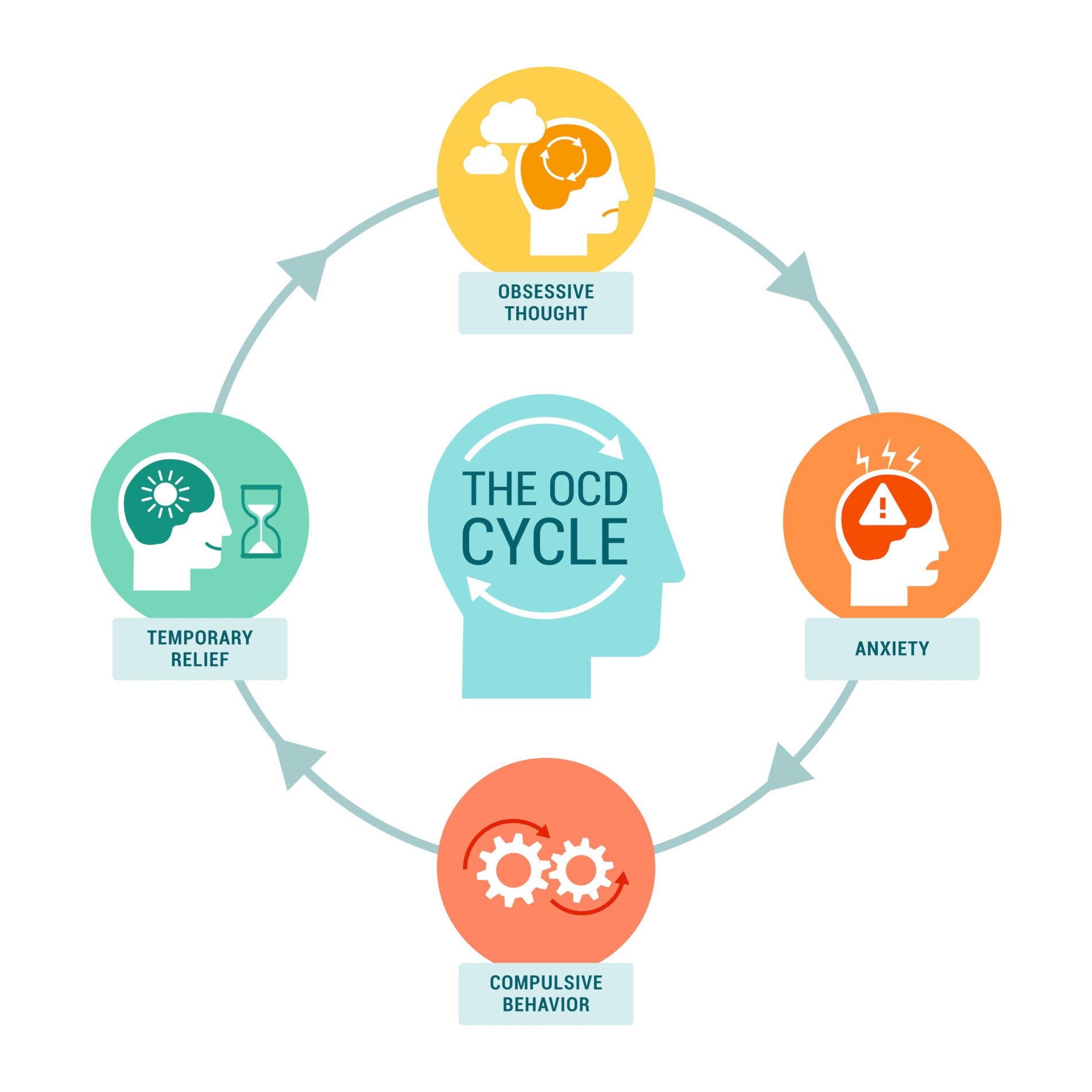
Let’s illustrate this cycle using an example of magical thinking, a common symptom of OCD:
- Obsession: A person has an intrusive thought that they believe their loved ones will be in an accident if they don’t touch every doorknob in their house three times before leaving.
- Anxiety: This thought causes intense anxiety and distress. They worry constantly about their loved ones’ safety.
- Compulsion: To reduce anxiety and prevent the feared event (the accident), they touch every doorknob in their house three times before going out.
- Temporary relief: The act of touching doorknobs gives temporary relief from the anxiety, but it also reinforces the cycle.
- Return of obsession: Later, the obsessive thought returns, and its association with safety is reinforced by the compulsion carried out, and the cycle repeats.
Why Does Magical Thinking OCD Happen?
No single cause explains why some people develop Magical Thinking OCD. Psychologists have identified several cognitive processes that combine to turn an ordinary, passing thought into a compulsion.
The Need to Feel in Control
Magical rituals tend to appear when the stakes feel high but real control is low.
Control feels safer than chance.
Believing that a thought or ritual can influence the outcome restores a felt sense of agency over an uncertain situation.
Psychologist Ellen Langer called this the “illusion of control”: people consistently overestimate how much influence they have over events that are really down to chance (Langer, 1975).
In one of her experiments, people who picked their own lottery ticket demanded far more money to sell it back than people simply handed one.
Yet the odds were identical either way.
The odds, of course, never changed.
This same bias helps explain why a ritual can feel protective, even when it has no real effect on the outcome.
A similar accidental-reinforcement process can help a ritual take hold in the first place. If a behavior happens, purely by chance, to occur right before a good outcome, it can be repeated as though it caused that outcome (Skinner, 1948).
Thought-Action Fusion: When a Thought Feels Like a Deed
Psychologist Paul Salkovskis proposed that everyone experiences intrusive, unwanted thoughts.
What turns a passing intrusion into OCD is how a person interprets it, not the thought itself (Salkovskis, 1985). Someone with Magical Thinking OCD often appraises the thought as a sign of inflated personal responsibility for any harm that might follow.
The appraisal is the problem.
Psychologists call this thought-action fusion: treating a thought as if it were equivalent to an action (Rachman, 1993).
Likelihood fusion is the belief that thinking about something makes it more likely to happen. Morality fusion is the belief that having an unacceptable thought is as bad as acting on it.
Both are magical beliefs.
Both give a private thought a power it does not really have, which is exactly why it can feel urgent to “undo” it with a ritual.
A large 2026 systematic review of 191 studies found that this pattern is not confined to OCD. Magical thinking and thought-action fusion also appear, to different degrees, across anxiety, mood and other conditions, alongside everyday superstition (Eddy, 2026).
The finding is broad.
What separates a harmless superstition from Magical Thinking OCD is not the belief itself, but the anxiety, time and disruption it comes to cost.
How does Magical Thinking OCD Get in the Way of Life?
Like all OCD subtypes, Magical Thinking can significantly affect people’s quality of life. While Magical Thinking OCD compulsions may start small, they typically will snowball over time.
In severe cases, Magical Thinking OCD can be deeply disruptive and impede someone’s ability to function and succeed in their everyday life. The obsessions and compulsions surrounding OCD can be incredibly time-consuming and draining.
“Magical Thinking had an enormous impact on me as a child. I had to do a particular task x number of times or God would be disappointed in, me and punish me. Or, I had to be cool because my crush could be watching me from behind a window, bush, or something.”
As science writer David Adam explains in his memoir The Man Who Couldn’t Stop (2014), the hardest part of living with OCD was not his intrusive thoughts.
It was his inability to dismiss them.
Adam describes the felt, unshakeable sense that his own thoughts had power, so that merely thinking about a danger could help bring it about.
The thought itself proves nothing.
They can make it nearly impossible to perform sufficiently in assigned tasks or be attentive in social interactions.
Some people can become so obsessed with their superstitions that it becomes all-consuming, and they can’t focus on anything else.
Is Magical Thinking OCD Treatable?
Similar to other forms of OCD, Magical Thinking OCD can be effectively treated with Exposure and Response Prevention (ERP).
ERP is a type of CBT.
It is the first-line psychotherapy for OCD.
People can learn to manage how their symptoms affect their daily lives through medication, therapy, and mindfulness.
ERP therapy has been found effective for around 80% of people with OCD (Foa, Yadin, & Lichner, 2012). This makes it one of the most effective mental health interventions available.
The evidence is strong.
In ERP, people work with a therapist to identify both external and internal triggers that cause them to stress and make them want to behave compulsively. ERP is designed to gradually reduce the anxiety that feeds the obsessions and compulsions through a process called habituation.
The goal of habituation is to purposely invoke and sit with the anxiety in attempt to disrupt the neural circuit between the processing and action parts of the brain.
Anxiety fades with practice.
In the case of Magical Thinking, this might involve being exposed to intrusive thoughts while resisting the compulsions that the person would typically do to alleviate their anxiety.
For example, let’s say you feel that you can only chew your food by a number that is divisible by 5 before swallowing, or else you will choke. With an ERP therapist, you will work toward overcoming this compulsion with the goal of chewing freely without counting.
The fear does not come true.
Overtime, you will see that nothing bad will happen (i.e., choking) when you do not perform the compulsion (i.e., counting), and your anxiety will decrease even without the compulsive response.
Sources:
Adam, D. (2014). The man who couldn’t stop: OCD and the true story of a life lost in thought. Picador.
Bolton, D., Dearsley, P., Madronal‐Luque, R., & Baron‐Cohen, S. (2002). Magical thinking in childhood and adolescence: Development and relation to obsessive compulsion. British Journal of Developmental Psychology, 20(4), 479-494.
Eddy, C. M. (2026). The many manifestations of magical thinking: A systematic review. Frontiers in Psychiatry, 17, 1759906.
Einstein, D. A., & Menzies, R. G. (2004). The presence of magical thinking in obsessive compulsive disorder. Behaviour Research and Therapy, 42(5), 539-549.
Foa, E. B., Yadin, E., & Lichner, T. K. (2012). Exposure and response (ritual) prevention for obsessive-compulsive disorder: Therapist guide. Oxford University Press.
Langer, E. J. (1975). The illusion of control. Journal of Personality and Social Psychology, 32(2), 311-328.
Rachman, S. (1993). Obsessions, responsibility and guilt. Behaviour Research and Therapy, 31(2), 149-154.
Salkovskis, P. M. (1985). Obsessional-compulsive problems: A cognitive-behavioural analysis. Behaviour Research and Therapy, 23(5), 571-583.
Skinner, B. F. (1948). “Superstition” in the pigeon. Journal of Experimental Psychology, 38(2), 168-172.
West, B., & Willner, P. (2011). Magical thinking in obsessive-compulsive disorder and generalized anxiety disorder. Behavioural and cognitive psychotherapy, 39(4), 399-411.


