Imposter syndrome is a psychological pattern common in people with ADHD where they doubt their accomplishments and have a persistent fear of being exposed as a fraud despite evidence of their competence.
Key Takeaways
- What It Is: Imposter syndrome is the persistent feeling of being a fraud despite clear evidence of competence, and it is common among people with ADHD.
- ADHD Connection: Masking symptoms and working harder to keep up in a neurotypical world can widen the gap between looking capable and feeling capable.
- The Imposter Cycle: Success reached through over-preparation or last-minute procrastination often gets credited to effort or luck rather than ability, so the self-doubt survives.
- Common Signs: Pressuring themselves, minimizing accomplishments, and comparing themselves unfavorably to peers are frequent patterns.
- Prevalence Varies Widely: Depending on the screening tool used, studies estimate imposter feelings affect anywhere from about 9% to 82% of people.
- No Quick Fix: There is no clinically proven cure, but self-reflection, reframing negative thoughts, and acknowledging real effort can ease the pattern over time.

Why ADHD Increases the Risk of Imposter Syndrome
Many people with ADHD feel they need to double their efforts to keep up in a predominantly neurotypical world, from friendships and romance to the workplace.
Extra effort often goes into concentrating, managing time, and limiting hyperactivity. On the outside, this can look like effortless success, and others may praise it.
Underneath, there can be real hidden struggle. Masking, fear of judgment, and the work of balancing ADHD symptoms while trying to fit in all add up (Barkley, 2020).
The gap is real.
How capable someone looks and how capable they feel can differ sharply. People with ADHD may also experience low self-esteem, low confidence, and fewer positive thought patterns as a result of their symptoms (Schubert & Bowker, 2019).
Praise then feels unearned.
Perfectionism and the Imposter Cycle
Perfectionism is another key contributor. Holding oneself to very high standards shifts attention toward flaws and problems rather than what went right, so success ends up feeling underserved (Wang, Sheveleva & Permyakova, 2019).
This links to what researchers call the imposter cycle: a self-reinforcing pattern in which achievement-related tasks trigger anxiety.
That anxiety drives either over-preparation, or procrastination followed by a last-minute push (Clance, 1985).
Either route usually works.
The task gets done, and positive feedback follows. But the success then gets discounted: credited to effort if they over-prepared, or luck if they procrastinated, rather than to ability (Clance & Imes, 1978).
Because the win is explained away, it never becomes evidence of competence, and the cycle restarts on the next task.
Signs of Imposter Syndrome in ADHD
Below are some of the signs of how imposter syndrome may appear in ADHD:
Pressure themselves
Many people with ADHD may put a lot of pressure on themselves to overperform, overachieve, and overcompensate for any self-identified areas they may “lack”.
This can lead to very high self-imposed standards for their work. Procrastination often follows, driven by a fear of falling short of perfect (Asherson, 2005).
The unfinished task then gets read as proof of laziness. In reality, it usually reflects fear, not a lack of effort.
People pleasing behaviors
People pleasing can show up as being unable to say “no” to others’ requests. It can also mean letting personal boundaries slide to avoid confrontation or rejection.
A lack of confidence can turn into a need for external validation. Reassurance becomes essential. The person seeks constant proof that they are intelligent, capable, and good.
This trait tends to be more pronounced in girls and women with ADHD than in boys and men with ADHD (Taylor & Keltner, 2002).
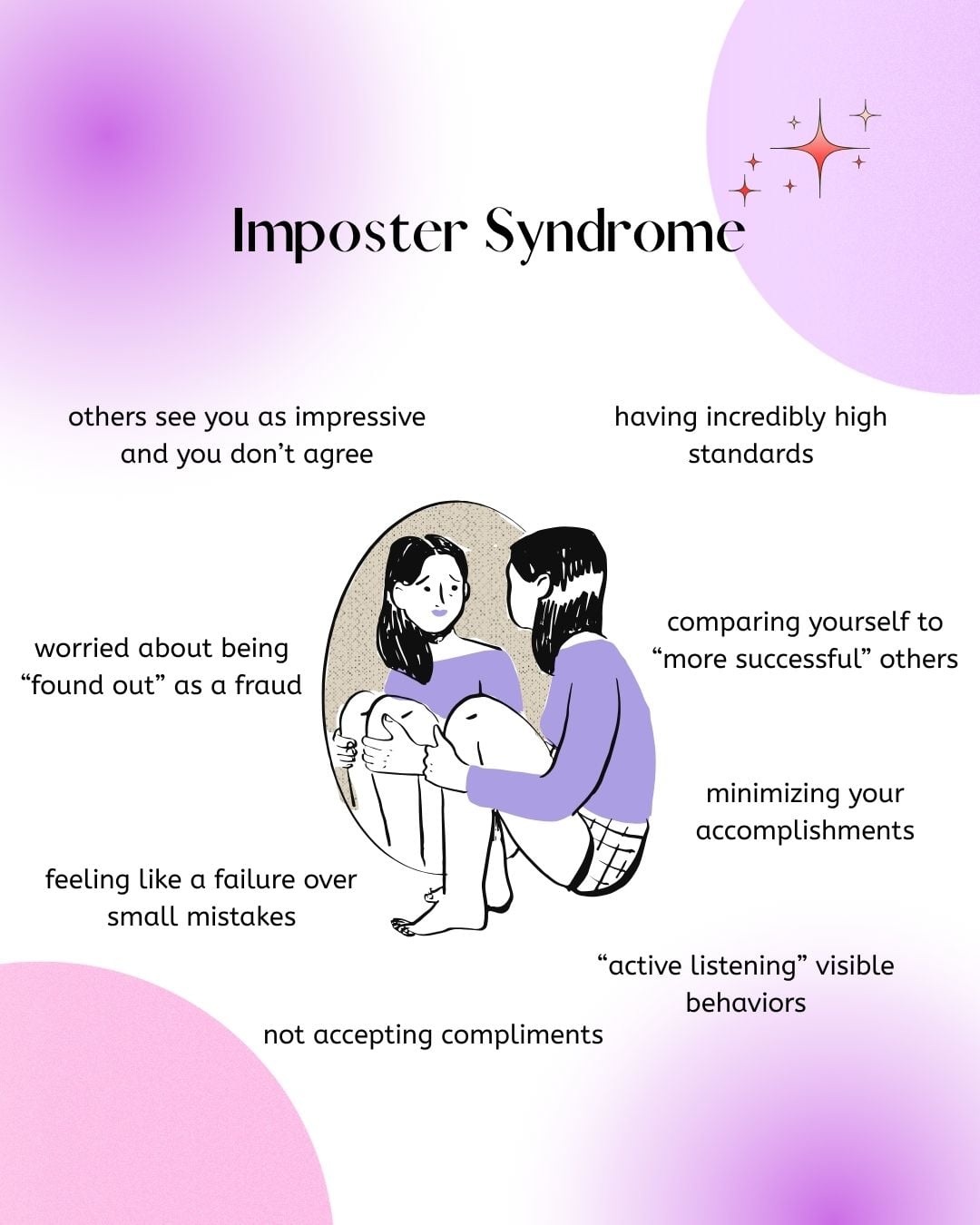
Minimizing accomplishments
Low self-esteem and confidence can make it easier to avoid taking credit for success. The credit disappears. It gets attributed to luck or circumstance instead of ability.
At work, for example, someone might minimize a finished project’s importance. They may shift the credit to a colleague or dwell on how it could have gone better.
Additionally, this minimization can also arise in dismissing any compliments or positive affirmations from others.
“I have developed this constant cycle of procrastinating and feeling HUGE guilt, and then doing it all last minute and somehow doing it so well that no one ever believes it was last minute… I’m constantly constantly constantly beating myself up because I only do a fraction of the hours I’m supposed to be doing.
In my Ph.D. I was surrounded by people struggling, putting in weekends of work, and I looked exactly like them, but the difference was I was mostly procrastinating and only doing work the last 20 percent of the time. Still, all came out excellent. Everyone thinks I’m an inspiration and I’m a super hard worker.”
‘Avery’
Suspicious about compliments
Someone with ADHD may find it hard to believe they deserve praise, even after clear positive feedback. Self-doubt clashes with the compliment, and suspicion follows.
They may assume compliments are just politeness, not genuine feeling. This chips away at the credit the words were meant to give.
Making comparisons
People with ADHD may regularly measure their own abilities and achievements against those of others.
In classes or academic settings, this often means judging their own performance harshly. They may conclude they are falling short or simply not good enough. That comparison is unfair.
They may believe they take longer, or make more mistakes, than their peers. This view is skewed: it focuses on people doing better while ignoring their own real successes.
Seen as capable to others
People with ADHD may feel they need to mask who they are. They might adopt a “persona” to fit in with neurotypical peers.
This can mean constant adjustments. Small ones add up: covering for forgetfulness, attentional difficulties, or time-management struggles.
The fear is that this true self will be “exposed”, seen as less capable or confident than the persona suggests.
This can further generate symptoms of performance anxiety, fatigue, and a disconnect in their sense of self.
“We worry about whether someone’s going to discover the real you, the incompetent or foolish or irresponsible one… it’s hard to dismiss these thoughts because they can be deeply ingrained.”
Dr. Sharon Saline
Feeling like a failure
Unfortunately, due to all the reasons outlined, feeling like a failure or fraud is also associated with imposter syndrome.
The high-achieving mentality, perfectionistic tendencies, and hyperfocus on mistakes and self-perceived inadequacies can make someone develop a very negative image of themselves.
They may feel like they are not living up to their own expectations or those around them, despite any available evidence showcasing otherwise.
The Problem With Imposter Syndrome
Imposter syndrome can have several problems associated with it. Firstly and most importantly, going about your life feeling like your achievements are not deserved is not a sustainable lifestyle.
Unfortunately, people experiencing imposter syndrome often refuse to credit their success as genuine. They feel inadequate compared to others, regardless of the evidence in front of them.
This takes a toll on self-esteem, quality of life, and overall wellbeing.
Comorbid Mental Health Risks
A 2020 systematic review pooled 62 studies on imposter syndrome (Bravata et al., 2020). It found frequent comorbidity with anxiety and depression, plus links to impaired job performance and burnout.
Prevalence estimates vary widely.
Depending on which screening tool is used, studies put the figure anywhere from about 9% to 82% (Bravata et al., 2020).
Elevated anxiety or depression can spill into daily life, creating new problems on top of the original self-doubt.
That stress is real.
Feeling like people will eventually discover the “real you” can itself become a source of distress and intrusive thoughts.
Low self-esteem can fuel this further, feeding negative self-perceptions and judgments. A vicious cycle forms: never feeling deserving, which only reinforces the imposter feeling.
Even the term’s own co-originator disagrees with the label.
As Pauline Rose Clance later reflected, she would call it the “impostor experience” rather than a syndrome. In her words, “it’s not a syndrome or a complex or a mental illness, it’s something almost everyone experiences” (Clance, as cited in Anderson, 2016).
How Can Someone With ADHD Overcome Imposter Syndrome?

Imposter syndrome can affect daily routines, mental health, and overall quality of life.
Learning to manage it can lead to real self-fulfillment. Here are some ways someone with ADHD can start.
Acknowledge the thoughts
The first step is acknowledgment. Take time to reflect on your thought patterns, behaviors, and the motivational drives behind them.
For example, procrastination might be the visible behavior. Underneath, the real worry may be not doing a good enough job.
That underlying worry often stems from insecurity, perfectionism, or a lack of self-belief.
Note down any such things that plague your day-to-day life to help get them from abstract to more concrete.
Challenge and reframe thoughts
Once negative thought patterns have been recognized, the next step is challenging and reframing them.
This takes time. Consistency and a slowly-built positive mindset get someone a long way. External factors matter too, like perceptions and comments from people around you.
“The biggest thing that’s helped me… is that if I were lazy, I wouldn’t care. I WANT things to be done, I WANT to get them done; I just don’t have the ability to get my mind to agree with me. Lazy people are lazy explicitly because they DON’T care, and so if I do, then I am not them.”
‘Zach’
Let go of perfection
Perfection does not exist. Mistakes are a natural part of life, and accepting that is an important first step.
When the urge to compare flares up, remember there are two sides to every skill gap. Someone else may excel at one thing, but you excel at others. Be kinder to yourself, and learn to forgive.
Focus on strengths
Slowly begin shining the spotlight on your strengths and successes. Getting distracted while hanging out with friends does not erase the fact that you showed up and built real connections.
‘…paying more attention to things that go well in your life… Because we have to shift from ‘ugh, I’ve wasted my time. I’m messing up. I can’t focus… I’m not productive’ to noticing when things are actually moving in a productive, effective direction. So this is about shifting your perspective from what’s wrong, or the ways that you’re not enough, to celebrating what’s positive.’
Dr. Sharon Saline
Ask loved ones or colleagues what they value about you. Positive validation from people who matter to you can help.
Begin writing everything down to help create a visual proof of all the great things you have accomplished.
Acknowledge efforts
Acknowledging effort is another big step. It keeps the evidence of your hard work in view.
Instead of dismissing success as ‘not that big of a deal,’ congratulate yourself. Celebrate every victory, big or small.
Becoming your own best champion, over time, builds a more positive mindset and stronger self-confidence.
Don’t make comparisons
Lastly, reducing comparisons as much as possible is key due to it being a big contributing factor to imposter syndrome.
“I think we do need to cut ourselves some slack and just accept the fact that we don’t need as much time as other people and to use that extra time for ourselves instead of sitting at our desks beating ourselves up over not working the same way other people do.”
‘Mark’
Each person is unique in their own strengths and weaknesses, so acknowledging that you are worthy of praise and love just like anyone else is an important first step.
Shift the focus from comparison to self-reflection instead. Turn that reflection into actionable steps for your own growth.
Be kind to yourself along the way. Other people’s opinions do not diminish your hard work or personal worth.
References
Asherson, P. (2005). Clinical assessment and treatment of attention deficit hyperactivity disorder in adults. Expert review of neurotherapeutics, 5(4), 525-539.
Barkley, R. A. (2020). Taking charge of ADHD: The complete, authoritative guide for parents. Guilford Publications.
Bravata, D. M., Watts, S. A., Keefer, A. L., Madhusudhan, D. K., Taylor, K. T., Clark, D. M., Nelson, R. S., Cokley, K. O., & Hagg, H. K. (2020). Prevalence, predictors, and treatment of impostor syndrome: A systematic review. Journal of General Internal Medicine, 35(4), 1252–1275. https://doi.org/10.1007/s11606-019-05364-1
Ivey, C. L. (2015). Glossary (Not) for Non-ADHD Partners: Negotiating Relational Terms after the Diagnosis. Departures in Critical Qualitative Research, 4(4), 99-116.
Mainali, S. (2020). Being an imposter: Growing out of impostership. JNMA: Journal of the Nepal Medical Association, 58(232), 1097.
Saline, S. [ADDitude Magazine]. (2023, February 27). Focus Issues and Imposter Syndrome with Dr. Sharon Saline, PsyD [Video]. YouTube. https://www.youtube.com/watch?v=NcQ838hjWJ8&ab_channel=ADDitudeMagazine
Schubert, N., & Bowker, A. (2019). Examining the impostor phenomenon in relation to self-esteem level and self-esteem instability. Current Psychology, 38, 749-755.
Taylor, E. W., & Keltner, N. L. (2002). Messy purse girls: Adult females and ADHD. Perspectives in psychiatric care, 38(2), 69.
Wang, K. T., Sheveleva, M. S., & Permyakova, T. M. (2019). Imposter syndrome among Russian students: The link between perfectionism and psychological distress. Personality and Individual Differences, 143, 1-6.