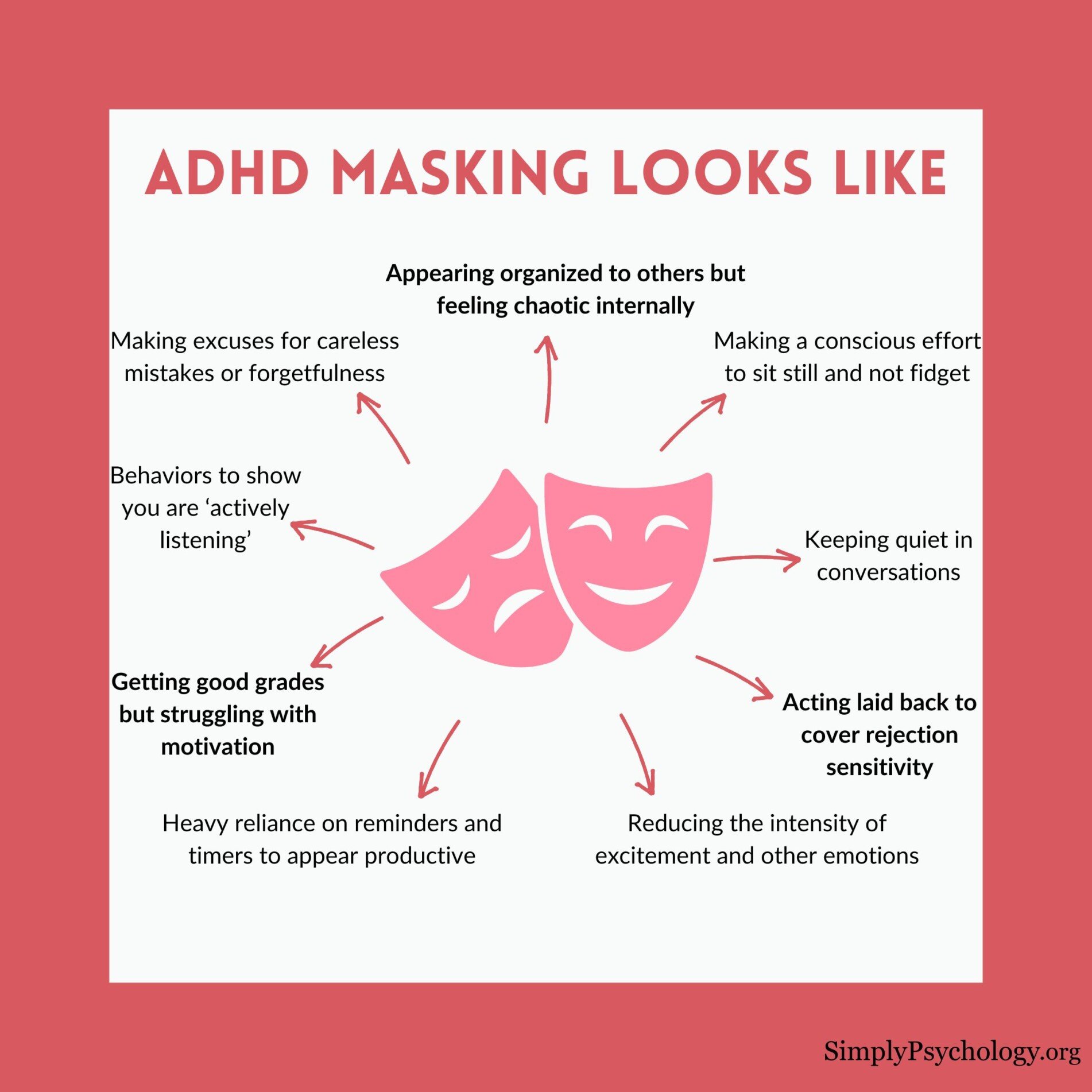
Masking in attention deficit hyperactivity disorder (ADHD) refers to the conscious or subconscious efforts of individuals to hide or suppress their symptoms in order to conform to social expectations or avoid negative judgments and stigmatization.
Researchers also use the term camouflaging. Some link masking to impression management, the everyday process of controlling how we come across to others (Grimell et al., 2025).
Masking is usually described when that effort is costly and hides something the person would otherwise show.

Examples of ADHD Masking
There are many ways in which ADHD symptoms can be masked. Below are some examples:
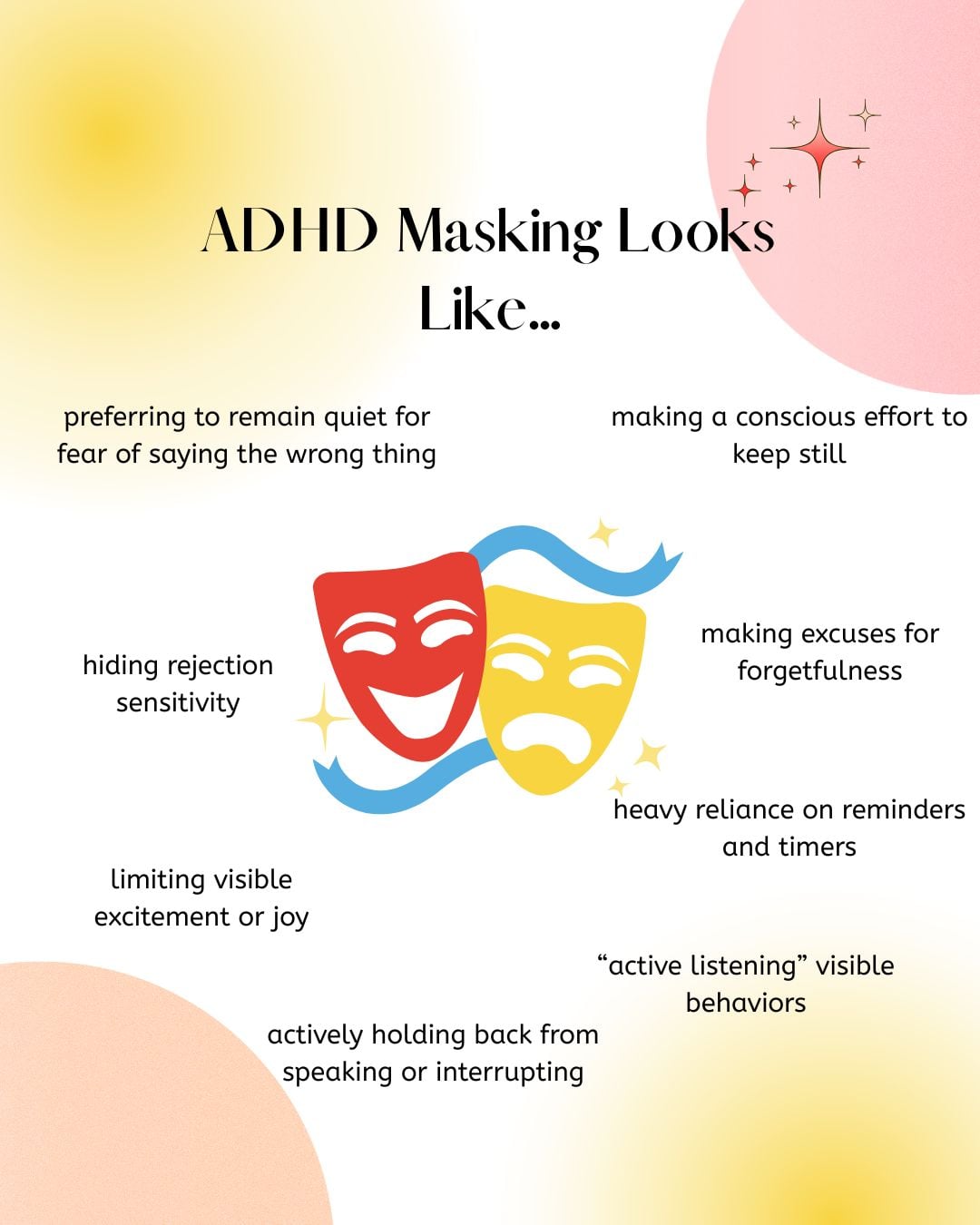
- Hiding feelings: Hiding your true feelings and presenting behaviors that would be more neurotypical instead
- Suppressing stims: Trying to suppress certain soothing behaviors, such as stimming (self-stimulating behavior)
- Feigning nonchalance: Masking the fact that you worry about criticism and negative feedback by portraying a more nonchalant persona
- Checking: Developing the need to obsessively check over things, e.g., your personal possessions
- Over-apologizing: Being overly apologetic to hide tendencies of forgetfulness or lack of focus
- Overcommitting: Taking on too much in order to showcase your capability and override any emotions of not being good enough
- Intense listening: Expending a lot of energy actively listening to ensure you do not miss any social cues or what is being said
- Hiding emotions: Masking any emotions such as fatigue, anxiety, or self-doubt
- Copying others: Imitating how peers talk and behave in order to blend in (Grimell et al., 2025)
“I used to literally bite my lip to stop interrupting and until it bled.”
Dr Alex Conner
Why do People with ADHD Mask?
There are several reasons why people with ADHD mask, and it can differ from person to person. However, there are some common underlying motivational factors that often drive the desire to mask (Sarenius, 2022).
In a qualitative survey of 202 adults who have ADHD, Mylett et al. (2026) found four main motivations. Participants wanted to fit in, to be liked, to avoid adverse experiences and to survive in a neurotypical society. They rarely separated these reasons.
Desire to belong
One such reason is the desire to belong and societal pressures. The majority of people crave social connections and want to fit in with their peers and society as a whole.
Masking ADHD can help people feel like they are behaving in more neurotypical ways, which can, in turn, reduce perceived notions of being an outsider or feelings of unwantedness.
“I always felt like I had to perform in order for people to understand my intentions, which I think is a feeling that a lot of us can relate to with masking. Like, let me go above and beyond to show that I can be responsible and kind and pleasing and obedient… because you need approval.”
René Brooks, Educator
Fear of being socially rejected
Following on from this, another reason for ADHD masking linking to the previous point is fear of stigmatization and bullying.
Some ADHD behaviors, such as impulsivity, are poorly accepted in social situations. Masking and suppressing such urges can act as a protective mechanism against judgment or criticism.
Peer rejection often starts early. In a classic study, classmates rated 165 children who had ADHD as less well liked and more often rejected than matched peers (Hoza et al., 2005). The study did not measure masking, so linking rejection to later masking is an interpretation, not a tested finding.
Stigma continues into adulthood. In a systematic review of 21 qualitative studies, McGill et al. (2026) found that stigma-based fear led some adults to keep masking. They worried about being disbelieved or told that ADHD is an excuse for underachievement.
Rejection sensitivity, the intense emotional reaction to perceived criticism or rejection, may also drive masking. No study has tested this directly.
They are unaware of having ADHD
Individuals with ADHD may learn to mask their symptoms, especially if they have not been diagnosed.
This can make it even harder for clinicians to identify ADHD, as the individual may appear to be anxious or shy rather than displaying typical ADHD symptoms.
This can be further exacerbated in girls and women as they often go underdiagnosed or misdiagnosed (Lai, Lin & Ameis, 2022).
Women who were diagnosed in adulthood describe how this happened. In a US focus-group study, 14 women said that perfectionism, people-pleasing and help from parents and teachers made their difficulties less visible (Babinski & Libsack, 2025).
Many had also believed that ADHD affects only school-aged boys. One participant said she “did really well with masking”, as the teacher’s favorite with top marks.
Masking before diagnosis raises a puzzle. Marios Adamou (2026) argues that people cannot deliberately conceal a condition they do not know they have.
In his view, adapting without knowing is an automatic response to years of criticism, not strategic hiding. That is partly a question of definition.
Racial and ethnic minority groups may be more likely to mask because of added discrimination. This could reduce the likelihood of early detection. No study has yet compared ADHD masking across ethnic groups. Until then, the link is a plausible hypothesis, not an established finding.
“I’ve lost a little bit of my own ethnic culture and my own foundations… I’m South Asian and Pakistani. I’ve lost a little bit of that … to try and become something I’m not.”
Sonya Barlow, Author (2023)
Being neurotypical is ‘favored’
Neurotypical behavior is usually favored in most societies and cultures, further driving the need to camouflage neurodivergent tendencies and reactions.
For example, in the workplace, it may be seen as better to be focused and attentive rather than unfocused and inattentive, which are some of the primary ADHD symptoms.
Such behaviors may be restricted or scolded early on. A child who struggles to concentrate or shouts out answers in class may be chastised by teachers. Peers may ostracize them too.
The notion that it is unfavorable to act in such ways can thus push people to begin masking who they are instead of being their authentic self.
Why Can Masking be a Problem?
Masking offers real benefits, especially in situations where being your authentic self can put you in danger. It can turn problematic when used too often or for long stretches of time.
Below are some common impacts of masking:
- Burnout: Constant self-monitoring is exhausting and can lead to fatigue and burnout.
- Self-esteem: Hiding your genuine self can lower self-esteem and confidence.
- Sense of self: Switching between masks can leave you unsure who you really are.
- Distraction: Monitoring your behavior uses mental energy that could go to the conversation.
- Anxiety: Fearing that your true identity will not be accepted can increase anxiety.
- Imposter syndrome: The gap between your real and presented self can feel like fraud.
- Late diagnosis: Effective masking can hide difficulties from others and delay support.
- Low mood: Anxiety and a disconnect from your identity can feed sadness and depression.
- Substance use: Some people may use alcohol or drugs to cope, though no study has tested whether masking causes this.
Burnout
Constant self-monitoring of emotions and behaviors can naturally become absolutely exhausting due to the heavy censorship and cognitive energy masking requires.
The worry, anxiety, and other related symptoms that can arise when camouflaging add to this mental load, further exacerbating the situation.
Consequently, this can lead to feelings of fatigue and burnout, with the body not being able to cope with the stress it is being put under.
Exhaustion is the most consistent theme in the research. One Swedish teenager explained that after school she could only lie on the sofa, because “it wears you down” (Grimell et al., 2025).
Medical students also described masking as using up energy they needed for everyday tasks (Godfrey-Harris & Shaw, 2023).
One caution applies. Fatigue is common in ADHD even without masking, and 62% of 243 adults in one clinic study met criteria for fatigue (Rogers et al., 2017). Exhaustion cannot be blamed on masking alone.
“I tried to mask and I try to mask maybe so hard that I didn’t realize I was masking and then eventually I got exhausted from masking because it hurts your brain and it makes you feel tired.”
Sonya Barlow, Author (2023)
Decreased self-esteem
Masking can create a sense of disconnect between your wish to be authentic and the version of yourself that you portray.
This frequent hiding of your genuine self can begin to take a toll and massively plummet positive self-perceptions.
With time, this can reduce self-esteem and confidence and encourage unhelpful thought patterns. Depression then becomes more likely (Sowislo & Orth, 2013).
“I’ve got really low self-esteem, and I think I’m [ __ ] at everything, and I don’t want people to know how [ __ ] I am, so I think I do my best to hide it.”
Sam Brown
Low sense of self
Linking to a decreased self-esteem due to the dissociation of the authentic you and masked you, a low sense of self can begin to develop.
Feelings of inadequacy and hyper-focusing on just the negative can begin to arise. Each person or occasion may call for a different mask. This can leave people overwhelmed and unsure which version of themselves to be.
Consequently, this can generate feelings of loss and confusion over what your true identity is and further agitate negative self-perceptions and judgments.
Can be distracting
Distraction is something many people with ADHD battle with, and it can become exacerbated with masking as a byproduct of the cognitive demand it takes on one’s mental load.
Instead of being able to be fully present, available, and focused in social situations, there are thoughts around censorship and behavioral management constantly circulating.
It can thus increase the prominence of loss of focus and overall contribute to reduced productivity.
The mechanism is plausible. Self-monitoring competes for the same limited mental resources. In a qualitative survey, adults described masking as interfering with important cognitive functions (Mylett et al., 2026).
No study has yet measured it in ADHD, though. Marios Adamou (2026) adds that the executive functions masking would draw on are the ones ADHD affects.
Increased anxiety
In some social settings, you may feel that your true identity will not be accepted, respected or cared for. So you mask and hide part of yourself. This can ultimately lead to increased anxiety.
The constant worry of not wishing others to recognize or see you struggling can also contribute to this. Lastly, being stressed when going out or not enjoying your time are common adjacent symptoms.
Imposter syndrome
Imposter syndrome describes when someone feels like their achievements and successes have not been rightfully earned despite any clear evidence proving otherwise.
This sense of self-fraud may arise from masking again due to the disconnect between one’s real self and the persona they adopt in social settings. As a result, this can prevent people from being present and enjoying their time interacting with others.
Late diagnosis
Effectively masking your symptoms can make it harder for others to notice that you have any difficulties and offer the correct avenues for care and support.
This can make it less likely that you will be referred for an early diagnosis, further exacerbating pockets where you are left dealing with symptoms alone.
Late diagnosis is therefore more likely (especially for women and people with other marginalized identities). That makes habits relied on for years harder to unlearn.
Masking is only one contributor, though. Several factors play a part:
- Masking: Often reported as a contributor, but no study has estimated how much it adds on its own.
- Stereotypes: ADHD is often pictured as a disorder of disruptive boys.
- Referral bias: Gender stereotypes and referrers’ expectations shape who is assessed (Lai et al., 2022; Young et al., 2020).
Depressed feelings
Due to the previously outlined reasons, all this emotional turmoil, anxiety, and identity disconnect can really take a harsh toll on someone’s psyche.
Feelings of extreme sadness, low moods, and bouts of depression can then arise, potentially further isolating someone.
Low mood can also heighten the need to hide, which may create a vicious cycle. That cycle is a proposal, not a tested finding. ADHD in adolescence predicts later major depression (Meinzer et al., 2013), so depression cannot be blamed on masking alone.
Surveys that measure everything at one point in time link more masking to more depressive symptoms (Wicherkiewicz & Gambin, 2026). They cannot show which comes first.
Substance use
Substance use is sometimes presented as a consequence of masking, but no study has tested this link. Women diagnosed with ADHD in adulthood described using alcohol, drugs or food to cope before their ADHD was recognized (Babinski & Libsack, 2025).
An expert consensus on females who have ADHD warned that they may use alcohol, cannabis and other substances to manage emotional turmoil, isolation and rejection (Young et al., 2020). Both describe coping with undiagnosed or unsupported ADHD. Neither isolates masking as the cause.
Can Masking be Beneficial?

Masking can certainly be beneficial for individuals with ADHD and can act as a behavioral mechanism aimed at guiding people in navigating day-to-day life and social expectations.
The main benefit is a sense of belonging. Masking helps people “fit in” with peers, social groups and society as a whole.
This can range from outings with friends to even more career-oriented situations and professional settings, such as helping you get a job.
By masking any ADHD reactions and symptomatology, people may feel safer and develop a higher sense of confidence, in turn, feeling more accepted by the world around them.
Masking may also be beneficial in reducing forms of social stigmatization and exclusion. Fears of being discriminated against or even bullied can often plague people with ADHD with other marginalized identities such as being a racial or gender minority.
Through masking, any potential negative attention can be reduced and help people feel safer and create a sense of “blending in.”
Despite these benefits, relying too heavily on masking can have the opposite effect.
Balance is key to avoiding severe side effects such as burnout and deconstruction of a sense of self.
What the Research Says About ADHD Masking
Research on ADHD masking is recent and small. Almost all of it dates from 2023 onwards. Most of it relies on self-report, so it describes those who say they mask, not everyone who has ADHD.
How Common Is Masking?
A qualitative survey of 202 adults who have ADHD found that 91.6% reported camouflaging (Mylett et al., 2026).
Participants described three kinds of strategy: hiding and pretending, suppression, and compensation. Consequences cut both ways. Some described easier social interactions and more control over how they were seen. Others described identity disturbance, exhaustion and reduced closeness.
That figure is not a prevalence rate. These adults chose to answer a survey about camouflaging, and about 71% were women.
A preregistered Dutch study gives a better guide. Preregistered means its analysis plan was filed in advance. It matched 105 adults who have ADHD, 105 autistic adults and 105 adults with neither diagnosis.
On a questionnaire built for camouflaging of autistic traits, the ADHD group scored above comparison adults but below autistic adults (van der Putten et al., 2024).
The gap from comparison adults lay in assimilation, the effort to fit in. The masking part of the questionnaire showed no clear difference. That does not show the groups mask equally.
Masking Depends on the Setting
In a Norwegian survey of 1,056 young adults who have ADHD and/or autism, masking varied sharply by audience (Wurth et al., 2025). Context mattered a great deal.
On a five-point scale, respondents rated how far they agreed that they had to mask their personality in each setting. In the ADHD group, the average ratings were:
- School or work: 4.13
- Family: 3.24
- Others who shared their diagnosis: 2.15
At school or work, 83% of the whole sample scored 4 or above. A fixed trait would not vary this much. Many people appear to adjust masking by audience.
The survey used a single question per setting, and most participants were women who had been diagnosed in adulthood.
That suggests safer settings may reduce masking, especially among others who share the diagnosis. Cross-sectional data, collected at a single point in time, cannot show that, though.
What Predicts Masking?
The largest study so far surveyed 5,651 Australian adults who were autistic, had ADHD, or both (Giblett et al., 2026). It looked at what predicted camouflaging scores:
- ADHD symptoms: More severe symptoms were linked to higher scores.
- Mental-health stigma: Reported stigma was linked to higher scores, though the link was small.
- Autistic traits: Traits on a short ten-item screen were linked to lower scores.
People who were autistic, or had both conditions, scored higher than those with ADHD alone. Stigma did not strengthen the links between traits and camouflaging.
Together with age, gender and diagnosis, these measures explained 26.4% of the variation in scores. Most of it remains unexplained.
The ten-item screen result does not match the Dutch finding that autistic traits, not ADHD traits, predicted camouflaging. The two studies used different measures. Both were self-report surveys, so neither can show what causes masking.
Who Masks: Women, Girls and Age
The most consistent claim is that masking helps explain why ADHD is recognized later, and less often, in girls and women. A UK expert consensus named strategies that “mask or overshadow” symptoms as one barrier to recognition (Young et al., 2020).
Young women in Northern Ireland described masking and a negative self-image as compounding poor school experiences (Keys et al., 2025). Comparisons by gender are few and mixed.
Most samples are mostly female. The research cannot say whether men who have ADHD mask less or are simply asked less.
Older age went with lower scores in both the Australian and the Dutch samples (Giblett et al., 2026; van der Putten et al., 2024). The data are cross-sectional. The pattern could reflect people masking less with age, differences between generations, or who volunteers.
Is Masking the Same as Coping?
Not every researcher agrees that masking is a distinct process. In a July 2024 video, the ADHD researcher and clinician Russell Barkley argued that much of what is called masking is ordinary self-regulation.
Most people use it in public. In his view, writing a to-do list, suppressing fidgeting or watching what you say is coping, which behavioral therapy sets out to teach.
“One person’s masking is another person’s coping strategies,” he said. Barkley also noted that the main comparison study used a scale built for autistic traits.
He rejected advice to show your “authentic self” in every situation, calling it a recipe for social and occupational difficulty.
In a follow-up video, he said that was his target. He added that self-regulating is more effortful and exhausting for those with ADHD, but still the right thing to do.
His objection has force, because the ADHD group in the Dutch study also reported more autistic traits than comparison adults. Two findings cut the other way:
- Wellbeing: Cross-sectional links between masking and lower wellbeing now exist (Wicherkiewicz & Gambin, 2026; Wurth et al., 2025).
- Lived experience: Participants describe hiding, pretending and not feeling like themselves, not only useful coping (Mylett et al., 2026; Grimell et al., 2025).
Does Camouflaging Transfer From Autism?
In an editorial in the British Journal of Psychiatry, Marios Adamou (2026) argues that camouflaging, as developed in autism research, does not transfer coherently to ADHD. He gives three grounds:
- Diffuse stigma: ADHD stigma is moralized, so adaptation is an automatic response to chronic criticism, not strategic hiding.
- Executive demands: The skills needed to hide symptoms in real time are the ones ADHD affects, so sustained concealment may undermine itself.
- Measurement: Measures lack ADHD-specific validity, samples are online, and the term now covers concealment, compensation, anxiety and perfectionism.
Adamou recommends calling the effortful behavior compensation and treating reports of masking as information about strain and shame. The data support parts of this argument.
The main questionnaire was built for autism. Few studies test masking against anxiety or perfectionism.
Other parts are predictions that the data do not settle. Group averages do not rule out people who suppress specific behaviors for limited periods.
Accounts of high-achieving women whose ADHD went unnoticed for years also sit uneasily with the claim that core traits always show (Babinski & Libsack, 2025). The disagreement is partly about definitions.
It will be settled only by a measure built and validated for ADHD. Participants’ accounts of strain stand either way.
A neurodiversity-affirming reading places part of that burden on environments that penalize ordinary ADHD behavior (Godfrey-Harris & Shaw, 2023).
Evidence Check: How Strong Is the Research on ADHD Masking?
Verdict: Supported with qualifications.
The best evidence supports two claims. Adults who have ADHD report masking-like effort, and more masking goes with lower wellbeing in surveys. It does not show how common masking is, that it causes poorer wellbeing, or that masking is distinct from coping.
First, adults who have ADHD report more camouflaging-type effort than comparison adults, and less than autistic adults. The strongest evidence is a Dutch study.
It was preregistered, meaning its analysis plan was fixed in advance, and compared 105 matched adults per group (van der Putten et al., 2024). It used the CAT-Q, a questionnaire built for camouflaging of autistic traits, so it is an imperfect fit for ADHD.
The Dutch study is still the most trustworthy single piece of evidence. Its diagnoses were self-reported, though.
Other samples point the same way. A Polish sample of 155 neurodivergent women (Kobylarczyk-Kaczmarek, 2026) and a 5,651-adult Australian study (Giblett et al., 2026) also found lower scores for ADHD than for autism.
All three used the same autism-derived questionnaire. Their agreement mostly shows that the instrument behaves consistently.
A qualitative survey found 91.6% of 202 adults reporting camouflaging (Mylett et al., 2026). They chose to answer a survey about camouflaging, so the figure is not a prevalence rate.
Second, more masking goes with lower wellbeing.
In 329 Polish women who have ADHD, more camouflaging went with lower life satisfaction and more depressive symptoms, even after controlling for demographics (Wicherkiewicz & Gambin, 2026).
A Norwegian survey of 1,056 young adults found lower quality of life with more masking in each of three settings (Wurth et al., 2025). A Polish sample linked camouflaging to lower self-esteem, though that result pools several diagnoses (Kobylarczyk-Kaczmarek, 2026).
The direction is the same in all three studies. That counts for something. But every study was cross-sectional, measuring everything at one point in time.
They cannot say whether masking lowers wellbeing, whether low wellbeing increases masking, or whether something else drives both. None accounted for anxiety, one alternative explanation (Adamou, 2026). Fatigue is also common in ADHD whether or not people mask (Rogers et al., 2017).
No systematic review or meta-analysis of masking in ADHD has been found. This verdict therefore rests on cross-sectional and qualitative evidence. The evidence divides into three groups:
- Secure: Many adults and young people who have ADHD report effortful hiding, suppressing and compensating, and those reports go with lower wellbeing in surveys.
- Contested: What the scores mean, because the questionnaire was built for autism, and whether the effort is masking, coping or compensation.
- Untested: Prevalence, cause and direction, how much masking adds to late diagnosis, and whether unmasking helps.
Managing your masking behaviors
There are several ways to approach masking. Look for strategies that promote self-acceptance and celebrate neurodiversity.
Let’s explore some common methods for navigating masking in a way that empowers individuals with ADHD.
Please note that the management strategies are to be taken as general advice and should not replace professional guidance. Please seek support from a medical professional if you require support for ADHD.
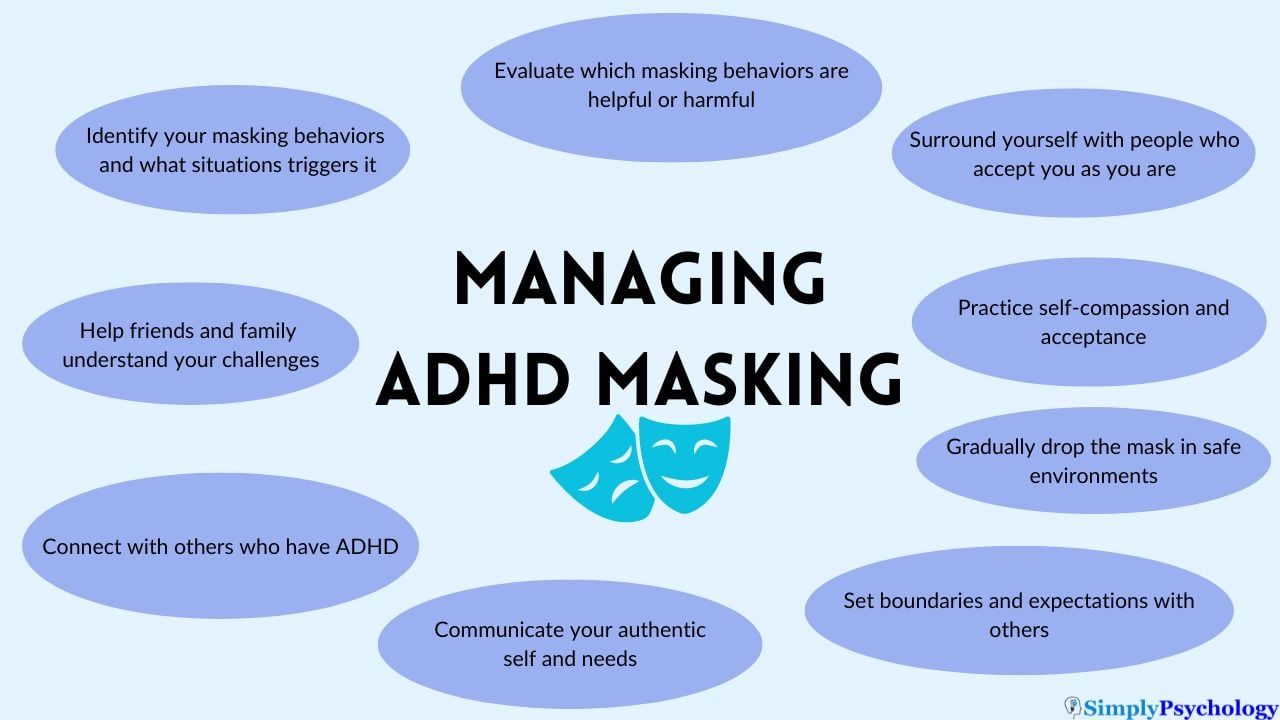
Identify the masking behaviors
Recognizing masking behaviors linked with ADHD is the first step in dealing with and coping with these behaviors
Is there a difference in how you behave at home in your own company compared to social situations? Do you feel the need to mask who you are with certain people and not others?
These are some questions you may begin thinking over. By identifying masking behaviors for what they are and reflecting on under which circumstances you seem to be engaging in them, you will further understand your neurodiverse traits better.
Separate healthy and unhealthy behaviors
Not all masking behavior is unhealthy, but not all masking behavior is healthy, either.
Reflect on your actions and identify which masking behaviors are not helping you live authentically. Examples include hiding stress or masking your need to fidget. Then separate what helps you progress from what may worsen the situation.
“I am continuing to learn what does and doesn’t work for me regarding medication and behavior modification. It’s a journey and sometimes, quite frankly, it’s a pain in the butt. But it’s so worth it.”
‘Ellen’ diagnosed with ADHD in her 50s.
Work on emotional regulation
Emotional dysregulation and inability to control feelings can be the underlying cause leading to masking for many.
Masking is not the only option. Other strategies can also support someone in social situations.
By working on alternative emotional regulation strategies and healthy coping mechanisms, you can reduce your need for masking and begin a positive journey moving forward using additional methodologies.
Some examples of alternatives are mindfulness, journaling, and engaging in therapy.
Celebrate your strengths and neurodiversity
It’s important to celebrate your own strengths and achievements, giving yourself the self-love and acceptance you deserve.
Educate yourself and others about ADHD, challenge biases, and advocate for policies that support the inclusion and empowerment of individuals with ADHD in all aspects of society.
Wider understanding of ADHD can reduce the pressure to mask. A more accepting world lets those with ADHD thrive as their authentic selves.
“I’m not trying to wear a mask and you know what there’s seven billion people in the world so if they don’t like you somebody will eventually.”
Sonya Barlow, Author (2023)
Consider dropping the mask
If you feel like you are in a safe environment to do so, it might be worth considering dropping the mask.
“The only people I unmasked around were either real friends or real friends who I know also have ADHD. I have plenty of acquaintance-level people I won’t unmask (or at least do my best not to) around & unsafe people including members of my own family.”
‘Rita’
Allowing yourself to both feel and express your emotions and behaviors freely and authentically can help reduce feelings of anxiety, imposter syndrome, and burnout.
“One example for me was hanging out with friends without having something to do while we talk. My friends now know that I listen better if I’m knitting or stitching or even playing a simple game on my phone. So if they see me doing that, they don’t immediately assume I’m “checking out” of the conversation. When I was masking, I felt like I had to keep “normal” amounts of eye contact, and it was miserable and exhausting. It made me not want to be around people at all.”
‘Harriet’
How to Start Unmasking
Beginning the process of unmasking ADHD can be challenging, particularly for those who have been masking their symptoms for a significant portion of their lives.
Dropping the ADHD mask is not as simple as flipping a switch. It’s important to remember that masking is a behavior that has been learned and reinforced over time for many individuals with ADHD. Unmasking is a gradual process that requires time and patience.
Here is a step-by-step guide to help you start your ADHD unmasking journey:
- Reflect on your ADHD masking behaviors: Take time to identify the specific ways in which you mask your ADHD symptoms, such as suppressing fidgeting, forcing yourself to focus on tasks that don’t interest you, or scripting social interactions.
- Identify safe spaces and people: Begin by finding supportive environments and relationships where you feel comfortable being your authentic self. It may be best to start with a trusted friend or family member who understands and accepts your ADHD.
- Set small goals: Start by setting small, achievable goals for unmasking your ADHD, such as allowing yourself to take breaks when needed, openly discussing your ADHD with a trusted friend, or engaging in activities that align with your interests and strengths.
- Reflect on what happened: After each situation where you practice unmasking, consider how it went. Did the other person respond positively? Did they notice or appreciate your authenticity?
- Gradually increase unmasking: As you become more comfortable, gradually increase your ADHD unmasking behaviors in different settings and with more people. Remember to go at your own pace and prioritize your well-being.
- Practice self-compassion: Unmasking ADHD can be emotionally challenging, so it’s crucial to practice self-compassion and be kind to yourself throughout the process. Celebrate your progress and recognize that setbacks are a normal part of the journey.
- Seek support: Don’t hesitate to seek support from friends, family, therapists, or ADHD support groups as you navigate the unmasking process. Remember that you are not alone, and there are many people who understand and appreciate the unique strengths and challenges of ADHD.
Unmasking is a personal journey, and it looks different for everyone. Some people unmask only in certain settings or with specific people. Others feel comfortable unmasking more broadly. The key is to find a balance that feels safe and authentic.
No trial has yet tested unmasking in ADHD, so this advice rests on indirect evidence and clinical reasoning. In a Norwegian survey, young adults reported the least masking around others who shared their diagnosis (Wurth et al., 2025). That suggests safer settings may reduce it.
Medical students also described settings where being open about ADHD carried real risk (Godfrey-Harris & Shaw, 2023). That is why choosing where to drop the mask matters.
Selective masking is common and often useful. Sustained masking with nowhere to drop it goes with worse wellbeing. How to reduce the second without losing the first has not been tested.
Key Takeaways
- Definition: Masking is hiding, suppressing or working around ADHD traits to fit in and avoid judgment.
- Why people mask: The wish to belong, fear of rejection and environments that penalize ADHD behavior.
- Costs: Many report exhaustion and a weaker sense of self, but research has not shown that masking causes this.
- Benefits: Masking can help people feel safer and more included in some settings.
- Verdict: Supported with qualifications – adults who have ADHD report masking-like effort, but prevalence and cause remain untested.
- Unmasking: Dropping the mask gradually, in safe settings, is common advice. No trial has tested it in ADHD.
References
Adamou, M. (2026). Camouflaging in ADHD: The need for construct validation before clinical adoption. The British Journal of Psychiatry. https://doi.org/10.1192/bjp.2026.10577
Babinski, D. E., & Libsack, E. J. (2025). Adult diagnosis of ADHD in women: A mixed methods investigation. Journal of Attention Disorders, 29(3), 207-219. https://doi.org/10.1177/10870547241297897
Barkley, R. A. (2020). Taking charge of ADHD: The complete, authoritative guide for parents. Guilford Publications.
Barlow, S. (Presenter). (2023, July 25). BBC Presenter: I’m Finally Being My Authentic Self – Sonya Barlow [Video]. https://www.youtube.com/watch?v=6AdH54tniiY
Chung, W., Jiang, S. F., Paksarian, D., Nikolaidis, A., Castellanos, F. X., Merikangas, K. R., & Milham, M. P. (2019). Trends in the prevalence and incidence of attention-deficit/hyperactivity disorder among adults and children of different racial and ethnic groups. JAMA network open, 2(11), e1914344-e1914344.
Giblett, M. J., Lind, P. A., & Medland, S. E. (2026). Autism traits, ADHD symptoms, and stigma as predictors of social camouflaging in adults from the Australian ASD and ADHD study. Research in Neurodiversity, 2, Article 100047. https://doi.org/10.1016/j.rin.2026.100047
Godfrey-Harris, M., & Shaw, S. C. K. (2023). The experiences of medical students with ADHD: A phenomenological study. PLOS ONE, 18(8), e0290513. https://doi.org/10.1371/journal.pone.0290513
Grimell, J., Ericson, M., & Frick, M. A. (2025). Identity work among girls with ADHD: Struggling with Me and I, impression management, and social camouflaging in school. Frontiers in Psychology, 16, Article 1591135. https://doi.org/10.3389/fpsyg.2025.1591135
Hoza, B., Mrug, S., Gerdes, A. C., Hinshaw, S. P., Bukowski, W. M., Gold, J. A., Kraemer, H. C., Pelham, W. E., Wigal, T., & Arnold, L. E. (2005). What aspects of peer relationships are impaired in children with attention-deficit/hyperactivity disorder? Journal of Consulting and Clinical Psychology, 73(3), 411-423. https://doi.org/10.1037/0022-006X.73.3.411
Jorgenson, C., Lewis, T., Rose, C., & Kanne, S. (2020). Social camouflaging in autistic and neurotypical adolescents: A pilot study of differences by sex and diagnosis. Journal of Autism and Developmental Disorders, 50, 4344-4355.
Katzman, M. A., Bilkey, T. S., Chokka, P. R., Fallu, A., & Klassen, L. J. (2017). Adult ADHD and comorbid disorders: clinical implications of a dimensional approach. BMC psychiatry, 17, 1-15.
Keys, Z., Kieran, A., & Burns, S. (2025). “You are all on motorbikes and I’m on a bicycle”: Exploring the retrospective school experiences of females with ADHD through a systemic lens. Emotional and Behavioural Difficulties, 30(4), 231-249. https://doi.org/10.1080/13632752.2025.2505829
Kobylarczyk-Kaczmarek, M. (2026). Camouflaging and self-esteem in neurodivergent women: A cross-sectional comparison across autism, ADHD, and dual diagnosis. Research in Autism, 138, Article 203023. https://doi.org/10.1016/j.reia.2026.203023
Lai, M. C., Lin, H. Y., & Ameis, S. H. (2022). Towards equitable diagnoses for autism and attention-deficit/hyperactivity disorder across sexes and genders. Current Opinion in Psychiatry, 35(2), 90-100.
McGill, L., Jardim-Lalor, I., & O’Connor, C. (2026). A systematic review of lived experiences of receiving a diagnosis of ADHD in adulthood. Journal of Attention Disorders, 30(10), 1274-1289. https://doi.org/10.1177/10870547261455946
Meinzer, M. C., Lewinsohn, P. M., Pettit, J. W., Seeley, J. R., Gau, J. M., Chronis‐Tuscano, A., & Waxmonsky, J. G. (2013). Attention–deficit/hyperactivity disorder in adolescence predicts onset of major depressive disorder through early adulthood. Depression and Anxiety, 30(6), 546-553.
Mylett, M. L., Boucher, T. Q., & Iarocci, G. (2026). “I wish I could just be myself”: Experiences of social camouflaging in adults with ADHD. Research in Neurodiversity, 2, Article 100018. https://doi.org/10.1016/j.rin.2026.100018
Quinn, P. O., & Madhoo, M. (2014). A review of attention-deficit/hyperactivity disorder in women and girls: uncovering this hidden diagnosis. The primary care companion for CNS disorders, 16(3), 27250.
Rogers, D. C., Dittner, A. J., Rimes, K. A., & Chalder, T. (2017). Fatigue in an adult attention deficit hyperactivity disorder population: A trans-diagnostic approach. British Journal of Clinical Psychology, 56(1), 33-52. https://doi.org/10.1111/bjc.12119
Sarenius, A. (2022). Masking: The Constant State of Seeking and Becoming.
Schatz, D. B., & Rostain, A. L. (2006). ADHD with comorbid anxiety: a review of the current literature. Journal of Attention disorders, 10(2), 141-149.
Sowislo, J. F., & Orth, U. (2013). Does low self-esteem predict depression and anxiety? A meta-analysis of longitudinal studies. Psychological bulletin, 139(1), 213.
Taurines, R., Schwenck, C., Westerwald, E., Sachse, M., Siniatchkin, M., & Freitag, C. (2012). ADHD and autism: differential diagnosis or overlapping traits? A selective review. ADHD Attention Deficit and Hyperactivity Disorders, 4, 115-139.
van der Putten, W. J., Mol, A. J. J., Groenman, A. P., Radhoe, T. A., Torenvliet, C., Agelink van Rentergem, J. A., & Geurts, H. M. (2024). Is camouflaging unique for autism? A comparison of camouflaging between adults with autism and ADHD. Autism Research, 17(4), 812-823. https://doi.org/10.1002/aur.3099
Wicherkiewicz, F., & Gambin, M. (2026). Relations between social camouflaging, life satisfaction, and depression among Polish women with ADHD. Journal of Autism and Developmental Disorders, 56(7), 2875-2883. https://doi.org/10.1007/s10803-024-06410-6
Wurth, P., Fuermaier, A. B. M., Strand, A. H., & Thorell, L. B. (2025). Diagnosis acceptance, masking, and perceived benefits and challenges in adults with ADHD and ASD: Associations with quality of life. Frontiers in Psychiatry, 16, Article 1668780. https://doi.org/10.3389/fpsyt.2025.1668780
Young, S., Adamo, N., Ásgeirsdóttir, B. B., Branney, P., Beckett, M., Colley, W., Cubbin, S., Deeley, Q., Farrag, E., Gudjonsson, G., Hill, P., Hollingdale, J., Kilic, O., Lloyd, T., Mason, P., Paliokosta, E., Perecherla, S., Sedgwick, J., Skirrow, C., … Woodhouse, E. (2020). Females with ADHD: An expert consensus statement taking a lifespan approach providing guidance for the identification and treatment of attention-deficit/hyperactivity disorder in girls and women. BMC Psychiatry, 20, Article 404. https://doi.org/10.1186/s12888-020-02707-9