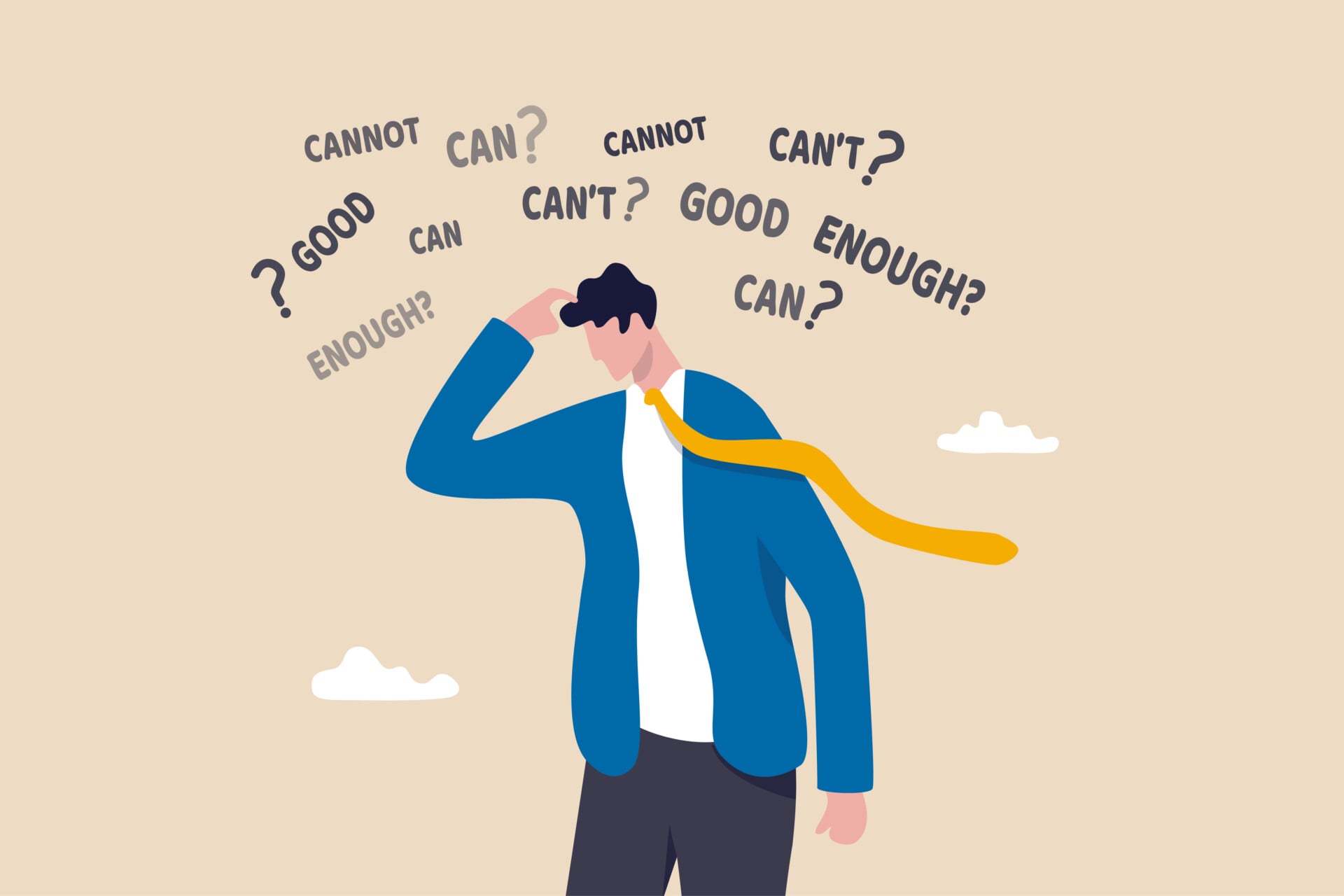
Have you ever told yourself:
“I don’t belong here.”
“I am fooling everyone.”
“I’m a total fraud, and everyone’s going to find out.”
“What am I doing?”
You’re not alone if you have ever felt like an imposter at what you do or at work. These thoughts are related to imposter syndrome, which is not a clinical diagnosis.
No one knows exactly how common these feelings are. A systematic review found estimates ranging from 9% to 82%, depending on the questionnaire and cutoff used (Bravata et al., 2020).
What Is Imposter Syndrome?
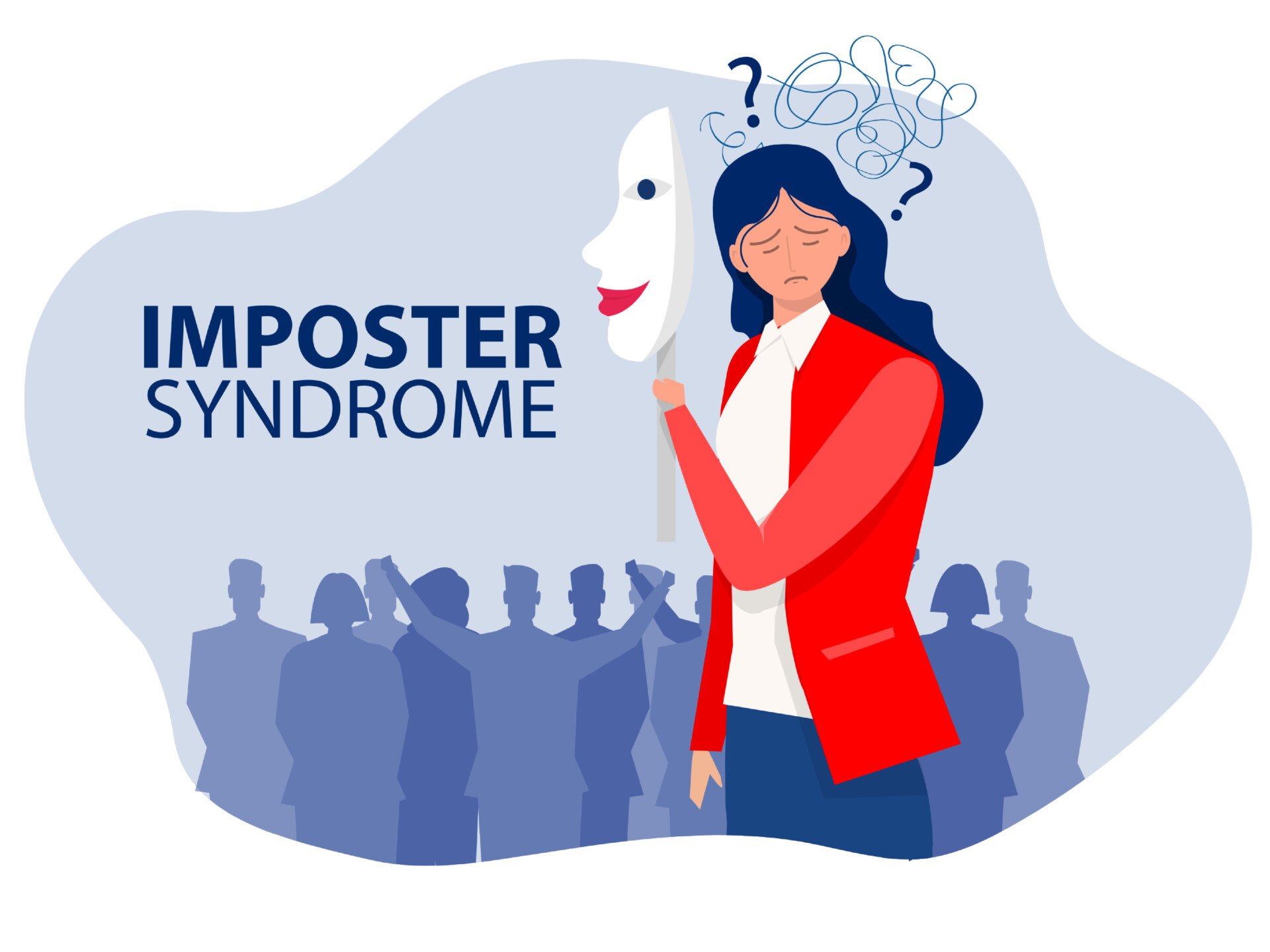
- Definition: Imposter syndrome, also called the imposter (or impostor) phenomenon or perceived fraudulence, is the feeling of being a phony who is less competent than others think.
- Core Fear: Despite objective success in education or work, people feel fraudulent and inadequate, struggle to internalize their achievements, and fear being found out.
- Who Is Affected: It can affect anyone, from a first-year college student to the most successful CEO, though high achievers report it more often.
- Gender: First described in high-achieving women (Clance & Imes, 1978), it affects men and women at comparable rates (Bravata et al., 2020).
- Duration: Many people feel it briefly, such as when entering a new role, but for others the experience can be lifelong.
- Not a Diagnosis: It does not appear in the main diagnostic manuals (the DSM and ICD), and researchers debate whether “syndrome” is the right word.
What it Feels Like
Imposter feelings reflect a mismatch between how you see yourself and how others see you. Others praise your talents, yet you credit your successes to “timing” or “good luck.” You don’t believe you earned them on merit. You worry others will eventually realize the same thing.
A person with impostor syndrome has:
- A sense of being a fraud
- Difficulty internalizing their success
- Fear of being discovered
And while, for some, the impostor syndrome can drive feelings of motivation to achieve, it typically comes at a cost in the manner of ongoing anxiety. One might over-prepare or work much harder to “make sure” that nobody discovers one is a fraud.
Hence, you pressure yourself to work harder to:
- Become deserving of roles you believe you don’t deserve
- Ease feelings of remorse over “tricking” people
- Keep others from recognizing your failures
- Make up for what you deem your lack of intelligence
The work you put in can keep you in this cycle forever. Your additional accomplishments don’t comfort you. In fact, you consider them nothing more than the product of your efforts to preserve the illusion of your success.
The recognition you earn is labeled as pity or sympathy, and even though you link your accomplishments to luck, you take full responsibility for any mistakes you make. Minor errors reinforce your lack of ability.
Unfortunately, this fuels a cycle of guilt, anxiety, and depression over time.
You live in constant fear of discovery. So you strive for perfection in everything you do. When you can’t achieve your goals, you might feel worthless, overwhelmed, and burnt out from your continued efforts.
What Causes Imposter Syndrome?
Clance and Imes (1978) proposed that two family dynamics, along with societal expectations, contribute to imposter feelings in high-achieving women from an early age.
Their account drew on about five years of therapy with more than 150 high-achieving women. It is a clinical hypothesis, not a tested causal model.
- The woman is viewed as the “sensitive” one in the family, while a sibling is deemed the “intelligent” one. Despite her academic success, her achievements are dismissed, leading her to doubt her abilities.
- The woman is praised excessively and told she can achieve anything with ease. When she faces difficulties, she concludes she must be an impostor since she doesn’t live up to this unrealistic standard.
1. Sensitive One
In this scenario, the family labels the woman the “sensitive” or socially adept one. A sibling or close relative is designated the “intelligent” one.
Family members imply that, whatever she achieves, she can never prove herself as bright as her sibling.
She believes this family myth to some extent. She also wants to disprove it. School becomes her chance to demonstrate her intelligence to her family and herself.
Her results are outstanding: top grades, academic honors, and praise from teachers. Her family remains unimpressed. They still credit the “bright” sibling with greater intelligence, even if that sibling’s academic performance is inferior.
This leads her to doubt her intellect. She wonders if her achievements are due to her sensitivity to teachers’ expectations, her social skills, and her feminine charms. Not her intelligence.
She becomes trapped in a cycle of seeking validation for her intellectual competence while secretly doubting herself. This perpetuates the impostor phenomenon.
2. Excessive Praise
The second family dynamic involves excessive praise and unrealistic expectations.
Here, the family constantly conveys that the girl is superior in every way: intellect, personality, appearance, and talents. They tell her she can achieve anything with ease. They recount examples of her precocity as an infant and toddler.
As she grows, she inevitably meets difficulties. She realizes she cannot effortlessly excel at everything.
Even so, she feels pressured to fulfill her family’s expectations and maintain the illusion of perfection.
She begins to doubt her abilities and her parents’ perceptions of her. When she enters school, these doubts intensify. She performs exceptionally well, yet she has to study to achieve good results.
Her parents defined intelligence as “perfection with ease.” She has internalized that definition. So she concludes that she must be unintelligent, because she doesn’t meet that unrealistic standard.
Some women, as children, would pretend to be sick to avoid revealing their imperfections. Others hid their studying from parents who believed that truly intelligent people don’t need to study.
These strategies convinced their parents of their effortless success. Internally, they felt like phonies.
This family dynamic lays the foundation for the impostor phenomenon. Societal expectations and stereotypes about women’s intellectual abilities can further worsen the girl’s self-doubt.
Imposter Syndrome in Women and Men
Clance and Imes (1978) first described imposter feelings in high-achieving women. Later research shows the experience is not limited to women. Context matters as much as gender.
The Original Study: Clance and Imes (1978)
Clance and Imes drew on roughly five years of individual and group psychotherapy with more than 150 high-achieving women. They were undergraduates, doctoral students, professionals, and university faculty who had earned degrees, professional recognition, and the respect of colleagues. By any outside measure, they had succeeded.
Despite this, the women shared a cluster of features. They felt no internal sense of accomplishment. They credited their achievements to luck, hard work, errors in other people’s judgement, or personal charm. They feared being “found out.”
The authors argued that group work helps, because people discover that other visibly successful individuals feel the same way.
The paper was a clinical account, not an experiment. The sample was small, self-selected (people already in therapy), and exclusively female. There was no comparison group and no standardized measure, because no imposter scale yet existed. It is the origin of a construct, not proof of one.
Do Women Experience It More?
The measurement evidence says no. Studies using imposter scales found no consistent gender difference in self-reported imposter feelings among students, professors, and professionals. A systematic review of 62 studies concluded that imposter feelings are common in both men and women (Bravata et al., 2020).
The original emphasis reflected who walked into the clinic. Every one of Clance and Imes’s clients was a woman who had sought therapy.
Clance herself came to accept this. Slate’s 2016 feature reports that she acknowledged the phenomenon is not gendered, contrary to her original theory (Anderson, 2016).
Where men appear less affected, it may reflect a greater reluctance to disclose such feelings.
Lived accounts make the experience concrete. Graduate students interviewed by gradPSYCH, the American Psychological Association’s magazine, describe it in their own words. William Somerville recalled thinking, “what gives me the right to be here?” (Weir, 2013).
Discrimination and Minority Status
Imposter feelings are not only personal. For people from marginalized groups, they are bound up with their environment. The systematic review found prevalence was particularly high among ethnic-minority groups (Bravata et al., 2020).
Cokley et al. (2017) surveyed US ethnic-minority undergraduates, including African American, Asian American, and Latino/a students. They measured perceived discrimination, imposter feelings, anxiety, and depression.
Imposter feelings acted as both a mediator and a moderator of the link between discrimination and mental health. A mediator helps explain how one thing affects another. A moderator changes how strong the link is. The pattern differed by group, and minority-status stress and imposter feelings compounded one another.
The study has limits. It was cross-sectional and self-report, so the direction of cause is uncertain.
Even so, it suggests that treating imposter feelings purely as a personal flaw misses their social context.
Frederick Hives, another gradPSYCH interviewee, describes a related pressure. He was raised to believe he would need to “work twice as hard to be half as good” (Weir, 2013). For some people, the sense of not belonging cannot be separated from the signals an environment sends.
How it Affects Your Life
Regardless of the different types of imposters, all of the symptoms associated with imposter syndrome can affect these aspects of a person’s life.
Work Performance and Career Progression
One may fear that their coworkers and supervisors expect more from them than they can manage. This person may feel unable to deliver.
Fear of not succeeding, or of doing things the wrong way, can make them hold themselves back from higher achievements. This affects work performance.
Undervaluing their skills can lead people with imposter syndrome to negate their worth. As a result, they may avoid aspiring to a promotion or a raise because they do not believe they deserve it.
They may also focus heavily on smaller, more manageable tasks instead of taking on more duties to prove their abilities. They fear compromising their other duties.
Imposter feelings are also linked to lower job satisfaction among professionals (Vergauwe et al., 2015). In organizations, imposter dynamics can stop people from speaking up or claiming credit. Because leaders and high performers are far from immune, this matters for retention and progression.
Job Dissatisfaction and Burnout
Sometimes, one may not feel sufficiently challenged in their profession.
But fear of failure, or of a coworker finding out they are fake, stops them from pursuing a promotion or extra responsibility.
Burnout is a real risk. This state of physical and emotional exhaustion, linked to chronic stress at work, can follow years of working to overcome feelings of inadequacy.
A systematic review found a link. Imposter feelings went with burnout, lower job satisfaction, and impaired job performance, including among clinicians (Bravata et al., 2020).
Research suggests that people with impostor syndrome tend to remain in their roles because they do not believe they can achieve higher. The person may underestimate their skills or fail to acknowledge how other positions might emphasize their abilities.
Self-Doubt
Success creates a cycle of self-doubt for people with imposter syndrome. Imposters, even when achieving a significant milestone, may be unable to recognize their accomplishments.
Rather than celebrate their achievements, this person may worry that others will discover the truth of their abilities.
Clance (1985) described how this self-doubt becomes a self-reinforcing cycle. It starts with an achievement-related task.
Faced with a task that will be evaluated, the person feels anxious and doubts themselves. They respond in one of two ways: over-preparing, or procrastinating and then rushing at the last minute.
Either route usually brings success and positive feedback, which gives brief relief. Then the success is discounted.
After over-preparing, they credit the outcome to sheer effort. After procrastinating, they credit luck.
Because the success is explained away, it never counts as evidence of ability. The belief that they are not really competent survives intact. Self-doubt, guilt about “deceiving” others, and fear of future exposure grow, and the next task restarts the loop.
Attributing Success to External Factors
Imposters deny their competency; they feel their successes are due to external factors or luck. But when things go wrong due to outside reasons, the person may actually blame themselves.
In attribution theory terms, this is an attributional style. It is a habitual way of explaining the causes of outcomes.
People high in imposter feelings credit good outcomes to external, unstable, uncontrollable causes. Examples include luck, an easy task, or ordinary effort.
Shortfalls get the opposite treatment. They are blamed on internal, stable causes, such as a lack of true ability.
This is close to the mirror image of the self-serving bias. It also resembles the pessimistic explanatory style seen in depression and learned helplessness.
Success never becomes evidence of competence. By placing the causes of their achievements outside themselves, imposters deny themselves any stable, internal reason for confidence.
Focus on Tasks/Goal-Setting
The fear of failure and the drive to be the best can sometimes lead to overachievement. The imposter may set highly challenging goals and experience heavy disappointment when they cannot achieve them.
Mental Health Impact
The fear of not being adequate enough can lead to mental health complications in some cases. One may experience:
- Frustration
- Depression
- Fear of being a fraud
- Lack of self-confidence
- Anxiety
- Shame
Imposter feelings rarely travel alone. A systematic review of 62 studies found that they often co-occur with depression and anxiety (Bravata et al., 2020).
They also overlap strongly with personality. In two samples of working professionals, they were strongly related to low emotional stability, or high neuroticism, a tendency toward negative emotion. They were more modestly related to low conscientiousness (Vergauwe et al., 2015).
Perfectionism and fear of failure tend to rise alongside imposter feelings, while self-esteem tends to fall.
The evidence is mostly cross-sectional. So the direction of cause is unclear. Imposter feelings may feed anxiety and depression, result from them, or share common roots with them.
Why is the impostor phenomenon so difficult to overcome?
Three things make the impostor phenomenon very challenging for high-achieving women to overcome. They are seeking external validation, facing negative societal consequences for confidence, and being trapped in an exhausting cycle of fear and hard work.
- Engaging in intellectual inauthenticity: Many women tell superiors what they want to hear instead of revealing their true opinions (“intellectual flattery”). They never learn whether their authentic views would be judged sensible, which feeds feelings of phoniness.
- Using charm to win approval: Some women use friendliness, humor, and perceptiveness to win over mentors. Even when praised, they discount it, believing it reflects those attributes rather than intellect. This reinforces the belief that they lack real intelligence.
- Facing negative consequences of displaying confidence: Successful or independent women are sometimes viewed as hostile forces in society, with their femininity called into question. Fear of rejection leads some to maintain a sense of being an intellectual phony.
- Engaging in a self-reinforcing cycle: Fear of being discovered as “stupid” drives women to work hard and use cover-up strategies. Good performance and approval bring temporary good feelings that keep the cycle going. Some come to believe that thinking they can succeed will lead to failure. Maintaining the notion of not being bright lets them avoid societal rejection somewhat.
Five Types of Imposters
Author and speaker Valerie Young (2011) described five recurring types of imposters, which she called competence types.
The five types are a descriptive framework, not an empirically validated taxonomy. They were not derived from factor-analytic or longitudinal research, so they work best as a heuristic for recognizing your own internalized rule about competence.
These competence types reflect one’s inner beliefs about what competency means to them. Let’s take a closer look at them.
In brief, the five types are:
- The Natural Genius: judges competence by ease and speed, so struggling or not mastering something on the first try feels like proof of inadequacy.
- The Perfectionist: sets excessively high goals and, on falling slightly short, fixates on the flaw rather than the achievement.
- The Soloist: believes that needing help signals incompetence, so insists on doing everything alone.
- The Superhero: ties self-worth to excelling in every role at once, such as work, parenting, partnership, and community.
- The Expert: believes they must know everything before a task counts, and fears being exposed as inexperienced.
1. The Natural Genius
This imposter spent their life picking up new skills with little to no effort. They believe they should understand new material and methods in record time. They set themselves lofty goals and feel crushed when they don’t succeed on their first try.
They believe competent people can handle anything with little difficulty. When they begin to struggle, they can feel like a fraud.
If something doesn’t come easily or fails on the first try, they might feel ashamed and embarrassed.
2. The Perfectionist
This type of imposter focuses on how they do things. They are perfectionists, demanding flawless performance from themselves in every aspect of their lives.
Perfection isn’t a realistic goal, so they can’t meet these standards. Instead of acknowledging the hard work they put in after achieving something, they might criticize themselves for tiny mistakes. They may feel ashamed of their supposed failure.
This imposter might even avoid new things if they believe they can’t do them perfectly the first time.
3. The Soloist (or Rugged Individualist)
These imposters tend to be very individualistic and prefer to work alone. They believe they should handle everything alone. If they cannot succeed independently, they feel unworthy.
Self-worth often stems from their productivity, so they tend to reject offers of help. The imposter sees asking for help as a sign of weakness.
Asking someone for help, or accepting support when offered, means failing their own high standards. It also means admitting their inadequacies. They present themselves as a failure.
4. The Superhero
These imposters link competence to their ability to succeed in every role they hold: employee, parent, student, or friend. In their opinion, failing to meet the demands of all these roles proves their inadequacy.
To succeed, they feel they must push themselves to the limit in every role. Even then, the imposter feelings may persist.
They might think they should be able to do more. They might also think it should be easier.
5. The Expert
This imposter has to learn everything there is to know about the focused topic before considering their work a success. They may spend so much time pursuing more knowledge that their primary task suffers.
Even though they are often highly skilled, they underrate their expertise.
They believe they should have all the answers. So they may regard themselves as a fraud when they can’t answer a question or encounter knowledge they previously missed. They are never satisfied with their level of understanding.
How to deal with imposter syndrome
Most experts do not consider imposter syndrome a mental illness. It also does not appear in the DSM or ICD, the main diagnostic manuals.
There is no easy treatment regimen for it either. A systematic review that searched the literature up to May 2018 found no published study evaluating any treatment for imposter feelings (Bravata et al., 2020).
The strategies below are therefore expert-recommended approaches, not proven cures. They usually combine mindfulness with behavioral and cognitive strategies, such as noticing how you explain your successes.
The aim is not a cure but a lasting shift in how you interpret your own success. People with imposter syndrome can focus on self-reflection and mindfulness of their thinking. Several different tactics can be involved.
Reframe one’s thoughts
It helps to be mindful of one’s beliefs and emotions. Notice the automatic habit of crediting success to luck or effort, and challenge it. Practice accepting evidence of competence as evidence of competence.
For example, one receives a raise but feels distressed or guilty because they don’t believe they deserved it. One can go back and analyze why they hold this belief, and examine whether it is valid.
Question one’s self
Every time one has a negative thought about their capabilities or wonders if they’re suitable for a job, pause and ask: is the thought actually accurate?
Is this emotional experience authentic, or am I responding based on outside variables? Does this thinking help or restrain me?
Embrace success
It can be irresistible to invalidate even the most minor win if one has imposter syndrome. Resist this urge by listing every triumph and permitting them to resonate emotionally.
Over time, this technique will give you a realistic picture of your achievements and help prove your self-worth.
The list works because it gives you durable evidence. Set it against the internal story that you are a fraud. Include accomplishments, positive feedback, and challenges you have mastered.
Talk it out
Whether it’s a friend, mentor, or therapist, it is wise to talk to someone else about these feelings. Acquiring an outside perspective can shake irrational beliefs and ground oneself back in reality.
Group settings can be especially powerful. In their original clinical work, Clance and Imes (1978) found that hearing visibly successful peers admit the same fears directly contradicts the belief that one is uniquely a fraud.
Practice self-compassion
Mindfulness-based approaches, including mindfulness-based cognitive therapy (MBCT), are often suggested for imposter feelings. They aim to cultivate a kinder, less self-critical stance toward oneself.
The idea is to help people reflect on their feelings and foster more compassionate, productive ways of connecting to themselves. Whether this reduces imposter feelings has not yet been tested.
Critical Evaluation of Imposter Syndrome
Experts disagree about whether imposter syndrome is a distinct condition at all. Most of the evidence is self-report, and the research has real limits.
Is It a Syndrome? The Central Debate
Imposter syndrome is a descriptive construct built from clinical observation. It is not a recognized diagnosis and does not appear in the DSM or ICD.
Kolligian and Sternberg (1991) asked directly whether an “imposter syndrome” exists. They built the Perceived Fraudulence Scale. They tested it in young adults. Perceived fraudulence emerged as a coherent experience with two dimensions: inauthenticity and self-deprecation.
But it correlated so heavily with depression, anxiety, low self-esteem, and perfectionism that the data did not support a distinct syndrome. It looked like a continuous dimension of self-experience.
The authors chose the neutral term “perceived fraudulence” to avoid implying a syndrome.
Feenstra et al. (2020) challenged the individual-deficit framing. Their conceptual argument is that the label locates the problem inside the person.
Yet feeling that you do not belong can be a reasonable reading of an unwelcoming or biased environment. That is especially so when you are one of very few people like you in a field. They argue for a person-in-context view. Interventions should target environments as well as individuals.
Defenders reply that a recognizable, distressing pattern exists, that naming it helps people, and that usefulness does not require a DSM entry. Both can be true. Imposter feelings are real and worth addressing. Imposter syndrome as a discrete disorder is not established.
Measurement and Prevalence
Everything empirical depends on how imposter feelings are measured, and the scales do not fully agree.
The first instrument, the Harvey Imposter Phenomenon Scale (Harvey & Katz, 1985), was criticized for poor discriminant validity. It did not reliably separate imposter feelings from low self-esteem.
The Clance Imposter Phenomenon Scale (CIPS; Clance, 1985) is now the most widely used. It has 20 items. A total above about 62 is commonly taken to indicate frequent, intense imposter feelings.
Mak et al. (2019) systematically reviewed the available scales. The CIPS had the strongest psychometric support. But the scales define the construct differently, its dimensionality is disputed, and validation across cultures is thin.
So prevalence figures from different studies are not directly comparable.
A 2025 meta-analysis of 30 studies and 11,483 health-service providers reported a pooled prevalence of 62% (Salari et al., 2025). Brauer and Proyer (2026) reanalyzed the same data with six published cutoff conventions. They got estimates from 11.6% to 63.8%.
Their conclusion is not “pick a better cutoff.” Imposter feelings are theorized as a continuous dimension. So any cutoff-based percentage answers a question the construct was never built to answer.
Real Self-Doubt or Impression Management?
Some sceptics suggest that imposter talk is a strategy. Lowering expectations cushions failure and makes success look more impressive. Leary et al. (2000) tested this in three studies.
In the first, participants completed imposter measures, rated themselves, and indicated how they thought others regarded them. High imposters showed low self-appraisals and low reflected appraisals.
In the second, participants were told they were expected to perform better or worse than they had predicted. They then reacted either anonymously or publicly. High imposters voiced lower performance expectations than low imposters only when responses were public.
That points to a self-presentational component: some impression management. Yet the researchers concluded that people may experience true feelings of impostorism. The characteristics attributed to imposters are partly interpersonal behaviors designed to minimize the implications of poor performance.
Contemporary Research
The strongest evidence is a systematic review, which sits near the top of the evidence hierarchy.
Bravata et al. (2020) searched Medline, Embase, and PsycINFO from 1966 to May 2018. Two investigators independently screened studies and extracted data. In total, 62 studies of 14,161 participants met the inclusion criteria.
Prevalence ranged from 9% to 82%, depending largely on the screening tool and cutoff. It was particularly high among ethnic-minority groups. Imposter feelings were common in both men and women.
They often co-occurred with depression and anxiety. They were associated with impaired job performance, lower job satisfaction, and burnout. No published study evaluated any treatment.
The authors noted that the studies were heterogeneous and publication bias may be present.
Three further threads point the same way:
- Context: Cokley et al. (2017) and Feenstra et al. (2020) link imposter feelings to discrimination and unwelcoming environments.
- Personality: In working adults, Vergauwe et al. (2015) found a strong overlap with neuroticism.
- Measurement: Mak et al. (2019) and Brauer and Proyer (2026) show that scales and cutoffs make cross-study comparisons unreliable.
Overall, research is moving away from imposter syndrome as a discrete disorder affecting a fixed share of high achievers. It points toward a common, dimensional experience that overlaps with anxiety and neuroticism, is amplified by discrimination, and has no evidence-based treatment.
Takeaway
Multiple people experience symptoms of impostor syndrome at some point in their lives. It is crucial to remember that perceptions do not always mirror reality.
Emphasize that success does not demand perfection. Real perfection is virtually impossible, so failing to achieve it does not define you as a fraud.
Ways of overcoming imposter syndrome include talking about fears and questioning negative thoughts. Maintaining a record of achievements and celebrating successes can be truly valuable.
Be kind to yourself. Kindness and understanding, rather than judgment and self-doubt, help you keep a practical perspective and pursue wholesome self-growth.
References
Anderson, L. V. (2016, April 12). Feeling like an impostor is not a syndrome. Slate. https://slate.com/business/2016/04/is-impostor-syndrome-real-and-does-it-affect-women-more-than-men.html
Brauer, K., & Proyer, R. T. (2026). Matters arising from Salari et al. (2025): Why it is (currently) impossible to estimate accurate prevalence rates of the impostor phenomenon. BMC Psychology, 14(1), Article 934. https://doi.org/10.1186/s40359-026-04987-4
Bravata, D. M., Watts, S. A., Keefer, A. L., Madhusudhan, D. K., Taylor, K. T., Clark, D. M., Nelson, R. S., Cokley, K. O., & Hagg, H. K. (2020). Prevalence, predictors, and treatment of impostor syndrome: A systematic review. Journal of General Internal Medicine, 35(4), 1252–1275. https://doi.org/10.1007/s11606-019-05364-1
Clance, P. R. (1985). The impostor phenomenon: Overcoming the fear that haunts your success. Peachtree Publishers.
Clance, P. R., & Imes, S. A. (1978). The imposter phenomenon in high achieving women: Dynamics and therapeutic intervention. Psychotherapy: Theory, Research & Practice, 15(3), 241–247. https://doi.org/10.1037/h0086006
Cokley, K., Smith, L., Bernard, D., Hurst, A., Jackson, S., Stone, S., Awosogba, O., Saucer, C., Bailey, M., & Roberts, D. (2017). Impostor feelings as a moderator and mediator of the relationship between perceived discrimination and mental health among racial/ethnic minority college students. Journal of Counseling Psychology, 64(2), 141–154. https://doi.org/10.1037/cou0000198
Feenstra, S., Begeny, C. T., Ryan, M. K., Rink, F. A., Stoker, J. I., & Jordan, J. (2020). Contextualizing the impostor “syndrome.” Frontiers in Psychology, 11, Article 575024. https://doi.org/10.3389/fpsyg.2020.575024
Harvey, J. C., & Katz, C. (1985). If I’m so successful, why do I feel like a fake? The impostor phenomenon. St. Martin’s Press.
Kolligian, J., Jr., & Sternberg, R. J. (1991). Perceived fraudulence in young adults: Is there an “imposter syndrome”? Journal of Personality Assessment, 56(2), 308–326. https://doi.org/10.1207/s15327752jpa5602_10
Leary, M. R., Patton, K. M., Orlando, A. E., & Wagoner Funk, W. (2000). The impostor phenomenon: Self-perceptions, reflected appraisals, and interpersonal strategies. Journal of Personality, 68(4), 725–756. https://doi.org/10.1111/1467-6494.00114
Mak, K. K. L., Kleitman, S., & Abbott, M. J. (2019). Impostor phenomenon measurement scales: A systematic review. Frontiers in Psychology, 10, Article 671. https://doi.org/10.3389/fpsyg.2019.00671
Robinson A. (2017). Overcoming imposter syndrome.
Sakulku J, et al. (2011). The imposter phenomenon.
Salari, N., Hashemian, S. H., Hosseinian-Far, A., Fallahi, A., Heidarian, P., Rasoulpoor, S., & Mohammadi, M. (2025). Global prevalence of imposter syndrome in health service providers: A systematic review and meta-analysis. BMC Psychology, 13(1), Article 571. https://doi.org/10.1186/s40359-025-02898-4
Vergauwe, J., Wille, B., Feys, M., De Fruyt, F., & Anseel, F. (2015). Fear of being exposed: The trait-relatedness of the impostor phenomenon and its relevance in the work context. Journal of Business and Psychology, 30(3), 565–581. https://doi.org/10.1007/s10869-014-9382-5
Weir, K. (2013, November). Feel like a fraud? gradPSYCH, 11(4). American Psychological Association. https://www.apa.org/gradpsych/2013/11/fraud
Young, V. (2011). The secret thoughts of successful women: Why capable people suffer from the impostor syndrome and how to thrive in spite of it. Crown Business.
Further Reading
- Is the imposter phenomenon affecting your mental health? Try Pauline Rose Clance, PhD’s Imposter Scale and find out.
- Bravata, D. M., Watts, S. A., Keefer, A. L., Madhusudhan, D. K., Taylor, K. T., Clark, D. M., … & Hagg, H. K. (2020). Prevalence, predictors, and treatment of impostor syndrome: a systematic review. Journal of General Internal Medicine, 35(4), 1252-1275.
- Sakulku, J. (2011). The impostor phenomenon. The Journal of Behavioral Science, 6(1), 75-97.
- Langford, J., & Clance, P. R. (1993). The imposter phenomenon: Recent research findings regarding dynamics, personality and family patterns and their implications for treatment. Psychotherapy: theory, research, practice, training, 30(3), 495.
- Weir K. Feel like a fraud?. American Psychological Association. 2013.