Do you often assume your partner is angry when they’re quiet, or fear the worst after a minor disagreement?
This is common in relationships, and the way we think may be to blame. Our minds sometimes play tricks on us through cognitive distortions, which are like mental “filters” that twist how we interpret a partner’s words and actions.
This skewed thinking can create confusion, conflict, and emotional distance in even the strongest relationships.
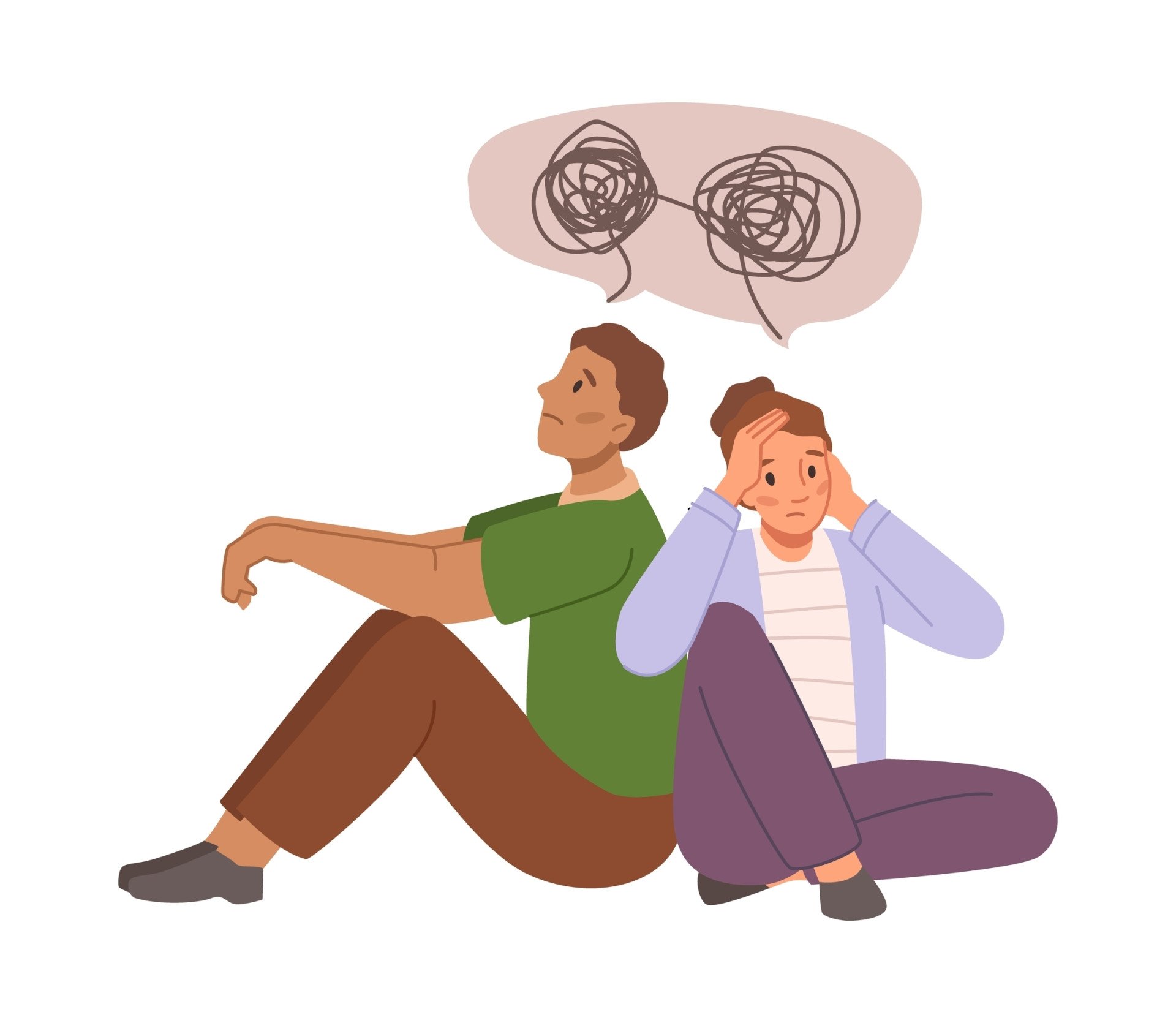
It’s understandably frustrating to feel like you’re constantly overreacting or being misunderstood. These habits can change. By learning about these distorted thinking patterns, you can start recognizing and defusing them.
With a supportive approach, you and your partner can replace these habits with clearer, calmer ways of thinking and communicating.
Cognitive distortions are unhelpful, automatic patterns of thought that distort reality, leading us to perceive situations in an inaccurate, often negative way.
Common Cognitive Distortions in Relationships
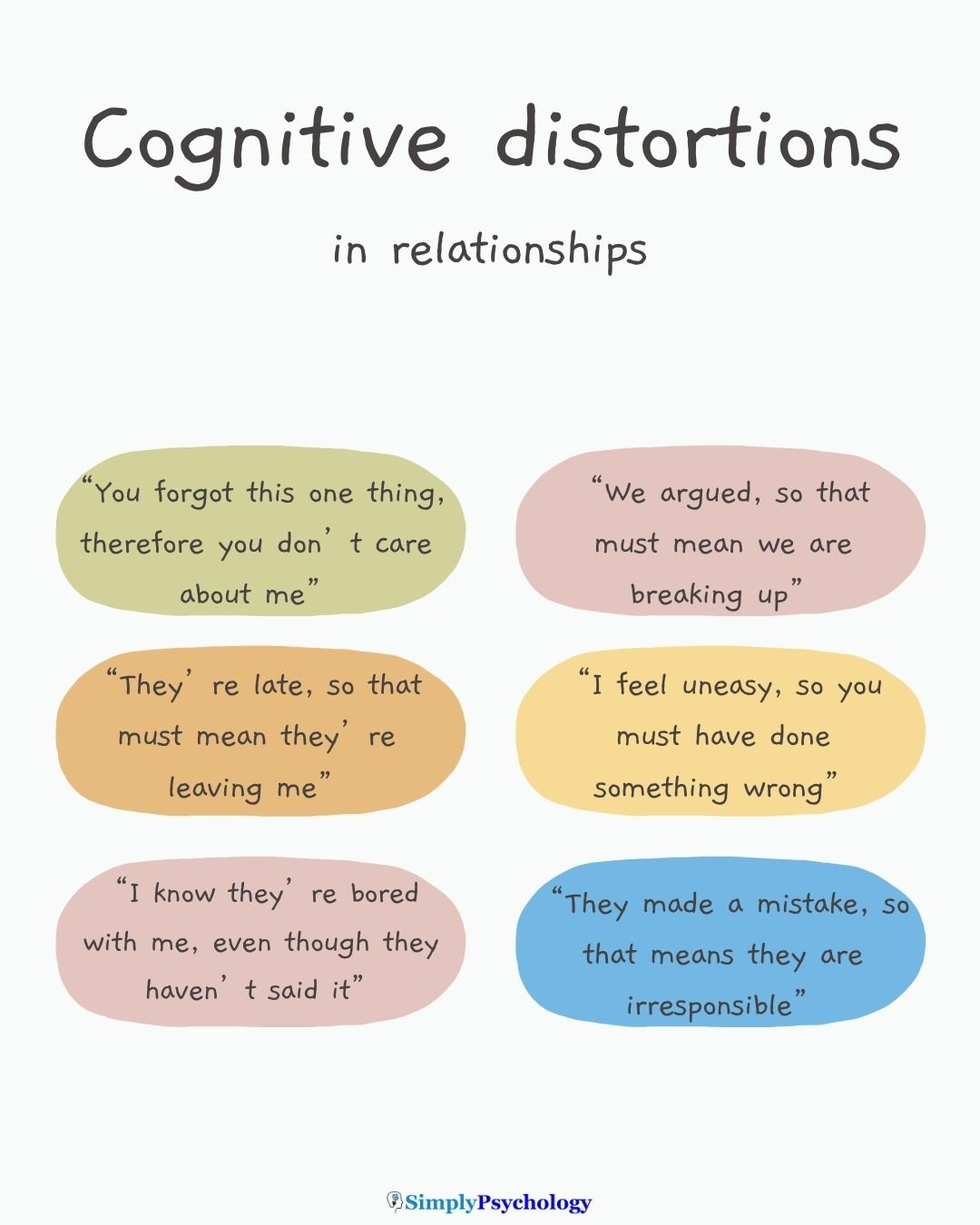
Below are eight common cognitive distortions in romantic relationships, with examples of how they show up and why they are unhelpful.
1. All-or-Nothing Thinking (Black-and-White Thinking)
This distortion involves seeing things in extremes, with no middle ground: either something is perfect or terrible.
- Relationship Example: If your partner forgets one small promise, you conclude, “They never follow through on anything!” (ignoring all the times they do).
- Why It’s Unhelpful: This rigid mindset oversimplifies complex people. It sets unrealistic standards, so every minor mistake feels like a complete failure and fuels disappointment. Your partner becomes either “always supportive” or “never there for me.”
2. Overgeneralization
Overgeneralization means drawing a broad, sweeping conclusion from one or two events. You take a single negative experience and assume it represents an unchangeable pattern.
- Relationship Example: “We had an argument last weekend, so I guess we’re always going to fight; maybe I’ll never have a happy relationship”. Or, one partner makes a mistake and the other thinks, “Yup, that’s how you’ll always be”.
- Why It’s Unhelpful: This distortion eats away at trust by turning one incident into “proof” of how things will always be. It breeds relationship pessimism and makes the benefit of the doubt hard to give.
3. Catastrophizing
Catastrophizing is when your mind jumps to the worst-case scenario and blows things way out of proportion.
- Relationship Example: If your partner is late to one dinner, you might think, “They must not care about me at all. What if this ruins our entire relationship?”. A minor disagreement spirals into “This is it, we’re going to break up”.
- Why It’s Unhelpful: It intensifies anxiety and panic over events that don’t warrant them, causing overreactions that strain the connection. Constantly expecting doom creates needless tension and can stifle the spontaneity and trust a healthy relationship needs.
4. Personalization
Personalization involves taking things personally and blaming yourself for events that aren’t your fault, or conversely, unfairly blaming your partner for things beyond their control. It’s an “it’s all because of me” mentality.
- Relationship Example: You might think, “They seem distracted tonight. I must have done something wrong,” or “My partner is in a bad mood; it has to be because I didn’t do enough”.
- Why It’s Unhelpful: This creates unwarranted guilt and defensiveness. If one partner always assumes “it’s my fault” or “you meant to hurt me,” honest communication suffers and resentment grows. Not everything your partner does is about you. Sometimes they’re just having a tough day.
5. Mind Reading
Mind reading is a distortion where you assume you know what someone else is thinking or feeling without actual evidence.
- Relationship Example: “I can tell they’re bored with me,” or “I know they’re attracted to that person at work, even though they haven’t said it”. You might not ask your partner what’s on their mind because you’ve already convinced yourself you “just know”.
- Why It’s Unhelpful: Mind-reading leads to huge misunderstandings. These assumptions are often just your own projected thoughts. When you act on unverified assumptions, it creates communication barriers and mistrust, making your partner feel unfairly accused.
6. Emotional Reasoning
This distortion means believing, “If I feel it, it must be true”. Your emotions become evidence of reality, even when facts don’t line up.
- Relationship Example: “I feel jealous and insecure, so my partner must be doing something untrustworthy,” or “I’m really upset; therefore, you obviously wronged me”.
- Why It’s Unhelpful: Our emotions, especially in heated moments, do not always reflect our partner’s actual intentions or the real situation. Emotional reasoning fuels conflict by overriding rational thinking; we stop looking at evidence and act solely on our feelings.
7. Filtering (Mental Filtering/Discounting the Positive)
Mental filtering means focusing only on the negative parts of an experience and filtering out all the positive aspects.
- Relationship Example: You dwell on the one criticism your partner voiced and ignore the ten compliments they gave. You zero in on “They forgot to take out the trash” and overlook that they cooked you dinner.
- Why It’s Unhelpful: This distortion creates a skewed view in which nothing is ever good enough. Positive actions get dismissed and problems get magnified. Over time, filtering erodes joy and appreciation and leaves your partner feeling unacknowledged.
8. Labeling
Labeling is a form of overgeneralization where you assign a fixed, negative label to someone (or yourself) based on one instance or trait.
- Relationship Example: Instead of saying, “My partner forgot to pay the bill this month,” labeling would say, “My partner is so irresponsible and selfish”. Common labels thrown out during conflicts might be “She’s crazy,” or “He’s selfish”.
- Why It’s Unhelpful: It oversimplifies and dehumanizes your partner. Once we apply a nasty label, we treat the person in line with it and stop seeing their good qualities, which fuels anger and erodes empathy. The antidote: no one is defined by a single moment.
Where Do These Thought Patterns Come From?
Cognitive distortions don’t emerge out of nowhere. Several factors contribute to developing these thinking habits.
Past Experiences and Trauma
If you’ve been through trauma or abandonment, you might have learned to expect danger or rejection.
This can cause you to brace for the worst in new relationships, leading to catastrophizing or mind-reading.
The brain creates these distorted interpretations as a protective reflex. It tries to “protect” you by assuming the worst.
Your brain is reacting to old scars, not necessarily your partner’s actual behavior.
Attachment theory offers the most developed explanation. Early bonds with caregivers shape an internal working model, a mental template for what to expect from close relationships.
When that model is insecure, it acts as a lens for reading a later partner’s behavior. Under stress, catastrophizing or mind reading becomes the path of least resistance.
Anxiety or Depression
People with anxiety disorders or depression are frequently affected by distorted thinking.
Anxiety can make you hyper-vigilant and prone to jumping to negative conclusions, while depression can tint everything in a negative light.
Beck (1976) identified a cognitive triad in depressive thinking. It combines negative views of the self, the world, and the future. Applied to a partner, it can turn a quiet evening into evidence that you are unloved and that nothing will change.
Rumination (repetitive negative thinking) reinforces these distortions, which are characteristic of conditions like generalized anxiety, major depression, and even post-traumatic stress.
Learned Family Dynamics
If your parents handled disagreements with blame, pessimism, or black-and-white statements, you likely absorbed those cognitive habits.
For example, a child whose family jumped to worst-case conclusions (“This is a disaster!”) may unconsciously mirror that catastrophizing in adult relationships.
These learned distortions can feel “normal,” but understanding you inherited a script gives you the power to rewrite it.
Personality Traits or Disorders
Certain personality types and disorders are associated with more distorted thinking. Individuals with Borderline Personality Disorder (BPD), for instance, often experience extreme all-or-nothing thoughts (sometimes called “splitting”). A deep-seated fear of abandonment drives this.
Likewise, traits like perfectionism can feed distortions, such as all-or-nothing thinking (“Anything less than perfect means I’m a failure”).
Knowing the role of personality or neurodivergence can promote self-compassion, allowing you to manage the tendency rather than view it as a personal failing.
What Research Says About Distorted Thinking in Couples
These thinking errors are more than pop psychology. They rest on decades of research into how partners interpret each other.
From Beck’s Theory to Couple Cognition
Aaron Beck (1976) argued that distress comes less from events than from the meaning the mind automatically assigns to them.
These automatic thoughts are shaped by deeper beliefs called schemas. Beck (1988) applied the idea to couples.
He argued that partners often mistake their own interpretation of an act for the act itself. Burns (1980) later popularized the list of distortions covered above.
Baucom and colleagues (1989) then described five kinds of thinking that shape how partners see each other:
- Selective Attention: what each partner notices or overlooks, which decides what evidence is even available.
- Attributions: the causes a partner assigns to the other’s behavior.
- Expectancies: predictions about how the partner or relationship will behave in future.
- Assumptions: general beliefs about what partners and relationships are like.
- Standards: beliefs about what a relationship and its members should be like.
Several distortions above map onto these categories. Mind reading is an unverified attribution, and catastrophizing is a distorted expectancy.
Mental filtering reflects selective attention. All-or-nothing thinking is usually a rigid standard applied without exceptions.
How Partners Explain Each Other’s Behavior
An attribution is the reason you give for why your partner did something. Researchers describe it along three dimensions: internal or external, stable or unstable, and global or specific.
Bradbury and Fincham (1990) reviewed the marital research and found two contrasting patterns.
- Distress-Maintaining: negative behavior is blamed on stable character (“He’s forgetful; that’s just who he is”), and kindness is explained away (“She only wanted something”).
- Relationship-Enhancing: negative behavior is excused as situational (“She snapped because work was awful”), and kindness is credited to character (“He’s just a caring person”).
Labeling, and personalization that blames a partner, are the distress-maintaining pattern in action.
The habit itself matters, not just the behavior. It helps explain why some relationships stay resilient through the same conflicts that erode others. Bradbury and Fincham called this link one of the most robust in the marital literature.
Do Distorted Thoughts Cause Unhappiness?
A link does not show which comes first. Fincham and Bradbury (1987) tested this by following married couples for twelve months.
Wives’ initial attributions for relationship problems predicted their satisfaction a year later. Initial satisfaction did not predict later attributions.
Later work added a twist. Karney and Bradbury (2000) tracked newlyweds across several assessments.
Attributions proved partly stable and partly responsive to satisfaction. Changes in attributions predicted later changes in satisfaction more strongly than the reverse.
A larger study followed 483 newlywed couples for four years. Lavner and colleagues (2017) measured marital problems rather than attributions.
Problems and satisfaction predicted each other. Early on, satisfaction predicted later problems more strongly. By year four, only problems predicted later satisfaction.
Together, these studies suggest a vicious cycle. Distorted thinking can erode satisfaction, and dissatisfaction can breed more distorted thinking. Changing thoughts matters, but it is unlikely to be the whole answer.
Why Context Matters
Nguyen and colleagues (2020) asked whether the link holds for every couple.
They studied 462 newlywed spouses (231 couples) living on low incomes in Harris County, Texas. Over 30% were Black and over 50% were Latinx. Marriages averaged under five months.
In home-based assessments, each spouse reported on attributions for relationship problems and on relationship satisfaction. Researchers also measured financial strain, and the financial resources and married couples in each spouse’s social network.
Maladaptive attributions again went with lower satisfaction. But the link was stronger for spouses, particularly wives, whose social networks had fewer financial resources and fewer married couples. Couples’ own financial strain did not change the link in the same way.
In other words, the same distorted thought may do more damage when a couple has less support. The study was cross-sectional. It shows an association, not a cause.
Signs Cognitive Distortions Are Affecting Your Relationship
How do you know if cognitive distortions are at play? Look for these common signs:
- Blow-Ups Over Small Issues: Frequent conflict over trivial things (a misplaced towel, a delayed text) is a red flag that one or both of you are perceiving more in the situation than is really there.
- Constantly Feeling Misunderstood or Walking on Eggshells: If your partner “just doesn’t get” what you’re saying, or one of you is always treading carefully to avoid upsetting the other, distortions are likely creating a communication barrier.
- Negative Assumptions Drive Your Reactions: Notice if you often react based on assumptions about what your partner meant or feels, rather than what they actually said or did.
- Difficulty Seeing Your Partner’s Perspective: When distortions run rampant, your own narrative, usually a negative one, dominates, making it hard to empathize. You might start viewing your partner as the villain during disagreements.
- Frequent Anxiety about the Relationship’s Status: You constantly doubt the relationship because of internal fears rather than your partner’s actions. If any disagreement leaves you fearing a breakup (“this is it, we’re doomed”), that’s likely catastrophic thinking playing tricks on you.
If you notice these patterns, don’t panic; they’re clues that your mindset might need adjusting. By spotting them, you can begin to address the root cause (the distorted thoughts) rather than just the surface arguments.
How to Recognize and Challenge Cognitive Distortions
Tackling cognitive distortions is a process, but with practice, you can train your brain to think in more balanced ways. These practical steps may help:
1. Catch the Distortion
Start by identifying your negative thought patterns.
A thought journal or log can help you jot down distressing incidents, what you thought, and what you felt, which reveals patterns.
Simply catching yourself (e.g., noticing, “I’m labeling him right now” or “There I go catastrophizing this issue”) is a huge first step.
When you put a name to the pattern, it becomes easier to distance yourself from it.
2. Challenge the Thought
Once you spot a distorted thought, question it. Treat it like a hypothesis rather than truth.
Ask yourself: “What’s the evidence for this thought? What’s the evidence against it?”.
For example, take the thought “My partner doesn’t care about me.” List evidence on both sides:
- Evidence for: They forgot something important once.
- Evidence against: They show care in many other ways.
You’ll often find the negative thought is an exaggeration or not 100% accurate.
3. Replace with a Balanced Thought
After poking holes in the distorted thought, reframe it to something more balanced and realistic. This is not forced “positive thinking,” but a fairer outlook.
- Original Distortion: “My partner doesn’t care about me” (Personalization/Labeling).
- Balanced Thought: “I’m upset that they forgot, but I know they’ve been caring in other ways. It’s likely an oversight, not a sign they don’t love me”.
By consciously swapping in a more reasonable thought, you teach your brain a new pattern, which can seriously reduce your stress and reactivity.
4. Reality-Check with Your Partner (Communicate)
Distortions thrive in silence and assumptions. A powerful way to challenge them is to open up gentle communication with your partner about what you were thinking, after you’ve calmed down.
Use a calm, non-blaming tone and “I” statements. For example: “I felt insecure when you didn’t say much at dinner, and my mind told me you were annoyed with me. Is that what you were feeling?”.
Checking in like this allows your partner to share their actual perspective, often defusing the distortion. By reality-testing your thoughts, you reinforce more accurate thinking.
Rebuilding Healthy Thinking and Communication
Challenging distortions paves the way for a stronger relationship. These five supportive practices help foster clearer thinking and closer connection:
- Pause Before Reacting: take a short breather so a distorted thought does not drive a knee-jerk reply.
- Reflective Listening: paraphrase what your partner said to confirm you understood it.
- Subjective Realities: accept that both partners’ views can be real and valid, even when they differ.
- “I” Statements: frame concerns from your own perspective to avoid triggering defensiveness.
- Reconnection and Reassurance: repair after a misunderstanding with an apology or reassuring words.
Pause Before Reacting
When emotions run high, take a breather.
This could mean counting to ten or stepping away for a short cool-down. Pausing prevents knee-jerk reactions driven by distorted thoughts.
If you feel a surge of anger, stop. Give yourself a moment to ask, “Is it possible I’m misreading this?”. A productive conversation is much easier once both people are calmer.
Couples therapist Esther Perel, author of Mating in Captivity, addresses this in a video answering a viewer’s question about chronic bickering.
As Perel explains, “critical mode” leaves little room for reflection. A partner reacts before asking what the other person meant. The assumption that fills the gap is usually a negative one: that the behavior was meant to hurt.
Perel also warns against “never” and “always” language. Absolute framing, she argues, escalates the conflict and hides what is really going on between two people.
Practice Reflective Listening
Distortions worsen when we assume we know what our partner means.
Counter this with reflective listening. Truly listen to your partner, then paraphrase what they said to check you understood.
For example: “So you were hurt because I didn’t check in about how your day went, did I get that right?”.
This ensures each of you feels heard, and it can reveal if a cognitive distortion was coloring your view.
Accept “Subjective Realities”
In any disagreement, remember that both of you likely have valid perspectives.
Cognitive distortions often tell us there’s only one truth (our own). Instead, approach conflict knowing that your partner’s feelings and views are as real to them as yours are to you, even when they differ.
This is accepting that there can be two “subjective realities”. Embracing this idea moves you away from blame (“You’re wrong, I’m right”). It also invites curiosity (“I see it this way, you see it that way, so what can we learn here?”).
Use “I” Statements and Express Feelings Calmly
When bringing up an issue, frame it from your own perspective to avoid triggering defensiveness.
Say, “I feel upset when X happens,” instead of “You always do X wrong” (which is an overgeneralization/label).
This reduces the chance that your words will be distorted in your partner’s mind as a personal attack.
Observational research supports the point. John Gottman (1994) identified four communication habits that predict relationship breakdown: criticism, contempt, defensiveness, and stonewalling. A distorted thought does the most damage when it surfaces as one of these habits in a real exchange. That is why how you voice a thought matters.
Focus on Reconnection and Reassurance
After working through a misunderstanding, make an effort to reconnect positively.
Explicitly reassure each other, as distortions can leave a residue of doubt. That might mean apologizing for snapping over a false assumption. It might also mean saying, “I appreciate you talking this out with me, I know we’re a team”.
Over time, building a habit of repair and reassurance strengthens trust, reinforcing that a moment of negative thinking is not a sign of doom.
Couple Therapy for Distorted Thinking
The steps above borrow from cognitive-behavioral couple therapy (CBCT). It grew out of behavioral couple therapy by adding direct work on how partners think (Baucom & Epstein, 1990).
A therapist might help a partner test whether a “he never listens” belief survives the evidence.
They might also check whether a standard, such as “a committed partner should want to spend all their free time with the family,” is realistic.
The evidence is encouraging. Fischer and colleagues (2016) reviewed the research and concluded that CBCT and its variants have strong support for treating relationship distress and its effects on health.
One caveat applies: no single ingredient has proved essential.
Adding explicit cognitive restructuring to behavioral therapy did not significantly improve outcomes (Baucom et al., 1990). A large trial found an acceptance-focused therapy performed comparably to more cognitively focused approaches (Christensen et al., 2004).
The strongest evidence favors combined behavioral and cognitive packages over cognitive restructuring alone (Christensen et al., 2004; Fischer et al., 2016).
Key Takeaways
- Definition: Cognitive distortions are automatic, biased thoughts that twist how you read a partner’s words, actions, and silences.
- Common Types: Eight patterns recur in couples: all-or-nothing thinking, overgeneralization, catastrophizing, personalization, mind reading, emotional reasoning, filtering, and labeling.
- Origins: Past trauma, anxiety or depression, family habits, and personality traits can all make these patterns more likely.
- Attributions: Unhappy couples tend to blame negative behavior on stable flaws, while happy couples give each other the benefit of the doubt.
- Vicious Cycle: Distorted thinking and dissatisfaction appear to feed each other, so thoughts matter but are not the whole story.
- Challenge Thoughts: Catch the thought, weigh the evidence for and against it, and reframe it into something balanced.
- Repair: Pausing, reflective listening, “I” statements, and reassurance rebuild trust after a misunderstanding.
References
Baucom, D. H., & Epstein, N. (1990). Cognitive-behavioral marital therapy. Brunner/Mazel.
Baucom, D. H., Epstein, N., Sayers, S. L., & Sher, T. G. (1989). The role of cognitions in marital relationships: Definitional, methodological, and conceptual issues. Journal of Consulting and Clinical Psychology, 57(1), 31–38. https://doi.org/10.1037/0022-006X.57.1.31
Baucom, D. H., Sayers, S. L., & Sher, T. G. (1990). Supplementing behavioral marital therapy with cognitive restructuring and emotional expressiveness training: An outcome investigation. Journal of Consulting and Clinical Psychology, 58(5), 636–645. https://doi.org/10.1037/0022-006X.58.5.636
Beck, A. T. (1976). Cognitive therapy and the emotional disorders. International Universities Press.
Beck, A. T. (1988). Love is never enough: How couples can overcome misunderstandings, resolve conflicts, and solve relationship problems through cognitive therapy. Harper & Row.
Bradbury, T. N., & Fincham, F. D. (1990). Attributions in marriage: Review and critique. Psychological Bulletin, 107(1), 3–33. https://doi.org/10.1037/0033-2909.107.1.3
Burns, D. D. (1980). Feeling good: The new mood therapy. Signet.
Christensen, A., Atkins, D. C., Berns, S., Wheeler, J., Baucom, D. H., & Simpson, L. E. (2004). Traditional versus integrative behavioral couple therapy for significantly and chronically distressed married couples. Journal of Consulting and Clinical Psychology, 72(2), 176–191. https://doi.org/10.1037/0022-006X.72.2.176
Fincham, F. D., & Bradbury, T. N. (1987). The impact of attributions in marriage: A longitudinal analysis. Journal of Personality and Social Psychology, 53(3), 510–517. https://doi.org/10.1037/0022-3514.53.3.510
Fischer, M. S., Baucom, D. H., & Cohen, M. J. (2016). Cognitive-behavioral couple therapies: Review of the evidence for the treatment of relationship distress, psychopathology, and chronic health conditions. Family Process, 55(3), 423–442. https://doi.org/10.1111/famp.12227
Gottman, J. M. (1994). Why marriages succeed or fail. Simon and Schuster.
Karney, B. R., & Bradbury, T. N. (2000). Attributions in marriage: State or trait? A growth curve analysis. Journal of Personality and Social Psychology, 78(2), 295–309. https://doi.org/10.1037/0022-3514.78.2.295
Lavner, J. A., Karney, B. R., Williamson, H. C., & Bradbury, T. N. (2017). Bidirectional associations between newlyweds’ marital satisfaction and marital problems over time. Family Process, 56(4), 869–882. https://doi.org/10.1111/famp.12264
Nguyen, T. P., Karney, B. R., Kennedy, D. P., & Bradbury, T. N. (2020). Couples’ diminished social and financial capital exacerbate the association between maladaptive attributions and relationship satisfaction. Cognitive Therapy and Research, 45(3), 529–541. https://doi.org/10.1007/s10608-020-10161-w
Perel, E. (n.d.). Stop bickering. It’s killing your relationship [Video]. YouTube. https://www.youtube.com/watch?v=xl7AcgjCyLU

