If you’re in a relationship with an overthinker, you may love their depth and sensitivity while also feeling the weight of their constant worry.
Loving an overthinker means caring for someone whose mind rarely rests—someone who replays conversations, imagines worst-case scenarios, and often seeks reassurance when doubt takes hold.

This dynamic can be both rewarding and challenging. Overthinkers are often deeply loyal, empathetic partners who notice the little things, but their spiraling thoughts can bring miscommunication and cycles of conflict that leave you feeling drained.
Supporting an overthinker doesn’t mean sacrificing your own needs — it means responding with patience and clarity while protecting your own wellbeing too.
What Does It Mean to Be an Overthinker?
Overthinkers are people whose minds often stay in overdrive — replaying conversations, imagining many possible futures, and dwelling on “what ifs.”
Common traits include:
- Second-guessing themselves and struggling to make decisions for fear of choosing “wrong”
- Replaying past events and conversations in their heads
- Catastrophizing by imagining worst-case scenarios
- Worrying about what others think, sometimes interpreting neutral signals as negative
- Seeking reassurance to calm uncertainty
- Perfectionistic tendencies, setting high standards and being critical of themselves
These patterns often go hand in hand with anxiety or insecurity: when someone’s sense of certainty or emotional safety feels fragile, overthinking becomes a way to try to gain control.
Crucially, overthinking doesn’t mean the person lacks love or trust — it is often a coping strategy (sometimes unconscious) to reduce uncertainty or avoid hurt, not an accusation or rejection.
The psychology behind overthinking
Overthinking is closely tied to rumination (dwelling on the past) and worry (anticipating the future). These processes can create mental loops that are hard to escape.
For example:
- Replay loops: “What did I say wrong in that conversation?”
- Future worries: “What if they’re upset with me next time?”
- Catastrophizing: “What if this small mistake ruins everything?”
- Endless “what ifs”: constantly imagining unlikely negative scenarios
Anxiety primes the brain to expect threat or rejection, while rumination keeps the mind stuck on potential mistakes. Together, they make it difficult to let go or feel at peace.
How Overthinking Affects Relationships
Overthinking often shapes the rhythm of a relationship in subtle but powerful ways.
Instead of being fully present, an overthinker may become caught in mental loops about what was said, what it meant, or what might happen next.
This constant analysis can create tension, as the overthinker struggles with doubt and the partner feels pressure to provide clarity or reassurance.
Over time, both may experience emotional strain: one from battling their thoughts, the other from feeling drained or unsure how best to help.
Misunderstandings and Miscommunication
- Small triggers, magnified: a delayed message, a tone of voice, or a perceived slight can be blown up into something more serious.
- Reading hidden meaning: overthinkers may read hidden meaning into neutral actions, misinterpret silences, or assume worst-case motives.
- Feeling tested or misjudged: partners may feel like they’re constantly being tested, even when the intent was benign.
- The result: repeated conflict, confusion, or hurt over things neither meant to escalate.
The Need for Reassurance
- Seeking repeated validation: overthinkers often seek repeated validation to calm anxious thoughts or uncertainty.
- The ask-relief-worry-ask-again loop: in the short term, reassurance can bring relief, but it also risks becoming a cycle: asking, relief, new worry, asking again.
- Exhausting for loved ones: partners may feel responsible for soothing the anxiety, which can be exhausting or confusing.
- Risk of dependency: if reassurance becomes overly relied upon, it can undermine trust in one’s own judgment or fuel dependency.
Psychologist James Coyne described this loop in 1976 as a self-defeating spiral, not a character flaw. In his model, a person seeks reassurance to settle a doubt, but because it doesn’t match their underlying worry, they soon doubt it and ask again.
Over repeated cycles, the reassuring partner grows weary.
That tiredness is easy to pick up on, and it can read as fresh evidence that something is wrong, feeding another round of asking.
A study of college roommates by Joiner, Alfano, and Metalsky found that excessive reassurance-seekers were rated as more irritating and rejection-worthy by the people they lived with. That held true even after accounting for how depressed they were, showing reassurance-seeking carries its own cost, apart from mood.
When Talking It Through Backfires: Co-Rumination
Reassurance-seeking isn’t the only interpersonal pattern that shapes what it’s like to love an overthinker. Psychologist Amanda Rose coined the term co-rumination for repeatedly and extensively discussing the same problem together, dwelling on its causes and consequences rather than moving toward resolution. The pattern cuts both ways.
Rose’s own research found this kind of talking-it-through was a double-edged sword. It was linked to closer, more emotionally connected friendships, but also to more anxiety and low mood, especially among girls.
A 2017 meta-analysis pooling multiple studies confirmed the risk is real, though modest, rather than dramatic.
More recent research narrows this further. Co-rumination is most likely to spread distress from one person to the other in relationships that are already close and emotionally attuned.
Applied to a couple, this means talking a worry through can build intimacy, but doing so without reaching resolution risks pulling the supporting partner into the same anxious spiral.
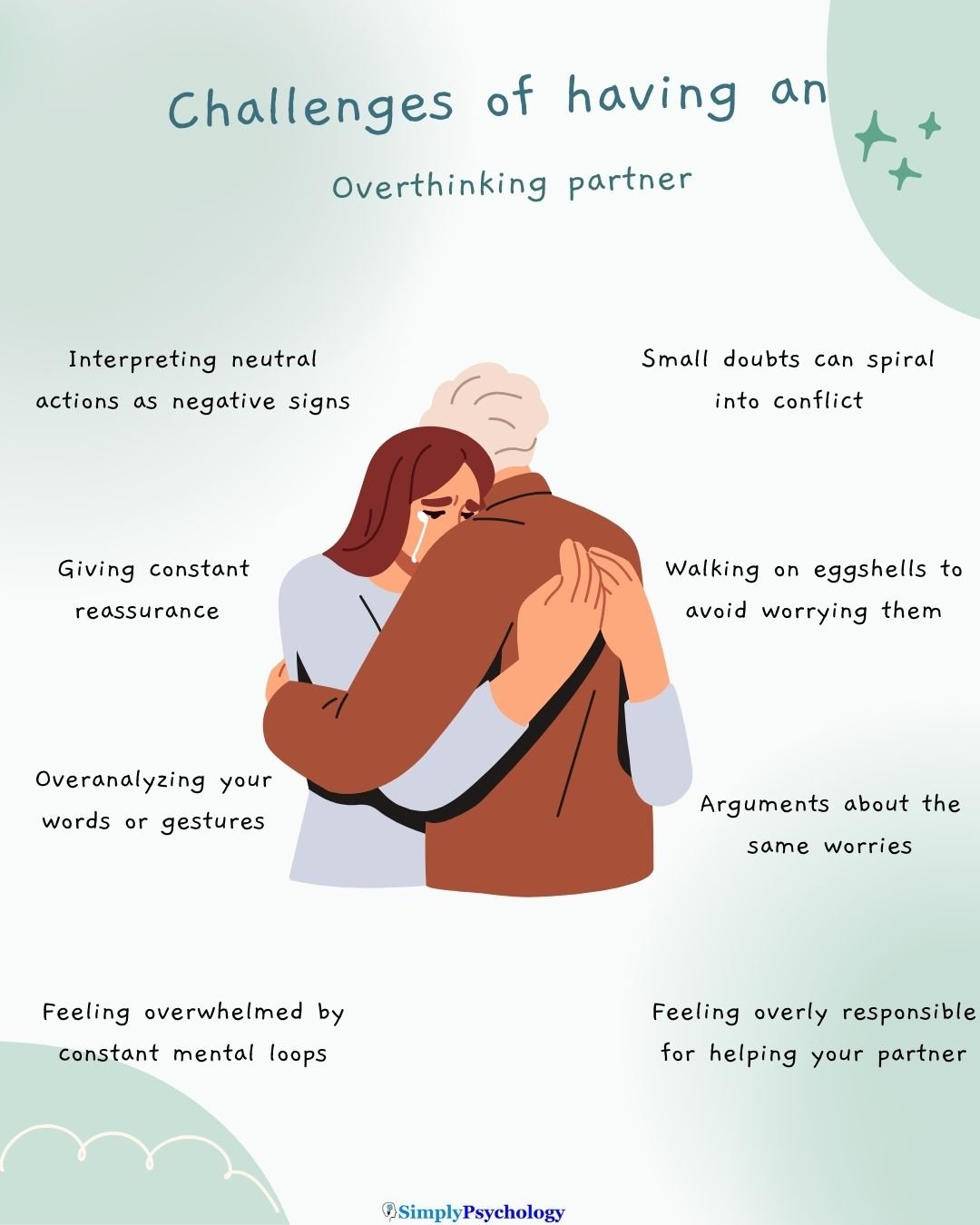
Challenges of Loving an Overthinker
Loving someone who overthinks can strain a relationship in ways that are subtle but cumulative.
The challenges often arise not from lack of love, but from recurring patterns of doubt, hesitation, and emotional tension — for both partners.
Over time, these stressors may erode communication, spontaneity, and feelings of safety, unless they’re recognized and addressed.
Conflict cycles
- Escalating minor doubts: a misread cue can escalate into an argument because the overthinker replays it, reinterprets it, or magnifies the issue.
- A defensive feedback loop: the partner responds defensively, which triggers more overthinking, more doubt, and another conflict.
- The issue outlives itself: the emotional reaction becomes more relevant than the original issue, so the “same” fight recurs even when circumstances change.
- Frustration on both sides: the overthinker feels unheard, and the partner feels they’re repeating apologies that never quite land.
Partner’s experience — feeling drained or walking on eggshells
- Constant anticipation: the partner may find themselves trying to predict what the overthinker will worry about next, moderating what they say or do to avoid triggering anxiety.
- Rising emotional labour: calming fears, giving reassurance, and repeating explanations can exhaust the partner, both mentally and emotionally.
- Walking on eggshells: over time, the partner may feel they’re tiptoeing around issues, compromising their own authenticity to maintain peace.
Trust and decision-making struggles
- Hesitating on milestones: overthinkers may second-guess whether moving in, defining the relationship, or future plans are “safe” or “right.”
- Delayed, revisited choices: decisions others make quickly may be delayed or revisited many times, adding uncertainty.
- Strained trust: trust suffers when one partner feels responsible for settling the other’s doubts, or when decisions feel permanently stalled.
How to Support an Overthinker
Supporting someone who overthinks takes care, patience, and strategy.
The goal is to offer reassurance and stability, while helping them build tools to manage their thoughts — without feeding into spirals of worry or dependence.
Here are some practical ways to balance being supportive and staying grounded.
Amanda Rose, Ph.D. studies this exact pattern. She’s a psychology professor at the University of Missouri.
As she explains, the urge to keep asking “do you really love me?” usually traces back to insecure patterns from early caregiving, not the current partner. In her view, reassurance alone can only meet an anxious partner partway.
Lasting change comes from patient communication, paired with the partner’s own work on where that insecurity began.
Words and Actions That Help
- Validate feelings without necessarily agreeing with every fear. E.g.: “I understand this is worrying you — let’s talk through it together.”
- Reflect back what they say (“What I hear is you’re feeling ___ because of ___”) to show you’re listening.
- Use gently grounding questions: “What evidence do we have?”, “What might be an alternative way to see this?”, or “What would you tell a friend in your shoes?”
- Offer reminders of past instances where their worries turned out okay, to build confidence and counteract catastrophizing.
Real couples describe what this looks like in practice.
Alec, a Dallas-based partner, said: “I know it comes from a place of not feeling safe enough. So in order to be a better boyfriend, I do what I do best: I listen.”
Tia, who described the experience from the overthinking side, said: “I know when I’m overthinking. I usually catch myself doing it. But I still need to reach the end of the thought process sometimes, and my partner does a stellar job at providing me time and space for just that.”
Setting Healthy Boundaries
- Set reassurance times: choose designated “reassurance times” so constant checking-in doesn’t dominate everyday interactions — agree to talk through worries at a specific time rather than at any moment.
- Be transparent about limits: it’s okay to say: “I want to support you, but when we revisit this repeatedly over short periods I feel emotionally drained.”
- Encourage independent coping: journaling, breathing exercises, and mindfulness build self-reliance instead of always rescuing.
Managing Overthinking Triggers in Digital Communication
Much of the ambiguity that fuels overthinking today arrives through text messages, read receipts, and delayed replies. These channels strip out tone and context.
That leaves exactly the kind of unclear cue that can set off a worry spiral. It’s also easy to seek reassurance instantly, such as a follow-up text sent minutes after an unanswered one.
The same boundary-setting principle applies here: agree on realistic response times, and save emotionally loaded conversations for a call or an in-person conversation rather than text.
Encouraging Professional Help
- Therapy (CBT): approaches like CBT are specifically effective at helping people recognize and restructure unhelpful thoughts, reducing rumination or spiraling thought patterns.
- Mindfulness-based practices: mindfulness-based interventions, such as breath work, the “STOP” skill (from DBT), or guided meditations, support staying present instead of being pulled into past or future worries.
- Easing into it: a joint plan to explore a therapist, or trying online resources or self-help CBT tools, can feel less intimidating than jumping straight into formal therapy.
Caring for Yourself While Loving an Overthinker
Loving someone who overthinks often means holding space for a lot of their worry, doubt, and “what ifs.” Over time, without self-care, empathy can turn into exhaustion or resentment.
It’s vital you balance caring for them with caring for yourself—so that your needs are met, your voice is heard, and your emotional wellbeing stays intact.
Otherwise, the relationship may feel one-sided, draining, or even unsustainable.
Healthy Boundaries
- Recognize your emotional, mental, and temporal limits. Know when you feel stretched too thin, triggered, or responsible in ways that aren’t sustainable.
- Communicate these limits clearly and compassionately (“I want to support you, but I need some quiet time,” or “I need to step back when the worry loops are intense”).
- Establish small routines of “you time” for things that recharge you (hobbies, seeing friends, exercise, rest). These aren’t indulgences—they’re necessary to maintain your energy.
- Use boundaries to avoid enabling unhelpful patterns—so reassurance doesn’t become a crutch, and you’re not perpetually in “fix-mode.”
Knowing When to Step Back
- Warning signs: chronic fatigue, anxiety, resentment, or a loss of your own identity or interests can signal the relationship is damaging your wellbeing.
- Ignored boundaries: take note if you feel you’re walking on eggshells regularly, or if your own boundaries are repeatedly ignored.
- Red flags: sleep loss, mood changes, and avoidance of others are signs your emotional health is suffering.
- When to seek help: a therapist, couples therapy, or a support group can offer clarity, build tools, and help you decide how to move forward safely.
The Strengths of Loving an Overthinker
While overthinking can be draining, it also brings unique strengths to a relationship.
Overthinkers tend to love deeply, notice details others miss, and reflect carefully on their words and actions. With the right balance, these qualities create loyalty, empathy, and strong emotional bonds.
This isn’t purely folk wisdom, either. Rose’s (2002) own research found that people who talk problems through this way often report closer relationships, alongside more worry. That gives the idea of overthinking as a relationship strength some genuine research backing.
Depth, Loyalty, and Care
Overthinkers rarely take relationships lightly. Because they think through consequences and meanings, they are often deeply loyal and committed.
Their attentiveness to small details—like remembering what you said in passing or sensing your mood—can feel like a profound form of care.
Empathy and Attentiveness
Many overthinkers are naturally empathetic. They notice subtle shifts in tone or body language and want to respond thoughtfully.
This sensitivity can make them supportive partners who value open communication and emotional connection.
Turning Overthinking into a Shared Strength
When guided constructively, overthinking can be an asset. Imagining different outcomes helps with planning, problem-solving, and anticipating challenges.
Working as a team, couples can transform overthinking from a source of stress into a shared strength that fosters preparedness and mutual growth.
Key Takeaways
- Not a Flaw: overthinking in a partner usually isn’t a lack of love or trust — it’s a coping strategy for reducing uncertainty or avoiding hurt.
- Reassurance Cycle: repeated reassurance-seeking can quietly erode a partner’s patience, which the overthinker often picks up on and reads as more reason to worry.
- Co-Rumination: talking a worry through together can build closeness, but doing so without ever reaching resolution can pull both partners into the same anxious spiral.
- Set Boundaries: designated “reassurance times” and clear limits protect both partners from unstructured, ever-open-ended processing.
- Real Strengths: loyalty, empathy, and attentiveness are genuine assets of loving an overthinker, not just a silver lining.
- Self-Care Matters: supporting a partner well means protecting your own wellbeing too — chronic fatigue or resentment are signs to step back and seek outside help.
References
Bonobology. (n.d.). Dating an overthinker: 15 tips to make it successful. https://www.bonobology.com/dating-an-overthinker/
Coyne, J. C. (1976). Toward an interactional description of depression. Psychiatry, 39(1), 28–40. https://doi.org/10.1080/00332747.1976.11023874
Joiner, T. E., Jr., Alfano, M. S., & Metalsky, G. I. (1992). When depression breeds contempt: Reassurance seeking, self-esteem, and rejection of depressed college students by their roommates. Journal of Abnormal Psychology, 101(1), 165–173. https://doi.org/10.1037/0021-843X.101.1.165
Rose, A. J. (2002). Co-rumination in the friendships of girls and boys. Child Development, 73(6), 1830–1843. https://doi.org/10.1111/1467-8624.00509
Rose, A. (2023, March). Do you really love me? Understanding excessive reassurance-seeking in relationships. Psychology Today, “Between Us” blog. https://www.psychologytoday.com/us/blog/between-us/202303/do-you-really-love-me
Schwartz-Mette, R. A., & Smith, R. L. (2018). When does co-rumination facilitate depression contagion in adolescent friendships? Investigating intrapersonal and interpersonal factors. Journal of Clinical Child & Adolescent Psychology, 47(6), 912–924. https://doi.org/10.1080/15374416.2016.1197837
Spendelow, J. S., Simonds, L. M., & Avery, R. E. (2017). The relationship between co-rumination and internalizing problems: A systematic review and meta-analysis. Clinical Psychology & Psychotherapy, 24(2), 512–527. https://doi.org/10.1002/cpp.2023