Dialectical Behavior Therapy (DBT) is an evidence-based treatment that combines standard cognitive-behavioral techniques for emotion regulation and reality-testing with concepts of distress tolerance, acceptance, and mindful awareness largely derived from Zen Buddhist meditative practices.

Origins
Marsha Linehan developed DBT in the 1980s to help people with suicidal thoughts who often had a diagnosis of borderline personality disorder (BPD).
Linehan trained as a behavior therapist and initially used standard behavioral methods with chronically suicidal clients. The results were often disappointing. She found that a treatment built entirely around changing behavior often backfired.
Clients who had grown up being told their reactions were exaggerated felt a therapist’s push for change as one more voice dismissing their pain. Some became more distressed or dropped out of treatment altogether.
Her solution was to treat acceptance and change as a synthesis, not a choice, borrowing the idea from dialectics.
She also drew on her long-standing Zen meditation practice. This became a secular form of mindfulness, taught years before it became common in psychotherapy (Linehan & Wilks, 2015).
In 2011, Linehan spoke publicly about her own history of severe mental illness. It was the first time she had done so. She described being hospitalised at seventeen during a period of intense self-harm, saying simply: “I was in hell.”
As she has since explained, she made a private vow that once she recovered, she would help others find their own way out of the same suffering. That balance, between accepting pain as real and refusing to be defeated by it, became DBT’s central idea.
Individuals with BPD often experience the following symptoms:
- Experience intense emotions
- Have difficulties with their relationships
- Their actions can be very impulsive
- Their thinking can be very black and white
Thus, DBT was developed to help people with DBT manage these core symptoms by providing them with skills to reach their goals.
This way, people with DBT would know how to respond to challenging situations or manage relationships so that they can have a better quality of life overall.
Biosocial Theory of Emotion Dysregulation
DBT’s explanation for why some people develop this pattern of intense emotion and impulsivity is the biosocial theory.
It holds that the pattern comes from a transaction between biology and environment, not from either one alone (Crowell, Beauchaine, & Linehan, 2009).
Emotional Vulnerability and Invalidating Environments
Emotional vulnerability is the biological half.
It describes a temperament that is highly sensitive to emotional triggers, reacts strongly once triggered, and takes longer than most people’s to return to baseline.
An invalidating environment is the social half, most often a family in which a child’s emotions are dismissed, punished, or labelled “too sensitive” rather than treated as real information.
Overt abuse is not required. Severe childhood adversity, though, is one of the clearest routes into it.
A large meta-analysis found that people who develop borderline personality disorder are far more likely to report childhood adversity than others (Porter et al., 2020).
In the pooled case-control data, they were nearly fourteen times more likely to report it.
Most do not go on to develop the disorder.
The Transaction: How the Two Interact
The transaction is what does the theoretical work.
An emotionally vulnerable child in an invalidating environment never learns to trust their own internal states, because the environment keeps telling them those states are wrong.
Over repeated cycles, the child learns to swing between suppressing real reactions and escalating until someone finally listens.
DBT’s therapeutic dialectic is built to interrupt exactly this cycle, neither invalidating nor simply indulging the distress (Crowell et al., 2009).
This link is not limited to a formal diagnosis.
A large 2026 meta-analysis linked childhood emotional abuse to adult deficits in distress tolerance, emotional clarity, and impulse control, exactly the skills DBT’s modules target (Amini-Tehrani et al., 2026).
Because the underlying studies were mostly cross-sectional, this cannot prove that childhood abuse causes these deficits, only that the two are connected.
Core principles of DBT
The D in DBT, dialectical, relates to two seemingly opposite viewpoints that can be true simultaneously.
Dialectics is a philosophical idea: two seemingly opposing truths, such as needing to accept yourself and needing to change, can both be true at once. DBT applies this in three concrete ways.
Acceptance strategies centre on validation: communicating, clearly and repeatedly, that a client’s emotional responses make sense given their history. A closely related idea is radical acceptance, fully acknowledging painful facts without fighting them, which frees up energy for changing what actually can be changed.
Change strategies come from standard cognitive-behavioural methods. They include tracing the exact chain of events behind a crisis, explicit skills training, and reinforcing helpful behaviour instead of a crisis.
The therapist’s own toolkit for holding this tension together is called dialectical strategies:
- Wise Mind: a synthesis of cool, logical thinking and feeling-driven urgency that neither ignores emotion nor lets it dictate action.
- Devil’s Advocate: the therapist argues against a client’s own stated commitments, to strengthen their resolve to keep them.
- Grain of Truth: looking for the valid point on both sides of a disagreement, rather than declaring one side simply correct.
Dialectical strategies in DBT help the individual and their therapist to get unstuck from extreme positions, balance out viewpoints, and view situations from multiple perspectives to reach a logical viewpoint.
The B in DBT, behavioral, means that DBT aims to adjust behaviors.
During sessions, DBT therapists assess the situations and target behaviors relevant to the client’s goals. This helps them figure out how to solve problems in the client’s life.
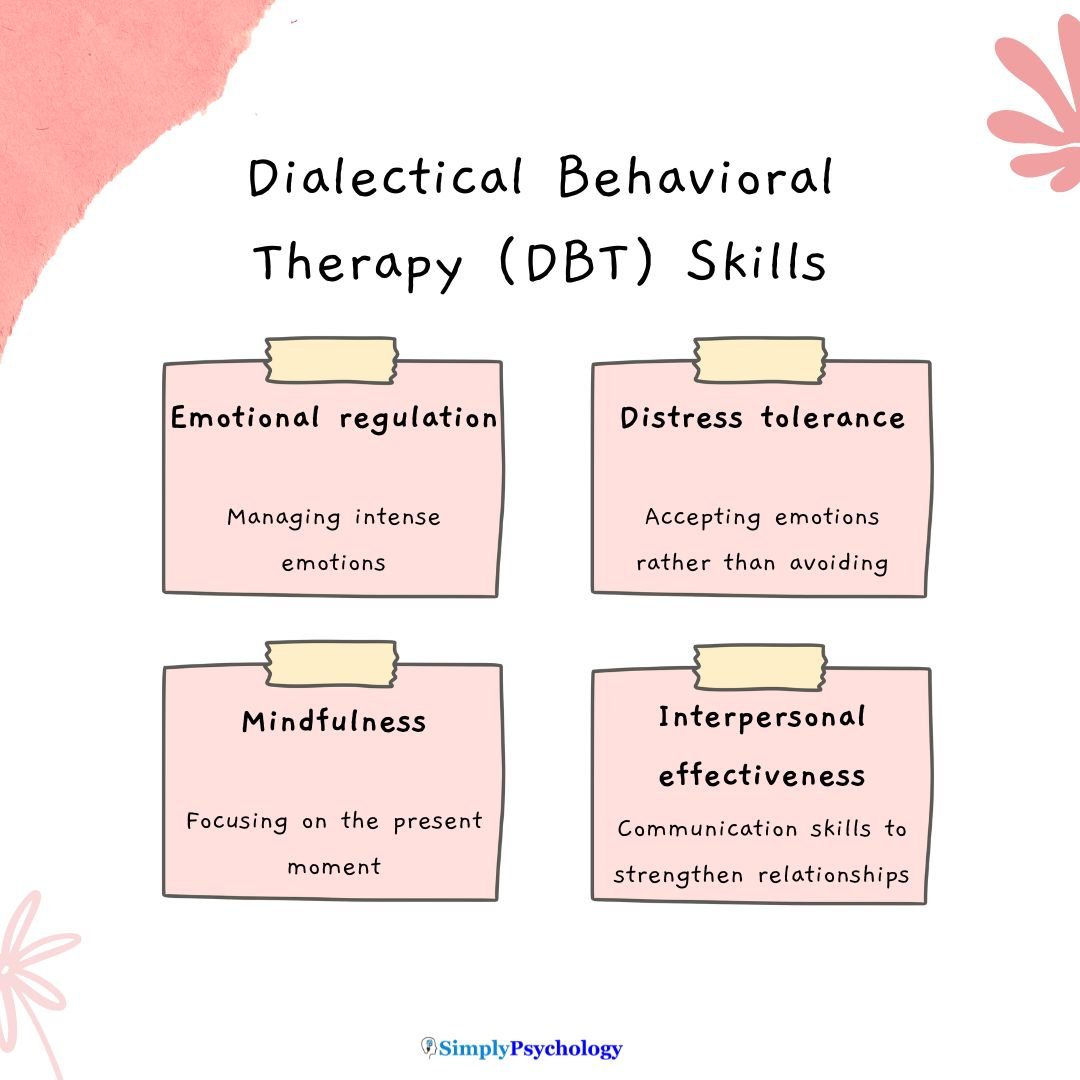
DBT Techniques: The Four Essential Skills
Below are the four skills learned in DBT sessions:
- Mindfulness: staying focused on the present moment, without judgement.
- Emotion Regulation: managing intense emotions so they do not control a situation.
- Distress Tolerance: getting through a crisis without making it worse.
- Interpersonal Effectiveness: communicating needs clearly while respecting others.

1. Mindfulness
The premise of mindfulness is to teach the individual to be focused on the present moment and feel grounded.
This technique is useful for those struggling with an unstable sense of self and/or those with difficulties focusing on the present.
Mindfulness encourages the individual to pay attention to what is happening around them as well as inside, such as their thoughts and feelings.
This foundational skill underpins all the others.
People completing mindfulness will learn to focus on their thoughts in a non-judgemental way and notice any negative thoughts that may arise.
For example, a mindfulness exercise may involve paying close attention to the physical sensations while slowly eating a raisin and noticing any thoughts or feelings that arise. This teaches being present with the current experience.
After focusing on the present moment, the idea is that the automatic negative thoughts are not engaged with, resulting in feeling more settled.
This, therefore, teaches healthy coping skills to those struggling with negative thoughts.
2. Emotion regulation
This technique helps people to learn how to manage their difficult emotions, which may arise, so that the intense emotions they experience do not end up controlling the situation.
For instance, someone might feel mounting anger during a disagreement with a friend. They can pause. Then they take some deep breaths, consciously relax their body, and consider the situation more objectively before responding.
Through emotional regulation, people are taught that they may experience intense emotions, but they can choose how to react to them in a healthy way.
They can also learn to avoid situations that they know will trigger strong emotions, helping them to have more positive emotional experiences overall.
3. Distress tolerance
This technique helps individuals think about helpful things they can do to manage their behavior and emotions. The goal is to avoid acting impulsively or riskily, in ways that could have negative consequences.
For example, when stuck in traffic, rather than getting angry, one can practice distraction by listening to music or imagery by imagining being in a favorite relaxed setting.
This component can help with challenging negative thought patterns. For instance, instead of thinking, ‘It’s not fair,’ they may ask themselves instead, ‘Can I control the situation?’.
If they realize the situation cannot be controlled, they learn to accept it for what it is.
Preparation also matters. This skill helps individuals prepare for intense emotions they may experience. Distraction techniques, such as listening to music or going for a walk, can help decrease feelings of distress.
4. Interpersonal effectiveness
Interpersonal effectiveness aims to teach individuals to communicate in healthy and respectful ways.
To demonstrate interpersonal effectiveness, individuals are often given role-play scenarios to practice assertiveness skills. This may involve refusing an unreasonable request or asking to have a need met appropriately.
Individuals learn to express themselves clearly while respecting others’ boundaries.
This technique can also help build listening skills and conflict resolution skills and help build trust with others, which can be a big issue for those with BPD.
Individuals can also learn to deal with challenging people in a healthy manner, acknowledge others’ thoughts and feelings, and learn to ask for what they need in a clear way.
What to expect in DBT sessions
There are different modes of treatment for DBT, which makes it different from other psychotherapies, which may typically consist of just one mode of treatment.
Each mode of treatment is intended to meet a specific function.
Individual psychotherapy
The function of one-to-one sessions with a therapist is to enhance the individual’s motivation to apply learned DBT skills to specific challenges and events in their lives.
These sessions are usually once a week and run for the duration of the therapy. The clients will be asked to complete homework tasks outside the individual sessions.
One example is the daily ‘diary card.’ Clients use it to track emotions, behaviors, and thoughts.
Another goal is client independence. The therapist helps the client learn to structure their own lives and become their own manager.
The therapist applies dialectical, validation, and problem-solving skills. Validation means communicating, clearly and often, that the client’s emotional reactions make sense given their history. Together, these skills help clients learn to manage their own life challenges.
Group skills training
Group skills training typically runs once a week for two-hour sessions for the duration of the therapy.
Within these sessions, the group will learn skills in the four components of DBT.
As these are in a group setting, the clients have opportunities to interact with others and roleplay scenarios.
The group leaders will also assign homework to aid the clients in practicing the skills they have been taught in their everyday life.
Phone Coaching
Another mode of treatment that is unusual for other therapies for mental health is phone coaching.
This means that the DBT therapist will be available to contact by phone for any incidents where the client may face a challenging moment.
The focus is the skill, not the crisis.
The therapist can give guidance on how to cope with a situation as it is happening. The overall goal of this contact is to coach the client on how to put their DBT skills into practice whenever required.
Consultation Team
DBT also includes a mode most clients never see directly: a therapist consultation team.
This is a standing group of the clinicians delivering DBT, meeting regularly to support one another. Linehan called this “therapy for the therapists.”
Treating chronically suicidal clients is demanding, and the team exists to help clinicians stay both compassionate and balanced, rather than drifting toward burnout or rigidity.
How Sessions Are Prioritized
When more than one problem shows up in a session, DBT works through a set order of priorities:
- Life-threatening behaviors: suicide attempts and self-harm come first, without exception.
- Therapy-interfering behaviors: missing sessions or anything that threatens the treatment relationship comes second.
- Quality-of-life-interfering behaviors: problems such as substance misuse or chaotic relationships come third.
- Skills acquisition: learning to use the four modules automatically runs throughout, as a standing fourth priority.
Stages of DBT treatment
Dialectical behavior therapy progresses through four stages:
- Stage 1: prioritizes life-threatening behaviors, teaching suicide prevention and crisis survival strategies so clients can function safely.
- Stage 2: builds emotion regulation skills to better tolerate distress and reduce mood instability and loneliness, while learning to identify emotions and increase positive experiences.
- Stage 3: focuses on stability in self-concept and emotions, through self-care, decision-making, and meaning-creation.
- Stage 4: aims to fulfil relationship needs by expanding social connections and building intimacy, using assertiveness and conflict-resolution training.
Each phase builds on the last, guiding the client from crisis stabilization to enhanced life meaning and satisfaction. The progression equips clients with layered skills for safety, emotional control, self-efficacy, and social fluency so they can pursue life goals.
Who can benefit from DBT?
Although DBT was developed with borderline personality disorder in mind, the techniques used in DBT can be effective for many of the following mental health conditions:
- Major depressive disorder
- Bipolar disorder
- Generalized anxiety disorder (GAD)
- Posttraumatic stress disorder (PTSD)
- Attention deficit hyperactivity disorder (ADHD)
- Eating disorders
- Substance use disorders
As well as helping individuals who have mental health conditions, DBT does not need to be limited to those with a diagnosed condition. People who experience any of the following may also benefit from DBT:
- Those who struggle with intense emotions that they feel they cannot control.
- Those who find it difficult to manage challenging situations.
- Those who are experiencing negative consequences from encountering a lot of stress.
- Those who struggle to maintain healthy relationships; may describe their relationships as unstable or like a rollercoaster.
- Those who experience negative and recurring thought patterns.
- Those who experience a lot of anger or get into many conflicts with others.
How Effective Is DBT?
- Founding RCT: Linehan et al. (1991) ran the first RCT of DBT in women with BPD, finding fewer, less severe self-harm episodes and better treatment retention than usual care.
- Routine Care: An uncontrolled evaluation in ordinary outpatient clinics found meaningful reductions in self-harm and overall symptom severity over a year of DBT (Stiglmayr et al., 2014).
- Bipolar Disorder: A small pilot trial found a trend toward reduced depressive symptoms and better emotional control in adults with bipolar disorder after a DBT skills group (Van Dijk et al., 2013).
- PTSD Safety: Adding trauma-focused exposure work to standard DBT was feasible and safe, without increasing dropout or self-harm, in women with BPD and PTSD (Harned et al., 2014).
- Eating-Disorder Feasibility: A small pilot found a condensed DBT skills group acceptable for adolescents with binge-eating behavior, though the small sample only supports feasibility (Kamody et al., 2019).
- Family-Based Treatment: When added to family-based treatment for adolescent anorexia nervosa and avoidant restrictive food intake disorder, DBT skills training was linked to improvements in eating disorder symptoms (Peterson et al., 2020).
- Trauma and PTSD: DBT-PTSD produced greater PTSD symptom remission than an established trauma therapy (58% versus 41%) in women with complex trauma histories (Bohus et al., 2020).
However, more randomized controlled trials are needed to compare DBT to first-line treatments for particular conditions. As DBT adaptations continue, studies must evaluate if DBT outperforms existing evidence-based approaches.
Critical Evaluation of DBT
The evidence above shows real benefits, but it is worth asking how strong that evidence actually is. Here are the main criticisms raised about DBT:
- Resource Intensity: Full-model DBT requires weekly individual therapy, a group, phone coaching, and a therapist team, all running together.
- Evidence Quality: Favourable results sit inside a trial literature that independent reviewers rate as consistently low quality.
- Which Ingredient Works: DBT bundles several active ingredients together, so no single trial can show which one is doing the work.
Resource Intensity and Access
Full-model DBT is demanding to deliver.
A standard course runs about a year and needs individual therapy, a weekly group, phone-coaching availability, and a working consultation team, all at once.
Few community services can sustain that much infrastructure.
Many instead offer partial, “DBT-informed” versions, such as a skills group without the individual therapy and coaching wrapped around it.
These partial versions have not been tested as rigorously. They fall short of the full model described above.
A 2026 review of stand-alone DBT skills groups for borderline personality disorder found large reductions in symptom severity (Arqueros et al., 2026).
The reviewers themselves, though, called for more rigorous trials before treating skills-only DBT as equal to the full model.
The gap between what research has tested and what most clients receive remains real.
Evidence-Quality Caveats
Even where DBT shows a benefit, the underlying trial base is not as strong as its reputation suggests.
A major 2020 Cochrane review pooling 75 randomized trials rated every single one of them as high risk of bias.
For most outcomes, the reviewers rated the evidence itself as low quality, citing small samples and inconsistency between studies (Storebo et al., 2020).
This caveat applies broadly, not only to DBT.
Even the strongest individual trials carry real limits.
The founding 1991 trial used a modest, all-female sample at a single site, and later trials have mostly stayed within a similar population.
The 2006 trial is more rigorous, because it compares DBT against genuinely expert non-DBT therapists rather than only treatment-as-usual.
That is part of why the field takes its findings seriously despite these caveats.
Which Ingredient Does the Work?
DBT bundles several ingredients into one package: skills training, validation, a structured target hierarchy, phone coaching, and a supportive team behind the therapist.
Because these all run together, a trial comparing “DBT” against treatment-as-usual cannot show which ingredient is actually doing the work.
This is a version of the broader “common factors” debate in psychotherapy research.
One trial offers a partial answer.
Linehan and colleagues (2006) compared DBT against treatment delivered by non-DBT experts nominated as skilled with this population, and found DBT still performed better.
That is evidence that something specific to DBT’s structure matters, not simply confident, experienced therapy of any kind.
This does not settle the debate completely, but it is stronger evidence than most therapies in this field can offer.
Contemporary Research
The most rigorous answer to how well DBT actually works comes from the largest evidence synthesis yet conducted on psychological treatment for BPD.
- Aim: Storebo and international Cochrane collaborators (2020) set out to establish how effective psychological therapies for borderline personality disorder really are, using Cochrane’s formal risk-of-bias grading.
- Method: A systematic review and meta-analysis pooling 75 randomized controlled trials and 4,507 participants, covering more than sixteen kinds of psychotherapy. DBT was the most-studied approach, tested in 24 of the 75 trials.
- Results: DBT showed benefit over treatment-as-usual on symptom severity, self-harm, and psychosocial functioning. Every one of the 75 trials, however, was judged high risk of bias, and most outcomes were rated low-quality evidence.
- Conclusion: DBT is among the best-supported treatments for BPD, particularly for self-harm, but the evidence remains individually thin and methodologically compromised rather than settled.
Read against the two founding trials described above, individual well-conducted trials show real, specific benefits, and the pooled synthesis confirms those benefits generalise for self-harm. The field still needs larger, lower-bias trials before treating DBT’s effectiveness as fully settled.
Benefits and considerations of DBT
Below are some of the positive changes that can arise as a result of completing DBT:
- Behavioral Change: recognising harmful patterns earlier and swapping them for healthier ones.
- New Skills: practical tools for handling almost any challenging situation.
- Cognitive Change: shifting negative thoughts and beliefs about the self.
- Radical Acceptance: responding constructively to situations that cannot be controlled.
- Healthy Coping: new, healthier ways of managing distress.
- Collaboration: working well with others, especially in group skills training.
- Communication: expressing needs clearly, leading to healthier relationships.
Considerations
While DBT has shown promising results for many individuals, it’s important to acknowledge that it may not be effective for everyone.
Factors such as individual differences, treatment adherence, and the complexity of certain mental health conditions can contribute to varying outcomes.
Additionally, DBT requires a significant commitment of time and effort. Some individuals may struggle to fully engage, or find it hard to bring the skills into daily life.
It’s crucial to consider personalized treatment plans and explore alternative therapeutic approaches for those who may not respond optimally to DBT. Consulting with a mental health professional can help determine the most suitable treatment path for each individual’s unique needs.
Expert perspective can help make sense of this.
Blaise Aguirre is a psychiatrist and founding medical director of a DBT-based programme for adolescents at McLean Hospital. As he puts it, “DBT skills are very effective for getting patients to stop self-injury and suicidality.”
He also cautions that changing a person’s deeper self-loathing is harder work. Ongoing professional support matters most for that longer-term change.
Further Reading
- Bohus et al. (2000), an early evaluation of inpatient DBT for borderline personality disorder
- The Linehan Institute Behavioral Tech: What is dialectical behavior therapy (DBT)?
- CBT vs DBT: how the two therapies differ
Key Takeaways
- Dialectic: DBT balances accepting yourself as you are with actively working to change, rather than treating these as opposites.
- Biosocial Roots: Intense, unstable emotion develops from a mix of biological sensitivity and an invalidating environment, not either alone.
- Four Skills: Mindfulness, distress tolerance, emotion regulation, and interpersonal effectiveness are taught through weekly individual and group sessions.
- Full Structure: Standard DBT combines individual therapy, group skills training, phone coaching, and a therapist consultation team.
- Evidence Base: DBT has good support for reducing self-harm and suicidal behaviour, though a major 2020 review rated the underlying trials as low quality.
- Not Universal: DBT demands significant time and commitment, and some people find it more helpful than others.
References
Amini-Tehrani, M., Mazidi, M., Ranjbar, S., Ohan, J. L., Weinborn, M., & Naragon-Gainey, K. (2026). Meta-analysis of associations between childhood emotional abuse and adulthood emotion regulation. Clinical Psychology Review, 128, Article 102778.
Arqueros, M., Soler, J., & Pascual, J. C. (2026). Stand-alone dialectical behavior therapy skills training for borderline personality disorder: A systematic review and meta-analysis. Personality Disorders: Theory, Research, and Treatment. Advance online publication.
Bloom, J. M., Woodward, E. N., Susmaras, T., & Pantalone, D. W. (2012). Use of dialectical behavior therapy in inpatient treatment of borderline personality disorder: a systematic review. Psychiatric Services, 63(9), 881-888.
Bohus, M., Kleindienst, N., Hahn, C., Müller-Engelmann, M., Ludäscher, P., Steil, R., … & Priebe, K. (2020). Dialectical behavior therapy for posttraumatic stress disorder (DBT-PTSD) compared with cognitive processing therapy (CPT) in complex presentations of PTSD in women survivors of childhood abuse: a randomized clinical trial. JAMA psychiatry, 77(12), 1235-1245.
Crowell, S. E., Beauchaine, T. P., & Linehan, M. M. (2009). A biosocial developmental model of borderline personality: Elaborating and extending Linehan’s theory. Psychological Bulletin, 135(3), 495-510.
Harned, M. S., Korslund, K. E., & Linehan, M. M. (2014). A pilot randomized controlled trial of Dialectical Behavior Therapy with and without the Dialectical Behavior Therapy Prolonged Exposure protocol for suicidal and self-injuring women with borderline personality disorder and PTSD. Behaviour research and therapy, 55, 7-17.
Kamody, R. C., Thurston, I. B., Pluhar, E. I., Han, J. C., & Burton, E. T. (2019). Implementing a condensed dialectical behavior therapy skills group for binge-eating behaviors in adolescents. Eating and Weight Disorders-Studies on Anorexia, Bulimia and Obesity, 24, 367-372.
Linehan, M. M., Armstrong, H. E., Suarez, A., Allmon, D., & Heard, H. L. (1991). Cognitive-behavioral treatment of chronically parasuicidal borderline patients. Archives of general psychiatry, 48(12), 1060-1064.
Peterson, C. M., Van Diest, A. M. K., Mara, C. A., & Matthews, A. (2020). Dialectical behavioral therapy skills group as an adjunct to family-based therapy in adolescents with restrictive eating disorders. Eating disorders, 28(1), 67-79.
Porter, C., Palmier-Claus, J., Branitsky, A., Mansell, W., Warwick, H., & Varese, F. (2020). Childhood adversity and borderline personality disorder: A meta-analysis. Acta Psychiatrica Scandinavica, 141(1), 6-20.
Salbach-Andrae, H., Bohnekamp, I., Pfeiffer, E., Lehmkuhl, U., & Miller, A. L. (2008). Dialectical behavior therapy of anorexia and bulimia nervosa among adolescents: A case series. Cognitive and behavioral practice, 15(4), 415.
Stiglmayr, C., Stecher-Mohr, J., Wagner, T., Meiβner, J., Spretz, D., Steffens, C., Roepke, S., Fydrich, T., Salbach-Andrae, H., Schulze, J. & Renneberg, B. (2014). Effectiveness of dialectic behavioral therapy in routine outpatient care: the Berlin Borderline Study. Borderline personality disorder and emotion dysregulation, 1(1), 1-11.
Storebø, O. J., Stoffers-Winterling, J. M., Völlm, B. A., Kongerslev, M. T., Mattivi, J. T., Jørgensen, M. S., Faltinsen, E., Todorovac, A., Sales, C. P., Callesen, H. E., Lieb, K., & Simonsen, E. (2020). Psychological therapies for people with borderline personality disorder. Cochrane Database of Systematic Reviews, 2020(5), Article CD012955.
The Linehan Institute Behavioural Tech (2017) What is dialectical behaviour therapy (DBT)? https://behavioraltech.org/resources/faqs/dialectical-behavior-therapy-dbt/
Van Dijk, S., Jeffrey, J., & Katz, M. R. (2013). A randomized, controlled, pilot study of dialectical behavior therapy skills in a psychoeducational group for individuals with bipolar disorder. Journal of affective disorders, 145(3), 386-393.
Disclaimer:
This article provides a general overview of Dialectical Behavior Therapy (DBT) for informational purposes only and is not intended as professional clinical advice. It should not replace consultation with qualified mental health professionals. If you are considering DBT or have mental health concerns, please seek guidance from a licensed therapist or healthcare provider.