Emotion regulation refers to the processes by which people influence which emotions they have, when they have them, and how they experience and express them (Gross, 1998). It can increase, decrease, or maintain an emotion without eliminating it.
It involves a range of strategies, from cognitive reappraisal (reinterpreting a situation to change how it feels) to mindfulness practices. These strategies build emotional control.

Effective emotion regulation has been linked to a range of positive outcomes, including improved well-being, better interpersonal relationships, and enhanced resilience in the face of stress and adversity.
Being able to regulate emotions is a skill, meaning that people often learn emotional regulation as they grow up. Some people may find it easier than others to regulate their emotions.
Emotional regulation reflects a set of processes that influence:
- Which emotions someone has
- When they have these emotions
- How they experience and express these emotions
Emotional regulation is not to be confused with eliminating or controlling emotions but with moderating the experience of the emotions being experienced. This includes the ability to alter the intensity or duration of an emotion rather than changing it completely.
Being able to moderate the intensity of the emotion can help to control behavior and emotional reactions.
When an emotion is felt, for example, anger, this can be triggered when feeling threatened or powerless.
Why is emotional regulation important?
Being able to regulate emotions is important since our emotions are closely connected to how we think and feel. Our thoughts and feelings help us to decide how best to respond to a situation and what action we should take. Essentially, emotional regulation can influence behavior.
Learning skills to regulate our emotions means that, instead of acting impulsively and doing something that may be regretted later, we are able to make thought-out choices.
This can mean that we can learn to manage relationships with others, problem-solve, and have better control over our mental health.
If our emotions are shut down or avoided, we may struggle with powerlessness, negative thinking, ruminating, resentment, and increased frustration. This could result in the development of anxiety, depression, or physical complaints.
Examples of common emotion regulation strategies
Below are some of the common healthy and unhealthy emotion regulation strategies that people use:
Healthy strategies
These can include the following:
- Practicing meditation or mindfulness
- Engaging in therapy
- Talking through emotions with friends
- Develop emotional intelligence skills
- Writing in a journal
- Noticing when a break is needed – having some space from others
- Having good sleep hygiene
Unhealthy strategies
These can include the following:
- Self-injurious behaviors
- Alcohol and substance abuse
- Emotional eating
- Avoiding or withdrawing from difficult situations
- Excessive use of social media to the exclusion of other responsibilities
- Withdrawing from others – social isolation
How Emotion Regulation Works: The Process Model
Psychologist James Gross (1998) proposed an influential process model that explains how emotion regulation actually unfolds. It identifies five points where a person can step in, either before an emotion fully forms or after it has already started.
Five Points of Intervention
Four strategies act before an emotion is fully underway. One acts afterwards:
- Situation selection: Choosing to approach or avoid a situation likely to trigger an emotion.
- Situation modification: Changing a situation to alter its emotional impact, such as rescheduling a stressful meeting.
- Attentional deployment: Directing attention toward or away from something, such as using distraction.
- Cognitive reappraisal: Reinterpreting a situation’s meaning to change how it feels.
- Response modulation: Acting on the emotional response once it has already started, such as hiding a facial expression.
For example, imagine waiting for a big job interview with a pounding heart. You could reschedule for a calmer time of day. That is situation modification. Or you could distract yourself with a playlist (attentional deployment), or reinterpret the pounding heart as excitement rather than panic (cognitive reappraisal).
The first four strategies act earlier and tend to work well. The fifth, acting after the emotion has already taken hold, is generally more costly.
Reappraisal vs. Suppression
Gross and John (2003) compared the two best-studied strategies: cognitive reappraisal and expressive suppression.
People who habitually used reappraisal reported more positive emotion and better relationships. People who habitually suppressed their feelings reported the opposite. Their friends also rated them as less authentic and less close, even though they did not see themselves this way.
This research was conducted mainly with North American students. Suppression is not costly everywhere. One study found that suppression predicted worse social outcomes for European American participants.
But it did not for participants from a cultural background where emotional restraint is more expected and normative (Butler et al., 2007). A strategy’s cost can depend on the culture someone is regulating within.
The model remains highly cited in the psychology of emotion. Gross has since refined it further, adding a fuller account of how people choose a regulation goal in the first place (Gross, 2015).
What is emotion dysregulation?
Emotion dysregulation is the inability to use healthy strategies to diffuse or moderate negative emotions.
It is common for people to occasionally use less-than-ideal emotional regulation strategies. However, individuals who regularly experience overwhelming, intense, negative emotions are much more likely to rely on unhealthy strategies.
Imagine a scenario where one of your friends does not turn up for a pre-arranged lunch with you. Instead of considering the many reasonable explanations for why this happened, this event can trigger feelings of hurt or abandonment for someone with emotional dysregulation.
They may feel intense anger or resentment. This can lead to acting on these emotions, such as shouting at the friend, accusing them of being a bad friend, or withdrawing from the friendship. The reaction can feel automatic.
In a distressing situation, someone with inadequate emotion regulation skills experiences distress related to negative emotions and a lack of control over their emotions.
When acting on our dysregulated emotions, we can end up behaving in ways that overwhelm us further, meaning we can get stuck in a vicious emotional cycle.
Dysregulation lies on a spectrum between underregulated and overregulated styles. Both make it hard to self-soothe and return to baseline emotional states.
A large 2010 meta-analysis tested six regulation strategies. Rumination, replaying a negative event over and over, was the strategy most strongly linked to psychological symptoms across anxiety, depression, eating, and substance-use disorders (Aldao, Nolen-Hoeksema, & Schweizer, 2010).
Reappraisal helped too, but far more weakly.
This is why researchers increasingly treat emotion dysregulation as a feature that cuts across diagnoses, not one tied to a single disorder.
Clinicians often measure it with a specific tool, the Difficulties in Emotion Regulation Scale. It scores how well someone recognizes their emotions, tolerates distress, and resists acting on impulse while upset.
Someone with dysregulated emotions may:
- Have reduced awareness and understanding of their emotions
- Have the inability to inhibit impulsive behaviors
- Have heightened, labile negative emotions
- Have a high sensitivity to emotions in a social context
Some of the common behaviors of someone with emotion dysregulation include:
- Dissociating
- Numbing
- Rage
- Violent outbursts
- Impulsive, reckless behavior
- Substance abuse
- Avoidance
- Self-injurious behaviors
What causes poor emotional regulation?
Having poor emotional regulation often comes from childhood. Below are some possible causes for why someone may struggle with regulating their emotions:
Temperament
A temperament is mainly determined by genetic inheritance and is usually stable across time and situations. It may be possible that some children develop poor emotional regulation due to their temperament.
Differences in temperament can be observable very early in life. Some infants are calm and even-tempered, while others tend to have more intense and longer stress reactions which may contribute to poorer emotional regulation.
Trauma
Trauma is described as the experience of catastrophic affect an individual cannot process, understand, and/or integrate. The overwhelming intensity of feelings can automatically freeze or shut down consciousness.
Many people who experience trauma, especially as a child, are likely to have poor emotional regulation. Someone who experiences trauma may have inflexible strategies to help with emotions – often one way of reacting to negative emotions.
The more trauma someone has experienced as a child, such as experiencing or witnessing abuse, the more likely they are to have severe emotional dysregulation.
Attachment styles
Early attachment experiences shape emotion regulation abilities. Infants need caregivers to help modulate their affects through attuned bonding.
Without this, children fail to develop self-soothing capacities and instead rely on external regulation.
Insecure attachment styles involve suboptimal parental attunement. Caregivers may be inconsistent, unavailable, extreme, or invalidating.
Children internalize these dynamics, learning unhealthy regulation habits like suppression or dramatic emotionality. The encoded patterns persist into adulthood as emotion dysregulation.
Low emotional intelligence
Low emotional intelligence (EI) can lead to poor emotion regulation in several ways:
- Limited Recognition: Those with low EI may not accurately recognize their emotions, making it hard to address them appropriately.
- Misunderstanding Emotions: Without understanding the causes or triggers of emotions, it’s difficult to strategize how to handle them.
- Impulsive Reactions: Low EI can result in knee-jerk emotional reactions without thoughtful response or self-reflection.
- Difficulty in Expression: People with low EI might struggle to express their emotions constructively, leading to miscommunication or conflict.
- Reduced Empathy: A lack of EI can mean reduced empathy for others, making interpersonal conflict more likely and harder to resolve.
- Ineffective Coping Strategies: Without the insight provided by higher EI, individuals might resort to maladaptive strategies like avoidance, substance abuse, or aggression.
Related disorders
Poor emotion regulation in childhood may increase the likelihood of developing other mental health disorders.
Likewise, having a neurodevelopmental condition may come with symptoms associated with poorer emotional regulation.
The following conditions can involve some difficulties with emotional regulation:
Borderline personality disorder (BPD)
People with this disorder often have emotional sensitivity, heightened and changeable negative moods, a deficit of appropriate regulation strategies, and a surplus of maladaptive regulation strategies.
Complex post-traumatic stress disorder (CPTSD)
This condition is often diagnosed in adults or children who have repeatedly experienced trauma such as violence, neglect, or abuse. In CPTSD, emotion regulation involves difficulty self-calming when distressed and chronic emotional numbing.
Disruptive mood dysregulation disorder (DMDD)
This childhood condition can involve experiencing extreme moods and intense temper outbursts. There is often a lot of anger with this condition, irritability, and strong behaviors in response to negative emotions.
Autism spectrum disorder (ASD)
Poor emotional regulation is a common symptom of autism. Individuals often have greater or more intense baseline levels of negative emotions or irritability, have poorer problem-solving skills, and can become easily overstimulated. They may also find it harder to detect other people’s emotions.
Attention-deficit hyperactivity disorder (ADHD)
Poor emotional regulation is a key symptom of ADHD. Individuals with this disorder may have strong reactions to small setbacks and feel their emotions more intensely than others. They often have difficulty calming down and a low tolerance for frustration or annoyance.
The cycle of distress
Wanting to minimize or avoid strong and negative emotions is part of what is often called a ‘cycle of shame.’ This pattern often looks like the Experimental Avoidance Model by Chapman, Gratz, & Brown (2006).
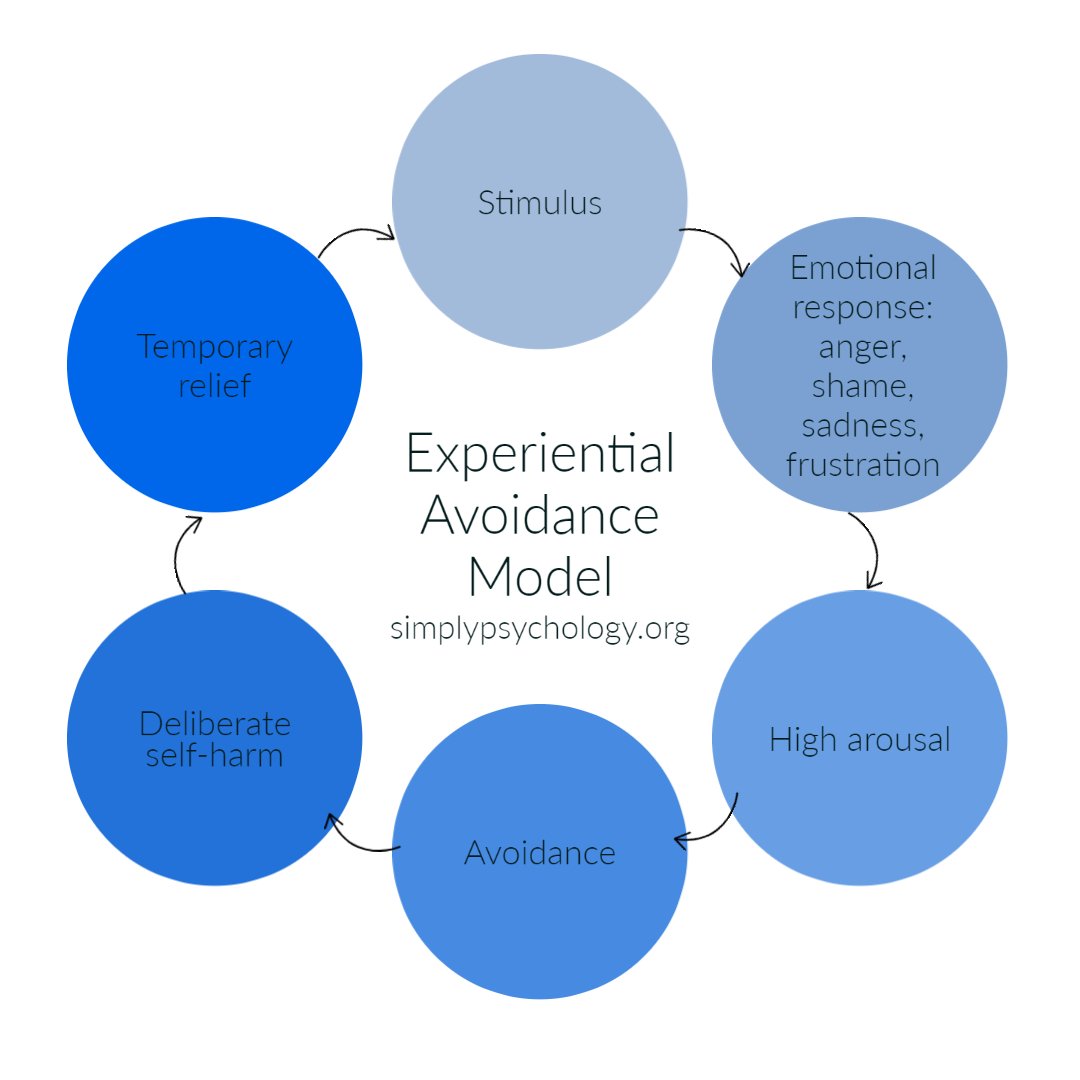
This model explains that self-harm is primarily maintained by negative reinforcement in the form of escape or avoidance of unwanted emotional experiences.
This effectively levels out the rollercoaster of emotions until the next time. This can be applied to any unhelpful coping strategy that people use instead of regulating their emotions.
When people use these unhelpful strategies, they do not feel good about using them despite their short-term effectiveness. These tend to add to a larger sense of shame or failure that sets the stage for the whole process to begin again. This is how it can become a vicious cycle.
Marsha Linehan developed dialectical behaviour therapy (DBT).
As a young woman, she experienced severe, hard-to-control emotional crises and self-harming behaviour herself. As Linehan explains, she later built DBT specifically to teach the regulation skills she felt she had lacked as a young patient.
She argues that severe emotion dysregulation is not a moral failing or a manipulation tactic. It is a learnable-skills deficit. Structured practice can address it. This is one clinician’s own account, offered to illustrate where regulation-focused treatment came from.
Breaking the distress cycle
Changing any part of the cycle can interfere with the pattern and lead to more positive thoughts and feelings.
Techniques such as those employed in cognitive behavioral therapy (CBT) can help you learn how to understand and work with the relationship between your thoughts, feelings, and behaviors.
Learn to pay attention to the way the thought-emotion-behavior relationship works for you, then ask yourself some questions:
- What particular ideas or thought patterns are causing a reaction in your mind?
- Which emotions do you find most difficult to endure or handle?
- What methods or actions do you take to ease your anxiety?
- To what extent do these techniques provide relief in both immediate and long-term situations?
- Are there any fundamental convictions you hold about yourself, others, or the world that have a bearing on the negative spiral?
- Alternatively, what are the thoughts and convictions that contribute the most to generating positive emotions for you?
Many different strategies exist to deal with overwhelming emotions.
What happens most often is that these strategies are not applied flexibly, and someone may use the same unhelpful strategy in every negative situation.
Putting effort into questioning what thoughts you have and what coping strategies you gravitate towards is an essential step toward ending the distress cycle.
Skills for regulating emotions
Learning emotion regulation skills will help us learn to effectively manage and change the way we feel and cope with situations.
A large 2026 meta-analysis pooling 71 studies found that these kinds of strategies do help. But the benefit was smaller for people with a diagnosed mental health condition than for people without one (Reents et al., 2026).
Skills like these are a useful starting point, not a substitute for professional support when emotions feel unmanageable.
1. Name the emotion
Attempting to avoid unpleasant thoughts and feelings can actually result in more unwanted negative thoughts and feelings.
Rather than avoiding unpleasant emotions, acknowledge their presence and name them specifically. It can be helpful to say out loud or think to yourself, ‘I am feeling sad/angry/afraid.
If you are uncertain about what emotion you are feeling, you can use a ‘Feelings Wheel,’ which displays many of the primary and secondary emotions one may feel.

Naming the emotion often leads to the emotion losing its power. It can allow us to let go of some of the pain and discomfort that accompany the unpleasant emotion.
2. Recognize and understand the emotion
It makes sense to believe that people who are unclear about their emotions are also less aware and less clear about their psychological needs.
A way in which you can become more aware of what you are feeling is to pay attention to what you are experiencing physiologically in your body.
For instance, you may have an unsettled feeling in your stomach when feeling anxious, or you may feel a tightness in your chest if you are feeling sad.
3. Validate the emotion
It is key to recognize that your emotions are present for a valid reason and that they are telling you something.
Practice self-compassion and give yourself support for the unpleasant emotions you are experiencing. Understand that feeling strong negative emotions are a normal part of life.
Try to breathe into the experience of your emotions. You can soothe hurt feelings by placing a hand over your body where you feel this experience, then breathe slowly into this area.
Inquire within as to whether there may be something you can do to address this feeling without any expectation that something needs to be done.
4. Identify and resolve emotional triggers
Often, we may have an interpretation of a situation that can trigger a strong emotional reaction. To help with regulating our emotions, it is key to learn to recognize emotional triggers.
By identifying triggers, you can address the underlying issue and change your emotional response.
Remember that you always have a choice on how to respond and what to do with the information you have.
5. Use chair work dialogues
Another technique that can aid emotion regulation is chair work dialogues (Greenberg, 2021). This involves imagining a conversation between different parts of yourself.
For example, you can externalize an internal critical voice by giving it a chair. Notice when this part attacks vulnerable emotions, making you feel flawed. Dialogue with the critic, expressing the pain it causes. Work to uncover the unmet needs or shame driving its harshness.
Chair work also allows compassionately soothing distressed parts of yourself. Comfort a scared inner child and provide the safety it lacked. Or encourage an angry part to express its frustration adaptively.
By making inner dynamics explicit through role play, you gain awareness of what triggers painful states. The parts can then integrate, resolving inner conflicts that dysregulate emotions.
6. Use imagery to transform emotions
Imagery is another effective strategy for modulating emotions (Greenberg, 2021). Visualization accesses right-brain processes, evoking feelings rapidly.
Imagine revisiting a scene where you felt overwhelmed, like childhood mistreatment or rejection. See yourself as a vulnerable child in this situation. What emotions arise? Fear, loneliness, shame? Stay with these painful feelings briefly.
Now visualize your current self entering the scene, ready to intervene. Offer the child protection and meet their unmet needs. Provide the safety and comfort they lacked. Dialogue with the child to understand their distress.
This imaginal process transforms difficult memories by accessing core hurts then symbolically resolving them. New empathy and care emerge, encoded as healthy emotional responses. Old triggers lose their power.
With practice, vividly revisiting scenes activates self-compassion automatically. Past wounds heal, and present emotions become more regulated.
Key Takeaways
- Definition: Emotion regulation is how people influence which emotions they have, when they have them, and how they show them (Gross, 1998).
- Dysregulation: Difficulty using healthy strategies to manage distressing emotions, often marked by poor awareness, low distress tolerance, and impulsive reactions.
- Causes: Temperament, trauma, inconsistent early caregiving, and low emotional intelligence can all make regulation harder to learn.
- The distress cycle: Avoiding difficult emotions can bring short-term relief but reinforces the same unhelpful coping strategy over time.
- Skill limits: Naming and validating emotions are useful starting points, though they help less once someone has a diagnosed mental health condition (Reents et al., 2026).
References
Aldao, A., Nolen-Hoeksema, S., & Schweizer, S. (2010). Emotion-regulation strategies across psychopathology: A meta-analytic review. Clinical psychology review, 30(2), 217-237.
Butler, E. A., Lee, T. L., & Gross, J. J. (2007). Emotion regulation and culture: Are the social consequences of emotion suppression culture-specific? Emotion, 7(1), 30-48.
Chapman, A. L., Gratz, K. L., & Brown, M. Z. (2006). Solving the puzzle of deliberate self-harm: The experiential avoidance model. Behaviour research and therapy, 44(3), 371-394.
Chapman, A. L., Gratz, K. L., & Brown, M. Z. (2006). Solving the puzzle of deliberate self-harm: The experiential avoidance model. Behaviour research and therapy, 44(3), 371-394.
Dunn, E. C., Nishimi, K., Gomez, S. H., Powers, A., & Bradley, B. (2018). Developmental timing of trauma exposure and emotion dysregulation in adulthood: Are there sensitive periods when trauma is most harmful?. Journal of affective disorders, 227, 869-877.
Girme, Y. U., Jones, R. E., Fleck, C., Simpson, J. A., & Overall, N. C. (2021). Infants’ attachment insecurity predicts attachment-relevant emotion regulation strategies in adulthood. Emotion, 21(2), 260–272.
Greenberg, L. S. (2021). Emotion regulation. In L. S. Greenberg, Changing emotion with emotion: A practitioner’s guide (pp. 279–307). American Psychological Association. https://doi.org/10.1037/0000248-012
Gross, J. J. (1998). The emerging field of emotion regulation: An integrative review. Review of General Psychology, 2(3), 271-299.
Gross, J. J., & John, O. P. (2003). Individual differences in two emotion regulation processes: Implications for affect, relationships, and well-being. Journal of Personality and Social Psychology, 85(2), 348-362.
Gross, J. J. (2015). Emotion regulation: Current status and future prospects. Psychological inquiry, 26(1), 1-26.
McRae, K., & Gross, J. J. (2020). Emotion regulation. Emotion, 20(1), 1–9.
Reents, M. F., Schroeder, P. A., Wolz, I., van den Hoek Ostende, M. M., Dolderer, M., Farshad, M., & Svaldi, J. (2026). Efficacy of emotion regulation strategy implementation in and across mental disorders: A systematic review and meta-analysis. Clinical Psychology Review, 125, 102718.