The dark side of emotional intelligence is that skill at reading and managing emotions can serve any goal, including manipulation. The research suggests the risk lies in how people use the skill, not in EI itself. EI is a tool, not a virtue.
Emotional intelligence (EI) is a subset of social intelligence that involves the ability to perceive our own and others’ emotions. It also lets us tell them apart. We can then use this information to regulate our thinking and behaviors[1].
Many scientific studies have provided compelling evidence of the importance of EI across different life domains. These include work, personal health, and relationships.
EI has shown positive correlations with job satisfaction, subjective well-being (both physical and emotional), and levels of social support. It is also an indicator of overall psychological adaptability (Sanchez-Alvarez et al., 2016; Cobos-Sanchez et al., 2020).
Goleman’s theory defines EI by four attributes:
- Self-awareness: the ability to recognize our own emotions and the impact they have on others;
- Self-management: the capacity to regulate emotions and impulsive reactions and flexibly adapt to changing circumstances;
- Social awareness: the ability to understand and empathize with the emotions of others;
- Relationship management: a set of social skills comprising positive influence, teamwork, clear communication, and conflict management.
Disadvantages of emotional intelligence
EI predicts many positive outcomes, but a review of the literature also found negative effects across health, academic, and occupational settings. Many of these effects were indirect[2].
The “dark side” bundles together four separate claims, and they are not equally well supported:
- Manipulation: emotional skill helps people manipulate others.
- Dark traits: high EI goes with narcissism, Machiavellianism, and psychopathy.
- Dark empaths: some people combine dark traits with high empathy.
- Personal costs: too much EI harms the person who has it.
Emotional manipulation
New evidence suggests that when people hone their emotional skills, they can also become better at manipulating others[3].
Indeed, “when we can control our emotions, we can also disguise our true feelings. When we are able to notice other people’s feelings, we can tug at their heartstrings and motivate them to act against their own best interests”.
This represents the dark side of EI: using one’s knowledge of emotions to strategically achieve self-serving goals.
In research conducted by the University of Cambridge, when a leader was giving an inspiring speech filled with emotion, the audience was less likely to scrutinize its content.
It seems that through EI, people can fabricate favorable impressions of themselves, expressing emotions strategically and reducing others’ ability to think critically[3].
Agreeableness seems to be the deciding factor. In a study of 884 workers, people high in EI were less Machiavellian, mainly because they were agreeable[4].
Low Agreeableness changed that picture. People who saw themselves as emotionally competent could still score high on Machiavellianism when they were low in the Big Five Trait ‘Agreeableness’ (i.e., cooperativeness, soft-heartedness, tolerance, and altruism).
The study was cross-sectional and relied on self-report, so it cannot show cause and effect.
The dark triad
Further research investigated the relationship between EI and dark triad personality traits, including Machiavellianism, Psychopathy, and Narcissism. Together, they form the “dark triad” of subclinical traits.
“Subclinical” means short of a clinical diagnosis.
They share common characteristics, such as a lack of empathy, a need for attention, gravitation toward power, deceit, and callous manipulation[5].
Two online surveys of 369 university students and 432 web respondents asked about tactics for influencing others’ moods. Mood worsening (e.g., criticizing others) and inauthentic displays (e.g., flattery and sulking) were more strongly related to primary than to secondary psychopathy[6].
High-EI people used these tactics less. Agreeableness largely explained why.
In only one sample did that protective link weaken at low Agreeableness, so support for a high-EI route to manipulation was partial[6].
In a study led by the University of Toronto, Machiavellian employees with high emotion-regulation knowledge showed more interpersonal deviance at work[7]. That included demeaning and embarrassing colleagues for personal gain.
Emotion-regulation knowledge means knowing which strategies work best for managing emotion in a given situation. The same skill also strengthened prosocial behavior in people with a strong moral identity.
It amplified the trait. It did not create it.
Psychopathy has also been associated with the tendency to adopt hard tactics in the workplace, with more evident threats of punishment and manipulation of people and situations.
Individuals high in narcissism seem instead to rely on softer or more charming workplace tactics, for example, the promise of reward and integration[8].
Their aim is to make good impressions initially and create positive relationships with colleagues that can be later exploited to offset work obligations.
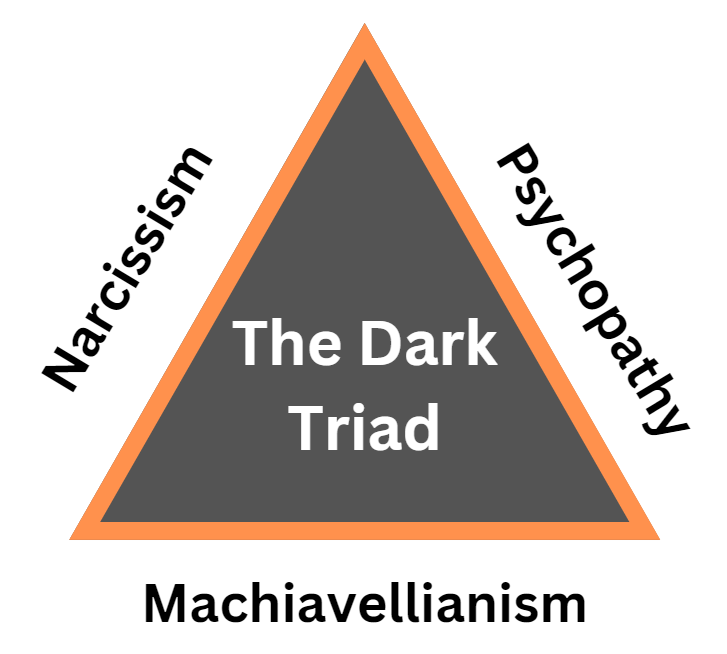
Is Emotional Intelligence Linked to Dark Traits?
Overall, it is not. A systematic review of 48 studies in adults found that all but one reported an overall negative association between the dark triad and EI[9]. The picture grew more complicated at the level of individual facets.
Narcissism is the one trait worth watching. A review summarized by Rico-Bordera et al.[10] found it related negatively to ability EI but positively to trait EI. Its authors linked that to narcissistic people’s distorted, favorable self-perception.
If that is right, part of the link is a measurement effect. Self-report EI items can capture a flattering self-image.
Rico-Bordera et al.[10] tested the “dark EI” idea directly in two studies:
- Aim: To test whether people combine high dark traits with high EI, and to compare the groups found on well-being and distress.
- Method: 1,241 Spanish students (Study 1) and 392 Spanish adults (Study 2) completed dark trait and EI measures. Latent profile analysis sorted them into groups by their pattern of scores.
- Results: Both studies found three profiles, and none combined high EI with high dark traits. The average-narcissism, high-EI profile had the highest well-being and the lowest distress.
- Conclusion: The authors read the results as not supporting a “dark EI” profile.
Two samples give this result more weight than a single correlation. The limits are real, though. Most participants were university students, and the EI measures were largely self-ratings.
The one performance-based test was unreliable (about .49) and did not separate the profiles. Missing a “dark EI” profile in self-report data therefore does not rule out skilled manipulation in behavior.
What other types of people are likely to use EI to their advantage?
EI overlaps with empathy but is a separate construct. It has therefore been hypothesized that people with high EI but reduced empathy are more likely to behave in antisocial and manipulative ways[11].
Without empathy, EI could, therefore, be ‘abused’. It may lead to aggressive rather than prosocial behaviors (Figure 2).
This is particularly evident in EI individuals with goal-driven persistence, sensitivity to rewards, and impulsivity. They use both prosocial and aggressive behaviors strategically to gain greater control of resources and thrive in the social world[12].
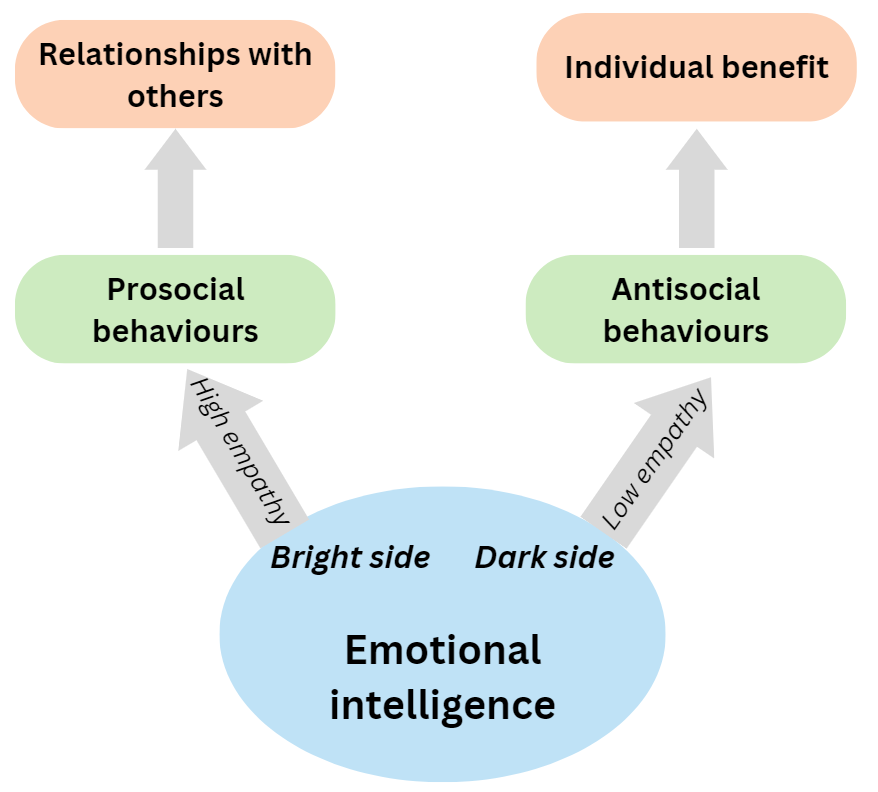
Do Dark Empaths Use Emotional Intelligence?
Research has not tested this directly. Dark empaths are defined by high empathy, not by high EI, and the two are different constructs.
A dark empath combines dark triad traits with high empathy, including the cognitive empathy needed to read how others think and feel. Heym et al.[13] studied 991 participants.
Their latent profile analysis found four groups: a traditional dark triad group (high dark traits, low empathy), dark empaths (high dark traits, high empathy), empaths, and typicals.
Dark empaths were less aggressive than the traditional dark triad group, and they had better well-being. They kept an antagonistic core, though. This sits comfortably with the findings above, because empathy and EI are different constructs and the studies used different measures.
Popular accounts credit dark empaths with tactics such as gaslighting, love bombing, ghosting, and intimidation. The profile study’s abstract does not mention these tactics. Treat them as popular description, not established findings.
The empathic narcissist is a clinical cousin of the label, pairing intact cognitive empathy with manipulation.
How to tell if someone is using emotional intelligence in a manipulative way?
People with manipulative tendencies might initially appear friendly and charismatic. Their primary intent is to use social interactions for personal gain, disguising them as benefits to others[14].
The first step to avoid being the target of their controlling behavior is recognizing some typical signs that these individuals display. These signs come from popular guides, not from the studies above, which did not test them.
- Inconsistent behavior: Their actions do not match the values or ethics they claim. Behavior shifts to serve changing personal needs and contradicts their initial words.
- Charisma: They easily sway people’s ideas, the so-called ‘awestruck effect’, using personal energy to spark positive emotions and gain control.
- Guilt-tripping: Emotional manipulators know our weak spots and use our insecurities to elicit guilt, which makes us easier to manipulate.
- Oversharing: They share many details early to make us feel like insiders. The aim is to win our confidence fast and influence us to behave as they expect.
- Reciprocity: They may flatter us or do small favors first, expecting bigger ones in return.
We might also try to reflect on our feelings when we interact with these people and use them as warning signs:
- Doubt: Manipulators show only one side of the story, so we question their honesty. Their inconsistency can also make us doubt our own perception of reality.
- Fear: They exaggerate facts to create urgency, and their unpredictable reactions leave us uneasy around them.
- Anger: We feel frustrated and resentful because they speak over us and impose how we should think or feel.
- Hopelessness: A strong connection can leave us feeling trapped, with little power to escape. We may feel sucked into the manipulator’s emotions and obliged to comply.
Noticing these signs is only the first step. It also helps to identify our personal weaknesses, such as the tendency to please others, low confidence and self-esteem, and emotional dependence on others.
We should then be assertive about our needs, stating them directly and persistently. Manipulators will try to change our views, so it is important to maintain personal boundaries to prevent them from taking advantage of us[15].
Evidence Check: Does Emotional Intelligence Hold Up?
Verdict: Supported with qualifications.
Any dark side assumes EI has real benefits. This section weighs two claims behind that premise. Meta-analyses support a positive association between self-report EI and job performance. They also support a small unique contribution of a trait EI questionnaire beyond personality.
There is a catch. The same literature shows that self-report and mixed EI overlap heavily with personality, ability, and self-perceptions. The mixed-EI link with performance fell to nil once those were controlled.
Self-Report EI and Job Performance
Level of evidence: Meta-analysis or systematic review; partly replicated.
The claim is that self-report and mixed-model EI measures predict job performance.
Joseph and Newman[16] pooled the associations among EI, personality, cognitive ability, and job performance. Ability-based EI predicted performance positively in high-emotional-labor jobs and negatively in low-emotional-labor jobs.
Job demands changed the sign.
O’Boyle et al. (2011) built on earlier meta-analytic work with 65 per cent more studies and over twice the sample size. They split EI into ability, self- or peer-report, and mixed streams. Corrected correlations with performance ran from 0.24 to 0.30.
The self-report and mixed streams showed the largest incremental validity beyond cognitive ability and the Five Factor Model[17]. Publication bias had negligible influence.
Joseph et al.[18] re-examined mixed EI. The updated correlation with supervisor-rated job performance was ρ = .29, against ρ = .47 in the 2010 review.
The relationship fell to β = -.02 once ability EI, self-efficacy, self-rated performance, Conscientiousness, Emotional Stability, Extraversion, and general mental ability were controlled[18].
That is effectively nil.
The claim holds in both O’Boyle et al. (2011) and Joseph et al.[18]. But the correlation means less than it first appears. With ability, self-efficacy, personality, and general mental ability held constant, mixed EI predicted performance at β = -.02 in the later review.
O’Boyle et al. (2011) instead found that the self-report and mixed streams added the most. The two results are contested. They differ in the controls entered and in date, and neither review tests why.
All three are meta-analyses of correlational, largely self-report studies, so none can show that EI causes better performance.
Trait EI and Personality
Level of evidence: Meta-analysis or systematic review; partly replicated.
The claim is that trait EI correlates with personality, not with IQ.
van der Linden et al.[19] meta-analysed the link between the general factor of personality, extracted from the Big Five, and EI measures. Across k = 142 data sources (N = 36,268), trait EI overlapped heavily with the general factor of personality (r ≈ .85).
Ability EI overlapped less (r ≈ .28). The authors suggested the general factor is very similar, perhaps synonymous, to trait EI.
Joseph et al.[18] reported a similar pattern for self-reported EI. It overlapped with ability EI, self-efficacy, self-rated performance, Conscientiousness, Emotional Stability, Extraversion, and general mental ability at multiple R = .79.
Andrei et al.[20] asked a different question. Does trait EI predict anything beyond personality? Their systematic review covered 24 articles (114 incremental validity analyses of the TEIQue), with a pooled analysis of 18 studies (23 independent samples, N = 4404, 105 effect sizes).
The pooled ΔR² was .06 (95% CI .03 to .08) beyond higher-order personality dimensions and other emotion-related variables. The increment came mainly from the well-being and self-control factors.
The evidence supports the claim as worded. Trait EI sits close to personality. The van der Linden authors suggest the top-level general factor may be synonymous with trait EI, which sits uneasily with placing it among lower-order personality facets.
Andrei et al.[20] describe the increment as relatively small, but statistically and practically significant. They also report significant funnel-plot asymmetry, which may mean the effect is overestimated.
Trait EI looks like largely personality with a modest residue. That residue is not shown to be a skill.
Two of the three works come from a team including K. V. Petrides, who proposed the trait EI construct, so the strongest syntheses come from its proponents.
Can you have too much emotional intelligence?
The evidence that high EI harms the person who has it is thinner than the intuition suggests. It supports a cautious claim. High EI is not unequivocally beneficial. It does not show that high EI is harmful.
Emotional Sensitivity and Stress
Empathy has a cost.
Emotionally intelligent people are better equipped to interpret others’ emotions and have more successful social interactions. Their empathy can also lead them to take things too personally and easily feel emotionally exhausted.
In a 2016 experiment, 166 men completed an ability test of emotional intelligence, including judging the emotional expression of human faces[21].
Then came the stress test.
They gave job talks in front of judges who assumed stern facial expressions, a standard laboratory stressor known as the Trier Social Stress Test.
Higher EI predicted greater cortisol reactivity (a bigger rise in the stress hormone cortisol) and slower recovery. That held only when testosterone was high. The authors read this as emotion recognition costing status-driven people more stress.
Other studies point the same way. Attention to emotion was positively associated with greater experience of negative emotions in victims of cyberbullying[22]. It was also linked to more severe symptoms in people with mental health disorders[23].
Overall, heightened emotional sensitivity may mediate the relationship between EI and over-reactivity to stress.
Uneven EI Profiles
Balance may matter more than level.
Individuals with an ‘uneven’ pattern of EI skills (for example, strong emotional awareness but weak stress management) display lower psychological adaptability. The effects were often indirect.
A review of the emerging literature found that uneven profiles of emotional skills or self-perceptions went with poorer outcomes[2]. The review was not described as systematic. People with high skill but low self-rated ability fared worse than people with balanced profiles.
By contrast, people with uniformly high or average EI profiles seem to cope better with challenging life circumstances. These include demanding academic or work environments and traumatic events[2].
They raised the possibility of an optimal level. They did not demonstrate one.
Disadvantages of High EI at Work
In the workplace, too high EI has been associated with various negative outcomes[24]. The evidence is thin, however.
For example, people with high interpersonal sensitivity might have difficulty delivering genuine, negative feedback to their colleagues, possibly impacting their growth potential.
In addition, they might be reluctant to make unpopular decisions that often leadership roles require to bring innovation and change to an organization.
People with high EI also tend to take fewer risks due to their high conscientiousness, which can result in excessive self-control and perfectionism.
Key Takeaways
- Manipulation: Emotional skill can help people manipulate others, but it appears to amplify the dispositions they already have.
- Dark Traits: Overall, EI goes with fewer dark personality traits, not more.
- Dark Empaths: People high in both dark traits and empathy appear in one profile study, but they were less aggressive than the traditional dark triad group.
- Personal Costs: Evidence that high EI harms the person who has it is thin. Uneven skill profiles may matter more than high EI itself.
- Warning Signs: Popular guides supply the common signs of manipulation, and the studies reviewed here have not tested them.
- Verdict: Supported with qualifications. Self-report EI predicts job performance, but one review found the link fell to nil once personality and ability were controlled.
References
- D. Goleman, Emotional intelligence: Why it can matter more than IQ. . Bloomsbury Publishing, 1996.
- S. K. Davis and R. Nichols, “Does emotional intelligence have a “dark” side? A review of the literature,” Frontiers in Psychology, vol. 7, Art. no. 1316, 2016, doi: 10.3389/fpsyg.2016.01316.
- A. Grant, “The dark side of emotional intelligence,” The Atlantic, vol. 2, 2014.
- P. J. O’Connor and V. S. Athota, “The intervening role of agreeableness in the relationship between trait emotional intelligence and Machiavellianism: Reassessing the potential dark side of EI,” Personality and Individual Differences, vol. 55, no. 7, pp. 750–754, 2013, doi: 10.1016/j.paid.2013.06.006.
- A. Furnham, S. C. Richards, and D. L. Paulhus, “The Dark Triad of personality: A 10 year review,” Social and personality psychology compass, vol. 7, no. 3, pp. 199–216, 2013.
- E. J. Austin, D. H. Saklofske, M. Smith, and G. Tohver, “Associations of the managing the emotions of others (MEOS) scale with personality, the Dark Triad and trait EI,” Personality and Individual Differences, vol. 65, pp. 8–13, 2014, doi: 10.1016/j.paid.2014.01.060.
- S. Côté, K. A. DeCelles, J. M. McCarthy, G. A. Van Kleef, and I. Hideg, “The Jekyll and Hyde of emotional intelligence: Emotion-regulation knowledge facilitates both prosocial and interpersonally deviant behavior,” Psychological Science, vol. 22, no. 8, pp. 1073–1080, 2011, doi: 10.1177/0956797611416251.
- P. K. Jonason, S. Slomski, and J. Partyka, “The Dark Triad at work: How toxic employees get their way,” Personality and individual differences, vol. 52, no. 3, pp. 449–453, 2012.
- S. A. Walker, K. S. Double, and D. P. Birney, “The complicated relationship between the Dark Triad and emotional intelligence: A systematic review,” Emotion Review, vol. 13, no. 3, pp. 257–274, 2021, doi: 10.1177/17540739211014585.
- P. Rico-Bordera et al., “The connection between dark traits and emotional intelligence: A multistudy person-centered approach,” Journal of Personality, vol. 93, no. 3, pp. 724–739, 2025, doi: 10.1111/jopy.12969.
- Akamatsu, D., & Gherghel, C. (2021). The bright and dark sides of emotional intelligence: Implications for educational practice and better understanding of empathy.
- A. M. Bacon, P. J. Corr, and L. P. Satchell, “A reinforcement sensitivity theory explanation of antisocial behaviour,” Personality and Individual Differences, vol. 123, pp. 87–93, 2018.
- N. Heym et al., “The Dark Empath: Characterising dark traits in the presence of empathy,” Personality and Individual Differences, vol. 169, Art. no. 110172, 2021, doi: 10.1016/j.paid.2020.110172.
- Bradberry, T., & Greaves, J. (2009). Emotional Intelligence 2.0. TalentSmart.
- H. B. Braiker, Who’s pulling your strings, pp. 1-260. New York, NY, USA:: McGraw Hill, 2004.
- D. L. Joseph and D. A. Newman, “Emotional intelligence: An integrative meta-analysis and cascading model,” Journal of Applied Psychology, vol. 95, no. 1, pp. 54–78, 2010, doi: 10.1037/a0017286.
- E. H. O’Boyle, R. H. Humphrey, J. M. Pollack, T. H. Hawver, and P. A. Story, “The relation between emotional intelligence and job performance: A meta-analysis,” Journal of Organizational Behavior, vol. 32, no. 5, pp. 788–818, 2011, doi: 10.1002/job.714.
- D. L. Joseph, J. Jin, D. A. Newman, and E. H. O’Boyle, “Why does self-reported emotional intelligence predict job performance? A meta-analytic investigation of mixed EI,” Journal of Applied Psychology, vol. 100, no. 2, pp. 298–342, 2015, doi: 10.1037/a0037681.
- D. van der Linden et al., “Overlap between the general factor of personality and emotional intelligence: A meta-analysis,” Psychological Bulletin, vol. 143, no. 1, pp. 36–52, 2017, doi: 10.1037/bul0000078.
- F. Andrei, A. B. Siegling, A. M. Aloe, B. Baldaro, and K. V. Petrides, “The incremental validity of the Trait Emotional Intelligence Questionnaire (TEIQue): A systematic review and meta-analysis,” Journal of Personality Assessment, vol. 98, no. 3, pp. 261–276, 2015, doi: 10.1080/00223891.2015.1084630.
- M. N. Bechtoldt and V. K. Schneider, “Predicting stress from the ability to eavesdrop on feelings: Emotional intelligence and testosterone jointly predict cortisol reactivity,” Emotion, vol. 16, no. 6, pp. 815–825, 2016, doi: 10.1037/emo0000134.
- P. Elipe, J. A. Mora-Merchán, R. Ortega-Ruiz, and J. A. Casas, “Perceived emotional intelligence as a moderator variable between cybervictimization and its emotional impact,” Frontiers in psychology, vol. 6, pp. 486, 2015.
- N. P. Lizeretti, N. Extremera, and A. Rodríguez, “Perceived emotional intelligence and clinical symptoms in mental disorders,” Psychiatric Quarterly, vol. 83, pp. 407–418, 2012.
- Chamorro-Premuzic, T., & Yearsley, A. (2017). The Downsides of Being Very Emotionally Intelligent. Harvard Business Review.
- Cobos-Sánchez, L., Flujas-Contreras, J. M., & Becerra, I. G. (2020). Relation between psychological flexibility, emotional intelligence and emotion regulation in adolescence. Current psychology, 1-10.
- N. Sánchez-Álvarez, N. Extremera, and P. Fernández-Berrocal, “The relation between emotional intelligence and subjective well-being: A meta-analytic investigation,” The Journal of Positive Psychology, vol. 11, no. 3, pp. 276–285, 2016, doi: 10.1080/17439760.2015.1058968.


