Learned helplessness is a psychological state in which repeated exposure to uncontrollable negative events leaves a person feeling powerless to change their situation.
This leads to passivity, decreased motivation, and a sense of hopelessness, which can persist even when circumstances change and control is possible.
Learned helplessness is often associated with depression.

Key Takeaways
- Definition: Learned helplessness occurs when a series of negative outcomes or stressors leads someone to believe the outcomes of life are out of their control.
- Expectation: If a person learns their behavior makes no difference to their environment, they may stop trying to escape, even when escape is possible.
- Origins: Martin Seligman and Steven Maier first identified it in the 1960s, when dogs given repeated, uncontrollable shocks stopped trying to avoid them.
- Depression and PTSD: Learned helplessness has been linked to, and used to explain, depression and post-traumatic stress disorder in humans, but not without criticism.
- Overcoming It: Seligman’s own approach is learned optimism. Learned hopefulness, which builds control through real experiences, is another route.
- 2016 Update: More recent neuroscience suggests passivity is the brain’s default reaction, and that it is control, not helplessness, that gets learned.
What Is Learned Helplessness?
Learned helplessness happens when repeated exposure to uncontrollable stressors teaches people to stop trying to control their response, even when control is possible.
They learn their actions do not affect their environment, and this belief saps their motivation to change their situation.
The Triadic Design Experiment
The first people to describe learned helplessness were the American psychologists Steven F. Maier and Martin E. P. Seligman.
Martin Seligman and Steven F. Maier ran the classic demonstration in the 1960s using a triadic design, which isolates controllability from the shock itself (Seligman & Maier, 1967).
The effect was reported in two companion papers in 1967. Overmier and Seligman (1967) first showed that earlier inescapable shock disrupts later escape and avoidance learning.
Seligman and Maier then added the controlled triadic design, which pinned the cause on uncontrollability rather than shock itself.
The discovery was partly accidental. Dogs that had earlier received inescapable shock in a Pavlovian harness behaved oddly in a later avoidance task, and did not escape even when escape was easy.
- Aim: To test whether controllability, not the shock itself, determines whether an animal later fails to learn an available escape response.
- Method: Three groups differed only in control: shock a dog could stop by pressing a panel, identical “yoked” shock it could not stop, or none. All were then tested in a shuttle box, a chamber with a low barrier to jump.
- Results: Escape and no-shock dogs quickly learned to jump the barrier. About two-thirds of the yoked dogs did not even try, lying down and whining as they accepted shocks they could have avoided.
- Conclusion: The yoked dogs had learned that responding and shock termination were independent, an expectation of uncontrollability that transferred to the new task.
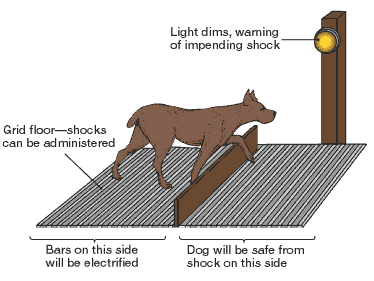
In the shuttle box, a warning signal preceded each shock, and a dog could escape by jumping the barrier. Even a dog that escaped by accident on one trial was unlikely to repeat the response next time. The single success did not take.
Some helpless dogs had to be physically dragged over the barrier many times before they escaped on their own. In Seligman’s account, it took up to 200 times or more (Seligman, 1975).
The shock itself never changed.
Because the escape and yoked groups received physically identical shock, the difference can only be explained by controllability itself, not pain or exposure. This is what makes the triadic design a clean isolation of a cognitive variable, not a mechanically weakened response.
Why Learned Helplessness Challenges Operant Conditioning
A strict Skinnerian account of operant conditioning holds that reinforcement and punishment automatically strengthen and weaken behavior. Learned helplessness is hard to square with that view.
In the shuttle box, escape was reinforced by the end of the shock. Other dogs learned it. The helpless dogs did not, even though the reinforcement was available to them.
What carried over from the first phase was not a stronger or weaker response. It was an expectation that responding is futile. On this reading, the dogs had learned a relationship between their behavior and outcomes, not a mechanical stimulus-response bond.
Learned helplessness therefore sits with latent learning as evidence that conditioning is better described in cognitive terms. The animal learns what causes what, and whether its own behavior matters.
Signs of Learned Helplessness: Three Deficits
Maier and Seligman (1976) identified three deficits that became the signature of learned helplessness:
- Lack of motivation: People with learned helplessness often do not respond to new challenges. They give up before they start, even at small setbacks.
- Difficulty learning from success: Even after coping successfully, people with learned helplessness struggle to learn from it. They rarely see success as a sign they can handle future challenges.
- Emotional deficit: People with learned helplessness often become passive, and their behavior can resemble depression. They might also appear emotionally flat or unresponsive.
However, later research complicates this picture. People with learned helplessness may seem emotionally numb, but they are actually experiencing high stress levels internally.
Scientists discovered this by measuring cortisol levels, a stress hormone, in their blood (Ackerman, 2022).
Is learned helplessness a mental health condition?
Learned helplessness is not a diagnosable mental health condition. It is a learned expectation that your actions cannot change outcomes, and that belief can drive passive, maladaptive behavior.
Although not a standalone disorder, learned helplessness can feature in or exacerbate other mental health conditions such as anxiety, depression, phobias, and loneliness.
Symptoms of learned helplessness, including low motivation, perceived lack of control, and low self-esteem, overlap with those of depression and anxiety.
This overlap is why Seligman extended the theory to depression.
In the 1970s, Seligman extended learned helplessness from animal research to clinical depression in humans. He proposed a learned-helplessness theory to explain how people become vulnerable to depression.
According to this theory, people repeatedly exposed to uncontrollable stress develop an inability to make decisions. They also struggle to engage effectively in purposeful behavior.
Subsequently, researchers have noticed that this learned helplessness theory is similar to posttraumatic stress disorder (Ackerman, 2022).
The link has a direct origin in animal research. Van der Kolk, Greenberg, Boyd, and Krystal (1985) made it explicit.
They argued that repeated, uncontrollable exposure to an aversive stimulus, the procedure behind learned helplessness, also produces lasting neurotransmitter and stress-hormone changes like those in PTSD.
As trauma psychiatrist Bessel van der Kolk recounts in The Body Keeps the Score (2014), he was “riveted” by Steven Maier’s 1984 talk on the dog studies.
The animals’ predicament matched that of his traumatized patients. They, too, had been unable to escape harm.
Van der Kolk draws this from clinical experience, not a controlled study.
He observes that a chance to escape does not necessarily lead traumatized animals, or people, to take it. That echoes the helpless dogs that failed to repeat a successful escape.
The Role of Explanatory Styles in Learned Helplessness
The initial learned helplessness theory was an important breakthrough. But it soon needed more work. Humans are cognitively more complex than other animals. The theory could not explain why helplessness is sometimes global and sometimes specific.
Nor could it explain why helplessness is chronic in some people and brief in others. It also could not say why self-esteem drops only sometimes.
Seligman and colleagues later reformulated the original learned helplessness model of depression (Abramson, Seligman, & Teasdale, 1978).
In their reformulation, they emphasized attributions: the mental explanations people give for why something happened. These explanations shape whether someone perceives a lack of control over negative outcomes, fostering learned helplessness.
The explanatory style model of learned helplessness seeks to identify patterns in individual reactions to positive and negative events and occurrences in their lives.
The model’s logic is that when individuals find themselves in a situation where something has gone either right or wrong, they will ask why. The answer determines whether they default to an optimistic or pessimistic explanatory style, across three dimensions (Healy, 2017):
- Stability: Believing a negative cause is permanent breeds chronic helplessness; believing it is temporary limits it.
- Globality: Believing a cause affects many areas of life spreads the helplessness; believing it is limited to one issue contains it.
- Locus: Blaming an internal cause damages self-esteem; attributing the event to external factors protects it.
The reformulation became testable once researchers could measure explanatory style. People using the Attributional Style Questionnaire (ASQ) imagine good and bad events, then rate each cause as internal or external, stable or unstable, and global or specific.
- Aim: Seligman, Abramson, Semmel, and von Baeyer (1979) tested whether depressed people show the internal, stable, global style the reformulation predicts.
- Method: University students completed the ASQ, and their level of depression was also assessed. More and less depressed students could then be compared.
- Results: More depressed students blamed bad events on internal, stable, and global causes far more than less depressed students did. They also tended to credit good events to external, unstable, and specific causes.
- Conclusion: A measurable depressive explanatory style goes together with depression, which supports the reformulated model.
The finding is correlational, so it cannot show that a pessimistic style causes depression rather than accompanying it. Much of the early evidence also came from mildly depressed students, not clinical patients.
In their writing on explanatory styles, Christopher Peterson and Martin Seligman (1984) stressed that a person’s explanatory style tends to follow a pattern. People tend to respond to positive and negative events in consistent, habitual ways.
This can be very advantageous to someone’s well-being when they default to an optimistic explanatory style. But it can be very problematic for those who tend toward pessimism.
In fact, learned helplessness and a pessimistic explanatory style are each linked with the development of depression in individuals (Healy, 2017).
Hopelessness theory of depression grew out of this work. Abramson, Metalsky, and Alloy (1989) proposed that the immediate cause is hopelessness. It is the expectation that highly desirable outcomes will not occur and that one is powerless to change this.
A negative life event, filtered through a pessimistic explanatory style, generates hopelessness, and hopelessness produces the depressive symptoms. This is a diathesis-stress account. The pessimistic style is the vulnerability (the diathesis), and the negative event is the stressor.
Optimistic vs. Pessimistic Explanatory Styles
The markers of an optimistic explanatory style stand in direct contrast to those signaling their pessimistic counterpart.
- The pessimistic style views negative events as permanent and positive events as temporary. The optimistic style reverses this: negative events are temporary, positive events are lasting.
- The pessimistic style blames the self when things go wrong and credits external factors when things go right. The optimistic style does the reverse (Healy, 2017).
However, even an optimistic explanatory style requires moderation to be most beneficial for overcoming learned helplessness.
For example, always blaming others when things go wrong, and always taking full credit when things go right, meets the definition of an optimistic style. But taken to this extreme, it becomes a problem in itself (Healy, 2017).
Learned Helplessness Compared With Related Theories
Four neighboring theories show what is distinctive about learned helplessness.
- Locus of control: Rotter (1966) described a stable belief that outcomes depend on your own behavior (internal) or on luck and others (external). The two compound: an external locus of control predicted a larger helplessness deficit (Hiroto, 1974).
- Attribution theory: Weiner (1985) analyzed explanations for success and failure by whether they are internal, stable, and controllable. The reformulated helplessness model applies attribution theory to uncontrollable negative events.
- Beck’s cognitive theory: Beck (1967) located depression in negative schemas about the self, world, and future, not in attributions about control. Cognitive behavioral therapy draws on both accounts.
- Self-efficacy: Bandura (1977) described the belief that you can perform the behavior needed for an outcome, the positive mirror image of helplessness. Helplessness stems from expecting outcomes to be uncontrollable; low self-efficacy stems from doubting your own capability.
Overcoming Learned Helplessness
Learned helplessness explains human behaviors that can otherwise seem odd or counterproductive. Understanding it provides ways to reduce its negative effects (Ackerman, 2022).
Focus on what you can control
Focusing on what you can control is a powerful way to combat learned helplessness. When you feel like everything is out of your control, it’s easy to give up and feel helpless.
But by shifting your focus to the things you can influence, you can start to regain a sense of power over your life.
Small wins add up.
For example, you might not control whether you get a promotion at work. But you can control how much effort you put into your job.
You can’t control the weather, but you can control how you prepare for and respond to it.
Here are some things you can control:
- Your attitude: Choose to approach challenges with a positive, can-do mindset.
- Your effort: Decide how much time and energy you put into your goals.
- Your response: You can’t always control what happens to you, but you can control how you react to it.
- Your self-care: Prioritize taking care of your physical and mental health.
- Your relationships: Nurture the relationships that bring positivity into your life.
By focusing on these areas, you remind yourself that you have the power to influence your life, even in small ways.
This can help combat the feeling of helplessness and give you the confidence to tackle bigger challenges over time.
Learned optimism
Learned optimism, a concept introduced by Martin Seligman, is the antithesis of learned helplessness. While learned helplessness means internalizing a sense of hopelessness, learned optimism means challenging negative thoughts and adopting a more positive outlook. Over time, this changes people’s behaviors, and ultimately their outcomes.
The process starts with recognizing and questioning the automatic negative thoughts that fuel helplessness. Faced with a setback, someone practicing learned optimism looks for alternative explanations rather than defaulting to self-blame or despair.
The reframe is the whole technique.
Instead of thinking, “I failed because I’m not good enough,” they reframe the setback. They might think, “This was a tough situation, but I can learn from it and do better next time.”
Consistently challenging negative self-talk, and focusing on what they can control, helps people gradually shift from helplessness toward resilience and empowerment.
Small shifts compound.
Cultivating learned optimism takes time and practice, but it can profoundly improve well-being, motivation, and the ability to overcome challenges.
It borrows from cognitive behavioral therapy (CBT). If a pessimistic explanatory style makes people vulnerable, then identifying, disputing, and restructuring internal, stable, global explanations for bad events is therapeutic.
Attributional retraining and behavioral activation, which rebuilds the link between action and outcome, flow from the same framework.
Learn from failures
Carol Dweck, a psychologist, has found another powerful way to reduce learned helplessness, and it involves experiencing failure. In her research, Dweck divided children into two groups:
- The first group was given tasks that were designed for them to fail. After failing, they were told to take responsibility for their failure and to believe that it happened because they didn’t put in enough effort.
- The second group was given tasks that were easy enough for them to succeed every time. They never experienced failure during the study.
Dweck’s (1975) results showed a clear difference between the two groups. The group that only experienced success showed no change in how they reacted to failure later on, still reacting extremely negatively when failure eventually came.
However, the group that experienced failure and was taught to take responsibility for it showed big improvements.
Attribution mattered, not exposure.
They didn’t react as badly when they failed at something later on. In simple terms, this study suggests that experiencing failure can help people overcome learned helplessness. The key is learning to see failure as a result of insufficient effort, not a lack of ability.
Ability was never the issue.
Failure isn’t permanent, and trying harder next time can change the outcome.
Learned hopefulness
Learned hopefulness emphasizes empowering experiences. Such experiences help individuals overcome learned helplessness.
It suggests that providing opportunities for people to learn new skills and gain a sense of control helps them become more resilient. This resilience helps them face everyday challenges and barriers.
Unlike learned optimism, which focuses on changing thought patterns, learned hopefulness emphasizes actual experiences. These experiences shape a person’s outlook and their ability to cope with difficulties.
When individuals are exposed to situations that allow them to successfully navigate challenges, they develop a sense of mastery and control. This, in turn, helps them approach future obstacles with greater confidence and determination.
Fostering learned hopefulness through supportive environments and skill-building opportunities helps people break free from learned helplessness. It builds a more empowered, proactive approach to life.
This resilience can serve as a buffer against the negative effects of stress and adversity.
Real-World Examples of Learned Helplessness
Overparenting and learned helplessness
Overparenting, often associated with “helicopter parents,” can inadvertently contribute to developing learned helplessness in adulthood.
When parents consistently intervene and solve their children’s problems, children may become overly dependent on their parents’ support.
This dependency can lead to a fear of failure and a belief that they are incapable of succeeding without their parent’s help.
The two feed each other.
While it can be difficult for parents to watch their children struggle, experiencing routine failures and challenges is essential to growing up.
These experiences teach children valuable skills such as problem-solving, coping with disappointment, and building resilience.
By facing and overcoming obstacles on their own, children develop self-efficacy, the belief that their actions can produce the outcome they want.
This lets them navigate difficult situations with growing confidence.
While well-intentioned, overparenting can deprive children of these crucial learning opportunities. This can lead to learned helplessness and a lack of confidence in their own abilities as adults.
Learned helplessness in education
Learned helplessness is a common subject of interest in the field of education. In particular, educators are interested in how early academic failure or low academic self-esteem affects later success. They also study how that relationship can be changed to improve a student’s chances (Firmin, Hwang, Copella, & Clark, 2004).
Learned helplessness in students creates a cycle where those who feel they are unable to succeed are unlikely to put effort into schoolwork. This, in turn, decreases their chances of success, leading to even less motivation and effort.
This cycle can culminate in a student with almost no motivation to learn a subject and no competence in it.
It can even generalize into a broader sense of helplessness. The student may lose all belief in their ability, and all motivation to learn any subject at school (Firmin, Hwang, Copella, & Clark, 2004).
Educators have developed a few strategies that can help prevent students from learning to be habitually helpless, such as:
-
Providing praise and encouragement based on the student’s abilities to help them believe they are good at these subjects.
-
Providing praise and encouragement based on a student’s efforts.
-
Setting individual goals with students, so they learn that goals are achievable and outcomes are within their control (Firmin, Hwang, Copella, & Clark, 2004).
Consider a hypothetical Year-10 student, Maya, who has struggled with maths. She fails several tests despite revising, and explains it as “I’m just bad at maths, I always have been, and I’m hopeless at everything.” That is a pessimistic explanatory style: internal, stable, and global.
Maya concludes that effort is pointless. She stops revising and stops attempting homework she could do. Her grades fall further, which seems to confirm her belief.
A teacher can reverse the cycle. The teacher helps Maya see failure as a result of too little effort or the wrong strategy. Small individual goals and praise for effort, not cleverness, show her that her actions do move the outcome.
Learned helplessness in relationships
Learned helplessness is also of interest to researchers focused on domestic violence, as it’s often observed in relationships involving abuse.
The phenomenon of learned helplessness has helped researchers understand this pattern. It explains why those who are abused often do not tell others, seek help, or leave the relationship (Ackerman, 2022).
In abusive relationships, abusers often subject victims to repeated abuse. This conditions victims to believe they have no control over their situation.
The abusers, as a result, maintain complete control, and the victims learn that they are helpless about their circumstances (Ackerman, 2022). These perceptions are often very difficult to shift, requiring intensive therapy and support (Ackerman, 2022).
Ageing and institutional care
Learned helplessness also explains passivity in nursing homes and other institutional settings, where residents’ daily choices are often made for them rather than by them.
- Aim: Langer and Rodin (1976) tested whether giving nursing-home residents more personal choice and responsibility would improve their well-being.
- Method: In a real nursing home, one floor’s residents got greater control over daily decisions, including a plant of their own to care for. A comparison floor was told the staff would look after everything.
- Results: The residents given more choice and responsibility became more active, alert, and engaged, and reported greater well-being than the comparison group.
- Conclusion: Restoring perceived control can reverse the passivity of learned helplessness, even in the frail aged.
Control, not comfort, made the difference.
A follow-up eighteen months later found the enhanced-control group in better health, with markedly lower mortality (Rodin & Langer, 1977).
Studies of learned helplessness in humans
Experiments as extreme as Seligman’s have never been performed on humans, since they would not pass ethical review. Milder human experiments, though, have reproduced the same pattern.
- Aim: Hiroto (1974) tested whether humans become helpless after an uncontrollable event, and whether locus of control shapes the effect.
- Method: Participants were split into three groups: one could end a loud noise by pressing a button four times, one could not, and one heard none. Everyone then tried a lever box that could switch off the noise.
- Results: Participants with no earlier control tended not even to try the lever, while the rest learned it readily. The deficit was larger with an external locus of control, or when the task was framed as chance rather than skill.
- Conclusion: Uncontrollable events produce the same motivational deficit in humans as in dogs, and beliefs about control shape how strongly it hits.
The design mirrored the dog studies: the second group heard exactly the same noise as the first, so only control differed. Laboratory noise is a far milder stressor than the adversity linked to clinical depression, so the leap to psychopathology remains large.
A second study asked whether helplessness learned on one kind of task spreads to a very different one.
- Aim: Hiroto and Seligman (1975) tested whether helplessness induced by one kind of task transfers to a quite different kind of task.
- Method: Participants first faced controllable or uncontrollable noise, or soluble or insoluble problems. They were then tested on a task from the other domain: escaping noise, or solving anagrams (unscrambling letters into words).
- Results: Uncontrollability in either domain impaired performance in the other: earlier inescapable noise disrupted anagram solving, and earlier insoluble problems disrupted noise escape. Participants given controllable pretreatments performed like untreated controls.
- Conclusion: People acquire a general expectation that responding is futile, not a deficit tied to one task.
This cross-task transfer is the clearest evidence that human helplessness is a generalized expectancy. It remains a short-term laboratory analogue, though, and later work showed that explanatory style moderates how far helplessness spreads (Abramson et al., 1978).
Learned hopefulness at volunteer organizations
One example of an environment where individuals can learn hopefulness is voluntary organizations.
Someone who volunteers at an after-school center, tutoring young children in mathematics, might see how their presence directly helps students grasp the material better.
This may have run-off effects in other areas of the participant’s life.
The effect can spread widely.
Zimmerman (1990) studied how empowered people felt after volunteering consistently in such environments. He measured this using cognitive, personality, and motivational indicators of perceived control.
The results were clear.
He found that those who volunteered felt more in control of their own lives. They were also more likely to attribute their successes to their own actions (Zimmerman, 1990).
Criticisms of Learned Helplessness
Seligman’s original (1967) learned helplessness theory, as well as the reformulations of others, have received a number of criticisms.
Psychologists believe that there is more to depression than learned helplessness.
While the symptoms of learned helplessness may mirror those of depression, there is an array of complex neurological and psychological factors underlying the condition.
Indeed, depression may not necessarily arise from a repeat failure.
For example, students may become depressed after repeatedly blaming themselves for chronic school stress and poor exam results.
Additionally, participants in these experiments often describe their task as a skill task, even while behaving as if it were a chance task. In other words, they act as if helpless, but still insist their effort matters (Ackerman, 2022).
Further limitations are worth weighing:
- Ethics: Giving dogs inescapable shock, and deliberately inducing passivity, raises serious animal-welfare concerns. Such studies would be tightly constrained today.
- Animal-to-human leap: Human depression involves guilt, rumination, self-concept, and social factors that harnessed, shocked dogs cannot capture.
- Incomplete original model: It could not explain why helplessness is global or specific, chronic or brief, or why self-esteem sometimes drops. This forced the reformulation.
- A stable vulnerability?: Hamilton and Abramson (1983) followed hospitalized depressed patients and found the pessimistic style did not stay fixed once the episode resolved. That complicates the diathesis-stress reading.
- Not universal: Explanatory style moderates who becomes helpless, so not everyone exposed to uncontrollable events does.
- Mislabeled mechanism: Maier and Seligman (2016) argue passivity is the unlearned default and control is what is learned, which re-specifies the classic account.
Despite these limits, the paradigm has been unusually productive. It produced a testable theory of depression, a reformulation, and the hopelessness theory, and it fed into cognitive therapy and positive psychology.
Contemporary Research
Fifty years after the original dog studies, Seligman and Maier returned to their own findings. They reviewed decades of neuroscience on the circuitry engaged by controllable versus uncontrollable stress (Maier & Seligman, 2016).
What the Brain Actually Learns
Thesis: Passivity after uncontrollable shock is not learned at all.
It is the mammal’s innate, default reaction, and what the brain actually learns is control.
The protection can even persist, priming the brain to resist future adversity.
The switch sits in the prefrontal cortex.
Evidence reviewed: Maier and Seligman synthesized five decades of animal research on the brain circuitry activated by controllable versus uncontrollable stress. Prolonged uncontrollable shock strongly activates the dorsal raphe nucleus (DRN), a serotonergic brainstem region whose output suppresses escape behavior.
The two pathways diverge early.
A controllable stressor instead engages the ventromedial prefrontal cortex (vmPFC), which detects the controllability and inhibits the DRN.
Verdict: As an authoritative review by the paradigm’s own originators, grounded in a large and convergent animal-neuroscience literature, it is unusually strong on integrative reach.
Its extension to human depression, though, remains an inference from rodent circuitry rather than a finding in people.
Testing the Circuit Directly
- Aim: Baratta et al. (2018) tested whether behavioural control over shock protects the brain circuit the review describes, and whether that protection holds across sexes.
- Method: Rats received tail-shock that was either controllable or uncontrollable. The researchers measured dorsal-raphe activity and the resulting behavioural deficits in both male and female rats.
- Results: In male rats, control blunted dorsal-raphe activation and blocked the deficits it drives, and pharmacologically activating the prefrontal cortex reinstated this protection. In female rats, the protection was absent even though drugs could still activate the same circuitry.
- Conclusion: The experiment directly corroborates the prefrontal-to-dorsal-raphe pathway the review proposed.
The missing protection in females is a real boundary condition, not a footnote, and may help explain why stress-related disorders are more common in women.
Vicarious Learned Helplessness
- Aim: Patel et al. (2026) tested whether merely watching another animal receive uncontrollable shock is enough to produce depression-like behaviour.
- Method: Male and female mice watched, through a partitioned chamber, a mouse receiving inescapable foot shocks over seven days. The observers were never shocked, and their prefrontal cortex was later analysed.
- Results: In both sexes, observers developed depression-like behaviour comparable to direct shock. Both sexes showed downregulated prefrontal mGluR2, but the molecular routes differed by sex.
- Conclusion: Vicarious trauma alone can produce depression-like pathology, and the sex-specific routes point towards sex-tailored treatments.
Males showed deficits in neurotrophic support and glucocorticoid signalling, whereas females showed impaired social-bonding pathways and postsynaptic scaffolding proteins. This is a single new animal study awaiting independent replication.
Inside the Prefrontal Synapse
- Aim: Abdulla et al. (2026) asked what changes inside the prefrontal synapse after uncontrollable stress.
- Method: Male and female mice received inescapable shock, escapable shock, or none. Mass spectrometry then mapped proteins and their phosphorylation in prefrontal synaptosomes, isolated nerve terminals.
- Results: Uncontrollable shock altered pathways for energy metabolism, neurotransmitter signalling, and receptor trafficking. It also changed muscarinic acetylcholine receptors and the machinery that moves them to and from the membrane.
- Conclusion: Prefrontal cholinergic signalling may help mediate responses to uncontrollable stress, alongside the serotonergic dorsal-raphe pathway.
Muscarinic receptors are one of the two main families through which acetylcholine acts in the brain. This is a descriptive survey, not a causal test: it shows what changes, not yet whether altering cholinergic signalling changes behaviour.
It does give researchers a concrete molecular target to test.
References
Abdulla, Z. I., Garcia-Milian, R., Giahyue, E., Fertuzinhos, S., Collin, F., Wang, W., Lam, T. T., Nairn, A. C., & Picciotto, M. R. (2026). mPFC synaptosome proteomics reveals novel pathways and muscarinic receptor changes in a learned helplessness mouse model. eNeuro, 13(4), ENEURO.0030-26.2026. https://doi.org/10.1523/ENEURO.0030-26.2026
Abramson, L. Y., Metalsky, G. I., & Alloy, L. B. (1989). Hopelessness depression: A theory-based subtype of depression. Psychological Review, 96(2), 358–372. https://doi.org/10.1037/0033-295X.96.2.358
Abramson, L. Y., Seligman, M. E. P., & Teasdale, J. D. (1978). Learned helplessness in humans: Critique and reformulation. Journal of Abnormal Psychology, 87(1), 49–74. https://doi.org/10.1037/0021-843X.87.1.49
Ackerman, C. (2022). Learned helplessness: Seligman’s Theory of Depression.
Bandura, A. (1977). Self-efficacy: Toward a unifying theory of behavioral change. Psychological Review, 84(2), 191–215. https://doi.org/10.1037/0033-295X.84.2.191
Baratta, M. V., Leslie, N. R., Fallon, I. P., Dolzani, S. D., Chun, L. E., Tamalunas, A. M., Watkins, L. R., & Maier, S. F. (2018). Behavioural and neural sequelae of stressor exposure are not modulated by controllability in females. European Journal of Neuroscience, 47(8), 959–967. https://doi.org/10.1111/ejn.13833
Beck, A. T. (1967). Depression: Clinical, experimental, and theoretical aspects. Harper & Row.
Dweck, C. S. (1975). The role of expectations and attributions in the alleviation of learned helplessness. Journal of Personality and Social Psychology, 31(4), 674–685.
Firmin, M. W., Hwang, C. E., Copella, M., & Clark, S. (2004). Learned helplessness: The effect of failure on test-taking. Education, 124(4), 688–693.
Hamilton, E. W., & Abramson, L. Y. (1983). Cognitive patterns and major depressive disorder: A longitudinal study in a hospital setting. Journal of Abnormal Psychology, 92(2), 173–184. https://doi.org/10.1037/0021-843X.92.2.173
Healy, C. (2017). Learned Helplessness & Explanatory Style.
Hiroto, D. S. (1974). Locus of control and learned helplessness. Journal of Experimental Psychology, 102 (2), 187-193.
Hiroto, D. S., & Seligman, M. E. P. (1975). Generality of learned helplessness in man. Journal of Personality and Social Psychology, 31(2), 311–327. https://doi.org/10.1037/h0076270
Langer, E. J., & Rodin, J. (1976). The effects of choice and enhanced personal responsibility for the aged: A field experiment in an institutional setting. Journal of Personality and Social Psychology, 34(2), 191–198.
Maier, S. F., & Seligman, M. E. P. (1976). Learned helplessness: Theory and evidence. Journal of Experimental Psychology: General, 105(1), 3–46. https://doi.org/10.1037/0096-3445.105.1.3
Maier, S. F., & Seligman, M. E. P. (2016). Learned helplessness at fifty: Insights from neuroscience. Psychological Review, 123 (4), 349-367.
Overmier, J. B., & Seligman, M. E. P. (1967). Effects of inescapable shock upon subsequent escape and avoidance responding. Journal of Comparative and Physiological Psychology, 63(1), 28–33. https://doi.org/10.1037/h0024166
Patel, S., Kushwaha, R., Sinha, D., Soren, K., Kumar, A., & Chakravarty, S. (2026). Vicarious learned helplessness: A translationally relevant novel model of stress contagion elucidating sex-dependent prefrontal cortex pathology. Frontiers in Behavioral Neuroscience, 20, Article 1788847. https://doi.org/10.3389/fnbeh.2026.1788847
Peterson, C., & Seligman, M. E. P. (1984). Causal explanations as a risk factor for depression: Theory and evidence. Psychological Review, 91 (3), 347-374.
Rodin, J., & Langer, E. J. (1977). Long-term effects of a control-relevant intervention with the institutionalized aged. Journal of Personality and Social Psychology, 35(12), 897–902.
Rotter, J. B. (1966). Generalized expectancies for internal versus external control of reinforcement. Psychological Monographs: General and Applied, 80(1), 1–28. https://doi.org/10.1037/h0092976
Seligman, M. E. P. (1972). Learned helplessness. Annual Review of Medicine, 23(1), 407–412.
Seligman, M. E. P. (1975). Helplessness: On depression, development, and death. W. H. Freeman.
Seligman, M. E. P., Abramson, L. Y., Semmel, A., & von Baeyer, C. (1979). Depressive attributional style. Journal of Abnormal Psychology, 88(3), 242–247. https://doi.org/10.1037/0021-843X.88.3.242
Seligman, M. E. P., & Maier, S. F. (1967). Failure to escape traumatic shock. Journal of Experimental Psychology, 74(1), 1–9.
Thompson, J. A. (2010). Learned helplessness: You’re not trapped.
van der Kolk, B. A. (2014). The body keeps the score: Brain, mind, and body in the healing of trauma. Viking.
van der Kolk, B. A., Greenberg, M., Boyd, H., & Krystal, J. (1985). Inescapable shock, neurotransmitters, and addiction to trauma: Toward a psychobiology of post traumatic stress. Biological Psychiatry, 20(3), 314–325. https://doi.org/10.1016/0006-3223(85)90061-7
Weiner, B. (1985). An attributional theory of achievement motivation and emotion. Psychological Review, 92(4), 548–573. https://doi.org/10.1037/0033-295X.92.4.548
Zimmerman, M. A. (1990). Toward a theory of learned hopefulness: A structural model analysis of participation and empowerment. Journal of Research in Personality, 24(1), 71–86.