Top-down processing is perception guided by what you already know, not by raw sensory data alone. The brain draws on memory, expectation, and context to form a hypothesis about new information, the mirror image of bottom-up processing, which builds perception directly from the senses.
Take-home Messages
- Definition: Top-down processing means perceiving the world by drawing on what we already know to interpret new information (Gregory, 1970).
- Hypothesis-Driven: Top-down theories stress higher mental processes such as expectations, beliefs, values, and social influences.
- Schemas: We build schemas from past experience, knowledge, emotion, and expectation, then use them to form hypotheses about new information.
- Efficiency: Attending equally to every sensation in the constant stream of stimuli we face daily would be overwhelming, so the brain shortcuts using top-down processing.
- Beyond the Senses: Sensing incoming information is not enough; prior knowledge and experience are needed to interpret what it means.
What is Top-Down Processing?
Top-down processing in psychology refers to perception guided by prior knowledge, experiences, and expectations, influencing the interpretation of sensory information.
Top-down processing involves the brain “sending down” stored information to the sensory system as it receives information from the stimulus, enabling a plausible hypothesis to be made without the need to analyze every feature of the stimulus.
Thus, top-down processing uses the contextual information of things that we already know or have already experienced in combination with our senses to perceive new information.
In top-down information processing, perceptions are interpreted from individual frameworks that help us perceive and interpret information.
These frameworks, also known as schemas, are constructed from past experiences, prior knowledge, emotions, and expectations (Piaget, 1953).
Why we use Top-Down Processing
British psychologist Richard Gregory (1970) proposed that perception is constructive: it depends on top-down processing to interpret new information.
He argued that sensory information alone is not enough. A great deal of what reaches the eye is lost before it reaches the brain (over 90%, on Gregory’s own estimate). Perception must draw on prior knowledge and experience to fill that gap.
Rather than processing every sensation from scratch, the brain combines the senses with existing knowledge to form a hypothesis about what the new information means.
Influences on Top-Down Processing
According to Gregory (1970), different factors can influence top-down processing, such as expectations, emotion, motivation, and culture. This is known as perceptual set theory.
Perceptual set means a temporary readiness to perceive some things rather than others, tilting the brain toward one interpretation before the evidence even arrives.
Context / Experience / Culture
The context in which we previously perceived information shapes our expectations when we meet similar information again. An identical shape can look like the letter B or the number 13, depending on whether it sits among letters or numbers.
- Aim: To test whether a prior expectation, created by context, determines how an ambiguous figure is perceived.
- Method: Bruner and Minturn (1955) showed participants a broken-B/13 figure, identical in both conditions, embedded in a sequence of letters (A, B, C) or a sequence of numbers (12, 13, 14).
- Results: Participants read the identical figure as the letter B among letters and as the number 13 among numbers, often unaware the two versions were physically the same.
- Conclusion: Context creates a perceptual set that fixes the interpretation of an ambiguous stimulus, one of the founding demonstrations of top-down processing.
Past experience shapes how we interpret what we perceive now.
A related study shows the same effect with whole scenes rather than single letters.
- Aim: To test whether the scene around an object changes how quickly and accurately it is recognised.
- Method: Palmer (1975) briefly showed a scene, such as a kitchen. He then flashed a target object that was expected (bread), unexpected (a mailbox), or misleading in shape (a drum resembling the bread).
- Results: Expected objects were identified more accurately than objects shown with no scene at all, while misleading objects were often wrongly identified as the expected item.
- Conclusion: A scene creates a top-down expectation that helps recognise likely objects and hinders recognition of unlikely ones.
Culture also shapes perception: it creates differences in the contexts and experiences people draw on when interpreting new information (Deregowski, 1972).
Motivation
Motivation can also influence top-down processing as you may be more motivated to perceive things depending on your needs and desires (Swets, 1964).
For example, imagine you are waiting for a phone call about a job you interviewed for. You hear the phone ring while you are in the shower, but it never rang.
The call never came. Yet your need for it was so strong that your brain manufactured the sound of the phone ringing. This is motivation shaping perception directly.
Examples
You can understand how top-down processing works by considering examples of this phenomenon in action.
Typos
The human mind does not read every letter individually but rather words collectively. As long as the first and last letters of the word are in the same spot, we can identify the correct word, despite the typo.
Goldstein (2018) argues that our ability to make sense of typos and misspellings is another example of top-down processing. We actively apply our previous experiences, knowledge, and expectations to identify misspelled words correctly.
Stroop Effect
The Stroop effect, named after psychologist John Ridley Stroop (1935), shows how interference slows reaction time. Try it yourself.
Picture a list of color names, each printed in a different, mismatched ink color. Naming the ink color, while ignoring the word itself, is the task.
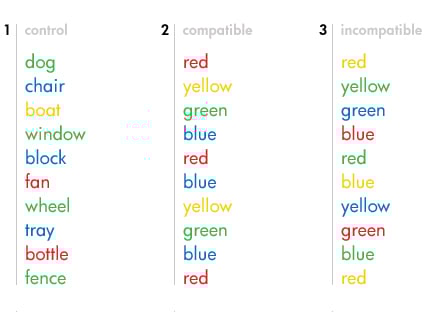
Stroop (1935) found that participants named the ink color quickly when it matched the word’s meaning, but needed far more attention when it did not.
Visual Illusions
The Necker cube is a visual illusion, an ambiguous wireframe drawing created by Louis Albert Necker (1832). Either of its two front squares can appear closer to the viewer.

Viewers can easily flip between the two orientations because the brain forms two equally probable hypotheses about the cube’s structure. Neither wins outright.
The sensory input never changes, yet the percept does: proof that perception flows from prior knowledge downward, not just from the eyes upward.
The same logic explains the Ponzo and Müller-Lyer illusions. Lines that are physically equal in length look different because depth cues that normally signal distance are triggered by a flat, two-dimensional drawing.
The brain “corrects” the lines for a depth that is not really there, so the illusion is the cost of a normally useful top-down habit.
The Hollow-Face Illusion
The hollow-face illusion is Gregory’s most striking demonstration of top-down processing. When a realistic mask is rotated to show its hollow, concave side, viewers still see a normal, convex face bulging outward.
Depth cues such as shading and motion correctly signal a hollow surface, but a lifetime of seeing convex faces overrides them. The stored expectation wins.
- Aim: To test whether the hollow-face illusion captures all visual processing equally, or only conscious perception.
- Method: Króliczak, Heard, Goodale, and Gregory (2006) had observers point at a target on the illusory face, either with a fast, flicking finger movement or with slow, deliberate pointing.
- Results: The fast movements were guided by the true hollow geometry and escaped the illusion, but slow pointing and conscious report followed the convex illusion.
- Conclusion: A fast, memory-light action route can bypass a stored prior that still dominates conscious perception, so top-down knowledge does not penetrate all vision equally.
This dissociation shows up in clinical populations too. People with schizophrenia are markedly less susceptible to the hollow-face illusion: their perception follows the true, hollow geometry rather than the convex face-prior. Brain-imaging analyses trace this to weaker top-down signalling from frontoparietal regions to visual cortex (Dima et al., 2009).
Auditory Illusions
Phonemic restoration shows that top-down processing shapes hearing as well as vision: listeners perceive speech sounds that are not physically present in the sound signal.
- Aim: To test whether listeners use top-down linguistic knowledge to restore speech sounds missing from the acoustic signal.
- Method: Warren (1970) recorded the sentence “The state governors met with their respective legislatures convening in the capital city” and replaced the first s in legislatures with a cough.
- Results: Listeners reported hearing the complete word, and struggled to say exactly where the cough had occurred.
- Conclusion: The auditory system fills the gap using word and sentence context, delivering what listeners expect to hear, not just what arrives at the ear.
Prior linguistic knowledge, not the raw sound alone, decides what we hear.
Real-World Applications of Top-Down Processing
Top-down processing is not only a laboratory curiosity. It shapes decisions in reading, policing, pain management, and hearing care, wherever the sensory signal is unclear and a judgement has to be made anyway.
Reading and Literacy
Skilled reading depends on the same top-down/bottom-up trade-off. Fast, automatic letter-and-sound decoding is bottom-up, but readers can also lean on sentence context and vocabulary, a top-down route, to identify a word that decoding alone leaves unclear.
This difference is measurable, not just a hunch.
Stanovich’s interactive-compensatory model turns this into a testable claim. Readers who are weaker at fast, context-free word recognition compensate by relying more heavily on context. Skilled readers need context least, because their decoding is already fast and accurate (Stanovich, 1980).
This reframes a familiar classroom pattern. A struggling reader who guesses words from context is not using a poor strategy. They are compensating for a weaker bottom-up skill, which has direct implications for how phonics and context-based teaching are balanced.
The underlying skill is what differs, not the strategy.
Police Shoot/Don’t-Shoot Decisions
Top-down processing also shapes split-second, high-stakes decisions. In a classic lab simulation, participants had to decide within a fraction of a second whether to shoot at armed and unarmed target figures. The stimulus itself was ambiguous.
Racial stereotypes acted as a top-down prior on the ambiguous, fast-moving scene. Participants were quicker to correctly shoot an armed Black target than an armed White target.
They were also quicker to correctly hold fire on an unarmed White target than an unarmed Black target (Correll, Park, Judd, & Wittenbrink, 2002). Expectation, not the input, decided the response.
The size of this bias tracked cultural stereotype knowledge, not the participants’ own measured prejudice. The finding is a stark demonstration that an ambiguous, briefly presented scene gets completed by whatever prior is most available.
It has informed police training that uses the same simulation to expose and reduce stereotype-driven misperception.
Pain Perception
Pain is not a direct readout of tissue damage. Expectation, attention, and belief shape it, much as they shape vision and hearing.
Wiech (2016) reviewed the brain-imaging evidence on pain and expectation. Manipulating a patient’s expectation, for example through placebo instructions or by directing attention elsewhere, changes how intense the pain feels. It also changes how active pain-processing brain regions become, even when the physical input stays the same.
This is the applied, clinical face of top-down perception. It is the mechanism behind placebo analgesia and distraction techniques. It also explains why identical tissue damage can feel more or less painful, depending on what a patient has been led to expect.
Expectation can turn the same signal into more or less pain.
Hearing in Noise
Understanding speech in background noise tests the same trade-off. Listeners lean on sentence context when the raw sound is degraded, just as Warren’s phonemic-restoration work shows in the lab.
Pichora-Fuller, Schneider, and Daneman (1995) compared younger and older listeners’ ability to identify sentence-final words masked by babble noise. High-context sentences, where the missing word was predictable, were identified far more accurately in noise than low-context sentences. Context filled the gap.
Older listeners, including those with age-related hearing loss, relied on this context even more than younger listeners, to offset their weaker hearing. The result matters for hearing-aid fitting: training a listener to use context, alongside improving the raw sound, can measurably improve real-world speech understanding.
Context did the work decoding alone could not.
Bayesian Approach
Human perception rarely relies on the senses alone. Kersten, Mamassian, and Yuille (2004) argue that the brain combines current sensory input with prior knowledge to interpret ambiguous stimuli, a process known as the Bayesian approach.
The Bayesian approach treats perception as a trade-off: how well an interpretation fits the current data, weighed against how probable it is given past experience.
This trade-off has two parts.
- Likelihood: how well each possible interpretation matches the current sensory evidence.
- Prior: how probable that interpretation is, based on everything perceived before.
When the sensory data are clear, the likelihood dominates and perception is data-driven. When the data are ambiguous, such as a shape defined only by shading, the prior takes over. The brain interprets it as whatever shape it has seen before (Kersten et al., 2004).
This is Gregory’s hypothesis, formalised as a mathematical trade-off.
This Bayesian idea has grown into a broader framework called predictive processing. In it, the brain acts like a prediction machine. Higher levels send predictions down about the causes of the input, and each lower level sends back only the mismatch, called the prediction error, to update the model.
This gives Gregory’s hypothesis a plausible mechanism in the brain. It is also the same framework behind the predictive-coding account of psychosis described below.
Critical Evaluation
Gregory’s theory is usually tested against James Gibson’s (1979) bottom-up account. Gibson argued that the senses pick up enough information from the environment directly, with no need for guesswork. The truth lies somewhere between the two.
Strengths
Top-down processing explains several things a purely bottom-up account cannot:
- Explains Illusions: It accounts for the Necker cube, the hollow-face illusion, and phonemic restoration under one principle: perception as inference.
- Efficient: Guessing the most likely interpretation is faster than analysing every feature of a scene from scratch.
- Testable: The Bayesian and predictive-processing frameworks turned Gregory’s “hypothesis” into a precise, measurable trade-off (Kersten et al., 2004).
- Clinical Relevance: Altered top-down weighting helps explain unusual perception in conditions such as psychosis.
Limitations
The theory also has real weaknesses:
- Understates the Senses: Gibson (1979) argued that a moving observer in good light picks up far richer information than Gregory assumed, leaving less for top-down processing to explain.
- Novel Stimuli: A brand-new object with no matching schema is still often perceived accurately, which the theory struggles to explain.
- Low Ecological Validity: Much of the supporting evidence comes from artificial lab displays and illusions, which may exaggerate top-down processing’s everyday role.
- Not All-or-Nothing: Fast, action-guiding movements can bypass a stored prior that still dominates conscious perception, so the illusion is not total (see the Hollow-Face Illusion above).
Contemporary Research
Recent work extends the theory to explain individual differences in perception, particularly in psychosis.
- Aim: To test whether strengthening prior knowledge improves perception of ambiguous images, and whether heavy reliance on priors relates to psychosis proneness.
- Method: Teufel et al. (2015) showed participants two-tone “Mooney” images, degraded pictures that look like meaningless blotches until the original photo reveals the hidden object. They measured recognition accuracy before and after that reveal, in healthy participants and people with early psychosis.
- Results: Prior knowledge produced a clear, measurable improvement in object detection. People with higher psychosis-proneness, and those with early psychosis, leaned on that prior knowledge even more strongly.
- Conclusion: Top-down priors normally sharpen perception, but over-relying on them, relative to the actual sensory evidence, is a marker of the psychosis-prone perceptual style.
This pattern is not unique to Teufel’s study. Powers, Mathys, and Corlett (2017) conditioned healthy people and voice-hearing patients to associate a tone with a light. Many later “heard” the tone from the light alone.
Sterzer et al. (2018) bring this evidence together into the predictive-coding account of psychosis: mis-set weighting between predictions and prediction errors produces hallucinations and delusions.
A different pattern has been proposed for autistic perception. Rather than over-weighting priors the way psychosis does, autistic perception may under-weight them, so sensory detail comes through more vividly and is shaped less by expectation (Pellicano & Burr, 2012).
This “hypo-prior” idea is an influential framework, not a settled finding. It offers one account of why autistic strengths in detail-focused processing can go together with sensory sensitivities, without treating either as a deficit.
References
Bruner, J. S., & Minturn, A. L. (1955). Perceptual identification and perceptual organization. The Journal of General Psychology, 53(1), 21-28. https://doi.org/10.1080/00221309.1955.9710133
Correll, J., Park, B., Judd, C. M., & Wittenbrink, B. (2002). The police officer’s dilemma: Using ethnicity to disambiguate potentially threatening individuals. Journal of Personality and Social Psychology, 83(6), 1314-1329. https://doi.org/10.1037/0022-3514.83.6.1314
Deregowski, J. B., Muldrow, E. S. & Muldrow, W. F. (1972). Pictorial recognition in a remote Ethiopian population. Perception, 1, 417-425.
Dima, D., Roiser, J. P., Dietrich, D. E., Bonnemann, C., Lanfermann, H., Emrich, H. M., & Dillo, W. (2009). Understanding why patients with schizophrenia do not perceive the hollow-mask illusion using dynamic causal modelling. NeuroImage, 46(4), 1180-1186. https://doi.org/10.1016/j.neuroimage.2009.03.033
Gibson, J. J. (1979). The ecological approach to visual perception. Houghton Mifflin.
Goldstein, E. B. (2018). Cognitive psychology. Mason OH: Cengage.
Gregory, R. (1970). The intelligent eye. London: Weidenfeld and Nicolson.
Kersten, D., Mamassian, P., & Yuille, A. (2004). Object perception as Bayesian inference. Annu. Rev. Psychol., 55, 271-304.
Króliczak, G., Heard, P., Goodale, M. A., & Gregory, R. L. (2006). Dissociation of perception and action unmasked by the hollow-face illusion. Brain Research, 1080(1), 9-16. https://doi.org/10.1016/j.brainres.2005.01.107
Necker, L. (1832). LXI. Observations on some remarkable optical phenomena seen in Switzerland; and on an optical phenomenon which occurs on viewing a figure of a crystal or geometrical solid. The London and Edinburgh Philosophical Magazine and Journal of Science, 1 (5), 329-337.
Palmer, S. E. (1975). The effects of contextual scenes on the identification of objects. Memory & Cognition, 3(5), 519-526. https://doi.org/10.3758/BF03197524
Pellicano, E., & Burr, D. (2012). When the world becomes “too real”: A Bayesian explanation of autistic perception. Trends in Cognitive Sciences, 16(10), 504-510. https://doi.org/10.1016/j.tics.2012.08.009
Piaget, J. (1953). The origin of intelligence in the child (International library of psychology, philosophy, and scientific method) . London: Routledge & Paul.
Pichora-Fuller, M. K., Schneider, B. A., & Daneman, M. (1995). How young and old adults listen to and remember speech in noise. The Journal of the Acoustical Society of America, 97(1), 593-608. https://doi.org/10.1121/1.412282
Powers, A. R., Mathys, C., & Corlett, P. R. (2017). Pavlovian conditioning-induced hallucinations result from overweighting of perceptual priors. Science, 357(6351), 596-600. https://doi.org/10.1126/science.aan3458
Stanovich, K. E. (1980). Toward an interactive-compensatory model of individual differences in the development of reading fluency. Reading Research Quarterly, 16(1), 32-71. https://doi.org/10.2307/747348
Sterzer, P., Adams, R. A., Fletcher, P., Frith, C., Lawrie, S. M., Muckli, L., Petrovic, P., Uhlhaas, P., Voss, M., & Corlett, P. R. (2018). The predictive coding account of psychosis. Biological Psychiatry, 84(9), 634-643. https://doi.org/10.1016/j.biopsych.2018.05.015
Stroop, J.R. (1935). Studies of interference in serial verbal reactions. Journal of Experimental Psychology, 18, 643–662.
Swets, J. (1964). Signal detection and recognition by human observers; contemporary readings. New York: Wiley.
Teufel, C., Subramaniam, N., Dobler, V., Perez, J., Finnemann, J., Mehta, P. R., Goodyer, I. M., & Fletcher, P. C. (2015). Shift toward prior knowledge confers a perceptual advantage in early psychosis and psychosis-prone healthy individuals. Proceedings of the National Academy of Sciences, 112(43), 13401-13406. https://doi.org/10.1073/pnas.1503916112
Warren, R. M. (1970). Perceptual Restoration of Missing Speech Sounds. Science, 167(3917), 392-393.
Wiech, K. (2016). Deconstructing the sensation of pain: The influence of cognitive processes on pain perception. Science, 354(6312), 584-587. https://doi.org/10.1126/science.aaf8934