If you have ADHD, you likely know the “inner emotional tornado” all too well. It’s that loud, relentless voice that labels every forgotten chore a moral failure and every workplace mistake a sign that you’re a total fraud.
This isn’t just “being hard on yourself” – it is a neurological phenomenon that leads to chronic stress and self-induced burnout.

According to Caren Magill, a prominent ADHD coach and advocate, many neurodivergent adults “OD on their own self-criticism,” trapping themselves in a state of permanent survival mode.
Renowned clinical scientist Dr. Russell Barkley adds that this isn’t a lack of willpower, but a “performance disorder” where you know what to do but your brain struggles to execute it.
This guide explores why your brain turns against you and how you can use expert-backed strategies to finally quiet the noise.
The “Feedback Loop from Hell”: What ADHD Self-Criticism Feels Like
For those with ADHD, self-criticism isn’t a quiet whisper; it’s a high-volume narrative that colors every waking moment.
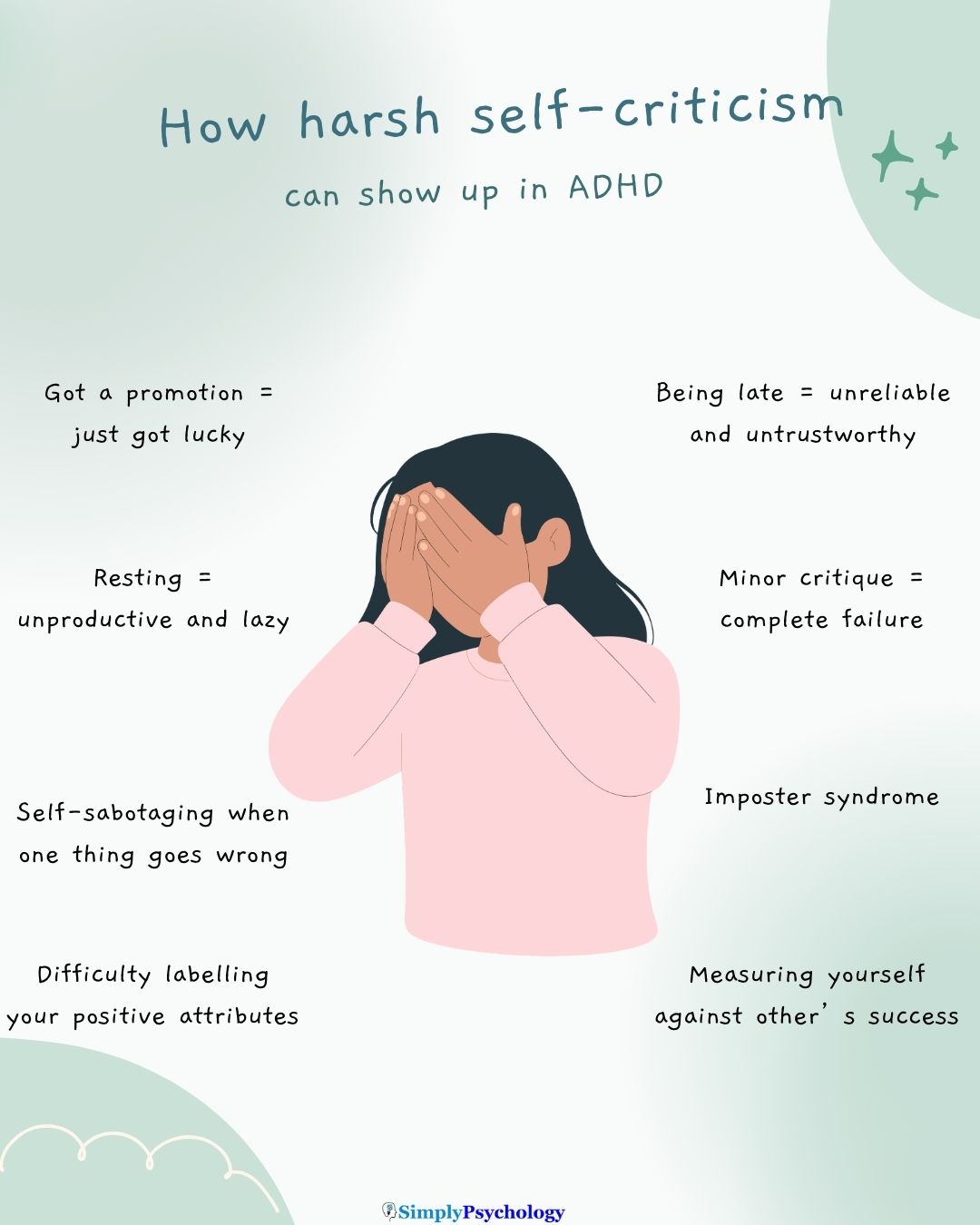
Here are common examples of how that internal narrative manifests in daily life:
1. The “Moral Failure” Loop
Instead of seeing a missed deadline as a scheduling error, you see it as a character flaw.
- The Thought: “I’m not just late; I’m a flaky, unreliable person who doesn’t respect other people’s time.”
- The Expert View: Dr. Barkley notes that ADHDers often buy into “moral misinterpretations,” labeling themselves as “lazy” or “lacking willpower” when the issue is actually neurological executive function.
2. Impostor Syndrome and the “Fraud” Narrative
When you do succeed, you don’t own the victory. You feel like you’ve just pulled off a magic trick.
- The Thought: “I only got this promotion because I got lucky or fooled them. Any day now, they’re going to realize I’m a fraud and fire me.”
- The Expert View: Magill explains this often leads to “self-sabotage,” where people quit jobs or pull away from relationships early to avoid the “inevitable” pain of being “found out.”
3. The “Broken Enough Meter”
Because it’s hard to feel a sense of completion, you never feel like you’ve done enough to earn rest.
- The Thought: “I can’t sit down and watch TV because the laundry isn’t folded, even though I worked 10 hours today. If I stop, it means I’m giving in to my laziness.”
- The Expert View: This leads to “self-induced burnout.” You overcommit and overdeliver to compensate for the “hidden” struggle of ADHD.
4. Rejection Sensitivity Spirals
A small piece of neutral feedback is interpreted as a total rejection of your worth.
- The Thought: “My boss asked for a tiny edit on that report. That means the whole thing was garbage, she hates my work, and everyone in the office thinks I’m incompetent.”
- The Expert View: This is often linked to Rejection Sensitive Dysphoria (RSD), where the brain’s fear center (the amygdala) perceives a social critique as a physical threat.
5. Comparing Your “Behind-the-Scenes” to Others’ “Highlights”
You judge your internal struggle against the polished exterior of neurotypical people.
- The Thought: “Why can everyone else just remember to pay their bills or keep their kitchen clean? I’m an adult; I should be able to do this. I am fundamentally broken.”
- The Expert View: Magill refers to this as living in “The Gap.” You are measuring your progress against an unreachable “ideal” version of yourself rather than looking at how much effort you are actually putting in to navigate a world not built for your brain.
“The more exhausted I am, the less capable I feel… all of the guilt and the shame and the ‘who I’m letting down’ are bright colors, full volume in my head.” — Anonymous ADHD Perspective
Why Your Brain Is Wired for Self-Judgment
It is important to understand that your inner critic didn’t appear out of thin air. It is a byproduct of how your brain interacts with the world.
1. A Lifetime of Negative Feedback
By the time a child with ADHD reaches adulthood, they have often received significantly more corrections and reprimands than their neurotypical peers (e.g., “sit still!”, “stop talking!”).
Caren Magill explains that this trains your brain to stop trusting its own capabilities, making you constantly look to others to validate your worth.
2. The “Gap” vs. The “Gain”
Magill references a framework called The Gap and the Gain. Most humans—but especially those with ADHD—measure themselves against an unreachable, “ideal” version of who they think they should be (The Gap).
When you live in the Gap, you focus entirely on what is missing, which paralyzes your ability to take action.
3. The Performance Gap
Dr. Russell Barkley emphasizes that ADHD is a biological disability of the executive system. You have the intelligence, but the “wiring” makes it hard to apply that knowledge at the “point of performance.”
When you fail to do something you know how to do, you naturally (but incorrectly) label yourself as “lazy” or “defective.”
Expert-Backed Strategies to Quiet the Inner Critic
You cannot simply “think” your way out of a neurological response, but you can use these tactical shifts suggested by Caren Magill and Dr. Russell Barkley to change the narrative.
Use the “Impostor Game”
Instead of fighting the feeling that you’re a fraud, Magill suggests leaning into it. Ask yourself: “I wonder how far I can get away with this?”
By turning the fear into a game, you lower the stakes, calm the amygdala, and allow your brain to start problem-solving again.
Measure Backwards
To escape “The Gap,” deliberately look backward. Acknowledge the skills you’ve learned and the challenges you’ve survived over the last year.
Instead of comparing yourself to others, compare your present self to your self a year ago. This focus on the “Gain” builds the dopamine and confidence needed to move forward.
Seek “High Value, Low Effort”
To stop the cycle of overworking to prove your worth, Magill recommends a new mantra: “What is the highest value I can provide with the lowest effort?”
This isn’t about being lazy; it’s about being strategic with your limited energy “spoons” to prevent burnout.
The “Locker Room Pep Talk”
Dr. Russell Barkley suggests using positive self-speech to refuel your executive “fuel tank.” Use statements of self-efficacy like, “I can do this, I’ve handled hard things before.” This acts as a manual override for negative self-talk.
Shifting from Shame to Science
The path to healing begins with education. As Dr. Barkley notes, recognizing that ADHD is a neurogenetic, biological condition—not a character flaw—is the most crucial step. It allows you to “own” your ADHD traits rather than moralizing them.
Checklist: Your Next Steps for Self-Compassion
- [ ] Name the feeling: When you feel a spiral starting, say out loud, “This is Rejection Sensitivity” or “This is my inner critic.” Naming it creates distance.
- [ ] Question the “Truth”: Ask yourself, “Would I believe this if a friend said it about themselves?”
- [ ] Celebrate “Small” Wins: Congratulate yourself for basic tasks like doing the dishes or answering an email. This builds positive self-worth.
- [ ] Consult a Professional: Discuss medication or ADHD-specific Cognitive Behavioral Therapy (CBT) with a doctor. These tools can quiet the physiological “noise” of negative thoughts.