Autocratic leadership is a management style in which a single leader holds absolute power and makes decisions with little to no input from employees or group members.
The defining characteristic of an autocratic leader is that workers are not allowed to participate in the decision-making process.
This leadership style involves clear direction, unilateral decision-making, and strict control over organizational activities.
While it can lead to quick decision-making, it may discourage creative collaboration and lower employee morale.
| Advantage | Disadvantage |
| Speed: Rapid decision-making in crises. | Turnover: High rates of employee burnout. |
| Clarity: No confusion over roles or tasks. | Stagnation: Lack of innovation and creativity. |
| Consistency: Uniform outputs and standards. | Dependency: The team may struggle if the leader is absent. |

Characteristics
Scholars in organizational behavior generally identify three defining characteristics of the autocratic leadership style.
While this model excels in high-stakes or time-sensitive environments, it often faces challenges regarding long-term employee engagement.
1. Centralized Decision-Making
Autocratic leadership is characterized by a concentration of power in a single individual.
In this model, the leader makes decisions independently, rarely seeking or incorporating input from stakeholders.
-
The Mechanism: This relies on a strict top-down communication flow.
-
The Impact: By excluding employees from the participative process, the leader ensures rapid execution but risks overlooking valuable frontline insights.
2. High Structural Rigidity
Autocratic organizations are defined by a rigid hierarchy that eliminates ambiguity regarding authority.
This structure is designed to maximize operational efficiency and maintain order.
-
The Efficiency Paradox: While the clear power dynamic prevents “decision paralysis,” the resulting environment can be detrimental to morale.
-
The Psychological Climate: Close monitoring and high levels of oversight can create a culture of compliance driven by extrinsic pressure—or even fear—rather than intrinsic motivation.
3. Standardized Rules and Processes
To maintain control and predictability, autocratic leaders implement exhaustive rules and clearly defined roles.
Every team member has a specific “lane,” and deviation is rarely permitted.
-
The Creative Cost: While these processes ensure consistency, they often signal to employees that their individual perspective is undervalued.
-
The Result: A byproduct of this standardization is the suppression of “differential thinking.” Because there is no room for experimentation, innovation and creative problem-solving are frequently stifled.
Examples
Autocratic Leadership in Political History
History provides extreme examples of autocratic regimes. These are government systems where a single person or party holds total power over the population.
Historical and Political Dictators
Hitler, Stalin, and Pol Pot relied on legitimate authority.
This psychological concept refers to power that is recognized as “rightful” within a specific hierarchy.
These leaders issued unilateral orders that compelled citizens to commit cruel acts.
By maintaining a strict social hierarchy, they ensured that their dangerous commands remained unquestioned by the masses.
Control of Information
Modern authoritarian regimes maintain dominance by suppressing institutional autonomy, or the independence of organizations like the media.
By exerting pressure on journalists, these regimes control the public narrative.
Why do they do this?
Controlling information limits the ability of citizens to organize or challenge the leader’s decisions.
Authoritarianism in the Modern Workplace
The workplace often mirrors these power dynamics, particularly in environments involving regimented labor.
Industrial Factory Managers
In many factories, managers exhibit a highly authoritarian style to maintain productivity.
These leaders independently determine work conditions and dictate exact procedures for every task.
Workers typically have no participation in the decision-making process.
If an employee fails to meet predetermined levels, they face immediate termination.
The Muczyk and Reimann Leadership Model
Researchers Muczyk and Reimann expanded the definition of autocracy by looking at supervisory oversight.
This refers to how closely a leader monitors the execution of tasks after a decision is made.
The Directive Autocrat
A directive autocrat combines unilateral decision-making with high levels of micromanagement.
This term describes a management style where a leader closely observes and controls the minute details of an employee’s work.
-
The Process: The leader makes a choice and then provides strict, step-by-step instructions.
-
Global Context: Research indicates that this directive style is a broad concept applicable across many different cultures.
The Permissive Autocrat
In contrast, a permissive autocrat retains all decision-making power but allows employees some freedom in how they execute those decisions.
This is the freedom for workers to decide how they will complete their assigned duties.
-
The Process: After the leader makes a solo decision, they allow the staff to “get on with it” without constant interference.
-
Execution: The leader provides the “what” (the goal) but ignores the “how” (the process).
Consider a hypothetical leader named Rashida. She exemplifies this style by refusing to allow employees to participate in any high-level planning.
However, once she assigns a task, she does not closely monitor her staff. This approach maintains the leader’s status as the sole authority while reducing the need for constant supervision.
The Vroom-Yetton Normative Decision Theory
The Normative Decision Theory provides a framework for determining the best leadership style based on the specific situation.
This model suggests that autocratic leaders vary in how they acquire the data needed to make a choice.
AI: The Pure Autocrat
In the AI (Autocratic) strategy, the leader solves a problem entirely by themselves.
They rely only on the information currently available to them at that moment.
This approach is highly efficient when the leader already possesses all the necessary technical expertise.
AII: The Informed Autocrat
The AII (Autocratic) strategy involves the leader making the final decision alone after gathering data from the workforce.
While the leader interacts with employees, this is not a collaborative process.
They specifically seek instrumental information, or raw data needed for the task, rather than asking for opinions or suggestions.
Advantages
Efficiency and Rapid Decision-Making
The most immediate benefit of an autocratic approach is the speed of execution.
Because the leader does not wait for a group to reach an agreement, they bypass the delays inherent in democratic systems.
The AI Strategy in Practice
In Vroom and Yetton’s Normative Decision Theory, the AI (Autocratic) strategy has a leader solve a problem entirely alone.
They rely only on the information already at hand.
This “lone wolf” approach gives an organization operational agility: the ability to react quickly to changing circumstances.
In fast-paced environments, the time saved by skipping meetings can be a real competitive advantage.
Leveraging Experienced Workforces
Autocracy does not always imply constant supervision.
The permissive autocrat model provides a unique balance of high-level control and task-level freedom.
The Permissive Autocrat
A permissive autocrat makes all the primary decisions but does not engage in micromanagement. Instead, they allow their staff to “get on with it” once a directive is issued.
-
When it works: This style is highly effective when the workforce is technically proficient, meaning they have the high-level skills needed to work without guidance.
-
The Result: The leader maintains the vision, while the employees enjoy a sense of trust in their execution.
Leadership in High and Low Control Situations
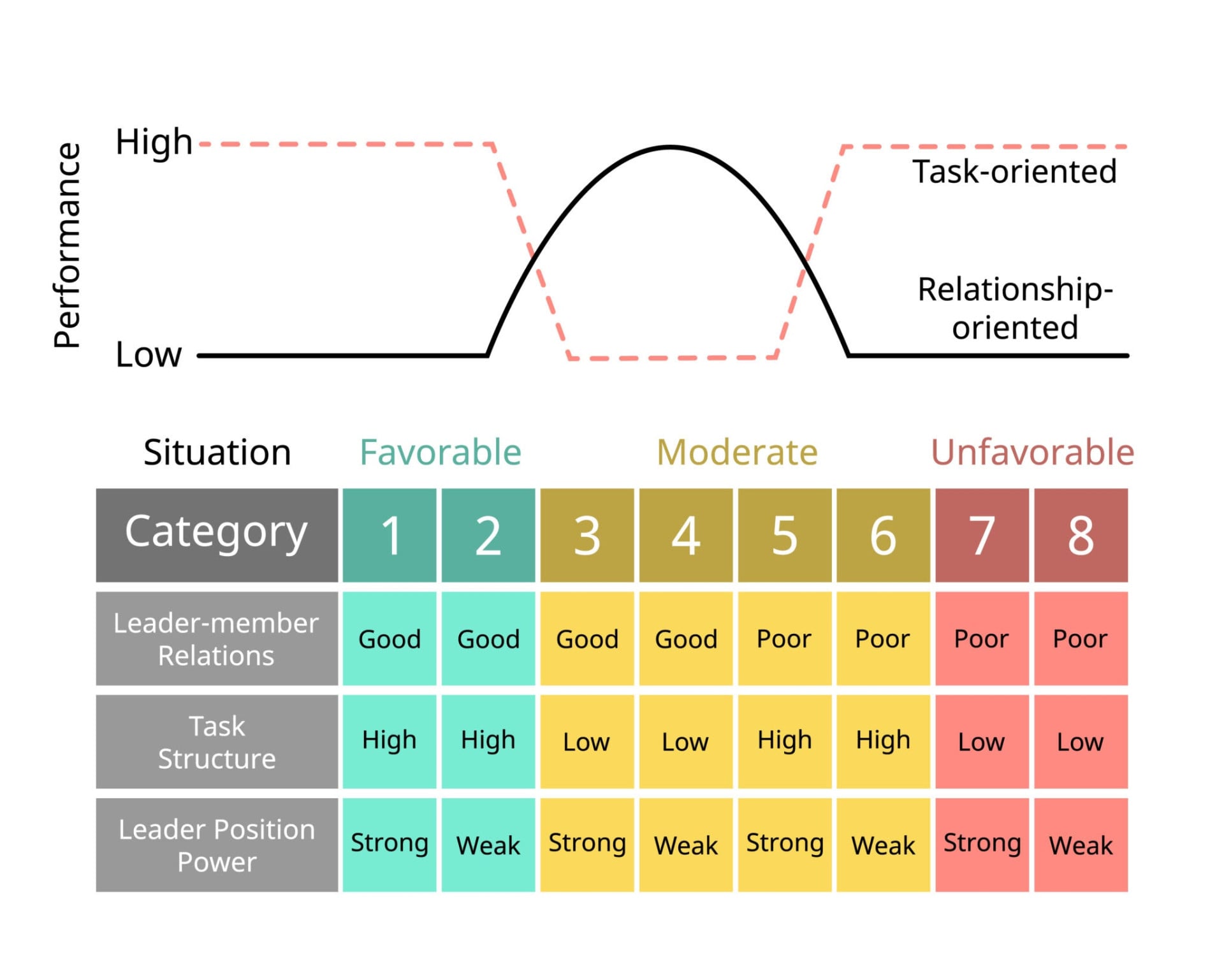
According to Fiedler’s Contingency Theory, a leader’s effectiveness depends on how “favorable” the situation is. Favorableness combines three things: how good the leader’s relationship is with the team, how clearly the task is defined, and how much formal power the leader’s position carries.
This theory argues that task-oriented leaders, those who focus on goals over interpersonal relationships, excel in two specific extremes.
High-Control Environments
In stable, highly structured environments, a directive leader can maintain peak performance.
When the leader’s position is already established and the tasks are well-defined, autocratic clear-headedness ensures the machine keeps running smoothly.
Low-Control (Chaotic) Environments
Conversely, in chaotic or unstructured situations, an authoritative leader provides a necessary “anchor.”
When a project is failing or the team is confused, the leader steps in to provide structural imposition.
This is the act of creating order and strict rules where none previously existed, driving the group toward a successful outcome through sheer force of will.
Cross-Cultural Versatility
Many leadership styles are sensitive to cultural dimensions, which are the specific values (like individualism or collectivism) that vary by region.
However, autocratic leadership has shown remarkable resilience across borders.
According to the Muczyk and Reimann model, autocracy and directive leadership are versatile concepts.
They can be effectively applied across a wide variety of global cultures, making them a “universal” language of management.
Societal and Structural Necessity
From a sociological perspective, some theorists argue that authority is the glue that holds civilization together.
The Freudian Perspective
Sigmund Freud posited that humans often lack the natural motivation for instinctual renunciation.
This term refers to the act of giving up immediate personal desires for the greater good of the community.
Freud argued that the “masses” are rarely moved by rational arguments. Therefore, society requires authoritative leaders to provide coercive influence.
Without a strong leader to set directives and organize labor, society might struggle to perform the difficult tasks necessary for its survival.
Disadvantages of Autocratic Leadership
Organizational Failures and Mismanagement
In a professional setting, the absence of collaborative input can lead to systemic inefficiencies and a toxic culture.
Reduced Productivity and Guidance
The “permissive autocrat” style allows for rapid decisions but often fails during the execution phase.
This occurs because the leader avoids micromanagement, or the close observation of employees, even when it is necessary.
-
The Risk: If a workforce lacks the technical expertise to work independently, production will likely stall.
-
The Outcome: Without a feedback loop, the leader remains unaware of the guidance the team actually requires to succeed.
Toxic “Theory X” Environments
Many autocratic managers operate under Theory X, a psychological assumption that employees are inherently lazy and avoid responsibility (McGregor, 1960).
Consequently, these managers rely on threats and punishments rather than positive motivation.
-
Scapegoating: When systems fail, Theory X managers often blame individual employees instead of fixing the underlying policy.
-
Suspicion: This mindset creates a pervasive atmosphere of distrust, where the leader constantly questions the motivations of their staff.
Occupational Health and Physiological Stress
The lack of job autonomy, or the ability to make choices about one’s own work life, has measurable physical consequences.
The Demand-Control Model
Research in occupational health on the demand-control model shows that high-demand roles with low control create extreme physiological strain (Karasek, 1979).
Study: Autonomy and Cardiovascular Health
Aim: To investigate the link between workplace autonomy and heart disease.
Procedure: Researchers monitored the health outcomes of workers in high-demand jobs with varying levels of decision-making power.
Findings: Workers with low autonomy experienced significantly higher blood pressure.
Conclusions: Employees with minimal control over their work lives are up to four times more likely to die of a heart attack than those with high autonomy.
Social and Psychological Pathologies
Autocracy can also foster negative personality traits and dangerous social dynamics.
The Authoritarian Personality
Psychologists use the term authoritarian personality to describe individuals who are rigid, inflexible, and intolerant of ambiguity (Adorno et al., 1950).
This mindset divides the world into a strict “us versus them” hierarchy.
-
Prejudice: These individuals often express contempt for those they perceive as “weak” or of lower status.
-
Scapegoating: This is a psychological defense mechanism where a person displaces their own repressed hostility onto minority groups. Consequently, this leadership style often breeds deep-seated discrimination.
The Danger of Destructive Authority
In extreme cases, legitimate authority, power perceived as socially “rightful”, can become destructive.
Historical and psychological evidence, including Milgram’s (1963) obedience experiments, shows that autocratic leaders can compel subordinates to commit cruel acts.
When power is unquestioned, it can override the individual conscience of the follower, leading to state-sponsored violence or cult-like behavior.
Negative Outcomes in Child-Rearing
The disadvantages of the autocratic approach are also evident in developmental psychology.
Authoritarian Parenting
Authoritarian parents are those who demand unquestioning obedience and set rigid standards without explanation (Baumrind, 1966).
Unlike authoritative parents who allow for discussion, authoritarian parents refuse to tolerate disagreement.
-
Impact on Children: Youth raised in these environments are often relatively withdrawn, unsociable, and unfriendly.
-
Emotional State: Because they lack the freedom to develop their own identity, these children tend to be more anxious and unhappy than their peers.
Critical Evaluation
Two further questions test autocratic leadership’s real-world value in the 2020s: how it holds up in large modern studies, and whether its advantages travel across cultures.
Contemporary Research
The largest recent synthesis of leadership research asks a simple question: does authoritarian control help or harm employees? The answer is stark.
Lin, Yang, and Shen (2025) meta-analysed 137 studies and 45,228 participants across 12 leadership styles, testing each against employees’ sense of belonging at work.
Study: Leadership Style and Feeling Like an Insider
Aim: To identify which leadership styles most strongly predict whether employees feel accepted as organisational insiders.
Method: Lin, Yang, and Shen (2025) meta-analysed 137 studies covering 45,228 participants, pooling effect sizes for 12 leadership styles against employees’ reported sense of belonging.
Results: Eleven styles, including participative and servant leadership, correlated positively with belonging. Authoritarian leadership was the only style that correlated negatively.
Conclusion: Relational and inclusive styles build belonging, while authoritarian control undermines it, regardless of the setting studied.
A separate 2026 meta-analysis of 54 studies from public hospitals worldwide found a similar pattern. Relational styles such as leader-member exchange and servant leadership again predicted lower staff turnover (Johansen et al., 2026).
But distance mattered. The benefit shrank as leaders grew more socially remote from their teams. Twice over, authoritarian-style control is the outlier that relational leadership beats.
Cultural Bias and Generalizability
Autocratic leadership’s reputation for cross-cultural versatility comes with a caveat: acceptance of top-down control varies by culture. Hofstede’s concept of power distance describes how far a culture accepts an unequal spread of power between leaders and everyone else.
Not every culture agrees.
High-power-distance cultures, including many in Asia, the Middle East, and Latin America, tend to accept hierarchical, autocratic leadership more readily. Low-power-distance cultures, such as Scandinavia and the Netherlands, favour egalitarian and participative approaches instead.
This matters for the evidence above. The meta-analyses behind these findings are dominated by Western samples. Their conclusions may not generalise to cultures where deference to authority is the norm, not the exception.
This nuances the versatility already discussed above. Autocratic leadership travels well in principle, but how well it lands still depends on the culture receiving it.
Further Information
- Wang, H., & Guan, B. (2018). The positive effect of authoritarian leadership on employee performance: The moderating role of power distance. Frontiers in Psychology, 9, 357.
- Gastil, J. (1994). A meta-analytic review of the productivity and satisfaction of democratic and autocratic leadership. Small Group Research, 25(3), 384-410.
Which group would use an autocratic leadership style?
An autocratic leadership style might be utilized in environments that require strong direction and unquestionable authority. This could include the military, law enforcement agencies, or manufacturing sectors where safety and procedure adherence are paramount.
It might also be used in crisis situations where swift and decisive action is necessary. However, it’s less suitable in settings that require creativity, innovation, and collaborative decision-making, like many tech or design firms.
What is the difference between authoritarian and autocratic leadership?
Authoritarian and autocratic leadership styles share similarities in that they both involve a high degree of control and decision-making power concentrated in the leader. However, there are subtle differences.
Autocratic leaders make decisions without input or consultation from others. They set policies and procedures and expect subordinates to follow without question.
While making most decisions themselves, authoritarian leaders can be more manipulative or coercive, maintaining control by creating an environment of fear or through strict discipline. This style may involve more feedback (although largely one-way) than the autocratic style.
In practice, these terms are often used interchangeably, and the exact definitions can vary slightly depending on the source.
What are the disadvantages of autocratic leadership?
Disadvantages of autocratic leadership include stifling creativity and innovation, as input from team members is rarely sought. It can also lead to low employee morale, high turnover, and a lack of personal growth for team members.
Lastly, it relies heavily on the leader, creating a risk if the leader is absent or makes poor decisions.
What are the advantages of autocratic leadership?
Autocratic leadership can result in quick decision-making, as only one person makes the decisions. It can be effective in situations requiring strong direction and control, like crisis management.
This style can also ensure consistency in operations, and it’s beneficial when team members are inexperienced and need clear, direct instructions.
Key Takeaways
- Definition: Autocratic leadership concentrates decision-making in one leader, with little or no input from employees.
- Speed vs. Morale: It enables fast decisions but risks lower morale and less creative collaboration.
- Two Autocrat Types: Muczyk and Reimann (1987) distinguish directive autocrats, who micromanage execution, from permissive autocrats, who decide alone but let staff choose how to execute.
- Vroom-Yetton Model: The normative decision theory splits autocratic decisions into AI (deciding entirely alone) and AII (gathering data first, then deciding alone).
- Best Fit: The style suits crises, safety-critical work, and unskilled or time-pressed teams, and fits less well where creativity and buy-in matter most.
- Modern Evidence: A 2025 meta-analysis of 45,228 employees found authoritarian leadership is the only style linked to feeling like an outsider at work.
References
Adorno, T. W., Frenkel-Brunswik, E., Levinson, D. J., & Sanford, R. N. (1950). The authoritarian personality. Harper & Row.
Anthony M.K., Standing T.S., Glick J., et al. (2005) Leadership and nurse retention. Journal of Nursing Administration 35 (3),146–155.
Bass, B. M., & Stogdill, R. M. (1990). Bass & Stogdill’s handbook of leadership: Theory, research, and managerial applications. Simon and Schuster.
Baumrind, D. (1966). Effects of authoritative parental control on child behavior. Child Development, 37(4), 887–907.
Guo, L., Decoster, S., Babalola, M. T., De Schutter, L., Garba, O. A., & Riisla, K. (2018). Authoritarian leadership and employee creativity: The moderating role of psychological capital and the mediating role of fear and defensive silence. Journal of Business Research, 92, 219-230.
Fiedler, F. E. (1967). A theory of leadership effectiveness. McGraw-Hill.
Freud, S. (1930). Civilization and its discontents. Hogarth Press.
Hardin (1968). The tragedy of the commons.. Science (New York, N.Y.), 162(3859), 1243–1248.
Harms, P. D., Wood, D., Landay, K., Lester, P. B., & Lester, G. V. (2018). Autocratic leaders and authoritarian followers revisited: A review and agenda for the future. The Leadership Quarterly, 29 (1), 105-122.
Hirschman, A. O. (1970). Exit, voice, and loyalty: Responses to decline in firms, organizations, and states (Vol. 25). Harvard university press. Hobbes, T (1651/1939).
Johansen, S. B., Bentzen, T. Ø., & Christensen, S. L. (2026). Going the distance? A meta-analysis of leadership styles, social distance, turnover intention, and organizational commitment. Social Science & Medicine, 405, Article 119555. https://doi.org/10.1016/j.socscimed.2026.119555
Karasek, R. A. (1979). Job demands, job decision latitude, and mental strain: Implications for job redesign. Administrative Science Quarterly, 24(2), 285–308.
Leviathan. New York: Modern Library Koukkanen L. & Katajisto J. (2003) Promoting or impending empowerment? Nurses assessment of their work environment Journal of Nursing Administration 33, 209–215.
Lewin, K., Lippitt, R., & White, R. K. (1939). Patterns of aggressive behavior in experimentally created “social climates”. The Journal of Social Psychology, 10 (2), 269-299.
Lin, Y., Yang, Y., & Shen, Y. (2025). The associations between leadership styles and perceived insider status: A meta-analysis. Frontiers in Psychology, 16, 1631075. https://doi.org/10.3389/fpsyg.2025.1631075
Maboko, D. R. (2012). Nursing leadership in an academic hospital in Gauteng. Journal of nursing management, 20 (7), 912-920.
McGregor, D. (1960). The human side of enterprise. McGraw-Hill.
Messick, D. M., Wilke, H., Brewer, M. B., Kramer, R. M., Zemke, P. E., & Lui, L. (1983). Individual adaptations and structural change as solutions to social dilemmas. Journal of Personality and Social Psychology, 44 (2), 294.
Milgram, S. (1963). Behavioral study of obedience. The Journal of Abnormal and Social Psychology, 67(4), 371-378. https://doi.org/10.1037/h0040525
Milgram, S. (1974). Obedience to authority: An experimental view. Harper & Row.
Murphy, L. (2005). Transformational leadership: a cascading chain reaction.Journal of Nursing Management, 13 (2), 128-136.
Muczyk, J. P., & Reimann, B. C. (1987). The case for directive leadership. Academy of Management Executive, 1(4), 301–311.
Nadarasa, T., & Thuraisingam, R. (2014). The influence of principals’ leadership styles on school teachers’ job satisfaction–study of secondary school in Jaffna district. International Journal of Scientific and Research Publications, 4 (1), 1-7.
Olson, M. (1965). The logic of collective action: Public goods and the theory of groups. Cambridge, MA: Harvard University Press.
Strachota, E., Normandin, P., O’Brien, N., Clary, M., & Krukow, B. (2003). Reasons registered nurses leave or change employment status. JONA: The Journal of Nursing Administration, 33 (2), 111-117.
Van Vugt, M., Jepson, S. F., Hart, C. M., & De Cremer, D. (2004). Autocratic leadership in social dilemmas: A threat to group stability. Journal of Experimental Social Psychology, 40 (1), 1-13.
Vroom, V. H., & Yetton, P. W. (1973). Leadership and decision-making. University of Pittsburgh Press.
Vroom, V. H., & Jago, A. G. (1988). The new leadership: Managing attitudes in organizations. Prentice-Hall.
Weiskittel, P. (1999). The concept of leadership. Nephrology Nursing Journal, 26 (5), 467.
Yukl, G. A. (1989). Leadership in organizations. Engelwood Cliffs, NJ: 1364 Prentice-Hall.
Ziller, R. C. (1965). Toward a theory of open and closed groups. Psychological Bulletin, 6 4(3), 164.