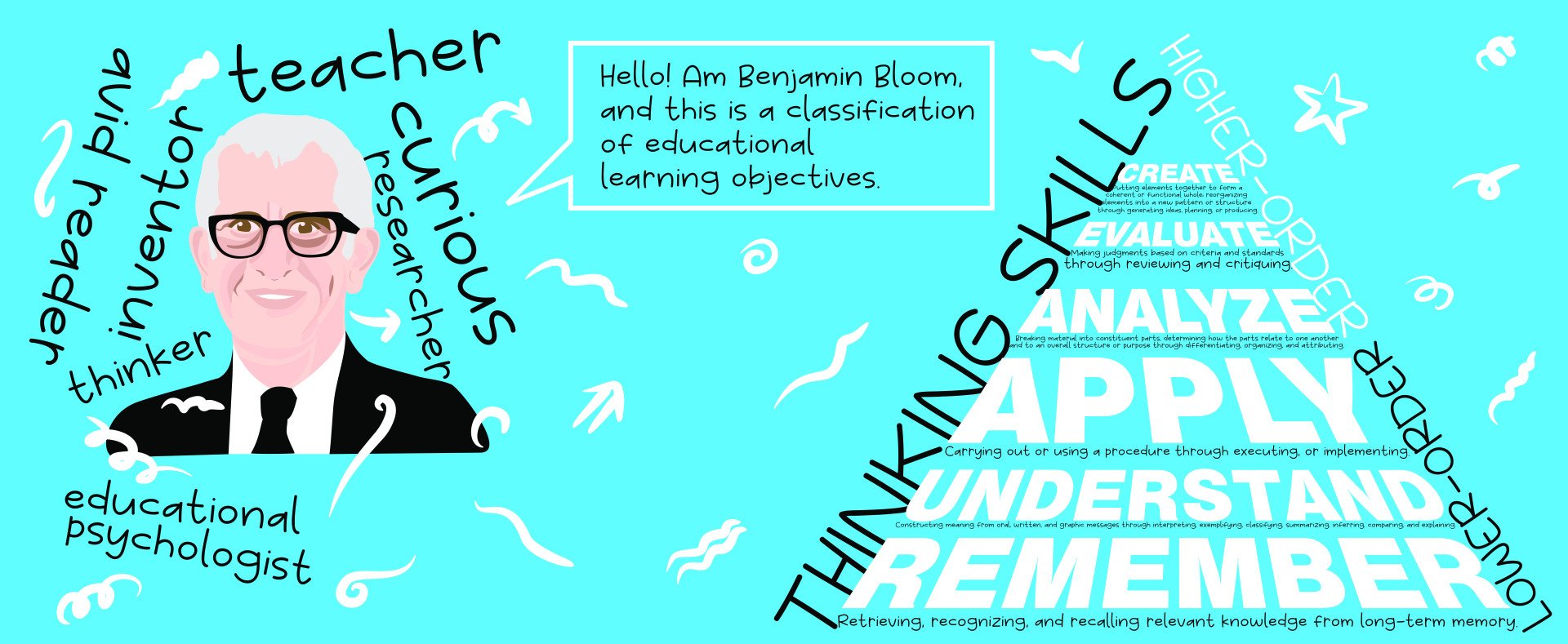
Bloom’s Taxonomy is a hierarchical framework that educators use to classify and structure educational objectives. It ranks them by complexity and specificity.
This taxonomy encompasses three primary domains: cognitive (intellectual processes), affective (emotional responses and attitudes), and psychomotor (physical skills and abilities).
Key Takeaways
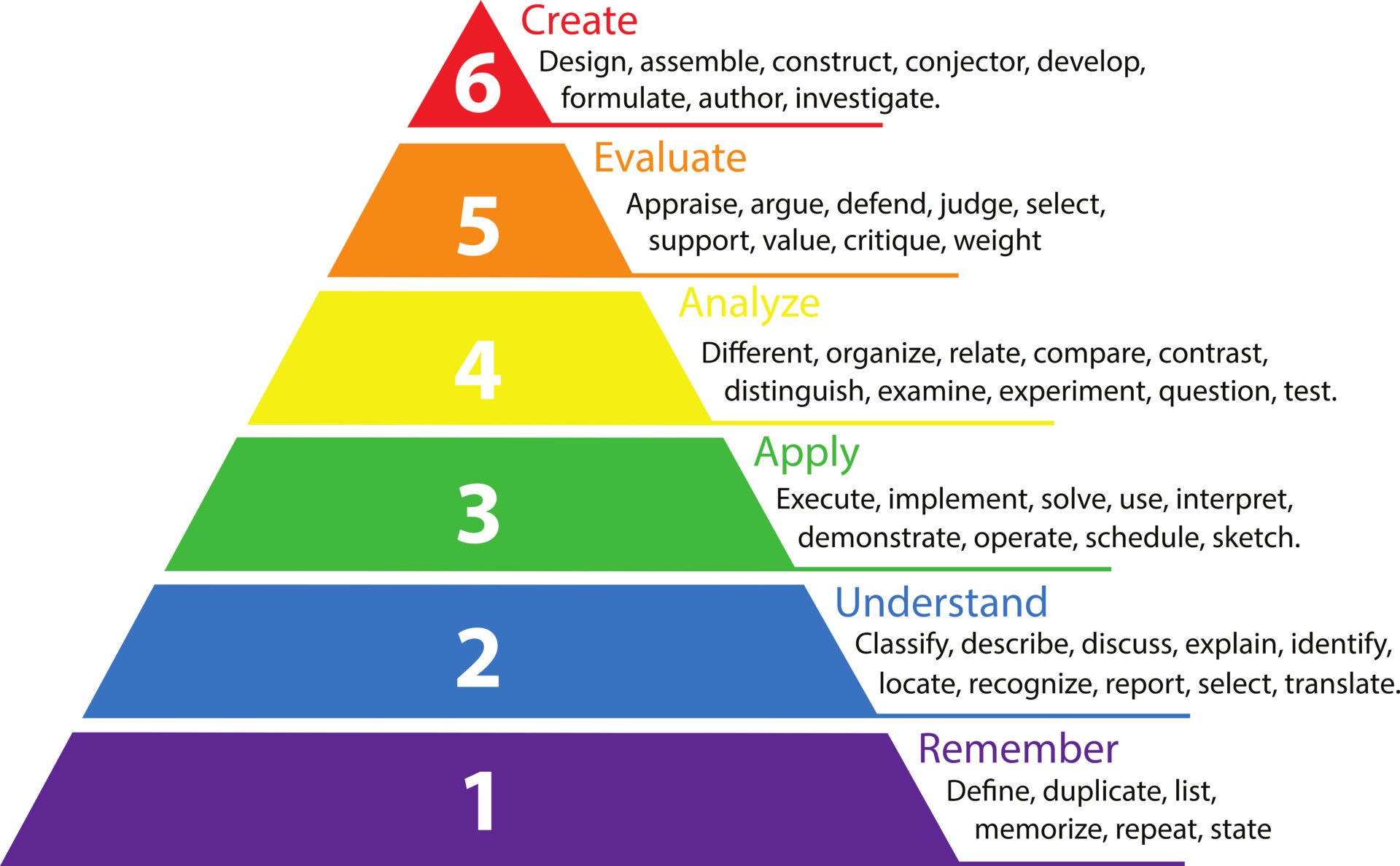
- Hierarchical Structure: Bloom’s Taxonomy classifies cognitive skills into six progressively complex levels, suggesting that learners must master lower-level skills like remembering and understanding before moving on to higher-level skills like analyzing and creating.
- Actionable Verbs: The Revised Taxonomy uses active verbs (Remember, Understand, Apply, Analyze, Evaluate, Create) to clearly define measurable learning objectives, making it an essential tool for creating concrete goals for any educational activity.
- Curriculum Design: Educators utilize the taxonomy to structure course content logically, ensuring a clear progression from basic knowledge acquisition to more complex critical thinking and problem-solving skills across a unit or entire course.
- Assessment Alignment: The framework helps ensure that assessment questions and activities are appropriately matched to the desired level of thinking, moving beyond simple quizzes to include opportunities for evaluation and innovation.
- Three Domains: While the six-level cognitive domain is the most recognized, the full taxonomy also addresses the affective domain (attitudes and values) and the psychomotor domain (physical skills), offering a holistic view of learning.
- Contested Hierarchy: The levels overlap, and people often learn by applying and creating first. Treat the taxonomy as a planning heuristic, not a law (Anderson & Krathwohl, 2001).
Bloom’s Taxonomy systematically organizes learning objectives within three distinct domains, each progressing from simpler to more complex skills:
-
Cognitive Domain (mental skills and intellectual development)
-
Affective Domain (emotional attitudes, values, and appreciation)
-
Psychomotor Domain (physical coordination and motor skills)
Educators employ this taxonomy to clarify learning goals, structure course content, and align assessments effectively.
Origins of Bloom’s Taxonomy
The taxonomy began in informal meetings of college and university examiners, starting at the 1948 Convention of the American Psychological Association. They wanted to cut the labor of exchanging test items and to build a common framework for classifying the intended outcomes of instruction (Bloom, 1956; Krathwohl, 2002).
Bloom, then an examiner at the University of Chicago, chaired the group. The first handbook, on the cognitive domain, appeared in 1956.
Companion handbooks followed for the affective domain (Krathwohl, Bloom, & Masia, 1964) and, through other authors, the psychomotor domain.
The aim was practical rather than theoretical. Naming the kinds of thinking an objective demands lets teachers write clear learning objectives. It also helps them plan instruction that climbs from lower- to higher-order skills, and design assessments that test the intended level, not just recall.
Bloom later linked the framework to mastery learning. This is the claim that most students can reach a high standard, given clear objectives, ongoing feedback, and enough time (Bloom, 1971; Guskey, 2005).
Original Cognitive Domain (1956)
In its original 1956 form, Bloom’s cognitive domain used nouns to name a hierarchy of six levels. It runs from Knowledge, the simple recall of facts, to Evaluation, the ability to judge the value of ideas or materials.
The handbook was more detailed than its six headings suggest. Each category was divided into named subcategories to help examiners sort test items (Bloom, 1956; Krathwohl, 2002). Knowledge, for example, split into knowledge of specifics, of ways and means of dealing with specifics, and of universals and abstractions.
Comprehension split into translation, interpretation, and extrapolation. Evaluation split into judgments made against internal evidence and against external criteria. Popular pyramid diagrams rarely show these subcategories.
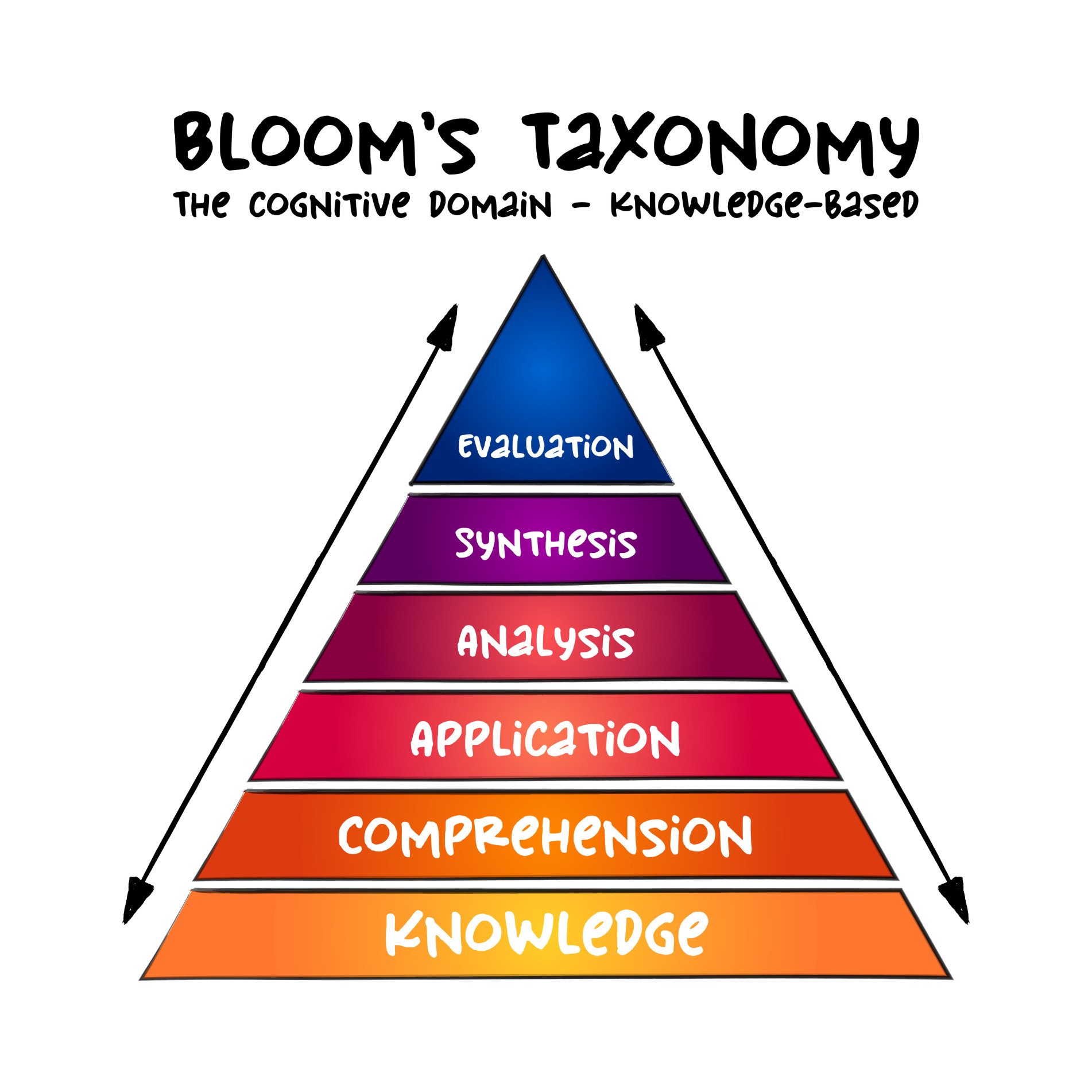
Bloom’s original taxonomy exclusively focused on cognitive development and was organized as follows:
-
Knowledge: Recalling information and basic facts (e.g., historical dates, mathematical symbols, scientific terms).
-
Comprehension: Understanding concepts and interpreting meaning (e.g., summarizing theories).
-
Application: Utilizing learned information in practical contexts (e.g., solving mathematical problems, conducting lab experiments).
-
Analysis: Breaking down information into parts to examine relationships (e.g., comparing literature themes).
-
Synthesis: Combining knowledge to form new ideas or solutions (e.g., developing original hypotheses).
-
Evaluation: Judging information based on criteria and standards (e.g., critiquing research methodologies).
The Revised Cognitive Taxonomy (2001)
The 2001 revision by Krathwohl and Anderson shifted Bloom’s original cognitive categories from passive nouns to active verbs, emphasizing learner engagement and active participation.
This revised taxonomy emphasizes a more dynamic approach to education instead of shoehorning educational objectives into fixed, unchanging spaces.

1. Remembering: Recalling facts and basic concepts
-
Action verbs: list, define, identify, recall, name, state, describe
-
Example: Naming chemical elements on the periodic table.
2. Understanding: Explaining ideas and concepts
-
Action verbs: explain, summarize, interpret, paraphrase, illustrate, classify
-
Example: Summarizing the main ideas of a historical text.
3. Applying: Using information practically in new situations
-
Action verbs: apply, use, demonstrate, implement, execute, solve
-
Example: Solving math problems using learned formulas.
4. Analyzing: Breaking information into components to explore relationships
-
Action verbs: analyze, compare, contrast, examine, differentiate, categorize
-
Example: Comparing themes in different literary texts.
5. Evaluating: Judging the value of information or ideas based on criteria
-
Action verbs: evaluate, assess, critique, justify, argue, defend, rate
-
Example: Critically assessing the validity of a research study.
6. Creating: Producing new or original work
-
Action verbs: create, design, invent, develop, construct, compose, propose
-
Example: Designing an original science experiment.
Importance of Higher-Order Thinking
Using Bloom’s Taxonomy, curriculum design seeks to progress students from foundational knowledge (LOTS) to higher-order thinking skills (HOTS).
HOTS go beyond rote memorization and simple application. These skills involve critical and creative judgment, demanding the restructuring of knowledge.
This progression equips them with the critical and adaptive skills required for complex problem-solving.
Fostering higher-order thinking skills (Analyzing, Evaluating, and Creating) is crucial in modern education. These skills help learners:
-
Apply knowledge creatively and critically in novel situations.
-
Move beyond rote memorization to deep, meaningful understanding.
-
Become independent, adaptive learners capable of problem-solving and innovation.
Higher-order thinking is essential in the 21st century, preparing students to face complex challenges, think critically, and continuously innovate in rapidly changing environments.
Differences Between Original and Revised Taxonomy
-
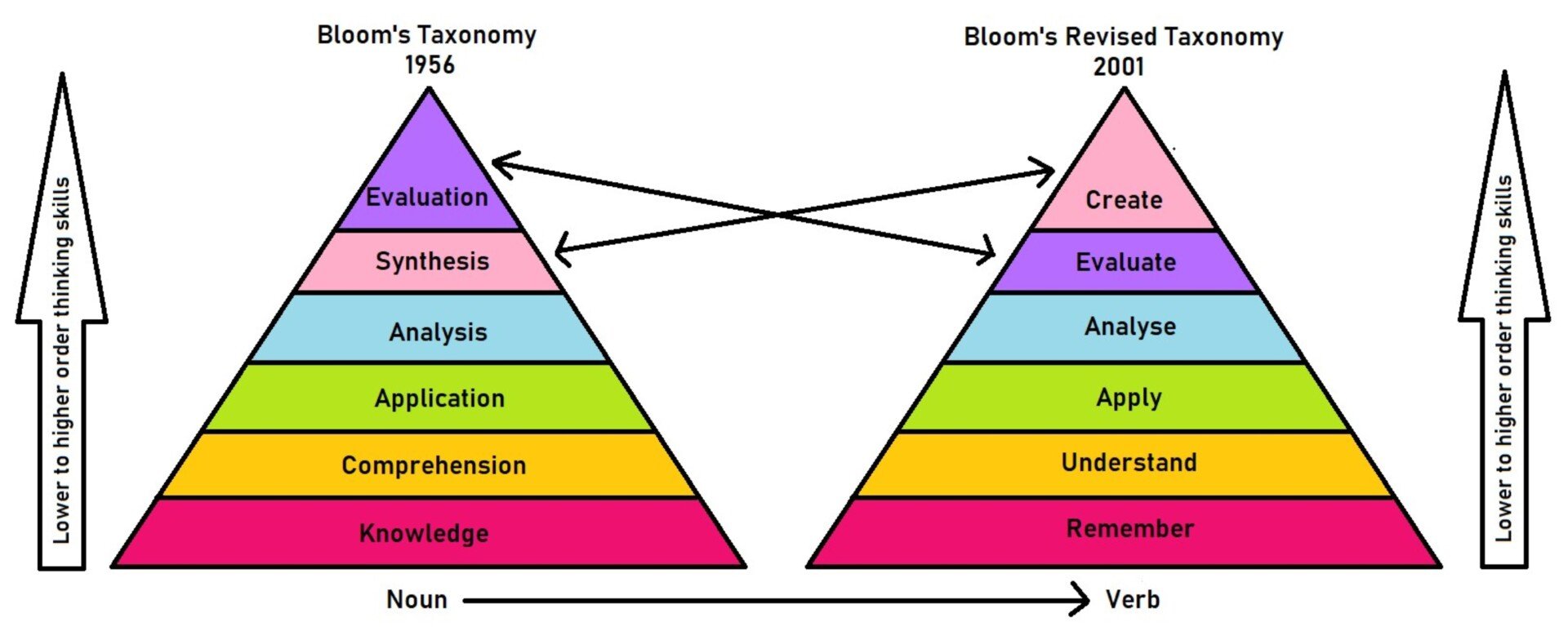
The original taxonomy (1956) used nouns (Knowledge, Comprehension, Application, Analysis, Synthesis, Evaluation).
-
The revised taxonomy (2001) emphasizes active verbs (Remembering, Understanding, Applying, Analyzing, Evaluating, Creating) to reflect dynamic cognitive processes more accurately.
-
The revised version swaps the top two levels. Synthesis became Creating and now sits above Evaluating, because making something new requires first judging the alternatives (Krathwohl, 2002).
Knowledge Dimension
Bloom’s revised taxonomy (Anderson & Krathwohl, 2001) introduces the Knowledge Dimension, which complements the cognitive domain by clarifying what learners are expected to know.
While the cognitive domain describes how learners use and process knowledge, the Knowledge Dimension classifies the type of knowledge students engage with:
- Factual Knowledge: Knowledge of basic elements, terminology, and details essential to a discipline (e.g. historical dates, mathematical symbols, scientific terms)
- Conceptual Knowledge: Understanding relationships among concepts, principles, and theories (e.g. grasping the principles behind economic theories like supply and demand).
- Procedural Knowledge: Knowing how to perform tasks and processes (e.g. conducting laboratory experiments or following a mathematical algorithm).
- Metacognitive Knowledge: Awareness and understanding of one’s own thought processes (e.g. reflecting on study habits to improve personal learning strategies).
By considering all four types of knowledge, teachers can ensure that students develop a well-rounded understanding of the subject matter.
They can move beyond simply memorizing facts to developing deep conceptual understanding and the ability to apply knowledge in practical situations.
Understanding metacognitive knowledge, or awareness of how one thinks and learns, helps teachers guide students toward self-awareness of their own learning processes.
This is essential for higher-order thinking and lifelong learning.
The Taxonomy Table: Combining Both Dimensions
Crossing the six cognitive processes with the four knowledge types gives a 6 × 4 grid, the Taxonomy Table (Anderson & Krathwohl, 2001). Any objective can sit in one or more cells, pinned by what the learner does and what they do it to.
This is the revision’s most practical tool. It exposes neglected objectives, such as plenty of Remember × Factual but no Create × Procedural. It also forces vague objectives to become specific.
| Knowledge type | Remember | Understand | Apply | Analyze | Evaluate | Create |
|---|---|---|---|---|---|---|
| Factual | ● | |||||
| Conceptual | ● | |||||
| Procedural | ● | ● | ||||
| Metacognitive | ● |
The marked cells place five objectives from a unit on scientific writing:
- Remember × Factual: recall the parts of a laboratory report.
- Understand × Conceptual: explain why a control group is needed.
- Apply × Procedural: carry out a titration following the standard procedure.
- Evaluate × Metacognitive: judge which of two study designs better controls for confounds, which takes strategic knowledge about method.
- Create × Procedural: design an original experiment to test a hypothesis of your own.
Laid out on the grid, this unit develops several knowledge types and climbs from recall to creation. An analysis limited to one row or column would reveal a lopsided curriculum.
Action Verbs for Each Level
Thanks to Bloom’s Taxonomy, teachers nationwide have a tool to guide the development of assignments, assessments, and overall curricula.
This model helps teachers identify the key learning objectives they want a student to achieve for each unit because it succinctly details the learning process.
The Cumulative Hierarchy: How Each Level Builds on the Last
According to Shabatura (2013), the taxonomy treats each level as a prerequisite for the next. Critics dispute how strictly that holds, as the Critical Evaluation section explains.
- Before you can understand a concept, you need to remember it;
- To apply a concept, you need first to understand it;
- To evaluate a process, you need first to analyze it;
- To create something new, you need to have completed a thorough evaluation
This hierarchy takes students through a process of synthesizing information that allows them to think critically.
Students start with a piece of information and are motivated to ask questions and seek out answers.
Not only does Bloom’s Taxonomy help teachers understand the process of learning, but it also provides more concrete guidance on how to create effective learning objectives.
| Bloom’s Level | Key Verbs (keywords) | Example Learning Objective |
|---|---|---|
| Create | design, formulate, build, invent, create, compose, generate, derive, modify, develop. | By the end of this lesson, the student will be able to design an original homework problem dealing with the principle of conservation of energy. |
| Evaluate | choose, support, relate, determine, defend, judge, grade, compare, contrast, argue, justify, convince, select, evaluate. | By the end of this lesson, the student will be able to determine whether using conservation of energy or conservation of momentum would be more appropriate for solving a dynamics problem. |
| Analyze | classify, break down, categorize, analyze, diagram, illustrate, criticize, simplify, associate. | By the end of this lesson, the student will be able to differentiate between potential and kinetic energy. |
| Apply | calculate, predict, apply, solve, illustrate, use, demonstrate, determine, model, perform, present. | By the end of this lesson, the student will be able to calculate the kinetic energy of a projectile. |
| Understand | describe, explain, paraphrase, restate, give original examples of, summarize, contrast, interpret, discuss. | By the end of this lesson, the student will be able to describe Newton’s three laws of motion in her/his own words |
| Remember | list, recite, outline, define, name, match, quote, recall, identify, label, recognize. | By the end of this lesson, the student will be able to recite Newton’s three laws of motion. |
Applying Bloom’s Taxonomy to Course Design
The revised version reminds teachers that learning is an active process, stressing the importance of including measurable verbs in the objectives.
And the clear structure of the taxonomy itself emphasizes the importance of keeping learning objectives clear and concise as opposed to vague and abstract (Shabatura, 2013).
Constructive alignment is the payoff. Map every objective, teaching activity, and assessment onto the same taxonomy level. Then what is taught, what students do, and what is assessed all target the same intended outcomes.
Misalignment then becomes visible. A course might teach for understanding but examine only recall. Tagging each element by level exposes the mismatch.
Using Bloom’s Taxonomy at the Course Level
Bloom’s Taxonomy can also be applied beyond individual lessons, extending to the broader course level.
For example, introductory or lower-level courses, typically aimed at first-year students, focus primarily on lower-order thinking skills such as remembering and understanding, as students work to build foundational knowledge.
These courses may touch on applying or analyzing. They rarely extend much further up the hierarchy.
Conversely, upper-level courses assume that students have already mastered basic cognitive skills and instead emphasize higher-order objectives such as evaluating and creating (Shabatura, 2013).
In this way, instructors can use Bloom’s framework to reflect on the nature and purpose of their course and determine the appropriate level of cognitive challenge for their students.
Assessment, Differentiation, and Clinical Education
The same level-by-level vocabulary supports three other uses:
- Assessment: Tagging every exam item by level exposes over-reliance on recall and lets assessors balance the cognitive demand of a paper.
- Differentiation: One topic can be a Remember or Understand task for students consolidating the basics, and an Analyze, Evaluate, or Create task for those ready to stretch.
- Nursing and medical education: Curricula and licensing exams map to cognitive levels, so graduates can apply, analyze, and evaluate facts in clinical reasoning, not just recall them.
Objectives for a clinical skill often span all three domains at once. They cover the cognitive (understanding the rationale for a procedure), the psychomotor (performing it with precision), and the affective (valuing patient dignity and safety).
Benefits of Clear Learning Objectives
Having clear and organized learning objectives allows teachers to plan and deliver effective instruction, design valid assessments, and ensure that all activities align with the intended outcomes (Armstrong, 2010).
Overall, Bloom’s Taxonomy provides a practical roadmap for both teachers and students. It helps teachers teach more intentionally and students learn more effectively.
The Affective Domain (1964)
The affective domain describes how learners handle emotions, feelings, attitudes, and values (Krathwohl, Bloom, & Masia, 1964). It covers appreciation, enthusiasm, and motivation.
Its five levels show increasing internalization. A learner first attends to something, then responds actively, then prizes it. Next they reconcile it with their other values. Finally, they act from it habitually as part of their character.
The domain matters because much of what schooling hopes to achieve lives here: curiosity, academic honesty, respect for evidence, and professional ethics. Yet these outcomes are far less often made explicit in objectives than cognitive skills.
From lowest to highest, with examples included, the five levels are:
-
Receiving: Awareness and willingness to hear new ideas (e.g., students will demonstrate attentiveness by actively listening during peer presentations).
-
Responding: Active participation and engagement (e.g., students will actively participate in group discussions, contributing thoughtful feedback to classmates).
-
Valuing: Internalizing values and recognizing their significance (e.g., students will express appreciation and respect for diverse perspectives during class debates).
-
Organizing: Integrating new values within one’s existing value system (e.g., students will integrate principles of ethical decision-making into their personal value system, demonstrated by reflecting on moral dilemmas in writing assignments.).
-
Characterizing: Consistently embodying internalized values in everyday behavior (e.g., students will consistently demonstrate integrity and responsibility in collaborative projects, exemplifying professional ethics and behaviors.).

The Psychomotor Domain (1972)
The psychomotor domain of Bloom’s Taxonomy refers to the ability to physically manipulate tools or instruments.
It focuses on the development of physical skills, coordination, and movement abilities, from basic reflexes to complex actions.
This domain emphasizes the development of physical dexterity and motor abilities, including physical movement, coordination, and use of motor-skill areas.
Bloom’s original committee never completed a psychomotor handbook. Others filled the gap.
Mastery of these specific skills is marked by speed, precision, and distance.
Psychomotor skills range from simple tasks, such as washing a car, to more complex tasks, like operating intricate technological equipment.
The domain involves learning through progressive stages of movement, ultimately leading to the mastery of physical and manual tasks.
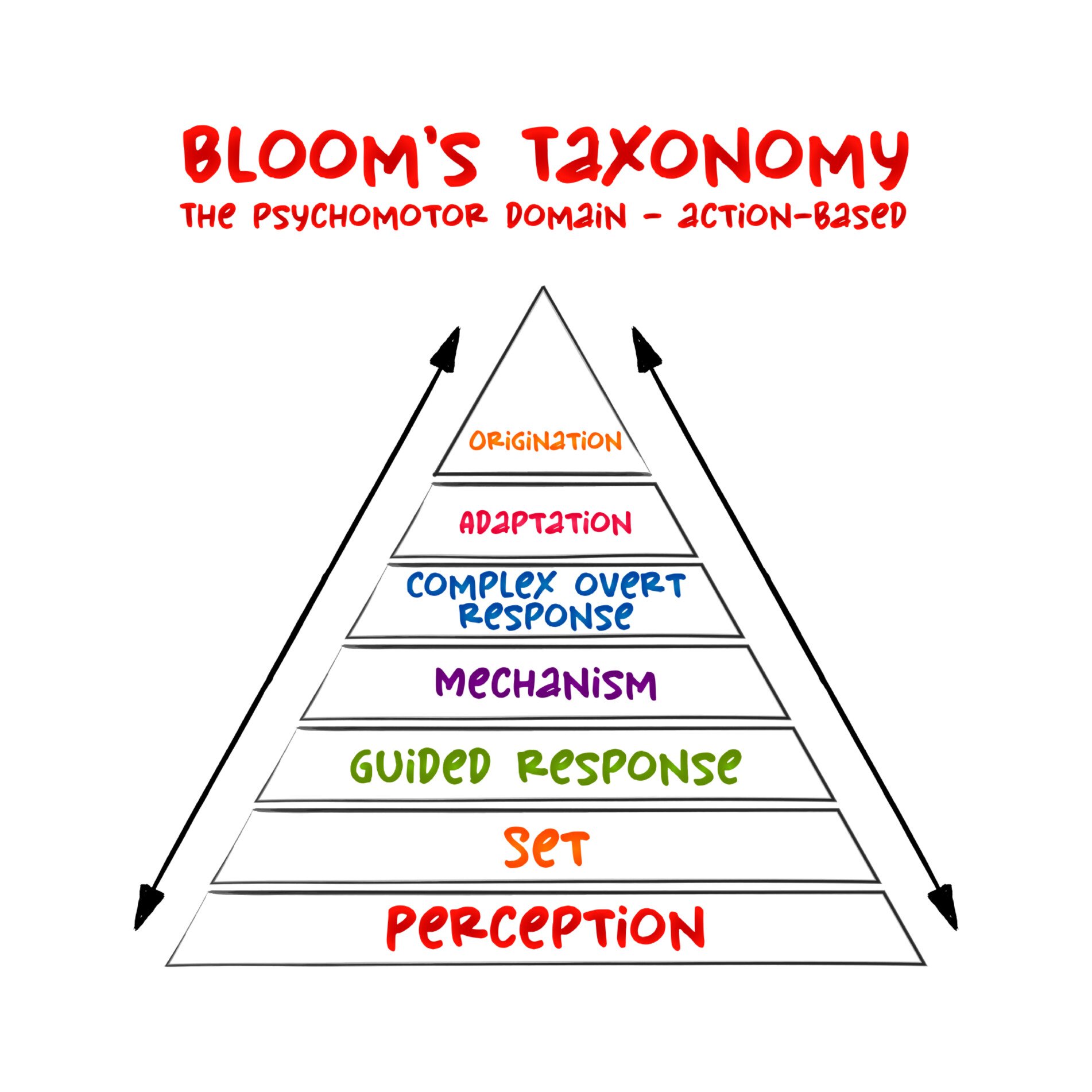
Three versions are now widely used. The seven-level scheme below is Simpson’s (1972).
-
Perception: Using sensory cues to guide motor activity (e.g., catching a ball based on visual cues).
-
Set: Readiness and willingness to perform (e.g., showing interest in learning new sports).
-
Guided Response: Initial stages of learning through imitation and trial-and-error (e.g., practicing basic dance movements).
-
Mechanism: Developing habitual movements and skills performed with confidence (e.g., executing routine gymnastics skills).
-
Complex Overt Response: Skilled, efficient, and automatic execution of complex tasks (e.g., consistently performing precise athletic techniques).
-
Adaptation: Adjusting motor skills effectively in response to different conditions (e.g., modifying dance routines to match new music).
-
Origination: Creating novel and original motor skills (e.g., inventing a unique style of artistic performance).
Harrow’s and Dave’s Psychomotor Taxonomies
Two other taxonomies organize the domain differently. Pick the one that best fits the skill being taught.
Harrow (1972): Six Levels by Type of Movement
Harrow’s version suits cases where the concern is the range of motor capacity, from reflex to expressive. The levels run:
- Reflex movements: involuntary responses.
- Fundamental movements: basic actions such as walking and grasping.
- Perceptual abilities: coordinating sensory input with movement.
- Physical abilities: endurance, strength, and agility.
- Skilled movements: learned complex skills, such as a sport technique.
- Non-discursive communication: expressive movement, such as dance and body language.
Dave (1970): Five Levels by Independence from a Model
Dave’s scheme is the simplest to teach. Its levels map onto stages of practice, so it is popular in vocational, clinical-skills, and sports training.
- Imitation: copying an observed action.
- Manipulation: performing from instructions, not just imitation.
- Precision: performing accurately and independently.
- Articulation: coordinating several skills fluidly.
- Naturalization: performing automatically, with mastery.
Critical Evaluation
Bloom’s Taxonomy accomplishes a seemingly daunting task. It takes the important, complex topic of thinking and gives it a concrete structure.
It remains widely used today. Teachers rely on it to set learning goals and design curricula, and questions or assignments aligned with its principles encourage students to engage in higher-order thinking.
It still has flaws, though. The original 1956 taxonomy presented learning as a static concept. The 2001 revision answered this with active verbs that stress the dynamic nature of learning, yet the updated structure still meets multiple criticisms.
Five objections stand out:
- Overlapping Levels: The pyramid suggests discrete steps, but most tasks use several cognitive skills at once and adjacent levels are hard to tell apart.
- Non-Linear Learning: People often learn by applying and creating first, so a strict climb from recall misrepresents how learning proceeds.
- Devalued Knowledge: Placing recall at the base can suggest that foundational knowledge matters least, which hurts students who depend most on school for it.
- Separated Domains: Splitting thinking, feeling, and physical skill into separate domains misrepresents how learning actually works.
- Theory and Worldview: The levels came from examiners’ judgment, not a theory of cognition, and they reflect a Western, academic view of learning.
Overlapping Levels
Many psychologists take issue with the pyramid shape. It creates the false impression that the cognitive steps are discrete and must be performed independently of one another (Anderson & Krathwohl, 2001).
Most real tasks need several cognitive skills working in tandem. Writing an essay involves remembering, understanding, analyzing, and creating all at once.
Few tasks are purely analysis or comprehension tasks.
The boundaries between adjacent levels are also hard to draw, especially among Analyze, Evaluate, and Create. Two competent educators will often classify the same task differently, which weakens the taxonomy as a precise measuring instrument.
The verb lists compound the problem when used mechanically. Describe can demand mere recall or genuine synthesis, depending on the task. Picking a word from the Create list does not make a task creative.
Treating the verb as the level produces objectives that are Bloom-flavored in wording but not in substance.
Non-Linear Learning
The strict order of the levels is also questionable. When we learn, we don’t always start with remembering and then move on to comprehension and creating something new. Instead, we mostly learn by applying and creating.
For example, you don’t know how to write an essay until you do it. And you might not know how to speak Spanish until you actually do it (Berger, 2020).
The act of doing is where the learning lies. It is not a regimented, linear process.
Kolb’s (1984) experiential learning cycle makes the same point: concrete action is the starting point of learning, not its culmination.
Even the 2001 revision conceded the point. Anderson and Krathwohl (2001) relaxed the strict requirement that each level be mastered before the next, accepting that the revised categories overlap.
Developmental theories raise a related question. When is each level realistic for a learner? Frameworks such as Piaget’s stages of cognitive development and Vygotsky’s zone of proximal development bear on that judgment.
The practical lesson is to treat the order as a planning heuristic, not a law of learning.
Devalued Knowledge
The structure also makes some of these skills seem more difficult and important than others. Adopting that mindset de-emphasizes knowledge and comprehension, which matter as much as, if not more than, the processes at the top of the pyramid.
Author Doug Lemov (2017) argues that this contributes to a national trend of devaluing knowledge. He goes further. Lower-income students, who have less exposure to sources of information outside school, suffer a knowledge gap in schools.
They depend on what school teaches directly, so that gap hits them hardest.
Cognitive science supports the point. Higher-order thinking is not content-free. It depends on a large store of well-organized background knowledge.
The labels “higher-order” and “lower-order” are contested too. Expertise in any field rests on automated, rapidly retrievable knowledge. That is a supposedly “lower-order” attribute. Much creative work also depends on deep factual mastery.
Calling recall lower and creation higher can lead teachers to under-teach retrieval practice and the foundational knowledge that the higher skills rely on.
Separated Domains
A further objection targets the decision to split learning into cognitive, affective, and psychomotor domains. In practice, thinking and feeling are deeply intertwined. A learner’s interest, values, and confidence shape how they reason, and reasoning in turn reshapes what they value.
The original authors saw this problem. Krathwohl, Bloom, and Masia (1964) recognized that the boundary between the cognitive and affective domains is indistinct.
Almost every cognitive objective carries an affective component, such as an attitude to the subject. Almost every affective objective has a cognitive one.
They kept the division largely for the practical convenience of classification, not because the two are independent (Krathwohl, 2002). Later frameworks, such as Fink’s (2003) taxonomy of significant learning, fold a “human dimension” and “caring” back into one interactive scheme, partly in response.
Theory and Worldview
The 1956 taxonomy was built by examiners for practical convenience, not derived from a theory of cognition. It also predates the cognitive-science revolution.
It offers no account of why the levels are ordered as they are, or of the mental processes beneath them. The ordering was a committee judgment about apparent complexity. Later frameworks, such as Marzano and Kendall’s (2007) New Taxonomy, were designed to put the classification on firmer theoretical footing.
The taxonomy also reflects its Western, formal-schooling origins.
Its apex, individual creation judged against explicit criteria, encodes an academic and arguably individualist idea of the highest learning. That idea does not translate neatly to traditions that prize mastery of a canon, communal knowledge, or embodied craft. Its universality should not be assumed.
Alternative Taxonomies
Several later frameworks keep Bloom’s aim of classifying learning outcomes. They address its weaknesses: the ad hoc ordering, uncertain boundaries, and strictly cumulative hierarchy.
SOLO Taxonomy (Biggs & Collis, 1982)
The Structure of the Observed Learning Outcome (SOLO) taxonomy classifies responses by structural complexity, not by a presumed type of thinking (Biggs & Collis, 1982). It has five levels:
- Prestructural: the task is missed or misunderstood.
- Unistructural: one relevant point.
- Multistructural: several unconnected points.
- Relational: the points are integrated into a coherent whole.
- Extended abstract: the integrated understanding is generalized to a new domain.
SOLO describes the quality of an actual response. That makes it easier to apply reliably than Bloom’s process categories, and teachers often prefer it for marking and feedback. It also maps onto the shift from surface to deep learning.
Marzano and Kendall’s New Taxonomy (2007)
Marzano and Kendall’s New Taxonomy of Educational Objectives was designed to give the enterprise the theoretical basis Bloom lacked (Marzano & Kendall, 2007). Three systems act on three domains of knowledge.
The domains are information, mental procedures, and psychomotor procedures.
The cognitive system has four levels: retrieval, comprehension, analysis, and knowledge utilization. Above it sit the metacognitive system (goal-setting and monitoring) and, highest of all, the self-system. The self-system covers the beliefs and motivations that decide whether a learner engages at all.
Putting motivation above cognition changes the question. It asks what governs whether and how deeply a learner engages, not only how complex the thinking is.
Webb’s Depth of Knowledge (1997)
Webb’s Depth of Knowledge (DOK) framework classifies tasks by the depth of cognitive engagement they demand, not by difficulty or by verb (Webb, 1997). It has four levels:
- DOK 1: recall and reproduction.
- DOK 2: skills and concepts.
- DOK 3: strategic thinking and reasoning.
- DOK 4: extended thinking, requiring sustained investigation over time.
DOK is widely used in the United States for assessment alignment, checking that test items reach the depth the standards intend. It is often contrasted with Bloom’s because it resists the assumption that a verb signals a fixed cognitive level.
Fink’s Taxonomy of Significant Learning (2003)
Fink’s taxonomy is deliberately non-hierarchical and interactive (Fink, 2003). It names six kinds of learning that reinforce one another:
- Foundational knowledge
- Application
- Integration
- Human dimension: learning about oneself and others.
- Caring: developing new interests and values.
- Learning how to learn
Unlike Bloom’s ladder, Fink’s categories form a relational set in which progress in one supports progress in the others. The “caring” and “human dimension” categories also cover outcomes that Bloom’s cognitive domain omits.
Contemporary Research
Educational research now tests the taxonomy’s structural assumptions instead of repeating them. Anderson and Krathwohl (2001) themselves relaxed the strict cumulative sequence, and a recent large-scale test of the Taxonomy Table points the same way (Larsen et al., 2022).
- Aim: To test whether the Taxonomy Table’s two dimensions are independent, and whether action verbs reliably signal the cognitive process an item targets.
- Method: Researchers coded 940 undergraduate biology assessment items against both dimensions. They used contingency and correspondence analysis, plus the Shannon evenness index, to test whether prompt words predicted the cognitive process.
- Results: The dimensions were not independent: knowledge type and cognitive process were significantly related, forming three clusters of combinations. Action verbs showed no clear relationship to the process an item actually assessed.
- Conclusion: Both dimensions remain worth using, but the axes should not be treated as orthogonal. Classifying items requires examining their actual cognitive demand, not their verb.
This is a rare large-scale empirical test of assumptions that Taxonomy Table users usually take on faith. Its verb finding gives quantitative support to the criticism that the verb lists are over-mechanical.
The study has limits. The 940 items came from undergraduate biology courses at a single institution, so the clustering may not generalize to other subjects or grade levels.
The broader lesson still holds. Neither the dimensional split nor verb choice can be assumed to classify reliably on its own.
The taxonomy and its grid work best as a design heuristic, not a validated model of how learning is sequenced or structured (Anderson & Krathwohl, 2001; Larsen et al., 2022).
References
Anderson, L. W., & Krathwohl, D. R. (Eds.). (2001). A taxonomy for learning, teaching, and assessing: A revision of Bloom’s taxonomy of educational objectives. Longman.
Armstrong, P. (2010). Bloom’s Taxonomy. Vanderbilt University Center for Teaching. Retrieved from https://cft.vanderbilt.edu/guides-sub-pages/blooms-taxonomy/
Armstrong, R. J. (1970). Developing and Writing Behavioral Objectives.
Berger, R. (2020). Here’s what’s wrong with bloom’s taxonomy: A deeper learning perspective (opinion). Retrieved from https://www.edweek.org/education/opinion-heres-whats-wrong-with-blooms-taxonomy-a-deeper-learning-perspective/2018/03
Biggs, J. B., & Collis, K. F. (1982). Evaluating the quality of learning: The SOLO taxonomy (Structure of the Observed Learning Outcome). Academic Press.
Bloom, B. S. (Ed.). (1956). Taxonomy of educational objectives: The classification of educational goals. Handbook I: Cognitive domain. David McKay.
Bloom, B. S. (1971). Mastery learning. In J. H. Block (Ed.), Mastery learning: Theory and practice (pp. 47–63). New York: Holt, Rinehart and Winston.
Clark, D. (2015). Bloom’s taxonomy: The affective domain. Retrieved from http://www.nwlink.com/~donclark/hrd/Bloom/affective_domain.html
Dave, R. H. (1970). Psychomotor levels. In R. J. Armstrong (Ed.), Developing and writing behavioral objectives. Educational Innovators Press.
Fink, L. D. (2003). Creating significant learning experiences: An integrated approach to designing college courses. Jossey-Bass.
Guskey, T. R. (2005). Formative Classroom Assessment and Benjamin S. Bloom: Theory, Research, and Implications. Online Submission.
Harrow, A.J. (1972). A taxonomy of the psychomotor domain. New York: David McKay Co.
Kolb, D. A. (1984). Experiential learning: Experience as the source of learning and development. Prentice-Hall.
Krathwohl, D. R. (2002). A revision of Bloom’s taxonomy: An overview. Theory Into Practice, 41(4), 212–218. https://doi.org/10.1207/s15430421tip4104_2
Krathwohl, D. R., Bloom, B. S., & Masia, B. B. (1964). Taxonomy of educational objectives: The classification of educational goals. Handbook II: Affective domain. David McKay.
Larsen, T. M., Endo, B. H., Yee, A. T., Do, T., & Lo, S. M. (2022). Probing internal assumptions of the revised Bloom’s taxonomy. CBE—Life Sciences Education, 21(4), Article ar66. https://doi.org/10.1187/cbe.20-08-0170
Lemov, D. (2017). Bloom’s taxonomy-that pyramid is a problem. Retrieved from https://teachlikeachampion.com/blog/blooms-taxonomy-pyramid-problem/
Marzano, R. J., & Kendall, J. S. (2007). The new taxonomy of educational objectives (2nd ed.). Corwin Press.
Revised Bloom’s Taxonomy. (n.d.). Retrieved from https://www.celt.iastate.edu/teaching/effective-teaching-practices/revised-blooms-taxonomy/
Shabatura, J. (2013). Using bloom’s taxonomy to write effective learning objectives. Retrieved from https://tips.uark.edu/using-blooms-taxonomy/
Simpson, E. J. (1972). The classification of educational objectives in the Psychomotor domain, Illinois University. Urbana.
Webb, N. L. (1997). Criteria for alignment of expectations and assessments in mathematics and science education (Research Monograph No. 6). Council of Chief State School Officers.
Further Reading
- Kolb’s Learning Styles
- Bloom’s Taxonomy Verb Chart
- Bloom, B. S. (1956). Taxonomy of educational objectives. Vol. 1: Cognitive domain. New York: McKay, 20, 24.
- Krathwohl, D. R. (2002). A revision of Bloom’s taxonomy: An overview. Theory into practice, 41(4), 212-218.
- Montessori Method of Education