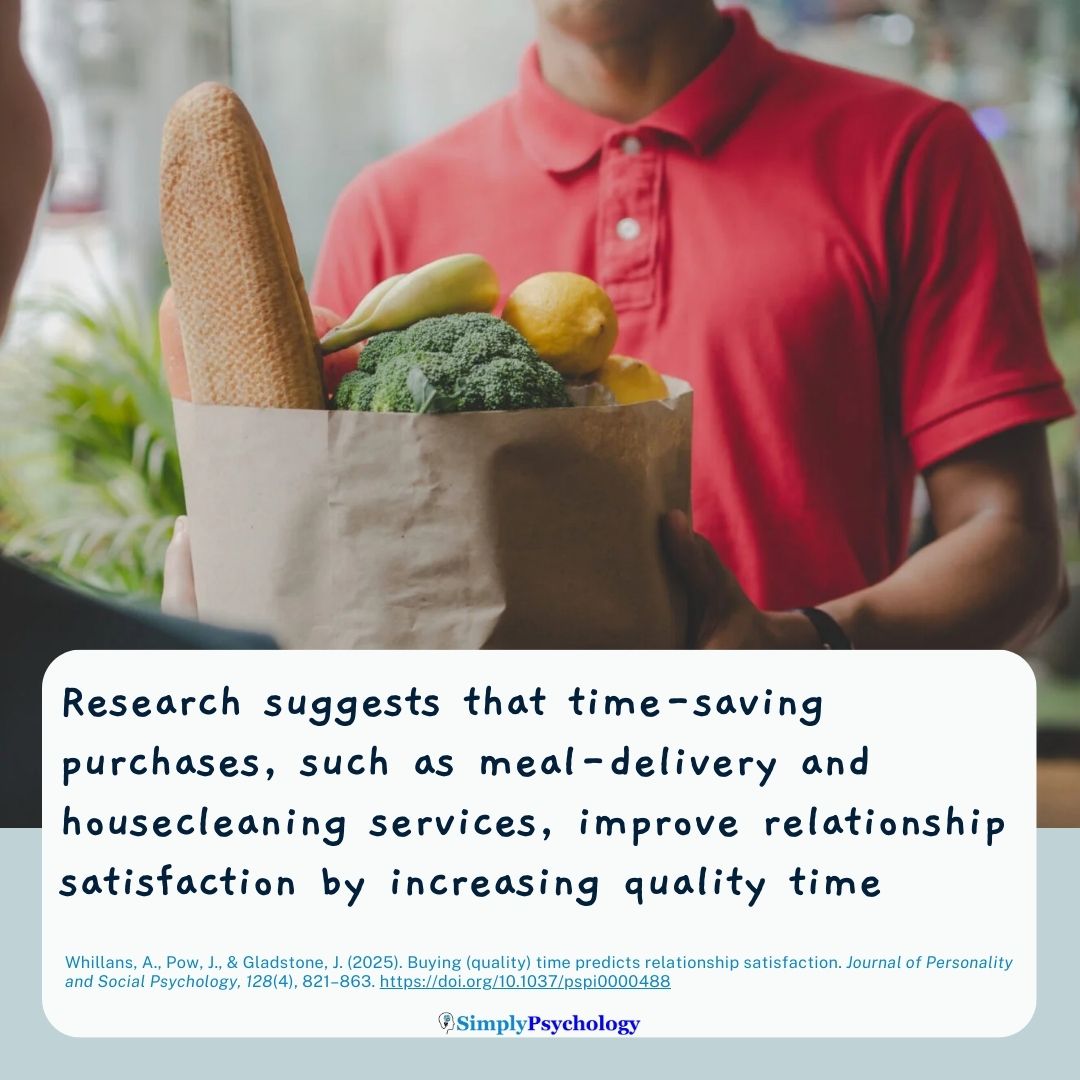
Quality time is important for relationship satisfaction because it fosters emotional connection, intimacy, and shared meaning.
When couples spend enjoyable, undistracted time together, they strengthen their bond, improve communication, and feel more supported.
This time helps buffer against stress and conflict, reinforcing the relationship’s value and stability.
Even small moments of meaningful connection can significantly enhance how satisfied partners feel with each other.

Whillans, A., Pow, J., & Gladstone, J. (2025). Buying (quality) time predicts relationship satisfaction. Journal of Personality and Social Psychology, 128(4), 821–863. https://doi.org/10.1037/pspi0000488
Key Points
- Focus: This study investigates whether purchasing time-saving services (e.g., housecleaning, meal delivery) enhances romantic relationship satisfaction by freeing up time for quality shared experiences.
- Method: Seven studies (longitudinal, daily diary, experimental, and cross-sectional) were conducted using surveys and diary methods with full-time working adults in committed relationships, primarily dual-income couples.
- Findings: Time-saving purchases predicted higher relationship satisfaction. The benefit was strongest when the saved time was spent together, when purchases were made jointly, and for individuals under higher stress.
- Implications: Investing in time-saving services may be an effective strategy for improving couple relationships, particularly for time-stressed individuals.
Rationale
Modern couples, especially dual-income ones, face significant time constraints due to work and household responsibilities.
Although quality time is vital for relationship health, many couples lack the time to nurture their bond.
While previous research has linked time-saving purchases to increased individual well-being, the current study addresses a gap by testing whether such purchases can directly enhance relationship satisfaction.
It proposes that buying time not only reduces daily stressors (like chores) but also allows couples to transform newly freed time into meaningful shared experiences.
This research extends the Conservation of Resources (COR) model by exploring how financial resources (used to buy time) can be transformed into relational benefits.
The next step was to empirically test this proposition through a series of methodologically diverse studies.
Method
Across seven studies:
- Study 1: 11-year longitudinal panel survey using UKHLS data (n = 33,456; ~98,000 observations).
- Study 2: 6-week daily diary with 71 dual-income participants.
- Study 3: Cross-sectional survey with 691 respondents examining time-saving purchase characteristics.
- Studies 4a & 4b: Experimental recollection tasks comparing time-saving vs. material purchases (n = 600 and n = 401).
- Study 5: Cross-sectional survey examining perceived partner support and shared mood.
- Study 6: Preregistered survey with 1,000 full-time employed respondents, measuring chore discussion, rumination, and shared time quality.
Procedure
- Study 1:
- Analyzed UKHLS panel data to assess changes in time-saving purchases and their effect on future relationship satisfaction.
- Study 2:
- Participants reported daily on purchases, stress, and relationship satisfaction for six weeks.
- Study 3:
- Surveyed participants on purchase behavior, relationship satisfaction, stress, and perceived utility of purchases.
- Study 4a & 4b:
- Random assignment to reflect on a time-saving or material purchase; measured postpurchase satisfaction and quality time.
- Study 5:
- Measured positive/negative mood and support during shared time.
- Study 6:
- Measured chore discussions, rumination, and quality time to test a “gain spiral” model.
Sample
- Total sample size across studies: ~36,000+ participants.
- Demographics:
- Primarily heterosexual, dual-income couples.
- Employed ≥30 hours/week.
- Majority aged 25–44.
- Balanced gender representation across studies.
- Representative UK data in Study 1; U.S. and online samples in later studies.
Measures
- Relationship Satisfaction: Four-item Revised Dyadic Adjustment Scale or similar validated measures.
- Perceived Stress: 11-item Perceived Stress Scale (Cohen et al., 1983).
- Quality Time: Self-reports of shared enjoyment and perceived partner support.
- Chore Coping: Items measuring frequency and rumination about chore discussions.
- Purchase Characteristics: Time saved, money spent, decision type (joint or individual), type (product vs. service), utilitarian vs. hedonic.
Statistical Measures
- Multilevel mixed-effects models (Study 1).
- Within- and between-person effects (Studies 1 & 2).
- Cross-sectional regression and mediation models (Studies 3, 5, 6).
- Bootstrap mediation with 20,000 simulations (Study 5).
- Experimental ANOVA and regression (Studies 4a & 4b).
Results
- Time-saving purchases predicted increases in relationship satisfaction across all studies.
- Benefits were strongest when:
- Time saved was spent together.
- Purchases were made jointly.
- Participants experienced higher stress levels.
- Hours saved—not just purchase presence—predicted satisfaction (Study 3).
- Positive mood and perceived support during shared time mediated satisfaction (Study 5).
- Chore-related rumination decreased, while constructive discussions increased (Study 6).
- Material or hedonic purchases did not yield the same relational benefits.
Insight
This research illuminates a practical, evidence-based route for improving relationship satisfaction: strategically outsourcing time-consuming tasks.
Rather than simply having more time, what matters is how that time is spent—ideally together, engaging positively.
These findings align with the COR model, showing that couples can convert financial resources into relational resources.
Notably, the study challenges assumptions that only emotional or communicative strategies enhance relationships, suggesting consumer behavior also plays a key role.
Future research could explore these effects across cultures or test workplace policies encouraging time-saving benefits for employees.
Clinical Implications
- Therapists could recommend time-saving strategies (e.g., hiring help) to couples facing time-stress.
- Interventions targeting relationship satisfaction might incorporate financial planning for outsourcing.
- Policymakers might support tax deductions for caregiving or household services to reduce time burdens on working couples.
- Practitioners should consider that the perception of time gained and how it is used may be more impactful than the actual hours saved.
Strengths
This study had several methodological strengths, including:
- The use of multiple methods (longitudinal, experimental, cross-sectional, diary) strengthens causal claims.
- Large, diverse sample sizes, including a nationally representative UK sample.
- Robust controls (e.g., stress, income, number of children) across studies.
- Preregistered studies and open data practices enhance transparency and replicability.
- Innovative use of subjective and objective time-use measures.
Limitations
This study also had several limitations, including:
- Reliance on self-reports may introduce bias or memory inaccuracies.
- Experimental studies used recollection paradigms, which may not reflect real-time behavior.
- Most samples were from Western, industrialized populations—limiting generalizability.
- The studies did not include same-sex couples or account for cultural norms around chores.
- The effect sizes, while consistent, were generally small.
Socratic Questions
- Why might time-saving purchases enhance relationship satisfaction more than material or experiential purchases?
- How does the Conservation of Resources model help explain the findings?
- Could time-saving purchases ever harm a relationship? In what context?
- How would you design an intervention to help couples implement these findings?
- What are the ethical or socioeconomic implications of recommending outsourcing for relationship health?
- What other relational or well-being outcomes might be influenced by time-saving behavior?
- How might cultural norms about gender roles and household labor influence the impact of these purchases?
- Are there alternative explanations for the findings that were not addressed by the researchers?
- How would you apply these findings to non-romantic relationships, such as roommates or close friends?
- Should governments or employers subsidize time-saving services as part of mental health or family support programs?