In contrast to the structural perspective, the functional perspective of attitudes focuses on how attitudes can serve a purpose for the individuals who possess them.
The functional view suggests that attitudes bridge the gap between a person’s internal needs and the external environment. Internal needs include safety and self-expression. The external environment comprises other people and information.
Therefore, each attitude held by an individual is expected to assist them in fulfilling their needs in some way.
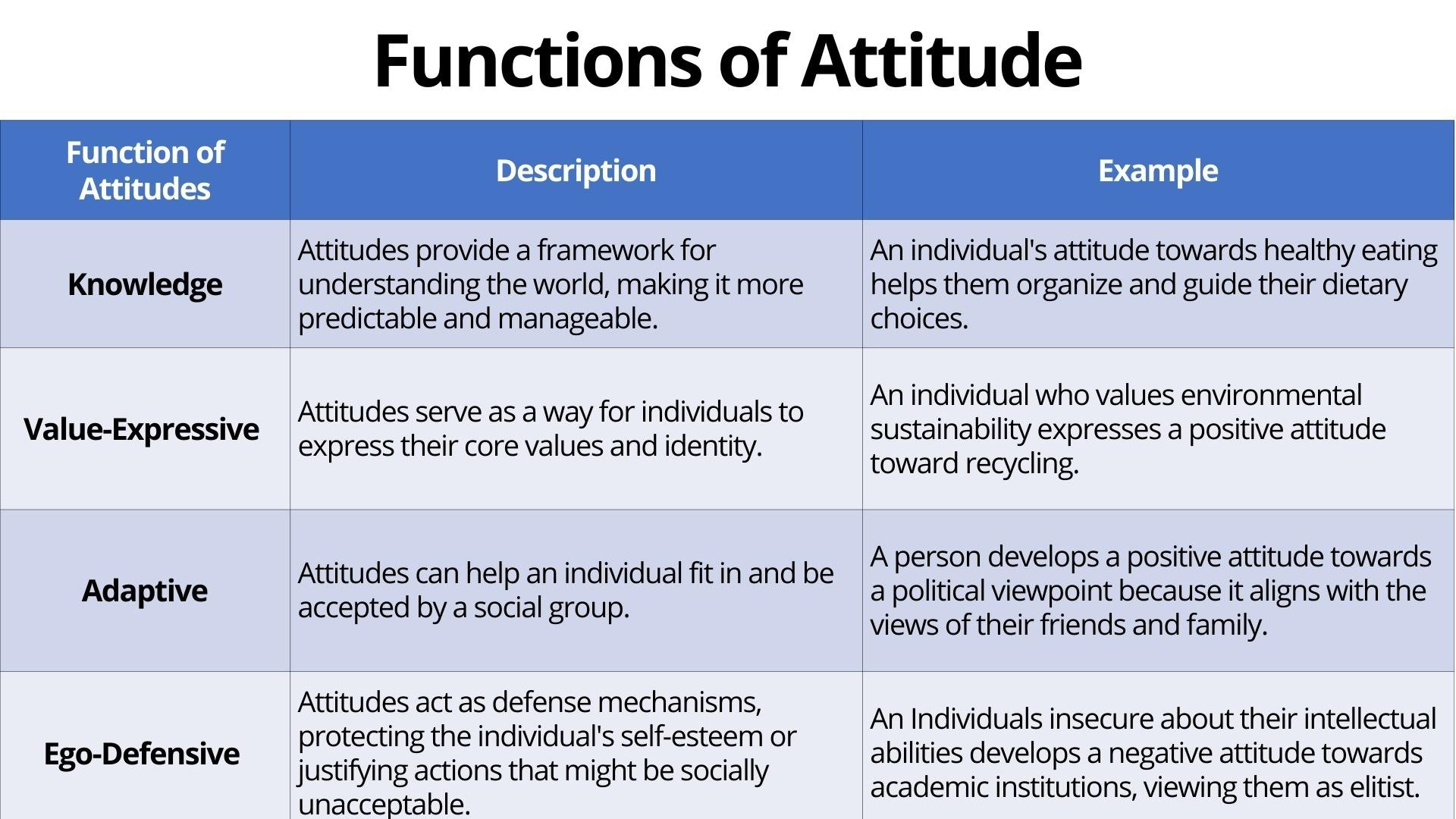
Katz (1960) proposed that the needs satisfied by attitudes, and consequently the functions they serve, can be classified into four main categories:
Katz’s thinking was shaped by Freudian ego psychology, and he argued that attitudes persist because they serve these needs. This matters for real-world persuasion: the most effective way to change someone’s attitude depends on which function it serves for them.
| Function | Description | Example |
|---|---|---|
| Knowledge | Attitudes provide a framework for understanding the world, making it more predictable and manageable. | An individual’s attitude towards healthy eating helps them organize and guide their dietary choices. |
| Value-Expressive | Attitudes serve as a way for individuals to express their core values and identity. | An individual who values environmental sustainability expresses a positive attitude toward recycling. |
| Adaptive | Attitudes can help an individual fit in and be accepted by a social group. | A person develops a positive attitude towards a political viewpoint because it aligns with the views of their friends and family. |
| Ego-Defensive | Attitudes act as defense mechanisms, protecting the individual’s self-esteem or justifying actions that might be socially unacceptable. | An individual insecure about their intellectual abilities develops a negative attitude towards academic institutions, viewing them as elitist. |
Knowledge Function
According to Daniel Katz’s theory (1960), attitudes serve a knowledge function by organizing and categorizing information in our cognitive system. This keeps our picture of the world stable and meaningful.
Attitudes act as schemas or mental structures that help us make sense of the world around us. They provide a framework for organizing our thoughts, beliefs, and perceptions, facilitating the processing and storage of information.
For example, healthy eating can guide small daily choices:
- choosing fruit and vegetables over junk food
- going for a run instead of watching television
In a broader sense, attitudes that serve the knowledge function can also contribute to a sense of self and identity.
For instance, someone who identifies as an environmentalist holds attitudes toward recycling, renewable energy, and conservation. These attitudes help define that identity and give a consistent way to interpret related information.
This function matters because it reduces uncertainty. Without it, everyday choices would feel unpredictable and disorganized. It also shapes our perceptions and guides how we respond to different situations and people, from social interactions to personal decisions.
Value Expressive Function
The value-expressive function refers to the role attitudes play in expressing a person’s self-concept and core values. These attitudes reflect a person’s self-identity.
In essence, attitudes let people define who they are and what they stand for. Three examples show this function at work:
- A person who values environmental sustainability may express a positive attitude toward recycling, reflecting their internal values.
- Someone’s attitude toward social justice issues, such as gender equality, articulates their core values to others.
- Self-expression can be non-verbal too, such as a bumper sticker, cap, or T-shirt slogan.
Value-expressive attitudes also bring self-consistency. Aligning outward behavior with inner beliefs supports self-affirmation and a positive self-image, and helps people feel good simply for asserting their identity.
Therefore, our attitudes are part of our identity and help us express our feelings, beliefs, and values.
Adaptive Function
The adaptive function, also called the utilitarian or adjustive function, posits that people hold certain attitudes because they are beneficial or rewarding to them in their social environment.
This is about fitting in.
Essentially, the adaptive function involves forming opinions that align with those of important groups. People do this to gain acceptance and approval, or to avoid social discomfort and disapproval.
If a person holds and/or expresses socially acceptable attitudes, others will reward them with approval and social acceptance. This social reward is powerful.
For example, people may:
- flatter their bosses or instructors, and believe it
- stay silent about an opinion they think is unpopular
Expression can be nonverbal too, like a politician kissing a baby.
The adaptive function can be particularly influential when social pressures are high, or when a group’s opinion carries real weight. Conformity matters. It underscores the powerful role of social influence in shaping our attitudes.
The adaptive function of attitudes is inherently linked to the behavioral component of attitudes. It is about belonging.
People seek out others who share their attitudes, and often develop similar attitudes to those they like, so as to fit into a social group.
This function does not always serve the person well, however. Attitudes adopted purely for social acceptance can sometimes clash with a person’s own beliefs or values, creating internal conflict.
Ego-Defensive Function
The ego-defensive function suggests that some attitudes exist to protect a person’s self-esteem, or to justify actions that might otherwise seem socially unacceptable. Katz’s thinking here drew on Freudian ego psychology: these attitudes act as defense mechanisms, shielding people from uncomfortable truths about themselves or the world.
They are hard to change. Directly challenging one raises the very threat it was formed to defend against.
Two examples show the ego-defensive function at work:
- Someone insecure about their intellectual abilities may dismiss academic institutions as elitist, a face-saving reason for their own struggles.
- Prejudice toward another group can serve the same function, offering a scapegoat to blame instead of confronting one’s own insecurities.
Attitudes like this help people balance inner needs, such as self-expression and defense, against the demands of the outside world. But protecting self-esteem has a cost: in the long run, ego-defensive attitudes can harden into stereotypes and bias.
Key Takeaways
- Four Functions: Katz (1960) proposed that attitudes serve a knowledge, value-expressive, adaptive (utilitarian), or ego-defensive function.
- Knowledge: Attitudes organize the world into a stable, predictable framework.
- Value-Expressive: Attitudes let people communicate their self-concept and core values to others.
- Adaptive: Attitudes help people gain social approval and avoid disapproval from important groups.
- Ego-Defensive: Attitudes protect self-esteem, which is why they are the hardest function to change.
- Why It Matters: The most effective way to change an attitude depends on which function it serves for the person holding it.
References
Eagly, A. H., & Chaiken, S. (1993). The psychology of attitudes. Harcourt Brace Jovanovich College Publishers.
Eagly, A. H., & Chaiken, S. (1998). Attitude structure and function. In D. T. Gilbert, S. T. Fiske, & G. Lindzey (Eds.), The handbook of social psychology (4th ed., Vol. 1, pp. 269-322). McGraw-Hill.
Hogg, M., & Vaughan, G. (2005). Social Psychology (4th edition). London: Prentice-Hall.
Katz, D. (1960). The functional approach to the study of attitudes. Public Opinion Quarterly, 24(2), 163-204. https://doi.org/10.1086/266945
LaPiere, R. T. (1934). Attitudes vs. actions. Social Forces, 13(2), 230-237. https://doi.org/10.2307/2570339