If you’ve ever taken an introductory psychology course or scanned any psychology textbook, then it is likely that you have encountered the term “ bystander effect .”
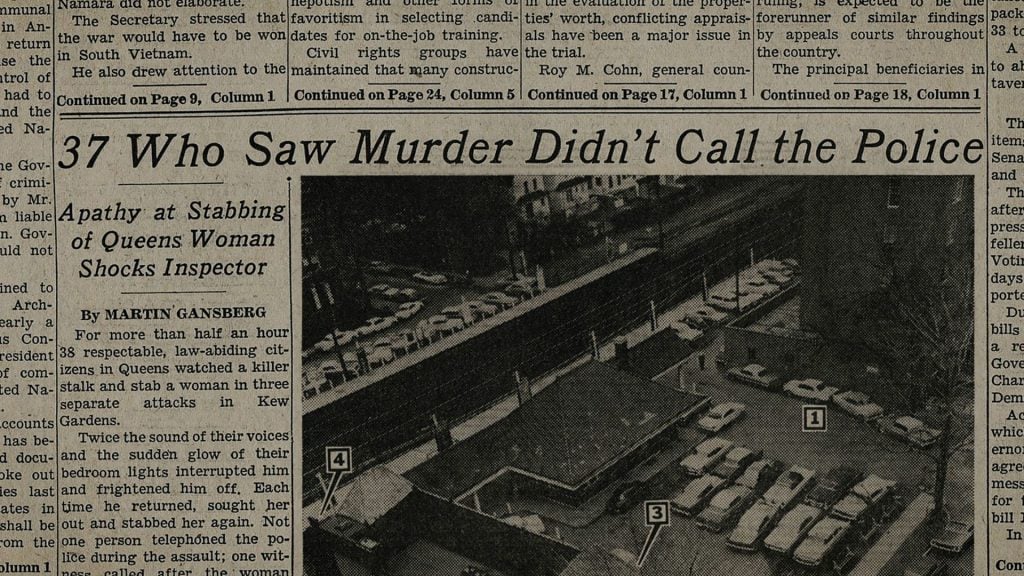
Kitty Genovese was stabbed to death outside her Queens apartment in the early hours of 13 March 1964. A New York Times report claimed 38 witnesses saw or heard the attack and did nothing, inspiring the concept later called the bystander effect.
That witness count was later found to be far too high.
The Murder of Kitty Genovese
The First Attack
Around 2:30 a.m. on March 13th, 1964, Genovese began driving home to her Kew Gardens apartment. She wanted to see her girlfriend on their first anniversary.
At a traffic light on Hoover Avenue, Winston Moseley spotted her from his parked car. He was a 28-year-old business-machine operator.
He had left his wife and two sons asleep at home in South Ozone Park, Queens, around 1 a.m. He had been driving for hours with a hunting knife in his pocket, looking for a victim.
He nearly gave up. Then, around 3 a.m., he spotted Genovese (Skoller, 2008).
Roughly 45 minutes after leaving the bar, Genovese parked in the Kew Gardens LIRR lot, just feet from her building’s front door. Moseley got out too.
His car was parked nearby, on Austin Street (see diagram below). He caught her with a hunting knife as she tried to run for the building.
He overtook her. He stabbed her twice in the back (Skoller, 2008).
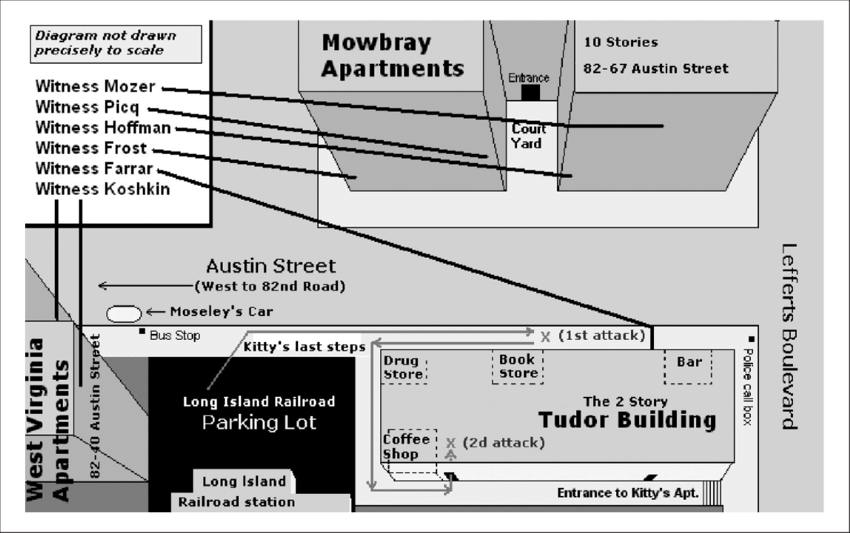
Diagram by Joseph De May (2004), based on the map used at Winston Moseley’s 1964 trial. It traces his route and marks where witnesses were located.
It was three in the morning. The area was desolate, and Franken’s Pharmacy and Interlude Coffeehouse were both closed. Robert Mozer, one of Genovese’s neighbors, awoke, saw the struggle below, and called out, “Let that girl alone!” (Krajicek, 2011).
Genovese screamed, “Oh my God, he stabbed me! Help me!” The noise had woken residents. Fearing he would be identified, Moseley fled back to his car.
Genovese got to her feet. She had not suffered any fatal wounds. She tried to reach her building’s entrance, made it inside, and collapsed in the vestibule right before the stairs.
The Return and Genovese’s Death
Moseley drove off, covering his face with a wide-brimmed hat. He returned 10 minutes later.
He found Genovese barely conscious in a hallway at the back of the building, out of sight of the street. There, he stabbed her again, raped her, and stole $49 from her wallet (Krajicek, 2011).
He left quickly.
About 30 minutes after the attack began, Moseley fled the scene. Sophia Farrar, a close friend, found Genovese and held her until help arrived (Lemann, 2014).
The first call to police was logged at around 3:50 a.m. Officers arrived within two minutes.
Genovese died of her stab wounds on the way to Queens General Hospital. She was buried three days later in Lakeview Cemetery in New Canaan, Connecticut (Pelonero, 2014).
The Aftermath
Moseley’s Conviction
Following the incident, the coroner’s report found 13 stab wounds and several other defensive wounds, showing that Genovese had fought back.
Homicide detectives began the search for her attacker, initially interviewing Zielonko, Genovese’s girlfriend. They quickly dismissed her as a suspect but only after having grilled her for six hours about her relationship with Genovese. Zielonko was cleared.
Six days after the murder, police arrested Winston Moseley on suspicion of robbery in Ozone Park, Queens. A television set found in his car’s trunk linked him to the crime.
A detective remembered that the same color car had been reported by witnesses to Genovese’s murder. That tip broke the case. During questioning, Moseley admitted to having murdered Genovese and two other women, Annie Mae Johnson and Barbara Kralik.
He was found guilty of all three murders and sentenced to death on June 15th, 1964. However, his sentence was later reduced to 20 years to life.
He would not go free.
Moseley later escaped from Attica Prison in 1968, adding 30 years to his sentence, and was denied parole 18 times. He died in prison on March 28th, 2016, at age 81 (Kassin, 2017).
Public Response
Genovese’s murder barely made news at first. The New York Times ran only a short item, “Queens Woman Is Stabbed to Death in Front of Home,” on March 14th.
That changed two weeks later. NYPD Police Commissioner Michael J. Murphy mentioned the case to Times metropolitan editor A. M. Rosenthal over lunch. Rosenthal commissioned Martin Gansberg to write it up.
The resulting article, “37 Who Saw Murder Didn’t Call the Police,” ran on March 27th, 1964, and claimed 38 witnesses stood by as Genovese was stabbed. It made national headlines, and the presumed public apathy sparked widespread debate about bystander intervention.
The Bystander Effect
The bystander effect is the psychological finding that people are less likely to help a victim when other people are present. It is often used to explain why Genovese’s neighbors were slow to act.
Two mechanisms explain the effect. Diffusion of responsibility is when each witness assumes someone else will step in. Pluralistic ignorance is when an ambiguous situation is misread as safe because no one looks alarmed. Both were tested directly.
Aim: Darley and Latané (1968) designed an experiment to isolate diffusion of responsibility from other explanations, by placing bystanders where they could not see or hear each other.
Method: 72 students at New York University discussed personal problems over an intercom, believing other students were listening in separate rooms. Depending on condition, they thought either no one else, one other student, or four other students were also listening.
No one could see or hear the others.
Partway through, one “student” (an actor on tape) appeared to have a seizure and called for help.
Results: The more people participants believed were listening, the less likely and the slower they were to report the seizure. 85% helped when they thought they were the only other listener. Just 31% helped when they believed four others were also listening.
Conclusion: Non-intervention was not indifference. Participants who did not help still showed visible signs of distress, but they had diffused their sense of personal responsibility across the group they believed was listening.
Aim: Latané and Darley (1968) tested whether other people’s calm reactions stop someone from recognising an ambiguous event, like smoke seeping into a room, as a real emergency.
Method: Male students filled out a questionnaire in a waiting room as smoke puffed in through a vent.
Some sat alone, some sat with two passive actors told to ignore it, and some sat with two other real participants.
Results: 75% of participants sitting alone reported the smoke. Only 10% did when seated with two actors who shrugged it off, and just 38% of the three-person groups produced even one reporter.
Conclusion: Seeing other people stay calm made participants reinterpret the smoke as something harmless, like steam or air conditioning, rather than a fire. The presence of others did not just discourage action, it changed how people understood the situation itself.
A third classic study went further.
Aim: Latané and Rodin (1969) tested whether the same inhibiting effect appears when the victim is a real person, and whether the bystander’s relationship to other witnesses matters.
Method: Participants sat nearby, filling out a questionnaire. A female experimenter worked in the next room, and they then heard her fall and cry out that she could not move her ankle.
Some participants were alone, some sat with a passive actor who did nothing, and others sat as pairs of strangers or pairs of friends.
Results: About 70% of lone participants went to help. That dropped to roughly 7% when a passive actor sat and did nothing. Stranger pairs helped less often than lone participants, but friend pairs helped about as often as people on their own.
Conclusion: A passive bystander who models inaction inhibits helping. But friends inhibit each other less than strangers do. They communicate more openly and worry less about looking foolish in front of one another, which points to group composition, not just size, as a factor in helping.
The Genovese case itself illustrates the effect, although the popular “38 witnesses” story was later shown to be exaggerated (see Inaccuracies Uncovered, below).
Psychologists have also mapped how people decide whether to help, in five steps:
- Notice: Register that something out of the ordinary is happening.
- Interpret: Decide the situation really is an emergency.
- Take responsibility: Judge that helping is personally up to them.
- Choose how to help: Work out what form of help to give.
- Act: Carry out the chosen helping behaviour.
Bystanders also weigh costs and benefits before acting, favouring whichever option works out best for them (Piliavin et al., 1969).
Clarity matters too. In one study, only 34% of people gave a stranger a dime when simply asked. That rose to 72% when they were told the dime was needed because a wallet had been stolen (Latané, 1970).
Severity matters as well. One study of real emergency medical calls found that the level of bystander help tracked how serious the emergency was (Faul et al., 2016).
People who feel personally competent to help, such as a trained swimmer or someone who knows first aid, step in more often. People are also more likely to help when the victim belongs to their own social group rather than to strangers (Rutkowski et al., 1983).
Inaccuracies Uncovered
The “38 witnesses” figure has not held up. A 2004 New York Times article and a formal 2007 study both challenged the original report, and a 2015 documentary, The Witness, added more detail.
Aim: Manning, Levine, and Collins (2007) tested whether the textbook story of “38 witnesses who did nothing” is actually supported by the historical record.
The check was thorough.
Method: They examined the trial record, police files, press reports, and the standard psychology-textbook retelling. They checked three specific claims: that there were 38 witnesses, that they watched the murder, and that they did nothing.
Results: All three claims fell apart. The “38” figure appears nowhere in police records, and the murder happened in two attacks ten minutes apart.
The fatal second attack took place in a vestibule almost no one could see. At least two neighbors called the police, one man shouted and drove Moseley off, and a friend held the dying Genovese in her arms. Some people did act.
Conclusion: Manning and colleagues concluded that the Genovese story works better as a modern parable than as historical fact.
They argued the myth had narrowed psychology’s questions toward why bystanders fail, rather than what makes intervention succeed, without denying that the bystander effect itself is real.
The story was hard to kill. About a dozen people did hear or see part of the attack. Many assumed it was a domestic quarrel or a drunken brawl, not a real emergency (Rasenberger, 2006). Her cries were easy to misread.
The first attack had already punctured Genovese’s lungs, so she likely could not scream loudly enough to make the danger obvious.
A 2015 documentary, The Witness, later found that investigators knew about these errors back in 1964, but the reporter kept them out of the story rather than undercut it. Some people, it seems, cared more about a dramatic narrative than about what actually happened that night.
In Pop Culture
In addition to the documentary, Genovese’s story has been the subject of many television episodes, books, and songs.
The case inspired the Law & Order episode “Remand” and the Law & Order: SVU episode “41 Witnesses.” It also inspired season 2, episode 1 of the Investigation Discovery Channel’s A Crime to Remember. The story keeps resurfacing.
Harlan Ellison’s short story “The Whimper of Whipped Dogs,” Malcolm Gladwell’s The Tipping Point, and Ryan David Jahn’s novel Good Neighbors all draw on the case.
The case also inspired two songs: Phil Ochs’s “Outside of a Small Circle of Friends” and Ruby Lynn Reyner’s “Kitty.”
Although there are many controversies surrounding this brutal murder, Genovese continues to live on through many avenues of society today.
Legal and Cultural Legacy
The Push for a National Emergency Number
Beyond psychology, the Genovese case helped push the United States toward a national emergency number. Until the late 1960s, callers had to know their local precinct’s number.
That system was slow and confusing. The belief that Genovese’s neighbors could not easily call for help fed the push for a single, simple number.
AT&T announced 911 as the national emergency number in 1968, and the first call was placed in Haleyville, Alabama, on 16 February 1968.
The United Kingdom’s 999 service, created in 1937, expanded around the same time, and policy briefings during the Genovese aftermath cited it as a model.
Duty-to-Rescue Laws
The case also fuelled a lasting legal debate about the duty to rescue. Common law in the US and UK has traditionally placed no general obligation on a stranger to help a stranger.
A minority of US states, including Vermont, Minnesota, and Rhode Island, now have “Bad Samaritan” laws. Several European countries have similar laws, making it an offence to withhold reasonable help from someone in grave danger. Vermont’s 1967 duty-to-rescue statute directly cited the Genovese case.
In March 1984, experts gathered in New York for the Catherine (Kitty) Genovese Memorial Conference on Bad Samaritanism.
Stanley Milgram, the psychologist famous for his obedience experiments, said the case “struck to the very heart of the nature of human fear.”
Critical Evaluation
The bystander effect is one of social psychology’s best-documented findings, but the Genovese case that inspired it was exaggerated. Modern research supports the phenomenon while showing it is smaller and more context-dependent than the original story suggested.
Real-World Evidence: The Subway Samaritan Study
Not every early test used a lab. Piliavin, Rodin, and Piliavin (1969) studied real subway passengers.
Aim: To test whether more bystanders means less helping when the emergency is real, face-to-face, and impossible to escape.
Method: A confederate collapsed on a moving subway train.
The victim appeared either ill, carrying a cane, or drunk, smelling of alcohol. Observers recorded whether, how fast, and by how many passengers the victim was helped.
Results: Help came quickly. Most people helped the “ill” victim within seconds, often before anyone else joined in.
The “drunk” victim was helped less often and after longer delays. Larger numbers of passengers did not reduce helping, and a bigger crowd sometimes brought a helper sooner.
Conclusion: Help can be the norm, not the exception. Piliavin and colleagues explained this with an arousal:cost–reward model.
Watching someone suffer is unpleasant and arousing. A bystander acts to relieve that discomfort, weighing the cost of helping against the cost of walking away.
Contemporary Research
The 2011 Meta-Analysis: Is the Effect Real?
Aim: Fischer et al. (2011) conducted the first modern meta-analysis of the bystander effect. The goal was to test whether it holds up in dangerous emergencies as well as in the safe, staged emergencies used in most studies.
Method: The team combined 105 effect sizes from more than 7,700 participants across the bystander literature from the 1960s to 2010. The sample was huge. They then tested whether danger, the type of bystander, and other factors changed the size of the effect.
Results: The overall effect was small but reliable (g = −0.35): people were less likely to help when others were present.
The effect was genuine, if modest.
The effect shrank in dangerous situations and disappeared, or reversed, when a perpetrator was physically present.
Conclusion: The bystander effect is real but modest, and far smaller than the dramatic contrasts seen in the original 1968 experiments. In genuinely dangerous emergencies, bystanders are often a source of help rather than inhibition.
CCTV Evidence: Intervention Is the Norm
Philpot et al. (2020) took a different approach: instead of a lab experiment, they analysed CCTV footage of 219 real public conflicts in Amsterdam, Cape Town, and Lancaster. At least one bystander stepped in during 90.9% of incidents, and each extra bystander made help slightly more likely, not less.
This finding flips the classic story: in real, unambiguous public attacks, intervention is the norm rather than the exception.
It suggests the bystander effect is partly an artefact of the safe, staged, ambiguous scenarios used in lab studies.
The Neuroscience of Freezing
Aim: Hortensius and de Gelder (2018) reviewed a decade of brain-imaging research on bystander inaction. The question was simple. Is it better explained as a fast, automatic reflex than as a slow, reasoned decision?
Method: They combined findings from brain-scanning (fMRI), brain-wave (EEG), and skin-conductance studies of people witnessing emergencies alone or with others present.
Findings: When others are present, brain regions that prepare the body to act become less active, while regions tied to self-focused threat, like the anterior insula, become more active.
Fear usually wins over empathy in the moment. People who feel more empathy than personal distress are the ones who help.
Conclusion: Freezing in an emergency looks more like a fast neural competition between fear and empathy than a slow, five-step decision. This reframes the classic model as a description of what people report afterwards, not what their brains do in the moment.
The Ethics of Staging These Experiments
The classic studies raise a question that goes beyond their findings: was it fair to run them at all? Darley and Latané’s participants believed a stranger was having a seizure and might be dying.
They were not told otherwise until the study ended. Consent came only afterward.
Baumrind (1964) made the same objection about deception in psychology experiments. Deception causes real distress, even when the staged emergency is not real. Debriefing afterwards cannot undo consent that was never given in the first place.
The field studies pushed the problem further. On the subway, real passengers were exposed to a staged collapse with no way to opt out at all.
Modern ethics review would not allow either design today without major changes. That gap says as much about how far research standards have moved since the 1960s as it does about the studies themselves.
Applications: Turning Bystanders Into Helpers
The decision model is not just theory. It shapes how real emergencies get handled today, from 911 calls to campus safety training.
Dispatcher-Assisted CPR
Cardiac arrest is a dangerous, unambiguous emergency. It should least trigger the bystander effect.
Yet bystander CPR rates have historically been low. The reasons look familiar: hesitation over whether it is really an emergency, not knowing how to help, and fear of doing it wrong in front of others.
Emergency dispatchers now train around this directly. A call taker turns an ambiguous, group-witnessed collapse into one clear instruction, aimed at a single caller.
The dispatcher then talks that person through chest compressions, step by step (Vaillancourt et al., 2008). It saves lives.
This mirrors exactly the naming technique used across all bystander training below. Trials that simplified dispatcher scripts, for example moving straight to compressions instead of starting with mouth-to-mouth instructions, measurably increased how often callers actually attempted CPR (Bray et al., 2011).
“You, Call an Ambulance”
The same principle underlies a piece of first-aid advice taught worldwide. Point at one bystander and give them a specific instruction, such as “you in the blue jacket, call an ambulance,” rather than asking a crowd in general.
A request to everyone is, psychologically, a request to no one. Each bystander can quietly assume someone else will respond. Naming one person removes that option.
Latané and Darley (1970) treated this as the practical corollary of diffusion of responsibility. A request spread across a crowd spreads the felt obligation just as thinly.
Pointing at one named person restores the undivided responsibility a lone bystander would feel. It also closes off audience inhibition. That is the fear of looking foolish if the emergency turns out to be harmless.
A person who has been personally instructed has less room to worry about looking foolish. Acting is now clearly expected of them, not optional.
First-aid and CPR courses now teach this pointing technique as standard practice. It converts a diffuse crowd into one bystander with a clear job.
Bystander Training on Campus and at Work
Structured bystander-intervention training is now standard practice against workplace and campus sexual harassment and assault. It teaches people to notice a situation, interpret it correctly, and step in safely.
Those are the same three steps the decision model isolates as the places intervention most often fails.
The training works.
A systematic review and meta-analysis of college bystander programmes found real gains. Training reliably boosts knowledge, self-efficacy, and self-reported willingness to intervene.
It also modestly reduces rates of sexual violence victimisation (Kettrey & Marx, 2019).
Confidence rises fastest. The effects on long-term behaviour are smaller than the effects on immediate knowledge and confidence.
That gap is itself a small demonstration of the decision model’s central claim. Helping can fail at any one of several separate steps, not just at a single, general willingness to help.
Who Is Kitty Genovese?
Early Life and Family
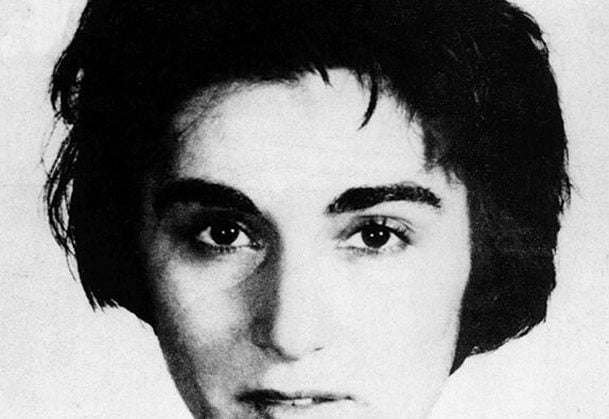
Catherine Susan “Kitty” Genovese was born on July 7th, 1935, in Brooklyn, New York, to Italian-American parents. She was the oldest of five children.
The family lived in a four-family row house in Park Slope. It was an Italian and Irish neighborhood.
As a teenager, Genovese attended Prospect Heights High School, an all-girls school. She thrived in English and music. Her graduating class of 712 students elected her “Class Cut-Up.”
She was talkative and energetic. She was popular in school (Worthen, 2019).
In 1954, her mother witnessed a horrifying murder. It prompted the family to move out of the city, to New Canaan, Connecticut.
Genovese had just graduated from high school. She did not follow her family to the suburbs. Instead, she stayed in the city with her grandparents to prepare for her marriage to Rocco Anthony Fazzolare.
Career and First Marriage
Fazzolare was an army officer and engineer. He dated Genovese while he was in college and she was in high school.
The couple married on October 31st, 1954. The marriage was soon annulled, and the two divorced in 1956 (Worthen, 2019).
In the late 1950s, Genovese moved into her own apartment in Brooklyn. Office work as a secretary held no appeal, so she became a bartender instead.
In August 1961, Genovese was arrested for bookmaking. She and a friend, Dee Guarnieri, had been taking bets on horse races from bar patrons. Both were fined $50, and Genovese lost her job (Worthen, 2019).
Genovese was headstrong and hardworking. She soon found a job at Ev’s Eleventh Hour Bar in Hollis, Queens, and eventually became the manager, filling in for the absentee owner.
Her salary reflected her reliability: about $750 a month, roughly $6,800 today. She was saving it to open her own Italian restaurant (Worthen, 2019).
Kew Gardens and the Night of the Murder
On March 13th, 1963, Genovese met Mary Ann Zielonko at Swing Rendezvous, an underground lesbian bar in Greenwich Village. The two fell fast for one another.
They decided to move in together. They found an apartment on the second floor of a two-story building next to the Long Island Railroad (LIRR) in Kew Gardens, Queens (Worthen, 2019). It would be the last place Genovese ever lived.
On March 13th, 1964, exactly a year after she met Zielonko, Genovese was stabbed to death. She was coming home from a late-night shift at the bar.
Her murder devastated the community. Reports later claimed that 38 witnesses saw or heard the attack and did nothing. Genovese’s story gained widespread attention.
Her legacy lives on in movies, books, music, and psychology textbooks. Scholars still study the “bystander effect” her case inspired. They continue to piece together what really happened that March night (Worthen, 2019).
References
Baumrind, D. (1964). Some thoughts on ethics of research: After reading Milgram’s “Behavioral study of obedience.” American Psychologist, 19(6), 421–423.
Bray, J. E., Deasy, C., Walsh, J., Bacon, A., Currell, A., & Smith, K. (2011). Changing EMS dispatcher CPR instructions to 400 compressions before mouth-to-mouth improved bystander CPR rates. Resuscitation, 82(11), 1393–1398.
Darley, J. M., & Latané, B. (1968). Bystander intervention in emergencies: Diffusion of responsibility. Journal of Personality and Social Psychology, 8(4, Pt. 1), 377–383.
Faul, M., Aikman, S. N., & Sasser, S. M. (2016). Bystander intervention prior to the arrival of emergency medical services: comparing assistance across types of medical emergencies. Prehospital Emergency Care, 20 (3), 317-323.
Fischer, P., Krueger, J. I., Greitemeyer, T., Vogrincic, C., Kastenmüller, A., Frey, D., Heene, M., Wicher, M., & Kainbacher, M. (2011). The bystander-effect: A meta-analytic review on bystander intervention in dangerous and non-dangerous emergencies. Psychological Bulletin, 137(4), 517–537.
Gansberg, M. (1964, March 27). 37 who saw murder didn’t call the police. The New York Times, p. 1.
Hortensius, R., & de Gelder, B. (2018). From empathy to apathy: The bystander effect revisited. Current Directions in Psychological Science, 27(4), 249–256.
Kassin, S. M. (2017). The killing of Kitty Genovese: what else does this case tell us?. Perspectives on psychological Science, 12 (3), 374-381.
Kettrey, H. H., & Marx, R. A. (2019). The effects of bystander programs on the prevention of sexual assault across the college years: A systematic review and meta-analysis. Journal of Youth and Adolescence, 48(2), 212–227.
Krajicek, D. (2011). The killing of Kitty Genovese: 47 years later, still holds sway over New Yorkers. New York Daily News .
Latané, B., & Darley, J. M. (1970). The unresponsive bystander: Why doesn’t he help? Appleton-Century-Crofts.
Lemann, N. (2014, March 10). A call for help: What the Kitty Genovese story really means. The New Yorker.
Manning, R., Levine, M., & Collins, A. (2007). The Kitty Genovese murder and the social psychology of helping: The parable of the 38 witnesses. American Psychologist, 62 (6), 555–562.
Pelonero, C. (2014). Kitty Genovese: A true account of a public murder and its private consequences. Skyhorse Publishing.
Philpot, R., Liebst, L. S., Levine, M., Bernasco, W., & Lindegaard, M. R. (2020). Would I be helped? Cross-national CCTV footage shows that intervention is the norm in public conflicts. American Psychologist, 75(1), 66–75.
Piliavin, I. M., Rodin, J., & Piliavin, J. A. (1969). Good Samaritanism: An underground phenomenon? Journal of Personality and Social Psychology, 13(4), 289–299.
Queens Woman Is Stabbed to Death in Front of Home. (1964). The New York Times, p. 26.
Rasenberger, J. (2004). Kitty, 40 years later. Retrieved from https://www.nytimes.com/2004/02/08/nyregion/kitty-40-years-later.html
Rasenberger, J. (2006). Nightmare on Austin street. American Heritage Publishing Company, Incorporated.
Rentschler, C. A. (2011). An urban physiognomy of the 1964 Kitty Genovese murder. Space and culture, 14(3), 310-329.
Rutkowski, G. K., Gruder, C. L., & Romer, D. (1983). Group cohesiveness, social norms, and bystander intervention. Journal of Personality and Social Psychology, 44 (3), 545.
Skoller, C. E. (2008). Twisted confessions: The true story behind the Kitty Genovese and Barbara Kralik murder trials. BookPros, LLC.
Solomon, J. (Director). (2015). The Witness [Video file]. FilmRise.
Vaillancourt, C., Charette, M. L., Stiell, I. G., & Wells, G. A. (2008). An evaluation of 9-1-1 calls to assess the effectiveness of dispatch-assisted cardiopulmonary resuscitation (CPR) instructions: Design and methodology. BMC Emergency Medicine, 8, Article 12.
Worthen, M. (2019). Kitty Genovese. Retrieved from https://www.biography.com/crime-figure/kitty-genovese