Learned helplessness is a psychological state in which repeated exposure to uncontrollable negative events leaves a person feeling powerless to change their situation.
This leads to passivity, decreased motivation, and a sense of hopelessness, which can persist even when circumstances change and control is possible.
Learned helplessness is often associated with depression.

Key Takeaways
- Learned helplessness occurs when a series of negative outcomes or stressors leads someone to believe the outcomes of life are out of their control.
- If a person learns their behavior makes no difference to their environment, they may stop trying to escape, even when escape is possible.
- Martin Seligman and Steven F. Maier first identified learned helplessness in the 1960s, in experiments where dogs exposed to repeated, uncontrollable shocks stopped trying to prevent them.
- Learned helplessness has notably been linked to and used as an explanation for depression and post-traumatic stress disorder in humans, but not without criticism.
- There are a number of ways to overcome learned helplessness. One mentioned by Seligman himself is learned hopefulness.
- A 2016 Update: More recent neuroscience suggests passivity is the brain’s default reaction, and that it is control, not helplessness, that gets learned.
What Is Learned Helplessness?
Learned helplessness happens when repeated exposure to uncontrollable stressors teaches people to stop trying to control their response, even when control is possible.
They learn their actions do not affect their environment, and this belief saps their motivation to change their situation.
The first people to describe learned helplessness were the American psychologists Steven F. Maier and Martin E. P. Seligman.
Martin Seligman conducted a series of classic experiments in the 1960s (Seligman & Maier, 1967). Some dogs were placed in a chamber where they received electric shocks from which they could not escape (the non-escape condition).
The dogs in the escape group could escape the shocks by pressing a panel with their nose.
A third group of dogs received no shock at all, acting as a baseline comparison.
Crucially, each dog that could not escape was “yoked” to a dog in the escape group, receiving identical shocks at the same moments. Only whether the dogs could control the shock differed.
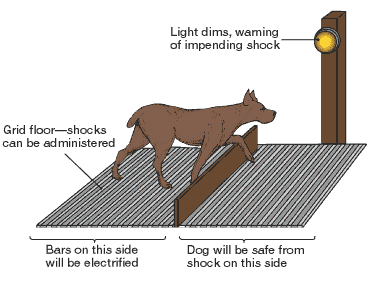
In the second phase, the animals were placed in a shuttle box divided by a barrier in the middle. The dogs could jump over the barrier to escape the shocks.
When dogs in the non-escape condition got the chance to escape by jumping across the partition, most failed even to try. They seemed to give up, passively accepting shocks the experimenters chose to give them.
In comparison, dogs who were previously allowed to escape the shocks tended to jump the partition and escape the pain.
3 symptoms of learned helplessness
Martin Seligman, the psychologist who first described learned helplessness, identified three main features that characterize this behavior:
- Lack of motivation: People with learned helplessness often do not respond to new challenges. They give up before they start, even at small setbacks.
- Difficulty learning from success: Even after coping successfully, people with learned helplessness struggle to learn from it. They rarely see success as a sign they can handle future challenges.
- Emotional numbness: People with learned helplessness may seem less affected by painful or stressful events. They might appear to be emotionally flat or unresponsive.
However, later research complicates this picture. People with learned helplessness may seem emotionally numb, but they are actually experiencing high stress levels internally.
Scientists discovered this by measuring cortisol levels, a stress hormone, in their blood (Ackerman, 2022).
Is learned helplessness a mental health condition?
Learned helplessness is not a diagnosable mental health condition but a thought disorder characterized by problematic thinking patterns that lead to maladaptive behavior.
Although not a standalone disorder, learned helplessness can feature in or exacerbate other mental health conditions such as anxiety, depression, phobias, and loneliness.
Symptoms of learned helplessness, including low motivation, perceived lack of control, and low self-esteem, overlap with those of depression and anxiety.
In the 1970s, Seligman extended learned helplessness from animal research to clinical depression in humans. He proposed a learned-helplessness theory to explain how people become vulnerable to depression.
According to this theory, people repeatedly exposed to uncontrollable stress develop an inability to make decisions. They also struggle to engage effectively in purposeful behavior.
Subsequently, researchers have noticed that this learned helplessness theory is similar to posttraumatic stress disorder (Ackerman, 2022).
The Role of Explanatory Styles in Learned Helplessness
The initial learned helplessness theory was an important breakthrough. But it soon became clear the theory needed more work to apply to humans, who are cognitively more complex than other animals.
Seligman and colleagues later reformulated the original learned helplessness model of depression (Abramson, Seligman, & Teasdale, 1978).
In their reformulation, they emphasized attributions: the mental explanations people give for why something happened. These explanations shape whether someone perceives a lack of control over negative outcomes, fostering learned helplessness.
The explanatory style model of learned helplessness seeks to identify patterns in individual reactions to positive and negative events and occurrences in their lives.
The model’s logic is that when individuals find themselves in a situation where something has gone either right or wrong, they will ask why.
The answers a person gives to that question determine whether they default to an optimistic or pessimistic explanatory style (Healy, 2017).
Unhelpful: When a negative event occurs, believing its cause is stable or long-lasting can lead to chronic feelings of helplessness.
Helpful: When a negative event occurs, believing its cause is temporary can reduce feelings of helplessness.
Unhelpful: If a person believes a negative event’s cause will affect many areas of life, they become more susceptible to widespread helplessness.
Helpful: If a person believes a negative event’s cause is limited to that one issue, they are less likely to experience helplessness.
Unhelpful: If someone attributes a negative event to their own actions or traits (an internal cause), it can damage their self-esteem.
Helpful: If someone attributes a negative event to external factors rather than their own actions, their self-esteem stays protected.
In their writing on explanatory styles, Christopher Peterson and Martin Seligman (1984) stressed that a person’s explanatory style tends to follow a pattern. People tend to respond to positive and negative events in consistent, habitual ways.
This can be very advantageous to someone’s well-being when they default to an optimistic explanatory style. But it can be very problematic for those who tend toward pessimism.
In fact, learned helplessness and a pessimistic explanatory style are each linked with the development of depression in individuals (Healy, 2017).
Optimistic vs. Pessimistic Explanatory Styles
The markers of an optimistic explanatory style stand in direct contrast to those signaling their pessimistic counterpart.
- The pessimistic style views negative events as permanent and positive events as temporary. The optimistic style reverses this: negative events are temporary, positive events are lasting.
- The pessimistic style blames the self when things go wrong and credits external factors when things go right. The optimistic style does the reverse (Healy, 2017).
However, even an optimistic explanatory style requires moderation to be most beneficial for overcoming learned helplessness.
For example, always blaming others when things go wrong, and always taking full credit when things go right, meets the definition of an optimistic style. But taken to this extreme, it becomes a problem in itself (Healy, 2017).
Overcoming Learned Helplessness
Learned helplessness explains human behaviors that can otherwise seem odd or counterproductive. Understanding it provides ways to reduce its negative effects (Ackerman, 2022).
Focus on what you can control
Focusing on what you can control is a powerful way to combat learned helplessness. When you feel like everything is out of your control, it’s easy to give up and feel helpless.
But by shifting your focus to the things you can influence, you can start to regain a sense of power over your life.
For example, you might not control whether you get a promotion at work. But you can control how much effort you put into your job.
You can’t control the weather, but you can control how you prepare for and respond to it.
Here are some things you can control:
- Your attitude: Choose to approach challenges with a positive, can-do mindset.
- Your effort: Decide how much time and energy you put into your goals.
- Your response: You can’t always control what happens to you, but you can control how you react to it.
- Your self-care: Prioritize taking care of your physical and mental health.
- Your relationships: Nurture the relationships that bring positivity into your life.
By focusing on these areas, you remind yourself that you have the power to influence your life, even in small ways.
This can help combat the feeling of helplessness and give you the confidence to tackle bigger challenges over time.
Learned optimism
Learned optimism, a concept introduced by Martin Seligman, is the antithesis of learned helplessness. While learned helplessness means internalizing a sense of hopelessness, learned optimism means challenging negative thoughts and adopting a more positive outlook. Over time, this changes people’s behaviors, and ultimately their outcomes.
The process starts with recognizing and questioning the automatic negative thoughts that fuel helplessness. Faced with a setback, someone practicing learned optimism looks for alternative explanations rather than defaulting to self-blame or despair. Instead of thinking, “I failed because I’m not good enough,” they reframe the setback. They might think, “This was a tough situation, but I can learn from it and do better next time.”
Consistently challenging negative self-talk, and focusing on what they can control, helps people gradually shift from helplessness toward resilience and empowerment. Cultivating learned optimism takes time and practice, but it can profoundly improve well-being, motivation, and the ability to overcome challenges.
Learn from failures
Carol Dweck, a psychologist, has found another powerful way to reduce learned helplessness, and it involves experiencing failure. In her research, Dweck divided people into two groups:
- The first group was given tasks that were designed for them to fail. After failing, they were told to take responsibility for their failure and to believe that it happened because they didn’t put in enough effort.
- The second group was given tasks that were easy enough for them to succeed every time. They never experienced failure during the study.
Dweck’s (1975) results showed a clear difference between the two groups. The group that only experienced success showed no change in how they reacted to failure later on, still reacting extremely negatively when failure eventually came.
However, the group that experienced failure and was taught to take responsibility for it showed big improvements. They didn’t react as badly when they failed at something later on.
In simple terms, this study suggests that experiencing failure can help people overcome learned helplessness. The key is learning to see failure as a result of insufficient effort, not a lack of ability. Failure isn’t permanent, and trying harder next time can change the outcome.
Learned hopefulness
Learned hopefulness is a concept that emphasizes the importance of empowering experiences in helping individuals overcome learned helplessness.
It suggests that providing opportunities for people to learn new skills and gain a sense of control helps them become more resilient. This resilience helps them face everyday challenges and barriers.
Unlike learned optimism, which focuses on changing thought patterns, learned hopefulness emphasizes actual experiences. These experiences shape a person’s outlook and their ability to cope with difficulties.
When individuals are exposed to situations that allow them to successfully navigate challenges, they develop a sense of mastery and control. This, in turn, helps them approach future obstacles with greater confidence and determination.
Fostering learned hopefulness through supportive environments and skill-building opportunities helps people break free from learned helplessness. It builds a more empowered, proactive approach to life.
This resilience can serve as a buffer against the negative effects of stress and adversity.
Examples
Overparenting and learned helplessness
Overparenting, often associated with “helicopter parents,” can inadvertently contribute to developing learned helplessness in adulthood.
When parents consistently intervene and solve their children’s problems, children may become overly dependent on their parents’ support.
This dependency can lead to a fear of failure and a belief that they are incapable of succeeding without their parent’s help.
While it can be difficult for parents to watch their children struggle, experiencing routine failures and challenges is essential to growing up.
These experiences teach children valuable skills such as problem-solving, coping with disappointment, and building resilience.
By facing and overcoming obstacles on their own, children develop a sense of self-efficacy and learn that they can navigate difficult situations.
While well-intentioned, overparenting can deprive children of these crucial learning opportunities. This can lead to learned helplessness and a lack of confidence in their own abilities as adults.
Learned helplessness in education
Learned helplessness is a common subject of interest in the field of education. In particular, educators are interested in how early academic failure or low academic self-esteem affects later success. They also study how that relationship can be changed to improve a student’s chances (Firmin, Hwang, Copella, & Clark, 2004).
Learned helplessness in students creates a cycle where those who feel they are unable to succeed are unlikely to put effort into schoolwork. This, in turn, decreases their chances of success, leading to even less motivation and effort.
This cycle can culminate in a student having almost no motivation to learn a subject and no competence.
It can even lead to a more generalized sense of helplessness. The student may lose all belief in their ability, and all motivation to learn any subject at school (Firmin, Hwang, Copella, & Clark, 2004).
Educators have developed a few strategies that can help prevent students from learning to be habitually helpless, such as:
-
Providing praise and encouragement based on the student’s abilities to help them believe they are good at these subjects.
-
Providing praise and encouragement based on a student’s efforts.
-
Setting individual goals with students, so they learn that goals are achievable and outcomes are within their control (Firmin, Hwang, Copella, & Clark, 2004).
Learned helplessness in relationships
Learned helplessness is also of interest to researchers focused on domestic violence, as it’s often observed in relationships involving abuse.
The phenomenon of learned helplessness has helped researchers understand this pattern. It explains why those who are abused often do not tell others, seek help, or leave the relationship (Ackerman, 2022).
In abusive relationships, abusers often subject victims to repeated abuse. This conditions victims to believe they have no control over their situation.
The abusers, as a result, maintain complete control, and the victims learn that they are helpless about their circumstances (Ackerman, 2022). These perceptions are often very difficult to shift, requiring intensive therapy and support (Ackerman, 2022).
Studies of learned helplessness in humans
Experiments as extreme as Seligman’s have never been performed on humans, since they would not pass ethical review. But milder human experiments have produced similar outcomes.
In a study by Hiroto (1974), human participants were split into three groups.
One group was subjected to a loud, unpleasant noise but could end it by pressing a button four times. The second group heard the same noise, but their button did not work.
Everyone was then given a box with a lever which, when manipulated, would turn off the sound.
As in the animal experiments, those who had no control over the noise tended not even to try turning it off. The other participants did (Hiroto, 1974).
Learned hopefulness at volunteer organizations
One example of an environment where individuals can learn hopefulness is voluntary organizations.
Someone who volunteers at an after-school center, tutoring young children in mathematics, might see how their presence directly helps students grasp the material better.
This may have run-off effects in other areas of the participant’s life.
Zimmerman (1990) studied how empowered people felt after volunteering consistently in such environments. He measured this using cognitive, personality, and motivational indicators of perceived control.
He found that those who volunteered felt more in control of their own lives. They were also more likely to attribute their successes to their own actions (Zimmerman, 1990).
Criticisms of Learned Helplessness
Seligman’s original (1967) learned helplessness theory, as well as the reformulations of others, have received a number of criticisms.
Psychologists believe that there is more to depression than learned helplessness.
While the symptoms of learned helplessness may mirror those of depression, there is an array of complex neurological and psychological factors underlying the condition.
Indeed, depression may not necessarily arise from a repeat failure.
For example, students may become depressed after repeatedly blaming themselves for chronic school stress and poor exam results.
Additionally, participants in these experiments often describe their task as a skill task, even while behaving as if it were a chance task. In other words, they act as if helpless, but still insist their effort matters (Ackerman, 2022).
Learned Helplessness in the Brain: What Recent Neuroscience Reveals
Fifty years after the original dog studies, Seligman and Maier revisited their own findings using modern neuroscience (Maier & Seligman, 2016). Their update reverses the classic interpretation.
Passivity after inescapable shock is not learned at all, this research suggests. It is the brain’s built-in default reaction, driven by a region called the dorsal raphe nucleus, which normally suppresses attempts to escape.
What is actually learned is control. A region called the ventromedial prefrontal cortex detects when an outcome can be controlled and switches off that default passivity response.
This means the original phenomenon may have been misnamed. Animals and people do not learn to be helpless; instead, they fail to learn that they already have control.
Researchers are now exploring this brain circuit as a possible target for new antidepressant treatments.
References
Abramson, L. Y., Seligman, M. E., & Teasdale, J. D. (1978). Learned helplessness in humans: critique and reformulation . Journal of abnormal psychology, 87 (1), 49.
Ackerman, C. (2022). Learned helplessness: Seligman’s Theory of Depression.
Dweck, C. S. (1975). The role of expectations and attributions in the alleviation of learned helplessness. Journal of personality and social psychology, 31 (4), 674.
Firmin, M. W., Hwang, C. E., Copella, M., & Clark, S. (2004). Learned helplessness: The effect of failure on test-taking. Education, 124 (4), 688.
Healy, C. (2017). Learned Helplessness & Explanatory Style.
Hiroto, D. S. (1974). Locus of control and learned helplessness. Journal of Experimental Psychology, 102 (2), 187-193.
Maier, S. F., & Seligman, M. E. P. (2016). Learned helplessness at fifty: Insights from neuroscience. Psychological Review, 123 (4), 349-367.
Peterson, C., & Seligman, M. E. P. (1984). Causal explanations as a risk factor for depression: Theory and evidence. Psychological Review, 91 (3), 347-374.
Seligman, M. E., & Maier, S. F. (1967). Failure to escape traumatic shock. Journal of experimental psychology, 74 (1), 1.
Seligman, M. E. (1972). Learned helplessness. Annual review of medicine, 23 (1), 407-412.
Thompson, J. A. (2010). Learned helplessness: You’re not trapped.
Zimmerman, M. A. (1990). Toward a theory of learned hopefulness: A structural model analysis of participation and empowerment. Journal of research in personality, 24 (1), 71-86.