Little Hans (a pseudonym for Herbert Graf) is the subject of Sigmund Freud’s famous 1909 case study, Analysis of a Phobia in a Five-Year-Old Boy. The case holds a foundational place in the history of psychoanalysis. Freud used it to illustrate and provide evidence for infantile sexuality, the Oedipus complex, and the origins of neurotic phobias.
Key Takeaways
Background: Little Hans (Herbert Graf) was a 5-year-old boy treated by Freud for an intense phobia of horses, published in 1909 as Analysis of a Phobia in a Five-Year-Old Boy. His father conducted the analysis, corresponding with Freud by letter.
Early Sexual Development: From about age three, Hans showed intense curiosity about “widdlers” (penises), his own and others’. At three and a half, his mother threatened to send for a doctor to cut his off, which Freud later called the origin of his castration anxiety.
The Phobia: Hans developed an intense fear of horses and became too frightened to leave the house. He especially feared white horses with black around the mouth and blinkers, which his father linked to his own moustache and spectacles.
Freud’s Interpretation: Freud read the phobia as an expression of the Oedipus complex. Horses symbolised the father, and the fear of being bitten was castration anxiety in disguise, displaced from father onto horse.
Resolution: Hans recovered once his father reassured him that no castration was intended. At 19, he visited Freud, reported no lasting effects, and had no memory of his childhood phobia at all.
Little Hans was nearly five when Freud met him in person, on 30th March 1908. Freud saw him only that once.
The bulk of the evidence instead comes from letters Hans’s father sent between January and May 1908, drawing on observations going back to when Hans was about three.
Freud was interested in the role of infantile sexuality in child development, and the case played a key role in shaping his ideas about the Oedipus complex and the castration complex.
Hans’s parents had close ties to Freud. His mother had been one of Freud’s patients before her marriage, and Max Graf, the father, was a physician and an early, sympathetic follower of Freud’s theories.
Freud had even given Hans a rocking horse for his third birthday, and knew the family well enough to carry it upstairs himself.
This closeness is worth bearing in mind, since it raises questions about bias in how the case was conducted and interpreted.
Hans’s Early Development
The first significant reports concerned Hans at age three, when he developed an active interest in his ‘widdler’ and those of others, asking his mother: “Mummy, have you got a widdler too?”
Widdlers and widdling were the dominant theme of his fantasies and dreams throughout this period. When he was about three and a half, his mother threatened to call the doctor to cut his widdler off if he continued touching it.
Freud later identified this threat as planting the seeds of castration anxiety that would shape the phobia.
The Birth of Hanna
When Hans was about three and a half, his baby sister Hanna was born. Freud read his reaction as intense jealousy: a new rival for his mother’s love and attention (Freud, 1909).
Hans was preoccupied with where babies came from. He was told the stork story, but he doubted it.
He also became fascinated and disturbed by heavily loaded carts and vans in the street. Freud interpreted these as symbols of his mother’s pregnant body, with the “loaded” cart standing for the pregnancy that had produced Hanna.
Hanna’s arrival resurfaces later in the analysis, in the giraffe fantasy Hans produced during the acute phase of the phobia.
Freud read the big giraffe as the father and the crumpled giraffe as the mother.
Hans’s taking possession of the crumpled giraffe, on Freud’s reading, expressed a wish to have his mother to himself. But in the same exchange Hans volunteered a rival equation of his own: “Hanna’s the crumpled giraffe” — identifying his baby sister, not his mother, with the toy he seized.
That detail is the seed of a later rereading. Wakefield (2007) revisited the two-giraffe fantasy and argued it fits sibling rivalry, the ongoing competition with Hanna for their mother’s attention, at least as well as a coded Oedipal scene.
Case History: Little Hans’ Phobia
When Hans was nearly five, his father wrote to Freud describing the main problem:
“He is afraid a horse will bite him in the street, and this fear seems somehow connected with his having been frightened by a large penis.”
The earliest signs of the condition appeared a few days before the phobia fully emerged.
Hans woke from a distressing dream in which his mother had gone away and he could no longer “coax” (cuddle) with her. In the evenings around this time, he fell into states of unusual anxiety mingled with tenderness toward his mother.
Freud interpreted this as an intensification of his libidinal feelings toward her that became too great to contain, succumbing to repression and transforming into generalized anxiety.
The Phobia Takes Hold
The phobia crystallised into a specific fear on 8th January during a walk with his nurse.
Hans grew visibly frightened on the street and, on the way home, confessed: “I was afraid a horse would bite me.”
Later in the analysis, he identified the precipitating incident more precisely. He had witnessed a heavy bus-horse collapse in the street, kicking violently as it fell, and heard its hooves clattering against the cobbles.
He told his father: “When the horse in the bus fell down, it gave me such a fright, really! That was when I got the nonsense.”
The family lived opposite a busy coaching inn, making avoidance almost impossible once Hans ventured outside. His anxiety was particularly triggered by white horses, horses with black nosebands, and horses pulling heavily laden carts or furniture vans.
A second incident reinforced his fear. He had heard a friend’s father warn her, “Don’t put your finger to the white horse or it’ll bite you,” as she departed in a horse-drawn cart. This created a direct link in Hans’s mind between white horses and the threat of being bitten.
When Hans was taken to see Freud on 30th March 1908, he described not liking horses with “black bits around the mouth.”
After the interview, the father recorded Hans saying, “Daddy, don’t trot away from me!”
Over the following weeks, the phobia gradually narrowed: Hans said he was especially afraid of white horses with black around the mouth wearing blinkers. His father interpreted this as a reference to his own moustache and spectacles.
The Father’s Role in the Analysis
It was Hans’s father who conducted the day-to-day analysis, not Freud.
He engaged Hans in regular conversations, asked probing questions about his phobia, and sent detailed records to Freud, who interpreted them and advised on how to proceed.
Freud justified this arrangement on the grounds that no outside analyst could have treated a child so young. Only a parent combining authority, affection and scientific interest, he argued, could overcome a five-year-old’s resistance to making unconscious thoughts conscious.
In practice, the father was highly directive. He often interpreted Hans’s dreams and fantasies directly to the boy, suggested what his unconscious wishes meant, and steered the inquiry toward the conclusions he expected.
Freud himself acknowledged the problem: Hans’s attention was deliberately turned in the direction the father anticipated, and Hans had to be told many things he could not articulate himself.
This arrangement has attracted significant critical attention.
Key Fantasies in the Analysis
During the course of the analysis, Hans articulated several vivid fantasies that helped Freud and his father decode his unconscious mind:
1. The Giraffe Fantasy
The Fantasy: Hans dreamed there was a big giraffe and a crumpled giraffe in a room. The big one called out, but Hans took the crumpled giraffe away and sat on it.
Freud’s Interpretation: The big giraffe represented the father, while the crumpled one represented the mother (or her genitals). The act of sitting on it symbolized Hans’s defiant wish to take possession of his mother.
2. The Plumber Fantasy
The Fantasy: Hans imagined that a plumber came, removed his bottom and his “widdler” with pincers, and replaced them with larger ones.
Freud’s Interpretation: This represented his desire to grow into a man with adult genitals like his father, thereby triumphing over his castration anxiety.
3. The Parenting Fantasy
The Fantasy: In a final, triumphant fantasy, Hans imagined that he was married to his mother and had his own children, relegating his father to the role of “Granddaddy.”
Freud’s Interpretation: This fantasy provided a friendly resolution to the Oedipus complex, satisfying his desires while maintaining his affection for his father.
After many letters were exchanged, Freud concluded that Hans feared his father would castrate him as punishment for desiring his mother.
In the phobia, the horse stood in for the father: Hans’s fear of being bitten was this castration fear in disguise.
Freud’s central argument, in short, was that the phobia was not really about horses at all, but a disguised expression of the Oedipus complex, managed through the defence mechanism of displacement.
Oedipus Complex
Freud held that during the phallic stage, roughly ages 3 to 6, a boy develops an intense sexual attachment to his mother. He comes to see his father as a rival he wishes to remove.
Because the father is far more powerful, the boy fears retaliation in the form of castration.
Hans had developed an exaggerated affection for his mother, climbing into her bed and wanting to “coax” with her. At the same time, he harbored a repressed death-wish against his father, unconsciously wishing him to fall down and die just as the horse had done.
Because Hans both loved and hated his father, this ambivalence produced an anxiety his ego could not tolerate directly.
Displacement and symbolic parallels
Unable to consciously confront his fear of his father, Hans used the defense mechanism of displacement: he unconsciously transferred that fear onto a safer external object, the horse.
Specific visual parallels reinforced the substitution.
The horse’s large size and large “widdler” symbolized the father.
The black noseband and the “black on the horse’s mouth” represented his father’s moustache.
The fear of being bitten by the horse was a disguised expression of his fear of being castrated by his father.
Falling horse and the death wish
The collapsing bus-horse provided the precipitating event for the phobia, but Freud interpreted it as more than a random trauma.
The sight of the falling horse represented Hans’s repressed wish that his father would fall down and die.
His terror at the event reflected guilt and anxiety surrounding this unconscious murderous impulse.
As the analysis progressed, Freud also interpreted Hans’s fear of heavily loaded carts and furniture vans as a symbolic reference to his mother’s pregnancy with his younger sister Hanna. The heavy vehicle represented a pregnant belly, he suggested, and the falling horse kicking its legs represented childbirth.
Protective function of the phobia
Freud noted that the phobia served a practical purpose for Hans.
By being too afraid to go out, he achieved his deepest wish: to remain at home in the constant company of his mother.
Resolution and Later Life
Hans recovered from his phobia after his father, at Freud’s suggestion, explicitly reassured him that he had no intention of castrating him.
The father explained the anatomical differences between the sexes and reassured Hans that he bore him no anger for loving his mother. The anxiety resolved, and Hans was able to leave the house freely again.
In the spring of 1922, Hans visited Freud’s consulting room at the age of 19.
Freud described him as a “strapping youth,” perfectly healthy and free from psychological troubles or inhibitions.
Despite the intense neurosis of his childhood, Hans had navigated puberty without lasting psychological damage. His resilience had been tested by his parents’ divorce and remarriages, which left him living independently, though he stayed on good terms with both.
His only regret about the family’s break-up was the separation it caused from his younger sister Hanna, of whom he was very fond.
One of the most striking aspects of Hans’s adulthood was his complete amnesia about his childhood phobia. Reading Freud’s published case history, the account seemed, in his own words, completely unknown to him, and he did not recognise himself in it.
The only detail that sparked a faint “glimmering recollection” was the description of a journey to Gmunden.
Herbert Graf, Hans’s real name, went on to a successful career as an opera producer.
Freud noted this as a fascinating phenomenon, concluding that the psychoanalysis had not protected the childhood events from amnesia; rather, the analysis itself had been “overtaken by amnesia.”
Freud noted this as a fascinating phenomenon, concluding that the psychoanalysis had not protected the childhood events from amnesia; rather, the analysis itself had been “overtaken by amnesia.”
Significance and Legacy
Whatever its evidential problems, Little Hans was historically pivotal and remains one of the most taught cases in psychology, for three main reasons.
The First Child Psychoanalysis
This mattered because Hans was Freud’s only child patient. Most of his developmental theorising up to that point rested on the recollections of adult patients, reconstructed backwards in analysis. Little Hans let Freud claim, for once, to watch the Oedipal drama unfold in a living child.
Little Hans was the first published psychoanalytic case study of a child. It was Freud’s chief claim to observe infantile sexuality directly, rather than reconstruct it from adult memories. The case became the template for treating children’s play, questions and fantasies as analysable psychological material.
It is also a direct ancestor of child psychoanalysis as a field.
Anna Freud and Melanie Klein each developed rival techniques for analysing young children, through play and observation, and both took Little Hans as their starting point.
A Model for Symptom Interpretation
The case also gave psychoanalysis a lasting method: reading a symptom as a meaningful, motivated compromise rather than a meaningless malfunction. That interpretive stance outlived many of Freud’s specific claims about Hans himself.
The template is visible in the reading Freud actually applied to Hans: a forbidden wish (desire for the mother, rivalry with the father) meets a danger (castration), and triggers a defence (displacement onto a safer object).
The wish then resurfaces in disguised form — the horse, the falling horse, the loaded carts — material that can be decoded rather than dismissed.
Each detail of the phobia was treated as meaningful, worth interpreting, rather than as noise.
That habit of reading behaviour for hidden motive proved more durable than the Oedipal machinery used to generate it. Later clinicians who rejected castration anxiety and infantile sexuality outright kept the interpretive habit.
They still treated a child’s symptom, play or fantasy as something expressing a conflict or need, rather than only as a target for direct correction — the interpretive stance Little Hans is credited with establishing.
A Teaching Fixture
In modern psychology education, Little Hans is the standard worked example for two things at once: the Oedipus complex, and the weaknesses of case-study evidence.
It is the ideal vehicle for teaching case-study methodology. Its richness and its flaws together show what the design can and cannot deliver: unmatched depth on one side, low generalisability, observer bias and unfalsifiability on the other.
It is equally a standard worked example for how to evaluate psychodynamic evidence. Students learn to ask who collected the data, what they already believed, and whether a rival account, behaviourist, attachment or cognitive, fits the same facts more economically.
The case also remains a live scholarly object. A 2007 centennial special issue of the Journal of the American Psychoanalytic Association reopened it using archival material.
Blum (2007), Ross (2007) and Wakefield (2007) relocated Hans’s distress in family conflict and attachment. Bierman (2007) argued his improvement may owe as much to sustained parental attention as to any Oedipal insight.
A century on, Little Hans functions less as proof of a theory than as a permanent case study in how psychological evidence should be weighed.
Critical Evaluation
Support for Freud (Brown, 1965)
Brown (1965) identified several behavioral details consistent with Freud’s interpretation:
1 . In one instance, Hans said to his father –“ Daddy don’t trot away from me ” as he got up from the table.
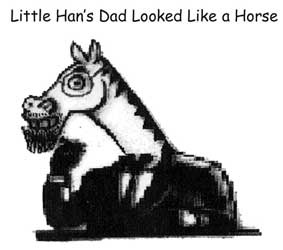
2 . Hans particularly feared horses with black around the mouth. Han’s father had a moustache.
3. Hans feared horses with blinkers on. Freud noted that the father wore spectacles which he took to resemble blinkers to the child.
4 . The father’s skin resembled white horses rather than dark ones. In fact, Hans said, “Daddy, you are so lovely. You are so white”.
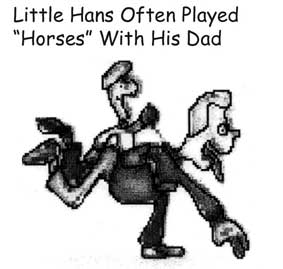
5 . The father and child had often played at “horses” together. During the game the father would take the role of horse, the son that of the rider.
Biased Sample
A major flaw in Freud’s developmental theory is that it rested almost entirely on the retrospective memories of adult patients. This makes Little Hans exceptionally important as Freud’s only actual child patient.
The case study still carries significant methodological limitations, though. As a single case, it lacks population validity: findings from one child cannot be generalized to children at large.
Critics at the time also argued Hans was not a “normal” child but one predisposed to neurosis, making universal claims about the Oedipus complex scientifically unjustifiable.
Research Bias
The data quality is further compromised by researcher bias and confirmation bias. Freud had formulated the theory of the Oedipus complex four years earlier, in his 1905 Three Essays on the Theory of Sexuality. The father was already a committed follower of his ideas.
There is a strong case that Freud and the father approached the analysis seeking confirmation of a pre-existing theory, rather than observing the child objectively.
Children are highly suggestible, particularly toward a parent. The father’s leading questions and direct interpretations, openly acknowledged by Freud himself, almost certainly shaped Hans’s responses in the expected direction.
Freud admitted this detracted from the objective evidential value of the study, though he defended the father’s interventions as therapeutically necessary.
Freud’s Own Defence Against the Suggestion Charge
The “leading interviewer” objection is not a modern add-on. Freud raised it himself, in its strongest form, inside the case history: that Hans would “allow anything to be forced upon him” out of gratitude to his father, so “none of his assertions can have any evidential value” (Freud, 1909).
He then made a striking concession: Hans “had to be told many things that he could not say himself,” which he admitted “detracts from the evidential value of the analysis” (Freud, 1909).
His defence was not to deny the leading, but to redefine the exercise.
A psycho-analysis, he wrote, “is not an impartial scientific investigation, but a therapeutic measure. Its essence is not to prove anything, but merely to alter something” (Freud, 1909).
As counter-evidence, he pointed to material the father could not have implanted, including Hans’s plumber fantasies. Even so, Freud admitted: “I shall not succeed in convincing any one who will not let himself be convinced” (Freud, 1909).
Unfalsifiability
A further criticism concerns unfalsifiability.
Freud’s interpretation that Hans’s fear of horses was a displaced fear of his father due to the Oedipus complex cannot be empirically tested or proven wrong.
Contradictory evidence could always be explained away as “resistance” or “denial” on the part of the patient, meaning the theory is immune to disconfirmation.
For this reason, critics argue the case lacks the scientific rigour required to support universal claims about child development.
Even if Hans did have a fully developed Oedipus complex, this would demonstrate only that such a complex might exist in one case. It would not show that it is universal, as Freud claimed.
Ethical and Consent Issues
By modern standards, the case also raises real ethical concerns. A young child cannot give informed consent, and Hans’s analysis was conducted by his own father.
This created a profound dual relationship: the roles of parent and therapist were hopelessly entangled. Hans’s questions about sex and his own body were pursued partly to serve the adults’ theoretical interest.
There was no independent safeguard for the child’s welfare against the investigators’ commitment to a hypothesis.
The imbalance was structural, not incidental. Freud met Hans in person only once, on 30th March 1908; every other exchange about the boy’s body, his fears and his fantasies passed through his father.
The father was simultaneously parent, questioner, and the person the child would naturally want to please. A modern research-ethics review would treat a parent-administered “treatment” of this kind, with no independent clinician present for the day-to-day work, as an unmanaged conflict of interest.
The Freud Archives
In 2004, the Freud Archives released a number of key documents which helped to complete the context of the case of little Hans (whose real name was Herbert Graf).
The released works included the transcript of an interview conducted by Kurt Eissler in 1952 with Max Graf (little Hans’s father). They also included notes from brief interviews with Herbert Graf and his wife in 1959.
Such documents have provided some key details that may alter the way information from the original case is interpreted. For example, Hans’s mother had been a patient of Freud herself.
Another noteworthy detail: Freud gave little Hans a rocking horse for his third birthday, and knew the family well enough to carry it up the stairs himself.
Given Hans’s horse phobia, it is worth asking why the gift was never mentioned in the case study. Disclosing it would not have broken confidentiality for either the family or Freud himself.
Information from the archived documents reveal much conflict within the Graf family. Blum (2007, p. 749) concludes that:
“Trauma, child abuse [of Hans’s little sister], parental strife, and the preoedipal mother-child relationship emerge as important issues that intensified Hans’s pathogenic oedipal conflicts and trauma. With limited, yet remarkable help from his father and Freud, Little Hans nevertheless had the ego strength and resilience to resolve his phobia, resume progressive development, and forge a successful creative career.”
Alternative Explanation: Behaviorism
A simpler account of Hans’s phobia can be offered through behaviorist principles, without reference to unconscious conflict.
Classical conditioning explains how the phobia was acquired: witnessing the bus-horse collapse was an unconditioned stimulus producing extreme fright, and through association, horses became a conditioned stimulus automatically triggering fear.
Stimulus generalization then explains how Hans’s fear broadened from that specific horse to all horses and to heavy vehicles resembling the bus.
Operant conditioning explains how the phobia was maintained: by refusing to leave the house, Hans avoided horses and experienced immediate relief. This negative reinforcement perpetuated and strengthened his avoidance behavior.
Wolpe and Rachman (1960) explicitly compared this case to Watson and Rayner’s “Little Albert” experiment, in which a baby was conditioned to fear a white rat through loud noise. That fear then generalised to other furry objects.
To a behaviorist, Little Hans was simply a naturally occurring version of Little Albert.
Gross cites an additional alternative offered by Slap (an American psychoanalyst): shortly after the phobia began, Hans had his tonsils removed, and the phobia subsequently worsened.
Slap suggests that the sight of the white-gowned surgeon may have contributed significantly to Hans’s specific fear of white horses.
Alternative Explanation: Bowlby’s Attachment Theory
John Bowlby reappraised the case and argued that Hans’s phobia was rooted in separation anxiety, not castration anxiety, and that Freud had fundamentally misdiagnosed the boy. Crucially, Bowlby based his counter-argument entirely on evidence within Freud’s own published text.
Bowlby found that Hans’s mother regularly used threats of abandonment as a disciplinary tool.
Hans explicitly told his father, “Mummy’s told me she won’t come back,” to which the father replied, “She said that because you were naughty.”
The week before the phobia fully emerged, Hans had woken crying from a dream that his mother was gone. He repeatedly cried in the street, begging to be taken home to “coax” with her.
These were not symbolic or displaced anxieties, in Bowlby’s view, but responses to genuine and well-founded fears of maternal desertion.
Bowlby also pointed out that the actual castration threats in the case came from the mother, not the father. This directly undermines Freud’s account of who Hans feared, and why.
He further noted that Hans’s specific fear of white horses biting him was directly linked to witnessing his friend Lizzi depart in a horse-drawn cart. Her father had warned her that the horse would bite.
To Bowlby, horses were associated in Hans’s mind with departures, not with paternal authority.
From this perspective, Hans’s refusal to leave the house was a straightforward, logical survival mechanism. By staying home, he ensured his mother could not leave while he was away. The phobia required no recourse to unconscious Oedipal conflict to explain it.
A contemporary attachment reading extends this further. Wakefield (2007) revisited Hans’s giraffe fantasy and reread it through attachment and sibling rivalry, the competition for his mother’s attention after Hanna’s birth.
On this view, the fantasy is not a coded Oedipal scene at all.
A Cognitive Reading
A cognitive account offers a third alternative to Freud’s theory. It notes that a phobia is not just a learned stimulus-response link but involves catastrophic beliefs and biased threat appraisal.
A frightened five-year-old who has just seen a huge animal collapse violently may form the irrational belief that horses are dangerous and will bite. His attention then becomes biased toward the feared cues, such as the horse’s mouth and size.
On this view, the phobia is maintained by Hans’s maladaptive thoughts about horses, not by unconscious wishes. This anticipates the modern cognitive-behavioural model of phobia.
On this reading, the visual details Freud read as displaced castration symbolism do a plainer job. The black muzzle and the blinkers are not disguised references to a moustache and spectacles.
They are simply the most vivid, most threatening features of the animal that collapsed in front of him — the features an anxious child’s attention would lock onto and rehearse.
The cognitive account also carries different treatment implications. Where Freud’s model called for interpreting a repressed wish, a cognitive-behavioural approach would target the belief itself.
Gradual, controlled exposure to horses, paired with corrective information that gently disconfirms the expectation of being bitten, is the logic behind modern exposure-based treatment of childhood phobias.
References
Bierman, J. S. (2007). The psychoanalytic process in the treatment of Little Hans. Psychoanalytic Study of the Child, 62, 92–110.
Wakefield, J. C. (2007). Attachment and sibling rivalry in Little Hans: The fantasy of the two giraffes revisited. Journal of the American Psychoanalytic Association, 55(3), 821–848.
Wolpe, J., & Rachman, S. (1960). Psychoanalytic “evidence”: A critique based on Freud’s case of Little Hans. Journal of Nervous and Mental Disease, 131(2), 135–148. https://doi.org/10.1097/00005053-196008000-00007
BSc (Hons) Psychology, MSc Psychology of Education
Associate Editor for Simply Psychology
Olivia Guy-Evans is a writer and associate editor for Simply Psychology, where she contributes accessible content on psychological topics. She is also an autistic PhD student at the University of Birmingham, researching autistic camouflaging in higher education.
BSc (Hons) Psychology, MRes, PhD, University of Manchester
Saul McLeod, PhD, is a qualified psychology teacher with over 18 years of experience in further and higher education. He has been published in peer-reviewed journals, including the Journal of Clinical Psychology.