In sociology, alienation is when humans feel disconnected or estranged from some part of their nature or from society. Individuals can be alienated from themselves and from others, often resulting in feeling powerless or without control over their own lives.
The term alienation was conceptualized by Karl Marx when he used alienation to describe the effects of capitalism on the working class. Before this, the meaning of alienation changed over the centuries.

In theology, alienation named humanity’s distance from God. In social contact theories, it meant the loss of an individual’s original freedom. The word kept shifting. In political economy, it simply meant the transfer of property ownership (Musto, 2010).
In Marx’s Economic and Philosophical Manuscripts of 1844, he presented alienation as a specific phenomenon. The labor product, he wrote, confronts labor ‘as something alien, as a power independent of the producer.’
According to Marx, the product of a worker’s labor under a capitalist system results in feeling alienated.
The production of labor is felt to belong to someone else and is simply a way for the worker to meet the needs of physical life – purely for wages.
Thus, alienation can make an individual or society feel isolated, unworthy, and insignificant (Mukhopadhyay, 2020).
Marx widened the problem of alienation to the economic sphere of material production. Further, he proposed that the economic sphere was essential to understanding and overcoming alienation in other spheres (Musto, 2010).
Key Takeaways
- Definition: Alienation is the estrangement Karl Marx said capitalist wage labor produces, cutting workers off from what they make, how they work, their own nature, and each other.
- Four Types: Marx described alienation from the product, the process, species-being (the self), and other workers, presented as a chain rather than a list.
- Root Cause: Alienation stems from the wage relation and private ownership of the means of production, not from any individual employer’s attitude.
- Species-Being: Marx’s argument rests on a claim about human nature: free, conscious, purposeful activity is what makes us human, so degraded work degrades the person.
- Overcoming It: Marx held that only a structural change in ownership, not a change in perception, could remove alienation.
- Modern Evidence: Recent research links platform and gig work to measurably higher powerlessness and loneliness, extending the theory into today’s economy.
What Causes Alienation?
Loss of Craft and Control
Marx held that work was less alienating in earlier societies. Workers then had more control over their conditions, possessed real skill, and made a whole product from start to finish. Work was more satisfying, because workers could recognize themselves in what they produced.
Capitalism and the industrial factories of the 19th century eroded this craftsmanship. Workers gained less control over their work. Many became unskilled, reduced to one stage of a production line.
This shift generates high alienation, Marx argued: workers feel powerless and out of control. The cause, he held, is the economic system itself, not any individual employer’s attitude.
The introduction of machines deepens this pattern. As machinery spreads, a worker’s task becomes narrower and less skilled, capital accumulates in fewer hands, and the workforce grows correspondingly more fragmented (Boudon & Bourricaud, 1989).
Alienation vs. Anomie
Other sociologists developed related concepts. Émile Durkheim coined anomie for the instability and social upheaval that tends to accompany capitalism.
Anomie describes the crisis that hits social norms once the division of labor expands (Musto, 2010).
People who experience it feel isolated from their society, because they no longer see their own values and norms reflected in the world around them.
Alienation and anomie are not the same thing. Alienation is an individual feeling disconnected from their own work or surroundings; anomie is a lack of shared values and norms across a whole society.
The two can look similar. For Marx, alienation comes from the structure of capitalism. For Durkheim, anomie is a social fact about a whole population, not one person’s economic position.
Marx 4 Types of Alienation
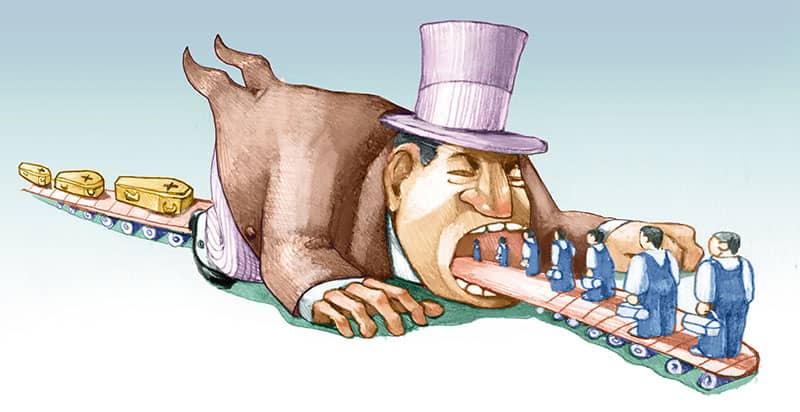
Alienation means the lack of power, control and fulfillment experienced by workers in capitalist societies in which the means of producing goods are privately owned and controlled.
According to Karl Marx in the Economic and Philosophical Manuscripts of 1844, the capitalist system leads to four distinct ways in which workers are alienated:
Alienation From the Product of Labor
Instead of the workers crafting products from the initial idea to completion, under capitalism, the product is entirely directed by someone else.
The product is highly specific in nature, is repetitive, and workers may only produce one aspect of a larger product on a production line.
Thus, the final product does not feel like the worker’s own and is creatively unrewarding. The product becomes an alien object, one that the worker produces only for the means of wages and survival.
Marx stated:
‘…the object which labor produces – labor’s product – confronts it (the worker) as something alien, as a power independent of the producer… Under these conditions, this realization of labor appears as loss of realization of the workers.’
Consider an assembly-line worker who spends a whole shift fitting windows into car doors and never sees a finished vehicle.
Or a cannery worker who cleans fish for years without knowing what they become. Neither sees the whole.
An unskilled worker in a watch factory presses a button to seal components together, where a watchmaker once trained for years. The comparison is deliberate. What is missing in each case is any felt connection to the finished thing.
Contrast a cabinetmaker who selects the timber, designs the piece, cuts the joints, and finishes the surface.
The cabinetmaker can point at a chair and say, ‘I made that, and it is mine.’ The line worker can point at nothing.
A modern parallel exists in digital work. A content moderator reviewing flagged posts for a social media platform produces something genuinely valuable, a usable public space. But the output is invisible and belongs entirely to the platform.
Alienation From the Process of Labor
Instead of having the freedom to choose how and when they work, workers under a capitalist system must work as and when their employer requires.
They also must complete the tasks set by their employer, meaning that the process of labor is something external to the worker.
According to Marx, the process of labor:
‘does not belong to his intrinsic nature… in his work he does not affirm himself but denies himself… does not freely develop his physical and mental energy.’
Marx perceived the process of labor as directed against the worker as if it ‘does not belong to him.’ While the process of labor is not physically forced upon workers, it is forced in the sense that it becomes non-voluntary.
If the worker does not want to starve and must pay for their home, they feel forced to engage in the process of labor under capitalism.
This is not incidental.
A fast-food worker must assemble each item in a fixed order and a fixed time, with no room to vary the recipe. Every parameter is decided elsewhere and handed down as instruction.
A more modern version is a warehouse picker whose handheld terminal specifies the route, the item, the bin, and the seconds allowed for each pick. That control is more constant and more precisely measured than anything a factory floor manager could enforce with a stopwatch.
Alienation From the Self
According to Marx, satisfying work is an essential part of being human. Workers under capitalism feel alienated from both the product and the process of their labor, so work stops being satisfying.
Marx’s term for this is species-being. The idea is that free, conscious, purposeful activity is what makes humans distinctively human, not simply the fact that they produce.
Degraded work, on this view, degrades the person, not only their output.
This is not the same as simply making something. Marx separated the two. Objectification is the normal act of putting one’s skill into a product. Alienation happens only once that product belongs to someone else and confronts its maker as a hostile power. The distinction matters.
Marxist theory is critical of capitalism for this reason: the laborers behind the goods and services lose their own value over time.
Workers who once crafted a whole product may now be reduced to producing one small component on a production line.
Work under capitalism alienates individuals from themselves. Work is no longer a joy. It becomes simply a means to earn wages to survive.
Marx implied that the work:
‘…estranges from man… his human aspect.’
Workers become alienated from their true selves, desires, and the pursuit of happiness by the demands placed on them by capitalists.
They are essentially converted into objects by the production method, meaning they are viewed and treated not as humans but as replaceable elements of a system.
Alienation From Other Workers
Under capitalism, workers are encouraged to compete against each other for jobs, better products, and higher profits. This pits individuals against each other in a competition to sell their labor for the lowest possible value. Competition replaces solidarity.
Instead of seeing their shared position and developing class consciousness, a class’s accurate awareness of its own interests and collective power, alienation prevents this and instead fosters false consciousness.
Marx called this fourth form the estrangement of man from man, using the standard English rendering of his term Entfremdung.
It follows directly from the other three: if a person’s relation to their own work is distorted, their relation to everyone else’s work is distorted too.
According to Marx, alienation:
‘(leads to)…the estrangement of man from man… Hence within the relationship of estranged labor each man views the other in accordance with the standard and the relationship in which he finds himself as a worker.’
Under capitalism, workers become profit-maximizing and self-interested individuals. Workers treat others as objects and as instruments to reach an end goal.
Alienation is not confined to the working class. Marx held that the capitalist is alienated too, living in an estranged relation to other people they must treat as instruments rather than as fellow human beings.
The difference is that the capitalist is comfortable in the estrangement, and the worker is not.
How to Overcome Alienation According to Marx
To overcome alienation, Marx argued, changing how it is perceived is not enough. What is required is a reorganization of society itself, because the cause is structural.
The Proletarian Revolution
Marx predicted a proletariat revolution: a social revolution in which working-class laborers overthrow the capitalist bourgeoisie. The continued exploitation of workers by capitalists would drive it.
In the Communist Manifesto, written in 1848, Marx and Engels argued this outcome was inevitable. Workers, they held, would eventually revolt against worsening conditions and low wages.
Marx saw this as historically necessary. It follows the same historical-materialist logic that had already carried earlier societies from one mode of production to the next.
Revolution, on this account, is the predictable outcome of a system in crisis, not an accident of politics.
In the resulting society, resources and wealth would be shared. Social classes would be abolished. Accumulated labor would widen and enrich a worker’s existence rather than exploit it. With no private ownership of the means of production, workers would gain real control over their own work, and alienation would lessen.
Beyond Redistribution
Marx rejected mere redistribution. He called simply transferring property to the community crude communism, and warned it would not abolish alienation.
It would universalize it instead, replacing the individual capitalist with the community as capitalist, while leaving the worker’s relation to their own activity untouched.
Ownership alone is not enough. What matters is a change in how people relate to their own productive activity, not simply who owns what. This is why twentieth-century state socialism, where state ownership often came with intensified industrial discipline, does not simply vindicate or refute Marx’s theory.
Marx’s mature formulation is more sober.
It appears in Capital: the realm of freedom begins only where labor determined by necessity ends, and its basic prerequisite is a shorter working day.
Necessary labor cannot be abolished, on this view, only minimized.
Critical Evaluation of Alienation Theory
Marx’s theory of alienation is best seen as a durable analytical framework with a serious critical literature, not as a simple finding that is either proven or disproven.
Strengths and Weaknesses
The theory connects feeling to structure. It explains how work feels by reference to who owns what, something most rival accounts do only one half of.
It has also proved analytically generative, producing a measurable research tradition (Seeman, 1959) and an empirical literature few 19th-century social theories ever attracted.
Its main weakness is different. The whole argument rests on a contestable claim about human nature: that free, conscious, purposeful activity is what people essentially are. This claim cannot itself be tested.
A related problem is that the theory is hard to disconfirm.
If alienation is objective, a satisfied worker can still count as alienated, which makes contrary survey evidence difficult to read as a genuine challenge.
The theory’s political prediction has also fared poorly. Alienation was meant to build class consciousness and drive revolution. The empirical literature instead finds that alienated workers tend to withdraw, disengage, or leave, a pattern closer to demobilization than to solidarity.
Contemporary Research
The strongest current evidence concerns platform and gig work. Here, the mechanisms Marx described are unusually visible and measurable.
Aim: Powerlessness and isolation matter here.
Paul Glavin and colleagues tested whether working for an online labor platform is associated with greater levels of each, two dimensions later used to measure alienation empirically.
Method: Two national surveys anchor this study. Canadian workers were surveyed in September 2019 (N = 2,460) and again in March 2020 (N = 2,469).
Platform participation was measured alongside standard scales of powerlessness and loneliness, controlling for financial strain.
Results: Platform workers reported greater powerlessness and greater loneliness than other workers.
Financial strain did not fully explain this gap. Rideshare driving showed a stronger association with both than online crowdwork did.
Conclusion: The authors linked the pattern to algorithmic control.
Platforms use distancing strategies, separating a worker from the firm, the client, and other workers, and this appears to undermine both autonomy and social connection (Glavin et al., 2021).
This is a strong result. Two large national samples, a replication across two independent waves, and a control for the most obvious alternative explanation all support it.
It cannot alone prove causation. People who already feel powerless may simply be more likely to take up platform work in the first place.
A separate study spanned six countries in Southeast Asia and Sub-Saharan Africa. It found a similar double pattern: high flexibility and autonomy on one side, low pay and social isolation on the other (Wood et al., 2019).
Earlier theorists predicted that automation would reduce alienation. Recent evidence points the other way: highly automatable US occupations report lower job satisfaction and worse health, not better (Liu, 2023).
Frequently Asked Questions
How Does Alienation Affect Workers’ Sense of Control?
Alienation can make workers feel powerless. Alienation in a capitalist society can make individuals believe that what happens in their lives is outside their control and that whatever they do does not matter.
If they feel controlled by the capitalists at work, this may extend into other areas of control in their lives.
Interacting with their boss may deepen this lack of control. A worker who does not feel safe voicing an opinion or giving honest feedback is less likely to do either.
The result is less control for the worker, and more power for the employer.
How Does Alienation Influence Job Satisfaction?
Alienation is believed to result in decreased job satisfaction. Specifically, alienation increases need deprivation, resulting in lower job involvement and ultimately decreased identification with their work organization (Efraty et al., 1991).
Other findings indicate that feeling powerless and meaningless in work, or work alienation, influences organizational commitment and work effort. Workers who feel they have little influence over their labor, and that their labor is not worthwhile, show worse outcomes on both counts (Tummers & Den Dulk, 2013).
How is Alienation Relevant Today?
A Marxist theory of alienation can explain the paradox of social power and loneliness that is often seen in capitalist societies today (Øversveen, 2022).
There is a global rise in self-reported loneliness, isolation, and mental illness. This may result from cultural, technological, and environmental change, together with political movements that capitalize on social frustration (Berardi, 2017).
References
Berardi, F. (2017). Futurability: the age of impotence and the horizon of possibility. Verso Books.
Boudon, R., & Bourricaud, F. (1989). A critical dictionary of sociology. University of Chicago Press.
Efraty, D., Sirgy, M. J., & Claiborne, C. B. (1991). The effects of personal alienation on organizational identification: a quality-of-work-life model. Journal of Business and Psychology, 6 (1), 57-78.
Tummers, L. G., & Den Dulk, L. (2013). The effects of work alienation on organizational commitment, work effort and work-to-family enrichment. Journal of Nursing Management, 21(6), 850–859. https://doi.org/10.1111/jonm.12159
Marx, K. (1959). Economic and philosophic manuscripts of 1844 (M. Milligan, Trans.). Progress Publishers. (Original work published 1844)
Mukhopadhyay, R. (2020). Karl Marx”s Theory of Alienation. Available at SSRN 3843057.
Musto, M. (2010). Revisiting Marx’s concept of alienation. Socialism and Democracy, 24(3), 79–101.
Øversveen, E. (2022). Capitalism and alienation: Towards a Marxist theory of alienation for the 21st century. European Journal of Social Theory, 25(3), 440–457. https://doi.org/10.1177/13684310211021579