The term minority influence refers to a form of social influence that is attributed to exposure to a consistent minority position in a group.
Minority influence is generally felt only after a period of time and tends to produce private acceptance of the views expressed by the minority.
An important real-life example of a minority influencing a majority was the suffragette movement in the early years of the 20th century.
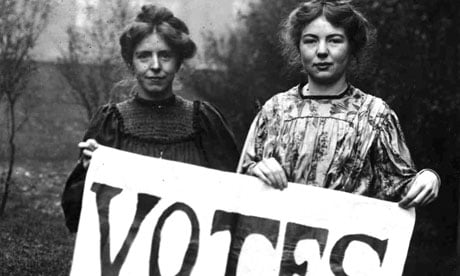
A relatively small group of suffragettes argued strongly for the initially unpopular view that women should be allowed to vote. The hard work of the suffragettes, combined with the justice of their case, finally led the majority to accept their point of view.
Conformity studies involve a minority group that conforms to the majority. Moscovici (1976, 1980) argued along different lines.
He claimed that Asch (1951) and other researchers had overstated how much a majority influences a minority. In his view, a minority can also influence the majority.
In fact, Asch agreed with Moscovici. He too believed minority influence was real, and a more important question to study than conformity. Why do some people resist group pressure and persuade others, rather than simply going along with the group?
Moscovici made a distinction between compliance and conversion. Compliance is common in conformity studies (e.g., Asch) whereby the participants publicly conform to the group norms but privately reject them.
Conversion describes how a minority changes the majority’s underlying beliefs, not just its public behaviour. A minority achieves this by convincing the majority that its view is correct, through factors such as consistency and flexibility.
Unlike compliance, conversion usually produces both public and private acceptance of a new view or behavior, a process known as internalization.
How does the minority change the majority view?
Moscovici argues that majority influence tends to be based on public compliance. It is likely to be a case of normative social influence.
In this respect, the power of numbers matters: the majority can reward or punish with approval and disapproval, which pressures minorities to conform.
Since majorities are often unconcerned about what minorities think of them, minority influence rarely relies on normative social influence. Instead, it usually works through informational social influence: new ideas and information that lead the majority to re-examine their views.
Minority influence therefore works through private acceptance, or internalization: convincing the majority that the minority’s views are right.
Four main factors have been identified as important for a minority to have an influence over a majority.
These are behavioral style, style of thinking, flexibility, and identification.
Behavioral Style
This comprises four components:
- Consistency: The minority holds the same position without wavering.
- Confidence: The minority appears certain that its views are correct.
- Objectivity: The minority appears unbiased rather than self-interested.
- Resistance to Pressure: The minority withstands social pressure and hostility without backing down.
Moscovici (1976, 1980) argued that consistency is the most important aspect of behavioral style. A minority that holds a steady, unchanging position is more likely to influence the majority than one that wavers or changes its mind.
Moscovici (1969) tested consistent and inconsistent minority behavior in his blue-green slide studies. He found that a consistent minority was more successful than an inconsistent one at changing the majority’s views. Consistency may be important for several reasons:
- Confronted with consistent opposition, members of the majority will sit up, take notice, and rethink their position.
- Consistency gives the impression that the minority is convinced it is right and committed to its viewpoint.
- When the majority meets someone who holds their ground under pressure and refuses to back down, they tend to assume that person has good reason to be so sure.
- A consistent minority disrupts the majority’s assumptions, creating doubt that makes the majority more likely to question its own view.
To change the majority’s view, the minority must propose a clear position and defend it consistently.
A distinction can be made between two forms of consistency:
(a) Diachronic Consistency – i.e., consistency over time – the minority sticks to its guns and doesn’t modify its views.
(b) Synchronic Consistency – i.e., consistency between its members – all members agree and back each other up.
Consistency alone may not be enough. Nemeth, Swedlund, and Kanki (1974) varied how a minority’s “green” answers were patterned across the same blue slides Moscovici used.
When the minority’s answers followed no obvious pattern, they had no influence at all. But when their answers tracked the slides’ actual brightness in a sensible way, minority influence rose sharply. It reached around a fifth of trials.
This shows that repeating the same answer is not enough on its own. What matters is whether the majority can see the minority’s pattern as tracking something real.
Style of Thinking
Identify three or four minority groups (e.g., asylum seekers, British National Party, etc.)
How do you think and respond to each of these minority groups and the views they put forward?
Do you dismiss their views outright or think about what they have to say and discuss their views with other people?
If you dismiss the views of other people without giving them much thought, you would have engaged in superficial thought/processing.
By contrast, if you had thought deeply about the views being put forward, you would have engaged in systematic thinking/processing (Petty et al., 1994).
A minority is more likely to influence the majority when it gets the majority to weigh both sides of an issue (Smith et al., 1996). Open discussion and debate of the minority’s arguments makes that influence even stronger (Nemeth, 1995).
Flexibility and Compromise
Consistency alone may not be enough to change a majority’s mind. What matters more is how the majority interprets that consistency.
Why Appearing Flexible Helps
A minority seen as rigid, uncompromising, and dogmatic is unlikely to change majority views. The majority often dismisses a rigid minority by treating its firmness as a personality quirk, not a genuine argument (Mugny & Papastamou, 1980).
This lets the majority avoid engaging with the substance of what the minority is actually saying.
A minority that instead appears flexible and willing to compromise is seen as more moderate, reasonable, and cooperative, rather than stubborn or extreme. These qualities make its position easier for the majority to take seriously, giving it a better chance of success.
Some researchers went further, asking whether this needs to be more than appearance. Perhaps actual flexibility and compromise, not merely the impression of it, is what really shifts majority opinion.
Nemeth’s (1986) Compromise Study
Method: Nemeth (1986) ran a mock-jury experiment: three participants and one confederate, acting as a consistent minority, had to agree on compensation for the victim of a ski-lift accident.
Results: When the confederate argued for a low amount and refused to shift at all, they had no effect on the group’s decision. When the same confederate began with the low figure and then compromised toward the majority’s preferred amount, the majority also moved toward the confederate’s position.
Conclusion: This result challenges a simple “consistency is everything” reading of the theory. It was the confederate’s willingness to change, an apparent break from pure consistency, that produced influence.
The likely resolution is that flexibility works alongside consistency rather than against it. An effective minority holds firmly to its underlying principle. It stays genuinely open about the specific means of reaching an agreement, signalling both conviction and good faith at once.
Identification
People tend to identify with people they see as similar to themselves. For example, people of the same gender, ethnic group, or age.
Research indicates that when the majority identifies with the minority, it takes the minority’s views more seriously and is more likely to adopt them.
One study compared a gay minority and a straight minority, both arguing for gay rights, and their influence on a straight majority. The gay minority had less influence (Maass et al., 1982).
The non-gay majority identified with the non-gay minority. They tended to see the gay minority as different from themselves, as self-interested and concerned with promoting their own particular cause.
Moscovici et al. (1969) Blue-Green Study
Aim: To investigate the effects of a consistent minority on a majority. Moscovici (1969) conducted a re-run of Asch’s experiment, but in reverse.
Instead of one subject amongst a majority of confederates, he placed two confederates together with four genuine participants. The participants were first given eye tests to ensure they were not color-blind.
Procedure: They were then placed in a group consisting of four participants and two confederates. They were shown 36 slides which were clearly different shades of blue, and asked to state the color of each slide out loud.
In the first part of the experiment, the two confederates answered green for each of the 36 slides. They were totally consistent in their responses. In the second part of the experiment, they answered green 24 times and blue 12 times.
In this case, they were inconsistent in their answers. Would the responses of the two confederates influence those of the four participants? In other words, would there be a minority influence? 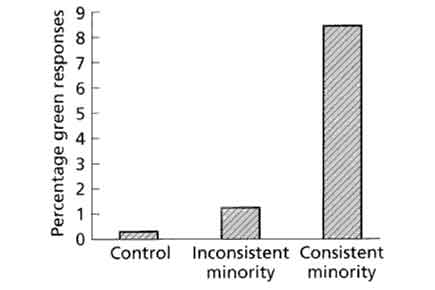
Results: In condition one, it was found that the consistent minority had an effect on the majority (8.42%) compared to an inconsistent minority (only 1.25% said green).
A third (32%) of all participants judged the slide to be green at least once.
Conclusion: Minorities can influence a majority, but not all the time, and only when they behave in certain ways (e.g., consistent behavior style).
Criticism: The lab-based design raises ecological validity concerns, and the sample was entirely female (see Evaluation below for the full critique).
Critical Evaluation of Minority Influence Research
Before looking at each criticism in detail, here are the main concerns raised about minority-influence research:
- Ecological Validity: Laboratory groups of strangers judging colour slides bear little resemblance to real minority groups, which have ongoing relationships and real stakes in the outcome.
- Sample and Design Limits: The original study used only female students and a “majority” of just four, both of which limit how far its findings generalize.
Ecological Validity
Sampson (1991) is a leading critic of laboratory minority-influence research, raising serious ecological validity concerns. He argues lab groups are rarely “real groups”: participants are usually strangers who complete an artificial task and will probably never meet again.
Real minority groups look very different. Members of campaigning organizations such as Greenpeace or women’s rights groups know each other and provide mutual support.
They often face determined opposition for years, not a single lab afternoon. Laboratory experiments also cannot recreate the differences in power and status that separate real-world minorities from majorities.
This artificiality raises a real question: does an effect found with strangers naming colours generalize to minorities who care deeply about their cause?
Sampson’s critique limits how confidently the colour-perception paradigm’s findings can be extended beyond the laboratory.
Sample and Design Limits
Moscovici’s colour-perception study used only female student participants. This makes it an unrepresentative sample: strictly, the results only tell us how these particular young women behaved in this particular task.
Some evidence from the wider conformity literature suggests women may respond somewhat more to group pressure than men in certain contexts.
An all-female sample therefore leaves open a real question: would men show the same, a smaller, or a different pattern of change?
A related criticism concerns the size of the “majority” itself. Some researchers argue four participants are not enough to count as a genuine majority. It may simply be a slightly larger sub-group within a small laboratory group.
Together, these two limitations mean the study’s precise percentages are best read as suggestive of an effect, not as a definitive real-world estimate.
Contemporary Research
A 2018 study published in Science tested minority influence at a larger scale than Moscovici’s lab groups.
Aim: Centola, Becker, Brackbill, and Baronchelli (2018) tested whether a minority must reach a “critical mass” to overturn an established group convention.
Method: Online groups first agreed on a shared naming convention through a coordination task. Researchers then introduced confederates who consistently promoted a competing convention, varying the size of this minority across groups.
Results: Groups with a committed minority below roughly 25% of members kept their original convention. Once the minority passed the 25% threshold, the group reliably and rapidly switched to the minority’s alternative.
Conclusion: A minority does not need to become a majority: it only needs to reach a critical mass, after which change happens abruptly.
Key Takeaways
- Compliance vs Conversion: Majorities produce public compliance through social comparison; minorities produce private conversion through validation, engaging with the argument’s content.
- Consistency: A minority is most persuasive when it holds the same position over time (diachronic) and its members agree with each other (synchronic).
- Flexibility: Appearing rigid gets a minority dismissed, but real flexibility on specifics, while holding firm on the core position, increases influence (Nemeth, 1986).
- Identification: Majorities take a minority more seriously when they see its members as similar to themselves, not as a self-interested outgroup (Maass et al., 1982).
- Blue-Green Study: Moscovici’s colour-perception experiment found consistent minorities shifted majority judgements far more than inconsistent ones (8.42% vs. 1.25% “green” responses).
- Critical Mass: A minority need not become a majority: once it passes roughly 25% of a group, change can happen abruptly (Centola et al., 2018).
References
Asch, S. E. (1951). Effects of group pressure upon the modification and distortion of judgment. In H. Guetzkow (ed.) Groups, leadership and men. Pittsburgh, PA: Carnegie Press.
Centola, D., Becker, J., Brackbill, D., & Baronchelli, A. (2018). Experimental evidence for tipping points in social convention. Science, 360(6393), 1116-1119. https://doi.org/10.1126/science.aas8827
Maass, A., Clark, R. D., & Haberkorn, G. (1982). The effects of differential ascribed category membership and norms on minority influence. European Journal of Social Psychology, 12(1), 89-104. https://doi.org/10.1002/ejsp.2420120107
Moscovici, S., Lage, E., & Naffrechoux, M. (1969). Influence of a consistent minority on the responses of a majority in a color perception task. Sociometry, 32(4), 365-380. https://doi.org/10.2307/2786541
Moscovici, S. (1976). Social influence and social change. London: Academic Press.
Moscovici, S. (1980). Toward a theory of conversion behavior. In L. Berkowitz (Ed.), Advances in experimental social psychology (Vol. 13, (pp. 209–239). New York: Academic Press.
Mugny, G., & Papastamou, S. (1980). When rigidity does not fail: Individualization and psychologization as resistances to the diffusion of minority innovations. European Journal of Social Psychology, 10(1), 43-61.
Nemeth, C. J. (1986). The differential contributions of majority and minority influence. Psychological Review, 93, 23-32.
Sampson, E. (1991). Social worlds, personal lives: An introduction to social psychology. (6th Ed.) San Diego, CA: Harcourt Brace Jovanovich.
Smith, C. M., Tindale, R. S., & Dugoni, B. L. (1996). Minority and majority influence in freely interacting groups: Qualitative versus quantitative differences. British Journal of Social Psychology, 35, 137–149.
Trost, M. R., Maass, A., & Kenrick, D. (1992). Minority influence: Personal relevance biases cognitive processes and reverses private acceptance. Journal of Experimental Social Psychology, 28,234-254.