Prospective memory (PM) is the ability to remember to perform future tasks or intentions, such as remembering to take medication or submit an assignment.
It involves two key components: cue detection (recognizing when to act) and intention retrieval (remembering what to do).
PM is crucial for daily functioning and academic success. Anxiety, particularly prevalent among college students, may impair PM by interfering with cognitive processes.
Understanding this relationship is important for developing strategies to support anxious students and improve their academic performance and overall well-being.

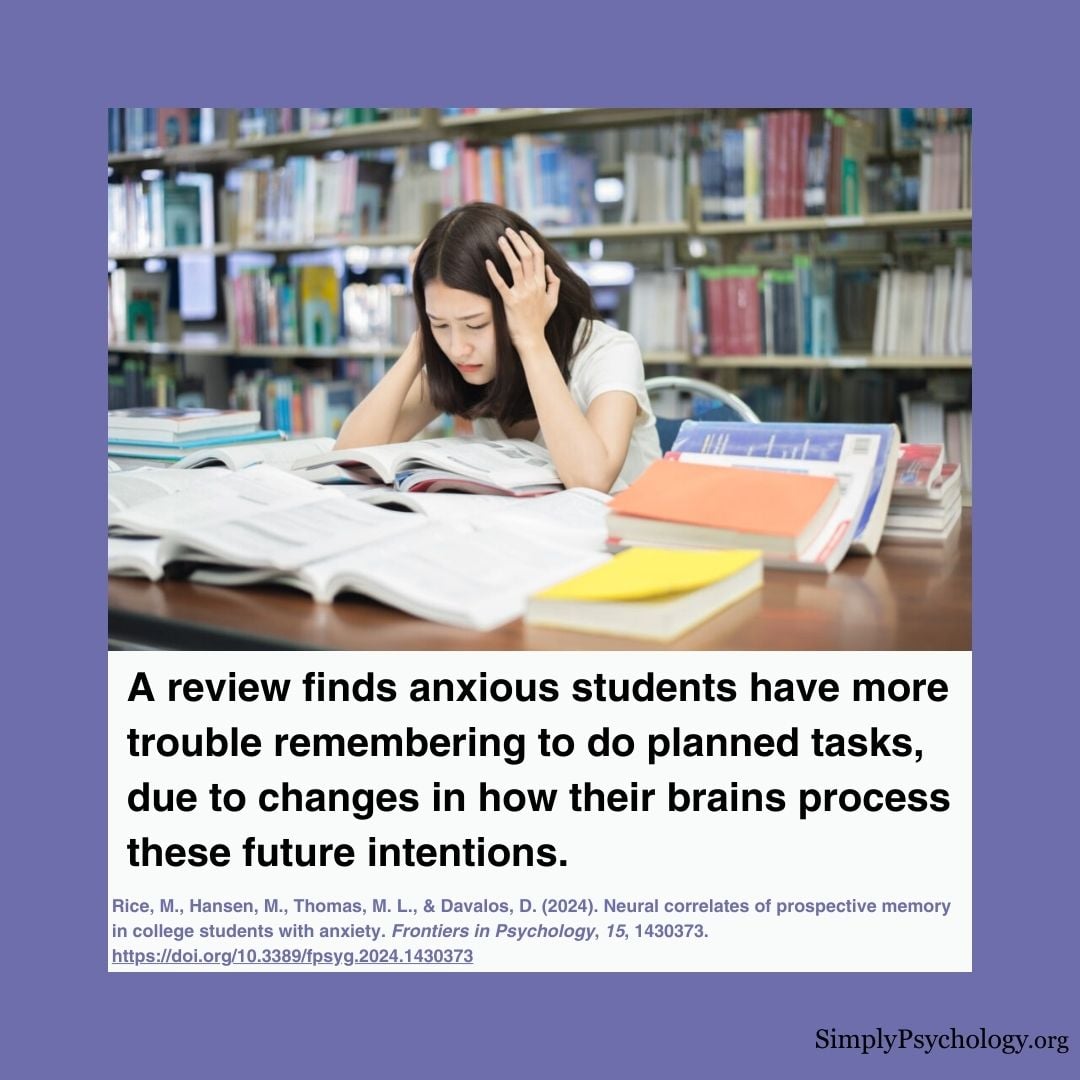
Rice, M., Hansen, M., Thomas, M. L., & Davalos, D. (2024). Neural correlates of prospective memory in college students with anxiety. Frontiers in Psychology, 15, 1430373. https://doi.org/10.3389/fpsyg.2024.1430373
Key Points
- Higher state anxiety was associated with lower prospective memory (PM) accuracy and reduced prospective positivity amplitude in college students.
- Lower prospective positivity amplitude was associated with lower PM accuracy.
- State anxiety was indirectly associated with lower PM accuracy, mediated by reduced prospective positivity amplitude.
- The N300 ERP component, associated with cue detection, was not significantly related to anxiety or PM performance.
- Intention retrieval, as measured by the prospective positivity, appears to be a key mechanism linking state anxiety to PM deficits in college students.
- The study provides neurophysiological evidence for the relationship between anxiety and PM impairments in a college student population.
- Understanding these cognitive dynamics is important for developing interventions to support anxious college students’ academic success and well-being.
- The research has limitations including reliance on self-report anxiety measures and lack of diversity in the sample.
Rationale
Prospective memory (PM) is crucial for daily functioning and academic success in college students. PM involves two key components: cue detection and intention retrieval (Einstein & McDaniel, 1990).
Previous research has found associations between anxiety and PM impairments in college students (Arnold et al., 2015; Bowman et al., 2019), but the neural mechanisms underlying this relationship remain unclear.
Event-related potentials (ERPs) provide a useful tool for examining the neural correlates of PM processes (West & Krompinger, 2005).
Specifically, the N300 and prospective positivity components have been linked to cue detection and intention retrieval, respectively (West, 2007).
Given the high prevalence of anxiety among college students and its potential impact on cognitive functioning, understanding how anxiety affects PM at a neural level is important.
This study aimed to extend previous behavioral findings by using ERPs to investigate how anxiety relates to the neural correlates of PM in college students.
Examining these relationships can provide insights into the cognitive mechanisms underlying anxiety-related PM deficits and inform interventions to support anxious students.
Method
The study employed a cross-sectional design using EEG/ERP methodology to examine relationships between anxiety, PM performance, and neural correlates of PM processes in college students.
Procedure
Participants completed self-report anxiety measures and then performed a computerized event-based, focal PM task while EEG was recorded.
The task involved an ongoing visual search task with embedded PM trials requiring participants to press a specific key when target letters appeared.
Sample
80 undergraduate students (M age = 20.12 years, SD age = 3.11; 56 women, 5 gender fluid, 1 transgender woman, 1 transgender man) from Colorado State University participated.
Participants were selected based on scoring in the upper or lower quartiles on a trait anxiety measure during screening.
Measures
- State-Trait Anxiety Inventory (STAI): 20-item measures of state and trait anxiety
- Beck Anxiety Inventory (BAI): 22-item measure of general anxiety symptoms
- Visual Search PM Task: Computerized task combining ongoing visual search with embedded PM trials
Statistical measures
- Multiple linear regression analyses examined associations between anxiety measures, ERP components, and PM accuracy
- Mediation analysis tested if ERP components mediated relationships between anxiety and PM performance
- All analyses controlled for age and gender
Results
Hypothesis 1: Higher anxiety will predict lower PM accuracy.
Result: Higher state anxiety significantly predicted lower PM accuracy (β = -0.27, p = 0.020). Trait anxiety and general anxiety (BAI) were not significantly associated with PM accuracy.
Hypothesis 2: Anxiety levels will predict N300 and prospective positivity amplitudes.
Result: Higher state anxiety significantly predicted lower prospective positivity amplitude (β = -0.27, p = 0.021). Anxiety measures were not significantly associated with N300 amplitude.
Hypothesis 3: N300 and prospective positivity amplitudes will predict PM accuracy.
Result: Higher prospective positivity amplitude significantly predicted higher PM accuracy (β = 0.27, p = 0.015). N300 amplitude was associated with PM accuracy at a trend level (β = 0.20, p = 0.087).
Mediation analysis: The relationship between state anxiety and PM accuracy was significantly mediated by prospective positivity amplitude (indirect effect: ab = -0.11, p = 0.047).
Insight
This study provides neurophysiological evidence for the relationship between anxiety and prospective memory impairments in college students.
The key finding is that state anxiety was associated with reduced prospective positivity amplitude, which in turn predicted lower PM accuracy.
This suggests that intention retrieval processes, rather than cue detection, may be the primary mechanism through which anxiety impacts PM performance in this population.
Contrary to some previous behavioral research suggesting cue detection deficits in anxious individuals, this study did not find significant associations between anxiety and the N300 component linked to cue detection.
Instead, the results highlight the importance of intention retrieval processes, as indexed by the prospective positivity.
These findings extend previous research by elucidating the neural correlates underlying anxiety-related PM impairments.
They suggest that college students with high state anxiety may be able to detect PM cues but struggle with retrieving and executing the intended actions.
This has important implications for understanding how anxiety affects cognitive functioning in academic settings.
Future research could explore interventions targeting intention retrieval processes to support PM functioning in anxious students.
Additionally, examining how different types of PM tasks (e.g., time-based vs. event-based) are affected by anxiety could provide further insights.
Investigating how other factors like stress or depression interact with anxiety to influence PM and its neural correlates would also be valuable.
Strengths
The study had many methodological strengths, including:
- Use of EEG/ERP methodology to examine neural correlates of PM processes
- Inclusion of multiple anxiety measures to assess different aspects of anxiety
- Control for age and gender in analyses
- Use of a well-established PM paradigm validated in previous ERP research
- Examination of both behavioral performance and neural correlates
Limitations
This study also had several methodological limitations, including:
- Reliance on self-report measures of anxiety, which may be subject to bias
- Limited diversity in the sample, particularly in terms of race/ethnicity and gender
- Cross-sectional design limits causal inferences
- Use of a single, computerized PM task may not fully capture real-world PM abilities
- Lack of assessment of other factors that may influence anxiety and PM (e.g., stress, depression)
These limitations impact the generalizability of findings to diverse populations and real-world PM situations.
The reliance on self-report and lack of clinical anxiety assessments also limits conclusions about clinical anxiety.
Future research should address these limitations to strengthen and extend the current findings.
Implications
The results have significant implications for understanding cognitive functioning in anxious college students and developing interventions to support their academic success.
The finding that intention retrieval processes may be particularly impacted by state anxiety suggests that strategies targeting this aspect of PM could be beneficial.
For example, techniques to enhance encoding and retrieval of intentions, or the use of external reminders, may help anxious students improve their PM performance.
Clinical psychologists working with anxious college students should be aware of potential PM difficulties, particularly in high-stress situations that may elevate state anxiety.
Cognitive-behavioral interventions targeting anxiety management and PM strategies could be valuable for this population.
The study also highlights the importance of considering different aspects of anxiety (state vs. trait) in relation to cognitive functioning.
The specific association with state anxiety suggests that situational factors influencing anxiety levels may be particularly relevant for PM performance.
Educational institutions could consider implementing stress reduction programs or providing resources to help students manage state anxiety, which may indirectly benefit their PM abilities and overall academic performance.
From a broader perspective, this research underscores the complex interplay between emotional states and cognitive processes.
It demonstrates how anxiety can impact specific cognitive functions at a neural level, contributing to our understanding of the mechanisms underlying anxiety-related cognitive impairments.
References
Primary reference
Rice, M., Hansen, M., Thomas, M. L., & Davalos, D. (2024). Neural correlates of prospective memory in college students with anxiety. Frontiers in Psychology, 15, 1430373. https://doi.org/10.3389/fpsyg.2024.1430373
Other references
Arnold, N. R., Bayen, U. J., & Böhm, M. F. (2015). Is prospective memory related to depression and anxiety? A hierarchical MPT modelling approach. Memory, 23(8), 1215-1228. https://doi.org/10.1080/09658211.2014.969276
Bowman, M. A., Cunningham, T. J., Levin-Aspenson, H. F., O’Rear, A. E., Pauszek, J. R., Ellickson-Larew, S., … & Payne, J. D. (2019). Anxious, but not depressive, symptoms are associated with poorer prospective memory performance in healthy college students: Preliminary evidence using the tripartite model of anxiety and depression. Journal of Clinical and Experimental Neuropsychology, 41(7), 694-703. https://doi.org/10.1080/13803395.2019.1611741
Einstein, G. O., & McDaniel, M. A. (1990). Normal aging and prospective memory. Journal of Experimental Psychology: Learning, memory, and cognition, 16(4), 717.
West, R. (2007). The influence of strategic monitoring on the neural correlates of prospective memory. Memory & Cognition, 35(5), 1034-1046. https://doi.org/10.3758/BF03193476
West, R., & Krompinger, J. (2005). Neural correlates of prospective and retrospective memory. Neuropsychologia, 43(3), 418-433. https://doi.org/10.1016/j.neuropsychologia.2004.06.012
Keep Learning
Socratic questions for a college class to discuss this paper:
- How might the relationship between anxiety and prospective memory impact students’ academic performance? Can you think of specific examples?
- Why might intention retrieval processes be more affected by anxiety than cue detection? What cognitive or emotional factors could explain this?
- How do the findings of this study compare to your personal experiences with anxiety and memory? Do they align with what you’ve observed in yourself or others?
- What are some potential interventions or strategies that could help anxious students improve their prospective memory based on these findings?
- How might the results differ if the study examined clinically diagnosed anxiety disorders rather than self-reported anxiety levels?
- What other factors not addressed in this study might influence the relationship between anxiety and prospective memory in college students?
- How could future research build on these findings to develop a more comprehensive understanding of anxiety’s impact on cognitive functioning in academic settings?
- What ethical considerations should researchers keep in mind when studying anxiety and cognitive performance in student populations?
- How might cultural factors influence the relationship between anxiety and prospective memory? How could future research address this?
- In what ways could the use of EEG/ERP methodology in this study be both advantageous and limiting? What other research methods could complement this approach?