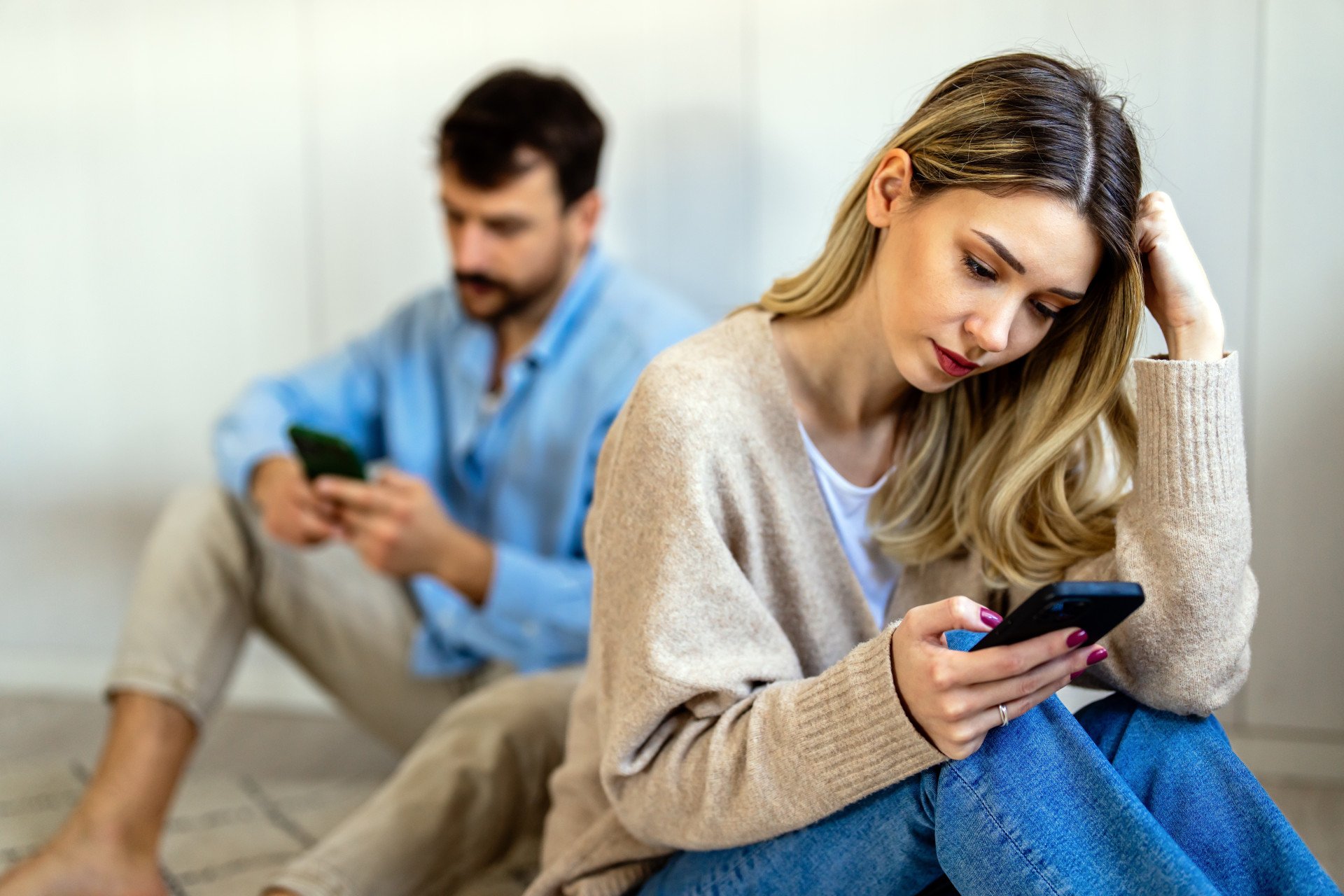
Romantic partners who ignore each other in favour of their smartphones cause distinct psychological harm. A new study reveals that this behaviour, known as phubbing, severely damages the daily self-esteem of individuals with anxious attachment styles. The research, published in the Journal of Personality, suggests that individual vulnerabilities shape how people experience digital distractions in relationships.
The modern phenomenon of phone snubbing, or phubbing, occurs when an individual uses a mobile device during a face-to-face interaction. This habit frequently sparks interpersonal conflict and lowers relationship satisfaction.
According to equity theory, equal investment in a close relationship leads to better relationship satisfaction. When a person notices their partner constantly looking at a screen, they may perceive an unequal investment and feel distressed. To explore how personalities affect these dynamics, lead researcher Katherine B. Carnelley from the University of Southampton investigated how deep-seated adult attachment patterns influence these daily situations.
The research team recruited a sample of 196 participants who were currently living with their romantic partners.
The final group had an average age of 36.39 years and reported a lengthy average relationship duration of 11.4 years. This sample was predominantly female, consisting of 144 women, 50 men, one non-binary individual, and one person who preferred not to state their gender.
Data collection occurred over a multi-year period using online diaries presented via Qualtrics. Participants completed one baseline survey followed by nine short daily diaries. The tracking process required approximately five minutes each day over a total span of 10 days, allowing researchers to capture real-time psychological fluctuations.
Participants proved highly compliant with the design requirements, completing an average of 7.91 days of diary entries. The daily measures were fully randomised to prevent any order effects from biasing the responses.
The compiled data revealed clear daily trends across the entire sample. On days when participants noticed their partners phubbing them more, they reported lower overall relationship satisfaction. They also experienced higher levels of anxious mood and significantly more daily anger and irritation. The authors noted that “this suggests that perceptions are of prime importance” when measuring how technology disrupts romance.
The psychological impact became much more severe when accounting for adult attachment anxiety. Attachment anxiety reflects a persistent fear of abandonment, typically leading to hypervigilance toward potential threat cues in relationships. On high phubbing days, participants scoring higher in attachment anxiety suffered significant drops in their daily self-esteem.
These individuals also reported a sharp increase in depressed mood on those same days.
Surprisingly, their relationship satisfaction was not impacted on days with high phone distractions. Highly anxious individuals tended to internalise the slight, feeling that they were not interesting enough to hold their partner’s attention. They blamed their own personal shortcomings rather than evaluating the relationship negatively.
In response to being phubbed, anxious participants reported higher levels of resentment, curiosity, and retaliatory phone use. When their partner ignored them, they copied the behaviour by picking up their own devices. Their primary motives for this retaliation were to seek support and approval from other people outside the relationship.
The study discovered a completely different pattern for individuals high in attachment avoidance. Attachment avoidance reflects a general discomfort with emotional intimacy and interdependence, often resulting in the use of deactivating emotional strategies. Avoidant participants generally reported lower relationship satisfaction and lower self-esteem on average throughout the study.
However, their daily personal well-being was entirely unaffected by partner phubbing.
When avoidant individuals did choose to retaliate by using their phones, they did so to gain approval from others. Interestingly, they reported lower levels of open conflict on high phubbing days compared to more secure individuals. Because confronting a partner requires emotional intimacy, highly avoidant people tend to turn away from the threat entirely.
The study possesses certain limitations that require careful consideration. The participant sample lacked diversity, as it was heavily skewed toward female and heterosexual individuals, which limits how perfectly these results apply to LGBTQ+ couples. Additionally, the tracking relied entirely on self-reports, which can be vulnerable to memory biases or social desirability.
The researchers also noted that their data did not test explicit causal processes. Future studies could use objective psychophysiological tools like heart rate monitors to measure internal distress without self-report bias.
These insights show how modern digital habits can worsen deep-seated personal insecurities. For individuals living with an anxious attachment style, a partner checking notifications during a conversation can trigger immediate feelings of inadequacy. Understanding these dynamics highlights the value of establishing clear technology boundaries to protect the mental health of vulnerable partners.
The study, “Attachment, Perceived Partner Phubbing, and Retaliation: A Daily Diary Study,” was authored by Katherine B. Carnelley, Claire M. Hart, Laura M. Vowels, and Tessa Thejas Thomas.