In experimental research, an independent variable is the factor you deliberately change or control, while a dependent variable is the outcome you measure. Think of it as cause and effect: the independent variable is the cause you manipulate, and the dependent variable is the effect you observe.
Key Takeaways
- Variable: Any characteristic, value, or quality that can be observed, measured, or counted. In most studies, there are two main types:
- Independent Variable: The factor that the researcher changes, controls, or uses to group participants to test its effect on another variable.
- Dependent Variable: The outcome (result) that is measured to see if it changes in response to the independent variable.
- Cause and Effect: In experimental research, the independent variable is considered the cause, and the dependent variable is the effect.
- Operational Definition: A precise explanation of how a variable will be manipulated (for an independent variable) or measured (for a dependent variable) in a specific study.

Independent Variable
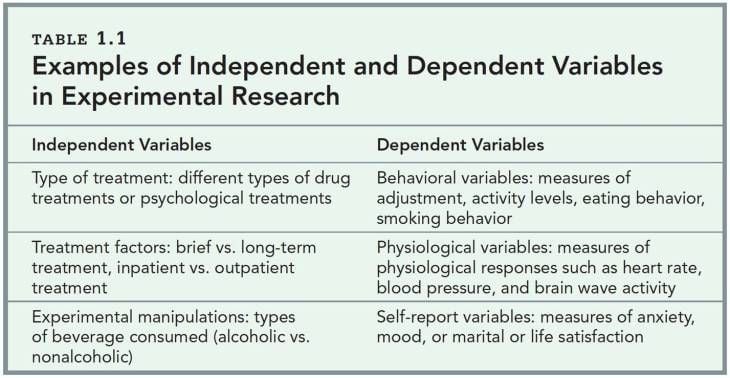
In psychology, the independent variable is the variable the experimenter manipulates or changes and is assumed to directly affect the dependent variable. It represents the presumed cause in a cause-and-effect relationship and is central to testing research hypotheses.
For example, in a clinical trial, participants might be randomly assigned to receive either a new medication or a placebo.
Here, the type of treatment (medication vs. placebo) is the independent variable, while changes in participants’ anxiety levels form the dependent variable.
Another example is a study on sleep duration and memory. Participants are assigned to sleep for 4, 8, or 12 hours.
Here, sleep duration is the independent variable, and memory recall (the number of words correctly remembered) is the dependent variable.
In a well-designed experiment, the independent variable should be the only systematic difference between the experimental and control groups.
Everything else should stay constant. These other conditions, such as environment, instructions, and timing, are called extraneous variables.
Recognising Independent Variables
To work out if a variable is independent, ask yourself:
-
Is it something the researcher changes or controls?
This could mean assigning people to different conditions (e.g., treatment vs. no treatment) or deciding how much of something participants receive. Sometimes it’s a characteristic (like age group) that’s used to divide participants into categories. -
Does it happen first in the study?
The independent variable comes before any changes in the dependent variable. It’s the starting point that might cause an effect. -
Is the study designed to see if it affects something else?
The independent variable is the suspected “cause” in a cause-and-effect relationship. The researcher wants to know if altering it changes the outcome.
Researchers work with two main kinds of independent variables: experimental variables and subject variables.
1. Experimental Variables
These are variables you can directly change or control in a study.
You might test just two levels (to see if there’s any effect at all) or several levels (to see how different amounts change the result).
An IV needs at least two of these levels, sometimes called conditions. Without two, scores cannot be compared. In a classic caffeine study, for example, the levels might be a caffeine treatment group, a no-caffeine control group, and a decaffeinated placebo group.
Comparing the treatment condition against the controls is what reveals whether caffeine had an effect.
Example:
A psychologist wants to test whether mindfulness training can reduce test anxiety in college students. The study has three groups:
-
A group that completes a short mindfulness course
-
A group that completes a full 8-week mindfulness program
-
A control group that receives no mindfulness training
The type and length of mindfulness training is the independent variable. The dependent variable is the level of test anxiety. It is measured with a standardized anxiety questionnaire.
People are randomly assigned to each group so personal differences (like age or motivation) don’t skew the results. This makes it easier to link any change in test anxiety directly to the mindfulness training.
2. Subject Variables
These are personal traits or characteristics people already have and that can’t be changed by the researcher, such as age, gender identity, income, or education.
Because you can’t randomly assign people to have these traits, studies using subject variables are called quasi-experiments.
They can show patterns or associations but can’t prove cause and effect as strongly as experiments with experimental variables.
Example:
A study on how gender identity affects brain activity when hearing infant cries might compare men, women, and people of other gender identities.
The independent variable is gender identity, and the dependent variable is brain activity measured with an fMRI scanner.
Dependent Variable
In psychology, the dependent variable is what researchers measure to see if it changes in response to something else. It is “dependent” on the independent variable, which is the factor the researcher changes or controls.
The dependent variable is the outcome, or effect, being measured.
An example of a dependent variable is depression symptoms, which depend on the independent variable (type of therapy).
In an experiment, the researcher changes the independent variable. They then watch for an effect on the dependent variable.
Suppose a psychologist wants to find out if listening to music while studying affects how much students remember.
The study environment (with or without music) is the independent variable. The number of facts remembered on a test is the dependent variable.
Recognising Dependent Variables
To check whether a variable is dependent, consider:
- Is it the result or outcome being measured?
This is what the researcher is most interested in finding out: scores, ratings, symptoms, or behaviours. - Does it change depending on another variable?
If its value could be different based on the condition or group a participant is in, it’s likely dependent on the independent variable. - Is it measured after the independent variable is introduced or changed?
Dependent variables are recorded after the “cause” is applied, so researchers can compare outcomes across different conditions.
Other Types of Variables
Beyond the IV and DV, researchers often need to name a few other roles a variable can play in a study.
- Control variables: Factors the researcher deliberately holds constant, such as testing everyone in the same quiet room at the same time of day, so they cannot influence the DV. Overlooking a control variable is a common design error.
- Mediating variables: Explain how or why the IV affects the DV by sitting on the causal pathway between them. Stress may raise illness because it suppresses immune function, so immune function is the mediator.
- Moderating variables: Change the strength or direction of the IV-DV relationship, specifying for whom or under what conditions the effect holds. Caffeine may improve performance for occasional users but not for regular drinkers.
- Covariates: Measured extraneous variables that are not the main interest but are statistically controlled, so their influence on the DV can be separated from the effect of the IV.
Baron and Kenny (1986) set out the classic framework for testing mediation and distinguishing it from moderation.
A correlational study has neither an IV nor a DV in this sense. It measures two co-variables and tests the relationship between them, without manipulating either one.
One example is age and hours of sleep per day. The result is a correlation coefficient between −1 and +1. Because nothing is manipulated, it cannot show cause and effect.
A third variable may explain both co-variables. And even a genuine causal link could run in either direction.
Levels of Measurement
Variables also differ in the kind of data they produce, and that decides how they can be analysed.
Stevens (1946) sorted measurement into four levels, each carrying more information than the last.
- Nominal: Unordered categories, such as eye colour or diagnosis. A nominal variable with two categories, such as pass/fail, is called binary.
- Ordinal: Ranked categories without equal gaps, such as race positions or a Likert agreement rating.
- Interval: Ordered with equal intervals but no true zero, such as temperature in Celsius or many standardised IQ scores.
- Ratio: Equal intervals and a true zero, such as reaction time or heart rate. Ratios are meaningful: 200 ms is twice 100 ms.
Cutting across these levels, a continuous variable can take any value on a scale, such as reaction time or weight. A discrete variable takes only separate, usually whole-number values, such as the number of words recalled.
Quantitative variables record amounts, while qualitative variables record kinds or categories.
The level of measurement also decides which statistical test fits. A chi-square test, which compares how often each category occurs, suits nominal data, and a correlation suits two continuous variables.
Examples in Research Studies
For example, participants might receive information that is either organized or random. We then measure how this affects how much they remember.
Here, the type of information is the independent variable because it changes, and the amount remembered is the dependent variable because we measure it.
Key Study: Loftus and Palmer (1974)
Moving from an idea to testable variables is clearest in Loftus and Palmer’s (1974) classic study of eyewitness memory. Their entire manipulation was a single word.
- Aim: To test whether the wording of a question distorts what people remember about an event.
- Method: Forty-five students watched short films of traffic accidents, then estimated the cars’ speed in miles per hour. The IV was the single verb in the question: whether the cars “smashed,” “collided,” “bumped,” “hit” or “contacted” each other.
- Results: “Smashed” produced the highest speed estimates. Every gentler verb produced lower ones, with “contacted” lowest.
- Conclusion: Because the verb was the only systematic difference between conditions, the higher estimates show that leading questions can reconstruct memory.
The design’s strength is its single-word IV and numerical DV. Together they make the causal claim tight and the study easy to replicate. Its limitation is ecological validity: watching a film clip and giving a speed estimate is far from real eyewitness testimony.
Hypothesis 1: Drinking an energy drink before exercise improves running speed.
-
IV: Whether or not the participant drinks an energy drink before exercise.
-
DV: Running speed (e.g., time to complete a set distance).
-
Reasoning: The researcher changes the drink condition and measures its effect on performance.
Hypothesis 2: People who sleep at least 8 hours will score higher on a memory test than people who sleep less than 5 hours.
-
IV: Amount of sleep (≥ 8 hours vs. ≤ 5 hours).
-
DV: Memory test score.
-
Reasoning: Sleep duration is the grouping factor; test scores are measured afterward.
Hypothesis 3: Playing calming music during study sessions reduces anxiety in college students.
-
IV: Study environment (calming music vs. no music).
-
DV: Level of anxiety (e.g., measured with a questionnaire).
-
Reasoning: The researcher changes the environment and measures anxiety afterward.
Hypothesis 4: Smokers have higher resting heart rates than non-smokers.
-
IV: Smoking status (smoker vs. non-smoker).
-
DV: Resting heart rate.
-
Reasoning: Smoking status is a subject variable; heart rate is measured as the outcome.
Hypothesis 5: A mindfulness course will improve focus more than a time management course.
-
IV: Type of course (mindfulness vs. time management).
-
DV: Focus level (e.g., measured with an attention test).
-
Reasoning: The researcher assigns participants to different courses and measures focus afterward.
Classic Experiments as IV and DV
Every classic experiment can be read as a careful specification of variables. Four well-known studies show how a clearly defined IV and a measurable DV turn an idea into a test.
| Study | Independent variable | Dependent variable |
|---|---|---|
| Bandura, Ross and Ross (1961) | Whether a child watched an adult model behave aggressively or non-aggressively | Imitative aggression, counted as specific pre-defined behaviours such as striking the Bobo doll with a mallet |
| Loftus and Palmer (1974) | The verb used to describe a car crash | Estimated speed in miles per hour |
| Asch (1951) | Group unanimity and group size | Conformity: the number of trials on which a participant gave the group’s wrong answer |
| Stroop (1935) | Whether a word and its ink colour matched | Time taken to name the ink colour |
In each case the precise operational definition is what made the effect measurable.
Learning Check
For the following hypotheses, name the IV and the DV.
1. Lack of sleep significantly affects learning in 10-year-old boys.
IV……………………………………………………
DV…………………………………………………..
2. Social class has a significant effect on IQ scores.
IV……………………………………………………
DV……………………………………………….…
3. Stressful experiences significantly increase the likelihood of headaches.
IV……………………………………………………
DV…………………………………………………..
4. Time of day has a significant effect on alertness.
IV……………………………………………………
DV…………………………………………………..
Operationalizing Variables
Operationalizing a variable means saying exactly how you will define and measure it in your study.
That lets another psychologist replicate your research. It is essential in establishing reliability, meaning consistency in the results.
An operational definition explains in precise, concrete terms what each variable means in the context of a study.
For the independent variable, it describes the conditions or categories participants experience. For the dependent variable, it specifies the method of measurement.
For example, if we study the effect of media violence on aggression, we must define both terms precisely.
In this case, we must state what we mean by the terms “media violence” and “aggression” as we will study them.
-
Independent variable (manipulated): Type of media content (participants watch either a 15-minute film showing scenes of physical assault, i.e. media violence, or a non-violent control film).
-
Dependent variable (measured): Aggression, defined as the number of electrical shocks a participant chooses to give another person in a controlled setting. This is the classic “aggression machine” paradigm introduced by Buss (1961).
The hypothesis “Young participants will have significantly better memories than older participants” is too vague to test.
A clearer, operationalized version would be:
-
Independent variable (grouping variable): Age group (participants aged 16–30 vs. participants aged 55–70).
-
Dependent variable (measured): Memory: number of nouns correctly recalled from a 20-word list.
The key point here is that we have clarified what we mean by the terms as they were studied and measured in our experiment.
If we didn’t do this, it would be very difficult (if not impossible) to compare the findings of different studies to the same behavior.
Operationalization gives even complex variables a clear, objective definition.
It also makes it easier for other researchers to replicate a study and check for reliability.
Origins and Pitfalls of Operationalization
The need for precise definitions traces to the physicist Percy Bridgman (1927).
He argued that a scientific concept means nothing more than the set of operations used to measure it. Psychology adopted a softened version of the rule.
Every construct must be tied to a concrete measurement procedure before it enters a testable hypothesis.
A precise definition is not automatically a good one. Its quality depends on construct validity, the degree to which a measure captures the construct it claims to (Cronbach & Meehl, 1955).
Counting electric shocks defines aggression exactly. Yet a critic may doubt that pressing a button in a laboratory is the same thing as aggression in the schoolyard. The number is precise, but it may be measuring compliance or competitiveness instead.
Flexibility is a second hazard. Complex constructs can usually be operationalized in many defensible ways.
A researcher who chooses among them after seeing the data can make almost any result look significant. Good practice fixes the operational definitions of the IV and DV in advance.
Learning Check
For the following hypotheses, name the IV and the DV and operationalize both variables.
1. Women are more attracted to men without earrings than men with earrings.
I.V._____________________________________________________________
D.V. ____________________________________________________________
Operational definitions:
I.V. ____________________________________________________________
D.V. ____________________________________________________________
2. People learn more when they study in a quiet versus noisy place.
I.V. _________________________________________________________
D.V. ___________________________________________________________
Operational definitions:
I.V. ____________________________________________________________
D.V. ____________________________________________________________
3. People who exercise regularly sleep better at night.
I.V._____________________________________________________________
D.V. ____________________________________________________________
Operational definitions:
I.V. ____________________________________________________________
D.V. ____________________________________________________________
Extraneous and Confounding Variables
The independent variable is never the only thing that could move the dependent variable. Everything else that might is an extraneous variable.
Extraneous Variables
An extraneous variable is any variable other than the independent variable that could affect the dependent variable. Background noise, room temperature, and the time of day testing happens are common examples.
Left uncontrolled, an extraneous variable adds “noise” to the data. That noise makes a real effect harder to detect, so the study loses sensitivity.
Extraneous variables threaten internal validity. If they are not controlled, we cannot be sure the independent variable caused the change we measured.
Researchers split them into two families. Each family needs a different control.
- Participant variables: Differences people bring with them: age, IQ, personality, mood, motivation or prior experience. Random allocation or matching spreads them evenly across conditions.
- Situational variables: Features of the setting or procedure, such as lighting, instructions, experimenter behaviour and order effects in repeated-measures designs. Standardisation and counterbalancing control them.
Confounding Variables
A confounding variable is an extraneous variable that has actually influenced the results, and that varies systematically with the independent variable. It supplies a rival explanation the design cannot separate from the independent variable.
That is the difference. An extraneous variable could affect the outcome; a confounding variable has, and it tracks the conditions.
Participants’ expectations, the placebo effect, and prior experience are common culprits. Two have names of their own.
Demand characteristics are cues in the situation that hint at the hypothesis and change how participants behave. Orne (1962) argued that participants are rarely passive: some try to confirm what they think the researcher wants, and others do the opposite.
Investigator effects are the mirror image, on the researcher’s side. Rosenthal and Fode (1963) told students their rats had been bred “maze-bright” or “maze-dull.” In fact the rats were allocated at random, but the “bright” rats still performed better.
Their expectations shaped how they handled and scored the animals.
Rosenthal and Jacobson (1968) took the effect into classrooms. In the Pygmalion study, teachers’ induced expectations raised the measured IQ of randomly chosen pupils described as “bloomers.”
Each confound has its own remedy. A single-blind procedure curbs demand characteristics, and a double-blind procedure curbs investigator effects.
Controlling Extraneous and Confounding Variables
Most of experimental design is a set of devices for stopping extraneous variables from becoming confounds. Each targets a different threat.
- Standardisation: Keeping the procedure, instructions and materials identical for every participant, so situational variables cannot differ between conditions.
- Controlled environment: Holding noise, lighting and time of day constant.
- Randomisation: Using chance to decide the order of materials or the allocation of participants, so uncontrolled variables are spread evenly rather than biasing one condition.
- Random allocation and matching: Assigning participants to conditions by random allocation, or matching them on a key trait, so the groups start out equivalent.
- Counterbalancing: Varying the order of conditions across participants so practice and fatigue effects cancel out.
- Blind procedures: Keeping participants (single-blind) and experimenters too (double-blind) unaware of the condition, often alongside a placebo condition.
Randomisation handles variables nobody has even identified. Fisher (1935) established random allocation as the device that turns unknown nuisance variables into random error rather than bias, which is what makes causal inference possible.
Uncontrolled variables have a wider consequence. Observational and correlational studies cannot establish causation, because nothing is manipulated and a confound can always explain the pattern instead.
Critical Evaluation
The variable-based experimental approach has clear strengths, but also real limits worth weighing.
Strengths
Manipulating a clearly operationalised independent variable, while holding other factors constant, lets researchers attribute change in the dependent variable to that cause. Campbell and Stanley (1963) called this protection of internal validity the central purpose of experimental design.
Precise operational definitions also make studies replicable.
Loftus and Palmer (1974) defined their independent variable as a single verb describing a car crash, and their dependent variable as a speed estimate. That precision is what lets another researcher repeat the procedure and check whether the effect appears.
The same logic runs through Milgram’s (1963) operationalisation of obedience as the maximum voltage administered, and Stroop’s (1935) operationalisation of interference as naming time.
Both turned an abstract idea into a reproducible number.
Clear operational definitions also hand researchers a systematic toolkit for ruling out rival explanations. Each control technique targets a specific class of extraneous variable, meaning any factor other than the independent variable that could affect the outcome.
Standardisation and random allocation are two. So is counterbalancing, which varies the order in which participants complete conditions so that practice and fatigue effects cancel out. Single- and double-blind procedures do the same job for expectation effects.
A well-controlled experiment can therefore eliminate confounds one by one, rather than leave them to chance.
Limitations
- Reductionism: Reducing a rich psychological phenomenon to a single IV and DV can strip away context. Studying “memory” as words recalled from a list may miss how memory actually works in everyday life.
- Construct validity: A precise operational definition does not guarantee it measures the right construct (Cronbach & Meehl, 1955). The more abstract the idea (love, intelligence, wellbeing), the wider the gap between the construct and any single way of measuring it.
- Ecological validity: The tight control that protects internal validity, such as a stripped-down lab and standardised tasks, can make a study so unlike real life that the findings do not generalise.
- The qualitative critique: Some researchers argue that imposing fixed variables on human experience distorts it, since meaning is shaped by context in ways a preset IV-DV design cannot capture.
Contemporary Research
The replication crisis has put variables, and especially their operational definitions, at the centre of methodological reform.
The Replication Crisis and Pre-Registration
The Open Science Collaboration (2015) attempted to replicate 100 published psychology findings and found that fewer than half reproduced the original result.
Simmons, Nelson and Simonsohn (2011) showed why. Flexibility in how a study’s variables are defined and analysed after the data are seen is called “researcher degrees of freedom.” It can push false-positive rates far above the standard 5% threshold.
The recommended fix is pre-registration: fixing the IV, the DV, their operational definitions and the planned analysis before data collection begins (Nosek et al., 2018).
Measurement and Analytic Flexibility
Flake and Fried (2020) reviewed how psychology studies commonly report their measures. They found many “questionable measurement practices”: using a scale without checking its reliability, or quietly changing how a variable is scored.
Silberzahn and colleagues (2018) gave the same dataset and research question to 61 analysts in 29 independent teams. Each team chose its own approach. Their differing choices about how to define and analyse the variables produced a wide range of results, from strong effects to none.
This shows that how a variable is defined is itself a source of variation.
FAQs
Can there be more than one independent or dependent variable in a study?
Yes, it is possible to have more than one independent or dependent variable in a study.
In some studies, researchers may want to explore how multiple factors affect the outcome, so they include more than one independent variable.
Similarly, they may measure multiple things to see how they are influenced, resulting in multiple dependent variables. This allows for a more comprehensive understanding of the topic being studied.
What are some ethical considerations related to independent and dependent variables?
Ethical considerations related to independent and dependent variables involve treating participants fairly and protecting their rights.
Researchers must ensure that participants provide informed consent and that their privacy and confidentiality are respected.
Additionally, it is important to avoid manipulating independent variables in ways that could cause harm or discomfort to participants.
Researchers should also consider the potential impact of their study on vulnerable populations and ensure that their methods are unbiased and free from discrimination.
Ethical guidelines help ensure that research is conducted responsibly and with respect for the well-being of the participants involved.
Can qualitative data have independent and dependent variables?
Yes, both quantitative and qualitative data can have independent and dependent variables.
In quantitative research, independent variables are usually measured numerically and manipulated to understand their impact on the dependent variable.
In qualitative research, independent variables can be qualitative in nature, such as individual experiences, cultural factors, or social contexts, influencing the phenomenon of interest.
The dependent variable, in both cases, is what is being observed or studied to see how it changes in response to the independent variable.
So, regardless of the type of data, researchers analyze the relationship between independent and dependent variables to gain insights into their research questions.
Can the same variable be independent in one study and dependent in another?
Yes, the same variable can be independent in one study and dependent in another.
The classification of a variable as independent or dependent depends on how it is used within a specific study. In one study, a variable might be manipulated or controlled to see its effect on another variable, making it independent.
However, in a different study, that same variable might be the one being measured or observed to understand its relationship with another variable, making it dependent.
The role of a variable as independent or dependent can vary depending on the research question and study design.
How do independent and dependent variables work in non-experimental or observational studies?
In non-experimental or observational studies, researchers don’t actively manipulate the independent variable.
Instead, they observe natural differences that already exist. They look for patterns or relationships between variables.
The independent variable is still the one thought to influence the outcome. But it’s based on pre-existing conditions, behaviours, or traits, such as age, gender, income level, or lifestyle habits. The researcher doesn’t assign it.
The dependent variable is still the outcome being measured. Here, though, researchers are less sure of cause and effect.
This is because other factors, called confounding variables, might also influence the result.
Example:
A psychologist might study whether exercise frequency is linked to stress levels.
Here, exercise frequency (independent variable) isn’t controlled by the researcher – it’s just recorded as reported by participants.
Stress levels (dependent variable) might be measured using a questionnaire.
The study could show that people who exercise more tend to report lower stress, but it can’t prove that exercise alone causes the difference.
Recognize Common Mistakes
- Mixing up cause and effect: A frequent error is thinking the variable you measure (dependent) is the cause, when in fact it is the effect. Always identify which factor is changed or controlled (independent) and which responds (dependent).
- Assuming correlation means causation: Just because two variables change together does not mean one causes the other. Only well-controlled experiments can establish cause-and-effect relationships.
- Overlooking control variables: Forgetting to keep other factors constant can make it hard to know if changes in the dependent variable are truly due to the independent variable.
- Using vague or undefined variables: Failing to operationalize variables can lead to confusion or make replication impossible. Clearly define how each variable will be measured.
- Switching roles between studies: The same variable can be independent in one study and dependent in another. Always decide based on the specific research question.
| Feature | Independent Variable | Dependent Variable |
|---|---|---|
| Role in the study | The “cause”: what the researcher changes, controls, or uses to group participants. | The “effect”: what the researcher measures to see if it changes. |
| When it happens | Comes first in time, before the dependent variable is measured. | Comes after the independent variable has been applied or varied. |
| How it changes | Changed or chosen by the researcher, or based on pre-existing traits (in quasi-experiments). | Changes naturally as a possible result of the independent variable. |
| Examples in psychology | Type of therapy (CBT, medication, control group) | Level of depression symptoms after treatment |
| Examples in everyday life | Amount of sleep (4, 6, or 8 hours) | Number of mistakes made on a test the next day |
| Key question to ask | “Is this the thing I’m changing or comparing between groups?” | “Is this the thing I’m measuring as the outcome?” |
References
Asch, S. E. (1951). Effects of group pressure upon the modification and distortion of judgments. In H. Guetzkow (Ed.), Groups, leadership and men (pp. 177–190). Carnegie Press.
Bandura, A., Ross, D., & Ross, S. A. (1961). Transmission of aggression through imitation of aggressive models. Journal of Abnormal and Social Psychology, 63(3), 575–582.
Baron, R. M., & Kenny, D. A. (1986). The moderator–mediator variable distinction in social psychological research: Conceptual, strategic, and statistical considerations. Journal of Personality and Social Psychology, 51(6), 1173–1182.
Bridgman, P. W. (1927). The logic of modern physics. Macmillan.
Buss, A. H. (1961). The psychology of aggression. John Wiley & Sons.
Campbell, D. T., & Stanley, J. C. (1963). Experimental and quasi-experimental designs for research on teaching. In N. L. Gage (Ed.), Handbook of research on teaching (pp. 171–246). Rand McNally.
Cronbach, L. J., & Meehl, P. E. (1955). Construct validity in psychological tests. Psychological Bulletin, 52(4), 281–302.
Fisher, R. A. (1935). The design of experiments. Oliver & Boyd.
Flake, J. K., & Fried, E. I. (2020). Measurement schmeasurement: Questionable measurement practices and how to avoid them. Advances in Methods and Practices in Psychological Science, 3(4), 456–465.
Loftus, E. F., & Palmer, J. C. (1974). Reconstruction of automobile destruction: An example of the interaction between language and memory. Journal of Verbal Learning and Verbal Behavior, 13(5), 585–589.
Milgram, S. (1963). Behavioral study of obedience. Journal of Abnormal and Social Psychology, 67(4), 371–378.
Nosek, B. A., Ebersole, C. R., DeHaven, A. C., & Mellor, D. T. (2018). The preregistration revolution. Proceedings of the National Academy of Sciences, 115(11), 2600–2606.
Open Science Collaboration. (2015). Estimating the reproducibility of psychological science. Science, 349(6251), aac4716.
Orne, M. T. (1962). On the social psychology of the psychological experiment: With particular reference to demand characteristics and their implications. American Psychologist, 17(11), 776–783.
Rosenthal, R., & Fode, K. L. (1963). The effect of experimenter bias on the performance of the albino rat. Behavioral Science, 8(3), 183–189.
Rosenthal, R., & Jacobson, L. (1968). Pygmalion in the classroom: Teacher expectation and pupils’ intellectual development. Holt, Rinehart & Winston.
Silberzahn, R., Uhlmann, E. L., Martin, D. P., Anselmi, P., Aust, F., Awtrey, E., … Nosek, B. A. (2018). Many analysts, one data set: Making transparent how variations in analytic choices affect results. Advances in Methods and Practices in Psychological Science, 1(3), 337–356.
Simmons, J. P., Nelson, L. D., & Simonsohn, U. (2011). False-positive psychology: Undisclosed flexibility in data collection and analysis allows presenting anything as significant. Psychological Science, 22(11), 1359–1366.
Stevens, S. S. (1946). On the theory of scales of measurement. Science, 103(2684), 677–680.
Stroop, J. R. (1935). Studies of interference in serial verbal reactions. Journal of Experimental Psychology, 18(6), 643–662.

